Lawyer, lawyer, pants on fire!

pants_fireI simply can’t not share this delicious irony.

From the Miami Herald:

Miami lawyer’s pants erupt in flames during arson trial in court

A Miami defense lawyer’s pants burst into flames Wednesday afternoon as he began his closing arguments in front of a jury — in an arson case.

Stephen Gutierrez, who was arguing that his client’s car spontaneously combusted and was not intentionally set on fire, had been fiddling in his pocket as he was about to address jurors when smoke began billowing out his right pocket, witnesses told the Miami Herald.

[…]

Posted in Lighter fare | Tagged ,
13 Comments

Brick By Brick: a great East and West, “both lungs” development

Here’s some good news.  A reader alerted me to a great East and West “both lungs” development.

From The Sudbury Star in Ontario:

Church revives Latin mass

For a group of worshippers who gather at St. Michael’s Church in Coniston, moving forward also means knowing where they’ve come from.

Father Vince Fiore of the Diocese of Sault Ste. Marie has begun to lead a traditional Latin mass, also known as the Tridentine Rite or the Extraordinary Form, rather than the New Rite, used in the Catholic Church since the 1969.

“There was a group of faithful in Sudbury who had requested that this mass be made available to them and had approached the bishop about making it available to them,” Fiore said. “The bishop turned to his priests and myself, having the Italian background, it may have been a little more convenient for me to transition into the Latin, so I was asked to learn it and make it available to this group of people.”

The Mater Dei Traditional Latin Mass Community is now about one year old. St. Michael’s Ukrainian Catholic Church offered them the building in Coniston as a place to conduct their services.

“We don’t have parochial status yet,” Fiore said. “We are a community and we offer mass in the traditional Latin Rite or the Tridentine Rite and we’re a community that’s growing.”

Between 40 and 60 people have been turning out for mass, including a low, or read mass [I love it!] on Wednesday, Thursday, Friday and Saturday at 11 a.m. and a high mass, complete with singing, a musician, [!] servers, incense and Gregorian chanting, on Sunday at 11 a.m.

For Fiore, the task of learning and offering the traditional mass was quite an undertaking.

“It was a bit, as a matter of fact, because I’m a priest ordained for nine years now and my experience has been in what’s called the Mass of Paul VI, the New Rite.” Fiore said. “It wasn’t just a matter of learning the mass and how to execute the rites, but learning the theology, as well. [Indeed.] The traditional mass is the ancient form of the mass and had not changed until (1969), when they made some changes – of course, no longer using Latin and being spoken in the vernacular, and all kinds of different changes that were made that you would not find in the traditional mass.”  [The Novus Ordo should be in Latin too, but I digress.]

He has since developed “a great love” for the Latin mass.

“I really fell in love with the theology and it gives me great joy to know that some of the great saints, like St. John Vianney, St. Augustine or St. Maximilian Kolbe, this is the mass they would have offered. I love speaking the Latin and being able to offer it, it has been a great joy for me to do so.”

Not only numbers, but enthusiasm is growing for the mass, he said, among those who already had an affinity for the ancient traditions of the church, and even those who first came out of curiosity.

[…]

Read the rest there.

Fr. Z kudos especially to our Ukrainian brethren who are so hospitable.

Posted in Both Lungs, Brick by Brick, Fr. Z KUDOS, Just Too Cool, Liturgy Science Theatre 3000 | Tagged
16 Comments

BRILLIANT by Mosebach: RETURN TO FORM – A CALL FOR THE RESTORATION OF THE ROMAN RITE

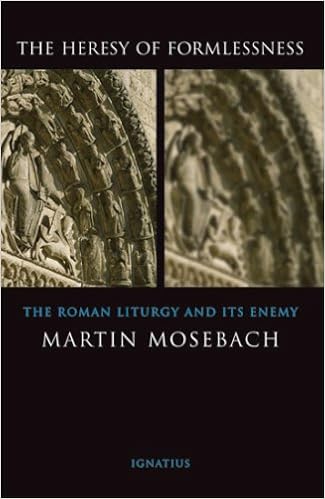
I have often lauded the important book by Martin Mosebach The Heresy of Formlessness.  I warmly recommend it.  US HERE – UK HERE  As a matter of fact, it was first on my suggestions for Lenten reading.  HERE

First Things has published a piece by Mosebach from last December 2016.  Let’s have a look with my now legendary emphases and comments:

RETURN TO FORM: A CALL FOR THE RESTORATION OF THE ROMAN RITE

The times in which a new form is born are extremely rare in the history of mankind. Great forms are characterized by their ability to outlive the age in which they emerge and to pursue their path through all history’s hiatuses and upheavals. The Greek column with its Doric, Ionic, and Corinthian capitals is such a form, as is the Greek tragedy with its invention of dialogue that still lives on in the silliest soap opera. The Greeks regarded tradition itself as a precious object; it was tradition that created legitimacy. Among the Greeks, tradition stood under collective protection. The violation of tradition was called tyrannis—tyranny is the act of violence that damages a traditional form that has been handed down.

One form that has effortlessly overleaped the constraints of the ages is the Holy Mass of the Roman Church, the parts of which grew organically over centuries and were finally united at the Council of Trent in the sixteenth century. It was then that the missal of the Roman pope, which since late antiquity had never succumbed to heretical attack, was prescribed for universal use by Catholic Christendom throughout the West. If one considers the course of human history, it is nothing short of remarkable that the Roman Rite has survived the most violent catastrophes unaltered.

[…]

Hereafter he gives a good summary of what happened to our liturgical worship after the Council and then what Pope Benedict tried to do, both before his election and after with Summorum Pontificum.

Then he really drills in.  The effect is electric.

Note how he talks about what I have hammered on for YEARS. The importance of LAY PEOPLE!

[…]

The great liturgical crisis following the Second Vatican Council, which was part of a larger crisis of faith and authority, put an end to the illusion that the laity need not be involved.

The now decades-old movement for the restoration of the Roman Rite has been to a considerable extent a lay movement. The position of priests who support the Roman Rite was and will be strengthened by Summorum Pontificum, and hopefully the cause of the Tridentine Mass will receive further support from the eagerly awaited reconciliation of the Society of St. Pius X with the Holy See. Yet this does not change the fact that it will be the laity who will be decisive in bringing about the success of efforts to reform the reform. The laity of today differs from the laity of forty years ago. They had precise knowledge of the Roman Rite and took its loss bitterly and contested it. The young people who are turning to the Roman Rite today often did not know it as children. They are not, as Pope Francis erroneously presumes, nostalgically longing for a lost time. [Do I hear an “Amen!”?] On the contrary, they are experiencing the Roman Rite as something new. [Yes, this is a great irony, a great tragedy, and a great gift.  First, it is ironic that something so old, should be so new… even as Augustine describes the transcendental beauty of God.  It is sad that so many for so long have been cheated of a patrimony which could have formed and supported them.  It is such a gift to have the treasury they slammed in our faces opened again.  Not only, we get to have it back but without the sloppiness or the negligence it may have had in some places.  Its loss purified and strengthened it, in a sense. In the words of Joni Mitchell: “Don’t it always seem to go / That you don’t know what you’ve got til its gone / They paved paradise / And put up a parking lot”.  Well, now we can recover the paradise.] It opens an entire world to them, the exploration of which promises to be inexhaustibly fascinating. It is true that those who discover the Roman Rite today and relish its formal exactness and rigorous orthodoxy are naturally an elite group, yet not in a social sense. [NOTA BENE] Theirs is a higher mystical receptivity and an aesthetic sensitivity to the difference between truth and falsehood. As Johan Huizinga, author of The Waning of the Middle Ages, [US HERE Kindle $1.20!  UK HERE] established nearly a century ago, there exists a close connection between orthodoxy and an appreciation of style.  [Ain’t it the truth!]

The vast majority of the faithful have in the meantime never known anything else but the revised Mass in its countless manifestations. They have lost any sense of the spiritual wealth of the Church and in many cases simply are not capable of following the old rite. [Their “receptivity” has been twisted.  In many of the various talks I give I talk about being “actively receptive”.  This is the key to participation.] They should not be criticized on account of this. The Tridentine Mass demands a lifetime of education,  [Okay… but so does the whole “Catholic Thing”.  As I convert I know how long it takes to get that Thing down into the marrow.  But that doesn’t mean that it cannot be undertaken swiftly and well.] and the post-conciliar age is characterized, among other things, by the widespread abandonment of religious instruction. The Catholic religion with its high number of believers has actually become the most unknown religion in the world, especially to its own adherents. [I often listen to or read what some Catholics say and wonder if they belong to the same Church or religion that I do.] While there are many Catholics who feel repelled and offended by the superficiality of the new rite as it is frequently celebrated today, by the odious music, the puritanical kitsch, the trivialization of dogma, and the profane character of new church buildings, the gap that has opened up in the forty years between the traditional rite and the new Mass is very deep, often unbridgeable. [Yes… it can be very hard.  Some are simply unwilling to walk the bridge.] The challenge becomes more difficult because one of the peculiarities of the old rite is that it makes itself accessible only slowly—unless the uninitiated newcomer to this ancient pattern of worship is a religious genius. [I think this over states the situation just a bit.] One has never “learned everything there is to learn” about the Roman Rite, because in its very origin and essence this enduring and truly extraordinary form is hermetic, presupposing arcane discipline and rigorous initiation.  [One who is not familiar with the traditional forms might get the impression from what Mosebach says that it is fruitless even to try.  I sharply disagree.  Mosebach gives a sober assessment.  Don’t let his sobriety and serious tone be taken for insuperable pessimism.]

If the Tridentine Mass is to prosper, the ground must be prepared for a new generation to receive such an initiation. [Amen.] Pope Benedict disappointed many advocates of the old liturgy because he did not do more for them. He refused the urgent requests to celebrate the Latin Mass at least once as pope, something he had occasionally done while a cardinal. But this refusal stems from the fact that he believed—no matter how welcome such a celebration would have been—that the reinstitution of the old rite, like all significant movements in the history of the Church, must come from below, not as a result of a papal decree from above. In the meantime, the post-conciliar work of destruction has wounded multitudes of the faithful. Unless a change of mind and a desire for a return to the sacred begin to sprout in countless individual hearts, administrative actions by Rome, however well-intentioned and sound, can affect little.  [Right.  And it could be that the only way this will come about is through greater “creative destruction” in the Church.  It could be that something like the debridement of a festering wound inflicted through confusion and infidelity will take place.  Then the wound will heal and life can go on and thrive again.]

Summorum Pontificum makes priests and the laity responsible for the Roman Rite’s future—if it means a lot to them. [As I have asked time and again… what are you willing to do?  If you want this you have to work and sacrifice!] It is up to them to celebrate it in as many places as possible, to win over for it as many people as possible, and to disseminate the arcane knowledge concerning its sacred mysteries. The odium of disobedience and defiance against the Holy See has been spared them by Pope Benedict’s promulgation, and they are making use of the right granted them by the Church’s highest legislator, but this right only has substance if it is claimed and used. The law is there. No Catholic can, as was possible not long ago, contend that fostering the Roman Rite runs counter to the will of the Church.  [This is what I and others are doing with the Tridentine Mass Society of the Diocese of Madison!  This is why we are having vestments made, why I am constantly after you for donations, why we are having Pontifical Masses, why are are ratcheting up our Sunday celebrations with more Solemn Masses when possible.  And we have big plans.  HELP]

Perhaps it is even good that, despite Summorum Pontificum, the Tridentine Mass is still not promoted by the great majority of bishops. If it is a true treasure without which the Church would not be itself, then it will not be won until it has been fought for. [OORAH!] Its loss was a spiritual catastrophe for the Church and had disastrous consequences far beyond the liturgy, and that loss can only be overcome by a widespread spiritual renewal. [One of my constant phrases is “We are our Rites!”… and … “Change how people pray and you change what they believe.”  The iconoclasts of the Consilium were drunk on the idea that they were not just changing rites, they were changing doctrine.  Bugnini’s secretary, later papal MC Piero Marini wrote in the smoking gun book A Challenging Reform: “They met in public to begin one of the greatest liturgical reforms in the history of the Western church.  Unlike the reform after Trent, it was all the greater because it also dealt with doctrine.”  (p. 46).] It is not necessarily a bad thing that members of the hierarchy, in open disobedience to Summorum Pontificum, continue to put obstacles in the way of champions of the Roman Rite. As we learn in the lives of the saints and the orders they founded, the established authorities typically persecute with extreme mistrust new movements and attempt to suppress them. [I learned recently that the Congregation for Religious may be about to give the FFI treatment to many more new foundations.] This is one of the constants of church history, and it characterizes every unusual spiritual effort, indeed, every true reform, [because it’s the Devil that is really driving it] for true reform consists of putting on the bridle, of returning to a stricter order. This is the trial by fire that all reformers worthy of their name had to endure. The Roman Rite will be won back in hundreds of small chapels, in improvised circumstances throughout the whole world, celebrated by young priests with congregations that have many small children, or it will not be won back at all.

Recapturing the fullness of the Church’s liturgy is now a matter for the young. Those who experienced the abolition and uncanonical proscription of the old rite in the late 1960s were formed by the liturgical praxis of the 1950s and the decades prior. It may sound surprising, but this praxis was not the best in many countries. The revolution that was to disfigure the Mass cast a long shadow ahead of itself. In many cases, the liturgical practice was such that people no longer believed in the mystagogical power of the rite. In many countries, the liturgical architecture of the rite was obscured or even dismantled. There were silent Masses during which a prayer leader incessantly recited prayers in the vernacular that were not always translations of the Latin prayers, and in a number of places Gregorian chant played a subordinate role. [NB] Those who are twenty or thirty today have no bad habits of these sorts. They can experience the rite in its new purity, free of the incrustations of the more recent past.  [This is a real gift.  Make use of it!  As I have written elsewhere, you have been given the beautiful new bicycle and patted on the head: now, take off the training wheels and RIDE THE DAMN BIKE!]

The great damage caused by the liturgical revolution after Vatican II consists above all in the way in which the Church lost the conviction with which all Catholics—illiterate goatherds, maids and laborers, Descartes and Pascal—naturally took part in the Church’s sacred worship. Up until then, the rite was among the riches of the poor, who, through it, entered into a world that was otherwise closed to them. They experienced in the old Mass the life to come as well as life in the present, an experience of which only artists and mystics are otherwise capable. [Once back in Italy, where I was handling the preparation of sacred music for the Mass in which Card. Ratzinger would take possession of his cardinatial see, a lib priest accused me of “elitism”, because “simple people” couldn’t understand the music.  That attitude fills me with rage at its condescension.  “So, beauty is only for the wealthy?”, I shot back at the truly elitist jerk. Then we had a fight, which I won.  The music for the Mass was glorious and the Cardinal was well pleased.] This loss of shared transcendence[YES!] available to the most humble cannot be repaired for generations, and this great loss is what makes the ill-considered reform of the Mass so reprehensible. It is a moral outrage that those who gutted the Roman Rite because of their presumption and delusion were permitted to rob a future generation of their full Catholic inheritance. [“AMEN!”] Yet it is now at least possible for individuals and for small groups to gradually win back a modicum of un-self-conscious familiarity with even the most arcane prayers of the Church. Today, children can grow into the rite and thus attain a new, more advanced level of spiritual participation.

The movement for the old rite, far from indicating aesthetic self-satisfaction, has, in truth, an apostolic character. [It truly is the cutting edge and most important tool of the New Evanglization.  Christ is the Perfect Communicator.  The most potent form of Social Communication which Holy Church has is SACRED LITURGICAL WORSHIP, in which Christ is the true Actor, the true Communicator communicating Himself in ever gesture and word and vestment and vessel, even brick of the church and carved pew and lovely bound book and stained-glass window.] It has been observed that the Roman Rite has an especially strong effect on converts, [Count me in.] indeed, that it has even brought about a considerable number of conversions. Its deep rootedness in history and its alignment with the end of the world create a sacred time antithetical to the present, a present that, with its acquisitive preoccupations, leaves many people unsatisfied. Above all, the old rite runs counter to the faith in progress that has long gone hand in hand with an economic mentality that is now curdling into anxiety regarding the future and even a certain pessimism. This contradiction with the spirit of our present age should not be lamented. It betokens, rather, a general awakening from a two-hundred-year-old delusion. Christians always knew that the world fell because of original sin and that, as far as the course of history is concerned, it offers no reason at all for optimism. The Catholic religion is, in the words of T. S. Eliot, a “philosophy of disillusionment” that does not suppress hope, but rather teaches us not to direct our hope toward something that the world cannot give. The liturgy of Rome and, naturally, Greek Orthodoxy’s Divine Liturgy of St. John Chrysostom open a window that draws our gaze from time into eternity.

Reform is a return to form. The movement that seeks to restore the form of the Latin Rite is still an avant-garde, attracting young people who find modern society suffocating. But it can only be a truly Christian avant-garde if it does not forget those it leads into battle; it must not forget the multitude who will someday have to find their way back into the abundant richness of the Catholic religion, once the generations who, in the wake of the Second Vatican Council, sought the salvation of the Church in its secularization have sunk into their graves.

I’ll tell you something.  That left me pretty revved up.

¡Hagan lío!

Posted in ¡Hagan lío!, "How To..." - Practical Notes, Benedict XVI, Hard-Identity Catholicism, Liberals, Liturgy Science Theatre 3000, Si vis pacem para bellum!, SUMMORUM PONTIFICUM, The Coming Storm, The future and our choices | Tagged , ,
35 Comments

IN THE WILD! Clement XIV (Ganganelli) Mug Shots

Updates to be added, below!  (Hint: fun!)

Originally Published on: Mar 2, 2017

The other day I shared a photo of my newly arrived Pope Clement XIV mugs. Clement XIV’s family name was Ganganelli. At that time I also said that it would be great to receive your own photos of your very own mugs “in the wild”.

Today I received from a famous Catholic writer…

17_03_02_clement_mug

I’ll keep his name to myself for now, unless he writes to say that I can use it. In any event, he has good taste.

And the mug has great company! That’s the coveted Innocent III action figure nearby!

For all the selections click (T-SHIRTS NOW AVAILABLE!)

>>HERE<<

Clement_XVI_Mug_01 Clement_XVI_Mug_02


UPDATE 3 March:

From a priest… in front of his diploma from the Jesuit-occupied Pontifical Gregorian University.

17_03_03_Clement_mug_01

Those of you who haven’t had the opportunity to spend time in Rome might not know the tomb of Clement XIV found in the Basilica of the Twelve Apostles, Dodici Apostoli, close to the aforementioned Gregorian University.  His memorial figure was carved by Canova.

clementxiv1783

Here is something uplifting.  Seminarians from the Jesuit-occupied Greg would bring flowers to Clement XIV as an homage.

UPDATE:

From a priest…

Oh, yes, I most certainly joined in with my STB classmates from the NAC in that tradition (which I hear isn’t done with as much pomp since my days in the late 1990s).

After our last class of the STB cycle we Americans walked out of Ma’ Greg, crossed the Pilotta, and rounded the corner to the Dodici.  In my year we were (humorously enough) joined by Franciscans who came from the Curia there or the sacristy to participate.  [The Basilica is tended by a flavor Franciscans, who have an HQ next door.] We went inside the church to lay red roses at Pope Clement’s tomb and paused for silent prayer.  Then we went outside to the front of the church in the piazza, popped champagne, and had some dolci!  All the while hoping that some of our more irascible Jesuit professors would not know or see.

Excellent.  This tradition must be revived!  C’mon

UPDATE 5 March 2017:

From a priestly reader…

17_03_05_Clement_mug_01

UPDATE 8 March:

From a reader and now proud steward of Papa Ganganelli drinkware:

It arrived last night, and is pictured on the bookshelf by my home desk. I plan to keep it at work, to further boost my rep there as that “very Catholic guy*” (as I’ve been called).

PP xiv cup

Posted in In The Wild | Tagged , ,
6 Comments

Talk from Ruth Institute: “Tips for Happy Marriage and Effective Parenting.”

I have gotten to know Ruth Institute and its chief Jennifer Roback Morse over the years at Acton University. I direct the married and the engaged, and those who sense that their vocation is to the married life, to this fine talk by Betsy Kerekes – threaded with good humor – on how to deal with daily tensions between spouses and kids.

“Tips for Happy Marriage and Effective Parenting.”  HERE

Check it out.

I was also very much in favor of their graphic:

Ruth Institute Aquinas

Go to Confession

So who is the bald guy at the top of this newsletter?

That is St. Thomas Aquinas, 1225-1274. He is widely considered the smartest man in the Western world since St. Augustine, who died in 430.  

What is he talking about, “sin makes you stupid?”
He’s making an astute observation about the human condition. When we do things that we know to be wrong, we go into self-protection mode: we kid ourselves, rationalize, refuse to see things that contradict our predilections, and generally act like idiots.

Did he literally say that?
No. Actually, he said “sin darkens the intellect” and a whole lot of other intelligent stuff too. Check out his Summa Theologica. (Don’t worry: only the title is in Latin. You can get it in English.)

I don’t even believe in sin. I don’t have to believe this Catholic stuff.
That’s true. You don’t have to believe it. Check it out for yourself. Watch and see: when people do something against their own value system, they quite often lose their minds. Unless and until they make amends.

[…]

So… listen and check them out.

Posted in "How To..." - Practical Notes, Lighter fare, One Man & One Woman | Tagged , , ,
2 Comments

TRIDUUM NOTE – How early can the Easter Vigil 2017 begin?

We are getting to that time of Lent when we should be thinking about the schedule for the Vigil of Easter.

Here is an oldie but goodie. Updated for 2017.

From a reader:

QUAERITUR:

There is a parish in our diocese that is advertising (in the bulletin and even in the diocesan paper) a 4:00 p.m. Easter Vigil. Are there ANY circumstances which allow for such an exception to the rule that the Easter Vigil may not begin until after sundown?

I seem to remember a clarification from Rome which stipulated that beginning an Easter Vigil at the same time as anticipated Masses is “reprehensible.”

I cannot think of any exceptions.

Given the time of year and daylight savings time, 4:00 pm is simply too early. It is still too light out. I am leaving aside the dilemma of people in, say, northern Alaska, where length of day and night and day at different times of the year can be pretty dramatic.

But, ad rem

Since this night is the most important of the year, you want to get it right. Right? That includes the right time when the rite is to begin. The symbolism of the light in darkness is important to the meaning of the rite. And the purpose of our liturgical rites is to have an encounter with mystery. The signs and symbols are important.

This Vigil (which is by definition a nighttime action) is not like the normal “vigil” celebrated in anticipation of a all other Sundays or Holy Day. It has a unique character in the whole liturgical year.

The rubrics for this rite, as found in the 2002MR says this is nox, night.

3. Tota celebratio Vigliae paschalis peragi debet noctu, ita ut vel non incipiatur ante initium noctis, vel finiatur ante diluculum diei dominicae.

The whole celebration of the Paschal Vigil ought to be completed at night, both so that it does not begin before the beginning of night, and that it finishes before dawn of Sunday.

sunset twilight

As your Lewis & Short Dictionary will indicate perago is “to complete”, in other words, “to get through it”. Vel…vel… is the equivalent of et… et.

To repeat: the Vigil is to

a) be gotten through entirely during nighttime
b) begin after nightfall
c) be completed before dawn

Also,

4. Missa Vigiliae, etsi ante mediam noctem celebratur, est Missa pachalis dominicae Resurrectionis.

The Mass of the Vigil, even celebrated before midnight, is the Easter Mass of the Lord’s Resurrection.

In most cases you don’t have to say that a vigil Mass is for the following Sunday. But the unique character of the Rite, different from the Sunday morning Mass, needs to be clarified. Also, the time midnight is explicitly mentioned.

Midnight is the traditional time to begin the Vigil Mass rites!

Also, the 1988 Circular of the CDW, called Paschale solemnitatis (Notitiae 24 [1988] pp. 81-107) dealt with the time of the beginning of the Vigil,

78. This rule is to be taken according to its strictest sense. Reprehensible [!] are those abuses and practices which have crept in many places in violation of this ruling, whereby the Easter Vigil is celebrated at the time of day that it is customary to celebrate anticipated Masses.

“Reprehensible”… get that? And that from a year long before this Pope.

The Jews made all sorts of distinctions about sundown and twilight and night. So do we when considering liturgical times.

We must drill into initium noctisThissunset twilight is the time when light from your planet’s yellow star is no longer visible. It is when twilight ends.  It is after nightfall.  This is the earliest time we can start the Vigil: initium noctis... the beginning of night, nightfall.

What does this mean?  We need some definitions.

Sunset is when the upper edge of the sun finally sinks the horizon. This is what the Jews called sunset. For Jews the evening twilight lasted until a few stars appeared. Then it was night. They had to figure these things out so that they knew, for example, how far they could walk to get to places, etc., before the sabbath fell.

There are also levels of twilight.  There is Civil Twilight, that is, when the sun’s center is 6 degrees below the horizon. Of course there is still a lot of light from the sun in the sky at that time. More helpful in this day of astronomical precision and electric lights is to go by Astronomical Twilight: when sunlight no longer illuminates the sky. That’s the time we are looking for.

The end of Astronomical Twilight is a fancy way of saying, “it’s night”.

17_03_08_Vigil_Mass_start_2017

CLICK FOR LARGER

Astronomical Twilight is helpful because we can use the calculations of the Naval Observatory to figure out when Astronomical Twilight takes place.

HOW?

Exempli gratia let’s say you are in the Diocesis Extraordinarii Ordinarii Madisonensis, where I am now.

Summon a chart for Astronomical Twilight from the Naval Observatory for your place and find the end of Astronomical Twilight for 15 April 2017 (yes 15, Saturday, because Easter Sunday is 16 April). NB: There is a drop down menu for the type of table!  Choose Astronomical Twilight… its defaut is sunrise/sunset. My results were 2024 + 0100 hour for daylight savings which begins 13 March in these USA), which means that the starting time can be 2124. Let’s call it 9:30 pm, to start the procession to go to the place for the flinty sparking of the fire.

Your nightfall (your exact Astronomical Twilight) will be a little different depending on your location (latitude and longitude, elevation, etc).

Clearly it is the Church’s intention that the rites begin when it is dark. There can be a little flexibility. There might still be traces of twilight but it would be black in church with the lights out, outside trees, mountains, and buildings might be in the way, etc.

The point is: let there be darkness!

So… if by 4:00 pm where you are night has fallen, fine! Start the Vigil Mass. If not, and I will bet it hasn’t in most places people inhabit, then 4:00 pm is too early.

Given how important the Vigil is, it is a grave liturgical abuse to begin Mass at 4:00 pm.

Didn’t that document say “reprehensible”?
Posted in "How To..." - Practical Notes, Classic Posts, Liturgy Science Theatre 3000 | Tagged , , ,
23 Comments

How you would have observed Lent in 1873

Today is Ember Wednesday in the 1st Week of Lent.  It is a day of even deeper penance.

For those of you who may think that Lent is a pretty tough time to be a Catholic, giving up chocolate and all year in and year out, this came to me email today.  This is what our forebears did for Lent in these USA (my emphases and comments):

DIOCESE OF NEWARK.

(1873) REGULATIONS FOR LENT.

Ash Wednesday, the first day of Lent, will fall on the twenty-sixth day of February.

1. Every day during Lent except Sunday, is a day of fast on one meal, which should no be taken before mid-day, with the allowance of a moderate collation in the evening.

2. The precept of fasting implies also that of abstinence from the use of flesh meat, but by dispensation, the use of flesh meat is allowed in this Diocese at every meal on Sunday, and at the principal meal on Mondays, Tuesdays and Thursdays, of Lent except Holy Thursday. [But not Wednesday and Friday and Saturday]

3. There is no prohibition to use eggs, butter or cheese, provided the rules of quantity prescribed by the fast be complied with. Fish is not to be used at the same meals at which flesh meat is allowed. [No surf and turf, friends.]

Butter, or if necessary lard, may be used in dressing of fish or vegetables.

4. All persons over seven years of age are bound to abstain from the use of flesh meat, and all over twenty-one to fast according to the above regulations unless there be a legitimate cause of exemption. The Church excuses from the obligations of fasting, but not from that of abstinence from flesh meat, except in special cases of sickness or the like, the following classes of persons: 1st, the infirm; 2nd, those whose duties are of an exhausting or laborious character; 3rd, women in pregnancy, or nursing infants; 4th, those who are enfeebled by old age. In case of doubt in regard to any of the above exemptions, recourse must be had to one’s spiritual director, or physician.

All alike, should enter into the spirit of this holy season, which is, in a special manner, a time of prayer, and sorrow for sin, of almsgiving, and mortification.

The faithful are reminded that by a special privilege granted d by the Holy see to the faithful of this Diocese, a Plenary Indulgence may be gained on the usual conditions, on St. Patrick’s Day or any day, within the Octave. [This does NOT dispense Catholics from the Lenten discipline on St. Paatrick’s Day, a dopey practice now which I abhor, promethean neopelagian that I am.]

By order of the Very Reverend Administrator,

GEORGRE H. DOANE. Secretary.

Bishop’s House, Newark, Feb. 6., A.D. 1873.

NB: Catholics are not obliged to follow the regulations of 1873.  You are obliged to follow them as they are hic et nunc, here and now. Be sure you know the regulations in your country. If you decide to do more than what the regulations require here and now, fine. But don’t trumpet the fact and don’t look down on those who choose not to add things on beyond the regulations.

Posted in Hard-Identity Catholicism | Tagged ,
29 Comments

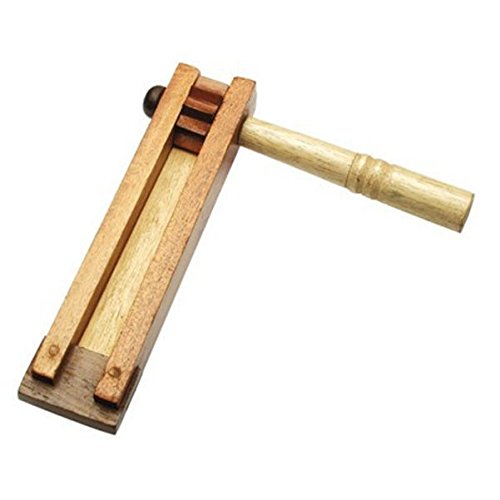
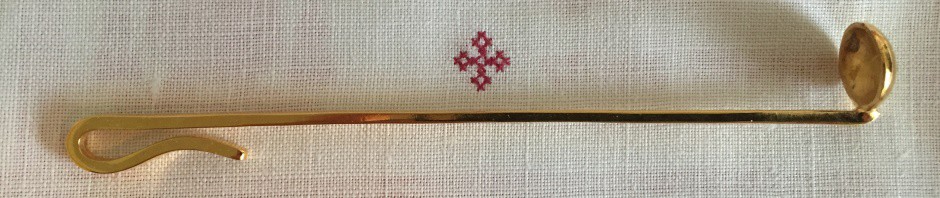
TRIDUUM NOTE: Do you have a crotalus? How about two crotali?

Let’s think ahead to the Triduum. Traditionally, after the Gloria of the Mass of the Lord’s Supper on Holy Thursday, the church’s bells are silenced and a wooden noise maker is used instead.   The harsh sound is striking.   The technical name for the ecclesiastical noise maker is: crotalus – the rattle of a snake.

In some places a wooden gizmo with little hammers or clappers are used.  In Italian they are called a “tric troc”. Other versions are handles with ratchets that you twirl around.  Italians call those “raganella”.

Check with your parish priest to find out if they have a clacker or whizzer or other gizmo.

You should probably order them in pairs, since during the Eucharistic procession to repose the Blessed Sacrament after Mass of Holy Thursday, the altar boys could alternate as they went.

They will be delighted.

To purchase…

US HERE – UK HERE  Or use the Amazon search box for a “Toca T-WR Ratchet”.  It is not at all expensive.

For Holy Week, the last time bells, or organ, can be rung in the Roman Rite is for the first few words of the Gloria of Holy Thursday.  After the beginning of the Gloria there should be no bells, which produce such cheery sounds.  However, even in the older form of the Roman Rite, there is no clear indication in the rubrics that there should be some other noise-maker to substitute the bells at the elevations and during the procession.
That said, it is a strong and venerable custom that noise-makers such as the crotulus or the “tric troc”, clappers, should be used.

I cannot imagine not using some noise-maker if one is available.  The association of the sounds with the Triduum are deeply part of the way we Catholics do things.  They set a wholly different tone during the Triduum.

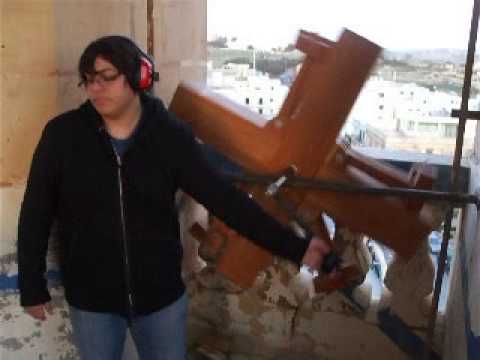
By the way, at least one church – this one in poor, poor unfortunate Malta – replaces their church bells with a really big crotalus.

YouTube thumbnailYouTube icon

Posted in "How To..." - Practical Notes, Just Too Cool, Liturgy Science Theatre 3000 | Tagged , ,
14 Comments

The German Church: Nuts

kasperIn our day we finally gone beyond the decades long, post-Conciliar scandal of priest against priest when it comes to sacramental discipline.  We have now reached bishop against bishop and conference against conference.  If you are in one diocese or country, you can step across the border and have an entirely different approach on, say, absolution of people who don’t have a firm purpose of amendment and, consequently, admission to Holy Communion.

Here is an article at First Things which succinctly state the issue. It is a bit too long, perhaps, and it has some old information. However, it serves as a good review if you haven’t been keeping up.

THE EROSION OF CATHOLIC SACRAMENTAL DISCIPLINE IN GERMANY

On February 1, 2017, the German Bishops’ Conference published a press release announcing their new document, “The Joy of Love Lived in Families Is Also the Joy of the Church,” which summarizes the implications of Amoris Laetitia for sacramental discipline and pastoral care in Germany. German psychiatrist Christian Spaemann replies to the bishops in the following article. –Ed.

The time has come. The German bishops have done something that altogether exceeds their authority: They have undermined the sacramental discipline of the Catholic Church.

[…]

Thank you, Card. Kasper.

If you want to dig more deeply into this disciplinary cadaver to see what theological cancer rotted it from within, you might read the rather difficult, but dead-on right, essay by Robert Stark in Catholic World Report: German Idealism and Cardinal Kasper’s Theological Project. HERE

And we could also look at the issue of the “Church Tax” in Germany. That must be a factor in their decisions.

Pray for the faithful priests in Germany.

The moderation queue is ON.

Posted in Liberals, Pò sì jiù, The Coming Storm, The future and our choices | Tagged , , , , ,
20 Comments

Yet another reason to appreciate Papa Ganganelli!

Mozart Order of Golden SpurDid you know that Pope Clement XIV, in addition to suppressing the Jesuits in 1773, made Wolfgang Amadeus Mozart a knight of the Order of the Golden Spur on 4 July 1770?  A singular papal honor!  By the way, his full name was Johann Chrysostom Wolfgang Theophilus Mozart.  There is a portrait of him wearing the medal.

When Mozart was 14 his ambitious father Leopold took him to Rome in 1770.  As the story goes, in April, during Holy Week, they managed to get through the guards and into the Gardens where they found Pope Clement serving food to the poor.  Thus, introductions were made.  It was during that Holy Week that young Wolfgang heard Allegri’s Miserere in the Sistine Chapel. That piece had been reserved to that chapel and forbidden elsewhere under pain of excommunication.  Mozart, however, had the gift of remembering what he heard, so he wrote it down.  Clement, true to his name, was pretty impressed.  It is said that, thereafter, the Pope personally gave Mozart a guided tour of important places in the City.   In July Papa Ganganelli knighted Mozart on his return to Rome from the south.

Clement_XVI_Mug_01 Clement_XVI_Mug_02

For all the selections click

>>HERE<<


As you place your orders, you can listen to this:

YouTube thumbnailYouTube icon

Posted in Just Too Cool | Tagged , ,
4 Comments