 I’ve been pondering lately. One needs to do this out of love. Ponder, comes from Latin pondus, “weight”. Hence, I am weighing things. Augustine famously wrote, amor meus pondus meum… my love is my weight. In Augustine’s time, gravity was thought to be an interior force that compelled things to go to where they belonged. Thus, the heart is always restless until it rests in God. Amor meus, pondus meum.
However, in the words of the modern poet’s song, John Mayer,
“Gravity is working against me
And gravity wants to bring me down”
Is it okay to say that I am still feeling the gravity of the abdication of Benedict XVI and its aftermath? I don’t think I am alone. Something truly ponderous must have driven Benedict – whom I knew a little, personally, before his election – to have left the Apostolic Apartments for the tiny house in the back of the Vatican gardens.
“Oh, I’ll never know what makes this man
With all the love that his heart can stand
Dream of ways to throw it all away”
I have long thought that, because he had had a stroke in 1991, he was afraid that he might have another and wind up being the captive of buffoons (he appointed) like Card. Bertone. Ratzinger had watched the last days of John Paul II and the machinations of Card. Sodano and others. With modern medicine people can keep a man alive for a long time and do things in his name while he is trapped in his body, unable to fight. John Paul was badly reduced at the end, couldn’t really even talk. His witness was amazing, but the governance of the Church suffered. The Church is resilient.
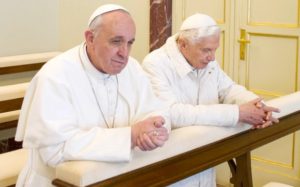
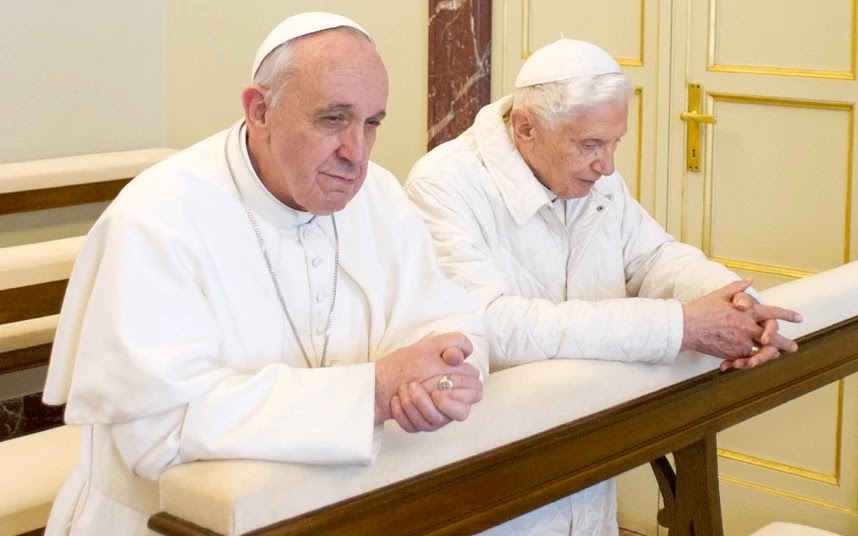
But now we have a witness of reduced Benedict and a still fairly ambulatory Francis, two bishops in white, whereas John Paul II, badly reduced was still gigantic.
“Oh twice as much ain’t twice as good
And can’t sustain like one half could
It’s wanting more that’s gonna send me to my knees”
I have a sense that more people than ever are asking questions, pondering, what the hell is going on these days. Perhaps we are in the lead up to the tribulations described in Scripture. Growing larger and larger on the horizon of my mind is the Pauline allusion to the “Restrainer” in 2 Thessalonians 2:6. We don’t know for sure to whom Paul referred, but clearly this figure is the one who hinders the Antichrist. One day, the Restrainer will stop restraining. Already, looking around the globe and seeing pandemic, China, and domestic lawlessness, I ponder:
“For the mystery of lawlessness is already at work; only he who now restrains it will do so until he is out of the way.
And then the lawless one will be revealed, and the Lord Jesus will slay him with the breath of his mouth and destroy him by his appearing and his coming.
The coming of the lawless one by the activity of Satan will be with all power and with pretended signs and wonders,
and with all wicked deception for those who are to perish, because they refused to love the truth and so be saved.
Therefore God sends upon them a strong delusion, to make them believe what is false,
so that all may be condemned who did not believe the truth but had pleasure in unrighteousness.”
Heavy, no? Seems to be a description of our time, or at least the lead up to worse manifestation of the same. Paul wrote, “For the time is coming when people will not endure sound teaching, but having itching ears they will accumulate for themselves teachers to suit their own likings, and will turn away from listening to the truth and wander into myths. (2 Tim 4:3-4)”. And the Lord Himself said, “They will put you out of the synagogues; indeed, the hour is coming when whoever kills you will think he is offering service to God. (John 16:2)”
It weighs on the heart.
In these last months I have taken serious note of how the Lord’s ejection of demons and his physical healings went hand in hand, overlapping.
I think that what we are seeing, world wide, is a massive demonic movement in the ongoing war within this vale of tears. We are always at war with the world, the flesh and the Devil. But sometimes in this dreadful trench war, offensives are launched. China. Domestic terror and lawlessness. Viral pandemic. Relentless stupid in every possible direction. Our own pastors shutting down the sacramental life of the Church.
Two men in white. I am mindful of Anne Catherine Emmerich’s vision of a two “popes” as if viewed in a mirror: one is the real deal and the other is an image. I am mindful of the really hard to swallow explanation of the Third Secret, especially in that with the other visions there were explanations by the Blessed Virgin, missing in this case. I am mindful of the messages of Akita and of Garanbandal.
Recently I was prompted by a friend to listen to a podcast by Taylor Marshall. Over a couple of days I got through it. They are … long. It was an interview with Edmund Mazza, and it was about the conundrum of whether or not Benedict XVI really abdicated the See of Peter, the papacy, or not. Maybe he did and maybe he didn’t.
Mazza has come up with a very interesting theory. That’s what I will focus on now.
First, let me remind you of some that was written a while back by Fr. Thomas Weinandy, OFM, a distinguished theologian who is not afraid of our ecclesial overlords. He offered an alarming but ringing possibility, in the wake of the disastrous Amazon Synod (“walking together”) and other odd actions of Francis. HERE
“What the Church will end up with, then, is a pope who is the pope of the Catholic Church and, simultaneously, the de facto leader, for all practical purposes, of a schismatic church. Because he is the head of both, the appearance of one church remains, while in fact there are two.
The only phrase that I can find to describe this situation is “internal papal schism,” for the pope, even as pope, will effectively be the leader of a segment of the Church that through its doctrine, moral teaching, and ecclesial structure, is for all practical purposes schismatic. This is the real schism that is in our midst and must be faced, but I do not believe Pope Francis is in any way afraid of this schism. As long as he is in control, he will, I fear, welcome it, for he sees the schismatic element as the new “paradigm” for the future Church.”
The problem here is that a Pope cannot be in schism with himself.
However, is there another way that Francis could be in schism? What if Francis were, indeed, the Bishop of Rome (as he called himself from the beginning in 2013), but not, in fact, the Vicar of Christ?
Thus, the thesis of Edmund Mazza.
Mazza was also on a podcast with Ann Barnhardt, whom I am sure you know has for a long time now been adamantly saying that Francis is an antipope and the Benedict XVI is still Pope. Benedict did not resign the papacy. He could have been pressured to resign. He didn’t use the proper language or terms. Etc.
For my part, I have not wanted to get too much into this for the simple fact that Cardinals who were in the conclave have not raised problems.
And yet this weighs on a lot of very smart and very thoughtful people who raise questions precisely out of love for the Church.
Cardinals did raise a problem with the “Pope Emeritus” conundrum.
If you were to go to those podcasts, you would have to listen for a long time and we don’t all have that time. I listened at 2x speed and it still took a while. Perhaps I can summarize the main line of Mazza’s argument.
Based on Benedict’s wording of his resignation, and based on comments made by Benedict’s secretary and confidant and, still, head of the Papal Household, Archbp. George Gänswein, Benedict may have tried to “split” the two-fold role of the Successor of Peter, namely a) Bishop of Rome and b) Vicar of Christ. So, Benedict resigned as Bishop of Rome, calling himself Pope Emeritus, like a Bishop Emeritus of the Diocese of Rome, but he retained for himself the role of Vicar of Christ.
My immediate reaction is, “No, can’t happen. These offices are inextricably tied together and are embodied in one man who is elected to the See of Rome, because that was Peter’s See.”
Not so fast.
In the podcasts, Mazza brings up the fact when Christ conferred on Peter what was clearly intended to an office that was to be handed down, when Christ gave Peter the “keys” and clearly made him head of the Apostles, earthly head of the Church built on his “rock”, when Christ at the Sea of Galilee confirmed Peter’s office, intended to be handed down, Peter had not yet been anywhere near Rome.
Peter was Vicar of Christ before he was Bishop of Rome.
When Christ takes the Apostles to Caesarea Philippi (Matthew 16:16-18) he gives people the “keys”. About a year later, the Apostles are ordained at the Last Supper.
Peter has the keys from Matthew 16 onward, but he is not a “bishop” until the Eucharist and Holy Orders were established by Christ.
Consider that when Christ gave primacy to Peter, there were no sees or dioceses. Peter later would found the Church at Alexandria and Antioch. Wouldn’t Antioch have been the primal see? But Peter left Antioch and went to Rome. So there seems to be nothing absolutely necessary about the one we now call “Pope” being Bishop of Rome.
As a matter of fact, the Successor of Peter could divorce the papacy from Rome and move it somewhere else … or nowhere. It is his person that matters. But there could still be a Bishop of Rome, appointed by him, if Rome still existed.
As I listened to the podcast with Ann Barnhardt, a conversation I had with Joseph Card. Ratzinger came to mind.
One day I ran into him in the hallway of the Palazzo del Sant’Uffizio where I was working. We struck up a conversation about some goofy German theologian. With a mischievous grin he said that he was relieved that Peter stopped in Rome and didn’t go to Germany to establish a Church. “Imagine,” he said, “the mistakes that could have been made and the efficiency with which we would have made them.”
Ratzinger was kidding around, but he also revealed that he had this image in his head: Peter leaving Rome for Germany.
There is nothing holding a Pope in Rome except for custom, property, tradition, international laws, finance, etc. Not theology. In his person a Pope is Vicar of Christ and Successor of Peter whether he is BISHOP of Rome or not.
In the podcasts, Mazza brings up the debate about Romanitas and the papacy in the 19th c. at the time of Vatican I. Is Romanitas of the very essence of the papacy or not? The answer is: “No.” Mazza checked with Archbp. J. Michael Miller of Vancouver (with whom I used to live in Rome in a clerical residence) about the possibility . Miller had written an amazing doctoral thesis: “The divine right of the papacy in recent ecumenical theology”. There are relevant sections in the thesis about the nature of the papacy. Miller confirmed that it is not wrong to to say that Romanitas is not of the very essence of the papacy, that is, the office of Vicar of Christ as Successor of Peter. It would obviously be of the essence of being Bishop of Rome, Successor of Peter in that sense.
So, cutting though the verbiage. There is a strong argument to be made that Benedict might have intended to renounce the active ministry (office of the Bishop of Rome) while retaining the spiritual ministry (Successor of Peter). Hence, while juridically Francis can be called Bishop of Rome, because he was elected by the “clergy” of Rome (the College of Cardinals), Francis is not, in fact the Successor of Peter on the other, spiritual level, even though he succeeded to the office of bishop that Peter held. The distinction is to be made about Peter qua (insofar as he is) Vicar of Christ and Peter qua (insofar as he is) Bishop of Rome.
Hitherto there has been a strong correlation of the two aspects, so much so that, with the conferral of the one, the other came also. However, consider also that the papacy can be conferred on any baptized male! At the moment that baptized male accepts the election, he has full authority in the Church. Period. Afterwards it is prescribed that he is to be immediately consecrated as a bishop so that he can simultaneously be Bishop of Rome.
On the Barnhardt podcast the possibility is raised that, if the hypothesis is right and that Benedict tried to split these roles, that Benedict was in error that this could be done. However, if that is the case, then his abdication would have been void. If the reason for his abdication was precisely to bifurcate the roles of the Successor of Peter, and if that is impossible, then Benedict acted erroneously and his act of abdication would be null, nothing.
If a Pope is forced to resign by some third parties, the resignation is void. For example, say that someone threatened the life of, say, his brother Georg. If the Pope resigns according to some erroneous notion that he is doing something impossible, the resignation would be void.
There’s a lot more to be said. However, let me wrap up with a point about: WHAT NOW?!?
When Benedict announced his resignation, he declared:
For this reason, and well aware of the seriousness of this act, with full freedom I declare that I renounce the ministry of Bishop of Rome, Successor of Saint Peter [ministerio Episcopi Romae, Successoris Sancti Petri], entrusted to me by the Cardinals on 19 April 2005, in such a way, that as from 28 February 2013, at 20:00 hours, the See of Rome, the See of Saint Peter [sedes Romae, sedes Sancti Petri], will be vacant and a Conclave to elect the new Supreme Pontiff will have to be convoked by those whose competence it is.
The office of the Successor of Peter qua Bishop of Rome is conferred on a man through his election to the See of Peter by the College of Cardinals. The Cardinals are the “clergy” of Rome. Every Cardinal is assigned a church in Rome, even though he may be Archbishop of, say, Ouagadougou. The original Cardinals were the clergy of Rome, deacons and priests, and the bishops of the closest sees.
However, the office of Successor of Peter qua Vicar of Christ is conferred not by the College of Cardinals – nemo dat quod non habet – but rather by Christ Himself. The 1870 Dogmatic Constitution on the Church of Christ of Vatican I, Pastor aeternus, deals with the Petrine Ministry. Pastor aeternus says from the onset: “Docemus itaque et declaramus, iuxta Evangelii testimonia primatum iurisdictionis in universam Dei Ecclesiam immediate ct directe beato Petro Apostolo promissum atque collatum a Christo Domino fuisse… Therefore we teach and declare, according to the Gospel’s witness, that a primacy of jurisdiction over the universal Church of God was immediately and directly promised to and conferred on the Blessed Apostle Peter by Christ the Lord.”
Not the College of Cardinals. Remember: this happened before Christ’s Passion and was confirmed afterwards long before Peter went to Antioch, much less to Rome.
Card. Ratzinger as Prefect of the CDF wrote a letter about the Primacy of the Successor of Peter in 1998. HERE I have scanned this and found some items to weigh. Not everything in it jives with the Mazza hypothesis.
Again… WHAT TO DO?
In another post – long before any of this came to my deeper pondering – I gamed out a few scenarios about what might happen should Francis die before Benedict, or should Benedict die before Francis.
If Francis is an antipope, then everything he has done is void.
However, if Francis is Successor of Peter qua Bishop of Rome then he could appoint clergy to the churches of the Roman See. In other words, he can legitimately appoint cardinals. And it is the role of cardinals to elect the Successor of Peter, who is Bishop of Rome and Vicar of Christ. Christ confers the “papacy”, primacy over the universal Church, while the cardinals confer the office of Bishop of the See of Rome. In that case, should Benedict die before Francis, and if things bump along as they are bumping along until Francis also goes to his reward, the cardinals named by Francis (and if any are left by previous Popes) would gather in conclave and elect a successor.
If Francis is antipope and none of this is possible, because the See of Peter can’t be separated from the person of the Vicar of Christ – which doesn’t seem right considering how that office was instituted, then that conclave would be illegitimate: none of the men Francis appointed would really be cardinals.
If Francis is not really Pope, in the fullest sense, but is just Bishop of Rome – carrying out the active ministry of the Successor of Peter while Benedict retains the spiritual ministry – then Francis legitimately names Cardinals and they would form a legitimate conclave on the death of Francis. But could they really elect a new Successor of Peter who would have both roles, Successor qua Vicar of Christ and qua Bishop of Rome? Not if Benedict is still alive. He would have to, I suppose, do something.
To underscore, however, the FACT that being Bishop of Rome and being Successor of Peter qua Vicar of Christ are not absolutely coterminous, consider the following scenario.
Let’s imagine for a moment that there is some future conclave. The Cardinals, deadlocked for weeks, decide to elect a man who is not even ordained a priest, a baptized layman. The layman accepts.
He AT THAT MOMENT has absolute jurisdiction in the Church, even though he is not in Holy Orders (cf. problems of exercise of the power of the keys!).
The Cardinals say, “We must now consecrate you.”
Joe the First, says, “Sorry, I am going to wait a while.”
Joe the First is still the Vicar of Christ. But he is not the Bishop of Rome. He isn’t a bishop. He has absolute authority, but not the office of bishop.
Joe adds, “As a matter of fact, Most Reverend Cardinals, I’m going home… see you in Wisconsin. Oh, yes, is “Card. Fang here? Yes? You, Cardinal Fang, shall govern with the title of Bishop of Rome for the time being. Start with the Jesuits. Claro? Good. Nobody expected the Spanish Inquisition, did they. I’ll change my clothes now.”
So, the Mazza Hypothesis is that Benedict renounced being the Bishop of Rome without renouncing the papacy, being Vicar of Christ.
There are many more data points one can bring in from other writings of Benedict/Ratzinger and other sources from those podcasts. That’s the general line.
Wrapped up in this question is whether the third grade of Holy Orders confers some truly different on a bishop or whether the main point is authority to use what is conferred by priesthood. Both priests and bishops are sacerdotes. Once upon a time it was possible for priests to ordain. We have the documents giving permission and taking it away. Similarly, is there a distinction in what is conferred by election by Cardinals to the See of Rome? Is the papacy really about authority – which Christ gives as an ontological aspect of the man’s soul, that can’t be lost? The office of Bishop of Rome can clearly be resigned. And it seems that one man could then function as Bishop of Rome while another man still retained that other character. That’s a point to resolve. Did Benedict think that the primacy, the papacy, being Successor Peter qua Vicar of Christ, was rooted in him ontologically, such that he thought he could divorce the active ministerium given by the College without giving up the petrinum munus given by Christ?
I’m pondering all of this and it is rather heavy.
Whoa, gravity, stay the hell away from me
Whoa, gravity has taken better men than me
Now how can that be?
Just keep me where the light is
Just keep me where the light is
Just keep me where the light is
Come on keep me where the light is
Come on keep me where, keep me where the light is

The moderation queue is ON.







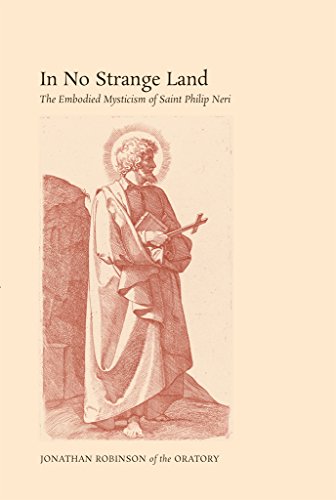
 I received word today that Fr. Jonathan Robinson of the Toronto Oratory passed away this morning. It seems that he had a fall on St. Philip’s Day (26 May) and had been in the hospital.



 maternalView on ROME 26/10– Day 21: fountain: “I don’t think discernment means what she thinks it means. These people always use that word as a justification for…”


























