
 I was informed that some prominent internet wonks were/are having a spat about the SSPX.
I looked around and found all manner of strange, useless and confusion-riddled comments about the status of the SSPX, their objectives and holiness, and blah blah. Various sections of the addled peanut gallery got involved in the online feud. As inevitably happens. Thus, we are again presented with a concrete demonstration that in many of these dust ups a heck of a lot of people don’t know what they don’t know.
Let’s aim for some clarity and charity about the SSPX.
I write this now, why?
Firstly, because of the aforementioned online and thoroughly unedifying dust up. Also, because someone wrote to complain that in some of my daily 5 minute podcasts I read paragraphs from a spiritual book by a priest of the SSPX, Fr. Patrick Troadec’s work Toward Easter. [US HERE] Imagine such a thing! Third, because of the whole COVID lockdown thing, many emails have come in asking a) if it is sinful to go to Masses at still open chapels of the SSPX and b) is it sinful – I am not making this up – to watch their live-streamed services on the internet. No, and no.
I’ll dig into some issues about the SSPX in a moment. From the onset, however, I warmly urge people who don’t know what they are talking about not to leap in with unhelpful notions about law, theology, etc., and stick to discussing something more fruitful, such as the evils of the designated hitter or of changing the rules about intentional walks. O… the humanity.
Ad ramos!
I preface this with my observation, from personal experience, of some of the priests of the SSPX. They are mostly terrific guys, dedicated, zealous for souls, hard workers and determined priests. Better formed in history, philosophy, liturgy and theology than a great many of garden variety priests I know. (Not that we think clergy should be well educated. Sheesh.) I would be, will be I hope, honored to have them working alongside me in this diocese or wherever God takes me.
Here are a few facts.
The SSPX (technically Fraternitas Sacerdotalis Santi Pii X) is a priestly Fraternity or Society of priests. The SSPX does not have formal canonical status other than they are exercising a canonical right to associate with each other. Their “association of the faithful” does not now have canonical recognition. Hopefully one day they will be set up and recognized formally as a, say, Personal Prelature or some variant. However, can. 299 §1 says that by private agreement among themselves, the faithful have the right to constitute associations for the purposes mentioned in can. 298 §1, which are, for example, when clerics or laity want to strive with common effort to foster a more perfect life, promote public worship, etc. The SSPX is an association of the faithful. No question.
Could it have higher status? Sure. It doesn’t have no status.
On 8 December 2015, Francis told the Catholic faithful that for the Holy Year of Mercy they could go to priests of the SSPX for the Sacrament of Penance and that they could be validly absolved. That provision was extended beyond the “Year of Mercy” in the 2016 Apostolic Letter Misericordia et misera. It stands today. This is a little odd, because it was not really a formal grant of faculties in the usual and expected way to the priests of the SSPX, as when a bishop grants faculties to a priest to receive sacramental confessions. Those faculties are demonstrable with a document saying that Fr. Soandso has the faculty, etc. In this case there is no document that I’m aware of that explicitly grants faculties to the priests of the SSPX to hear confessions and to absolve. However, Popes can do what they want in this regard. It’s better when they do things in a way that make things clear, with all the i’s dotted. In this case, Francis said that people can be absolved by SSPX priests and that, as they say, is that. Popes can do that sort of thing, whereas other entities such as dicasteries of the Holy See (e.g., the Pontifical Commission “Ecclesia Dei” (PCED) of old and now CDF, and diocesan bishops) have to use another procedure. So, SSPX priests can validly absolve sins even when there is no danger of death. You can go to confession to them not just because there are no other priests around. You can go to them because you want to. No question.
On 27 March 2017 the Congregation for the Doctrine of the Faith (which had absorbed my old office, the PCED) informed all the bishops of the world that they could give faculties to SSPX priests to witness marriages. As in the case of hearing confessions, marriages require that a priest have the appropriate faculty. There had been considerable debate about the validity of SSPX witnessed marriages. What Francis did removed doubt. The priests can now have the faculty themselves and they can work with a local diocesan priest. Since then, I think most, not all, diocesan bishops have worked with local SSPX priests in this regard and simply given the SSPX priests the faculty.
Something important to note about this is that that letter of the CDF did NOT say that, “Up until now, the marriages witnessed by the SSPX priests were invalid.” The Apostolic Letter Misericordia et misera did NOT say that, “Until now, the absolutions given by priests of the SSPX were invalid.” That’s food for thought. That moves the goal posts significantly. We can’t just think of the SSPX priests and confession and marriages in the same way that we did before those grants.
Furthermore – AND PAY ATTENTION because this is really important – suspended priests cannot receive faculties. If the SSPX priests can receive faculties, and they have, all over the place, then they are not suspended!
Another point, and one that touches close to home with many lay people who love our Catholic tradition: attendance at SSPX Masses.
The Masses celebrated by SSPX priests are celebrated in a Catholic rite. No question. As I have written a zillion times on this blog about fulfilling Sunday and Holy Day obligations, in can. 1248 §1 we read that a person who assists at a Mass celebrated anywhere in a Catholic rite either on the feast day itself or in the evening of the preceding day satisfies the obligation of participating in the Mass. Again, the SSPX priests use a Catholic rite, the Missale Romanum and other liturgical books of the Latin Church. So, yes, you can choose to go to a Mass of the SSPX, not just because there is no other Mass, but because you want to. No question.
As to the question: “Is it sinful to go to an SSPX Mass?” Answer: It depends on why you are going there.
Frankly, yes, it would be sinful to go to their Masses out of sheer desire to hurt local parishes or priests or because you hate the local bishop, or Pope, or some aspect of the Church, blah blah blah. Frankly, yes, it would be sinful to attend a parish where there are liturgical abuses that you happen to know are abuses but you like those abuses and you don’t care about authority. Frankly, no, it is not sinful to attend an SSPX Mass if you are seeking sound liturgy and preaching and other good people who desire the same. No question.
As a matter of fact, you can contribute money to their collections: it is a matter of justice. If you receive services from them, you can contribute.
Sometimes I hear the claim that the SSPX is “not in communion” with the Catholic Church. I have heard that they are “not Catholic”. These claims are absurd on the face of it. No reasonable and even half-informed mind can conclude that they are not “Catholic”. They are clearly not Protestant, who are heretics. They are clearly not Orthodox, who are schismatics. And I am not sure that there is such as thing as “imperfect communion”. What would that be, exactly? You are either in communion or you aren’t. In the past, sometimes we have seen statements, for example in the decree issued by the Congregation for Bishops in 2009 which lifted the excommunications of the SSPX bishops, that such a gesture aimed at “full communion” and as well as “proof of visible unity”. It doesn’t say that there wasn’t/isn’t communion or unity. It aims at making both more apparent, which is not the same as bringing either one about.
Moreover, the three bishop members of the SSPX – excluding the fourth, a separate case – are NOT excommunicated. Benedict XVI lifted that excommunication incurred in 1988 – probably with retroactive effect – in 2009. And the priests are not excommunicated.
Also, it is claimed that the SSPX has been in schism since 1988 because the illicit consecration of bishops by Archbp. Lefevbre was a “schismatic act” (cf. Ecclesia Dei adflicta 3). However, it takes more than “an act” to create a real schism.
It was obviously, manifestly, NOT Archbp. Lefevbre’s intention to set up a separate or rival Church, or to make himself or someone else an anti-Pope, or to create other aspects of a true schism. The SSPX priests quite openly have used the names of the Popes in the Roman Canon during Mass. They have recourse to diocesan tribunals in marriage and other matters. They follow the decrees of the Sacra Paenitentieria Apostolica in the matter of indulgences. They accept faculties for marriages etc. from local bishops. Recently, they communicated to their followers the dispensations and provisions given by local bishops in this time of Coronavirus lockdown. These are not the acts of schismatics.
The SSPX has common and shared faith, sacrament and governance. Protestants have some shared faith, a couple sacraments, and no governance. Orthodox have shared faith and sacraments but not shared governance. The SSPX has all three, as is clear by the fact that Francis acted in their regard about the Sacraments of Penance and Matrimony in way that would be impossible with, say, heretics or schismatics. They are not “separated brethren”. No question.
Some don’t like the SSPX because they say that people should attend the Traditional Latin Mass and not the Novus Ordo. How shocking that they should say that people would do better to come to their Masses rather than someone else’s, particularly when they sincerely believe that the Novus Ordo is flawed and inadequate. They do NOT believe that it is invalid! They think it is flawed and, in some respects, possibly harmful to the faith. It could be argued that after several decades of the Novus Ordo a large percentage of Catholics have a flawed understanding of a great deal of Catholic teaching. But I digress. The SSPX doesn’t say that Novus Ordo is invalid.
The SSPXers are often said to be against or critical of the Second Vatican Council. However, they acknowledge that Vatican II was, in fact, the 21st Ecumenical Council. What they say about the Council is what the Council said about itself: it was intended to be a pastoral Council (which is itself a historical departure) rather than a Council that would issue dogmatic statements. Paul VI took the documents and he promulgated them. That doesn’t mean that everything in every document is beyond criticism. Some things are crystal clear and others are as clear as mud. Libs say that everything in the mud is dogmatic according to their own interpretations. It is legitimate to debate about the debatable things. We can be convinced one way or another by clarifications made by legitimate authority (e.g., CDF) or by the force of the arguments. For example, the “Dogmatic Constitution” Lumen gentium had a point about the possibility of salvation outside the church (there’s a dogmatic teaching about that). It was not clear. Many debated about it. Hence, in 2000 the CDF issued Dominus Iesus. It is possible to be confused by things in Council documents, debate them, make arguments and then have them clarified, over time, by subsequent authoritative declarations. BTW… one might read the commentary on Gaudium et spes by young Fr. Ratzinger in the book edited by Herbert Vorgrimler (HINT: deep reservations about its drafting, structure and anthropocentrism).
So, the SSPX is in a strange state, but not really the state that some (most?) think they are in. Their chapels are not parishes; a parish is a formal canonical structure. They don’t have a clear ecclesiastical jurisdiction, as dioceses or a personal prelature or religious order does. Their priests are not incardinated anywhere, which make them odd ducks in a way, but not less priests than priests who are incardinated in a diocese or in a religious group. They can and do receive faculties from legitimate authority and, hence, they are not suspended.
Let’s bring this to the bottom line.
When it comes to critics of the SSPX, clerical and lay, it seems to me that a little more charity, thoughtfulness and prudence might be adopted. There is a rigidity running through some conservative or tradition-leaning Catholics which reminds me a little of the attitude of the Pharisees. Libs remind me of Pharisees all the time, by the way.
Within the very heart of how the Church applies and interprets her laws there is a beautiful and gentle principle the spirit of which we can learn from when talking about the SSPX: odiosa restringi et favores convenit ampliari, or else odiosa sunt restringenda et favoribilia amplianda/ampliantur. That is to say, laws that place burdens or restrictions on people must be interpreted strictly so that they don’t put onto people what the laws don’t say. On the other hand, laws which grant favors or freedoms to people should be interpreted as generously as possible so that people can enjoy favors and freedoms. Be narrow and picky with laws that restrict and wide and generous with laws that grant things.
The SSPX is an association of the faithful. They don’t yet have canonical recognition. But they could and, I think, will. Until then they are still a real thing in the Church. Their sacraments are valid. The priests can receive faculties, so they are not suspended. Their bishop members are not excommunicated. They have shared faith, sacraments and governance, which is borne out everyday in practice by their recourse to tribunals, reference to the decrees of the Paenitentieria, etc. They aren’t a separate Church. They aren’t heretics. They aren’t a schism. You can satisfy your Mass attendance obligations at their chapels. You can be validly absolved by them. They can witness your marriages.
Is their situation complicated? Heck, yeah it is! Especially in regard to the question of incardination of the priests. That’s really the most difficult canonical issue.
Also, the situation of the SSPX and of the wider Church is evolving, especially in light of the concession of faculties. As it evolves, we have to step back, cool down and reevaluate.
We probably have a whole bunch of living to do before the trumpet sounds. I think our views can evolve in a constructive way. I sure hope so.
Meanwhile, quite a few people would do well to stick a sock in it when it comes to the SSPX. Carping at them, or parroting inaccuracies, does no one any good and it confuses people. This is a really complicated situation that is not helpfully characterized by glib cliches or reduced to simplistic conclusions. Having a gentler attitude, even in regard to their lawful status, as suggested by the Latin dictum I quoted above, seems to me to be the better and the more Catholic approach. We might apply a little mercy.
Speaking of mercy, during the Year of Mercy convoked by Francis – which the SSPX observed! – the leadership, 250 priests and 5500 followers of the SSPX had their pilgrimage to St. Peter’s Basilica, where they were welcomed. Then-Superior Bp. Fellay gave a sermon and they prayed for Francis.
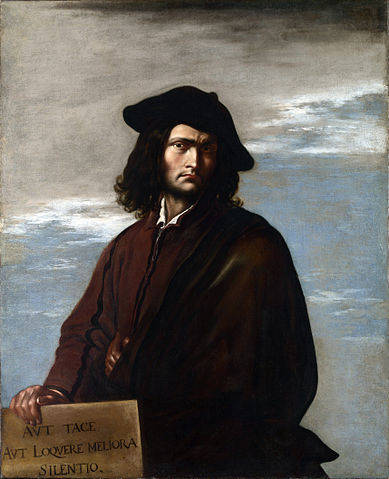
I have on my wall a reproduction of a painting in London’s National Gallery by Salvatore Rosa called “The Philosopher”, possibly a self-portrait. The stern, somberly garbed figure holds a sign with the words: AUT TACE AUT LOQUERE MELIORA SILENTIO.
“Either shut up or say something better than silence would be.”
I want to keep the knucklehead stuff out of the combox, so I will turn on moderation.






 jhogan on From “The Private Diary of Bishop F. Atticus McButterpants” – 26-10-12 – Brainstorming!: “I would like to laugh at the bishop’s situation and ideas; unfortunately, it is far too close to the truth…”




























