Magister: Comments on the state of the Curia

Some time ago I issued a serious rant.  HERE  I think you should take it to heart.

From Sandro Magister:

A Firing, a Demolition: Behold the New Curia

The reform of the Vatican curia that Pope Francis is carrying out is being done partly in sunshine and partly in shadow. [Mostly shadow.  There is a lot that doesn’t reach the light.]

Among the provisions recently adopted in shadow, there are two that are emblematic.

*

The veil was lifted on the first by the vaticanista Marco Tosatti, when on December 26 he broke the news of an order the pope had given to a dicastery [CDF] head to summarily fire three of his officials, an order given without explanations and without accepting objections. [He has the power to do that.]

It is now known that the dicastery in question is not second-tier, it is the congregation for the doctrine of the faith. [CDF] And the three officials fired enjoyed the full approval of their prefect, Cardinal Gerhard L. Müller, in his turn made the target of repeated acts of humiliation, in public, on the part of the pope.

But which of the three rejects is the official whom Francis personally – as Tosatti has reported – reprimanded harshly by telephone for having expressed criticisms against him, which had come to the pope’s ear through an informant? [True.  One of them was called personally.]

It is the Dutch priest Christophe J. Kruijen, 46, in service at the congregation for the doctrine of the faith since 2009, a theologian of acknowledged expertise, awarded with the prestigious Prix Henri De Lubac in 2010 by the French embassy to the Holy See, unanimously bestowed upon him by a jury made up of the cardinals Georges Cottier, Albert Vanhoye, and Paul Poupard,…

[… read about him there…]

*

The second measure taken in shadow concerns the congregation for divine worship, [CDW] the prefect of which is Cardinal Robert Sarah, he too the object of repeated public humiliations on the part of the pope, and now condemned to preside over offices and men who are pulling against him.

Directed by the secretary of the congregation, the English archbishop Arthur Roche, [NB:] a commission has been set up within the dicastery at the behest of Francis, the objective of which is not the correction of the degenerations of the postconciliar liturgical reform – meaning that “reform of the reform” which is Cardinal Sarah’s dream – but the exact opposite: the demolition of one of the walls of resistance against the excesses of the postconciliar liturgists, the instruction “Liturgiam Authenticam issued in 2001, which sets the criteria for the translation of liturgical texts from Latin into the modern languages.

With Benedict XVI these criteria had been further reinforced, in particular through the pope’s intention to hold firm the pro multis of the Gospel and the Latin missal in the words of consecration of the blood of Christ, against the “for all” of many current translations.

But Francis immediately made it understood that this matter left him indifferent. And now, with the institution of this commission, he is meeting the expectations for a modernization of liturgical language championed, for example, by the liturgist Andrea Grillo, a professor at the Pontifical Atheneum of St. Anselm [This fellow is Bad News™.] and in great esteem at Casa Santa Marta:

> La traduzione/tradizione impossibile: i punti ciechi di “Liturgiam authenticam”

There are those who fear that after the demolition of “Liturgiam Authenticam,” the next objective, of this or another commission, will be the correction of “Summorum Pontificum,” the document with which Benedict XVI liberalized the celebration of the Mass in the ancient rite.

What is there to say about this?   Not much.  And what can be said, really can’t be said at this time.

Could the Pope roll back the 2011 translation of the Novus Ordo in English?  Unlikely.  However, he could provide options.   So far we have seen sharp and growing polarization.  Those who were already inclined to doctrinal and canonical fidelity continue to choose to be faithful.  Those who were already antinomian and untroubled by doctrine, continue to choose to be dissidents.  The ambiguities of documents today leave both sides free to choose… and they are choosing.  The liberal side, however, now has far greater cover, so that they are freer to pursue their agenda even more aggressively than before.  Options don’t bring much unity, when you reach the bottom line.

We are our rites.  If we pray a certain way, our belief is shaped.  From our belief, our prayer is brought forth.  There is a reciprocal and dynamic relationship between how we pray and what we believe.  While many factors are at play, there seems to be a strong corollary between the state of many of the Church’s institutions and how our sacred liturgical worship was altered.

Traditional liturgy and sound translations do not on their own preserve us from error.  However, hatred for traditional liturgy and sound translations it is unfailingly a signal of heterodoxy, and heterodoxy is always predictive of hostility toward sound liturgy.

Lex Orandi Lex Credendi … and vice versa

Perhaps this will galvanize some Catholics to get off their backsides and do something in favor of the liturgical revival we so desperately need.  

Card. Sarah sent out a clarion call to priests.  Fathers!  Let’s get going!  Benedict XVI gave us clear and sound liturgical teaching and direction. He gave us the stupendously important tool of the aforementioned Motu Proprio, the “emancipation proclamation” for all the priests of the Roman Rite.  It has been almost 10 years since SP went into force.  Take off the training wheels and ride the damn bike!

Do not be flustered.  Do not be paralyzed with anxiety.  Do not run in circles, panting and tearing at your clothing.  Pontiffs come and pontiffs go.  You, on the other hand, are called to influence your corner of the world according to your vocations, God’s plan for you.  So, form alliances, create a solid group with a vision and goal, discern your tactics to carry out your strategy.  Examine your consciences.  GO TO CONFESSION!  Get to work.  Don’t sit around in your wilted flower bed and wring your hands, waiting for priests to do everything for you.  Not. Gonna. Happen.  YOU have to make things happen.

The moderation queue is ON.

Posted in Hard-Identity Catholicism, Liturgy Science Theatre 3000 | Tagged , , , , , ,
33 Comments

Card. Burke’s interview in ‘La Verità”: More Cardinals are completely with the Four

Lots of lefties are hopping up and down in little circles because the Four Cardinals (Burke, Caffara, Meisner, Brandmueller) offered Five Dubia (questions, narrowly framed, asking for yes or no clarificatory responses) arising from the objective lack of clarity in Chapter 8 of Amoris laetitia.  As these catholic libs, chimp-like, fling their stuff around, Card. Burke continues to give interviews in an attempt to bring sobriety to the debate.

Today I saw an interview dated 11 January in the Italian publication La Verità.  Card. Burke is asked some tough questions and he gives straight on answers.  Asked whether they are “inventing” a way to correct formally the Pope, Burke answered “Of course not.”  But he points out that, in the past, Popes have been corrected.  He sustains that it is an “error” to say that, in certain cases, the divorced and remarried living in more uxorio, can receive Communion.  He doesn’t think that that is a heresy, but an error:

“No, it seems to me that it can qualify as an error, but we are dealing with a complex situation.  Heresy is the obstinate denial or obstinate doubt, on the part of the baptized, of a truth that one must believe by divine and Catholic faith.  One heresy could be that of one who sustains that there do not exist intrinsically evil acts; to affirm this would be to say something contrary to the doctrine of the Church and would clearly be a heresy.  The affirmation about access to the sacraments of which we were speaking a while ago, on the other hand, refers to a practice (prassi) that contradicts two doctrines: that of indissolubility of matrimony and that of the real presence of Jesus in the Eucharist.  At first glance we can say that certainly it’s an error.”

Card. Burke confirms that the Four Cardinals are united and that he knows many cardinals who are with them.

The accusations – open from some and veiled from … another – flung at them pretty much roll off his back.

In regard to the accusation that the Four are “doctors of the law” (an insult leveled by Pope Francis at those who resist antinomianism):

“It seems to me that the moral law isn’t something that imprisons a person; it is quite the opposite: the moral law frees a person and orients him to fulfill the good.  In fact, when there is no respect for moral law there come about chaotic situations and morally there results a kind of imprisonment.  For people of faith, we have to say that the divine law frees, and it is not a negative thing.  And then to teach moral law is a great act of charity towards one’s neighbor, because it points to the path of authentic freedom and happiness.  It is impossible to affirm that a person can find some form of happiness in  sinning.”

He was asked:

Q: Why so much noise for a problem that many have a hard time understanding?

BURKE: We are dealing here with a question that concerns the Church in a profound way: matrimony and family, which is its fruit, and they constitute the foundation of the very life of the Church.  Our task is not to lose ourselves in difficult or vague questions; we are simply giving our contribution to the growth of the Church in the most elementary cell of life.

Posted in One Man & One Woman, Our Catholic Identity | Tagged , , ,
20 Comments

Order of Malta to Pope Francis: No thanks.

From the Sovereign Military Order of the Knights of Malta comes a statement to Pope Francis.  HERE

The statement is pretty thick, but in effect SMOM is standing up for itself.

The conclusion (but read the whole thing there)…

[…]

In the light of these fundamental legal regulations, it is clear that, in strictly legal terms, a refusal to a command ‘in Obedience’ does not justify in any way the involvement of ‘religious superiors’, all the more so as they do not all belong to the Order.

Such involvement, in addition to being legally impossible, is also superfluous in terms of protecting members of the Order: from the time that the members of the Second and Third Class who wish to appeal against disciplinary measures they consider too harsh, can dispute these before the Magistral Courts, as provided for by Article 129 of the Constitutional Code.

Failure to cooperate with the aforementioned Group has therefore strictly legal grounds, thus it is not and cannot in any way be considered as a lack of respect towards the Group, nor towards His Eminence Secretary of State.

The position of the Grand Magistry is that the depositions that individual members consider that they could make to the Group cannot, in their terms and judgments, be in contradiction, directly or indirectly, with the decision of the Grand Master and the Sovereign Council concerning the replacement of the Grand Chancellor.

Posted in ¡Hagan lío! | Tagged
17 Comments

Another look at Fr. Cameli in Jesuit-run ‘America’: Use of Scripture

Screen Shot 2017-01-10 at 15.27.06The other day there was misleading piece at Jesuit-run America by a Chicagoan Fr. Louis Cameli. He launched an ad hominem attack against the Four Cardinals of the Five Dubia.  Cameli continued with a not entirely honest defense of his personally preferred reading of Amoris laetitia Chapter 8 by which just about anyone can be admitted to Holy Communion no matter what through “accompaniment”.

The other day I pointed out Cameli’s dishonest use of St. John XXIII’s words at the opening of the Second Vatican Council.  He quoted the famous speech “Gaudet Mater Ecclesia“, but cut out all the bits that John said which directly contradicted him. Have a look: it’s blatant.  HERE

wile-e-coyote helpIn an amusing aside, the Wile E. Coyote of contemporary liberal catholicism over at Fishwrap (aka National Schismatic Reporter) went on grand mal spittle-flecked nutty flung at Raymond Card. Burke (part of his ongoing struggle with Burke Derangement Syndrome, I’m afraid), Raymond Arroyo, Fr. Raymond De Souza (which may need a song to the tune of “Georgia on my mind”… “Raymond… O Raymond…”) and my good friend, the brilliant Fr. Gerry Murray.   In channeling his inner George T. Bell, Winters’ obvious intent was to flag those whom he hopes his cohorts of the liberal Left will now target.  He want to hurt people and silence them, as liberals do.  Agere sequitur esse. But I digress.  I got onto that because Winters solemnly proclaimed: “I wish to associate myself with every word of Cameli’s argument.”   I have to wonder if Winters also associates himself with Cameli’s shameful bowdlerizaton of John XXIII’s Gaudet Mater Ecclesia.  Enough of the boring part.
Let’s have a look at how Fr. Cameli used Scripture in his attack on the Cardinals and his defense of the untenable.

Cameli juxtaposes to Christ’s clear teaching about indissolubility in Matthew 19, the account in John of the meeting between Christ and the Samaritan woman.  My emphases and comments:

In the second instance (Jn 4:5-42), Jesus interacts with the Samaritan woman. This is not a conversation about general principles or truths. Jesus encounters a woman with a complex life story that involves five husbands and a current live-in boyfriend. [“complex life story… live in boyfriend”… we used to call this “sin”.] He does not simply announce the truth of marriage and then challenge her to live it out. From the beginning, with his request for water, he engages her and draws her to himself. Then, at a certain point, he says to her: “‘Go, call your husband and come back.’ [Of course He did, for the sake of propriety.  He was talking to her and she was unaccompanied.] The woman answered him, ‘I have no husband.’ Jesus said to her, ‘You are right in saying, “I have no husband”; for you have had five husbands, and the one you have now is not your husband. What you have said is true!’”  [Whatever else this is, this is certainly a challenge to the woman.  It is at least a challenge and probably a reprimand.] Perhaps embarrassed by this revelation, she seeks to divert the conversation, but Jesus stays with her and accompanies her. [Can anyone discern what “accompanies” means there?  Christ called her out.  He constrained her to acknowldge the truth of her situation.] Eventually, she embraces faith in Jesus, and this is evident in her words to her fellow townsfolk: “Come and see a man who told me everything I have ever done! He cannot be the Messiah, can he?”

After reading that you are supposed to have a new vision of Matthew 19… I think.   It didn’t work for me.

“Our Lord did not simply announce the truth and challenge to live her out”, quoth Cameli.  No, indeed.  Jesus’ words to the woman who had had five husbands and was presently in an adulterous relationship with a sixth wasn’t just a statement of fact, some kind of neutral observation.  Nor is it a compliment.  Christ’s words to the woman are a rebuke, based on the truth of marriage. He challenged her.  So what if He didn’t trot out Deuteronomy or other rules in Torah.  They both knew them!  He directly challenged her. To miss that is to miss the point.

“With his request for water, he engages her and draws her to himself,” quoth Cameli.  Fine.  He also told her to go get her “husband”, and come back because, out of propriety, He didn’t want to be talking to a woman alone.

“But Jesus stays with her and accompanies her”, quoth Cameli.  What does that mean?   Sure, He doesn’t say to her, “Scram!  Get lost.”  He also doesn’t stalk away.   However, He in no way accommodates her marital situation.   Think about it.  Jesus ate with sinners.  Eating with them didn’t make them NOT sinners.  By eating with them He was not acquiescing to their sin.  If the Lord didn’t reject the Samaritan woman, or storm off, He clearly didn’t condone her life.

“Eventually, she embraces faith in Jesus”, quoth Cameli.  Maybe so, but Jesus did not accept her marital situation.

If Our Lord “accompanied” her, He did so by telling her the truth of her situation and by not letting her dodge or squirm off the hook..

You cannot adapt the truth of marriage to whatever situation people find themselves in.   If you do that, you are not being true to the Gospel.


Posted in Linking Back, The Drill | Tagged , , , , ,
26 Comments

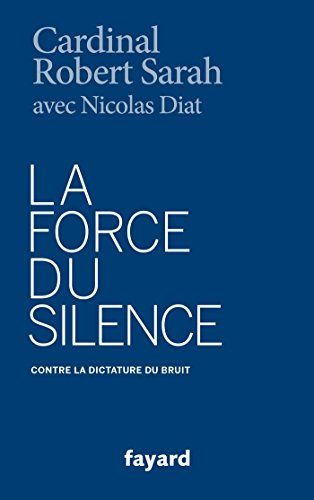
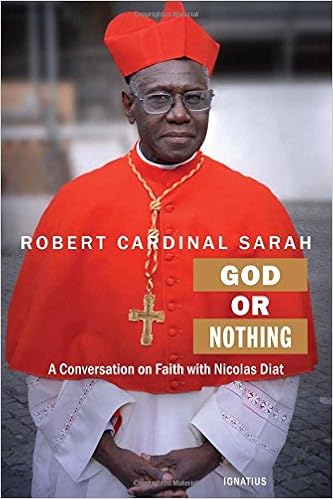
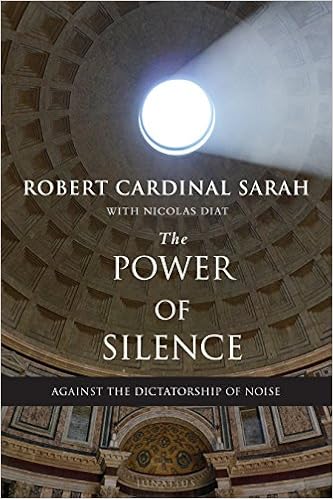
Card. Sarah’s new book available in ENGLISH

I warmly recommend that you – especially clergy – read everything you can get your hands on by His Eminence Robert Card. Sarah.

I’m delighted to announce that Card. Sarah’s new book, Le Force du Silence, hitherto only in French, is now available to PRE-ORDER in ENGLISH. It will be released on 15 April (Holy Saturday).  A great Eastertide reading gift to yourselves or friends.

US HERE – UK HERE

The original French, if you prefer…

US HERE – UK HERE

And if you haven’t read it yet…

US HERE – UK HERE

Posted in The Campus Telephone Pole | Tagged ,
5 Comments

Canonist Ed Peters explains situation to Crux priest. Important info for priests, confessors.

The other day at Crux there was a piece by Fr. Paul Keller about a theoretical (Deo gratias) case study in which the writer – basing himself on the objectively unclear notions of Amoris laetitia Chapter 8 – figures out how to give Holy Communion to a woman living in a publicly known permanent state of adultery.   The piece is characterized more by probably well-intentioned sentimentality than reason and knowledge of the Church’s law and perennial teaching.

Keller’s piece once again raised in my mind the question of why the Knights of Columbus are bank rolling Crux.

Enter Ed Peters at his splendid blog In The Light Of The Law.  Peters pull Keller’s offering to pieces and exposes the errors.

Read the Crux piece first, keeping in mind that this is what we are going to hear a lot more of in the future.  Then read Peters’ piece, keeping in mind that this is what we ought to be hearing a lot more of in the future.

Here is a key bit:

Amoris assumes, without ever quite stating it, that individual consciences (which, yes, can be very complex, and often deal with hard cases, and are never fully knowable to another, and might be only partly informed, and so on, and so on), are the final arbiter of whether a would-be communicant must be given the sacrament, as if only Canon 916 (which most people would recognize as being the canon that looks at conscience) were on the books, and by which canon one could, in some hypothetical case, see an objectively grave sinner approaching for holy Communion without that act itself being sinful, while Canon 915, meanwhile, which requires minsters to make a distribution decision in accord with objective criteria, simply does not exist.

The pervasive and steadfast refusal of nearly all “Amoris supporters” (I dislike the term but it saves time) to face squarely the ancient tradition behind and unambiguous rule of Canon 915 is what dooms virtually all defenses of Amoris so far to irrelevance at best and to pastoral and even doctrinal disasters at worst.

However, there is something buried in Peters’ presentation which all confessors (i.e., priests with the faculties to receive sacramental confessions) should understand.

One of the worst sins/crimes a priest can commit is that of solicitation in the context of confession of sins against the Sixth Commandment.  Can. 1387. says: “A priest who in the act, on the occasion, or under the pretext of confession solicits a penitent to sin against the sixth commandment of the Decalogue is to be punished, according to the gravity of the delict, by suspension, prohibitions, and privations; in graver cases he is to be dismissed from the clerical state.”  Pretty serious, right?

I strongly suspect that most confessors who read that canon, when they were taught about that canon way back when, assume that it means solicitation for themselves.  However, the canon is not limited to themselves.  It means solicitation – period.  That means that if the confessor recommends, condones, approves, etc., sins by the penitent against the Sixth Commandment with anyone (including with the civil spouse with whom the penitent lives in adultery), then that confessor is guilty of the delict described in can. 1387!

Fathers, did you get that?  More HERE.

Posted in Canon Law, One Man & One Woman, The Coming Storm, The Drill, The future and our choices | Tagged , , , , ,
31 Comments

Variation on the dreaded Christmas gift sweater

This almost needs a caption call.

From The Onion:

Pope Francis Wearing Sweater Vestments He Got For Christmas

17_01_09_Francis_sweater

Moderation queue is ON, of course.

Posted in Lighter fare |
54 Comments

FEEDBACK and REQUEST from seminarian

From a seminarian:

Thank you kindly for the biretta program you set up. Because of this program, another seminarian and I (both attending the same seminary) received our birettas. Please pass on my thanks to our beloved benefactors and our dear supplier.

I also ask for a prayer request. The reception of this biretta comes at a time in formation and life when I dearly needed a reminder that there are indeed good, decent people in the world who want and need seminarians and priests willing to be authentically Catholic. Living authentically Catholic is incredibly hard today. (It seems even harder in seminary.) I ask you, please pray for my brother seminarians and myself to persevere through the difficulties of formation directors and even our own personal stubbornness and to be open to the workings of God in our lives.

I see the work you do, and the work of many holy and faithful priests and I am inspired and filled with hope for what tomorrow holds. So, once again, thank you for your ministry. Thank you for your love of all things Catholic. Thank you also for the constant reminders to go to confession.

For you newcomers, what’s this all about?

HERE


Posted in ACTION ITEM!, PRAYER REQUEST, Seminarians and Seminaries |
18 Comments

Card. Müller: “a possible fraternal correction of the Pope seems to me to be very remote”

17_01_08_MuellerUPDATE:

Newly appended to the end of Pentin’s article on Card. Müller…

Update 12 January 2016:

A spokesman for Cardinal Müller told the Register that he was “speaking out of his authority as prefect of the Congregation for the Doctrine of the Faith, and was not advised by anyone to do so.” He also said that a “recent interview with Carlos Granados published in Spanish entitled “Informe sobre la esperanza” (Madrid 2016) is forthcoming in English and entitled “The Cardinal Müller Report” (Ignatius…2017). In this book the third chapter is entitled “What can we hope for from the family?” This will be an excellent point of reference regarding the Cardinal’s comments on the Sacrament of Marriage.”

—- Originally published 8 January —

In an interesting development, His Eminence Ludwig Card. Müller was interviewed on Italian TV. There is an account of the interview at La Stampa. He spoke about the issue of the Five Dubia respectfully submitted by the Four Cardinals.

Inter alia (my translation):

“Everyone, above all Cardinals, has the right to write a letter to the Pope. However, I am amazed that this became public, essentially constraining the Pope to say ‘yes’ or ‘no’. I don’t like this. Also, a possible fraternal correction of the Pope seems to me to be very remote, it’s not possible in this moment because it doesn’t concern a danger for the faith as St. Thomas said.”

“We are very distant from a correction and I say that is a loss to the Church to discuss these things publicly. ‘Amoris laetitia’ is very clear in its doctrine and we can interpret the whole teaching of Jesus on matrimony, the whole teaching of the Church in 2000 years of history.” He concluded, Pope Francis, “asks to discern the situation of these people who are living in unions that are not regular, that is, not in accord with the teaching of the Church on matrimony, and asks to help these persons to find a path for a new integration in the Church according to the conditions of the sacraments, of the Christian message on matrimony. But I don’t see any conflict (contrapposizione): on the one hand we have the clear teaching on matrimony, and on the other hand the obligation of the Church to concern itself with these people in difficulties.”

The video of the interview is HERE.

Posted in One Man & One Woman, The Drill | Tagged , , , , ,
76 Comments

ASK FATHER: Reception of Eucharist multiple times with same Mass formulary

From a reader…

QUAERITUR:

Would it be wrong to receive the Eucharist attending the Saturday Mass of Anticipation & Sunday Mass? [Both with the same Liturgy].

Since matters of reception of the Eucharist in Communion more than once in a short period keeps coming up, I discern that few priests are instructing their flocks about how to receive the Eucharist in Holy Communion.  This shouldn’t surprise us, since I suspect that some priests out there wouldn’t be able to tell you if you asked them to their faces.

Let’s review.  Repetita iuvat.

No, it is not wrong to receive on Saturday and again on Sunday, even if the Mass texts are the same.  You are receiving Communion on different days, Saturday and Sunday.  It makes no difference that the Mass formulary was the same.

That said… Catholics in the state of grace can receive twice in one day, on the same day.

The 1983 Code of Canon Law says:

Can. 917 – Qui sanctissimam Eucharistiam iam recepit, potest eam iterum eadem die suscipere solummodo intra eucharisticam celebrationem cui participat, salvo praescripto Can. 921, § 2.

Someone who has already received the Most Holy Eucharist can receive it again (iterum) on the same day only within the Eucharistic celebration [i.e. Mass, not a Communion service] in which the person participates, with due regard for the prescription of can. 921 § 2.

That iterum does not mean “again and again”, but merely “again, one more time”.

Can. 921 § 2 says that if a person is in danger of death, he may receive Communion even it is not in the context of Mass. That is Viaticum.

Also, that “Eucharistic celebration” in the canon does not mean just any service involving Communion. It means Mass. That was cleared up by the Holy See in an official response to a dubium, an officially proposed question.

So, say in the morning you attend a Novus Ordo Communion service wherein you receive Communion, or you went to a Mass in either Form. Later in the day you stumble into a church where Mass about to be celebrated and decided to stay for it. At that Mass you can receive Communion again (iterum). This would be even if you were, say, visiting a Maronite Catholic Church, or a Ukrainian Catholic Church and their Divine Liturgy was about to get under way.

However, if you were at Holy Mass in the morning and then stumbled into a Communion service at a priest-less parish in the afternoon, you could NOT receive again because a Communion Service isn’t Mass. If you were at Mass in the morning and then in the afternoon when you were visiting your auntie in the hospital when the chaplain came, you could not receive even if the priest invited you to do so (which in my opinion he should not). However, if you stayed for another Mass immediately following, you would be able to receive.

Canon 917 tries to walk the line between promoting frequent reception of the Eucharist and a superstitious or excessive frequency, which – I can assure you – some people fall into.

The key here is that the second time must be during a Mass, and you may not enter the Mass at some late point merely in order to receive.

Viaticum, which is Communion in the context of Last Rites for someone in danger of death, is a separate issue. Even if a person has received twice in a day, if the person is in danger of death, he can – of course – be given Viaticum.

Posted in "How To..." - Practical Notes, ASK FATHER Question Box, Liturgy Science Theatre 3000 | Tagged , , , ,
13 Comments