Bp. Paprocki talks about moral issues in the lead up to the upcoming election

Fr. Z’s Blog likes Bp. Paprocki of Springfield in the sad state of Illinois. You might recall that he did an exorcism of the whole state after the abomination of same-sex “marriage” was approved there.

Bp. Paprocki talks about moral issues in the lead up to the upcoming election.

One party on the ballot is firmly set aggressive positions in favor of intrinsically evil acts.

Again, I would vote for the corpse of Millard Fillmore to keep Hillary Clinton and her evil culture of death out of the White House.

Posted in The Coming Storm, The future and our choices | Tagged , , , , , ,
4 Comments

MADISON, WI – 2 November All Souls: Pontifical Requiem at the Throne

On 2 November, All Soul’s Day Bishop Robert Morlino of the Diocese of Madison will celebrate a special Pontifical Requiem Mass at the Throne (Extraordinary Form) with an intention for the deceased priests and bishops of the Diocese of Madison.

The Requiem Mass will take place on Wednesday, 2 November, at 7 pm at Holy Name Heights (Bishop O’Connor Catholic Center).

Clergy and seminarians are encouraged to attend and participate “in choro” with choir dress (cassock, surplice, biretta).

All are warmly welcome to attend the Holy Mass.

The music for the Mass, under the direction of Mr. Aristotle Esguerra, will be Gregorian Chant and Tomás Luis de Victoria’s (+1611) Requiem for 4 Voices.

The Mass is sponsored by the Tridentine Mass Society of Madison.

Posted in Events, Liturgy Science Theatre 3000 | Tagged
10 Comments

2 Nov – All Souls, Indulgences, and YOU!

It seems somehow fitting to post about indulgences on 31 October.

From the Handbook of Indulgences

Visiting a Church or an Oratory on All Souls Day

A plenary (“full”) indulgence, which is applicable only to the souls in Purgatory is granted to the Christian faithful who devoutly visit a church or an oratory on (November 2nd,) All Souls Day.

Will you not, for love, try to gain these indulgences?  Make a plan.

Requirements for Obtaining a Plenary Indulgence on All Souls Day (2 Nov)

  • Visit a church and pray for souls in Purgatory
  • Say one “Our Father” and the “Apostles Creed” in the visit to the church
  • Say one “Our Father” and one “Hail Mary” for the Holy Father’s intentions (that is, the intentions designated by the Holy Father each month)
  • Worthily receive Holy Communion (ideally on the same day if you can get to Mass)
  • Make a sacramental confession within 20 days of All Souls Day
  • For a plenary indulgence be  free from all attachment to sin, even venial sin (otherwise, the indulgence is partial, not plenary, “full”).

You can acquire one plenary indulgence a day.

A partial indulgence can be obtained by visiting a cemetery and praying for the departed.  You can gain a plenary indulgence visiting a cemetery each day between 1 November and 8 November. These indulgences are applicable only to the Souls in Purgatory.

A plenary indulgence, applicable only the Souls in Purgatory, is also granted when you visit a church or a public oratory on 2 November. While visiting the church or oratory say one Our Father and the Apostles Creed.

A partial indulgence, applicable only to the Souls in Purgatory, can be obtained when saying the “Eternal rest … Requiem aeternam…” prayer.

Do you know this prayer?

Requiem aeternam dona ei [pl.eis], Domine, et lux perpetua luceat ei [eis]. Requiescat [-ant] in pace Amen.Eternal rest grant to them, O Lord, and let perpetual light shine upon them. May the souls of the faithful departed, through the mercy of God, rest in peace. Amen.

It is customary to add the second half of the “Eternal Rest” prayer after the prayer recited at the conclusion of a meal.

Gratias agimus tibi, omnipotens Deus, pro universis beneficiis tuis, qui vivis et regnas in saecula saeculorum.

Fidelium animae, per misericordiam Dei, requiescant in pace. Amen.

We give Thee thanks, almighty God, for all Thy benefits, Who livest and reignest, world without end.

May the souls of the faithful departed, through the mercy of God, rest in peace. Amen.

My friend Fr. Finigan has a good explanation of being detached from sin and the disposition you need to gain indulgences.  HERE

Keep in mind that having high standards is a good thing.

Shouldn’t we be free from attachment to sin?  To what degree is being attached to sin okay?

In the final analysis, perhaps we have to admit that gaining plenary indulgences is rarer than we would like.

That said, it is not impossible to gain them.

I don’t think we have to be a hermit living on top of a tree beating his head with a rock to be free of attachment to sin so as to gain this plenary or “full” indulgence.

Also, we do not know the degree to which a “partial” indulgence is “partial”.  It could be a lot.  That in itself is something which should spur us on!

Generally, if someone is motivated to obtain an indulgence, he does so from true piety, desire to please God and to help oneself and others.

When it comes to complete detachment from sin, even venial, few of us live in that state all the time.

Nevertheless, there are times when we have been moved to sorrow for sin after examination of conscience, perhaps after an encounter with God as mystery in liturgical worship or in the presence of human suffering, that we come to a present horror and shame of sin that moves us to reject sin entirely.  That doesn’t mean that we, in some Pelagian sense, have chosen to remain perfect from that point on or that by force of will we can chosen never to sin again.  God is helping us with graces at that point, of course.  But we do remain frail and weak.

But God reads our hearts.

Holy Church offers us many opportunities for indulgences.  The presupposition is that Holy Church knows we can actually attain them.

They can be partial (and we don’t know to what extent that is) and full or plenary.  But they can be obtained by the faithful.

Holy Church is a good mother.  She wouldn’t dangle before our eyes something that is impossible for us to attain.

That doesn’t mean that a full indulgence is an easy thing.  It does mean that we can do it.  In fact, beatifications and canonizations have been more common in the last few decades and in previous centuries.  The Church is showing us that it is possible for ordinary people to live a life of heroic virtue.

Therefore, keep your eyes fixed on the prize of indulgences.   Never think that it is useless to try to get any indulgence, partial or full, just because

Perhaps you are not sure you can attain complete detachment from all sin, even venial.  Before you perform the indulgenced work, ask God explicitly to take away any affection for sin you might be treasuring.  Do this often and, over your lifetime, and you may find it easier and easier. Support your good project with good confessions and good communions.  You need those graces.

A person does not become expert in worldly pursuits overnight or without effort.  Why would not the same apply to spiritual pursuits? It takes time and practice to develop skills and virtues.  It takes time to develop habits of the spirit as well.

We can do this.  And when we fall short, we still have the joy of obtaining the partial indulgence and that’s not nothing.

So… take that, Luther!

Posted in "How To..." - Practical Notes, Four Last Things, Hard-Identity Catholicism, Liturgy Science Theatre 3000, New Evangelization, Our Catholic Identity | Tagged
7 Comments

Rome 2 – Days 5&6: Churches, Masses and Crucifix

Since I was on the ceremony crew the other day for the Pontifical Mass at St. Peter’s I couldn’t get any photos.  But, before Mass I found some interesting sights to record and share.

This is inside the sacristy of the chapter of canons of St. Peter’s.  Our vestments are laid out.

This is what I had for the Mass.  Before you ask, yes, it was both heavy and warm.

In the little chapel off the sacristy, it seems that some canon or other is saying the traditional Mass.  As it should be.

This altar was consecrated by Henry Card. Stuart.

A real plus was a chance to spend time with the glorious wooden 13th c. Crucifix which I wrote about the other day.  I had taken note that the it was displayed in the sacristy of the canons.  I had hoped that they hadn’t yet removed it.  They did, but into an adjoining room… and they left the door open!

The Cross was clearly carved by a master who had deep faith and who prayed.

Another wooden point of reflection.  The door to my old cupboard in the hall off the main sacristy.  I said Mass in the basilica every day for years.  I had my own niche for my personal gear for Mass.

Highlights of a meal.

Artichokes have been around, some from Brittany (so so) and new ones from S. Italy (much better).

On Sunday, Archbishop Alexander King Sample of Portland sang the Mass at Ss. Trinità dei Pellegrini for Christ The King.  Before Mass…

During the sermon, a young server had a hard time focusing.

Later in the day, I said Mass for the intention of my benefactors.  Thank you, all of you.  I am very grateful.  It is my pleasure and duty to keep you in my prayers.

The image of Mary over the altar.

Many relics are on the altar at St. Trinità in anticipation of All Saints.

The big busts are Augustine and Ambrose and Pius V and Gregory the Great.  The smaller are Matthew, Luke, Peter and Paul.  In the center is the co-patron of Rome and certainly patron of this church, St. Philip Neri.

And now for something completely different.  Who knows what this is?

The spiffy poster for the All Souls Mass at the aforementioned church.

I popped in for a visit at the little church of St. Bridget on the Piazza Farnese.

Packing and sleep to follow.  I barely managed to get the case closed, having introduced a large new reliquary for my fragment of the Cross back home.

Posted in On the road, What Fr. Z is up to |
14 Comments

Pope Francis sweeps the membership of the Congregation for Divine Worship

People are beating me black and blue in email asking what I think about the major changes made by Pope Francis to the Congregation for Divine Worship and Discipline of the Sacraments.  As earthquakes rock Italy, earthquake Francis rocked the CDW.

What came to mind after I saw the long list of new names, and the lack of old names on it, was the story in Herodotus of the advice requested of Thrasybulus, the 7th c. BC ruler of Miletus. Periander, tyrant of Corinth, sent a message to Thrsasybulus asking about the secret of his success as a ruler. Thrasybulus took the messenger into a wheat field, drew his sword, and whacked off the tops of the tallest stalks of wheat until they were all the same height.

There’s no question about who is in charge!

Allow me to remind you that Congregations are extensions of the authority of the Roman Pontiff in certain defined areas. The Pope can’t do it all. He delegates his own authority to bodies, such as congregations. It is only logical that he would choose as members of those bodies, such as congregations, those whom he thinks will carry out his will. Of course, being human, they become also very political. They wind up being parking places for prelates or stepping stones for ecclesiastics. They can help and then can thwart. They can push or they can delay. In the Roman Curia, as a matter of fact, cunctando regitur mundus.

So, does it surprise me that Pope Francis has changed up the members of the Congregation for Divine Worship? Not at all. What surprised me was the extent of the change. Usually a Pope will change a few members at a time, leaving some continuity in the congregation. This time, he swept the deck. Along with others, out are Cardinals Pell, Ranjith, Bagnasco, Ouellet, Scola, and Burke. BAM. In are other names from the past, but seemingly on the other end of the liturgical spectrum. Call it “deRatzingerization”.

Not all members of the CDW have been experts on liturgy, by the way. But some are. Congregations also have juridical sections, with a staff of canonists.  A blast from the past comes in the form of a new member, the one time dogsbody of liturgical revolutionary Annibale Bugnini, Archbp. Piero Marini, olim Papal MC. He was the one who inserted to Masses oddities such as the Mexican shaman exorcising St. John Paul II in Mexico. A book came out over Marini’s name a few years back, A Challenging Reform: Realizing the Vision of the Liturgical Renewal. In this thinly veiled attack on Benedict XVI Marini recounts how the members of the Consilium were so excited to get their mandate from Paul VI because they knew that what they were going to do was not only change perennial worship, but also doctrine.

Reason 8 for Summorum Pontificum.

Clearly the “purge”, as Italian vaticanista Marco Tosatti called it, is a signal, just as the selection of new American Cardinals was to Catholics in these USA. The consistory names seem to signal that Pope Francis doesn’t want “culture warriors”. The names of the new CDW members might mean that Francis doesn’t want tradition to be… well… tradition… that’s is, something handed on. What does the Pope want for worship?  That’s a little hard to determine. He is, first and foremost, a Jesuit. They aren’t famous for being deep into liturgy. Quite the opposite. That said, he has kept Benedict XVI’s MC by his side. You can say what you want about his vestment choices – I, for one, am not impressed – but he hasn’t been doing anything weird. He just gets on with things and says Mass.

Cardinal Sarah, the Prefect of the CDW, is going to be even more alone now than he was when quite a few of the old guard were removed from the middle levels of the Congregation. Members of the congregation can’t do much on their own. They can create obstacles for the Prefect.

Keep in mind that Card. Sarah called strongly – not as Prefect, but as a concerned churchman – for priests to begin saying Mass ad orientem again.  Card. Sarah is an impressive and compelling figure.

Tosatti, in his piece wrote (my translation):

With this extraordinary purge (a removal and substitution of this scope are an absolute exception in the praxis of the Roman government), Cardinal Sarah seems to be very alone, and there aren’t appearing any voices who can be liturgically discordant in respond to the dominant politically correct liturgical vector. After having laughed at liturgists with (Anglican) Primate Welby, the Pontiff decided to made some of them weep.

So, what do I think?  Hey!  It’s the Pope’s congregation.  He can use it as he will.  I feel for Card. Sarah, who will now have a harder time as Prefect, with less support from the members of the Congregation than before.  I don’t like the idea of a return to influence, even the tiny dab of influence he’ll have, of Archbp. Marini.

However, this might galvanize some Catholics to get off their backsides and do something in favor of the liturgical revival we so desperately need.   Card. Sarah sent out a clarion call to priests.  Fathers!  Let’s get going!  Moreover, as I have written before, and I now write on the closing day in Rome of the Summorum Pontificum Pilgrimage, Benedict XVI gave us clear and sound liturgical teaching and direction. He gave us the stupendously important tool of the aforementioned Motu Proprio, the “emancipation proclamation” for all the priests of the Roman Rite.  It has been 9 years since SP went into force.  It is time for us to take off the training wheels and ride the damn bike!

Do not be flustered.  Do not be paralyzed with anxiety.  Do not run in circles, panting and tearing at your clothing.  Pontiffs come and pontiffs go.  You, on the other hand, are called to influence your corner of the world according to your vocations, God’s plan for you.  So, form alliances, create a solid group with a vision and goal, discern your tactics to carry out your strategy.  Examine your consciences.  GO TO CONFESSION!  Get to work.  Don’t sit around in your wilted flower bed and wring your hands, waiting for priests to do everything for you.  Not. Gonna. Happen.  YOU have to make things happen.

Posted in Si vis pacem para bellum!, SUMMORUM PONTIFICUM, The Coming Storm, The Drill, The future and our choices, Turn Towards The Lord | Tagged , ,
74 Comments

Dems and voter fraud

Did you see this video on voter fraud?  It seems that Obama did not qualify legally to be on one of the state’s ballots because of voter fraud.

I can only imagine what the Clinton machine is churning.

YouTube thumbnailYouTube icon

They even mentioned the Coleman and Franken debacle.

Posted in Liberals, The Coming Storm, The Drill | Tagged
14 Comments

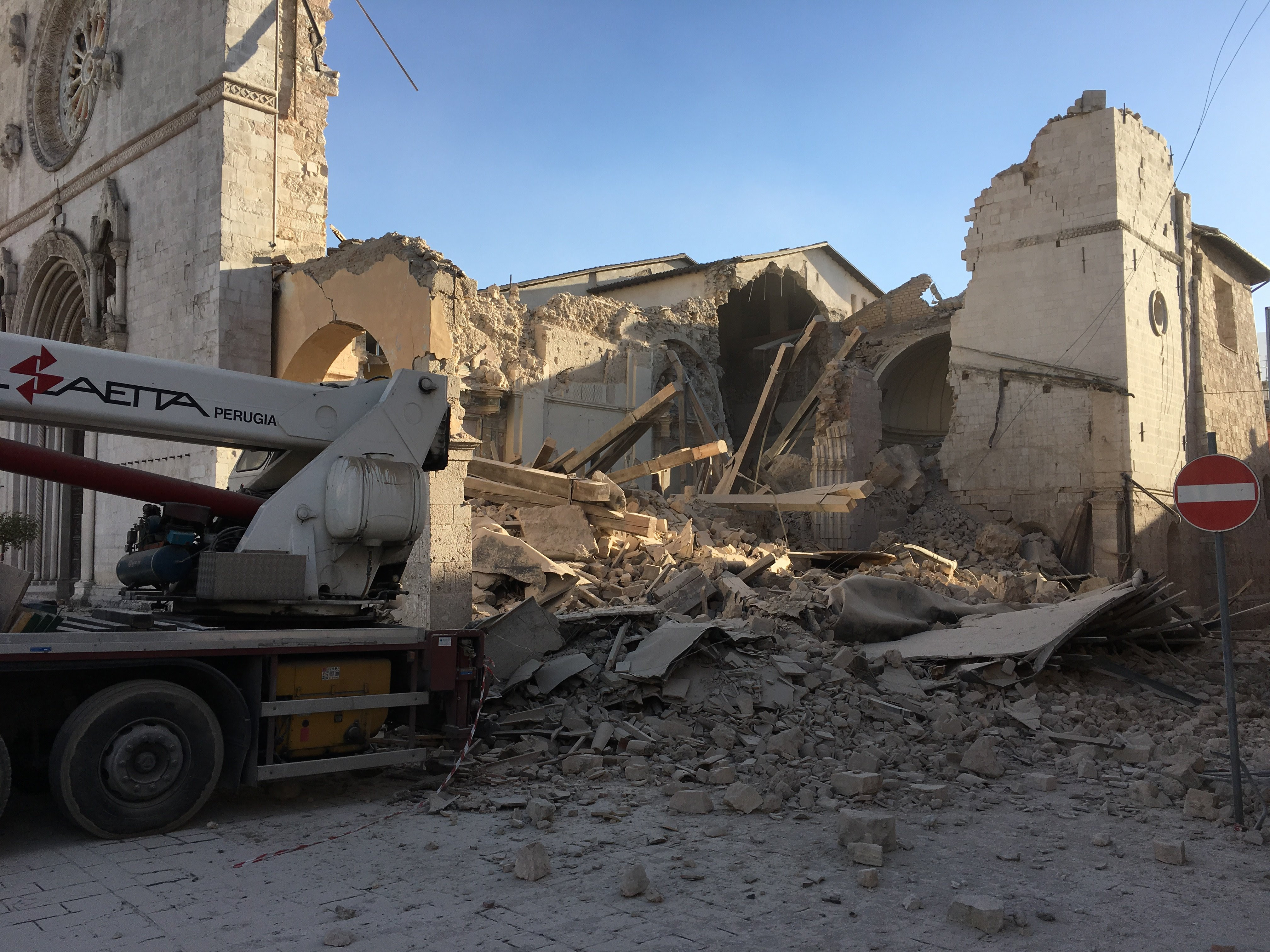
Another Earthquake in Central Italy: Basilica in Norcia Destroyed

Just as I got up today, everything started to sway around.  I was feeling the strong 7.0 earthquake that struck just a few kilometers from Norcia.  One text I received said that it was felt as far away as Salzburg, which is along the same fault. There was an aftershock of 4.3.  I sent a text to a friend in Norcia, but I haven’t heard back yet.

At an Umbrian news site

I received this email:

Dear friends,

Around 7:40 AM, a powerful earthquake struck close to Norcia. The monks are all safe, but our hearts go immediately to those affected, and the priests of the monastery are searching for any who may need the Last Rites.

The Basilica of St. Benedict, the historic church built atop the birthplace of St. Benedict, was flattened by this most recent quake. May this image serve to illustrate the power of this earthquake, and the urgency we monks feel to seek out those who need the Sacraments on this difficult day for Italy.

Relying, as ever, on your prayers and support,
Fr. Benedict
Subprior

Note: If you want to help the rebuilding process, you can give to the monks by clicking here.


Posted in ACTION ITEM! | Tagged ,
27 Comments

I grew up Lutheran. I was admitted to Catholic Communion because I said publicly that I believed what the Catholic Church teaches.

raphael_disputa_large

I grew up Lutheran. It is of constant consternation and amazement to me that I have had to fight with Catholics over what the Catholic Church teaches about the Eucharist. I have met Lutherans who believe more about the Eucharist than a few of my seminary profs. I am not exaggerating.

As things rev up toward 2017 and the Lutherfest, much about Catholic Lutheran dialogue will be in the offing. You will read lots of blah blah about…

….intercommunion.

I say YES! I want intercommunion, too!

I want intercommunion between Catholics and former Lutheran converts to Catholicism.

Also, before everyone out there gets their underthings in a twist, I said “blah blah”.  Mark my words.  A lot of the blah blah about how wonderful we all are together in this warm envelope of fraternal dialogue and sky-filled fellowship of sharing with open-hearts and arms for the sake of the unity of Christians in one hope of charity which propels us forward, ever forward, to the heights despite our historic differences, with eyes and hearts fixed first on not on what separates but what brings together in the unity of united unitors united but not-yet-fully-unified…. yes… I can write ecumenical documents for hours …  A lot of the blah blah is really blah blah.  Everyone knows that it is blah blah.  We all smile at the blah. And we hope for more, rich, deeper sharing from the now heaped up blah in the future, for the sake of…  okay, I’m doing it again…

When I became a Catholic, I knelt in front of the Blessed Sacrament exposed and in Latin declared (grad school classical languages major that I was) aloud with many witnesses in a public rite:

I accept and hold in each and every part all that has been defined and declared by the Sacred Council of Trent concerning original sin and justification. I profess that in the Mass there is offered to God a true, real, and propitiatory sacrifice for the living and the dead; that in the holy sacrament of the Eucharist the body and blood together with the soul and divinity of our Lord Jesus Christ is really, truly, and substantially present, and that there takes place in the Mass what the Church calls transubstantiation, which is the change of all the substance of bread into the body of Christ and of all substance of wine into His blood. I confess also that in receiving under either of these species one receives Jesus Christ whole and entire.

I professed that and became, formally, a Catholic because I had come to believe it, through an intellectual and affective conversion.  Only then was I admitted to Holy Communion.

Lutherans don’t believe what Catholics believe about the Eucharist.  

I had to – formally – adhere to Catholic dogma.  I had to – formally – leave heresy, though I had left it a long time before.  I was admitted to Catholic Communion, and to the Catholic Communion, because I said publicly that I believed what the Church teaches.

Might I add an anecdote?

Once upon a time, I was sent to attend as a Catholic representative an ecumenical Thanksgiving Breakfast.  Yes.. as you spit your beverage on the screen.  I… I… was sent. Upon my entry, a young Lutheran pastor planted himself in front of me and said, “Are you the priest at St. Raphael who won’t give Communion to non-Catholics?”  “I am”, quoth I.  “THANK YOU!”, said he.  He continued, “We don’t have intercommunion among Lutherans!”  “I know!”, I responded.  “I used to be one of you!”  We sat together and had a great breakfast.  It was founded on honesty.  We didn’t gloss over anything.  We didn’t pretend that there were differences.

I saw this at LifeSite:

ZAGREB, Croatia, October 28, 2016 (LifeSiteNews) — It is “irreformable” dogma of the Catholic Church that only those who believe that Jesus Christ is truly present in the consecrated bread and wine are able to receive Holy Communion, stated Cardinal Raymond Burke. The Vatican cardinal said that St. Paul makes it clear that unless the person receiving recognizes the body of Christ, he “eats condemnation to himself.”

“This is a sacrilege. This is among the gravest of sins,” he said.

The cardinal was responding to a question on intercommunion with other Christian denominations asked by LifeSiteNews’ John-Henry Westen during the October 23 launch of the Croatian version of the cardinal’s book on the Eucharist in Zagreb, Croatia.

“No one can approach to receive the Holy Eucharist unless he believes that the host that he is receiving — even though it looks like bread, tastes like bread, and smells like bread — is in reality the body and blood of Christ. Only that person who believes in this way can approach the Blessed Sacrament, can approach to receive Holy Communion,” he stated.

[…]

I was thrown out of my seminary by the prof who, in class, explicitly denied the Church’s teaching on transubstantiation. I fought him in class when he stated that “no real change takes place”.

Shall I tell you about it?  It was a matter of great personal suffering.

This heretic stated in class that when the “ordained minister [we are all ministers, you see, some ordained and some non-ordained], says the words of institution [not consecration] over bread and wine “no real change takes place.”   Wait for it.   “No real change takes place.  It becomes [and this is word for word] a symbol of the unity of the community gathered there in that moment”.

How many things are wrong with that?

I had been good.  I had kept my head down.  Then… I raised my hand.

I asked about transubstantiation.

“How”, I asked, “does that reflect the Church’s teaching on transubstantiation?”

“The Church no longer teaches transubstantiation.”

“When did that happen?”, I asked.

He said, “With Vatican II.”

“Okay,”, I admitted, “let’s say that Vatican II did that.  Can you tell me how that harmonizes with what the Church used to teach on transubstantiation?”

He said that transubstantiation wasn’t a valid term, because we don’t adhere anymore to Aristotelean categories of substance and accident, form and matter, and all that.

I then asked him why Paul VI in his encyclical on the Eucharist, after Vatican II, said that we had to refer to transubstantiation, even when we use new ways to describe the Eucharist.

He became furious.

Purple, he ranted at me about outdated Aristotelean categories, blah blah blah.

I responded… and this, dear readers, was my Waterloo,…

“I grew up Lutheran. Even Lutherans believe more than you do!”

Soon after, the rector had a heart attack and he, rector of vice (not kidding, but that’s another story), became the rector.

The next day he threw me out of the hell on earth that was our seminary, back in the day.

Yep. I’ve been fighting this fight for a long time. I take this issue seriously.  Some of you younger priests and seminarians haven’t fought this fight yet.  You will.   In that day, find us older guys, with the scars.  We’ll help you.

(BTW… a now well-know Archbishop and St. Therese de Lisieux got me back in.)

May I suggest to all priests reading this to review the Church’s teaching on the Eucharist and preach it clearly and boldly?

May I suggest to all priests and bishops to revive the Forty Hours Devotion?

May I suggest to all lay people to ask, request, beg, cajole, demand, urge the return of devotions such as Forty Hours and frequent Exposition and Benediction?

Posted in Be The Maquis | Tagged , , ,
70 Comments

WDTPRS – 31st Ordinary Sunday: We stumble mostly by choice.

The Collect for the 31st Ordinary Sunday, which was in the ancient Veronese Sacramentary, is also found in the Extraordinary Form on the 12th Sunday after Pentecost.

Omnipotens et misericors Deus, de cuius munere venit, ut tibi a fidelibus tuis digne et laudabiliter serviatur, tribue, quaesumus, nobis, ut ad promissiones tuas sine offensione curramus.

LITERAL TRANSLATION:

Almighty and merciful God, from whose gift it comes that You be served by the faithful worthily and laudably, grant us, we beseech You, that we may run toward Your promises without stumbling.

OBSOLETE ICEL (1973):

God of power and mercy, only with your help can we offer you fitting service and praise. May we live the faith we profess and trust your promise of eternal life.

CURRENT ICEL (2011):

Almighty and merciful God, by whose gift your faithful offer you right and praiseworthy service, grant, we pray, that we may hasten without stumbling to receive the things you have promised.

Munus means, first, “a service, office, post”. Synonyms are officium and ministerium.  A Greek equivalent is leitourgia, a needed civic work or service one performs because he ought to for the sake of society; whence our word “liturgy”.  In the New Testament munus/leitourgia points to a concepts such as taking up collections for the poor (i.e., what man does for man) and religious services (what man does for God).  Munus also means “a present, gift”. Munus is a theologically loaded word, indicating among other things the three offices (tria munera) which Christ passed to His Church, the Apostles and their successors: to teach, to govern, to sanctify.

When the Lord gives us commands (and He does, e.g., love one another as I have loved you; pick up your Cross and follow me; be perfect as your Father in heaven is perfect; do this in memory of me, etc.), we can sum them up in the two-fold commandment of love of God and of neighbor.  All followers of Jesus have been given a two-fold munus to fulfill which reflects the three munera Christ gave to the Church’s ordained priesthood.  I invite you to try an experiment.  See what happens to your perception of the Collect if you make munus mean “office” rather than “gift.”  While reading it, hearing it, can you keep both concepts simultaneously in mind?

Offensio (related to offendo) concerns “a striking against, a stumbling”. It is also “an offense” and “that which causes one to offend or sin” as in a lapis offensionis (a “stumbling-block” cf 1 Pet. 2:8).  Offendo, by the way, can also mean “to meet by chance”.

Servio, “to serve”, is very rarely found in the passive.  We must break “that it be served in reference to You” down into “that You be served”.

This Collect gives me the image of a person hurrying to fulfill a duty or command given by his master or superior.  He is rushing, running.   He might even be carrying a heavy burden.   While dashing forward, he strives to be careful under his burden lest he stumble, fall, lose or ruin it what he carries.  Isn’t this how we live our Christian vocations?  God has given us something to do while in this vale of tears.  When we discern God’s will and do our best to live well according to our state in life, we will experience heavy burdens.  Our human nature is wounded and there is an Enemy who hates and tempts us.  When we are faithful to our vocations, we receive many opportunities to participate in carrying the Cross of Jesus.

The Lord Himself told us through the Gospels that if we want to be with Him, we must participate in His Cross, even daily (Luke 9:23).  During His Passion, our Lord literally carried His (and our) Cross.  As He was driven by the soldiers over the uneven road, as careful as He must have been, He stumbled and fell.  We stumble and fall, though not like our sinless Lord.  We stumble mostly by choice.

In this Collect do we hear an echo of the petition in the Lord’s Prayer? “Lead us not into temptation.”  There is a tempter out there who desires us to fall and give offense to the Lord.  The Enemy places obstacles before our feet.  That one we do not want to meet with, even by chance.

As we draw closer to the end of this liturgical year, Father prays that we run, rather than drag along, toward the reward of heaven.  We beg God that we do so without mishap.   We beg not to give offense by what we do. We ask that the road be made free of stumbling blocks for our running feet.  Our Lord understands the tough road we travel. He does not abandon us when we stumble in sin.

Posted in Liturgy Science Theatre 3000, WDTPRS | Tagged , ,
2 Comments

WDTPRS: Christ the King (1962 Missale Romanum)

In the post-Conciliar, Novus Ordo calendar, the Solemnity of Christ the King is the last Sunday of the liturgical year, just before Advent begins.  In the traditional Roman calendar it falls on the last Sunday of October.

The feast was established by Pope Pius XI in 1925, as Pius Parsch says in The Church’s Year of Grace, to “renew in the minds and hearts of the faithful the ancient concept of Christ as divine King who, enthroned at the right hand of the Father, will return at the end of time in might and majesty.”  It also falls during October, a month of celebration by Communists, who impose radical atheistic materialism.  The different editions of the Missale Romanum give different emphases to this feast, though both look to the end times and the definitive coming of Christ’s Kingdom.

Since all of the prayers are of relatively modern origin, those for the older, traditional Mass and the Novus Ordo both written in the 20th century, we can dispense this week with abstruse references to 9th century sacramentaries.  I am sure you will miss them.

This week we can do something a little different.  I want to put the three main orations of the older, traditional Missale Romanum along with those of the so-called Novus Ordo.  For the translations of the older prayers, we can use the version in the beautifully bound hand missal from Baronius Press, The Daily Missal and Liturgical Manual (2007).

What is the point of this exercise?  Let’s see what theological changes were made to the feast by the reformers.  How we pray has a reciprocal relationship with what we believe: change the prayer and you change the belief.

OLDER COLLECT (1962MR)
Baronius Press:
Almighty and everlasting God,
who in Thy beloved Son,
the King of the whole world,
hast willed to restore all things,
mercifully grant that all the families of nations
now kept apart by the wound of sin,
may be brought under the sweet yoke of His rule.

In this Collect Christ is King “of the whole world” (Latin: universorum Rex) and the goal is that all nations be brought under His “yoke”, His rule.  The “yoke” from the Latin word iugum, is a symbol of subjugation. The ancient Romans made conquered armies pass under a yoke as a sign of their status.

NEWER COLLECT (2002MR)
LITERAL VERSION:
Almighty eternal God,
who desired to renew all things
in Your beloved Son, the King of the universe,
graciously grant
that the whole of creation, having been freed from servitude,
may zealously serve Your majesty and praise You greatly without end.

The first part of the prayer is the same as the older version, as you can see even from the different translations.  In the second part, however, instead of a reference to “nations”, we hear of “the whole of creation”.  Instead of “nations” being subjected to the King, “creation” is freed from the bondage caused by the Fall and sin.  In the older prayer there is an emphasis on this world, probably because of the rise of atheistic Communism.  In a sense, the older prayer has strong political overtones. The newer prayer has in mind the Prince of this world, the Enemy who dominates material creation until the end times, when Christ will return.  Both prayer have an eschatological vector to them, however.  They both aim at the ultimate triumph of Christ.

OLDER SECRET (1962MR)
Baronius Press:
O Lord, we offer Thee the Victim of man’s redemption:
grant, we beseech Thee, that Jesus Christ Thy Son our Lord,
Whom we are immolating in this sacrifice,
may Himself bestow on all nations the gifts of unity and peace.

Once again we see the emphases on “nations”, meaning not just the Gentiles, or non-Jews, but on the actual nations of the earth.   Furthermore, the Latin has “nations” capitalized, “Gentes”.

NEWER SUPER OBLATA (2002MR)
LITERAL VERSION:
O Lord, offering to You the victim sacrifice of the reconciliation of humanity,
we are praying submissively that Your Son Himself
will grant all peoples the gifts of unity and of peace.

Again, the first part of the prayer is same as the older.  In the Latin there are minor changes, but it is effectively the same.  The second part, however, shows the theological change desired by the snipping and pasting experts of Fr. Bugnini’s Consilium.  In the older prayer there is an explicit appeal to “sacrifice” with also a strong verb “immolate”.  This sacrificial language was removed from the newer prayer.  But this prayer retains the reference “nations” (gentes).


OLDER POSTCOMMUNION (1962MR)
Baronius Press:
We have received the food of immortality and beg, Lord,
that we who are proud to fight under the banner of Christ our King,
may reign with Him for ever in His realm above.


There is clear military imagery and language.  We have a sense from this prayer that we are soldiers of a Militant Church under a great Captain and King.  We have been given food for the march to battle and glory.

NEW POST COMMUNION (2002MR)
LITERAL VERSION:

Having been remodeled according to the nourishment of immortality,
we beseech You, O Lord,
that, we who glory in obeying the mandates of Christ the King of all things,
will be able to live with Him without end in the heavenly kingdom.


The first part of the prayer and the very last part are essentially the same as they were before the Conciliar reform.  The middle part eliminates the military images.  Instead of fighting through the victory and glory in heaven, we “live” (vivere) with Him in the heavenly kingdom.

All in all, it is hard to find fault with the newer prayers for the Solemnity of Christ the King, celebrated at the end of the liturgical year.  The change of placement of the feast and the change of the theology of the prayers probably reflect the soft approach to Communism adopted by Rome in those years, called ostpolitik, a conscious de-emphasis of triumphant language and imagery.  It is as if the writers of the newer prayers did not want to give the impression that Christ was to be accepted as Lord and King by political entities in this earthly existence.

412xNxChrist-the-Judge-Michelange.jpg.pagespeed.ic.xyMYheBBRvEach year Holy Church presents to us the history of salvation, from Creation to the Lord’s Coming (His First and also His Final Coming).  At this time of year, as we move in the Northern Hemisphere into the darkness of autumn and winter, as we head toward the end of the liturgical year, we more and more in the Church’s liturgy consider the Four Last Things: death, judgment, heaven and hell.   This feast reminds us that the Lord Jesus is indeed coming and that He will not come as “friend” or “brother” or “gentle shepherd” with hugs and a fluffy lamb on His shoulders.  He will come as King and our Judge.  The Dies Irae prayed at Requiem Masses identifies Christ as “King of Fearful Majesty” and “Just Judge”.  He is of course a King and Judge of mercy to those who submit themselves to His rule.

What will His coming be like?  If not with hugs and fluffy lambs, will it be all trumpets and angels with harps and banners?  Consider the description of His Coming in 2 Peter 3: 10-12 (Douay-Rheims):

“But the day of the Lord shall come as a thief, in which the heavens shall pass away with great violence and the elements shall be melted with heat and the earth and the works which are in it shall be burnt up. Seeing then that all these things are to be dissolved, what manner of people ought you to be in holy conversation and godliness? Looking for and hasting unto the coming of the day of the Lord, by which the heavens being on fire shall be dissolved, and the elements shall melt with the burning heat?”

Christ Jesus will judge us all, dear friends, and submit all things to the Father (cf. 1 Cor 15:28).  Having excluded some from His presence, our King, Christ Jesus, will reign in majestic glory with the many who accepted His gifts and thereby merited eternal bliss.

Posted in Liturgy Science Theatre 3000, WDTPRS | Tagged
4 Comments