To decompress, I’ve been reading more 18th c. nautical fiction and some feudal Japanese murder mysteries.
However, since the passing of Mother Angelica there is this.
USA HERE – UK HERE – ITALY HERE

USA – CLICK!

Here is a shot of one the intrepid staff at Gammarelli cutting fabric for the cope.
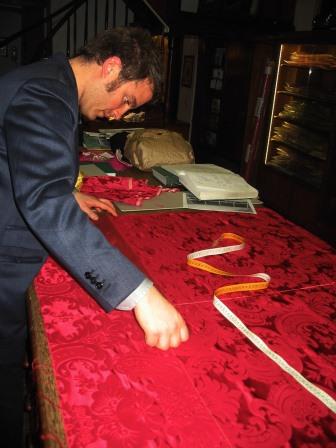
This reminds me of the famous Moroni portrait of The Tailor which hangs in the National Gallery. It is an interesting painting, because Moroni depicts a tradesman rather than a noble or church figure. Moroni, by the way, was influenced by the Council of Trent and was in the city when the Council was going on.
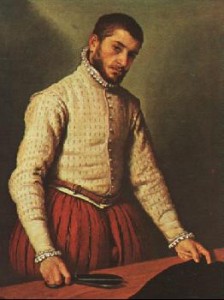
This painting has been used by Gammarelli for a long time as a kind of logo. Here it is on one of their bags.

____
Dear readers… I will have a couple fundraising campaigns coming up. (One will be for my upcoming 25th Jubilee.) The present campaign is for a full Pontifical Set in fiery red silk damask with gold column trim.
Right now the dollar is strong against the euro, so we would like to get this going fast. We want these by 1 July, the Feast of the Most Precious Blood.
I have started a GOFUNDME campaign.
Your donations will go to the Tridentine Mass Society of Madison, a 501(c)(3) charitable organization, and they are tax deductible.
CLICK HERE
Link to share: https://www.gofundme.com/tutxmfak
You can choose that your name does NOT appear online in the list of donors.
To get an idea of what the vestments will be like, perpend.
In 2015, I was Assistant Priest to Bishop Paprocki for a Votive Mass for the Holy Innocents celebrated for the soul of Nellie Gray. My friends Msgr. Charles Pope and Fr. Paul Scalia were Deacon and Subdeacon. We had vestments from Gammarelli in a similar style to what we want to have made. However, we want the full Pontifical Set: more guys = more gear. Also, we should get gloves for the bishop in red, along with pontifical dalmatic and tunic. Here is a little video from that Mass:
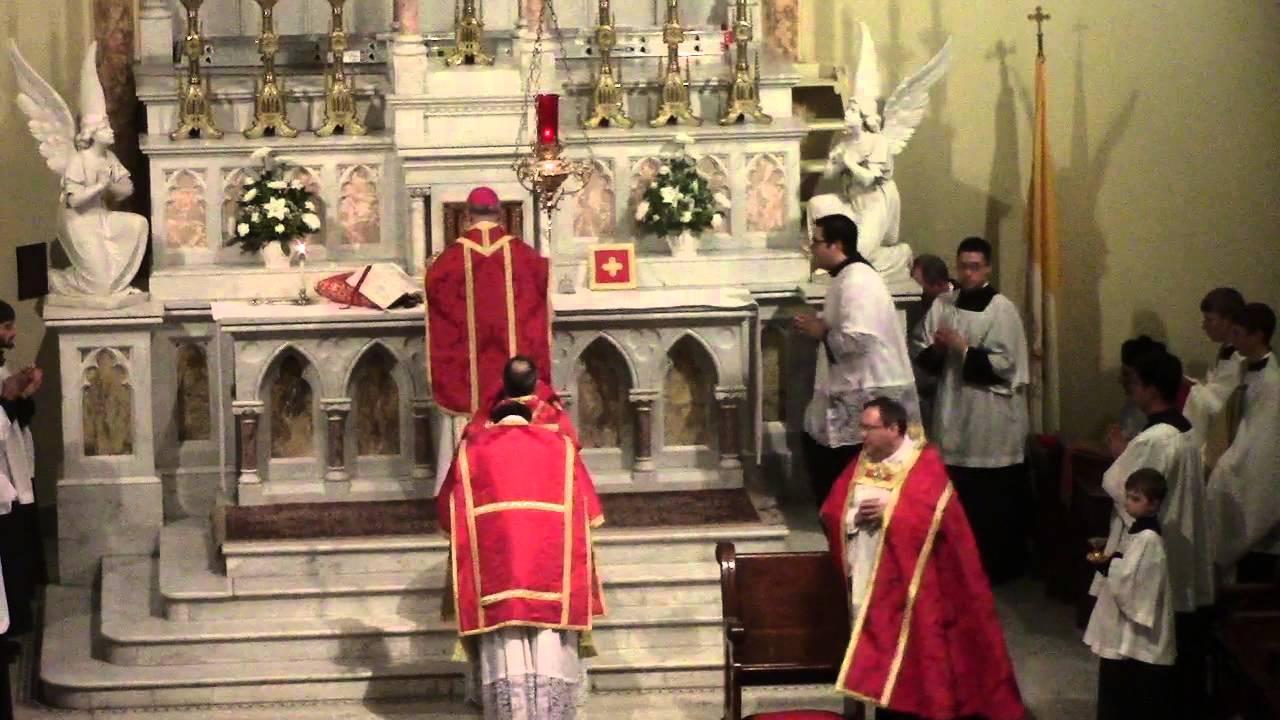

I think our set will be even more striking.
Ours will have the “column” gold trim, as do these purple/violet vestments. For example, just out of the shipping box, the purple set…


Everyone, please help. Many hands make light work
Holy Mass needs beautiful vestments.
A full Pontifical Set typically includes:
– Chasuble with stole, maniple, burse, veil
– Four dalmatics with 1 stole and 2 maniples. (They might squeeze extra stoles from the fabric.)
– Humeral veil
– Cope and stole
– Antependium
– Gremial
– Fabric and trim for tabernacle veil.
Having a full Pontifical Set will enable us to have Solemn Masses and even help other Traditional Mass communities. When the Diocese of Madison has had ordinations, they have borrowed our gold dalmatics. Mutual enrichment.
Brick by brick.
BTW… we are also working to complete a set in GREEN to match THIS. We will, during the summer, start thinking about true Rose vestments. But that’s another story.
UPDATE 24 March:
I received photos from Gammarelli. They are cutting the fabric for the red vestments.
The chasuble.
An action shot.


You can see how they have to figure out how the patterns will fit into the bolt, which has a pattern. This requires careful planning.

This gives you a sense of the red silk. This looks like the back of the chasuble and the chalice veil.

UPDATE:
Now posted at ewtn.com:
Mass of Christian Burial
4/1 12 PM ET
Archbishop Charles J. Chaput presides over the Solemn Funeral Mass for EWTN Foundress, Mother Angelica, live from the Shrine of the Most Blessed Sacrament in Hanceville, Al.
Well… I said it was whole-cloth. Right?
_____________ ORIGINAL Published on: Mar 29, 2016 @ 09:33
I have noticed in a couple sources about the funeral Mass of Mother Angelica that a homilist is listed but not a celebrant.
Friday, April 1
11 AM: Mass of Christian Burial and Rite of Committal.
The funeral Mass will be celebrated in the Shrine’s Upper Church by bishops and clergy from around the world. The homilist will be Fr. Joseph Mary Wolfe, MFVA. The Mass will conclude with a Procession carrying Mother Angelica’s body through the Shrine’s Piazza and into the Crypt. The procession will be followed by the Rite of Committal and interment in the Crypt Chapel.
The bishop of the local diocese, Birmingham, is listed for the evening before.
So… I am lead to speculate that perhaps a well-known American Prince of the Church might fly in from Rome for the exequies.
Whole-cloth speculation on my part, of course.
But wouldn’t that be just right? Fitting?
Moderation queue is ON.
UPDATE:
While I’m at it, if they have a full-scale Pontifical Mass in the traditional Roman Rite, I’d be happy to fly in to be one of the sacred ministers. I’m just saying.
 CNA has this about reactions to Mother Angelica of the Annunciation’s death.
Benedict XVI responds to Mother Angelica’s death
Vatican City, Mar 28, 2016 / 02:54 pm (CNA/EWTN News).- Benedict XVI had a special response to Mother Angelica’s death falling on Easter Sunday: “it’s a gift.” [It’s a sign.]
Archbishop Georg Ganswein, Benedict’s personal secretary, told CNA about the Pope emeritus’ comment March 28.
Mother Angelica, an Ohio-born Poor Clare nun, founded EWTN Global Catholic Network in Alabama in 1981. It has since become the largest religious media network in the world. She passed away March 27, Easter Sunday, at the age of 92.
Her death prompted memorials, eulogies and remembrances from around the world.
In Rome, Monsignor Dario Vigano, prefect of the Secretariat for Communications, pledged that he would pray for the repose of her soul. Many other priests, religious, and laity in Rome are praying for her.
Archbishop Joseph Kurtz of Louisville, president of the U.S. bishops’ conference, said Mother Angelica was an “extraordinary woman, devout believer and media pioneer.”
“Mother Angelica reflected the Gospel commission to go forth and make disciples of all nations (Mt 28:19), and like the best evangelists, she used the communications tools of her time to make this happen,” he said March 28. “She displayed a unique capacity for mission and showed the world once again the vital contribution of women religious.”
Archbishop Kurtz praised Mother Angelica’s role in founding EWTN, Our Lady of the Angels Monastery, the Franciscan Missionaries of the Eternal Word, the Shrine of the Most Blessed Sacrament, and the Knights of the Holy Eucharist.
“Her work, begun in the cloister, reached across the globe. She was a convincing sign as to how even the humblest of beginnings can yield abundant fruit.”
Kristina Arriaga, executive director of the Becket Fund for Religious Liberty, remembered the nun as “a shining example of courage and faith.”
“We mourn her loss, but her legacy lives on in EWTN and in the lives of all those she touched,” Arriaga said.
The Becket Fund is defending EWTN in its legal fight against the federal government’s requirement that its insurance coverage include drugs and procedures that violate Catholic faith and morals, including provision of drugs that can cause abortions. Refusal to comply could result in heavy fines. A U.S. Supreme Court decision in June could impact the fate of Mother Angelica’s network.
Other Catholic bishops reflected on the nun’s life.
“In founding and growing EWTN into a major media resource for the global Church, she achieved things almost everyone thought impossible,” Archbishop Charles Chaput of Philadelphia, a past EWTN board member, said March 27. “She will be sorely missed, but she has left us an on-going gift in the men and women who continue the great service of the EWTN apostolate.”
Bishop Robert Barron, an auxiliary of Los Angeles, remembered Mother Angelica as “one of the most significant figures in the post-conciliar Catholic Church in America.” She was “the most watched and most effective Catholic evangelizer of the last fifty years.”
[…]
Bishop Robert Baker of Birmingham, the diocese where EWTN is headquartered, said Mother Angelica was a pioneer in using the media as a force for good.
“Her greatest gift was her strong reverence for the Lord of the Holy Eucharist and devotion to the Blessed Mother,” he said March 28.
“Mother Angelica has left the Church and world a great legacy through her Eternal Word Television Network and family, which have brought a multitude of people closer to the Lord and his Church,” he continued.
“How providential that her death occurred on Easter Sunday, our celebration of Our Lord’s victory over sin, suffering and death!”
It is Easter Monday. In Rome and all over Italy, everything is pretty much closed up for what they call “Pasquetta” (Little Easter) and also “Lunedì dell’Angelo” (Angel Monday), which calls to mind the exchange between the angel and the women at the empty tomb.
They shut down everything the day after Christmas and the day after Pentecost too.
In any event, we are in the Octave of Easter!
We still use the beautiful Sequence. Here’s what it sounds like in my native place, at my home parish. In the chant version (I am one of the schola, btw) note well the fine dynamics and phrasing. The Cantor at St. Agnes in St. Paul, Paul LeVoir, is quite simply one of the best singers of Gregorian chant I’ve ever heard. I owe a lot to him.
Podcast: Play in new window | Download
Subscribe: RSS
UPDATE 28 March 2128 GMT:
Bishop Hinder on Kidnapped Priest: ‘Strong Indications That Father Tom Is Still Alive’
UPDATE 28 March 2002h GMT:
According to Kathnet, there may still be hope.
Bischof: Verschleppter Priester im Jemen vermutlich am Leben
While I hope this is true, that takes nothing away from my conviction that we have to “get our game face on”, and soon.
___
It seems fairly clear that this priest was killed by adherents of the Religion of Peace for hatred of the Christian Faith. He is more than likely a true martyr, through red, bloody, martyrdom. And he died in the manner of Our Lord.
From The Right Perspective:
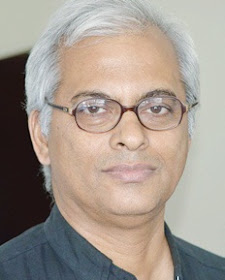
ISIS CRUCIFIES CATHOLIC PRIEST ON GOOD FRIDAY
Isis crucified a Catholic priest on Good Friday, the latest atrocity committed by the radical Islamist terror group.
The Rev. Thomas Uzhunnalil was kidnapped in Yemen in during a March 4 raid on a nursing home run by Mother Teresa’s Missionaries of Charity. 16 nuns and nurses were killed in the attack. Pope Francis already had honored the slain nuns as martyrs.
His execution, using the same grisly method the Romans used on Jesus Christ and commemorated by Christians around the world every Good Friday, was confirmed at the Easter Vigil Mass by Cardinal Christoph Schonborn of Vienna.
Rev. Uzhunnalil was a Salesian, an order founded in 1859 by St. John “Don” Bosco. It is the second-largest order in the Catholic Church, with more than 28,000 Priests, Brothers, Sisters and novices working across the globe to help poor children.
We had better get our game face on soon.
Sts. Nunilo and Alodia, pray for us.
St. Lawrence of Brindisi, pray for us.
St. Pius V, pray for us.
 We observed the Sacred Triduum: the priesthood was celebrated, the Eucharistic Christ was reposed and the altar stripped, the Passion was sung and the Cross was kissed. Our liturgical death was complete. Then in the evening, in some places even at midnight, the Easter Vigil began. Flowers, instrumental music, white and gold vestments returned after a long drought of ornamentation. The Exsultet rang out next to the Christ-like Paschal candle, burning brightly in the shadows. Baptismal water was blessed. At last we again sang Alleluia. Catechumens were received or baptized, some also being confirmed. They received Christ for the first time in the Eucharist.
On Easter day we now hear the Sequence Victimae paschali laudes about Christ the “Victor King” and His duel with Death. Holy Church and her children are renewed in the promise of the resurrection. Since Christ has risen, we too may rise.
Here is the Collect for Mass “during the day” which has its roots in the ancient Gelasian Sacramentary:
Deus, qui hodierna die, per Unigenitum tuum, aeternitatis nobis aditum, devicta morte, reserasti, da nobis, quaesumus, ut, qui resurrectionis dominicae sollemnia colimus, per innovationem tui Spiritus in lumine vitae resurgamus.
I like the repeated “re-“ sounds in reserasti… resurrectionis… resurgamus as well as “-er-“ sound: hodierna… per… aeternitatis… reserasti. Read it aloud. In the second part listen to the assonance on the vowel i, pronounced like the English double e as is “see”.
Latin colo, means “cultivate” as in “to cultivate, take care of a field”, and also “to regard one with care, i.e. to honor, revere, reverence, worship.” It is used in both agricultural and religious contexts. Latin cultus, means “worship”.
LITERAL VERSION:
O God, who today, once death was conquered, unbarred for us the gateway of eternity through Your Only-begotten, grant to us, we beg, that we who are reverently observing the solemn annual rites of the Lord’s resurrection, may through the renewing of Your Spirit rise again in the light of life.
CURRENT ICEL (2011):
O God, who on this day, through your Only Begotten Son, have conquered death and unlocked for us the path to eternity, grant, we pray, that we who keep the solemnity of the Lord’s Resurrection may, through the renewal brought by your Spirit, rise up in the light of life.
At Easter we Christians renew our profession of faith as one transformed people. In the waters of baptism, we passed through death to new life.
In ancient times, catechumens had a long period of preparation before their admittance to the sacred mysteries of the Mass. They were permitted to attend the reading of Scripture and the sermon but they were sent out before the Eucharistic part. At the Easter Vigil the catechumens stood before the congregation and recited their profession of faith. The doors were then opened to them. Anointed, baptized, clad in white linen robes, they were permitted to stand within the sanctuary and to participate in the Eucharist for the first time.
The newly baptized were called infantes, the “new born children” of the Church. With them, St Augustine of Hippo (d 430) used agricultural imagery when comparing the sacred area the basilica’s sanctuary to a threshing floor where grain and chaff are separated.
Augustine taught the white-robed infantes that not only are bread and wine transformed, people are too. Bread is made from many kernels of wheat, wine is from many grapes. Grain and grapes are changed by us and wine and bread are changed by God. In turn, the transformed bread and wine are given back to transform us. Augustine was especially concerned that they see themselves as a transformed people deeply, intimately connected to the Eucharist: “Estote quod videtis, et accipite quod estis… Be what you see and receive what you are” (s. 272,1). He compared the new Christians to wheat, grown, harvested, ground, formed, baked through the agency of others, prepared for the Eucharist. God plants new Christians to be wheat sprigs (spicas) not thorns (spinas). The newly baptized were now new tender shoots in the fields of God, “irrigated by the fountain of Wisdom, drenched with the light of justice.”
Can we recapture something of the joy and zeal of converts in our participation in Holy Mass?
A Church-wide liturgical catechesis could help. So will Holy Mass celebrated in such a way that we can sink into it, grow from it, rest in it, be nourished by the mysteries our Church sacramentally re-presents in it for us. Mass is not just play-acting or simple remembering: it is about Life itself. Everything we do and say during Mass has meaning, sometimes plain, often veiled.
The Octave of Easter extends our opportunity to pray and worship within the mystery of Our Lord’s resurrection.
May you and yours have a blessed and grace-filled Eastertide.
 The EXSULTET is one of the most spectacular moments of all the Church’s liturgical life.
When it is sung well in Latin the Church is in her glory!
I have fond memories of singing the Exsultet. The first time, I was a deacon on retreat at a monastery in central Italy, where the largest community of Benedictine nuns in Italy sing every word of their office and Mass in Gregorian chant in their 12th c. abbey. Another time, I was asked by my bishop (of an ancient Roman Suburbicarian diocese) to sing the Exsultet in Latin. We started outside in the deep night in the square before an enormous fire. It took over 10 minutes to get everyone inside, with long pauses between each “Lumen Christi!” The candle was the size of a Scottish caber. Though there was still much movement and exuberance I started singing, and when they heard the rarely use Latin and chant the great crowd quieted. As I sang about the “red-glowing flame” being “divided into parts” I could see a thousand candles and hear the fire still crackling outside as it cast flickering glows through the main door.
Most precious, however, are the times I sang the Exsultet in my home parish.
Here is my rendering of the 1970 Missale Romanum version of the Exsultet. Alas, there is no space to give you the Latin also. The Exsultet is also called the Praeconium Paschale. Paschale is an adjective of a Latinized Hebrew word pascha, for the Passover meal of the lamb. The sure and certain Lewis & Short Dictionary says the adjective praeconius, a, um is “of or belonging to a praeco or public crier” while the substantive praeconium is “a crying out in public; a proclaiming, spreading abroad, publishing.” In a Christian context this of course also infers the Good News! A praeconium is simultaneously a profession of faith and a call to faith extended to all who hear.
The Exsultet is a poem, elements of which go back to St. Ambrose (+397). It is to be sung by a deacon (or priest or cantor) during the Easter Vigil as a hymn of praise to God for the light of the Paschal Candle. The text became part of the Roman liturgy around the 9th century. The text is theologically packed. It contains a summary of Easter’s mystery. Christ is risen: we too can rise in Him. This was prepared for from the fall of man, directed by a loving Father, and awaits only the end of the world, although our baptismal character allows us to live the reality now: Already, but not yet!
There is an introductory invitation to “Exult!” (whence its name) given to three different groups: the angels, the Church on earth, and the whole Church together. There follows an account of works of God in the Paschal Mystery and the history of salvation. It begins with a dialog just like a Preface during Holy Mass.
Like a Eucharistic Prayer the Exsultet is a remembrance (anamnesis) which makes the past mysteries present to us. The singer deacon begs the congregation to pray for him as he tells the story of our family history of salvation with all the foreshadowing and “types” of our redemption. So great is God’s ability to turn evil to good that the deacon dares to call Adam’s fall our “happy fault… felix culpa” since because of it we were sent the gift of our Savior. You hear of the work of bees and the shattering of chains of sin. All evil is driven away.
The constant refrain is that this is a blessed night when heavenly and earthly realities merge together and become one.
Finally, there is a humble petition that God the Father will accept our Paschal candle, our evening sacrifice of praise, and make it into one of the lights of the heavens.
This poem/hymn/prayer is too much to grasp all at once. But year by year we have the chance to hear it renewed in the heart of the Church’s greatest night. The mysteries within it do not change, but we do. Each year we are a little different. We can hear it each year with new insight and understanding.
Consider the setting.
For forty days we have done penance. We participated at the anniversary of Holy Mass and the Priesthood on Holy Thursday with the mandatum and the procession to the altar of repose, Christ in agony in Gethsemane. On Good Friday, the day with no Mass, after our humble prostration before the Crucified Lord we stood for the singing of the Passion. Now we are in a dark church. The fire was kindled and the “Light of Christ” was thrice announced. The faithful have little candles sparked to life from the single flame of the Paschal candle, the “Christ candle”, now lighted as the symbol of His resurrection. The candle is incensed and then:
Podcast: Play in new window | Download
Subscribe: RSS
2002 Missale Romanum
Exult now O ye angelic throngs of the heavens:
Exult O ye divine mysteries:
and let the saving trumpet resound for the victory of so great a King.
Let the earthly realm also be joyful, made radiant by such flashings like lightning:
and, made bright with the splendor of the eternal King,
let it perceive that it has dismissed the entire world’s gloom.
Let Mother Church rejoice as well,
adorned with the blazes of so great a light:
and let this royal hall ring with the great voices of the peoples.
Wherefore, most beloved brothers and sisters,
you here present to such a wondrous brightness of this holy light,
I beseech you, together with me
invoke the mercy of Almighty God.
Let Him who deigned to gather me in among the number of the Levites,
by no merits of mine,
while pouring forth the glory of His own light
enable me to bring to fullness the praise of this waxen candle.Deacon: The Lord be with you!
Response: And with your spirit!
D: Raise your hearts on high!
R: We now have them present to the Lord!
D: Let us then give thanks to the Lord our God!
R: This is worthy and just!
Truly it is worthy and just
to resound forth with the whole of the heart, disposition of mind,
and by the ministry of the voice,
the invisible God the Father Almighty,
and His Only-begotten Son
our Lord Jesus Christ,
Who, on our behalf, resolved Adam’s debt to the Eternal Father
and cleansed with dutiful bloodshed the bond of the ancient crime.
For these are the Paschal holy days,
in which that true Lamb is slain,
by Whose Blood the doorposts of the faithful are consecrated.
This is the night
in which first of all You caused our forefathers,
the children of Israel brought forth from Egypt,
to pass dry shod through the Red Sea.
This is the night
which purged the darkness of sins by the illumination of the pillar.
This is the night
which today restores to grace and unites in sanctity throughout the world Christ’s believers,
separated from the vices of the world and the darkness of sins.
This is the night
in which, once the chains of death were undone,
Christ the victor arose from the nether realm.
For it would have profited us nothing to have been born,
unless it had been fitting for us to be redeemed.
O wondrous condescension of Your dutiful concern for us!
O inestimable affection of sacrificial love:
You delivered up Your Son that You might redeem the slave!
O truly needful sin of Adam,
that was blotted out by the death of Christ!
O happy fault,
that merited to have such and so great a Redeemer!
O truly blessed night,
that alone deserved to know the time and hour
in which Christ rose again from the nether world!
This is the night about which it was written:
And night shall be made as bright as day:
and night is as my brightness for me.
Therefore the sanctification of this night puts to flight all wickedness, cleanses sins,
and restores innocence to the fallen and gladness to the sorrowful.
It drives away hatreds, procures concord, and makes dominions bend.
Therefore, in this night of grace,
accept, O Holy Father, the evening sacrifice of this praise,
which Holy Church renders to You
in the solemn offering of this waxen candle
by the hands of Your ministers from the work of bees.
We are knowing now the proclamations of this column,
which glowing fire kindles in honor of God.
Which fire, although it is divided into parts,
is knowing no loss from its light being lent out.
For it is nourished by the melting streams of wax,
which the mother bee produced for the substance of this precious torch.
O truly blessed night,
in which heavenly things are joined to those of earth,
the divine to the human!
Therefore, we beseech You, O Lord,
that this waxen candle, consecrated in honor of Your name,
may continue unfailing to dispel the darkness of this night.
And once it is accepted as a placating sacrifice,
may it be mingled with the heavenly lights.
Let the morning star meet with its flame:
that very star, I say, which knows no setting:
Christ Your Son, who, having returned from the nether realm,
broke serene like the dawn upon the human race,
and now lives and reigns forever and ever.
God is great.
Apropos my post about Lady Day and Good Friday falling together, which won’t happen again for over a hundred years.
From CNS:
.- A single thorn held to have been taken from Christ’s crown of thorns that traditionally ‘bleeds’ each time that Good Friday falls on March 25, has done so again this year.
Bishop Raffaele Calabro, Bishop Emeritus of Andria in Italy’s Apulia region, confirmed today that the thorn has bled.
“The miracle has started, the wonder is underway,” Bishop Calabro stated.
The thorn has been kept in a reliquary in Andria’s cathedral since 1308.
A commission who observed the miracle confirmed the formation of three spherical formations or “gems” on the thorn and that “on the base of the thorn is the residue of the preceding miracle of 2005, renewing.”
The last time the miracle of the bleeding thorn took place was in 2005, and it is not expected to do so again until 2157. The occurrence has been recorded since 1633.
Bishop Calabro thanked God “for what he is doing, as the miracle is a gift from the love of God and is a sign of his love for this community.”
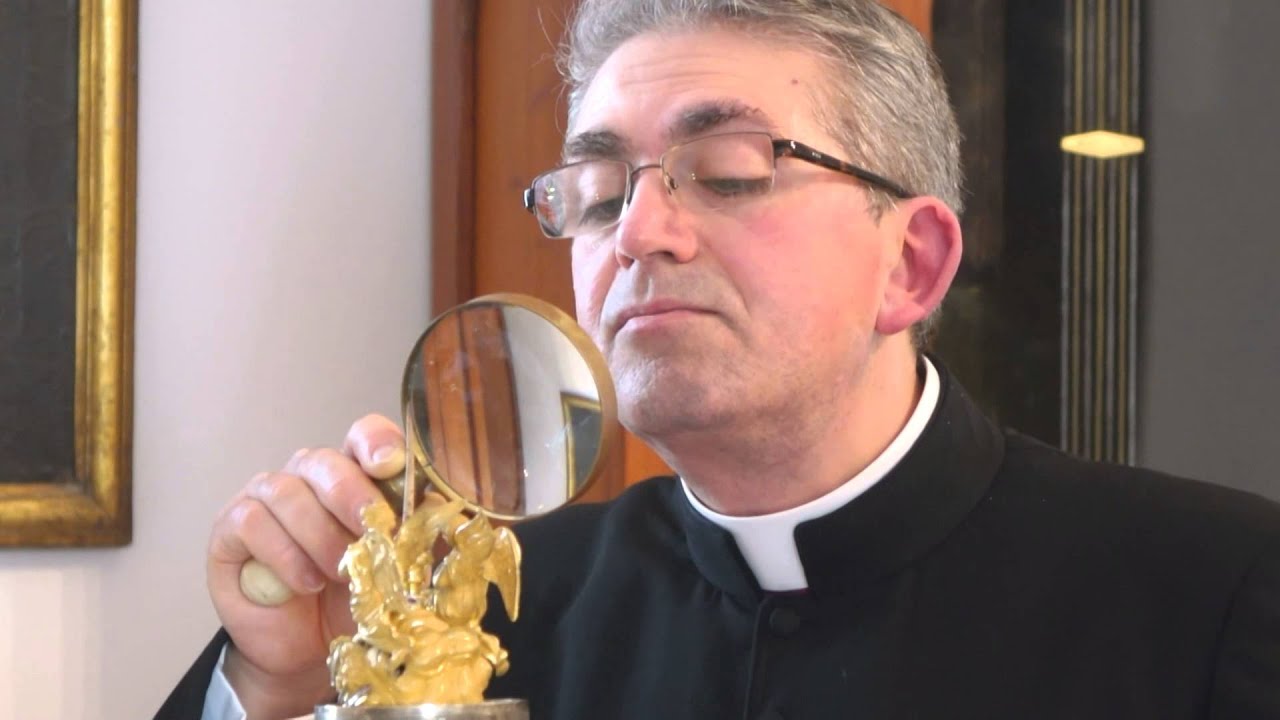
I am reminded of what I once heard an old bishop say: “Meno chiacchiere – più processioni”.
 Today I muse about why catholic feminists (an oxymoron – emphasis on moron – I know, but bear with me) are not vexed by Pope Francis and his dramatically public choice to wash the feet of non-Christians.
Think this through for them.
What the Lord did at the Last Supper was wash the feet of His Apostles. Not just any of His disciples. Not everyone in the street. What He did, He did for the sake of apostolic ministry.
catholic feminists have always wanted hierarchs to include women in the foot washing, but they understood – if not by reason, by emotion – that the Lord’s gesture was about apostolic ministry and therefore priesthood. They wanted to be included because they want women to be priests.
Then comes Francis.
For decades catholic feminists have been pushing for women to be included in the foot washing rite, because they wanted women to be ordained. Little did they think that Francis would reason, “Well, if women, why not non-Christians?”
Francis blows the connection of apostolic ministry and foot washing out the window.
For Francis, washing feet is a gesture of kindness to everyone. It is not about apostolic ministry, it is about religious tolerance, welcome, mercy, [fill in a natural virtue]. It isn’t connected to the Faith. If non-Christians are included, then this isn’t an exclusively Christian deal.
And it certainly isn’t about ordination … of anybody.
So, I ask again, “Why aren’t catholic feminists having a fit that Francis washes the feet of non-Christians?”
That Francis, in addition to washing the feet of women, washes the feet of non-Christians he has, single-handedly, taken the feminist power of this symbolism off the table.
Or, perhaps that was exactly what he wanted to do….
By washing the feet of non-Christians, he enervated the catholic feminist agenda. The foot washing rite is no longer symbolically significant in their battle for the ordination of women. The fact that the Pope authorized the inclusion of women in the foot washing robs feminist catholics of a primary symbol in their decades long struggle for ordination.
How many times is it again that Francis has said that women can’t be ordained?
Moderation queue is ON. I won’t even think of letting your comments through if you didn’t read more than the title and then think it through.

Coat of Arms by D Burkart









A Daily Prayer for Priests


They find you a pro-life agent in your area who commits to giving a portion of the fee to a pro-life group!

PLEASE subscribe via PayPal if it is useful. Zelle and Wise are better, but PayPal is convenient.
A monthly subscription donation means I have steady income I can plan on. I put you my list of benefactors for whom I pray and for whom I often say Holy Mass.
In view of the rapidly changing challenges I now face, I would like to add more $10/month subscribers. Will you please help?
For a one time donation...



Help Monks in Wyoming (coffee – UPDATED LINK) and Norcia (beer) and the wonderful "Soap Sisters" of Summit, NJ!


Please follow me on Twitter!










Visits tracked by Statcounter
since Sat., 25 Nov. 2006:

 ISIS CRUCIFIES CATHOLIC PRIEST ON GOOD FRIDAY