Scratching my head about the bishop in Paraguay

I will be the first to admit that what we do not know about this case, could fill volumes.  However, there are a few curiosities that leave me scratching my head.

Here is a story form CWN about the Paraguayan bishop recently relieved of his mandate by Pope Francis.

Keep in mind that while the Supreme Pontiff exercises full jurisdiction in the Church and that his decisions have no appeal, should the Supreme Pontiff want there to be sound rule of law through the Church at every level, he, too, will observe the laws of which he is the Legislator.  So, the removal of bishops by the Pope should have some canonical basis.  It doesn’t have to, technically, but it really should.

Let’s have a look:

Bishop Rogelio Ricardo Livieres Plano, [Argentinian, by the way, and Opus Dei] who was removed from his post in Paraguay, has issued a bitter complaint, charging that other bishops conspired against him [which is plausible] and saying that Pope Francis “must answer to God” for his removal.  [Which is true.  We all must answer to God for all that we do or fail to do that we ought.]

The deposed bishop, in a letter to Cardinal Marc Ouellet, the prefect of the Congregation for Bishops, said that he was being “persecuted” for his orthodoxy, [!] and complained that he had not been given an opportunity to defend himself.

The bishop’s letter, which was leaked to the media in Paraguay, [who knows by whom] said that the action against him was “unfounded and arbitrary.” He angrily charged that although Pope Francis has spoken often about “dialogue, mercy, openness, decentralization, and respect for authority of the local churches,” he did not give Bishop Livieres a chance to “clarify any doubts” about his ministry. [In my discussions with Argentinians recently, I have come to learned, from explanations made by the same Argentinians, that their dialogue tends to be blunt even to the point of rancorous.]

Father Federico Lombardi, the director of the Vatican press office, observed that the bishop’s letter was “a very violent reaction.” He remarked to reporters: “Maybe it is easier to understand why there was a problem.” [No.  That actually doesn’t help at all.  “Blunt speech” and “voicing an opinion” are not a canonical basis for removal from office unless the opinion is obviously heresy.]

Father Lombardi had earlier said that Bishop Livieres had been removed from office because of his discordant relations with the other bishops of Paraguay. [Again, how is “not getting along with others” a canonical basis for removal from office?] Most observers have agreed that the case pivoted on the bishop’s decision to promote a priest who had been characterized by an American diocese (Scranton, Pennsylvania) as a danger to children. [And yet Fr. Lombardi clarified the other day that the case of the Vicar General was not a major element in the decision!  So, which is it?  By the way, that choice for VG was really a bad move.  No question.  What was he thinking?]

I am left with some questions, but it is unlikely that we will get answers.  I am not sure we need answers.  However, since some answers that don’t add up are being offered, I am left scratching my head.

Don’t get me wrong.  I don’t have a problem with the removal of bishops who are a disaster.  It may be that removal of this bishop was surely founded on canonical grounds and for good reasons.  But when the reasons given publicly don’t add up very well, I start to wonder what’s really going on.  Removal of a bishop is a serious event.  It should make everyone stop and think about their own conduct in their own state of life.

This is an “examine your conscience” moment for all of us.

Oh… and another thing.  This Argentinian bishop serving in Paraguay will be criticized by liberals for fighting back.  But those same liberals praised the Bishop of Toowoomba in Australia for getting all feisty.   He, you see, was “prophetic”, but the Paraguayan must be an “ideologue”.

Moderation queue is ON.

Posted in The Drill | Tagged , ,
29 Comments

Kneeless in Seattle

St. Margaret beating the Devil with a hammer. A bit fuzzy…but hey!

From Fr. Carota’s blog:

I received this text message yesterday (Sunday) from a young man who is a member of “Juventutem” and had to go to Seattle for work.   When he went to mass there, this is what happened:

“In the Seattle Cathedral I was just denied communion kneeling and made a scene of.  He eventually, after a minute standoff scoffed, said I ought to learn obedience, and then threw the Sacred Host sideways into my mouth.”

“For every knee shall be bowed to me, and every tongue shall swear.” Isaiah 45:24

“That in the name of Jesus every knee should bow, of those that are in heaven, on earth, and under the earth:”  Philippians 2: 10.

Very ironically, the exact above reading (from St. Paul to the Philippians) was read at the Novus Ordo Mass this young man went to where he was spiritually abuse by the priest.   St. Paul is saying we need to kneel at only the name of Jesus.  What does that mean we need to do in front of the the presence of Jesus in Holy Communion which is a billion times more holy than on His Name.

God compelled the devil to show himself to the Desert Father Abba Apollo.  He was ugly, black, skinny limbs and had NO KNEES to adore God on.  Pope Benedict said: “The inability to kneel is seen as the very essence of the diabolical”.

[…]

That priest didn’t get the memo.

Redemptionis Sacramentum states:

[91.] In distributing Holy Communion it is to be remembered that “sacred ministers may not deny the sacraments to those who seek them in a reasonable manner, are rightly disposed, and are not prohibited by law from receiving them”. Hence any baptized Catholic who is not prevented by law must be admitted to Holy Communion. Therefore, it is not licit to deny Holy Communion to any of Christ’s faithful solely on the grounds, for example, that the person wishes to receive the Eucharist kneeling or standing.

Posted in Be The Maquis, Cri de Coeur, Liberals, Liturgy Science Theatre 3000, Our Catholic Identity | Tagged , , ,
85 Comments

FOLLOW UP: Good news on the Spanish Front! – Spanish TLMs in D. Raleigh a success!

Do you recall that just a while back I posted about a parish initiative launched by Fr. Paul Parkerson in Dunn, North Carolin in the Diocese of Raleigh?  HERE

In his parish he implemented two TLMs on Sundays.  One will have English re-readings and sermon, the other SPANISH.

This last weekend was the maiden voyage of this project.  I was curious as to how it turned out.

No sooner thought, than received.

One of Fr. Parkerson’s parishioners sent me a copy of a letter she sent to Fr. P.  My emphases:

I wanted to thank you for making the bold, revolutionary, but most of all, pastoral step of offering the Holy Mass in the extraordinary Form twice this past Sunday, one Holy Mass with repeated readings and homily in English and another with repeated readings and homily in Spanish. My initial assessment of the changes to the schedule and the “form” of the Masses this past weekend was that it was a great success.

When the upcoming transitions in the Mass schedule were first announced, there was a great deal of enthusiasm among the parishioners. Many offered to donate Spanish-Latin Missals and more English-Latin Missals, as well. Several new people have joined the choir/schola and have offered to sing at both Masses. For the first time, though, there is actually a choir made up of primarily Latinos, who were grateful and visibly moved to be part of the Mass in the Extraordinary Form on Sunday. Some of our more seasoned young men who serve at the Altar have offered to help train new boys so that there would be enough altar servers to serve both Masses on Sundays. Some of the fathers in the parish have generously volunteered to found a chapter of the Knights of the Altar and there is a real eagerness amongst not only English speaking boys, but also Spanish speaking boys who anticipate learning how to serve the Mass in the Extraordinary Form on a regular basis.

My biggest surprise on Sunday, the first Sunday of our new Mass schedule, was that both Masses were well attended by both English and Spanish speaking parishioners. We gave out 100 Spanish-Latin Mass Missals and also used all of our English-Latin Missals at both Masses. Both Masses were beautiful and reverent but there was a unity that we had not experienced here prior to Sunday. It was the Latin language and the ancient Form of the Mass that provided us all with the opportunity to worship together. Kneeling together, I caught a glimpse of the Church, the One Holy Church, what it was in the past and what it can be now (thanks be to God) and what it needs to continue to be in the future!

There was a true communion, not only with the people of our own parish, but also with the whole Church here on earth, with those in purgatory and with the Communion of Saints.

May God continue to bless you and the flock you serve here at Sacred Heart.

Fr. Z kudos to Fr. Parkerson.   In the Extraordinary Form we have a common patrimony.

I have written occasionally about the need to reach out through the traditional forms of our Catholic Faith to the Latino communities with whom we share our places of worship.  We have to bring communities together.  A while back I posted a question about Extraordinary Form resources in Spanish HERE.  There were good responses.  And recently I posted about a beautiful new Latin and Spanish hand missal from Angelus Press HERE.


Posted in "How To..." - Practical Notes, Brick by Brick, Fr. Z KUDOS, Hard-Identity Catholicism, Just Too Cool, Linking Back, New Evangelization, SUMMORUM PONTIFICUM, The future and our choices | Tagged , , , ,
9 Comments

¡Hagan lío! Taking HIM to the streets!

From the Catholic Sentinel:

CHARLOTTE, N.C. — Attendance at Mass remains central to Catholics’ faith because they must be nourished by Jesus’ body and blood or they will not remain strong Catholics, said Bishop Peter J. Jugis of Charlotte.

“Take a moment to ask yourself: Why do you go to Mass?” he said in his homily for the closing Mass of the 2014 Eucharistic Congress in Charlotte.

He emphasized that Catholics need the Eucharist to remain focused on Christ and keep their faith alive.

“You need the Eucharist. You need Jesus. If you think you can live a Christian life without Jesus, you are mistaken,” he said at the Sept. 20 Mass. “You are not really living. A Catholic without the Eucharist will not remain a strong Catholic for long. One’s faith will become watered down, if he is not constantly being fed by Jesus.”

The 10th annual congress, organized by the Diocese of Charlotte, focused on the theme “Behold, I make all things new,” from Chapter 21, Verse 5 of the Book of Revelation. It drew an estimated 13,000 people to the Charlotte Convention Center for Mass and eucharistic adoration, confession, educational talks and music Sept. 19-20. [13k!]

“Sometimes if we are not careful,” Bishop Jugis said in his homily, “our Mass attendance can become routine,” a habit that Catholics don’t really think about.

[…]

During the congress, 7,000 Catholics participated in a eucharistic procession through downtown Charlotte.

Marie De Mayo, a member of St. Gabriel Church in Charlotte, recalled attendance at the first congress, when 3,500 Catholics processed through downtown — an unusual sight for the majority Protestant region.

“As the procession was moving along Tryon Street that first year, there were a lot of curious stares from non-Catholics, construction workers hanging on windows,” she told the Catholic News Herald, Charlotte’s diocesan newspaper. “Even policemen did not know what to make of the bishop, priests and devout Catholics in total devotion, silence and prayer.”

“As the Lord was passing and families knelt down, there was a hush of the real presence of Jesus blessing the people and the city,” she added.

Now, she said, “after 10 years, the numbers have increased greatly as more Catholics participate.”

Meno chiacchiere – più processioni. … Less jabbering – more processions.” 

Posted in ¡Hagan lío!, "How To..." - Practical Notes, ACTION ITEM!, Be The Maquis, Brick by Brick, Fr. Z KUDOS, Hard-Identity Catholicism, Just Too Cool, Our Catholic Identity, The Coming Storm, The future and our choices | Tagged , , , ,
6 Comments

Card. Kasper gives YET ANOTHER interview to America Magazine and an Argentinian daily

Walter Card. Kasper, author of a proposal for the civilly remarried to receive Communion – and thus to create an under-class of Catholics, “tolerated but not accepted” Catholics, has given an interview – yet another – to Amerika, which has been an open and biased cheerleader for Card. Kasper’s notions, and La Nación, a major daily in Argentina.  (No, I’m sure it’s just a coincidence that he chose a paper that the Pope is likely to follow.)

Q. There is much interest in this synod, especially regarding how it will deal with the question of whether there will be some opening towards Catholics who are divorced and remarried.

A. [KASPER] Yes, this interest in church questions is a positive thing and we should be grateful for it. But the problem is that some media reduce everything at the synod to the question of Communion for the divorced and remarried people. The agenda of the synod is much, much broader and concerns the pastoral challenges of family life today. The problem of divorced and remarried is one problem, but not the only one. Some media give the impression that there will be a breakthrough and start a campaign for it. [Like… Amerika?  Which has been Card. Kasper’s official English Stratocaster?] I too hope there will be a responsible opening, but it’s an open question, to be decided by the synod. We should be prudent with such fixations otherwise, if this doesn’t happen, the reaction will be great disillusion.  [And who can say that that isn’t among the objectives of the Left?]

Q. Some cardinals and bishops seem to be afraid of this possibility and reject it even before the synod meets. Why do you think there is so much fear of a development in the church’s discipline?

A. I think they fear a domino effect, if you change one point all would collapse. That’s their fear. This is all linked to ideology, an ideological understanding of the Gospel that the Gospel is like a penal code.  [?!?  No, that’s not nasty.  Keep reading.]

But the Gospel is, as the Pope said in ‘The Joy of the Gospel’ (Evangelii Gaudium), quoting Thomas Aquinas, the Gospel is the gift of the Holy Spirit which is in the soul of faithful and becomes operating in love. That’s a different understanding. It is not a museum. It is a living reality in the church and we have to walk with the whole people of God and see what the needs of the people are. Then we have to make a discernment in the light of the Gospel, which is not a code of doctrines and commandments. [So, Gospel = joy.  Doctrines and commandments = … ?]

Then, of course, there is also a lack of theological hermeneutics because we cannot simply take one phrase of the Gospel of Jesus [Which we know mostly from the Gospels of MML&J.] and from that deduce everything. [We can’t take just one phrase… even if it’s crystal clear and the words of the Lord Himself?] You need a hermeneutic to see the whole of the Gospel and of Jesus’ message and then differentiate between what is doctrine and what is discipline. Discipline can change. So I think we have here a theological fundamentalism which is not Catholic.  [I think he just suggested that defense of the non-admission of civilly remarried Catholics to Communion, based on a phrase – never mind that it is the Lord speaking – is “theological fundamentalism”.  Am I wrong?]

Q. So you mean you cannot change doctrine but you can the discipline?

A. Doctrine, in so far as it is official binding doctrine, cannot change. So nobody denies the indissolubility of marriage. I do not, nor do I know any bishop who denies it. But discipline can be changed. Discipline wants to apply a doctrine to concrete situations, which are contingent and can change. So also discipline can change and has already changed often as we see in church history. [What is the message in this?  Okay, we teach that marriage is indissoluble.  Now that we have admitted that, you who are living in civil re-marriage can just pretend that the doctrine of indissolubility doesn’t apply to you because, if it did, you would feel bad.  Is that it, or did I get that wrong?]

Q. What did you feel when you learned that this book of the five cardinals was being published which attacks what you said?

A. Well first of all everybody is free to express his opinion. [Or…maybe not! We all know that this isn’t entirely true in the Church.] That is not a problem for me. The Pope wanted an open debate, and I think that is something new because up to now often there was not such an open debate. Now Pope Francis is open for it and I think that’s healthy and it helps the church very much.

Q. There seems to be fear among some of the cardinals and bishops because as the Pope said we have this moral construction which can collapse like a pack of cards.

A. Yes, it’s an ideology, it’s not the Gospel.  [?!? Read that again.  It’s an “ideology”.]

Q. There’s also a fear of the open discussion at the synod.

A. Yes, because they fear all will collapse. But first of all we live in an open pluralistic society and it’s good for the church to have an open discussion as we had at the Second Vatican Council. It’s good for the image of the church too, because a closed church is not a healthy church and not inviting for the people of the day. On the other hand when we discuss marriage and family we have to listen to people who are living this reality. There’s a ‘sensus fidelium’ (‘sense of the faithful’). [The problem is that for there to be a “sensus fidelium“, the sensus is of the fidelium… the faithful.  “The faithful” aren’t just the rank and file, just lay people.  They are also the clergy.  Also, they must be “faithful”, which doesn’t mean simply that they have some opinion or other, more or less well-formed.  Moreover, in no way can “sensus fidelium” be a matter of polling or majority opinion.] It cannot be decided only from above, from the church hierarchy, [nor can the hierarchy be excluded!] and especially you cannot just quote old texts of the last century, [Like that outdated Catechism of the Catholic Church or the even older Familiaris consortio.] you have to look at the situation today, [and then again, and again and again… tomorrow and tomorrow and tomorrow…] and then you make a discernment of the spirits and come to concrete results. I think this is the approach of Pope Francis, whereas many others start from doctrine and then use a mere deductive method. [I think he just contrasted “discernment” and “deduction”. Is that what you read?]

Q. In a sense the synod is like a replay of the Second Vatican Council.

A. Yes, I think it is a very similar situation. Immediately before the Second Vatican Council there were Roman theologians who had prepared all the texts and expected the bishops would come and applaud and in two or three weeks it would all be over. But it didn’t happen in this way, and I think it will also not happen this time.

Q. In an Italian daily, Il Mattino, you are reported as saying that you think the real target of these attacks is the Pope not yourself.

A. Maybe it was a bit imprudent of me to say it. But many people are saying this; you can hear it on the street every day. I myself do not want to judge the motives of other people. [Watch this!] It is obvious that there are people who are not in full agreement with the present pope, [See what he did there?  The people who are defending the Church’s doctrine and discipline are against the Pope. See?] but this kind of thing is not totally new, it happened also at the Second Vatican Council. Then there were people against the ‘aggiornamento’of John XXIII and Paul VI, though perhaps not in this organized way. Even Cardinal Ottaviani, the Prefect of the Holy Office at that time, was against the intentions of the majority of the Council. [That was a dig at the present Prefect Card. Müller, head of the CDF, he being in the role of Card. Ottaviani and Francis in the role of John XXIII or Paul VI.]

Q. Many analysts think it’s not a coincidence that this book comes now precisely on October 1. There has been resistance to Francis from the beginning, but this seems a more organized kind of resistance.

A. Yes, it is a problem. I do not remember such a situation where in such an organized way five cardinals write such a book. [What this!] It’s the way that it’s done in politics but it should not be done in the church. It’s how politicians act, but I think we should not behave in this way in the church.  [Look in the mirror, Your Eminence.  You yourself put out a book.  Card. Kasper has been incessantly giving interviews.  That’s what politicians do, even as they give stump speeches.  Moreover, it was affirmed, above, that Pope Francis wanted discussion.  Card. Kasper said that himself.  It is precisely through books and articles, rather than through interviews with secular newspapers that true, working theologians discuss and debate.  Let’s review: “The Pope wanted an open debate.”  Card. Kasper now has the experience of open debate as desired by Pope Francis.  His arguments are on display for the world to see.  The other books that are coming, the “Five Cardinals” book, the “Pell intro” book, the scholarly articles in Communio, present their responses and counter arguments.]

Q. In recent weeks the Pope said we must read the signs of the times. He wants the synod to do this.

A. Yes, to read the signs of the times was fundamental for the Second Vatican Council. I cannot imagine that the majority of the synod will be opposed to the Pope on this point.

[But wait!  There’s more.  Now the press.. the media we were warned about, above, as creating expectations and conflicts that can lead to disillusionment, takes up the Cardinal’s water bucket…] Q. In recent weeks too Pope Francis, in his homilies, has spoken again and again about mercy, and insisted that pastors must be close to their people, and avoid having a closed mind… it seemed as if he was referring to people like the five cardinals and supporting you on the question of mercy.

A. I think there is often a misunderstanding on what mercy is all about. Some are thinking that mercy is cheap grace, and ‘light’ Christianity. But it is not that, I think mercy is a very demanding virtue; it is not a cheap thing. It does not take away the commandments of the Lord; that would be absurd. But as it is the fundamental virtue according to St Thomas Aquinas, mercy is a hermeneutical key for interpreting the commandments.  [What just happened?  Did he do anything to dispel the leading suggestion of the questioner? That the cardinals who are responding to Kasper are, in the Pope’s eyes “closed minded”?  Indeed, he did not.  Also, note the use of “hermeneutic” again.  See what he did?  Earlier, Kasper says that his opponents are fundamentalists, who have an “ideology”, which is about the worst thing you can have, sort of like ecclesiastical Ebola.  Card. Kasper, on the other hand, has a “hermeneutic”, by which he interprets the Gospel of Jesus (with or without phrases from Matthew and those other guys).  Then he invokes St. Thomas Aquinas.  I suspect that Aquinas would find the proposal that those who are living in an adulterous relationship are properly disposed to receive Communion simply absurd.]

Q. Some were surprised that the Pope appointed a number of very conservative participants to the synod?

A. I think he did this because he didn’t want to be criticized by selecting only those who are in favor of one position. He wants an open discussion; he wants the other group too to have their voice. He wants to be fair. He does not want to exclude anybody, but to include everybody and have all participate in the discussion. He wants to hear everyone, and everyone should have a voice. And I think this is very positive.  [Is this a different person responding now?]

Q. His understanding is that God speaks through the people and their real situations. [?  Okaaaay… and… ?]

A. Of course. That’s the theological conception in the last book of the New Testament: Listen to what the Spirit is saying to the Churches! In the synod there should be a listening and prayerful atmosphere.

Q. Coming back to the question of communion for the divorced and remarried. Is the communion the prize for the perfect one or is it something to help the sinner?

A. We are all sinners. Nobody is really worthy to receive Holy Communion. [Nobody is worthy….  And, therefore, we shouldn’t worry about grace and mortal sin?] Communion has a healing effect. Especially people living in difficult situations need the help of grace, and need the sacraments. [John 8:11.   Ooops.  That’s just one phrase.  Here’s another 1 Cor 11:27-29.]

Q. So in terms of the sacraments, do you think that at the end of the day the decision should be up to the individual or the couple?

A. No, the sacraments aren’t only private events but public celebrations of the whole Church. The admission to the Eucharist goes through baptism and, after sin, through the sacrament of penance, that is, confession and absolution. [Which requires – from the conscious, at least – for validity a firm purpose of amendment.] Absolution is an official act of the Church, a juridical act. [Watch this…] Therefore divorced and remarried people should find a good priest confessor [do you have the players in mind so far?] who accompanies them for some time [… doing what, exactly?  Hearing their confessions, as a confessor?  Just talking to them?] and if this second, civil marriage, is solid [“solid” in what sense? “Solid” over and against a valid previous union?  Is the Cardinal suggesting that the civil marriage approved by the state now bequeaths to us some spiritual, theological data to consider?  That the civil marriage says something about the validity of the first (actual) marriage?  That the civil marriage says something about .. what… spiritual character of the second “marriage”?] then the path of new orientation can end with a confession and absolution. [And the couple is still living together… right?  With or without sexual relations?] Absolution means admission to Holy Communion. I do not start immediately with the question of admission to communion but with a penitential path. This does not mean to impose special acts of penance because normally these persons are suffering a lot; a divorce is not such an easy thing. It’s suffering. In this situation they need the help of grace through the sacraments and if they have an earnest desire and do what they can do in their difficult situation the Church should find ways to help them in a sacramental way. [This, friends, is dangerous ground indeed.]

Q. This then is a development of pastoral practice.

A. Yes, it is pastoral practice ending in a sacramental practice. [Oh no, it’s only pastoral, it’s not doctrinal.  And so what will this mean to all the people who are preparing to marry in the Church?  They will hear Father explain that marriage is for life, indissoluble.  They will then look at each and, knowing that the divorced and remarried go to Communion all the time, that this talk about indissolubility and “for life” is a shame, will just smile and nod their heads.] The Church by its nature is a sacramental reality. It’s not just pastoral counselling, it’s a sacrament and the sacrament has its own value. To say, “I absolve you” is different from giving good human counsels. It is saying: God says Yes to you and accepts you anew; you have a new chance.

[…]

There is a lot more of this stuff.  Go look at it yourselves.

By now it is clear that I don’t agree with His Eminence.

As a former Lutheran, my antennae are red hot.  This reminds me of what Luther would respond when challenged.  Luther, and lots of catholic liberals today, will appeal to a “Gospel” which is somehow over and against, beyond the Church.  They create another “magisterium” which contrasts with the Church’s institutional Magisterium.  They are “prophetic” and “of the people” which is the true locus of the Holy Spirit, whereas others are hierarchical institutional, hide-bound, book-bound, facing only the past, ideological and fearful.

I’m turning on the moderation queue.


Posted in One Man & One Woman, Our Catholic Identity, The Drill | Tagged , , ,
45 Comments

ASK FATHER: Biretta woes! Wherein Fr. Z offers wisdom.

And now for something really important.

Pompoms on birettas.

From a seminarian in these USA …

QUAERITUR:

Any suggestions as to where to purchase a good biretta? It seems most of offerings from American companies have the black pom which falls totally flat. I’d appreciate any suggestions.

O tempora! O mores! What are they teaching in seminaries these days?

An "academic" biretta trimmed in green for Canon Law. Note that both strings are still in place. If the guy is smart, he'll cut just the top string, unless he wants to pom to flatten out.

The trick to the pom (that is, to have it flare out in a ball instead of going flat) is to cut only the top string of the two strings. Poms always arrive with two strings around the pom. Those which have “fallen flat” can be revived by holding the hat upside down, thus hanging the pom upside down, smoothing it down and getting it nice and even and then winding a black string or thread around and around the pom’s fibers tightly about 3/4″ to 1″ from its (inverted) based. It helps to have two people for this project, but one can do it.

Otherwise, contact John Hastreiter at Leaflet Missal Company in St. Paul, MN.

BTW… the Roman biretta usually doesn’t have a pompom on it. Notice that a Cardinal’s biretta doesn’t have one: they are Roman clergy. The pom is, I think, a French thing.

And pay attention to your birettiquette!

And your liturgical Beretta-quette as well.

PS: I still want a one of those groovy Spanish birettas, with the five horns.  I don’t know when I would ever use it, but I want one anyway.

Or there’s this one!   Whew!

It looks like something out of Star Trek but, you’ve gotta admit… that‘s a hat!

Posted in "How To..." - Practical Notes, ASK FATHER Question Box, Liturgy Science Theatre 3000, Seminarians and Seminaries | Tagged ,
18 Comments

Nuns on the Bus: check out their ride!

I was recently sent a link to a page about the Nuns on the Bus tour taking place.  This is effort run by Sr. Simone Campbell of the lobby group NETWORK to sign up as many people who will vote for democrats (the pro-abortion party) as possible.

Here is a video about their luxury bus.

Posted in Dogs and Fleas, Liberals, Magisterium of Nuns, Women Religious | Tagged , , ,
19 Comments

ATTENTION MEN: Pluscarden Abbey Monastic Experience Weekend

One of you readers sent this and, especially for my friends across the Pond, I share it here:

Pluscarden Abbey in Moray in NE Scotland is holding a monastic experience weekend for Catholic men aged between 18-35 in November. Pluscarden is a haven of orthodoxy and its previous Abbot is now Bishop of Aberdeen. The Abbey celebrates mass in the ordinary form but does so solely in Latin and all the offices are in Latin.

HERE

Posted in "How To..." - Practical Notes, Events, The Campus Telephone Pole | Tagged , ,
1 Comment

OLDIE ASK FATHER: Eastern Subdeacon for Roman Solemn Mass? A Clerical Bedtime Story.

Just the day, someone sent me a note about this post.  I noted that it’s one year anniversary was about to strike, and so here it is again.  One year later.

From a reader:

I have a friend who is a Eastern Catholic subdeacon, officially installed in his own rite. [installed?] Would it be possible for him to serve a subdeacon during a Latin Extraordinary Form Solemn high Mass? And if so, which vestments would he wear, his own eastern vestments or the Tunicle?

The Latin Church has its Code of Canon Law and the Eastern Churches have their Code.  For this, we have to consult also the Eastern Code.

Can. 701 of the Eastern Code says:

“For a just cause and with the permission of the eparchial bishop, [like the diocesan bishop in the Latin Church] bishops and presbyters of different Churches sui iuris can concelebrate, especially to foster love and to manifest the unity of the Churches. All follow the prescripts of the liturgical books of the principal celebrant, avoiding any liturgical syncretism whatever, and preferably with all wearing the liturgical vestments and insignia of their own Church sui iuris.

This canon does not mention deacons or subdeacons. However, can. 1501 of the Eastern Code (parallel to can. 19 of the Latin Code) says:

“If an express prescript of law is lacking in a certain matter, a case, unless it is penal, must be resolved according to the canons of the synods and the holy fathers, legitimate custom, the general principles of canon law applied with equity, ecclesiastical jurisprudence and the common and constant canonical doctrine,”…

… and can. 1499 (parallel to can. 17) says, in part,

“If the meaning remains doubtful and obscure, they [laws] must be understood according to parallel passages, if there are such, to the purpose and circumstances of the law, and to the mind of the legislator.”

Let’s pull this all together.

An Eastern subdeacon (who is ordained, not just installed – the Eastern Churches continue to ordain men to the subdiaconate – just WE LATINS SHOULD BE DOING!!) can serve as a subdeacon at Latin Rite Mass, as long as his bishop/eparch permits.

Said subdeacon would follow the rubrics of the Roman Missal, but he would ideally wear the vestments proper to his own Church.

So, to illustrate, ….

nce upon a time in the Diocese of Black Duck at St. Fidelia in Tall Tree Circle, Father the Parish Priest, Guido Schmitz, was blessed with a visit by his 2nd cousin Subdeacon Grigori of the Eparchy of St. Theophan the Recluse.  Father 1st Assistant, upon meeting the Subdeacon, quoth, “We have a real subdeacon! Let’s have a Solemn Mass on Sunday!  Sven can be Deacon.”  Reverend Mister Sven Martínez was a not-quite-elderly Permanent Deacon around the place, rare in his permanent diaconal ministry as an expert in all matters liturgic.

Everyone deemed this a winning plan.

And so they gathered around the black bakelite telephone in the pastor’s office and called Subdeacon Gigori’s’s Eparch.

The Eparch, who answered his own phone, was delighted at this opportunity to foster unity between both lungs of the Church.  He, though not a Latin himself, sought every opportunity to underscore that he understood the mens of the Lawgiver in Summorum Pontificum, that the Roman Rite had its great liturgical tradition that rivalled his own.  He knew that Pope Francis had clearly affirmed Benedict’s provisions in TBI™, and that the Supreme Pontiff also had been involved with Eastern Churches in S. America.  Consequently, the Eparch concluded swiftly that it was both pleasing and opportune to deign to grant to the Reverend Subdeacon his Permission.

He added, with not-quite-mock menance, the stern admonishment to “Say The Roman Black and Do The Roman Red!”

Even as they were sharing their goodbyes and protestations of good will, the fax machine spit out the Eparch’s perfectly legible chirograph.  (The Eparch followed up with letters to both the Subdeacon and the parish priest.)

Subdeacon Grigori happened to have all his proper vestments with him.  They had a couple walk-throughs and – badda bing badda boom – ecce Sunday Solemn Mass.

And so it was that that happy Sunday with the Solelmn Mass and the real Eastern Subdeacon, became a matter of fond recollection and anecdotes.

Later in the year, Subdeacon Grigori returned for another visit!  The first stay at St. Fidelia had been so very agreeable both for its liturgical excellence in the Roman Rite – a new experience for the Subdeacon, if you get my drift – and because of the priestly fraternity that he knew was sure to follow the Sacred Synaxis.

This time, however, Subdeacon Grigori was without his own proper Eastern vestments!  They were were in the bag lost by the airline.  “Haudquaquam mihi molestum’st“, quoth he, in his best effort to fit in with his Latin hosts, “Let us be flexible.”

When it came time for the Solemn Mass, our Subdeacon vested contentedly as a Roman subdeacon, this being the only commonsensical course to pursue.  The music for the Ordinary was the Mass by Stravinsky, in honor of their Western/Eastern, modern/traditional liturgical nexus.

Subdeacon Grigori, as before, flawlessly carried out his subdiaconal ministry according to the Roman Red and Black, not a syllable lacking or gesture out of place.  He even used the thurible in the Roman manner, though afterwards he showed the altar boys how they used it in his Church.

Having decorously mactated the Victim, the clerics went to the Church hall for coffee and doughnuts with the folks. Subdeacon Grigori gave the parishioners a presentation about the differences between Roman and Byzantine liturgy.

Once the pastoral duties were complete, including a baptism and a Churching, the clerics went off together, parish priest, Fathers assistant, and Subdeacon, to St. Ipsidipsy over in the next county.  St. Ipsidipsy was, of course, the infamous parish entrusted to their mutual friend, Msgr. Zuhlsdorf (hey… fiction is the only way I’ll make Monsignor…).  In Monsignor’s rectory they had a light lunch.  Since they were way out in the wilderness, they then repaired, as was their wont, to Monsignor’s private outdoor firing range near the satellite dish arrays, backup generators, CPU cooling tower, bocce ball courts, and various antennae.

Having prayed to St. Gabriel Possenti and their Guardian Angels for steady hands and safety, they proceeded to put thousands of rounds through a variety of handguns. AR-15s with high-capacity magazines were not lacking. A Barrett .50 cal sniper rifle was fired with great effect.

They all agreed with Grigori’s observation that the glint of sunlight off the shower of casings falling to the ground about their feet was not unlike the sparkle of sun in the Holy Water during that morning’s Asperges.

The only dark note in the afternoon came when Father 2nd Assistant’s Sig Sauer P220 jammed from an errant round of .40 cal that had mysteriously made its way into the .45 ammo can. They consulted, set the Sig apart for closer inspection, and Father continued with his Beretta (… what else?).

Every story has its low point, and they had had theirs. It was a grave moment of concern, but their natural, hard-wired conservative, nay rather, even traditional Catholic cheerfulness overcame even that hitch in their afternoon.

Once all the paper was conclusively dead and all the metal targets had been sufficiently rung and spun, they invoked St. Joseph, Defender of the Church and Mary, Queen of the Clergy and sought out the humble church of St. Ipsidipsy where they sanctified their Sunday through Exposition, Vespers (sung antiphonally), and Benediction.

The scent of spent gunpowder mingled with the incense as together they wafted through the waning sunlight from the windows, their ears ringing merrily from both the .50 cal. and the Sanctus bells.

The conclusive clank of the tabernacle’s door sent them back to the rectory to clean their weapons over Campari sodas and then to enjoy homemade Bucatini all’amatriciana, steaks, salad, bottles of Barolo, which Monsignor had prudently opened before even the first round of .45 ACP had been fired.  They tucked in, reviewing news from the blogs, sharing the usual informations priests are privy to – amusing and dire – about diocesan and parish matters, chuckling for a while over a story in the Fishwrap and by turns glowering over the liberals’ continued misinformation campaigns, reviving anecdotes from seminary and past assignments all while not forgetting to proffer current tips on the best places to buy ammo.

The designated driver had been chosen by lot back at St. Fidelia’s (it fell to Father 2nd Assistant, who was therefore to be exempted for the next couple weeks), and so they brought out the cigars, the Warres ’77, the Hennesey XO and the Lagavulin 16.  Unicuique suum, after all, which happened also to be the motto on the coat of arms of Father 3rd Assistant.

His actis sumptisque omnibus, waving goodbye to Monsignor Z, they hitched up their cassocks, piled into the Father Pastor’s spacious new Volkswagen Phaeton, and sped down the road.

And so they came back to St. Fidelia’s, tired but happy.

THE END

Posted in Lighter fare, Linking Back, Liturgy Science Theatre 3000 | Tagged ,
14 Comments

Help the Transalpine Redemptorists!

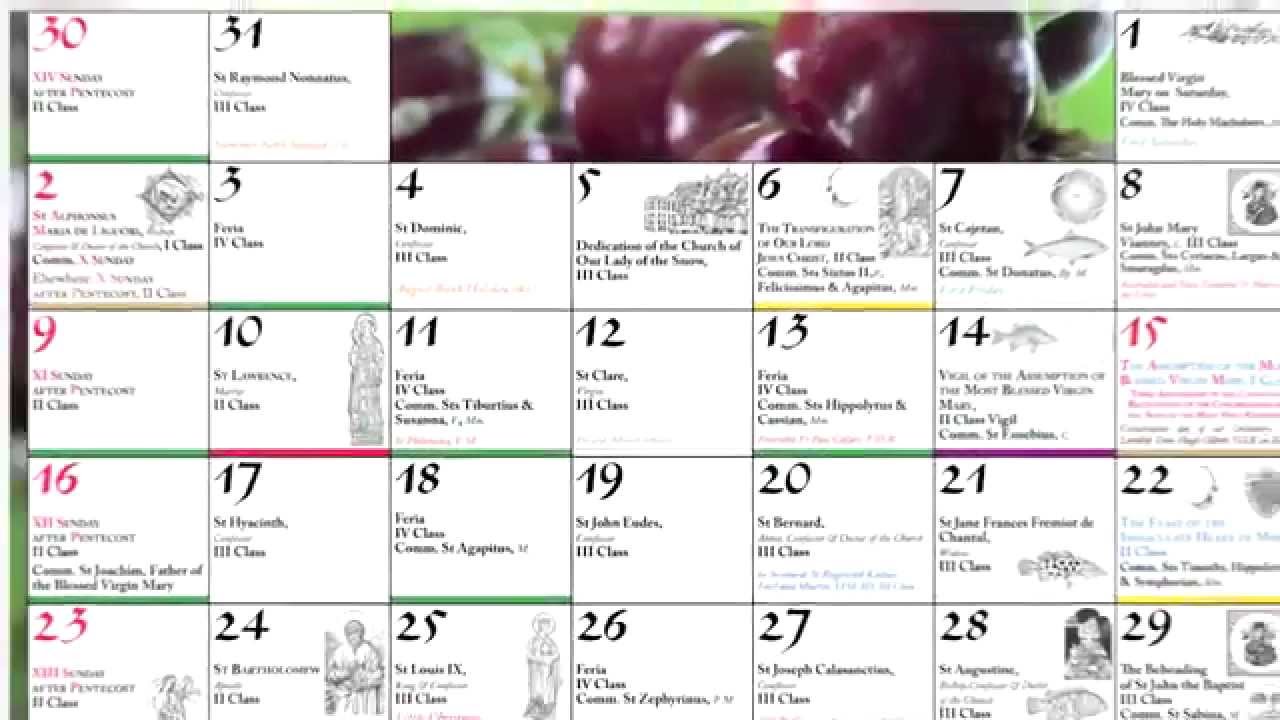
The Transalpine Redemptorists waaaaaay out on Papa Stronsay of the Scottish coast are doing some campaigning to help them make ends meet. They have a calendar which looks pretty nice.

I had a nice note from “Br. Martin” who sent me a link to a video about it.

YouTube thumbnailYouTube icon

To learn more about how to support the the Sons of the Most Holy Redeemer on Papa Stronsay click HERE.

Posted in ACTION ITEM!, Brick by Brick | Tagged ,
18 Comments