Rumors about Summorum Pontificum – GET A GRIP!

17_02_17_screenshot_SummorumMy email is filling with panicked messages about a story at LifeSite which suggests that Pope Francis is maneuvering to end the universal legislation established by Benedict XVI in Summorum Pontificum. HERE

Please, friends, breathe into a paper bag or whatever else you have to do to get a grip.

First, I don’t believe it.

Second, I don’t think it would make a lot of difference: this thing is going to continue one way or another.

So, put on your big boy underwear, stop whining, and GET BACK TO WORK.


Honestly… if some people put half the energy they use to worry and whine and wring their hands about rumors into building up a traditional Mass community where they live, we’d see some remarkable progress.

¡Hagan lío!

Posted in ¡Hagan lío!, Liturgy Science Theatre 3000, Si vis pacem para bellum!, SUMMORUM PONTIFICUM | Tagged
42 Comments

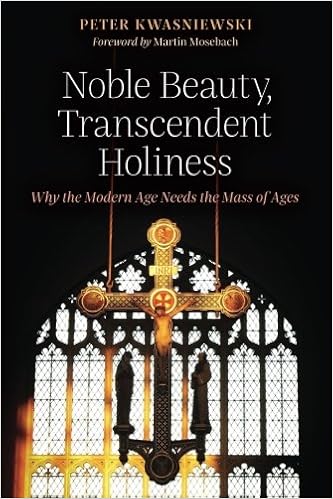
REVIEW – Peter Kwasniewski’s new book: Noble Beauty, Transcendent Holiness: Why the Modern Age Needs the Mass of Ages

I’m digging into Peter Kwasniewski’s new book:

Noble Beauty, Transcendent Holiness: Why the Modern Age Needs the Mass of Ages

US HERE – UK HERE

It has a forward by the great Martin Mosebach, author of The Heresy of Formlessness (a must read, a hard read but richly rewarding).

Firstly, I could read Peter’s prose forever.  He writes with clarity and great force, which surely reflect both his deft mind and his convictions.

Next, I think we may have a Vulcan Mind-Meld going on.

Chapters

1  Why the New Evangelization Needs the Old Mass
2  Reverence Is Not Enough: On the Importance of Tradition
3  The Spirit of the Liturgy in the Words and Actions of Our Lady
4  The New Liturgical Movement: Urgent Care for a Sick Church
5  Different Visions, Contrary Paths
6  Formed in the Spirit and Power of the Liturgy
7  Laying Our Foundation on Solid Rock
8  How the Usus Antiquior Elicits Superior Participation
9  A Perpetual Feast of All Saints
10  The Peace of Low Mass and the Glory of High Mass
11  Homage to Our Lady, Queen of the Liturgy
12  “Always Forward, Never Back”

Intriguing, no?

The book is seeded through with exquisite photo images and apt accompanying quotes.  There is a prayerful tone within as well.  Peter is a Benedictine Oblate.  For example, at the end of one chapter you find on a page apart:

Prayer for the Traditional Movement

O Lord, remember in Thy Kingdom N. and N.,
[names of individuals or communities]
and all religious, clergy, and laity throughout the world who are dedicated to the usus antiquior.
Bless us, govern us, defend us, purify us, and multiply us for the good of souls,
for the restoration of Thy Church,
and for the glory of Thy Holy Name.
Amen.

Every couple pages there are illustrative quotes blocked out which you will wish you could commit to perfect memory.  For example, just flipping to a random page (106) I find…

Those who doubt and deny win immediate fame. And the defer- ence refused to tradition, to antiquity, to authority, is given at once and wholly, with infinite thoughtlessness, to the notions of some writer or other, to one of those prophets of the hour who trumpet the vague phrases: progress, evolution, broad-mindedness, and dogmatic awakening. This is intellectual foolery. And it seems to me that good sense and dignity require from us not only an atti- tude of reserve, but above all a spirit of tranquil resistance and conservatism. Conservation is the very instinct of life, a disposi- tion essential for existence. We shall be truly progressive if we hold fast to this spirit, for there is no progress for a living organism which does not preserve continuity with its past.

Moreover, the book is deeply personal.  I am confident that you will resonate with what he writes.  Here is a sample with my usual treatment:

“Always Forward, Never Back”

Every line written in these pages is born from my personal experience of the things of which I speak. I have sat through every possible permutation of the Novus Ordo, and some impossible ones. I have collaborated or argued with every type of priest or liturgist. I have seen the Reform of the Reform in action and made such contributions to it as I could. I have worked with bishops who promote all the best and bishops who ruthlessly stomp on tradition. I have participated in silent private Masses, magnificent Pontifical Masses, and more or less successful dialogue Masses. I try never to write about anything that has not been intimately and frequently a part of my life as a Catholic. [And now some honest self-examnation…] This will, I trust, help explain the bitterness and harshness of some passages, the tolerance and pragmatism of others, and the melancholy triumphalism that permeates the whole—at once exultant over so many victories and chastened by the sight of so much devastation. It is a hard time to be thinking and writing about the liturgy, when so much is in flux, indiscernible and unpredictable, at the mercy of potentates and volunteers. I am thoroughly prepared to be surprised with the passage of each year at how many good things have sprung up and how many bad things have persisted or emerged from hibernation.

Dr. Eric de Saventhem (1919–2005), first President of the International Federation Una Voce, spoke these prophetic words in a speech in New York City in 1970—words all the more remarkable in the face of the escalating victories of philistinism and modernism, the threat of total devastation, and the hopelessness of the situation emerging at that time: [Speaking of great quotes…]

A renaissance will come: asceticism and adoration as the main- spring of direct total dedication to Christ will return. Confraternities of priests, vowed to celibacy and to an intense life of prayer and meditation, will be formed. Religious will regroup themselves into houses of strict observance. A new form of Liturgical Movement will come into being, led by young priests and attracting mainly young people, in protest against the flat, prosaic, philistine or delirious liturgies which will soon overgrow and finally smother even the recently revised rites.

It is vitally important that these new priests and religious, these new young people with ardent hearts, should find—if only in a corner of the rambling mansion of the Churchthe treasure of a truly sacred liturgy still glowing softly in the night. And it is our task, since we have been given the grace to appreciate the value of this heritage, to preserve it from spoliation, from becoming buried out of sight, despised and therefore lost forever. It is our duty to keep it alive: by our own loving attachment, by our support for the priests who make it shine in our churches, by our apostolate at all levels of persuasion.1

All this has been fulfilled before our eyes, and there is not the slightest sign that the “new form of Liturgical Movement” will back down just because of new threats and intimidations and the premature swaggering of the anti-Ratzinger faction. Indeed, if history tells us any lesson, it is that unjust persecution makes the flame burn more intensely and then, as soon as opportunity arises, blaze out more vehemently.

And yet, so much more is waiting to be done; there is fire to be kindled on the earth, in every place, every community, every church—the fire of the Catholic Faith in its totality and integrity, its tradition and beauty. In this connection we might draw courage from the noble words of the Book of Nehemiah (2:17–18):

Then I said to them, “You see the trouble we are in, how Jerusalem lies in ruins with its gates burned. Come, let us build the wall of Jerusalem, that we may no longer suffer disgrace.” And I told them of the hand of my God which had been upon me for good, and also of the words which the king had spoken to me. And they said, “Let us rise up and build.” So they strengthened their hands for the good work.

[…]

[1. The full text is available at the FIUV website: http://www.fiuv.org/p/address- given-bydr.html]

Do I hear an “Amen!“?

Allow me to continue with Nehemiah through a verse which I have for a long while displayed on this blog’s side bar:

Aedificantium enim unusquisque gladio erat accinctus.

And each of the builders had his sword girded at his side while he built.

– Nehemiah 4:18

Peter’s new book is a sword for your side as you build in your own parishes. It is a new arrow for your quiver when you need to explain, defend and spread the vision we share of a Holy Church revitalized in her sacred liturgical worship.

Without a revitalization of our worship, no other undertaking we mount in the Church will succeed.

Hence, the stakes are high.

Do I need to say it?

Yes, I need to say it.

Buy a least two copies, one for you and one for your parish priest or a seminarian.

Noble Beauty, Transcendent Holiness: Why the Modern Age Needs the Mass of Ages

US HERE – UK HERE

Posted in Liturgy Science Theatre 3000, SUMMORUM PONTIFICUM | Tagged
13 Comments

ASK FATHER: Can an ex-woman, a trans “man”, be ordained?

13_07_26_trans_bathroom_signFrom a reader…

QUAERITUR:

With the increase of transgender people pushing their agenda, would it be possible for a biological woman who thinks she’s a he and has gone through the Sex “change” process somehow slip through the cracks and make it to ordination, or does the screening process to weed out such people, as such would not be able to be validly ordained?

This sex-change, trans thing is intrinsically evil.

Talk about your Self-absorbed Promethean Neopelagians!

A woman who undergoes this ghoulish process is, at the end, not a man.  She is still a woman, a seriously mutilated woman.  She can dress like a man, try to act like a man, fool some people (not as many as she thinks) that she is a man.  She cannot ever be a man.

They are to be shown great compassion, because they are deeply confused and no doubt in a lot of pain.  But their confusion and pain doesn’t alter reality.

Women cannot be validly ordained to holy orders.  An attempt to ordain any woman, including mutilated women, would be, without question, invalid.

Hence,

Women cannot be ordained.
She is a woman.
She cannot be ordained.

As for a “screening” process, it is hard to imagine that such a person would not be identified as such right away.


Posted in Self-absorbed Promethean Neopelagians, Sin That Cries To Heaven, You must be joking! | Tagged ,
27 Comments

“For goodness’ sake, own your faith, Fr. Martin!” Analysis of Jesuit’s homosexualist activism

james_martinOver at Crisis there is a piece by Rev. Mr. Jim Russell entitled

“A Final Word On Fr. Martin”

Alas, I fear that that is far too optimistic.  Jesuit Homosexualist-activist Fr James Martin is sure to come up with something weird again soon.  He can’t go too long without the spotlight, after all.

Let’s have a look at Russell’s offering, jumping into its midst.   My emphases and comments:

[…]

After being asked hundreds upon hundreds of times by hundreds of different people, exactly why won’t Martin himself own the faith of the Church regarding homosexuality? All he does is pull a few puppet-strings each time the question comes up. Suddenly the Gospel he is supposed to believe down to the marrow of his bones, under the same obligation that St. Paul himself was when saying “woe to me if I do not preach,” is magically objectified into a mere “stance” or “prohibition” that the Church only “officially” teaches, and it’s just untouchable because it’s soooo far from the “stance” of the “LGBT community.” And, besides, it’s clear that “LGBT Catholics” have never “received” the teaching in the first place, Martin says.  [That is a typical lib ploy: pit the “official” Church against the, say, “spirit-filled” church.  Fishwrap writers use this trop all the time.]

If some of this sounds vaguely familiar, it’s because the more Martin talks, the more he simply fades into the murky shadows of many who spoke similarly over the last fifty years. It was another Jesuit, the late Fr. Richard McCormick, who famously embraced the falsehood of a “double magisterium” (naturally the second “magisterium” comprised theologians like himself!) and who insisted that teachings “not received” were not even true teachings at all. The more Martin speaks, the more he disappears into McCormick.  [Good reminder about McCormick.  He exerted tremendous influence on countless clerics and academicians.  How often have you, in your internet peregrinations, found some lib claiming that if an “official” teaching (usually about sex) isn’t “received” (accepted, believed) by people (I hesitate to say “the faithful”), then it doesn’t have to be accepted or obeyed.  Thus a majority determines what might be the teaching right now.  Of course who says which “majority” gets to decide is a little vague.  This is also what lies at the black heart of Card. Kasper’s method.  For example, the meaning of Christ’s teachings in Scripture can drift around over time, mean different things in different eras according to what Benedict warned of when he wrote for Card. Meisner’s funeral: the Zeitgeist.  Thomas Stark put his finger on the bruise when he said that Kasper has replaced philosophy with politics. Read: Stark in Catholic World Report: German Idealism and Cardinal Kasper’s Theological Project. HERE  I’m with Stark quoting Péguy: “Modernists are people who do not believe what they believe.” ]

Not only that, but Martin’s approach is also rooted squarely in the hero he’d like to canonize, Sr. Jeannine Gramick, who has famously admitted her strategy for achieving decades of dissent by doing the same thing—not owning her faith. Her self-labeled “creative circumvention” allowed her to “wiggle” around admitting her dissent by also framing true Church teaching as an objectified “stance.”

However, just as a train receding into the midnight horizon might occasionally throw a spark of illumination from its wheels, Martin’s retreat is not flawless. Recently, he forthrightly admitted his erroneous view that God creates LGBT people as LGBT people. Compare this to the Catechism’s clear assertion that homosexuality has a “largely unexplained” psychological genesis. [If God made them that way, then what they are inclined to do isn’t wrong.  That’s the argument.   Of course that’s crazy.]

This admission is really the crack in the dam that lets the floodwaters past. Virtually everything else that contradicts the Gospel regarding homosexuality arises from this singular flaw. If the entire spectrum of “LGBTQIA” is God’s handiwork, then we can jettison the whole “objectively disordered” kerfluffle and go with Martin’s self-recommended “differently ordered” instead. Then, same-sex sex acts and same-sex “marriage” and transgender surgeries become goods that we don’t have to reject. [Don’t have to?  Nay, rather: can’t reject… must accept.] We can let “gay pride” into our sanctuaries, festooning them with rainbow flags.  [Can? Nay, rather: must.  They will never be satisfied with “can”.]

Make no mistake—Martin’s personal media puppet, which keeps his personal views behind the curtain of the fictional narrative of “created this way,” is nothing more than a Trojan horse. [Interesting mix of metaphors.  Although… both are wood… both look like something that they are not…]

Thankfully, more astute minds than mine have seen just how unrealistically wooden the Martin puppet is; many faithful Catholic writers are taking on the myriad false assertions now incessantly repeated at every media opportunity and every presentation at parishes with faux-Catholic views on this issue. This is largely another reason why I believe the entertainment buzz of the Martin marionette’s performance is fading fast. Simply put, the stilted rhetoric and attached strings are leaving neither the Church nor the “LGBT community” feeling very satisfied.

Thus, Martin himself is creating new videos and print responses to the “critiques” he’s getting from both sides of the as-yet nonexistent bridge. Yet it’s all the same dodgy, scripted formula we’ve seen and heard before, attempts that are not passionately, single-mindedly focused on actually building that bridge, but instead are constructed so that, just as in Oz, we pay no attention whatever to the “man behind the curtain” as the spectacle before us plays out.

Am I being too harsh? Is it too much to ask that the creative artist behind the performance come out, and take a bow? I think not. [NB!] Literally, for goodness’ sake, own your faith, Fr. Martin. Stop attempting the impossible task of building a bridge in a bubble, via “creative circumvention.”

Instead, stake your claim. Are you with the Church and the Good News of its teaching on homosexuality, or not? Because, if you are, your stunt-double Pinocchio is doing a really terrible job of preaching that Gospel. If you are not, I’d suggest taking a good, long look at First Corinthians 9:16.

[..]

There’s more before and more after.  It’s worth your time.

Fr. Z kudos to Rev. Mr. Russell.

Posted in Our Catholic Identity, Sin That Cries To Heaven, The Drill | Tagged , , , ,
14 Comments

Registration Issue

The blog registration form has been under attack lately.   To deal with this I tried to do something clever.  It didn’t work.  I goofed something up.  It could be that I screwed up some registrations from some of you good readers.

So, if you registered in the last few days and either a) heard nothing back or b) it didn’t work for you, try again.  I think I put the settings for the registration process back to the way they were before I tried to be clever.

Posted in SESSIUNCULA |
Comments Off on Registration Issue

When the ghost of Gene Roddenberry designs a church

“What happens in Vegas, stays in Vegas.”

So runs the popular phrase.

I hope with all my heart that that is true!

Today a friend (and father of a priest) wrote an email with an astonishing link:

When the ghost of Gene Roddenberry designs a church

“The Mass is ended. Live long, and prosper.”

The church in question? See the Las Vegas Review-Journal.

$12M Roman Catholic church going up in South Summerlin

Vegas_church_Star_Trek

I can hear the theme song in my head as I look at that. Do doooo do do do do dooooo….

What do you want to bet that in spite of Laudato si’, building has air conditioning.   Perhaps as carbon offsets they can get some of those green gals from Orion as “Eucharistic Ministrices”.

“But Father! But Father!”, you eco-liturgical V2-Spirit-filled terrorists are wailing, “What’s wrong with that design?  It embodies noble simplicity and it’s… it’s… groovy!  We thought you were traditional.  This is traditional 1960s, right?  But you wouldn’t know anything about that because YOU HATE VATICAN II!”

If you want to know what’s wrong with this picture, obtain and read my friend Fr. Uwe Michael Lang’s new book: Signs of the Holy One: Liturgy, Ritual, and Expression of the Sacred.

US HERE – UK HERE

Posted in Lighter fare | Tagged ,
82 Comments

Fr. de Souza responds to responses about “reconciliation” of newer and traditional Forms of the Roman Rite

Mass eucharist sacrificeUPDATE 26 July:

Joseph Shaw of the LMS posted a response to Fr. de Souza’s response to us, who responded… etc.  HERE

___ Originally Published on: Jul 25, 2017 @ 11:14

Some discussion about the “mutual enrichment” hoped for and promoted by Benedict XVI with Summorum Pontificum has been generated by Card. Sarah’s article in the French magazine La Nef for the 10th anniversary of the promulgation of that Motu Proprio’s text.  I read an English translation of Sarah’s article in a PODCAzT.

Cool reactions followed quickly.  For example, scholars Joseph Shaw of the LMS in England HERE and Gregory DiPippo of NLM HERE. I provided my own reaction to Card. Sarah’s La Nef offering HERE.

A warm embrace came from Fr. Raymond de Souza HERE.  I had the impression that he thought that there should be a large-scale revamping of the traditional form and some tweeking of the newer form with traditional elements.  Inter alia, he made the claim that the post-Conciliar Lectionary was universally accepted as being superior to the older, traditional use of Sacred Scriptures in Holy Mass.  Card. Sarah had written that there should be a reconciliation of old and the new.   The aforementioned Shaw and DiPippo, however, made substantive arguments against such a move.  I added my own observations.

Fr. de Souza has issued a new piece in which he doubles down on the Lectionary issue but seems to back away from the large-scale revamping of the traditional form.  HERE  In fact, Father says:

“The more pressing issue by far is the enrichment of the OF, which can happily be done independent of any changes in the EF.”

I warmly agree.  It is by far more pressing to deal with the OF, since it is dominant right now.  It is attractive to think about the elements from the EF that might be introduced to the Novus Ordo.  I suppose, however, they would be introduced as “options”.

Something that, for sure, could be started unilaterally, would be to clean up many of the abuses inflicted on the Novus Ordo, which, alas, is rather open to abuse.

Concerning the Lectionary, de Souza:

I wrote that the superiority of the OF lectionary was a matter of broad consensus. I understated that, actually; it is nearly a unanimous position even in conservative liturgical circles, but evidently leading voices in the EF community do not think so. While there are clearly some weaknesses in the OF lectionary – the prologue of St. John’s Gospel is never heard by most Catholics – its more ample inclusion of Scripture is surely an improvement. It may be here that Cardinal Sarah’s warning about treating the EF as a “museum object” is most on the mark.

Why, Father, the snarky dig at at the end?

Fr. de Souza also wrote that this blog has “a pugilistic style”.  And his dig isn’t pugilistic?

While I grant that one cannot make extended elaborations in short pieces online, Fr. de Souza sidestepped the substantive arguments brought up by Shaw, DiPippo, et al., about the alleged superiority of the new Lectionary.  Fr. de Souza seems to think that the sheer quantity of Scripture used in the Novus Ordo is enough automatically to warrant superiority.

Fr. Finigan at his fine blog (HERE) made sound observations about Fr. de Souza’s views (my emphases and comments):

One problem is that of experience. Most of those Catholics who regularly participate at Masses celebrated in the usus antiquior have experienced the modern rite; most Catholics who regularly participate in the modern rite have not experienced the usus antiquior and do not really understand its attraction or its salient features when compared with the rite that they know. [That is certainly the case with most younger priests.] Some regular experience of celebrating the usus antiquior would lead most priests (or Cardinals) to understand the impossibility of forming a common reformed rite that would really be the usus antiquior which Pope Benedict understood as being attractive to many people, and which he said could not be suddenly considered forbidden or harmful.

This is a good point.  The discussion about the interplay of the two rites would change dramatically were the priests involved well-versed also in the traditional form.  When opining about their Roman Rite it is better to know the Roman Rite… which by definition includes the traditional Form.

Fr. Finigan goes on to address the Lectionary issue:

I would also gently urge that there needs to be greater awareness of the real work that is being done on the liturgy by traditionalist scholars. To take an example that is relevant to the current debate: only last year, Matthew P. Hazell published what is volume I in Lectionary Study Aids: Index Lectionum: A Comparative Table of Readings for the Ordinary and Extraordinary Forms of the Roman Rite. [US HERE – UK HERE ] His blog Lectionary Study Aids has other resources that would be useful for anyone interested in actually studying the question. His book has a Foreword by Peter Kwasniewski and consists of comparative tables by which the lectionaries of the modern rite and the usus antiquior can be compared to see which passages of scripture are included or omitted.
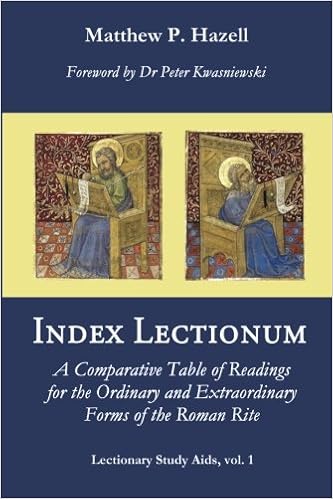
Thanks to Matthew Hazell, it is no longer necessary to rely on feelings or impressions when forming an opinion about the lectionary of the modern rite and it is possible to go beyond the simple assessment that it has lots more verses of the bible and therefore must be so much better. In the Foreword, Peter Kwasniewski makes a brief start on analysis of the modern lectionary, looking at, among other problems, Old Testament omissions, loss of Johannine material, omission of morally demanding texts (notoriously 1 Cor 11.27-29), and reductive redistribution.

Those who would defend the superiority of the modern lectionary cannot simply default to the position that “everybody” knows it is better because it has a higher biblical word-count; there is a real debate to be had, and an increasing amount of source material to be used.

Fr. de Souza brings up a point I made about the period of stability that we need before tinkering with the EF: traditionalists have often been treated horribly over the last few decades.   HERE  My emphases:

It is unlikely that apologies are going to be forthcoming. Yet Fr. Zuhlsdorf’s point about wounds requiring time to heal is valid; he may be right that the EF community is too wounded just now for reconciliation. A challenge though is to ensure that wounds are not passed down to younger devotees of the EF who were not around to have their hearts riven.

Cardinal Sarah’s intervention has made clear that even when friends of the EF – Sarah himself, or Cardinal Raymond Burke – speak about enrichment of the EF by the OF, they lack for supportive listeners in the EF leadership.

First, I had in truth written  that “many” of the traditional community have been wounded.  It is inaccurate to lump all those who prefer the traditional form of the Roman Rite into one group and them imply that “they are too wounded now for reconciliation”.

Fr. de Souza acknowledges that there are “younger devotees” who are frequenting the old form of Holy Mass (who did not personally experience the wars of previous decades), and hopes that they won’t get shot up in the crossfire.  Fine.  However, start messing around too deeply and too quickly with the older form, start tinkering in an artificial way with the older form, and we will see in the 2010’s what we saw in the 1960-70’s: wounds.

Moreover, he seems to be saying that, “Those poor people over there are psychologically too fragile to do the work I think ought to be done.”  That’s not at all pugilistic.

Okay, in fairness, perhaps I read him wrong and he isn’t being dismissive.

Moving on, it seems to me infra dignitatem to pit “EF leadership” against Card. Sarah and Card. Burke in the way that Fr. de Souza did.  I, for one, commented that, while I didn’t agree with everything Card. Sarah wrote, I was taking his suggestions to prayerful consideration.

Does anyone seriously believe that “EF leadership” are against Cardinals Sarah and Burke just because they don’t want have their arguments swept aside and then see massive, sudden, artificial changes imposed on the EF?

I firmly believe in and have for decades argued for what Ratzinger/Benedict promoted: we must allow a way through “mutual enrichment”, or what I like to call a “gravitational pull” of two forms, to jump-start the organic development of sacred worship interrupted by the brutal imposition of an artificially created order.  HOWEVER, we have to avoid the mistakes of the past and resist the temptation to start tinkering too quickly and too deeply.

Suddenly impose artificial changes on the EF and a tremendous opportunity will be lost.

We need a significant period of stability before we legislate changes.

Let the older rite take root and become, again, part of the warp and weft of our lives.  Let the newer rite be cleaned up and implemented without wide-spread abuses imposed on it.

There are already mutual enrichments going on, which are not a result of tinkeritis.  I think that reasonable and well-informed traditionalists understand that changes will result over time, nolens volens.  That’s the way of things.  That’s what happened over the centuries.  If we force the process too abruptly, however, there will be problems.

We, especially we clerics, have to avoid the trap and resist the temptation to tinker, to “fix stuff”, into which Fr de Souza may have fallen… with many others.

We don’t have to be afraid of the side-by-side celebration of these two forms of the Roman Rite.  Just let them be offered in the very best way possible and we will see what happens over time.

In any event, I welcome Fr de Souza’s additional comments, especially because they occasioned a thoughtful response from Fr. Finigan.  I imagine that others will follow and a fruitful dialogue will continue.

Posted in Liturgy Science Theatre 3000, Mail from priests, SUMMORUM PONTIFICUM, The Drill, The future and our choices | Tagged , , , , ,
45 Comments

On this day… “Getting Francis Wrong”

Here is something to ponder.  HERE

On this day in 2013 I posted:

Over at First Things I saw a piece called Five Myths About Pope Francis by William Doino Jr.

What are those myths?

1. “Francis is the anti-Benedict.”
2. “Francis is Not a Cultural Warrior.”
3. “Francis is a ‘Social Justice’ Pope.”
4. “Francis Will Be More Charitable Toward Dissenters.”
5. “Francis Loves the World.”

I think it would be interesting to reread the article in question and see how things are going now…. with some perspective.

Moderation queue is ON.

Posted in Linking Back | Tagged
32 Comments

My View For A While: Parental Edition

Off I go for a brief southern sojourn.  But first, the joy of airports at Zero Dark Thirty and cramped flights.

Did I mention “cramped”?


Delta’s definition of “comfort” differs from that which most of us understand.


To experience “comfort” is this seat in “comfort” class you would have to be 6 years old.

UPDATE

After a lousy bagel and schmear in the club, it’s off to the next flight.

In the ramp – chute? – Delta’s version of a red carpet for its boarding patrons.


Class.

Posted in On the road, What Fr. Z is up to | Tagged
18 Comments

WDTPRS – 7th Sunday after Pentecost: circumventing God’s plan

Nadal 7th post PentecostIn the traditional Roman calendar this Sunday is the 7th Sunday after Pentecost.

Today’s Collect survived the cutting and pasting experts of the Consilium to live on as the Collect for the 9th Sunday of Ordinary Time.

COLLECT (1962MR):

Deus, cuius providentia in sui dispositione non fallitur te supplices exoramus, ut noxia cuncta submoveas, et omnia nobis profutura concedas.

Blaise/Chirat (a dictionary of Latin in French) indicates that dispositio is “disposition providentialle”. It has to do God’s plan for salvation. Fallo is an interesting word. It means basically, “to deceive, trick, dupe, cheat, disappoint” and it has as synonyms “decipio, impono, frustror, circumvenio, emungo, fraudo”. Fallo is used to indicate things like simply being mistaken or being deceived. It can apply to making a mistake because something eluded your notice or it was simply unknown. In our Latin conversation it is not uncommon to say nisi fallor, “unless I am mistaken…”. If you look for submoveo you may have to check under summoveo. Find profutura under prosum. Don’t confuse noxia with noxa.

LITERAL WDTPRS VERSION:

God, whose providence, in its plan, is not circumvented, humbly we implore You, that you clear away every fault and grant us all benefits.

There is no getting around or circumventing God’s plan.

Why, given who God is and who we are, would we want to try?

But we do, don’t we.

We have to make a choice about which way to go with noxia.  Does it mean “harmful things” that are outside us or that are within us, that is, our own sins, our faults?  Both?

OBSOLETE ICEL (1973 9th Sunday Ordinary Time):

Father, your love never fails. Hear our call. Keep us from danger and provide for all our needs.

ROFL! Quite simply dreadful.  This may be one of the worst I have ever seen.  But we NEVER have to HEAR IT AGAIN.

CURRENT ICEL (2011  9th Sunday Ordinary Time):

O God, whose providence never fails in its design, keep from us, we humbly beseech you, all that might harm us and grant all that works for our good.

We have to make a choice about which way to go with noxia.  Does it mean “harmful things” that are outside us or that are within us, that is, our own sins, our faults?  Both?
God knows who we are and what we need far better than we can ever know ourselves.

Foreseeing all our sins and many faults, all that we say and do is embraced in His eternal plan.

He has disposed all things so as to make glorious things result from the evils for which we alone are responsible.

Sometimes, moreover, it is hard to understand that God actually cares are us.  Given how immeasurably vast God is and how small we are, it is easy for some, mired in earthly distractions, to lapse into sort of deism and imagine a God who created everything and then, like a clock maker, just set the pendulum to swing and stepped away.

There is an old adage that, if you want to know if God is interested in you, just make a plan.

It is good for us each day never to forget to make an Act of Faith, which is a good Trinitarian prayer.

O my God, I firmly believe that Thou art one God in Three Divine Persons, Father, Son and Holy Ghost. I believe that Thy Divine Son became Man, and died for our sins, and that He will come to judge the living and the dead. I believe these and all the truths which the Holy Catholic Church teaches, because Thou hast revealed them, Who canst neither deceive nor be deceived.


Posted in Liturgy Science Theatre 3000, WDTPRS | Tagged , , , ,
4 Comments