YOUR URGENT PRAYER REQUESTS

Please use the sharing buttons! Thanks!

Registered or not, will you in your charity please take a moment look at the requests and to pray for the people about whom you read?

Continued from THESE.

I get many requests by email asking for prayers. Many requests are heart-achingly grave and urgent.

As long as my blog reaches so many readers in so many places, let’s give each other a hand. We should support each other in works of mercy.

If you have some prayer requests, feel free to post them below.

You have to be registered here to be able to post.

I still have a pressing personal petition.  Two, in fact.

Posted in SESSIUNCULA |
38 Comments

This saint, after 1969, never said Mass using the Novus Ordo

Summorum Pontificum was a tremendous gift to the whole Church.  It was certainly one of the most – if not the most – important achievements of Benedict XVI, part of what I cal his Marshall Plan.  It is a great tool of the potential revitalization of Catholic identity which is so desperately needed.

At NLM Peter Kwasniewski reminds us about something important.

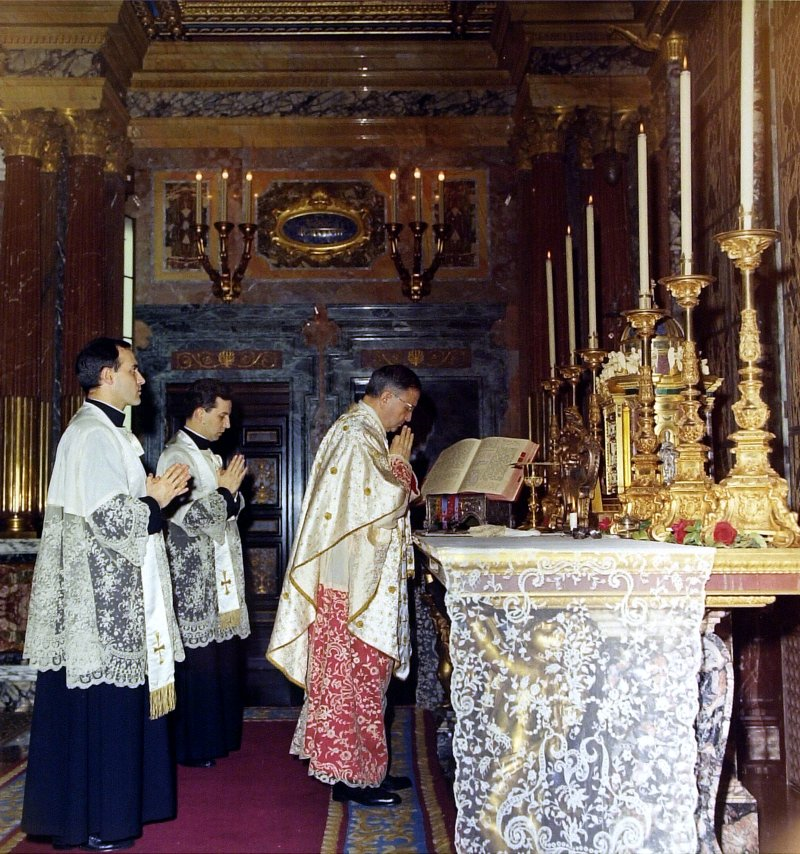
St. Josemaría Escrivá (1902-1975), the founder of Opus Dei, celebrated the traditional Latin Mass all his life as a priest. He had mystical experiences in connection with it. He loved it so much that he obtained permission (it was thought at the time that such permission was necessary) to continue with the Mass he had always offered, rather than shifting over to the Novus Ordo Missae. These are facts that deserve to be better known.[1] A marvelous gallery of photos of the saint celebrating the usus antiquior may be found here.

The footnote says: There are, as one might expect, different stories circulating around about what exactly happened after 1969, some of them more colorful than others. This is a fairly sober account, although its title is oddly anachronistic: “Why St. Josemaría Escrivá Only Celebrated the Extraordinary Form.”


It is possible that some of you newer readers here haven’t yet seen my Marshall Plan reference.

I have argued that Summorum Pontificum, the centerpiece of Benedict XVI’s “Marshall Plan” (my image) for the Church, is one of our greatest tools for a true revitalization of the Church and Catholic identity.

After World War II these United States rebuilt war-ravaged Europe for humanitarian reasons, but also to help create trading partners and a prosperous bulwark against Communism.

After Vatican II, many spheres of the Church were devastated, ravaged by internal dissent, a loss of continuity with our tradition, and from erosion by the secularism and relativism of the prevailing modern world.

We need a Marshall Plan for the Church in the modern world.  Certainly what we have been doing up to this point isn’t producing fantastic results across the board.  That’s because we don’t seem to know who we are anymore.

Joseph Card. Ratzinger had been concerned for years about the loss of Christian identity, which is at the heart of Western Civilization. Later, as Benedict XVI, he gave us a great tool by which we could reinvigorate our Catholic identity and, so, resist the negative influences of secularism and relativism.

I think that Benedict intended Summorum Pontificum to play a key part in a long-term strategy to rebuilt our Catholic identity, to correct our way of reading … well… just about everything over the last half century or so, and to establish a strong defense against the dictatorship of relativism.

Only with a solid identity can we, as Catholics, have something positive and healthy to offer to the world at large, a clear voice offering important contributions in the public square.  Look, for example, at the clarity and courage of the Little Sisters of the Poor against the evil machinations of the Obama Administration.  They have a clear identity and they are steadfast.  As a result they provide an inspiring example and they keep certain values before the public eye.

Our identity as Catholics is inextricably bound together with the way we pray as a Church.

To give shape and strength to our Catholic identity in these difficult times, we need an authentic liturgical renewal, a renewal that reintegrates us with our tradition, brings us into continuity with the deep roots of our Catholic Christian experience of two millennia.

Contrary to the notions of most progressivists, “the Catholic thing” did not begin in the 1960s.

There can be no authentic change for a better future without continuity with our past.

Liturgy is the tip of the spear.

Benedict XVI pointed us toward a healthier vision of the Church’s doctrine, history, public worship and our very identity as Catholics.

Just as a return to, for example, reading the Fathers of the Church can help us, collectively, correct the way we have been reading Scripture, so much and too long under the domination of an over-played historical-critical method, so too the Extraordinary Form can help us learn how to worship God as a Church which is not fragmented into tiny shards, and to reorient ourselves away from ourselves.

No positive initiative that we undertake in the Church will succeed unless it is rooted in and oriented by a revitalized sacred liturgical worship of God.  Everything comes from worship and everything goes back to worship in a dynamic, ongoing commercium.

Start your local movement for the implementation of Summorum Pontificum NOW.  I don’t think we have a lot of time to waste.

¡Hagan lío!

Posted in ¡Hagan lío!, Benedict XVI, Liturgy Science Theatre 3000, Our Catholic Identity, Saints: Stories & Symbols, SUMMORUM PONTIFICUM | Tagged , , ,
13 Comments

19 Sept – NAPLES: The blood of St Januarius liquefied!

Il cardinale Crescenzio Sepe durante la celebrazione in occasione della festa di San Gennaro a Napoli, 19 settembre 2015. ANSA / CIRO FUSCO

Il cardinale Crescenzio Sepe durante la celebrazione in occasione della festa di San Gennaro a Napoli, 19 settembre 2015. ANSA / CIRO FUSCO

According to ANSA the miracle was repeated today: the preserved blood of the 4th c. martyr St. Januarius (San Gennaro) liquified.  Good thing for Naples!

Here is something that I wrote for the UK’s best Catholic weekly, the Catholic Herald:

The feast of the bishop martyr St Januarius (d c 305), known in Italian as San Gennaro, is celebrated this week.  He is the patron saint of Naples where the faithful venerate vials of his dried blood which regularly liquefies on three days a year: 19 September (the saint’s feast), 16 December (anniversary of the 1631 eruption of the volcano Vesuvius which looms over the Bay of Naples), and the 1st Sunday of May (the day of the translation or moving of the saint’s relics to Naples).

16_09_19_Gennaro_02The liquefaction of San Gennaro’s blood is taken seriously by the people of the area. When it fails to change state, bad things tend to happen, such as famine, disease and earthquakes, for example, the terrible quake of 1980 which killed almost 3000 people and injured thousands more.  Hence, on these special liquefying days, throngs jam the Cathedral. The Cardinal Archbishop displays the reliquary with the larger of the two ampoules and slowly oscillates it.  When it changes, he announces “The miracle has happened”, thus launching the corybantic assemblage into that great hymn of praise the Te Deum.

Scientists can’t explain this phenomenon.  One inexplicable detail is that the weight and volume of the blood isn’t always the same after the blood solidifies again.  Sometimes the weight increases and the volume decreases, and vice versa.  Sometimes the liquid bubbles or foams becomes bright red.  At other times it is duller and rather viscous.  And it seems truly to be blood. In 1902 it was examined. The spectral lines produced by the light that passed through it had the characteristics of hemoglobin.  In any event, this miraculous transformation has been observed consistently since it was first noticed during a procession in 1389.  That’s a solid track record.

Speaking of miracles, if we do not believe in miracles, we do not ask for them.  While we accept God’s will and schedule in all things, if we do not ask for miracles they will not be granted.

We are not alone. The Church Militant (us) and the Church Triumphant (saints and angels) are closely knit, interwoven in charity. In this vale of tears we must intercede for each other.  We must believe in and ask for the intercession of saints.  No one is too small to be an occasion of grace for others.

How often do you invoke the help of the saints and holy angels?


UPDATE:

Check out the entry on St. Januarius by my friend Greg DiPippo at NLM.  Very cool stuff there.

Posted in Just Too Cool, Pray For A Miracle, Saints: Stories & Symbols | Tagged , , , ,
6 Comments

PSA: International Talk Like A Pirate Day

Setting aside all the insignificant stuff, like indissolubility of marriage and Communion, Popes and potential heresy and schism, let’s keep our eyes focused on what really matters.

Today, 19 September, is…

Talk Like A Pirate Day.

If you do nothing else, please use the exclamation “YARRRR!” (aka “ARRRR!”) at least 5 times before bedtime.

Helpful words:

  • bilge
  • scurvy
  • matey
  • scupper
  • grog
  • “Which it’s…” [fill in the blank – cf. Preserved Killick (not a pirate but… hey!)]

This has been a public service announcement.

Posted in Lighter fare, Preserved Killick | Tagged
8 Comments

Read the reviews right away before they are removed.

This is HILARYous.

Read the reviews right away before they are removed.

Clinton and Quisling Kaine.

16_09_18_screenshot_01

Click


Posted in SESSIUNCULA | Tagged ,
23 Comments

Ross Douthat on candidate Quisling Kaine (D-VA) and on Francis’ papal doctrine dance

At the NYT (aka Hell’s Bible) see what Ross Douthat has to say:

Dilution of Doctrine

LAST weekend Tim Kaine, the Democratic vice-presidential nominee and a churchgoing Catholic, briefly escaped obscurity by telling an audience of L.G.B.T. activists that he expects his church to eventually bless and celebrate same-sex marriages.  [Quisling.]

In short order his bishop, Francis X. DiLorenzo of Richmond, Va., had a statement out declaring that the Catholic understanding of marriage would remain “unchanged and resolute.” [That’s not enough.  CAN. 915!]

In a normal moment, it would be the task of this conservative Catholic scribbler to explain why the governor is wrong and the bishop is right, why scripture and tradition make it impossible for Catholicism to simply reinvent its sexual ethics.

[NB] But this is not a normal moment in the Catholic Church. As the governor was making his prediction, someone leaked a letter from Pope Francis to the Argentine bishops, praising their openness to allowing some divorced-and-remarried Catholics to receive communion.

The “private” letter was the latest move in a papal dance that’s been going on since Francis was elected. The pope clearly wants to admit remarried Catholics to communion, and he tried by hook and crook to get the world’s bishops to agree. [There Are Fifty Ways To Rig A Synod.] But he faced intense resistance from conservatives, who pointed out that this reform risked evacuating the church’s teaching that sacramental marriages are indissoluble and second marriages adulterous.

The conservative resistance couldn’t be overcome directly without courting a true crisis. So Francis has proceeded indirectly, offering studied ambiguity in official publications combined with personal suggestions of where he really stands.

This dance has effectively left Catholicism with two teachings on marriage and the sacraments. The traditional rule is inscribed in the church’s magisterium, and no mere papal note can abrogate it.

But to the typical observer, it’s the Francis position that looks more like the church’s real teaching (He is the pope, after all), even if it’s delivered off the cuff or in footnotes or through surrogates.

That position, more or less, seems to be that second marriages may be technically adulterous, but it’s unreasonable to expect modern people to realize that, and even more unreasonable to expect them to leave those marriages or practice celibacy [continence] within them. So the sin involved in a second marriage is often venial not mortal, and not serious enough to justify excluding people of good intentions from the sacraments.

Which brings us back to Tim Kaine’s [BOOOOO!] vision, because it is very easy to apply this modified position on remarriage to same-sex unions. If relationships the church once condemned as adultery are no longer a major, soul-threatening sin, then why should a committed same-sex relationship be any different? If the church makes post-sexual revolution allowances for straight couples, shouldn’t it make the same ones for people who aren’t even attracted to the opposite sex?

An allowance is not the same thing as a blessing. [Ummm…] Under the Francis approach, the church would not celebrate second marriages, and were its logic extended to gay couples there wouldn’t be the kind of active celebration Kaine envisions either.

Instead, the church would keep the traditional teaching on its books, and only marry couples who fit the traditional criteria. But it would also signal approval to any stable relationship (gay or straight, married or cohabiting), treating the letter of the law like the pirate’s code in the “Pirates of the Caribbean” movies: More what you’d call “guidelines” than actual rules.

The cleverness of this compromise, in theory, is that it leaves conservative Catholics with that letter to cling to, and with it the belief that the church’s teaching is supernaturally guaranteed. Thus there is no crisis point, and less risk of imitating Anglicanism’s recent schisms.  [We don’t know that.]


[…]

Read the rest there.

Kaine is a quisling.  Can. 915 should be applied.

UPDATE:

At The Spectator, Damian Thompson has reacted to Douthat.  Let’s enter n medias res (with my usual treatment – “ZISK”):

[…]

Douthat is surely right that the Pope planned to relax the rules dramatically, but last year’s synod of bishops sent him a clear message that it wanted the communion ban upheld. Having called the synod, Francis had backed himself into a corner. There were, however, a few ambiguities in Amoris Laetitiadeliberate ones, we can now see – that allowed liberals to argue that, if you read between the lines, the Pope had changed the rules.

That’s what the Argentine bishops have just claimed, spinning the document so far in a liberal direction that it’s almost unrecognisable. But not unrecognisable to its author, Francis. He barely had time to read the guidelines – sent to to him in a semi-finished state – before he said:

‘The document is very good and completely explains the meaning of chapter VIII of Amoris Laetitia. There are no other interpretations.’

There are no other interpretations. Uh? As Dan Hitchens points out, ‘the bishops of Poland and Costa Rica have said they’ll stick to the established practice; so has Bishop Philip Egan of Portsmouth, Archbishop Charles Chaput of Philadelphia, and – in a document released last week – the six bishops of Alberta, Canada.’ They won’t be changing their minds. [And more bishops will do this, too.]

According to the bishops of Buenos Aires, couples living in sexually active second marriages don’t need ‘permission’ to receive the sacrament. They should, however, exercise ‘discernment’ guided by a priest. You’ll need to read the whole text to grasp their convoluted argument.

The episode raises some puzzling questions. Here are a few of them. It’s too early to be confident of the answers.

• Why did Francis approve a highly contentious draft document in such a rush? Some of the Pope’s critics describe the Bergoglian modus operandi as ‘Jesuitical’, meaning manipulative. But the Society of Jesus is intellectually subtle; this looks more like moving goalposts in the middle of the night and being caught in the spotlights. It’s bizarre. You can’t help wondering if someone close to the Pope had a hand in drawing up the guidelines for Francis’s former diocese, which might mean that he was familiar with them long before September 5.

• Are the Buenos Aires guidelines on communion for the divorced-and-remarried intended for the whole Catholic Church? After all, they’ve received the papal imprimatur. Unlikely, at least in the short term. The Polish and African bishops aren’t about to let a pope with such a rudimentary grasp of theology overrule the verdict of Jesus in Mark’s Gospel: ‘Whoever divorces his wife and marries another woman commits adultery against her’. Francis must realise this. Is he therefore happy to tolerate ‘local’ solutions to pastoral problems – in other words, a Catholic Church in which doctrine is geographically adjusted, as it is in different provinces of the Anglican Communion and rival Orthodox patriarchates? Moving to that structure won’t be a smooth experience and the church won’t be very catholic if it happens. Is Francis so convinced of his own position (whatever that is) that he’s ready to countenance schism?

• Could this startling pronouncement herald a shake-up of the Vatican’s doctrinal watchdog, the Congregation for the Doctrine of the Faith? Francis doesn’t hide his low opinion of its prefect, Cardinal Gerhard Müller, a conservative appointed by Benedict XVI. If Müller were sacked and replaced by, say, Cardinal Christoph Schönborn – an Austrian nobleman and former Ratzinger protégé who has turned into a liberal waffle-merchant in his old age – then the Buenos Aires guidelines could be infiltrated into middle-of-the-road dioceses. (Westminster, for example, where the local bishop, Cardinal Vincent Nichols, has been described as ‘probably the leading papolator in the college of cardinals’.) This would still raise the spectre of schism.

• Alternatively, might the Pope simply lose interest in the divorced-and-remarried question? Don’t rule it out. Fr Raymond de Souza argues in the Catholic Herald, that Francis has a habit of making impulsive, sweeping decisions and then reversing them. He asks: ‘Does the improvisational, non-consultative mode of the Holy Father’s reforms mean that he can move fast, going back to fix up the details later? Or does it mean that he simply goes back, undoing what he had proposed to do for lack of proper preparation and attention to detail?’ To put it differently, is Bergoglio a Machiavelli or a Baldrick?

Interesting reactions.

Posted in 1983 CIC can. 915, Sin That Cries To Heaven | Tagged , , , , , ,
16 Comments

Your Sunday Sermon Notes

I can picture it now.  It’s time for the homily at Sunday Mass.  You resolve to pay close attention and remember details because you know that Fr. Z will ask…

Was there a good point or two made during the sermon at the Holy Mass which you heard to fulfill your Sunday obligation?

Let us know.

For my part, on this 18th Sunday after Pentecost (Extraordinary Form, of course), I picked up on the Lord’s harrowing line:  Why do you harbor evil thoughts in your hearts?

I stressed that we can commit mortal sins by thinking and that all thoughts will be revealed at the General Judgment.

One of the ways that we can sin is through impure thoughts.  Sometimes impure thoughts are mortal sin (when we give consent of will to them once they pop up and if we take pleasure in them).  However, if we fight them off the sin might be venial or not sinful at all.  St Francis de Sales pointed out that we can suffer temptations for the entire course of a lifetime, but if we don’t consent, we don’t commit a mortal sin.

We are surrounded more and more by immodesty and impurity, and so we have to condition ourselves against temptations and impure thoughts.   Custody of the eyes is important, because we tend to desire what we fix our gaze on.  Prayer to our Guardian Angels and to the Blessed Virgin is important when fighting temptations.  We should also change our patterns, change activities and get busy with something else.

If we have temptations or if we have vicious habits, we will have to suffer to get rid of them.  We mustn’t come down off the Cross when we begin to suffer.

Posted in SESSIUNCULA | Tagged , ,
26 Comments

¡Viva Cristo Rey! Mexican bishop persecuted by homosexualists

It’s coming.

It it time to take  “¡Hagan lío!” to another step.

From LifeSite:

Mexican bishop says he’ll evangelize in prison if he’s locked up for ‘homophobia’

September 16, 2016 (LifeSiteNews) – The Catholic bishop of Cuernavaca, Mexico, is being investigated in response to his opposition to the gay agenda, according to national and local media sources, but he says if he goes to prison he’ll take advantage of the opportunity to bring the Gospel of Christ to the inmates there.

Bishop Ramón Castro has been informed that he’s being investigated in response to a complaint by the socialist governor of the state of Morelos, Graco Ramírez, for speaking out against the creation of homosexual “marriage,” which was recently passed by the state legislature and signed into law by Ramírez. He is accused of “homophobia,” according to Mexican news outlets.

The bishop is reportedly accused of “meddling in politics” for denouncing the gay agenda on numerous occasions, as well as for organizing a meeting at the Cathedral of Cuernavaca for the purpose of hearing the complaints of various civil organizations about the crisis of violence and criminality affecting the state. His accusers reportedly claim that he used the meeting to organize opposition to homosexual “marriage.” [These homosexualists are evil.]

“If I go to prison, no problem, I’ll do the work of evangelization there,” the bishop told his flock during a sermon at the cathedral in mid-August, and added that he wished to “thank the Bar Association of Cuernavaca, which has shown solidarity by coming to my defense.”

The bishop told worshippers that the kingdom of God is not established without opposition because it denounces injustice, corruption, and poverty, according to the local Sol de Cuaulta newspaper.

Jesus said, ‘I have come to bring fire and divisions,’ referring to the consequences of living a firm and real commitment to the Gospel,” the newspaper quoted Castro as saying. “The presence of Jesus in our lives isn’t a matter of indifference to us, nor to those who surround us. If it were, we would have to doubt that it was anything but a superficial veneer.”

The Mexican constitution prohibits religious ministers from “entering in associations for political purposes,” supporting or opposing candidates for public office, or opposing government institutions or laws. The provisions are the remnants of the strongly anti-clerical provisions of Mexico’s 1917 constitution, which helped to incite civil war in the country in the 1920s and 30s.

Castro denies that he violated the law and says he merely agreed to hear the complaints of various civil organizations over problems suffered in the state, particularly problems related to violence and corruption, and that the meeting was not called to address the issue of homosexual “marriage.”

“The Church has a mission to carry out. I in no way have meddled in politics. I only received people in the cathedral to listen to them. I didn’t convoke anyone,” Castro said in a television interview. [It’s coming.]

Castro also had a complaint lodged against him by the homosexual Movement for Equality in Mexico (MOViiMX) to the National Council for the Prevention of Discrimination (CONAPRED) about HIS participation in a recent “March for Peace” in Morelos. The group quoted him as saying that state representatives “sold their consciences” in approving the state’s homosexual “marriage” constitutional amendment.

[NB] The accusations have not discouraged Bishop Castro from expressing his opposition to the gay agenda, however. He was notably present at the recent March for the Family in Cuernavaca organized to protest against a national homosexual “marriage” constitutional amendment proposed by the nation’s president.

It’s coming.

Posted in ¡Hagan lío!, Si vis pacem para bellum!, Sin That Cries To Heaven, The Coming Storm, The future and our choices, The Last Acceptable Prejudice | Tagged , , ,
16 Comments

WDTPRS – 18th Sunday after Pentecost: Who says mercy has to be gentle? Wherein Fr. Z rants.

Traversi_Operation_anagoria 1753 smThe Collect for Sunday Mass this week in the Extraordinary Form wound up in the Ordinary Form Missale Romanum as the Collect for Saturday in the 4th Week of Lent. Go figure. It had an ancient source in the Gelasian Sacramentary. For a change, the redactors of Fr. Bugnini’s and Card. Lercaro’s Consilium, with their scissors and glue pots, didn’t mess around with this prayer.

Dirigat corda nostra, quaesumus, Domine, tuae miserationis operatio, quia tibi sine te placere non possumus.

LITERAL WDTPRS TRANSLATION:

O Lord, we beg You, may the working of Your mercy direct our hearts, for without You we cannot please You.

Fairly stark.  I have mentioned with some frequency St. Augustine of Hippo’s insight that God crowns His own merits in us. Surely that is what is at work in today’s prayer.

AN OLD HANDMISSAL VERSION:

Grant, we beseech thee, O Lord, that the operation of thy mercy may direct our hearts, forasmuch as without thee we are not able to please thee.

This is what you would have heard… or rathyr, hearde of yore in the 1559 BCP1549 Book of Common Prayer

O GOD, for asmuche as without thee, we are not able to please thee; Graunte that the workyng of thy mercie maye in all thynges directe and rule our heartes; Through Jesus Christ our Lorde.

I rathyr lyke the way they turned downe syde up the ourdre of thynges.

CURRENT ICEL (from Saturday 4th Week of Lent):

May the working of your mercy, O Lord, we pray, direct our hearts aright, for without your grace we cannot find favor in your sight.

OBSOLETE ICEL (1973 – Saturday 4th Week of Lent):

Lord, guide us in your gentle mercy, for left to ourselves we cannot do your will.

A MOCKING OBSOLETE ICEL VERSION:

God,
you are nice.
Be nice and help us love.

This gets to the essence of what the old ICEL “translators” gleaned from the Latin originals, don’t you think?  After all, it expresses our need for the sacrament of niceness, which is the heart and soul of the old ICEL versions and the destitute theology behind them.

Seriously, the Latin original says nothing about God’s mercy being “gentle” when directing our hearts, our inmost thoughts and aspirations.

If we invoke His mercy, then surely we admit that we aren’t always so “nice” after all.  Right? We don’t ask for mercy unless we haven’t been “weighed and found lacking”.

Augustine, taking his cue from from the medical practices of the day, said that the doctor doesn’t stop cutting just because the patient screams for him to stop.  Think of all the writhing, pleading, people holding the poor patient down.  No anesthesia then, right?  But in our modern times, with all the distractions, the numbing of screens, noise, the pace, many of us are becoming tender little snowflakes, much like some young people we now censoriously mock for their delicacy in the face of challenges to contemporary conventions and political correctness.  As a Church we have some serious toughening to do.  Hard correction, training and nourishment is required. We have to stop all the excuses and pandering, the incessant reduction of expectations with the inexorable drift into the Charybdis of mediocrity, the tepidity which Christ will spew out.

It sometimes hurts to be corrected!

God knows what we need better than we can ever ponder to ask for.

Moreover, God’s correction, as harsh as it can seem at times, is certain gentle compared to the torments of everlasting Hell.

We must steel ourselves, and not come down off the Crosses we are offered every time it starts to hurt.

And so, even as I now remind you to examine your consciences and “GO TO CONFESSION!”, I also must put to you hard questions (especially to you priests out there).

Is the liturgical worship, especially Holy Mass, where you regularly go, helping you to prepare for death?  Does it help you to conversion and correction and self-recognition?  If not, maybe some changes have to be made.

Fathers, is the way you say Mass (including the music choices, etc.) helping your people towards recognition of sinful behavior, towards desire to change, and towards a good death?  Is it helping them to get ready to die?  If not, I suggest that you are in serious trouble.

I am not saying that everyone has to be on the rack all the time.  Hardly.  However, if we are in a constant state of distraction from reality (yes, we are going to die and be judged and God cannot be deceived), if we are always being wrapped in soothing, lulling, enervating false affirmation of our nice wonderfulness… we are in serious trouble.

The moderation queue is ON.
Posted in Hard-Identity Catholicism, Liturgy Science Theatre 3000, WDTPRS, Wherein Fr. Z Rants | Tagged ,
7 Comments

CQ CQ CQ – #HamRadio Saturday – Misc

It has been a few weeks since I’ve posted under this rubric.

One of you readers sent me a laser measuring device, which should be helpful. Thanks! Also, I got some Anderson Powerpole stuff.  Thanks!

I have some serious to do lists over the next couple days, but hopefully I’ll be able to get out this week with the new rig.

Also, you may recall that me older Kenwood had an brush with Zuhlsdorf’s Law.  One of the parishioners is an electrician and he has done stuff with radios.  He was kind enough to have a look.  When he got back to me, he said that he had good news and bad news.  The good news is that there is nothing wrong with it.  The bad news is that there is nothing wrong with it.  Thus, we are not sure what happened.  That said, I hope never to recreate the problem.

Meanwhile, I have now a transceiver that I could take southward to my maternal parent’s house.  Alas, having just visited there, I noticed that there are powerlines running in two directions through her back yard.  I also noticed while driving around in the area that there were antennas everywhere!  I suspect that quite a few people who retired there from the north – or perhaps their heirs – may be ready to shed some equipment.  Just a thought for later.

I received links to some amazing videos of a Contest Station here in WI, near Eau Claire. Pretty amazing. Interesting music choices, too!

YouTube thumbnailYouTube icon

YouTube thumbnailYouTube icon

YouTube thumbnailYouTube icon

Meanwhile, I struggle to figure out how to string something minimal up.

I’m in limbo.

Posted in Ham Radio | Tagged , ,
6 Comments