“No one may share in the Eucharist except those who believe in the truth of our teachings…”

Mosaic_of_St._Justin_Martyr,_Mount_of_the_BeatitudesA reading from the first apology of Justin Martyr in defense of the Christians, c. 100-165

No one may share in the Eucharist except those who believe in the truth of our teachings and have been washed in the bath which confers forgiveness of sins and rebirth, and who live according to Christ’s commands.

For we do not receive this food as ordinary bread and as ordinary drink; but just as Jesus Christ our Savior became flesh through the word of God, and assumed flesh and blood for our salvation, so too we are taught that the food  over which the prayer of thanksgiving, the word received from Christ, has been said, the food which nourishes our flesh and blood by assimilation, is the flesh and blood of this Jesus who became flesh.

The apostles in their memoirs, which are called gospels, recorded that Jesus left them these instructions: he took bread, pronounced the prayer of thanksgiving, and said: “Do this in memorial of me.  This is my body”.

In the same way he took the cup, pronounced the prayer of thanksgiving, and said; “This is my blood”, and shared it among them and no one else.

From that time on we have always continued to remind one another of this.

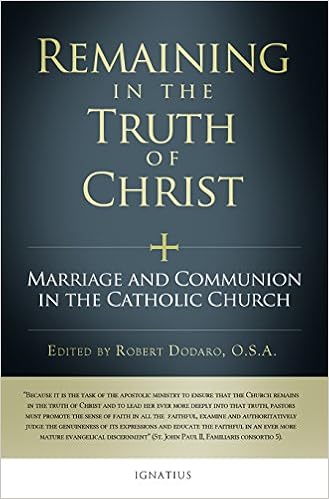
From Pope St. John Paul II’s Post-Synodal Apostolic Exhortation Familaris consortio 5  cited in Remaining in the Truth of Christ (aka The Five Cardinals Book™):

Because it is the task of the apostolic ministry to ensure that the Church remains in the truth of Christ and to lead her ever more deeply into that truth, pastors must promote the sense of faith in all the faithful, examine and authoritatively judge the genuineness of its expressions and educate the faithful in an ever more mature evangelical discernment.

From Pope Benedict XVI’s 2007 Post-Synodal Apostolic Exhortation Sacramentum caritatis, in the section on “The Eucharist and the indissolubility of marriage” (29 ff.) cited in Remaining in the Truth of Christ (aka The Five Cardinals Book™):

[O]ne should begin by assuming that the fundamental point of encounter between the law and pastoral care is love for the truth: truth is never something purely abstract, but a real
part of the human and Christian journey of every member of the faithful. Finally, where the nullity of the marriage bond is not declared and objective circumstances make it impossible to cease cohabitation, the Church encourages these members of the faithful to commit themselves to living their relationship in fidelity to the demands of God’s law, as friends, as brother and sister; in this way they will be able to return to the table of the Eucharist, taking care to observe the Church’s established and approved practice in this regard. This path, if it is to be possible and fruitful, must be supported by pastors and by adequate ecclesial initiatives, nor can it ever involve the blessing of these relations, lest confusion arise among the faithful concerning the value of marriage.

Now in TEN languages!
US HERE – UK HERE ITALYHERE

Posted in Benedict XVI, One Man & One Woman, Our Catholic Identity, Patristiblogging | Tagged , , , , , , , , , ,
5 Comments

My View For Awhile: escape from humidity edition

Off I go again.

We are in the wretched boarding phase, during which everyone in an aisle seat is reduced to a meat turnstile by those who have no sense either of their depth and girth as augmented by packs and purses, or of the presence of other human beings around them.

No I did not buy this at the Strand, though it would have been great to be able to do so.


I spoke by phone with the author recently.  He’s a great fellow.  I look forward to meeting him in person before too long.

UPDATE:

It’s nice to be able to check luggage status  using the app.  

Yes.  So far so good.

UPDATE:

Waiting.  Leaning.

It occurred to me that my last flight had the same number of people board as the flight in the movie Sully which I saw the other day.  Real suspense, even though you know the outcome, which is hard to pull off.   It was a bit creepy, since I’ve flown into LGA quite a few times.


I wonder:  A good candidate for an inflight movie?

In any event, it seems that Tom Hanks would be dangerous to travel with.  There was Sully, and the one where he crashed in the ocean and was stranded on an island.  And the terrific Apollo 13.  Hanks and flying… not so much.

So waiting …

Posted in On the road, SESSIUNCULA, What Fr. Z is up to |
18 Comments

Bishops of Alberta stand up! No Communion for ‘remarried’ without continence

One good thing resulting from the confusion surrounding both the Post-Synodal Apostolic Exhortation Amoris laetitia and the recent Argentinian Letter, is that the Church’s teachings on important moral issues, and about disposition to receive Communion, are being reviewed and clarified (and, yes, the usual suspects are also lying about them).

Here is some good news From LifeSite:

Alberta bishops: No Communion for ‘remarried’ Catholics unless they practice continence

EDMONTON, Alberta, September 15, 2016 (LifeSiteNews) — The Catholic Church has not changed her practice towards divorced and civilly remarried Catholics — despite what the faithful may have been led to believe through the media or other sources, the Alberta and Northwest Territory bishops stated in pastoral guidelines released Wednesday.

It is “erroneous” to conclude that divorced and civilly remarried Catholics can receive Holy Communion “if they simply have a conversation with a priest,” stated the guidelines, signed by the six bishops responsible for over 1,000,000 Catholics in five dioceses.

The 10-page document is intended to “answer the call of Pope Francis in his Apostolic Exhortation Amoris Laetitia, particularly to assist priests in their duty to accompany those Catholics who are divorced and remarried without having received a decree of nullity,” noted a statement from Edmonton’s Archbishop Richard Smith, president of the Alberta-NWT bishops.

In Chapter 8 of Amoris Laetitia, the Holy Father makes it clear that the Church’s pastors are to accompany divorced and remarried with a “discernment filled with merciful love, which is ever ready to understand, forgive, accompany, hope, and above all integrate.”

The Alberta bishops letter is highly significant, however, because it does not mention the infamous footnote 351 to paragraph 305 in AL in which the pope states that “in certain cases,” this integration of divorced and civilly remarried Catholics “can include the help of the sacraments.”

The Alberta bishops’ letter also stands in stark contrast to the directive from the bishops of the pastoral region of Buenos Aires in Argentina called “Basic Criteria for the Application of Chapter Eight of Amoris Laetitia.”

[…]

Read the rest there.

Also, since the Alberta bishops have been at it…

Alberta bishops: Priests may need to deny sacraments to Catholics who seek euthanasia

EDMONTON, Alberta, September 16, 2016 (LifeSiteNews) — While the legalization of assisted suicide and euthanasia in Canada does not alter the truth that these acts are “gravely immoral,” it is “foreseeable” that priests will receive requests for the sacraments from Catholics contemplating these actions, the Alberta and NWT bishops stated in a document released Wednesday.

As well as requests for confession and anointing of the sick from Catholics who might have arranged for or are considering assisted suicide or euthanasia, or from their families, priests can also expect requests for Catholic funerals “for persons who have been killed by these practices,” noted the 34-page “Vademecum for Priests and Parishes.”

“How are we to respond with a pastoral care that at once expresses the Church’s deep concern for the salvation of souls and safeguards the dignity of the sacraments and the nature of her funeral rites?” wrote the six bishops, who are responsible for more than one million Catholics in five dioceses.

The document outlines the obligations of a priest when asked to confer the sacrament of penance or anointing of the sick in various scenarios, such as hearing the confession of a Catholic who has already requested assisted suicide or euthanasia, or is contemplating it — including the priest’s duty to uphold the inviolability of the seal of confession, and under what circumstance he must defer or deny absolution.

The latter would be called for if a penitent has “officially requested physician assisted suicide or euthanasia” and therefore is in an “objective state of sin,” having “incited and socially arranged for someone to kill them.”

[…]

Read the rest there.

UPDATE:

From a reader:

As I’m sure you know, we are facing persecution on many sides, especially from the Minister of Education in trying to impose gender ideology on our Catholic schools and an incompetent, corrupt, lay-dominated Catholic school board who seem to think that Christianity is simply ‘secularism with a smile.’ We need prayers that the bishops and priests remain steadfast and that the Catholic faithful be clear on the truth of the human person and the meaning of sexuality.

A local ideologue in Edmonton, essentially, is working to impose the LGBTQ agenda on our Catholic schools, conveniently forgetting why a separate school district was established in the first place, and the machine of the NDP is finding this an easy backdoor to try to mute the Church’s teachings on matters pertaining to the family and sexuality.

Hostem repellas longius!

Posted in ¡Hagan lío!, 1983 CIC can. 915, One Man & One Woman, Our Catholic Identity | Tagged , , , ,
6 Comments

Memories of Vatican II’s halcyon days. Who could have predicted that things would fall apart?

Over at Crisis there is a great piece recounting memories of Vatican II times… those spirit-filled, halcyon days!

I particularly enjoyed this paragraph about the writer’s days in a Catholic girls school:

We attended Mass in Latin, sang hymns in Latin and studied Latin. Our quietly spoken, yet determined teacher Mother Conleth, managed to convey to us that conjugating verbs in Latin and translation, was essential to any kind of semi-decent life on earth. She would begin each class with Salve puellae (“Hello girls”) and then get down to business. Not to do one’s Latin homework was simply human perfidy and would produce abject horror on her face. I am amazed my school retained large Latin classes despite the anti-Latin forces beyond but Mother Conleth, of blessed memory, was a supernatural tour de force.

And there is this cringeworthy description of the shift from decent music to schlock.

This was the era of confident banners at feast day marches, the Children of Mary and their Aspirants, Sodalities and St Vincent de Paul. We sang the school song to St Brigid, Far away enthroned in glory, sweetest saint of Erin’s Isle and of course to St Patrick. We sang Soul of My Savior, Hail Queen of Heaven, the Pange Lingua and that triumphalist Catholic hymn which would make feminists blanche—Faith of Our Fathers Living Still with its words: “Our fathers chained in prisons dark, Were still in heart and conscience free, How Sweet would be their children’s fate, if they like them could die for Thee.”

[…]

It was only in my senior year that a general sense of something strange, new, even “revolutionary” began wafting through the corridors. We sang Spirit of God in the Clear Running Water in the local church as this is “what the Bishops want now.” Mother Conleth, however, loathed such changes and showed it in her “non verbals.”

She also makes serious points in her piece, as if that weren’t serious enough.

I imagine that many of you readers had similar experiences of those “halcyon days”.

As you contemplate them, many of you younger readers here haven’t had the joys of Joy Is Like The Rain, or the ditty the writer mentioned above. Here it is:

YouTube thumbnailYouTube icon

BTW… the writer asks some questions at the end, such as, “Who could’ve predicted what happened?”

Well… how about the people engineered it?

Posted in Our Catholic Identity | Tagged , ,
27 Comments

US admits Muslim Syrian refugees but bars Christians?

From Spero News:

The U.S. bars Christian, not Muslim, refugees from Syria

The title of this blog post–The United States Bars Christian, Not Muslim, Refugees From Syria–will strike many readers as ridiculous.

But the numbers tell a different story:

The United States has accepted 10,801 Syrian refugees, of whom 56 are Christian. Not 56 percent; 56 total, out of 10,801.

That is to say, one-half of one percent. The BBC says that ten percent of all Syrians are Christian, which would mean 2.2 million Christians. It is quite obvious, and President Obama and Secretary Kerry have acknowledged it, that Middle Eastern Christians are an especially persecuted group.

So how is it that one-half of one percent of the Syrian refugees we’ve admitted are Christian, or 56, instead of about 1,000 out of 10,801–or far more, given that they certainly meet the legal definition? The definition: someone who “is located outside of the United States; Is of special humanitarian concern to the United States; Demonstrates that they were persecuted or fear persecution due to race, religion, nationality, political opinion, or membership in a particular social group.” Somewhere between a half million and a million Syrian Christians have fled Syria, and the United States has accepted 56. Why?

[…]

Why?

Pres. Obama.

And this is what is in store, on steroids, depending on the outcome of the election in November.

Posted in The Coming Storm, The future and our choices, The Religion of Peace | Tagged , ,
11 Comments

ASK FATHER: Year of Mercy indulgence when no chance of confession

From a reader…

I’m a shut-in in a rural area. EMs bring me Communion on Fridays. Confess once a year (prev. yrs ago @ 2 wks). Really no way to confess @ 3 wks for Plenary Indulgences (Priest has 3 parishes). Any exceptions to that rule? Thanks

Okay…. I think I understood that.   Dear readers… there is no reason to write to me in Code.  Even as I get older, I still have the time and energy to read sentences, etc.

Now… to work.

First, you should send a note back to the priest through the agency of the Extraordinary Minister of Communion, asking him to come to hear your confession, especially because the Year of Mercy is soon coming to a close.

If that doesn’t bear immediate fruit, there is another option.

The parameters for obtaining an indulgence are set by the Supreme Legislator (aka the Pope, for those of you in Columbia Heights). Indulgences are the purview of the Apostolic Penitentiary (that’s a person, not a big prison for apostles).   The Apostolic Penitentiary is the highest tribunal in the Church that deals with matters of the internal forum (e.g., confession) and indulgences.  Any dispensation or derogation of the norms attendant to indulgences would come from the Apostolic Penitentiary. You could write to the Major Penitentiary of the Apostolic Penitentiary and ask for a dispensation.

His Eminence
Mauro Card. Piacenza
Major Penitentiary of the Apostolic Penitentiary
Palazzo della Cancelleria
00120 VATICAN CITY

You might then send a copy of your letter to your parish priest, just so that he knows of your earnest desire.

And your desire to obtain an indulgence is both understandable and praiseworthy.  But keep this also in mind.  While indulgences are useful aids, and we should all strive to gain them whenever possible, they are – fortunately – not necessary for salvation.

The fact that you are (at the moment – we hope the parish priest will work with you) unable to meet the conditions required for the grant of an indulgence does not in any way mean that your prayers are inefficacious, or that your desire to obtain an indulgence will not be rewarded by Our Lord with a merciful shower of grace.

Continue in your diligent prayer, especially for more vocations to the priesthood so that others won’t need to face the deprivation you currently deal with.

Offer up your inability to earn a plenary indulgence in the ordinary way.  That in itself will surely be a sacrifice pleasing to Our Lord.  His graciousness is unbounded.

Posted in "How To..." - Practical Notes, ASK FATHER Question Box, Year of Mercy | Tagged , , ,
2 Comments

ASK FATHER: Could the Congregation for the Doctrine of the Faith issue a binding interpretation of #AmorisLaetitia

From a reader…

QUAERITUR:

As a recent convert and a lawyer (but definitely not a canon lawyer), in view of Pope Francis’ recent endorsement of the broad view of AL, can the Congregation for the Doctrine of the Faith issue a binding interpretation of AL.

Sure.  The Congregation can do this.  We have the famous case of the explanation of Ordinatio sacerdotalis.

However, just as in the case of Ordinatio sacerdotalis, the Holy Father would have to sign off on such a document and order its publication.

Even were the CDF to draft such a thing (itself hard to do without the knowledge of the Pope), is it likely that Francis would approve it?

When it comes to documents, Francis holds all the cards.  Congregations are merely extensions of his own office.  He delegates his authority to group A his task about subject A, to B his task about B, etc.

Posted in "How To..." - Practical Notes, ASK FATHER Question Box, The Drill | Tagged ,
12 Comments

15 Sept: Seven Sorrows of Mary, Mater Dolorosa, Queen of Martyrs

Today is the Seven Sorrows of the Blessed Virgin Mary.  Can you name them?

Here the entry from the Roman Martyrology:

Memoria beatae Mariae Virginis perdolentis, quae, iuxta crucem Iesu adstans, Filii salutiferae passioni intime fideliterque sociata est et nova exstitit Eva, ut, quemadmodum primae mulieris inoboedientia ad mortem contulit, ita mira eius oboedientia ad vitam conferret.

In the older, pre-Conciliar Missale Romanum we find this wonderful Collect for today’s Holy Mass.

COLLECT (1962MR):
Deus, in cuius passione,
secundum Simeonis prophetiam
dulcissimam animam gloriosae Virginis Matris Mariae
doloris gladius pertransivit:
concede propitius;
ut qui dolores eius venerando recolimus,
passionis tuae effectum felicem consequamur.

LITERAL VERSION:
O God, at whose Passion,
according to Simeon’s prophecy,
the most sweet soul of the glorious Virgin, Mary our Mother,
was pierced by a sword of sorrow:
mercifully grant
that we who observe her sorrows by veneration
may attain to the happy result of Your Passion
.

Also, in the old Communion Antiphon we have a connection between the great sorrow of Mary at the Cross and how she merits to be called Queen of Martyrs:

ANTIPHONA AD COMMUNIONEM:
Felices sensus beatae Mariae Virginis,
qui sine morte meruerunt martyrii palmam
sub Cruce Domini
.

Sensus is an incredibly complicated word. It means, among other things, the faculties of sensing and perceiving, but also of the sentiments of the heart and mind. In a collective “sense” sensus stands for “the common feelings of humanity, the moral sense”. Sensus is also our disposition of mind or humor and inclination. It signifies understanding of the thinking faculty, in the sphere of reason.

LITERAL VERSION:
Blissful the sentiments of the Blessed Virgin Mary,
which beneath the Cross of the Lord,
without death merited the martyr’s palm
.

This antiphon underscores how the totality of Mary’s being, “magnified” by God at every point of her life, was united with her Son as He endured the sufferings of the Cross.

This feast reminds us that there is a path to holiness through the sufferings and sorrows we endure.  We must learn to unite them to the sufferings of our Lord.  Mary teaches us to do this.  The martyrs teach us to do this.

Here is something that I wrote for the best Catholic weekly in the UK, the Catholic Herald in my column “Omnium Gatherum”:

September brings lovely Marian feasts, including – in the traditional Roman calendar – Our Lady of the Good Shepherd (3 Sept), Nativity of Mary (8), Name of Mary (12), Seven Sorrows of Mary or Our Lady of Sorrows (15), Our Lady of Ransom (24).

The feast of the Our Lady of Sorrows was instituted in Cologne in 1413 as a response to the Protestant Hussites (the ones that put the sword gashes on the face of Our Lady of Czestochowa in Poland). Pope St Pius X assigned her feast to 15 September 15 so she could remain close to the Cross and the Feast of its Exaltation on 14 September.

Our Lady’s Seven Sorrows are 1) The Prophecy of Holy Simeon, 2) The Flight of the Holy Family into Egypt, 3) The Loss of the Child Jesus in the Temple, 4) The Encounter of Jesus with His Blessed Mother as He Carries the Cross, 5) The Crucifixion and Death of our Lord Jesus Christ and Mary at the foot of the Cross, 6) The Descent from the Cross, and Jesus in the Arms of His Most Blessed Mother, 7) The Burial of our Lord, and the Loneliness of the Blessed Virgin.

Speaking of seven, Our Lady revealed to St Bridget (d 1373) a devotion we can use to obtain seven graces if we meditate on her sorrows and recite seven Hail Mary’s. These graces are (in her voice) 1) I will grant peace to their families, 2) They will be enlightened about the divine mysteries, 3) I will console them in their pains and I will accompany them in their work, 4) I will give them as much as they ask for as long as it does not oppose the adorable will of my divine Son or the sanctification of their souls, 5) I will defend them in their spiritual battles with the infernal enemy and I will protect them at every instant of their lives, 6) I will visibly help them at the moment of their death, they will see the face of their Mother, 7) I have obtained from my divine Son, that those who propagate this devotion to my tears and sorrows, will be taken directly from this earthly life to eternal happiness since all their sins will be forgiven and my Son and I will be their eternal consolation and joy.

Our beautiful devotions enrich our lives.

Posted in Liturgy Science Theatre 3000, Our Solitary Boast | Tagged , , ,
9 Comments

Benedict XVI: last Pope of old era or first of the next?

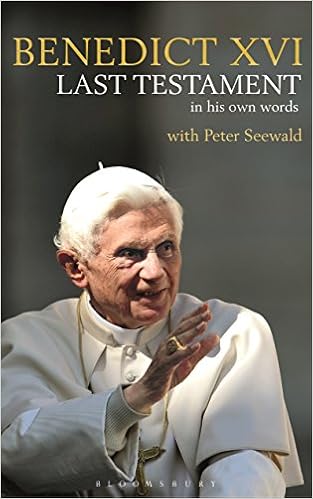
popebenedictpopejohnpaulcommunionI’m reading the Italian edition of Pope Benedict’s book-long interview with German journalist Peter Seewald.  I’m jumping around a bit and I ran across an interesting section.  Here is my on the fly translation from the Italian (not from the German original):

SEEWALD: Do you see yourself as the last Pope of the old world or the first of the new?

BENEDICT: I would say both.

SEEWALD: As a bridge, a kind of connecting element between the two worlds?

BENEDICT: I don’t belong to the old world anymore, but the new one in reality hasn’t yet begun.

SEEWALD: The election of Pope Francis is perhaps an exterior sign of a epochal turning point?  With his does a new era begin definitively?

BENEDICT: The temporal divisions were always decisive a posteriori: only in a second time is it established that here began the Middle Ages or there began the modern era.  Only a posteriori is it seen how movements developed.  For this reason I won’t hazard a like affirmation now.  Nevertheless, it is evident that the Church has been abandoning more and more the old traditional structures of European life and, hence, changes appearance and lives new forms.  It’s clear above all that the dechristianization of Europe progresses, that the Christian element is vanishing more and more from the fabric of society.  Consequently, the Church must find a new form of presence, must change its way of presenting itself.  There are epochal upheavals underway, but one doesn’t yet know to what point it can be said with precision that one or the other begins.

SEEWALD: You know the prophecy of Malachy, that in the Middle Ages compiled a list of future pontiffs, foreseeing also the end of the world, or at least the end of the Church.  According to such a list the papacy would terminate with your pontificate. And if you were effectively the last to represent the figure of the Pope as we have known up to now?

BENEDICT: Anything is possible.  This prophecy was probably born in circles around Philip Neri.  In that time Protestants sustained that the papacy was finished, and he wanted only to demonstrate, with a very long list of Popes, that, instead, that was not the case.  It is not for this reason, however, that one must conclude that it will in fact end.  Rather, that his list wasn’t long enough!

Seewald deftly worked up to the Malachy question, didn’t he?

In any event, I found Benedict’s answer quite interesting.  He wouldn’t be pinned down, but he suspects that he a kind of liminal figure, if not a bridge.  Bridge has additional connotations, of course, when talking about the papacy.

I was interested to read his diagnosis of the Church and of Europe, especially in light of his earlier thoughts about the identity of Europe, the Christian Catholic dimension which made Europe Europe.  He seems resigned to the fact that Europe is gone.  Indeed, he seems resigned to the fact that what the Church was, in Europe, is gone.

As I read this, however, a little bell chimed in my head way back in my memory palace.  I went hunting to find where it was ringing.

I think I found it in the prophecies of Garabandal.  Conchita seems to have received a message that

“After His Holiness Paul VI, there will be only two more popes before the end of the present period (el fin de los tiempos) which is not the end of the world. The Blessed Virgin told me so, but I do not know what that means.”

So, if we count the Pope everyone forgets to remember, John Paul I of the 33 days, then John Paul II was the last Pope before “el fin de los tiempos”.  Not being a native speaker of the Spanish of tiny villages of Northern Spain in the 60’s and 70’s before TV homogenized everything, I want to be a little cautious about what “el fin de los tiempos” means.  I think that Spanish handles possessives a little differently than Italian does, and because Italian dominates my ear, I tread carefully.  Spanish speakers of Spanish might help me out here, but I have a strong inclination to render “fin del los tiempos” as “the end of an era”, not just “the end of times”, in some apocalyptic sense.

If I am right, and I welcome some Spanish Spanish speakers to jump in, this “fin del los tiempos” sounds rather like what Benedict says to Seewald.

A couple more thoughts.

First, Benedict’s name-sake, St. Joseph, was also a liminal figure, standing astride the two covenants, old and new.  He, too, was a “humble laborer”, and, in the pages of Scripture at least, pretty quiet, but decisive when he was directed from above.  He tried to keep his family safe.

Second, another liminal figure would be St. John the Baptist.  I can’t help but think of Benedict’s great attachment to the work of St. Augustine, who has a profound explanation of the figure of the Baptist in relation to Christ, as the forerunner to the Word.  Augustine’s exploration of Voice and Word is amazing.

Third, St. Benedict himself is a liminal figure in late antiquity, standing between the classical age and the medieval period.  His influence in the development of Christendom and Europe itself was foundational.

Furthermore, Summorum Pontificum remains of immense importance.  Is some ways it may be the most important contribution of the pontificate because it concerns the starting point and the ending point of all initiatives … all successful initiatives … in the Church, worship, liturgical worship, of God.  The knock-on effects are slowly accumulating.  But of these things I have written extensively elsewhere.

In any event, I found this passage in the new book to be interesting.

PRE-ORDER NOW!

US Hardcover – HERE
UK Hardcover – HERE
US Paperback – HERE 
UK Paperback  – not yet

Posted in Benedict XVI, Francis, Pope of Christian Unity, SUMMORUM PONTIFICUM | Tagged , , ,
29 Comments

Canonist Ed Peters on Pope Francis’ “Argentinian Letter”

Distinguished canonist Ed Peters (who also comments here) has posted on his fine blog In The Light Of The Law some thoughts about Pope Francis’ latest move, the letter to the Argentinian bishop about a draft document that seems to attempt to apply Amoris laetitia chapter 8.

First, On the Buenos Aires directive:

On the Buenos Aires directive
September 13, 2016

Canon 915, the modern (yet resting on ancient roots) norm that prohibits ministers of holy Communion from giving that sacrament to Catholics who “obstinately persevere in manifest grave sin” does not expressly name divorced Catholics living in their second (or third, or fourth, or fifth…) ‘marriages’ as examples of persons ineligible for holy Communion, but they have long been the ‘go-to’ example of those covered by the canon. Even its harshest critics generally conceded that Canon 915 applies to divorced-and-remarried Catholics—the emotional hardships associated with such cases being, in some critics’ minds, a good argument for abandoning the norm.

Now, in his unequivocal endorsement (“There are no other interpretations possible” [!]) of a leaked draft of some Argentine bishops’ plan for implementing his document Amoris laetitia, [NB] Pope Francis has neither ‘abrogated’ Canon 915 nor ‘interpreted’ it out of existence (both being the sort of technical operations the pope shows little interest in). Nevertheless, his action will likely make it harder for Catholic ministers, who remain bound by canon law even in stressful cases, to observe Canon 915 at the practical level.  [That is, isn’t it.  Priests who are faithful and obedient to the law will be between a hard spot and that other thing.  If they obey the law, they will be accused of being against the Pope.]

Basically, the Argentine draft (assuming it is still a ‘draft’) directs ministers of holy Communion (chiefly parish priests) to work through concrete cases impacting access to at least three sacraments (Matrimony, Penance, and the Eucharist), guided not by the Church’s accumulated pastoral wisdom as summed up in norms like Canon 915 (which seem not even not to be mentioned!), but instead by a line of endlessly malleable considerations phrased in verbiage redolent of the 1970s. [Rem acu!] If some pastors after the publication Amoris were already being told by irate parishioners that ‘Pope Francis says you have to give me Communion’, [Yes, that happened.] what might they expect in the wake of his sweeping approval of this Argentine interpretation of Amoris? [We’ll know soon.]

Fundamentally the Argentine draft stumbles, I suggest, in the same way as does Amoris, namely, in thinking that an individual’s subjective, albeit sincere, conclusions about his or her eligibility for Communion per Canon 916 trumps the Church’s authority, nay her obligation, to withhold the sacrament in the face of certain objective, externally verifiable conditions per Canon 915. …

[…]

Read the rest there.

Also, Dr. Peters comments on Jeff Mirus’ piece.  Mirus argues contra aliquos who say that by his letter Francis has lapsed into heresy.  Thus, Peters:

May I demur re Mirus this once?

Pretty much everything Dr. Jeff Mirus writes is worth reading, but his latest column, correctly defending Pope Francis against charges of heresy based on his endorsement of the Buenos Aires Directive, overstates the argument in one small, technical regard and, I think, misses a larger, more important point in another. I basically agree with everything Mirus wrote, except as follows.

1. Mirus writes: “It is impossible to prove that advocacy of any disciplinary approach indicates heresy in the mind of the advocate.” That is not correct. A classic example pointed to a man whose refusal to abide by disciplinary norms such as genuflecting before the tabernacle might show a wordless, but clearly heretical, denial of the Real Presence. This is a small, technical point, perhaps, but it reminds us all to be wary of universal assertions. My second concern is larger.

2. Most of Mirus’ column is spent trying to show how the objectively grave sin of remarriage after divorce (with all necessary caveats & conditions included) might in a specific case be rendered subjectively venial at least for one partner. As holy Communion may be (and perhaps even should be, assuming sorrow for sin, CCC 1393) taken by one in venial sin, Mirus argues that some divorced-and-remarried Catholics should feel free to approach for holy Communion. Now, everything Mirus says so far is at least arguably, and much of it is actually, true.

[NB] But it misses the crucial point: One’s approaching for holy Communion is a matter of personal conscience chiefly guided by Canon 916 (which Mirus does not cite, but would have cited had he adverted to it); but distribution of Communion by a minister is a matter of objective status chiefly under Canon 915, which Mirus does not cite, but should have considered.

As has been explained many times, [NB] in certain cases ministers of holy Communion are bound not by the would-be recipient’s assessment of conscience, but by the demands of canon law responding to one’s external, objective status. [external, objective] Long story made short, Catholics who have entered marriages subsequent to mere divorce are objectively disqualified from being given holy Communion (CCC 1650, 2384), whatever might be their subjectively reduced culpability for their state. This is a crucial point: two canons (and the values behind two canons) come into play every time a minister and recipient meet over the Host. Yes, Amoris seems to miss this point and the Buenos Aires Directive clearly misses it. Still.  [So, many people in irregular situations are going to be told by the less than faithful (or well-informed) dissidents that they can go to Communion regardless of their objective status.  On the other hand, faithful priests will be in an awkward situation.  When they try to apply the law (which they are obliged to do, which they promised to do) they will be accused of being [FILL IN BLANK].  Two parishes, side by side, will communicate diametrically opposed messages.  Hey… what’s new?]

To be sure, more goes into these cases than what I just outlined, but this should suffice to show that, even if Mirus’ theory of venial sin for some divorced-and-remarried Catholics is correct, it does not answer the question about their being admitted to holy Communion.

Thanks to Ed Peters.  He has no combox over there.  Comment here, but remember that he works hard on his posts at his blog.  You should check it out often.

Posted in 1983 CIC can. 915, Canon Law, One Man & One Woman, The Drill | Tagged , ,
28 Comments























