How to pray the “Cursing Psalms” against our enemies

field daySaturdays are my field days.  I field strip my computers (scan, defrag, update etc.), police the Cupboard Under The Stairs, do laundry, try to fill up a garbage bag or two (that’s satisfaction), police both the fridge (especially on a wake-up) and my conscience.  Well, that last one I do everyday.  Which it ain’t easy in these days of political electioneering and ecclesiastical goat rodeos on nearly every front.

This morning a couple friends with whom I have an instant message group going – often hilarious – mentioned the “maledictory psalms”, also known as the “cursing psalms” and “imprecatory psalms”. They call for judgment and disaster to fall upon the enemies of God and God’s people.

Since I’ve been using the Bux Protocol™ a lot these days, the reference to the maledictory psalms got me thinking about posting on this difficult topic: how to pray for enemies.

Christ the Lord commanded us to love our enemies (Matthew 5:44).  And yet a couple dozen or so psalms – which all Christians can use for prayer – seem to wish some pretty dire things on our enemies.  And, yes, we have enemies.

Love for “enemy” can be expressed different ways.  Love for our enemies does not mean that we must hope that they prosper or succeed in their wicked ways.  Love, charity, means that we will their true good. We pray for their salvation.  We ask God to use the necessary corrections, chastisements, whatever, to punch through their pride and turn their minds and hearts, even if that means suffering unto loss of limb and life.

A standard list of the maledictory psalms will include – and alert that Psalms are numbered differently in various editions of Scripture and in newer and older books you might consult – 5, 6, 11, 12, 35, 37, 40 52, 54, 56, 58, 69, 79, 83, 137, 139, and 143.  Many of these psalms were “edited” or even wholly excluded from the revised psalter used in the Liturgy of the Hours.   However, there are lot’s of maledictions, curses and imprecations throughout the Psalter: 5:10; 6:10; 7:9-16; 10:15; 17:13; 18:40-42; 18:47; 26:4-5; 28:4; 31:17, 18; 35:3-8; 40:14; 54:5; 55:9, 19; 56:7; 58:6-10; 59:ll-15; 68:2; 69 (most of the psalm); 70:2-3; 71:13; 79:6, 12; 83:9-17; 104:35; 109:6-20; 129:5; 137:7-9; 140:8-11; 141: 10; 143:12; 149:6-9.  Of special note are Ps 55, 108, and 136 which give libs a serious case of the collywobbles (except perhaps if they use it against defenders of doctrine and law).

So, what to make of these psalms? First, since they are the inspired word of Almighty God, we can safely say that they are not bad and they can be used for prayer.   St. Augustine believed that every word of the Psalms was Christ speaking to the Father, but in different voices, as the Head, the Body and both together, Christus Totus.  I’ll go with Augustine.

That said, it might make the Christian scratch her head when we pray “Blessed be he that shall take and dash thy little ones against the rock” (Ps 137:9).

How to use these psalms in prayer in a way that is pleasing to God and that does not imperil our own salvation by spurring us to soul killing hatred?  Isn’t this a serious consideration in these times of aforementioned political circuses and ecclesial misadventure?

One of the best explanations of the maledictory psalms – and therefore how to pray for our enemies – I’ve run across came in a comment made on this very blog under another entry I wrote about the maledictory psalms (thanks Henry Edwards!). Namely, …

In the Introduction (by Pius Parsch) to the Baronius edition of the 1962 Roman Breviary [UK HERE], we read that

As Christians we may never wish evil upon a sinner directly and personally, but [NB] these [curse] psalms have nothing to do with personal enmities. The theme of all our praying is God’s kingdom and sin, and the curse passages in the psalms are expressions of absolute protest against evil, sin and hell. Try changing the curses into an expression of divine justice and you pronounce them no longer with your own mouth, but with the mouth of Christ and the Church. The curse thus resembles the woes that our Lord addressed against the Pharisees. There is something quite stirring and grand about these curses. The all-just God steps before us as we pray and warns us of the punishments of hell.  [NB: warns us!]

In regard to Psalm 108 (109)—perhaps the most maledictory of all the so-called curse psalms and omitted entirely from the LOH psalter—he says that

Psalm 108 is a curse formula and very difficult to reconcile with the Christian idea of prayer. Let us suppose that the Church or Christ Himself is praying this psalm. Then the curses become no longer wishes, but rather the solemn sentence of divine justice upon unwillingness to repent. With tears in her eyes the Church prays these terrible words–just as Jesus once declaimed his eightfold “Woe is you . . .” against the Pharisees. At the opening of the psalm, the Church laments. In the following two sections, where curses and punishments are asked for, a picture of the everlasting hell is painted for us. The petition which comprises the fourth part of the psalm can be a prayer of the individual soul; I stand terrified before the picture I have seen: “Have mercy on me, a poor weak mortal!”.

While there is a great deal more to be said about the maledictory psalms, that seems a good place to pause so that I can do my job and admonish you.

We members of the Church Militant have enemies.  There are the relentless, ineluctable foes which are the world, the flesh and the Devil.  There are also the agents of the Devil among us, outside the Church and, verily, inside.

We must strive not to hate enemies, to love enemies with the love that is charity, the love that desires what is truly good for them.  If they are doing great harm to our persons, families, nation and Church, yes, we can pray for their conversion or for their ruin lest they continue to do harm and lest they go to Hell.  For example, HERE. And while we pray for and against our enemies (and bear wrongs patiently), we must see to it that we don’t go to Hell, either.

As we soldier on through this vale of tears, we must constantly field strip our consciences while asking God for all the graces we need to do His will and to conform ourselves to His will and ways.

And now, from St. Paul’s Second Letter to Timothy 3:11-17:

Persecutions, afflictions: such as came upon me at Antioch, at Iconium, and at Lystra: what persecutions I endured, and out of them all the Lord delivered me.  And all that will live godly in Christ Jesus, shall suffer persecution.  But evil men and seducers shall grow worse and worse: erring, and driving into error.  But continue thou in those things which thou hast learned, and which have been committed to thee: knowing of whom thou hast learned them;  And because from thy infancy thou hast known the holy scriptures, which can instruct thee to salvation, by the faith which is in Christ Jesus. All scripture, inspired of God, is profitable to teach, to reprove, to correct, to instruct in justice, That the man of God may be perfect, furnished to every good work.

Finally, since I am trying to fulfill my mission to keep as many of you out of Hell as I can…

GO TO CONFESSION!

Posted in "How To..." - Practical Notes, GO TO CONFESSION, Hard-Identity Catholicism, Preserved Killick, The Drill, What are they REALLY saying? | Tagged , , ,
21 Comments

PARIS: Notre Dame Terror Suspect Engaged To Murderer of Fr. Hamel

This is interesting.

Remember, this is coming your way wherever you are.

From Sky News:

Paris Terror Plot Suspect Was Engaged To Priest Killer

A woman accused of plotting a Paris rail station bombing was legedly linked to a man behind a deadly church attack.

One of the women arrested over a foiled terror attack in Paris had been engaged to a man who slit a priest’s throat, it has emerged.

Adel Kermiche, 19, murdered Father Jacques Hamel, who was in his 80s, during a morning mass in July.

Kermiche and his accomplice Abdelmalik Petitjean were then shot by police as they left the church in Saint-Etienne-du-Rouvray, Normandy, using nuns as human shields.

On Friday, Paris prosecutor Francois Molins said the detained woman, referred to as Sarah H, was also betrothed to another extremist who carried out a deadly attack in June.

Larossi Abballa killed two police officials in Magnanville and filmed the aftermath on Facebook Live before being shot dead in a raid on his home.

Sarah H’s current fiance was arrested on Thursday, Mr Molins said.

She and two other females – one a teenager – were detained after a car full of gas cylinders was discovered close to Notre Dame Cathedral in the French capital on Sunday morning.

The Peugeot 607 also contained three jerry cans of diesel and was found with its hazard lights on.

The three women are accused of planning to attack a railway station in Paris this week.

Mr Molins said the suspects were guided by Islamic State (IS) commanders in Syria.

“The terrorist organisation uses not only women, but young women, who get to know them and develop their plot from a distance,” he told a news conference.

An interior ministry statement said: “An alert has been issued to all stations but they had planned to attack the Gare de Lyon on Thursday.”

The youngest of the women, Ines Madani, 19, is said to have written a letter pledging allegiance to IS.

Shouts of ‘Allahu Akbar’ – Arabic for God is Greatest – can be heard on video footage of the women’s arrests.

Madani apparently stabbed a police officer in the leg before being shot and wounded. She is being treated in hospital.

[…]

There’s more.

Sts. Nunilo and Alodia, pray for us.
St. Lawrence of Brindisi, pray for us.
St. Pius V, pray for us.
Martyrs of Otranto, pray for us.
St. Michael the Archangel, defend us in battle.
Our Lady of Victory, intercede for us with your Divine Son.

Posted in The Coming Storm, The future and our choices, The Religion of Peace | Tagged , , ,
6 Comments

Pope Francis writes to a bishop about the proper interpretation of Chapter 8 of #AmorisLaetitia

pope francis pointingPope Francis wrote to the Bishop of San Miguel of his old haunts Argentina, about the proper interpretation of Chapter 8 of the Post-Synold Apostolic Exhortation Amoris laetitia.
Let’s test your Spanish.

Via InfoCatólica with my emphases:

Carta del Papa Francisco en respaldo a los criterios de aplicación del capítulo VIII de «Amoris laetitia»

Vatícano, 5 de septiembre de 2016

Mons. Sergío Alfredo Fenoy
Delegado de la Regíón Pastoral Buenos Aires [He is Bp. of San Miguel but also the Delegate for the Pastoral Region of Buenos Aires.  I don’t fully understand the role of the Pastoral Regions.  Do they relate to other regions in Argentina or to the CELAM?  But I digress.]

Querido hermano:

Recibí el escrito de la Región Pastoral Buenos Aires «Criterios básicos para la aplicación del capítulo VIII de Amoris laetítia». Muchas gracias por habérmelo enviado; y los felicito por el trabajo que se han tomado: un verdadero ejemplo de acompañamiento a los sacerdotes… y todos sabemos cuánto es necesaria esta cercanía del obispo con su clero y del clero con el obispo. El prójimo «más prójimo» del obispo es el sacerdote, y el mandamiento de amar al prójimo como a sí mismo comienza para nosotros obispos precisamente con nuestros curas.

El escrito es muy bueno y explícita cabalmente el sentido del capítulo VIII de Amoris laetitia . No hay otras interpretaciones. Y estoy seguro de que hará mucho bien. Que el Señor les retribuya este esfuerzo de caridad pastoral.

Y es precisamente la caridad pastoral la que nos mueve a salir para encontrar a los alejados y, una vez encontrados, a iniciar un camino de acogida, acompañamiento, discernimiento e integración en la comunidad eclesial. Sabemos que esto es fatigoso, se trata de una pastoral «cuerpo a cuerpo» no satisfecha con mediaciones programáticas, organizativas o legales, si bien necesarias. Simplemente acoger, acompañar, discernir, integrar. De estas cuatro actitudes pastorales, la menos cultivada y practicada es el discernimiento; y considero urgente la formación en el discernimiento, personal y comunitario, en nuestros Seminarios y Presbiterios.
Finalmente quisiera recordar que Amoris laetitia fue el fruto del trabajo y la oración de toda la Iglesia, con la mediación de dos Sínodos y del Papa. Por ello les recomiendo una catequesis completa de la Exhortación que ciertamente ayudará al crecimiento, consolidación y santidad de la familia.

Nuevamente les agradezco el trabajo hecho y los animo a seguir adelante, en las diversas comunidades de las diócesis, con el estudio y la catequesis de Amoris laetitia.

Por favor, no se olviden de rezar y hacer rezar por mí.
Que Jesús los bendiga y la Virgen Santa los cuide.

Fraternalmente,

Francisco

A careful and thoughtful reading of this letter produces neither heat nor light.

First, this is not to the bishops of Latin America, but to one bishop.  It seems that in Buenos Aires they are giving Communion to the divorced and remarried.  But that isn’t really addressed in the letter, except by some sort of inference.  This isn’t a smoking gun either for the liberals or conservatives, for dissidents or the faithful.  It is written in a code. For example, “Simplemente acoger, acompañar, discernir, integrar.”  What do those words really say?  They are simply not so simple.

In any event, just watch.  Dissenters and libs will get their sweaty hands on this and, in the throes of a hyperparoxsysmic spittle-flecked nutty of elation, claim that the Pope told the entire body of bishops of the CELAM – nay, rather, the whole world – that they must give Holy Communion to the divorced and remarried.

As I have stated before, those who are faithful to the Church’s teachings will probably continue to do what they did before the advent of Amoris laetitia and dissenters and liberals will continue in their own way as well.

The Pope doesn’t not change doctrine or discipline in letters to individual bishops nor in off-the-cuff remarks during airplane pressers.  As one of my priestly friends quipped, in a jocular moment, “The Holy Father is the Vicar of Christ on earth.”

After all, as Card. Müller stated both clearly and accurately in a speech in Madrid, Pope Francis did not intend in any way to cancel the previous discipline, because “if he had wanted to eliminate such a deeply rooted and significant discipline (i.e., no Communion for those living in manifestly, objectively sinful situations), he would have said so clearly and presented supporting reasons,” … something he did not do.  In other words, if the Pope wants to change something, he knows how to do it properly.   HERE

Remember: Our study of Amoris laetitia must be done through the lens of the Church’s whole magisterial body of perennial, previous teaching, including but not limited to the Catechism of the Catholic Church and Familaris consortio.

Also, may I recommend once again this supremely useful tool?  Priests, especially, should have it.  I have heard that some priests are using this book with great effect in their preparation of couples for matrimony.


Now in TEN languages!

US HERE – UK HERE  – ITALY HERE

Comment moderation queue is ON, as you might guess it would be.

UPDATE 12 Sept:

Interesting.

Screen Shot 2016-09-12 at 10.49.05


Posted in Francis, One Man & One Woman | Tagged ,
24 Comments

Just Too Cool: Medieval Cathedral of Amiens was decorated in bright colors

Church architecture reflects the belief of the people, their ecclesiology, what they believe about the Church (or at least what their pastors believe).

Compare churches built by our forebears and the structures built these days, hardly to be distinguished from municipal airport terminals.

I saw this super cool info at ChurchPop.

When the exterior of the Cathedral Basilica of Our Lady of Amiens in France was cleaned, it was found that it was decorated in bright colors.

Wow! Medieval Cathedrals Used to Be Full of Brilliant Colors

For being the “dark ages,” medieval Europeans were sure able to produce some of the world’s most beautiful and intricate buildings ever made.

It turns out they were even more beautiful than we knew.

First, here’s a picture of how the Cathedral Basilica of Our Lady of Amiens in France looks today:

Back in the 1990s, there was a cleaning program underway on the exterior. Midway through the project, scientists discovered something pretty intriguing on the western facade: traces of paint. Further tests were done, and they were able to determine how the western facade was painted back in the 13th century! Then they figured out a way to project the light of the colors very precisely onto the building.

The result? A breath-taking view of how the cathedral looked when it was first finished.

[…]

Posted in Just Too Cool | Tagged
23 Comments

Was that a Catholic Mass or a Protestant service?

From the often amusing Eye Of The Tiber:

No One At Mass Sure Whether They At Catholic Or Protestant Service

Despite efforts to figure whether they were in a Catholic or Protestant service, local parishioners were left baffled after an “animated” man wearing vestments put on a head mic and began pacing back and forth as he delivered his sermon.

“The man looked like a priest and I was quite certain I was in a Catholic Church,” said longtime parishioner Joyce Parlin who had no clue as to what the hell was going on. “But he kept pacing back and forth, ending each statement with a ‘can I get an amen?’ No one was exactly sure what he was asking for. I overheard one gentleman respond, ‘yes, I suppose,’ but the priest or pastor or whatever he was kept desperately asking if he could get more amens.”

Parlin went on to add that the priest or pastor or whatever the heck he was continually used words like “fellowship” and “ministry” during his sermon, words, Parlin admitted, she had never heard before.

“He also used the phrase ‘saved by the Blood of the Lamb,’ which I suppose is some sort of Christian take on the TV show ‘Saved by the Bell.’ Hell, I don’t know.”

At press time, the band has begun singing praise a worship as beach balls are being thrown to and fro, confirming that the event is a Life Teen Mass.

Jokes are funny because they contain some truth.

Remember: We Catholics are shaped by our worship. You know the adage: Lex orandi – Lex credendi.  If we believe certain things, we come to pray in a certain way.  If we pray in a certain way, we come to believe certain things.  Change our prayers and you change our beliefs.

We are our rites.

Posted in Lighter fare, Our Catholic Identity | Tagged
15 Comments

Women-priest fakers AGAIN allow Protestants to define who Catholics are. Fr. Z rants about consequences.

First, those who promote ordination of women as deacons (aka deaconettes) claim that they are only interested in diaconate for women, not priesthood. While your planet’s yellow sun doesn’t give me mind reading powers, I think that’s not true. No matter what they say in public, I don’t believe for an instant that they are not really aiming at priesthood.  Enough.

Second, when wymyn have fake ordinations, simulating a sacrament, against the Church’s laws and teachings, they sin and commit scandal. There are consequences for those who participate, including excommunication. That’s for the Catholics. But these fake ceremonies are usually held in Protestant churches. Are there consequences for them? There ought to be.

I saw this from the liberal RNS:

NORTHBROOK, Ill. – Her whole life, Susan Vaickauski felt an internal struggle.
But earlier this summer, as Vaickauski lay prostrate at the foot of the altar of a church in the Chicago suburbs, while friends, family and supporters sang the litany of the saints over her, that struggle disappeared.
In its place, she said, she felt “this overwhelming sense of peace and just God saying, ‘Yes, this is exactly what I was asking of you. This is where I want you to be. This is what I want you to do.’ It’s this feeling of knowing you did what’s being asked of you.” [I suspect that whatever “voice” that was, it was not God speaking.]
What she felt God asking her to do – what she always has felt God calling her to do, she said – was to become a Catholic priest, a vocation that has been barred to women. [She is still not a Catholic priest.]
She answered that call on Saturday, June 11, when she was [not] ordained to the priesthood by Roman Catholic Womenpriests, an international movement to prepare, [pretend to] ordain and support female priests.
Vaickauski’s [fantasy] ceremony was held at a Protestant church, as the Roman Catholic Church officially does not recognize these ordinations. [The Church does not recognize them in any way, including “officially”.  NB: When you see language like this, this “official” category, alarms should ring.  The Fishwrap does this often: they juxtapose the “official” Church with the church of the spirit… or something.  They seem to place the notions of masses of people over and against the Church’s ordained pastors, the Magisterium.]

[…]

Since she was ordained earlier this summer, Vaickauski has [not] celebrated Catholic Mass for a small worshiping community of 20 to 50 people once a month at Northbrook United Methodist Church, where she was [not] ordained. She’s been asked to offer spiritual direction and funerals.  [It just gets worse.]

First, pray for this confused woman.  She is in grave spiritual peril and she is committing terrible scandal.

Next, what about this business of these wymyn conducting these fake ordinations at Protestant churches?  The consequence for Catholic in these simulated ordinations are clear.  I contend that there ought to be consequences for the Protestants.

What could those consequences be?

Here is something that I have written in the past.

Antics like this should have consequences for ecumenical dialogue.

The women’s ordination thing is silliness.  It is a circus.

A Protestant church hosted the circus.  They gave the Catholic Church the finger.

There should be consequences.

We either take ecumenism seriously or we don’t. If we do – and I believe we must –  we have to react strongly when ecumenical ideals are so grossly violated by Protestants who invite or permit these “women priest” ceremonies in their churches.

The most sacred rites of the Catholic Church are Holy Mass and ordination to Holy Orders.

They effectively trampled rites that we Catholics hold as sacred.

These silly Catholic women-priest supporters are committing sacrilege in simulating Mass and Orders.

However, the Protestants who host them are assisting in a mockery of our Holy Mass and a mockery of our priesthood.

For a long time progressivist Catholics were staging Jewish sedar meals in their churches.  Some Jews were angered by this.  We got the message from the Jews and stopped doing what was offensive to them.

By allowing this group of fakers into their churches, those Protestants accepted the premise that what those women play at is actually a Catholic ordination and a Mass.

How dare PROTESTANTS decide what a Catholic Mass is?

And if they respond, “Gee, we mean no disrespect. We are just giving space to this group”, then what they are doing is aiding a protest against the Catholic Church.  In the case cited at the top of this entry, the staff of that Methodist church are clearly more than just giving space: they are going to employ this faker.

There is no way around this.

Protestants who give these fakers aid are either on their side, and thus support their claim that what they are doing really is an ordination and Mass, or in claiming not to be taking sides they are still giving support to an anti-Catholic protest.

Bishops have to take action when offensive, anti-Catholic things like this take place.

Upon hearing the news that this ceremony is going to take place (or has taken place), the local Catholic bishop must call the pastor of that Protestant parish and say,

“I’m the Catholic Bishop.  Do not allow this sacrilege to be committed in your church. You wouldn’t do this for a group of dissident Jews wanting to ordain rabbis, but we are Catholics so you don’t care what offense you give us.  Until an apology is issued, don’t look for us to dialogue with you again.”

Then that Catholic bishop should call the head of the denomination and convey the same message.

Then that Catholic Bishop should send an informative note to the USCCB’s ecumenical office and to the CDF and to the Pontifical Council for Promoting Christian Unity to let them know the facts of the sacrileges that took place and who helped them.

Then that Catholic bishop should call the press and give them his view about the offense the Protestants gave and the damage they inflicted on ecumenical dialogue.

True ecumenism does not consist in lying down and letting some other church kick you and define what Mass is for you, or say who can be ordained, or stick their “F-You” finger in your face by hosting these sacrilegious fakers.

Susan Vaickauski, center right, celebrates Communion alongside Presiding Bishop Joan Clark Houk, center left, of the Great Waters Region of Roman Catholic Womanpriests at her ordination to the priesthood on June 11, 2016, at the Northbrook United Methodist Church in Northbrook, Illinois. RNS photo by Emily McFarlan Miller

Susan Vaickauski, center right, celebrates Communion alongside Presiding Bishop Joan Clark Houk, center left, of the Great Waters Region of Roman Catholic Womanpriests at her [fake] ordination to the priesthood on June 11, 2016, at the Northbrook United Methodist Church in Northbrook, Illinois. RNS photo by Emily McFarlan Miller

Moderation queue is ON.

Posted in "How To..." - Practical Notes, Liberals, The Drill, Wherein Fr. Z Rants | Tagged , , , ,
41 Comments

Brilliant discussion on the Catholic Church and Western Civilization

This video is great. It was forwarded to me by the Rush of Madison, the great Vicki McKenna.

Watch or listen to this video. It has many points which could be broken into individual discussion. There is a apologia Christianity in the West. They point out that the modern fads of global warming and black lives matter, etc., are actually a return to irrational paganism. Racism and bigotry now masquerade as progressivist rationalism. Listen for their reference to man as “a poor, bare forked animal” (King Lear) or as a “rational amphibian”. Note the passing references to the Church’s role in the development of economics and international law. They point out the relationship of reason and faith, and what happens when reason and faith are delinked (hint: bad things). Etc. Etc.

Oh… and they refer to Dante. If you don’t know your Dante… well… pffft.

I’d really like a transcript of this.

Posted in SESSIUNCULA | Tagged , , ,
4 Comments

CLOSE ASTEROID FLYBY

One of these days… one of these days….

From SpaceWeather:

ASTEROID DOUBLE FLYBY:  On Sept. 7th, a newly discovered asteroid about the size of a large grey whale flew over the south pole of Earth only 25,000 miles away. For scale, that’s only a few thousand miles above the orbits of typical geosynchronous satellites. After the Earth flyby, the space rock turned and headed in the general direction of the Moon, executing a wider flyby of 179,000 miles on Sept. 8th. Where will this asteroid go next?

[…]

Where to next? This asteroid spends all of its time in the inner solar system. In Oct. 2017 it will fly by Venus. In March 2020 it will fly by Venus again before returning to Earth in June of the same year. Not one of these encounters is expected to result in an impact. [So they tell us.] This table from NASA lists the many close approaches of 2016 RB1.

Asteroid 2016 RB1 was discovered on Sept. 5th by astronomers using the 60-inch Cassegrain reflector telescope of the Catalina Sky Survey, located at the summit of Mount Lemmon in the Catalina Mountains north of Tucson, Arizona.  [How many more are out there which they haven’t discovered, I wonder.]

Visit http://spaceweather.com for answers and photos of today’s encounter with Earth.

To the Moon, huh?

YouTube thumbnailYouTube icon

Posted in Look! Up in the sky!, TEOTWAWKI | Tagged
6 Comments

Rutler on Luther and Islam

lutherAs  a former Lutheran, I won’t look forward to Catholic-Lutheran hoopla in 2017.  I, for one, won’t celebrate theological revolt and the shredding of the fabric of Christendom.
A must read is to be found at Crisis from the keyboard of Fr. George Rutler.  Today he makes observations about Martin Luther.

Luther Looks at Islam

Martin Luther cut a figure of such massive importance that reflections on him are a Rorschach test for theologians and historians alike. In few instances have personality and principle been so melded. If the Dominican Aquinas argued contra and sed contra, the former Augustinian would settle his case by slapping the table: “Dr. Martin Luther will have it so!” Aquinas spoke syllogisms while Luther shouted slurs. Interpreting the Rorschach blots his own way, Chesterton, no lightweight himself, resented that though Luther’s intellect was negligible in comparison with that of the Angelic Doctor, “his broad and burly figure has been big enough to block out for four centuries the distant human mountain of Aquinas.” With new attention focusing on Luther for the fifth centenary of his revolution, he still looms in Chesterton’s summary as “one of those great elemental barbarians, to whom it is indeed given to change the world.”

This barbarism consists in a proto-modern confusion of conscience with ego which, as Maritain wrote in his “Three Reformers,” is “something much subtler, much deeper, and much more serious, than egoism; a metaphysical egoism. Luther’s self becomes practically the center of gravity of everything, especially in the spiritual order.” Those sparring partners, Calvin and Luther, were both young when they made their mark: Calvin wrote his Institutes at the age of 25 and Luther was 33 when he advertised his 95 theses. And the emperor Charles V was 21 when he faced Luther at the Diet of Worms. But the personality of Calvin does not loom over his works as in the case of Luther. The difference shapes hasty caricatures of Calvin as a Pecksniffian ectomorph and Luther a Rabelaisian endomorph. [niiiiice] Saint Thomas More parodied Luther’s scatological diction when he called him a “buffoon … (who will) carry nothing in his mouth other than cesspools, sewers, latrines…” But on the whole, the Catholic humanist reformers distinguished themselves from Luther by the astringency of their Aristotelian disdain, More’s friend Erasmus being a prime example of this protocol, along with such as Cajetan, Caisius, and Giberti.  [When I read lots of Latin with Fr. Reginald Foster, we spent time on the works of Erasmus and St. Thomas More and we looked at the correspondence between the three.  Guess which one’s Latin was inelegant.]

One of Luther’s Ninety-Five denunciations of Rome was, “Those who believe that they can be certain of their salvation because they have letters of indulgence will be eternally damned, along with their teachers.” Obviously Luther was not the sort to ask, “Who am I to judge?” [Heh.] But his judgment courted an equation of the authentic teaching of the Church on indulgences with the corruption of those who crassly sold indulgences. The theses, many of which were reasonable in themselves, risked faulting not just the disease of the limb, but the limb itself. This is awkward as the 500th commemoration of Luther’s movement follows upon the Holy Year of Mercy for which Pope Francis announced various ways to receive indulgences. Francis has said with measured diplomacy: “I think that the intentions of Martin Luther were not mistaken. He was a reformer. Perhaps some methods were not correct.”  [Perhaps, indeed.]

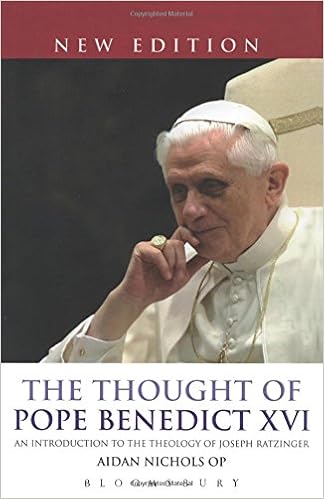
If the intentions were honest, it is a fact that, even apart from psychoanalysis of Luther’s immoderate temperament, “The road to Hell is paved with good intentions.” That aphorism is a variant of Vergil: facilis descensus Averno. According to Johannes Aurifaber, the last words penned by Luther on February 17 in 1546, the day before he died, were in praise of Vergil’s Aeneid. Luther wrote his lines in the same dactylic hexameters Vergil used; but more poignantly, the warning about good intentions paving the road to Hell was given by Saint Bernard of Clairvaux who was a moral hero and spiritual giant in Luther’s estimation. As a profound scholar of the Wittenberg reformer, Pope Benedict XVI gave Luther his due especially for parts of the German catechisms, but, he also held, as Father Aidan Nichols has written in his

US HERE – UK HERE

The Theology of Joseph Ratzinger,

that Luther was a “radical theologian and polemicist whose particular version of the doctrine of justification by faith is incompatible with a Catholic understanding of faith as co-believing with the whole Church, within a Christian existence composed equally of faith, hope, and charity.” 

[…]

In various ways, Islam and the Protestant schools had some affinities. Recognizing Islam as an Arian heresy, Luther thought that any Pope of Rome was worse than the Prophet of Medina. Theologically, Allah as pure will had a certain cogency for Luther who called Reason “that pretty whore.” After Luther, once marriage was described as a non-sacramental civil union, divorce could be a reasonable solution, albeit with more strictures than in Islam. Luther saw no problem with Henry VIII taking a second wife, just as he had advised Philip of Hesse. There was something of a scandal when it was found out that Luther had told Philip to lie about his bigamy, but the logic was consistent with the Shi’a practice of “taqiyya,” or lying to promote the faith.

[…]

There is more to this Must Read™.

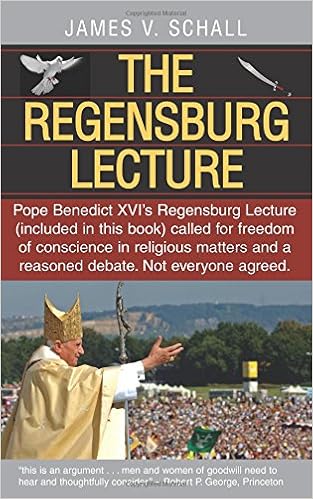
You might also want to read about Benedict XVI’s amazing Regensburg Address.

US HERE – UK HERE

Posted in Benedict XVI, Hard-Identity Catholicism, Mail from priests, The Drill, The Religion of Peace | Tagged , ,
17 Comments

Bp. Morlino (D. Madison) will say Sunday Masses ‘ad orientem’

Francis_Ad_Orientem

“We become a mighty army marching toward the place of the rising sun to meet the Lord led by the priest. That’s who we really are. As we offer the Eucharistic sacrifice, we march together toward the East to go run and meet the Lord who comes from the East at the end of history.

Now, no general ever led his troops by facing them and walking backwards. He would trip pretty soon. And if he’s built like me, it would be particularly not pretty.”

His Excellency Most Reverend Robert C. Morlino, the Extraordinary Ordinary, the Bishop of Madison, has announced that he is going to say Holy Mass ad orientem at the church of the Cathedral parish.

NB: The Cathedral of Madison burned down some years ago and so the Bishop has been using a downtown church that was clustered with the Cathedral for his regular Sunday Mass.

Here is the Bishop’s sermon.  Note how he weaves in reflection also on the Four Last Things.

Just after 8:00 in the sermon he starts to speak about the change to Masses ad orientem.

Play

CLICK!


Posted in Liturgy Science Theatre 3000, Turn Towards The Lord | Tagged , ,
12 Comments