Of Islamic Terror, Anniversaries and You

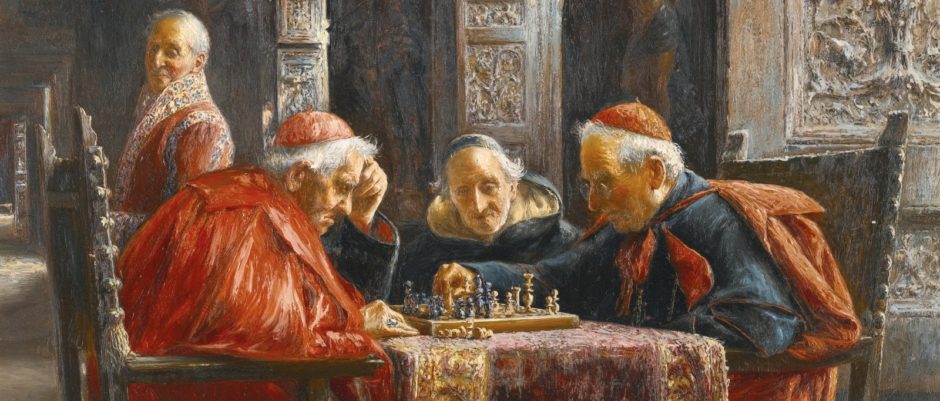
LepantoYesterday, the Vigil of Peter and Paul, was the 2nd anniversary of ISIS (which Pres. Obama  – what a guy – called the “JV team”) declaring a “caliphate”.

Dates are important to Christians.  Dates are important to Islamic terrorists.  They attack on anniversaries.  Attack are also up since this years “Holy Month” of Ramadan began.  “Holy”…? The “Bloody Month” of Ramadan.  So far the count is 181 attacks, nearly 1,300 people dead. HERE

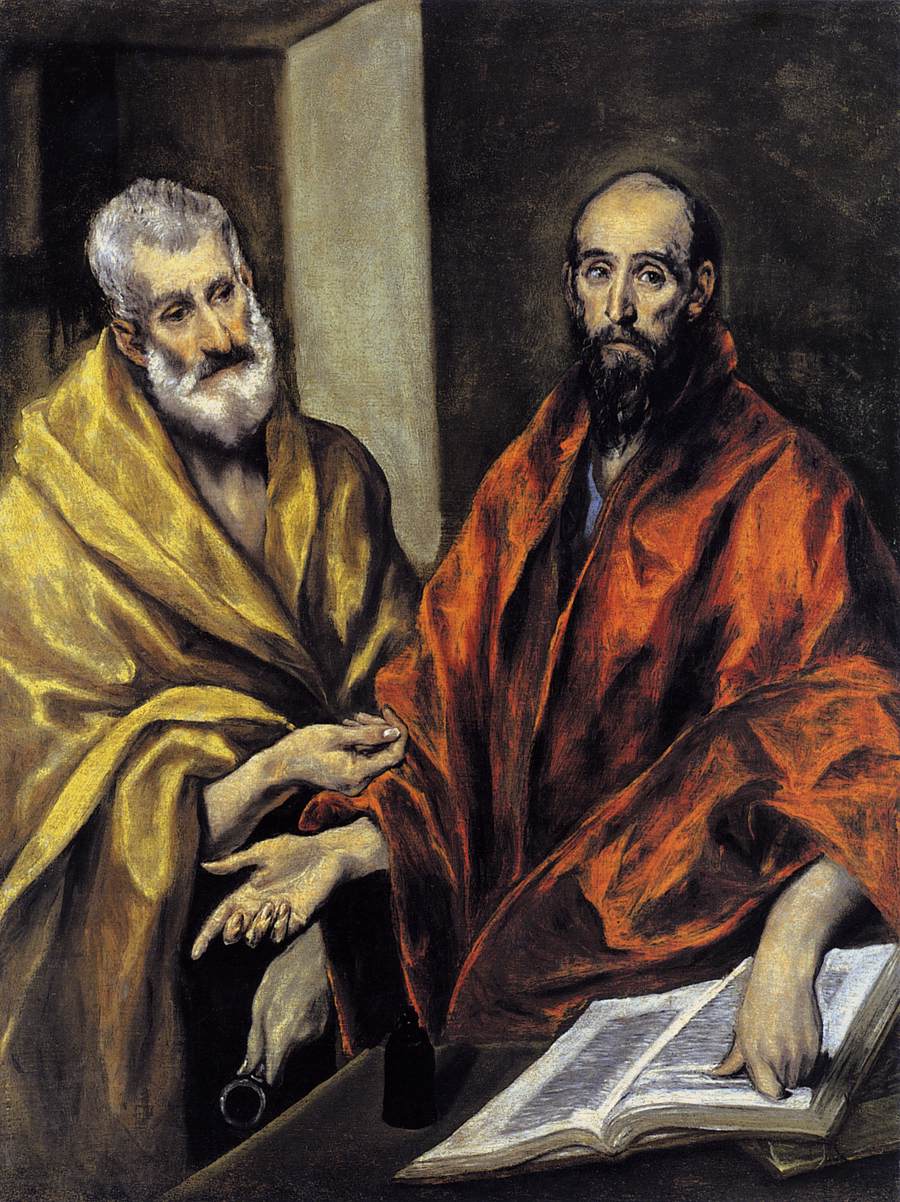
Today I read the Letter of the Ecumenical Patriarch of Constantinople, Bartholomew I, to Pope Francis for Peter and Paul. He wrote: “In concelebrating with You the venerable memory of the Chief among the Apostles Peter and the Apostle to the Gentiles Paul, who were martyred in Your See and honored greatly by the Elder as well as the New Rome, ….”

Yesterday, ISIS terrorist practitioners of the Religion of Peace murdered innocent people in Istanbul, aka Constantinople, aka the Second Rome or New Rome.

There may be, probably are, other reasons for these whack-jobs to attack in an Islamic nation Turkey, where their leader is pushing toward sharia law.  That makes sense, right?

ISIS has said that it will attack Rome.  Do we believe them? Think about it.  They must attack Rome.  It’s symbolic of everything they are about.

Moreover, today there met the “leaders” of these USA, Canada and Mexico (whence are rushing into these USA who knows who).  Brexit took place a few days ago.  The EU is shredding.  Istanbul was attacked.  These brain-trusts led off with global warming and butterflies.

Meanwhile, the Bloody Month of Ramadan continues until 5 July, a day after an important anniversary in these USA.

Dear readers, this is coming to a town near you.  Don’t brush this off with a shrug, saying, “It’ll never happen here.”   Bad things always happen to someone else … until they happen to you.

But don’t worry!   The Obama Administration says that ISIS is on the run!  HERE

Finally, another important date is 13 October 2017.

UPDATE:

Attacks have me thinking.

I often beg you to be aware of your surroundings.

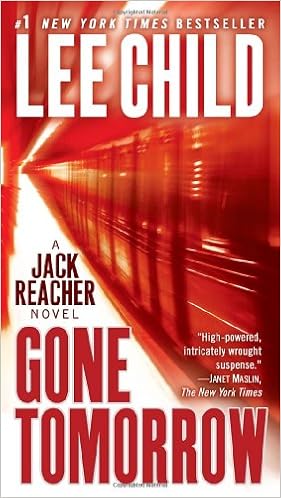
There came into my mind one of the Jack Reacher books by Lee Child, Gone Tomorrow (UK HERE).


If you want to read what I am talking about, click HERE.  ABC posted the first chapter, free to read.

They posted it on 29 June 2009.

WARNING: If you get hooked on Jack Reacher novels, blame Lee Child, not Fr. Z.

Here is the first part of the excerpt:

Chapter One

Suicide bombers are easy to spot. They give out all kinds of tell-tale signs. Mostly because they’re nervous. By definition they’re all first-timers.

Israeli counterintelligence wrote the defensive playbook. They told us what to look for. They used pragmatic observation and psychological insight and came up with a list of behavioral indicators. I learned the list from an Israeli amy captain twenty years ago. He swore by it. Therefore I swore by it too, because at the time I was on three weeks’ detached duty mostly about a yard from his shoulder, in Israel itself, in Jerusalem, on the West Bank, in Leb anon, sometimes in Syria, sometimes in Jordan, on buses, in stores, on crowded sidewalks. I kept my eyes moving and my mind running free down the bullet points.

Twenty years later I still know the list. And my eyes still move. Pure habit. From another bunch of guys I learned another mantra: Look, don’t see, listen, don’t hear. The more you engage, the longer you survive.

The list is twelve points long if you’re looking at a male suspect. Eleven, if you’re looking at a woman. The difference is a fresh shave. Male bombers take off their beards. It helps them blend in. Makes them less suspicious. The result is paler skin on the lower half of the face. No recent exposure to the sun.

But I wasn’t interested in shaves.

I was working on the eleven-point list.

I was looking at a woman.

I was riding the subway, in New York City. The 6 train, the Lexington Avenue local, heading uptown, two o’clock in the morning.

[…]


Posted in Semper Paratus, Si vis pacem para bellum!, The Coming Storm, The Drill, The future and our choices, The Religion of Peace | Tagged , , , ,
17 Comments

SSPX Communique: We do “not seek ‘primarily’ a canonical recognition”

A Communique from the SSPX’s chief, Bp. Bernard Fellay, with my now oft-imitated, legendary treatment:

At the conclusion of the meeting of the major superiors of the Society of Saint Pius X that was held in Switzerland, from June 25 to 28, 2016, the Superior General addressed the following communiqué:

The purpose of the Society of Saint Pius X [NB] is chiefly the formation of priests, the essential condition for the renewal of the Church and for the restoration of society.

  1. In the great and painful confusion that currently reigns in the Church, the proclamation of Catholic doctrine requires the denunciation of errors that have made their way into it and are unfortunately encouraged by a large number of pastors, [NB] including the Pope himself.
  2. The Society of Saint Pius X, in the present state of grave necessity which [here’s the old “state of emergency” argument] gives it the right and duty to administer spiritual aid to the souls that turn to it, does not seek primarily a canonical recognition, [primarily… they said – above – their “chief” purpose is formation of priests and they follow with another “desire”] to which it has a right as a Catholic work. It has only one desire: faithfully to bring the light of the bi-millennial Tradition which shows the only route to follow in this age of darkness in which the cult of man replaces the worship of God, in society as in the Church.   [Which goal we should all embrace.]
  3. The “restoration of all things in Christ” intended by Saint Pius X, following Saint Paul (cf. Ep.h 1:10), cannot happen without the support of a Pope who concretely favors the return to Sacred Tradition. While waiting for that blessed day, the Society of Saint Pius X intends to redouble its efforts to establish and to spread, with the means that Divine Providence gives to it, the social reign of Our Lord Jesus Christ. [This sounds as if they won’t agree to any kind of unity until this or a future Pope behaves in the way they determine is acceptable.  Peter must conform to their expectations.]
  4. The Society of Saint Pius X prays and does penance for the Pope, that he might have the strength to proclaim Catholic faith and morals in their entirety. [Do I hear an “Amen!”?] In this way he will hasten the triumph of the Immaculate Heart of Mary that we earnestly desire as we approach the centennial of the apparitions in Fatima.  [Which date, as it approaches, seems to be more and more important.]

Bishop Bernard Fellay, Superior General of the Society of Saint Pius X
Ecône, June 29, 2016
The Feast of Saints Peter and Paul

So, we will keep our eyes on the SSPX with hope and we will pray for improved conditions for manifest unity.  What a great day that will be.

Prayer can accomplish a great deal, friends.  God grants many amazing things through our prayers and mortifications.  But we have to ask.

Posted in "How To..." - Practical Notes, SSPX | Tagged ,
54 Comments

Wherein Pope Francis wears a maniple and kisses the foot of his predecessor

From a reader…

I have been watching the Holy Father offer Mass for the feast of St. Peter and St. Paul. It appears that he is wearing a maniple! HERE

I first notice it at 31:32.

Okay… let’s have a look. I provide the readership with a helpful arrow.

16_06_29_Francis_maniple_01

And…

16_06_29_Francis_maniple_02

Noooo… as nice as the thought is, His Holiness of Our Lord has managed to get his arm under his stole, which he raised up when he raised the book.  That happens once in a while when priests wear limp, floppy, drooping vestments.

However, in the first photo, above, note that the dalmatic is decorated with the coat-of-arms of Francis’ predecessor Benedict XVI.  Francis also wore a stole of Benedict when he was in Armenia.

Meanwhile, after Mass today Pope Francis kissed the foot of his predecessor!

16_06_29_Francis_maniple_03

Noooo… as nice as the thought is, Francis did not kiss Benedict’s foot.

16_06_29_Francis_maniple_04

He went to venerate the image of St. Peter made by Arnulfo di Cambio.  It is good to see the tiara.   They used to put a camicia griccia on the statue, but that’s long gone now.

Posted in Benedict XVI, Francis, Lighter fare, Liturgy Science Theatre 3000 | Tagged
14 Comments

28 June – Vigil of Sts. Peter and Paul: Firm upon the Rock of Apostolic Faith

During this Fortnight For Freedom we observe (not celebrate!) the Vigil of the Feast of Sts. Peter and Paul.

Vigils in the liturgical calendar are not just reminders that tomorrow is a feast.  They are also reminders to prepare for the feast!  We do penance.  We especially do penance because of the horrid recent SCOTUS decisions which undermine religious liberty.

In the Extraordinary Form here is the Collect:

Præsta, quaesumus, omnípotens Deus: ut nullis nos permíttas perturbatiónibus cóncuti; quos in apostólicæ confessiónis petra solidásti.

Which is:

Grant, we beseech You, almighty God, that we, whom You have made firm upon the rock of apostolic faith, may not be shaken by any distresses.

We stand upon the Rock who is Peter…. or… we… DON’T.

In the meantime, I love the Introit (John 21:18-19):

The Lord said to Peter, When you were young you girded yourself and walked where you would. But when you are old you will stretch forth your hands, and another will gird you, and lead you where you would not.Now this He said to signify by what manner of death he should glorify

Amen. And Amen.

Remember that tomorrow you can gain an indulgence (pretty easy to do in this Year of Mercy, anyway).

N.17—The faithful who use with devotion an object of piety (crucifix, cross, rosary, scapular or medal) properly blessed by any priest, can acquire a partial indulgence.

But if this object of piety is blessed by the Supreme Pontiff or any bishop, the faithful who use it devoutly can also acquire a plenary indulgence on the feast of the holy Apostles Peter and Paul, provided they also make a profession of faith using any legitimate formula.

Posted in "How To..." - Practical Notes, Liturgy Science Theatre 3000, WDTPRS | Tagged , , ,
9 Comments

VIDEO – Nigel Farage, who spearheaded Brexit, addressed European Parliament

You might find this interesting. Nigel Farage, who spearheaded Brexit, addressed European Parliament.

Below is part of the transcript Farage’s speech to the European Parliament on 28 June (FULL HERE):

Isn’t it funny? When I came here 17 years ago and I said that I wanted to lead a campaign to get Britain to leave the European Union, you all laughed at me – well I have to say, you’re not laughing now, are you? The reason you’re so upset, you’re so angry, has been perfectly clear, from all the angry exchanges this morning.

You as a political project are in denial. You’re in denial that your currency is failing. Just look at the Mediterranean! As a policy to impose poverty on Greece and the Mediterranean you’ve done very well.

You’re in denial over Mrs. Merkel’s call for as many people as possible to cross the Mediterranean – which has led to massive divisions between within countries and between countries.

The biggest problem you’ve got and the main reason the UK voted the way it did is because you have by stealth and deception, and without telling the truth to the rest of the peoples of Europe, you have imposed upon them a political union. When the people in 2005 in the Netherlands and France voted against that political union and rejected the constitution you simply ignored them and brought the Lisbon treaty in through the back door.

What happened last Thursday was a remarkable result – it was a seismic result. Not just for British politics, for European politics, but perhaps even for global politics too.

[…]

What I’d like to see is a grownup and sensible attitude to how we negotiate a different relationship. I know that virtually none of you have never done a proper job in your lives, or worked in business, or worked in trade, or indeed ever created a job. But listen, just listen.

[…]

Interesting.

Meanwhile…

Posted in The Coming Storm, The future and our choices | Tagged , , ,
27 Comments

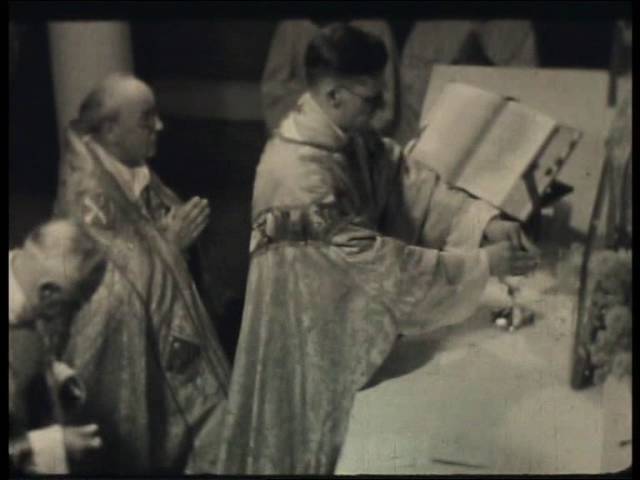
Video of a 1st Mass in 1954

One of you kind readers sent me a link to a video of the 1st Mass on Trinity Sunday in 1954 of Fr. Gerald Coates.  The video was posted by the Tower Convent School (in West Sussex, founded in 1903 by the Sisters Of The Blessed Sacrament).

You may want to mute your audio.

What may strike you, if you know the Extraordinary Form, is how consistent our liturgical worship was then and still is now.

YouTube thumbnailYouTube icon

It would be interesting to know what became of Fr. Coates, whether he is still among the living or not. Say a prayer for him, either way.

Posted in Liturgy Science Theatre 3000, Mail from priests, Our Catholic Identity, Priests and Priesthood | Tagged
11 Comments

The assault on religious liberty continued today at SCOTUS

The assault on religious liberty, indeed on the first two Amendments, continues today with another SCOTUS decision.

From LifeSite:

Just one day after issuing a major ruling striking down a portion of a pro-life law in Texas saving thousands of babies from abortion and closing unscrupulous abortion clinics, the Supreme Court has made a second anti-life decision.

Today, the nation’s highest court refused to hear an appeal from pro-life pharmacists in Washington state who are challenging a state law forcing them to sell the morning after pull and abortion-causing drugs that violate their conscience as Christians instead of allowing them to refer customers to nearby pharmacies.

A pro-life family that runs pharmacies in Washington State has been at the center of an epic battle over religious rights for years. In 2007, abortion activists convinced the Washington Board of Pharmacy to pass regulations that force pharmacists in the state to dispense abortion causing drugs. This caused a major dilemma for the Stormans family, owners of a third-generation pharmacy. Their religious convictions prevented them from selling drugs that destroy innocent human life. Yet the State insisted they do so.

[…]

Justice Samuel Alito, joined by Chief Justice John Roberts and Justice Clarence Thomas, dissented from the denial and would have agreed to hear the case. They wrote:

“This case is an ominous sign. At issue are Washington State regulations that are likely to make a pharmacist unemployable if he or she objects on religious grounds to dispensing certain prescription medications. [“unemployable” That’s indeed ominous.  “And he shall make all, both little and great, rich and poor, freemen and bondmen, to have a character in their right hand, or on their foreheads. And that no man might buy or sell, but he that hath the character, or the name of the beast, or the number of his name.”] There are strong reasons to doubt whether the regulations were adopted for—or that they actually serve—any legitimate purpose. And there is much evidence that the impetus for the adoption of the regulations was hostility to pharmacists whose religious beliefs regarding abortion and contraception are out of step with prevailing opinion in the State. Yet the Ninth Circuit held that the regulations do not violate the First Amendment, and this Court does not deem the case worthy of our time. If this is a sign of how religious liberty claims will be treated in the years ahead, those who value religious freedom have cause for great concern…. Ralph’s has raised more than ‘slight suspicion’ that the rules challenged here reflect antipathy toward religious beliefs that do not accord with the views of those holding the levers of government power. I would grant certiorari to ensure that Washington’s novel and concededly unnecessary burden on religious objectors does not trample on fundamental rights.”

Read the rest there.

Posted in Emanations from Penumbras, The Coming Storm, The future and our choices | Tagged ,
13 Comments

Benedict XVI’s address for his 65th anniversay, Francis’ response

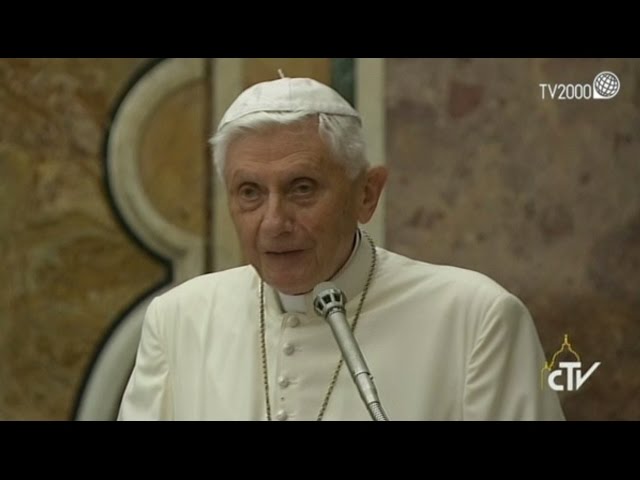
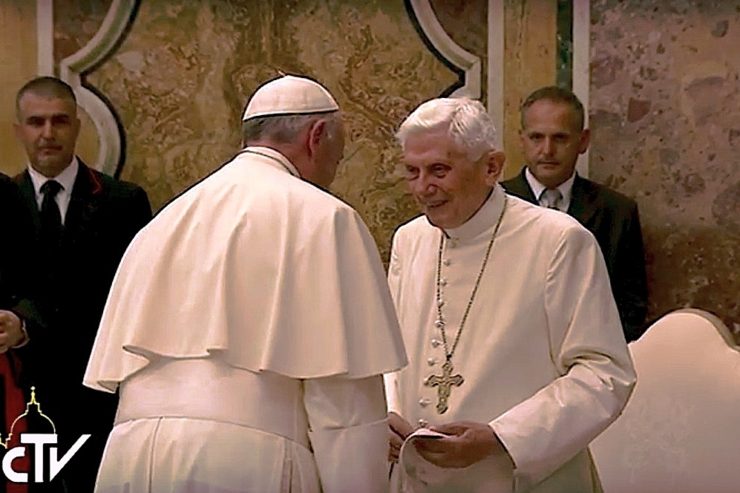
Benedict XVI, cent’anni, doesn’t appear in public very often.  He just gave his first public address since his resignation in the Sala Clementina (alas, not from the central, raised chair). Benedict appeared on the occasion of his 65th anniversary of ordination to the priesthood.

YouTube thumbnailYouTube icon

From CNA:

.- On Tuesday Benedict XVI gave his first public speech since his final day as Pope, expressing gratitude for a lengthy priesthood and for Pope Francis’ “goodness,” which he said moves him deeply.

Speaking to Pope Francis and the College of Cardinals gathered inside the Vatican’s small Clementine Hall for the 65th anniversary of his priestly ordination, Benedict said the Greek word “Efkaristomen (let us give thanks),” expresses “all that there is to say” for the occasion. [That smacks of Modern Greek.  Better is eukaristomen.  In his address, Benedict said both versions.]

“Thank you, thank you everyone! Thank you Holy Father – your goodness, from the first day of your election, every day of my life here moves me interiorly, brings me inwardly more than the Vatican Gardens.”

“Your goodness is a place in which I feel protected,” he said, and voiced his hope that Francis would be able to “move forward with all of us on this path of Divine Mercy, showing Jesus’ path to God.” [Very gracious.]

Since his resignation from the papacy in 2013, Benedict XVI has made only a handful of public appearances, none of which he spoke at. The celebration inside the Vatican Palace, then, marks not only another rare public appearance, but also the first time he has spoken in public since his resignation Feb. 28, 2013.

The June 28 celebration was held for Benedict in honor of the 65th anniversary of his ordination as a priest, which took place June 29, 1951 – the feast of Saints Peter and Paul – in the cathedral of Freising. His older brother Georg, who is still living today and was present for the ceremony, was ordained with him.

After the choir singing sacred polyphony had finished, Benedict listened to brief speeches made by Pope Francis; Cardinal Angelo Sodano, Dean of the College of Cardinals, and Cardinal Gerhard Muller, Prefect of the Congregation for the Doctrine of the Faith.

Cardinal Muller gifted [ = gave] Benedict several copies of a book containing his homilies on the priesthood printed specifically for the occasion of his anniversary. Benedict in turn gave one to Pope Francis.

In his brief, off-the-cuff speech, Benedict thanked both Cardinal Sodano and Cardinal Muller for their speeches, and for the book. [And he didn’t say anything confusing.]

He told Cardinal Sodano that his address, which quoted scripture from the day of Benedict’s ordination and his speech during his visit to Freising in 2006, “truly touched my heart.”

Benedict then returned to the word “Efkaristomen (let us give thanks),” which he recalled a fellow priest ordained on the same day had written on the memorial card for his first Mass.

This word, he said, hints not only at “the dimensions of human thanksgiving,” but also “the deepest word that is hidden,” and which appears in both the liturgy and Scripture in the expression “gratias agens benedixit fregit deditque,” meaning “having given thanks, he broke it and gave it.”

“Efkaristomen sends us again to that reality of thanksgiving, to that new dimension that Christ has given,” Benedict said, explaining that Jesus has transformed into thanksgiving “the cross, suffering and all of the evil in the world.”

In doing so, Jesus “fundamentally transubstantiated” life and the world, he said, adding that the Lord both has given and continues to give us daily “the bread of true life, which overcomes the world thanks to the strength of his love.”

Benedict closed his address by expressing his hope that all would, with the help of God, help in the “transubstantiation of the world: that it be a world not of death, but of life; a world in which love has overcome death.”

In his brief speech, Pope Francis told Benedict that “you continue to serve the Church, you do not cease to really contribute with vigor and wisdom to her growth.”

By contributing to the Church and her mission from the small monastery of Mater Ecclesiae inside the Vatican, Benedict represents “anything but these forgotten corners in which today’s culture of waste tends to relegate people when, with age, their strength becomes less,” Francis said.

He prayed that the retired Pope would continue to feel the hand of “the merciful God who supports you,” that he would continue to both experience and bear witness to the love of God, and that alongside Peter and Paul, he would “continue to exult with great joy while walking toward the goal of our faith.”

From ZENIT comes the English translation of Francis’ address to Benedict:

Holiness, [i.e., Benedict]

Today we celebrate the history of a call that began sixty-five years ago with Your Priestly Ordination, which took place in the Cathedral of Freising on June 29, 1951. But what is the underlying note that runs through this long history and that from that first beginning up to today dominates it ever more?

In one of the many beautiful pages that you dedicate to the priesthood, you underscore how, at the hour of Simon’s definitive call, Jesus, looking at him, basically asks him only one thing: “Do you love me?” How beautiful and true this is! Because it is here, you tell us, it is in that “do you love me,” that the Lord founded the feeding, because only if there is love for the Lord can He feed through us: “Lord, you know everything; you know that I love you” (John 21:15-19). This is the note that dominates a whole life spent in priestly service and true theology that you have not accidentally described as “the search for the Beloved”; it is this that you have always witnessed and still witness today: that the decisive thing in our day – of sun or rain – that alone with which all the rest comes, is that the Lord be truly present, that we desire Him, that we be close to Him interiorly, that we love Him, that we truly believe profoundly in Him and believing that we truly love Him. It is this loving that truly fills our heart, this believing is what makes us walk safely and calmly on the waters, even in the midst of a storm, in fact as happened to Peter; this loving and this believing is what enables us to look to the future, not with fear and nostalgia, but with gladness, also in the now advanced years of our life.

And so, precisely by living and witnessing today, in such an intense and luminous way, this only truly decisive thing – to have our gaze and heart turned to God – you, Holiness, continue to serve the Church, do not cease to truly contribute with vigor and wisdom to her growth; and you do so from that small Mater Ecclesiae Convent in the Vatican, which reveals itself to be altogether something other than one of those forgotten corners in which the disposable culture of today tends to relegate individuals when, with age, their strength fails. It is altogether the opposite; and allow your Successor to say this forcefully, who chose to call himself Francis! Because Saint Francis’ spiritual journey began at San Damiano, but the true place he loved, the beating heart of the Order, there where he founded it and where finally he rendered his life to God was the Porziuncola, the “small portion,” the little corner near the Mother of the Church; near Mary that, because of her very firm faith and her living so entirely of love and in love with the Lord, all generations call Blessed. Thus, Providence willed that you, dear Brother arrive in a place so to speak precisely “Franciscan” from which emanates a tranquillity, a peace, a strength, a trust, a maturity, a faith, a dedication and a fidelity that do me so much good and give strength to me and to the whole Church.

The wish with which I desire to conclude is therefore a wish that I address to you and together with all of us and with the entire Church: that you, Holiness, be able to continue feeling the hand of the merciful God that supports you, that you be able to experience and witness to us the love of God; that, with Peter and Paul, you be able to continue to exult with great joy while you journey toward the goal of the faith (cf. 1 Peter 8-9; 2 Timothy 4)!

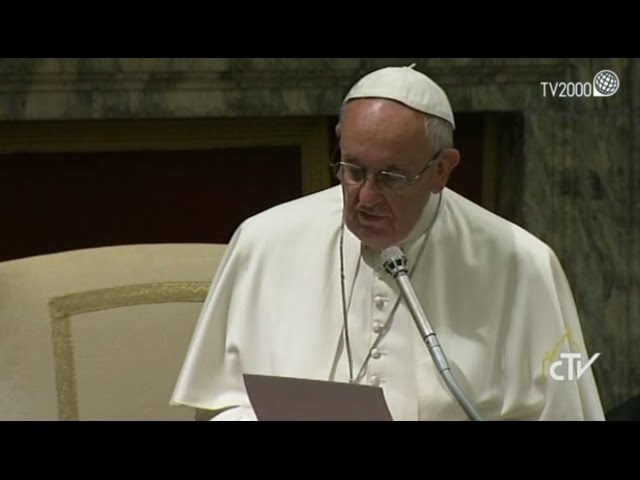
Here is Francis’ discourse/response.
YouTube thumbnailYouTube icon

Posted in Benedict XVI | Tagged ,
18 Comments

Quotes from Justice Thomas’ dissent in WHOLE WOMAN’S HEALTH v. HELLERSTEDT

Justice Clarence Thomas dissented today.

In his dissent to the SCOTUS majority opinion in WHOLE WOMAN’S HEALTH v. HELLERSTEDT Thomas wrote about the false principles they are using, and have been using.

Here are a few excerpts from his 16 page dissent:

Ultimately, this case shows why the Court never should have bent the rules for favored rights in the first place. Our law is now so riddled with special exceptions for special rights that our decisions deliver neither predictability nor the promise of a judiciary bound by the rule of law.

[…]

The majority’s furtive reconfiguration of the standard of scrutiny applicable to abortion restrictions also points to a deeper problem. The undue-burden standard is just one variant of the Court’s tiers-of-scrutiny approach to constitutional adjudication. And the label the Court affixes to its level of scrutiny in assessing whether the government can restrict a given right—be it “rational basis,” intermediate, strict, or something else—is increasingly a meaningless formalism. As the Court applies whatever standard it likes to any given case, nothing but empty words separates our constitutional decisions from judicial fiat.
Though the tiers of scrutiny have become a ubiquitous feature of constitutional law, they are of recent vintage.Only in the 1960’s did the Court begin in earnest to speak of “strict scrutiny” versus reviewing legislation for mere rationality, and to develop the contours of these tests. See Fallon, Strict Judicial Scrutiny, 54 UCLA L. Rev. 1267, 1274, 1284–1285 (2007). In short order, the Court adopted strict scrutiny as the standard for reviewing everything from race-based classifications under the Equal Protection Clause to restrictions on constitutionally protected speech. Id., at 1275–1283. Roe v. Wade, 410 U. S. 113, then applied strict scrutiny to a purportedly “fundamental” substantive due process right for the first time. Id., at 162– 164; see Fallon, supra, at 1283; accord, Casey, supra, at 871 (plurality opinion) (noting that post-Roe cases interpreted Roe to demand “strict scrutiny”).

At about this point in the post you might need some.

Then the tiers of scrutiny proliferated into ever more gradations. See, e.g., Craig, 429 U. S., at 197–198 (intermediate scrutiny for sex-based classifications); Lawrence v. Texas, 539 U. S. 558, 580 (2003) (O’Connor, J., concurring in judgment) (“a more searching form of rational basis review” applies to unpopular group”); Buckley v. Valeo, 424 U. S. 1, 25 (1976) (per curiam) (applying “‘closest scrutiny’” to campaign-finance contribution limits). Casey’s undue-burden test added yet another right-specific test on the spectrum between rational-basis and strict-scrutiny review.
The illegitimacy of using “made-up tests” to “displace longstanding national traditions as the primary determinant of what the Constitution means” has long been apparent. United States v. Virginia, 518 U. S. 515, 570 (1996) (Scalia, J., dissenting). The Constitution does not prescribe tiers of scrutiny. The three basic tiers— “rational basis,” intermediate, and strict scrutiny—“are no more scientific than their names suggest, and a further element of randomness is added by the fact that it is largely up to us which test will be applied in each case.” Id., at 567; see also Craig, supra, at 217–221 (Rehnquist,J., dissenting).
But the problem now goes beyond that. If our recent cases illustrate anything, it is how easily the Court tinkers with levels of scrutiny to achieve its desired result. …

[…]

Eighty years on, the Court has come full circle. The Court has simultaneously transformed judicially created rights like the right to abortion into preferred constitutional rights, while disfavoring many of the rights actually enumerated in the Constitution. But our Constitution renounces the notion that some constitutional rights are more equal than others. A plaintiff either possesses the constitutional right he is asserting, or not—and if not, the judiciary has no business creating ad hoc exceptions so that others can assert rights that seem especially important to vindicate. A law either infringes a constitutional right, or not; there is no room for the judiciary to invent tolerable degrees of encroachment. Unless the Court abides by one set of rules to adjudicate constitutional rights, it will continue reducing constitutional law to policy-driven value judgments until the last shreds of its legitimacy disappear.

* * *

Today’s decision will prompt some to claim victory, just as it will stiffen opponents’ will to object. But the entire Nation has lost something essential. The majority’s embrace of a jurisprudence of rights-specific exceptions and balancing tests is “a regrettable concession of defeat—an acknowledgement that we have passed the point where‘law,’ properly speaking, has any further application.” Scalia, The Rule of Law as a Law of Rules, 56 U. Chi. L. Rev. 1175, 1182 (1989). I respectfully dissent.
[…]

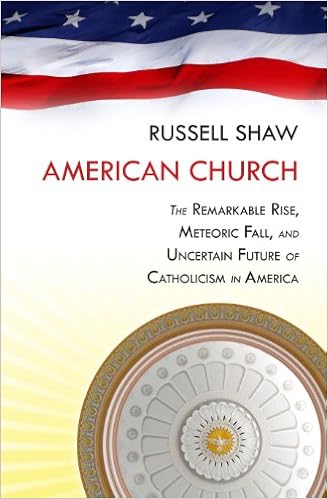
Meanwhile, I received a book which I am looking forward to digging into… after Thursday. Russell Shaw’s new book, American Church: The Remarkable Rise, Meteoric Fall, and Uncertain Future of Catholicism in America.

Posted in Emanations from Penumbras, The Coming Storm, The Drill | Tagged , ,
15 Comments

“Keep calm and carry on!”

I enjoyed my visits to Tokyo immensely.  Especially fun was coming up with captions for the public safety posters in the subway.

For example:

Not to be outdone, LA has this safety video.

YouTube thumbnailYouTube icon

Note that the other passenger looks down at the dismembered body, steps over the detached arm, and gets on the train.

One person on Twitter responded to me, “the very essence of keep calm and carry on”.


Posted in Lighter fare | Tagged , , , ,
3 Comments