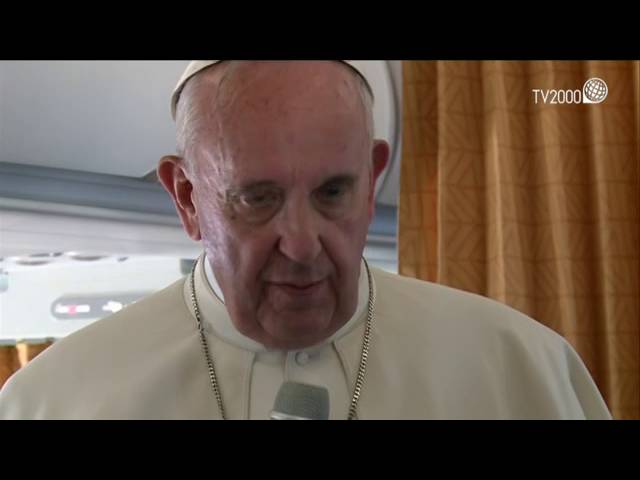
Pope Francis told journalists during the airplane presser on his return to Rome from Lesbos that to understand the controversial bit in Amoris laetitia Infamous Footnote 351 we should have recourse to Card. Schönborn’s address at the presentation of the Post-Synodal Exhortation on 8 April. A journalist asked the Pope if the document changed anything for divorced and remarried couples (who currently may not receive Communion).
The pope said (listen to the video):
I can say, yes. Period. But that would be too simple/small an answer. I recommend to you that you all read the presentation which Cardinal Schönborn gave, who is a great theologian. He was the secretary for the Congregation of the Doctrine of the Faith, [Ummm… no, he wasn’t. He was member, but never an official of the Congregation. He was a member of the ITC and was the editor for the CCC, but he was not in the CDF as an official.] and he knows the doctrine of the faith well. In that presentation, your question will be answered.
He said (emphasis mine):
I recommend to you that you all read the presentation which Cardinal Schönborn gave, …. In that presentation, your question will be answered.
Okay, Your Holiness. You ask. I hear. That’s what I am going to do.
Let’s make sure that others can read it, since it is that important.
For the exact words of the Cardinal, the video of the presentation is archived at http://www.radiovaticana.va/# for 8 April. It is also on YouTube (embedded below).
Schönborn begins at about… 00:27:00. Fr. Lombardi notes that the translations handed out to journalists were not official, were just working translations. I assume Schönborn wrote it in German, but I don’t know that. It was delivered in Italian, which I think we have to take as the official version. He makes some informal remarks at the beginning and then get’s into his prepared text. NB: Along the way Schönborn departs from his text and makes remarks aside.
Here is the English (working translation – over 3100 words in English!). I won’t try to insert all of his asides, but I capture the sense of a couple in red:
The evening of 13 March 2013, the first words of the newly-elected Pope Francis to the people gathered in St. Peter’s Square and throughout the world were: “Buona sera” – “Good evening”. The language and style of Pope Francis’ new text are as simple as this greeting. The Exhortation is not quite as brief as this simple salutation, but is similarly close to reality. In these 200 pages Pope Francis speaks about “love in the family”, and does so in such a concrete and simple way, with words that warm the heart like that good evening of 13 March 2013. This is his style, and it is his hope that aspects of life are spoken about in the most concrete way possible, especially with regard to the family, one of the most elementary realities of life.
It must be said that the documents of the Church often do not belong to one of the most accessible literary genres. This text of the Pope’s is readable, and those who are not dissuaded by its length will find joy in its concreteness and realism. Pope Francis speaks about families with a clarity that is not easy to find in the magisterial documents of the Church.
Before entering into the text itself I would like to say, in a very personal way, why I read it with joy, gratitude and always with strong emotion. In the ecclesial discourse on marriage and the family there is often a tendency, perhaps unconscious, to discuss these realities of life on the basis of two separate tracks. On the one hand there are marriages and families that are “regular”, that correspond to the rules, where everything is “fine” and “in order”, and then there are the “irregular” situations that represent a problem. Already the very term “irregular” suggests that such a distinction can be made very clearly.
Those, therefore, who find themselves on the side of the “irregular” families, must live with the fact that the “regular” families are on the other side. I am personally aware of how difficult that is for those who come from a “patchwork” family, due to the situation of my own family. The discourse of the Church in this regard may cause harm and can give the sensation of exclusion.
Pope Francis’ Exhortation is guided by the phrase “It is a matter of reaching out to everyone” (AL 297) as this is a fundamental understanding of the Gospel: we are all in need of mercy! “Let him who is without sin among you be the first to throw a stone” (John 8, 7). We are all, regardless of the marriage or family situation in which we find ourselves, are journeying. Even a marriage in which everything is “going well” is journeying. It must grow, learn, and overcome new phases. It knows sin and failure, and needs reconciliation and new beginnings, even in old age (cf. AL 297).
Pope Francis has succeeded in speaking about all situations without cataloguing them, without categorising, with that outlook of fundamental benevolence that is associated with the heart of God, with the eyes of Jesus that exclude no-one (cf. AL 297), that welcome all and grant the “joy of the Gospel” to all. This is why reading Amoris Laetitia is so comforting. No-one must feel condemned, no-one is scorned. In this climate of welcome, the discourse on the Christian vision of marriage and the family becomes an invitation, an encouragement, to the joy of love in which we can believe and which excludes no-one, truly and sincerely no-one. For me Amoris Laetitia is, first and foremost, a “linguistic event”, as was Evangelii gaudium. Something has changed in ecclesial discourse. This change of language was already perceptible during the Synod process. Between the two Synods of October 2014 and October 2015, it may clearly be seen how the tone became richer in esteem, as if the different situations in life had simply been accepted, without being immediately judged or condemned. In Amoris Laetitia this tone of language continues. Before this there is obviously not only a linguistic choice, but rather a profound respect when faced with every person who is never firstly a “problematic case” in a “category”, but rather a unique person, with his story and his journey with and towards God. In Evangelii gaudium Pope Francis said that we must take of our shoes before the sacred ground of others (EG 36). This fundamental attitude runs throughout the Exhortation. And it is also provides the most profound reason for the other two key words, to discern and to accompany. These words apply not only to the so-called “irregular situation” (Pope Francis underlines this “so-called”) but rather for all people, for every marriage and for every family. Indeed, we are all journeying and we are all in need of “discernment” and “accompaniment”.
My great joy as a result of this document resides in the fact that it coherently overcomes that artificial, superficial, clear division between “regular” and “irregular”, and subjects everyone to the common call of the Gospel, according to the words of St. Paul: “For God has consigned all to disobedience, that He may have mercy on all” (Rom. 11, 32).
This pervasive principle of “inclusion” clearly troubles some people. Does this not favour relativism? Does the frequently evoked mercy not become permissiveness” Does there no longer exist the clarity of limits that must not be exceeded, situations that must objectively be defined as irregular or sinful? Does this Exhortation favour a certain laxity, a sense that “anything goes”? Is Jesus’ mercy not instead often severe and demanding?
To clarify thus: Pope Francis leaves no doubt regarding his intentions or our task:
“As Christians, we can hardly stop advocating marriage simply to avoid countering contemporary sensibilities, or out of a desire to be fashionable or a sense of helplessness in the face of human and moral failings. We would be depriving the world of values that we can and must offer. It is true that there is no sense in simply decrying present-day evils, as if this could change things. Nor it is helpful to try to impose rules by sheer authority. What we need is a more responsible and generous effort to present the reasons and motivations for choosing marriage and the family, and in this way to help men and women better to respond to the grace that God offers them.” (AL 35).
Pope Francis is convinced that the Christian vision of marriage and the family also has an unchanged force of attraction. But it demands “a healthy dose of self-criticism”: “We also need to be humble and realistic, acknowledging that at times the way we present our Christian beliefs and treat other people has helped contribute to today’s problematic situation” (AL 36). “We have also proposed a far too abstract and almost artificial theological ideal of marriage, far removed from the concrete situations and practical possibilities of real families. This excessive idealization, especially when we have failed to inspire trust in God’s grace, has not helped to make marriage more desirable and attractive, but quite the opposite” (AL 36).
I would like to relate here an experience of last October’s Synod: as far as I know, two of the thirteen “circuli minores” started their work by first hearing an account from each participant of his own family situation. It soon emerged that almost all the bishops or other participants in the “circulus minor” had encountered, in their families, the themes, concerns and “irregularities” that we, in the Synod, have discussed in a rather too abstract way. Pope Francis invites us to speak about our own families “as they are”. And here the magnificent aspect of the Synod journey and of its continuation with Pope Francis: this sober realism of families “as they are” does not take us far at all from the ideal! On the contrary, Pope Francis succeeds, in the work of both Synods, to offer a positive outlook to families, profoundly rich in hope. But this encouraging outlook on families requires that “pastoral conversion” we find in Evangelii gaudium. The following text from Amoris Laetitia outlines this “pastoral conversion”:
“We have long thought that simply by stressing doctrinal, bioethical and moral issues, without encouraging openness to grace, we were providing sufficient support to families, strengthening the marriage bond and giving meaning to marital life. We find it difficult to present marriage more as a dynamic path to personal development and fulfilment than as a lifelong burden. We also find it hard to make room for the consciences of the faithful, who very often respond as best they can to the Gospel amid their limitations, and are capable of carrying out their own discernment in complex situations. We have been called to form consciences, not to replace them” (AL 37).
Pope Francis speaks of a profound trust in the hearts and the nostalgia of men. He expresses this very well in his reflection on education. Here we perceive the influence of the great Jesuit tradition in education in personal responsibility. He refers to two contrary dangers: “laissez-faire” and the obsession with controlling and dominating everything. On the one hand it is true that “Families cannot help but be places of support, guidance and direction, Vigilance is always necessary and neglect is never beneficial” (AL 260).
But vigilance can also become excessive: “Obsession, however, is not education. We cannot control every situation that a child may experience. … If parents are obsessed with always knowing where their children are and controlling all their movements, they will seek only to dominate space. But this is no way to educate, strengthen and prepare their children to face challenges. What is most important is the ability lovingly to help them grow in freedom, maturity, overall discipline and real autonomy” (AL 261). I consider this thought on education very enlightening in connection with the pastoral practice of the Church. Indeed, precisely in this sense Pope Francis often returns to the issue of trust in the conscience of the faithful: “We have been called to form consciences, not to replace them” (AL 37). The great question, obviously, is this: how do we form consciences? How do we arrive at what is the key concept of all this great document, the key to correctly understanding Pope Francis’ intentions: “personal discernment”, especially in difficult and complex situations? “Discernment” is a central concept in Ignatian exercises. Indeed, these must help to discern the will of God in the concrete situations of life. It is discernment that grants a person a mature character, and the Christian path should be of help in reaching this personal maturity: not forming automatons, externally conditioned and remote-controlled, but people who have matured in their friendship with Christ. Only when this personal “discernment” is mature is it also possible to arrive at “pastoral discernment”; which is important especially in “those situations that fall short of what the Lord demands of us” (AL 6). The eighth chapter refers to this “pastoral discernment”, a chapter likely to be of great interest not only to ecclesial public opinion, but also to the media.
I should however mention that Pope Francis has described Chapters 4 and 5 as central, not only in terms of their position but also their content. “we cannot encourage a path of fidelity and mutual self-giving without encouraging the growth, strengthening and deepening of conjugal and family love” (AL 89). These two central chapters of Amoris Laetitia will probably be skipped by many people keen to arrive at the so-called “hot potatoes”, the critical points. As a pedagogic expert, Pope Francis knows well that nothing attracts and motivates as strongly as the positive experience of love. “Speaking of love” (AL 89) . this clearly brings great joy to Pope Francis, and he speaks about love with great vivacity, comprehensibility and empathy. The fourth chapter is a broad-ranging comment on the “Hymn to charity” in the thirteenth chapter of the First Letter to the Corinthians. I recommend meditation on these pages to all. They encourage belief in love (cf. John 4, 16) and trust in its strength. It is here that growth, another key word in Amoris Laetitia, finds its main location: in no other place does it manifest itself so clearly, but it can also turn cold. I can only invite you to read and enjoy this wonderful chapter. I think it is important to indicate one aspect: Pope Francis speaks here, with rare clarity, of the role of the passions, passions, emotion, eros and sexuality in married and family life. It is not by chance that Pope Francis reconnects here with St. Thomas Aquinas, who attributes an important role to the passions, while modern society, often puritanical, has discredited or neglected them.
It is here that the title of the Pope’s exhortation finds its fullest expression: “Amoris Laetitia!” Here we understand how it is possible to “discover the dignity and beauty of marriage” (AL 205). But here it is made painfully visible how much harm wounds to love can cause, and how lacerating the experience of a failed relationship can be. Therefore it is unsurprising that it is largely the eighth chapter that has attracted attention and interest. Indeed, the question of how the Church treats these wounds, of how she treats the failure of love, has become for many a test question to understand whether the Church is truly the place where God’s Mercy can be experienced.
This chapter owes much to the intense work of the two Synods, to the extensive discussions in the arenas of public and ecclesial opinion. Here the fruitfulness of Pope Francis’ method is shown. He expressly wished for an open discussion on the pastoral accompaniment of complex situations, and has been able to fully base this on the two texts that the two Synods presented to him to show the possibility of “accompanying, discerning and integrating weakness” (AL 291).
Pope Francis explicitly makes his own the declarations that both Synods presented to him: “the Synod Fathers reached a general consensus, which I support” (AL 297). With regard to those who are divorced and civilly remarried, he states: “I am in agreement with the many Synod Fathers who observed that … the logic of integration is the key to their pastoral care. … Such persons need to feel not as excommunicated members of the Church, but instead as living members, able to live and grow in the Church and experience her as a mother who welcomes them always…” (AL 299).
But what does this mean in practice? Many rightly ask this question. The definitive answers are found in Amoris Laetitia, paragraph 300. These answers certainly offer material for further discussions, but they also provide an important clarification and an indication of the path to follow. “If we consider the immense variety of concrete situations … it is understandable that neither the Synod nor this Exhortation could be expected to provide a new set of general rules, canonical in nature and applicable to all cases”. Many expected such rules, and they will be disappointed. What is possible? The Pope says clearly: “What is possible is simply a renewed encouragement to undertake a responsible personal and pastoral discernment of particular cases”.
How this personal and pastoral discernment can and should be is the theme of the entire section of Amoris Laetitia constituted of paragraphs 300-312. In the 2015 Synod, in the Appendix to the statements by the Circulus germanicus an Itinerarium of discernment, of the examination of conscience that Pope Francis has made his own.
“What we are speaking of is a process of accompaniment and discernment which “guides the faithful to an awareness of their situation before God”. But Pope Francis also recalls that “this discernment can never prescind from the Gospel demands of truth and charity, as proposed by the Church”.
Pope Francis mentions two erroneous positions. One is that of excessive rigour: “a pastor cannot feel that it is enough simply to apply moral laws to those living in ‘irregular’ situations, as if they were stones to throw at people’s lives. This would bespeak the closed heart of one used to hiding behind the Church’s teachings” (AL 205). On the other hand, the Church must certainly never “desist from proposing the full ideal of marriage, God’s plan in all its grandeur” (AL 207).
Naturally this poses the question: what does the Pope say in relation to access to the sacraments for people who live in “irregular” situations? Pope Benedict had already said that “easy recipes” do not exist (AL 298, note 333). Pope Francis reiterates the need to discern carefully the situation, in keeping with St. John Paul II’s Familiaris consortio (84) (AL 298). “Discernment must help to find possible ways of responding to God and growing in the midst of limits. By thinking that everything is black and white, we sometimes close off the way of grace and of growth, and discourage paths of sanctification which give glory to God” (AL 205). He also reminds us of an important phrase from Evangelii gaudium, 44: “A small step, in the midst of great human limitations, can be more pleasing to God than a life which appears outwardly in order but moves through the day without confronting great difficulties” (AL 304). [S. inserted what he thinks is a key to read AL: experience of the poor, in their lives they experience the small steps on the way to virtue which can be larger than the successors of those more comfortable … He notes that Francis has a lot of experience with the poor.] In the sense of this “via caritatis” (AL 306), the Pope affirms, in a humble and simple manner, in a note (351) devethat the help of the sacraments may also be given “in certain cases”. [He also departed here, to point out that 351 adds something. In the text of AL we read that people in “irregular” situations must receive the help of the Church, and the Infamous Note adds “sacraments”.] But for this purpose he does not offer us case studies or recipes, but instead simply reminds us of two of his famous phrases: “I want to remind priests that the confessional should not be a torture chamber but rather an encounter with the Lord’s mercy” (EG 44), and the Eucharist “is not a prize for the perfect but a powerful medicine and nourishment for the weak” (EG 47).
Is it an excessive challenge for pastors, for spiritual guides and for communities if the “discernment of situations” is not regulated more precisely? Pope Francis acknowledges this concern: “I understand those who prefer a more rigorous pastoral care which leaves no room for confusion” (AL 308). However, he challenges this, remarking that “We put so many conditions on mercy that we empty it of its concrete meaning and real significance. That is the worst way of watering down the Gospel” (AL 311).
Pope Francis trusts in the “joy of love”. Love is able to find the way. It is the compass that shows us the road. It is both the goal and the path itself, because God is love and love is from God. Nothing is more demanding than love. It cannot be obtained cheaply. Therefore, no-one should be afraid that Pope Francis invites us, with Amoris Laetitia, to take too easy a path. The road is not an easy one, but it is full of joy!
[00532-EN.02] [Original text: Italian – working translation]
In the text for the presentation – that’s what the Pope asked us to check – the Cardinal does not talk about development of doctrine. There is no mention of novelties or new things. He doesn’t mention Newman. None of this is in the text as passed out before the presentation, nor in his actual delivery (watch the video).
Did the Pope also mean “Schönborn’s presentation and all his Q&A answers!”? I don’t know. But he didn’t say “Listen to what Schönborn says about Amoris laetitia.” He said read the presentation of Amoris laetitia.
So, what did Schönborn really say in the Q&A about development?
Here is the audio. In the video go to 1:48:30 ff.:
Podcast: Play in new window | Download
Subscribe: