Francis has left Church teaching on Communion for the divorced and remarried absolutely intact [Yes… but is that enough?]
Amoris Laetitia offers a compressive and eloquent, to the point of being lyrical at times, defence of the Catholic vision of marriage, Humanae Vitae and all.
While doctrinally packed, the pastoral concern of the document is no less intense. [“intense”…] At times, the tone is so personal as to read like a letter from one individual to another, [vintage Francis] and the concern of the Pope for married couples and families is palpable and most especially for young people being denied a formation in the true Christian understanding of marriage. [There’s a key point. Are people being formed in the Faith? If people are to exercise their consciences, are they doing so according to the mind of the Church (and not by prevailing worldly mores or a fantasy, deluded “mind” of the Church?]
But, as good as it is, the real expectation surrounding this exhortation was not[not] about what it would say about married couples but rather divorced and remarried couples, discussion of whom dominated the media coverage of both sessions of the Synod on the Family. [And other “irregular” couples, mind you.]
What we all wanted to know, really, was where the Pope would come down on the so-called Kasper proposal of allowing those in second, sacramentally invalid, marriages [adulterers] to receive Communion, even though their second unions are technically adulterous. [technically and in fact adulterous]
It was suggested that a “penitential path” could be found, whereby couples in this situation would, through personal reflection and internal forum conversations with their priest, progress towards the reception of Communion. [The Tolerate But Not Accepted Kasperian Approach.]
In fact, Amoris Laetitia shamelessly adopts the Kasper methodology of intimate and intense pastoral guidance but[BUT] the goal is no longer their eventual reception of Communion, but instead a deeper and more mature understanding by the couple of their situation in the light of the Church’s teaching. [Yes… this is sort of fair. However, then human nature kicks in and liberals toss out the teaching part in favor of a mercy emptied of content.]
In the eighth chapter, [sigh] entitled Accompanying, Discerning, and Integrating Weakness, Pope Francis revisits the important distinction between the “law of gradualness” and “gradualness of the law” and, like St John Paul II before him, makes clear that while individual circumstances, understanding, and intentions can mitigate the culpability of a person, it cannot detract from the objective seriousness of a situation of sin, still less render it good.
The key to Amoris Laetitia’s treatment of the divorced and civilly remarried is the recognition that every marriage, and certainly every broken marriage, is unique. In line with his own image of the Church as a hospital, the intimate process of pastoral discernment outlined by the document represents a profound period of diagnosis, where the individual’s reality, and pastoral needs, can become clear. [Diagnosis is a first step. And we all acknowledge that the one seeking the proper diagnosis not be a cold-hearted, clinical machine.]
The first goal of this period of pastoral discernment is, according to Pope Francis, to provide a solid mechanism for welcoming those in irregular situations into the Church; a welcome that needs to be as individual as the person and their situation and which reflects that, whatever their circumstances, the parish is the proper home of every Christian. [So far so good! Who will object to that? And I’ll be most parishes are that way. Can they perhaps improve? Probably. But I don’t know of places where parishes and priests are as insensitive as this Letter perhaps (or some people behind the Letter) assume.]
Pope Francis repeats, again and again, that couples in irregular unions are not excommunicated, they are not, in the language of the old code of canon law, the vitandi – those to be shunned. On the contrary, their presence and participation in the life of the parish is essential, how else are they to be helped?
The second purpose of the period of pastoral discernment is to allow for the person to be met exactly where they are and genuinely accompanied along a period of discernment, formation of conscience, and growth in the faith. [I am reminded of a priest friends references to young people and “psycho-geography”. “I just want you to know that I’m there for you!”, they assure. “I know where you’re coming from!”, they reassure. “Are you in a bad place today?”, they sympathize. That said… okay… we’ll meet them where they are and then go with them where they are going!]
Where Amoris Laetitia parts company with the Kasper proposal is the stated goal of this process. Kasper and his supporters were clear that the goal is always full sacramental participation in the life of the Church, most especially through Communion. [The disaster scenario if there isn’t not true conversion and amendment of life. Alas, I think that the soon-to-be infamous Footnote 351 is going to be taken by some as carte blanche to pass over that amendment step into an affirmation of “where they are” and “being there for them” before they go all the way to “the end” of the penitential process of discernment.]
Pope Francis is clear that the goal of this pastoral accompaniment is as individual as the person’s situation – and he does state that, in some cases, this can include access to the sacraments. [The infamous Footnote 351. But NB!…] This will be held out by many as Kasper’s vindication, but, in fact, it couldn’t be further from the case.
When Francis refers to the sacraments his is referring, and this is explicit in the text, first of all to Confession, [CONFESSION!] which is our primary means of encountering the mercy of God. It is within this context that he insists that pastors consider the full complexity of a person’s situation and never think that “it is enough simply to apply moral laws to those living in “irregular” situations, as if they were stones to throw at people’s lives.”
The period of pastoral accompaniment and discernment described in Amoris Laetitia is, effectively, an extended guided examination of conscience leading to Confession. [The writer is right. And the Letter is great on this point. So… what could go wrong? Right? We all remember what quite a few bishops and lots of priests did after Humanae vitae. They basically told people that they could – in good conscience – do whatever they wanted to do about contraception. “But Father! But Father!”, some of you wide-eyed progressives are bleating, “That can’t happen now! This is Pope Francis we’re talking about! He’s the first Pope who ever kissed a baby or smiled! He’s … ummm… leading us out of the darkness of rigid doctrine into the ineffable light of freedom and joy! Priests won’t tell homosexual couples or the divorced and remarried or the cohabitating they can do anything they want because they are going to be faithful to the the Church’s… ummm… you see, they’ll be… like, it’ll be Communion and… but… they won’t… ahhhh…. YOU HATE VATICAN II!”]
It is in the light of this period of discernment that the person or couple can find their place in the life of the parish of which Francis says “necessarily requires discerning which of the various forms of exclusion currently practised in the liturgical, pastoral, educational and institutional framework, can be surmounted.” [At some point during the period of the two Synods that led to this, I recall mentioning that the Germans were determined that they couldn’t come home empty-handed. They have their Church Tax to think about, after all, and keeping people in the rolls! So, it seemed to me at the time that if they couldn’t get admission to Communion outright for the divorced and remarried and other “irregulars”, then perhaps they could get law changed to open up things such as being lectors at Mass, or Ministers of Communion (though they couldn’t receive – and how long would that last until people thought it was absurd and just did it anyway) or membership on the boards and committees of Church entities. Is that what that is all about? QUAERITUR.]
And for some this will mean being able to take Communion. But, crucially, when discussing these situations and the huge scope for different circumstances, the Pope refers to two documents in particular, St. John Paul II’s Familiaris Consortio, and the Pontifical Council for Legislative Texts’ Declaration Concerning the Admission to Holy Communion of Faithful Who are Divorced and Remarried.
These documents both articulate the significance which individual circumstances can have, but also make it clear that only couples in irregular marriages who live a life of marital abstinence can receive Communion, and this is left absolutely intact by Francis. [As I keep saying, theologically this is okay. I am wondering about the application down the line.]
Without question, there will be those who will try and contort Amoris Laetitia into the Kaspser proposal, [into the full monty Kasper Proposal, mind you] but they will do so against the obvious and clear intentions of Pope Francis. [The people who would do such a thing have not been overly obedient to Popes and Canon Law and the Magisterium in the past. What make you think that they will be now?] In fact, what the Pope has produced is something much more personal, pastoral, coherent, and enduring. If it can be successfully brought, in its fullness, into parish life, its potential is enormous. [As I said in a previous post.]
Good analysis and food for thought.
The people who would twist Francis’ Letter in such as way as to bring their own practices into a full-monty Kasperite scenario, are not the sort of people who in the past have been firmly obedient to Popes, Canon Law and the Magisterium. What make you think that they will be now suddenly be obedient to the full-picture in Francis’ Letter rather than pick and choose the bits they like?
More later.
I may release comments slowly so this doesn’t produce more heat than light.

 Please use the sharing buttons! Thanks!



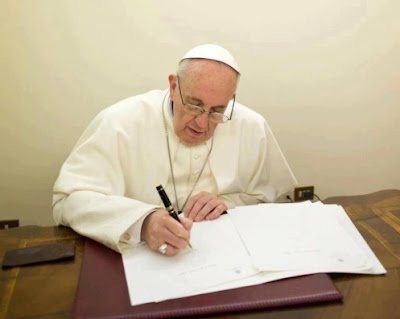 Now that the Post-Synodal Apostolic Exhortation (P-SAE) Amoris Laetitia is settling in, I have few more observations.





























