Zuhlsdorf’s Law and the blog

If you are reading this today, we are both lucky. I actually got it posted and you brought up the page!

Today we have a great example of Zuhlsdorf’s Law in full force.

Zuhlsdorf’s Law

Murphy was an optimst. Therefore…

When you need your technology to work, that is when it will fail.
The extent of the failure is proportioned to the urgency of the need.
When you want to show someone the great gizmo or program you have, that is when it won’t work.

The traffic generated by the news of Pope Benedict’s resignation is bringing the server down.

And, for the love of all that’s good, true and beautiful, do NOT send me email telling me that the Pope resigned.

Posted in Lighter fare | Tagged
5 Comments

Some thoughts about Pope Benedict’s impending resignation

In no special order…

  • My 2013 prediction, #3?  Wow.  Was I wrong or what?
  • There are some men who ought to be cardinals who aren’t and there is at least one who is who shouldn’t be.  Mahony get’s to vote and Chaput doesn’t?
  • What does this mean for the SSPX?
  • Benedict knows his Augustine.  When the Vandals were coming and as Augustine lay dying, he wrote to the priests and nearby bishops urging them not to flee, not to abandon their people.
  • Liberals have been howling that Benedict is an ultra-conservative throwback, which was absurd on the face of it.  How risible is that claim now?
  • Is the Holy Father going to create a few more cardinals before 8 p.m. on 28 February?
  • Card. Husar turns 80 on 26 February. Card. Kasper on 5 March. Card. Poletto on 18 March.
  • In Dante’s Divine Comedy, in the Inferno, it is probable that the one whom Dante said “made the great refusal” was the Pope who resigned, Peter Celestine – whose resignation paved the way for Boniface VIII.
  • A priest friend sent an email: “Suddenly Frodo saw before him a black chasm. At the end of the hall, the floor vanished and fell to an unknown depth. The outer door could only be reached by a slender bridge of stone, without kerb or rail, that spanned the chasm with one curving spring of fifty feet….They could only pass across it single file. At the brink Gandalf halted and the others came up in a pack behind.” — The Bridge of Khazad-dûm
  • Does the Pope know something we don’t know about TEOTWAWKI?
  • The Pope resigned on the World Day for the Sick (Feast of Our Lady of Lourdes).
  • The Pope in one of his interviews with Peter Seewald said that when a Pope is unable to fulfill his duties, he should resign.
  • When the Pope visited the tomb St. Pope Peter Celestine he took off his pallium and left it on the tomb:
Posted in Benedict XVI |
46 Comments

Papal Resignation Breakfast

I am still in shock.

So, what’s for breakfast?

I was going to make Eggs Benedict… but….

20130211-075025.jpg

This whole thing is strange.

Today is a Vatican holiday. The Roman Curia is not working.

20130211-075042.jpg

But there was a consistory? So, … they round up all the residential cardinals who are actually in Rome (I hear that Card. Burke was out of town… the Prefect of CDF is not yet a cardinal… oy veh…) and there is a consistory and… bammo…

Posted in Benedict XVI |
8 Comments

Benedict XVI intends to resign

The Holy Father, Pope Benedict, had called the Cardinals together for a consistory.

And announced that he will resign.

His last day will be 28 February.

Dear Brothers, I have convoked you to this Consistory, not only for the three canonizations, but also to communicate to you a decision of great importance for the life of the Church. After having repeatedly examined my conscience before God, I have come to the certainty that my strengths, due to an advanced age, are no longer suited to an adequate exercise of the Petrine ministry. I am well aware that this ministry, due to its essential spiritual nature, must be carried out not only with words and deeds, but no less with prayer and suffering. However, in today’s world, subject to so many rapid changes and shaken by questions of deep relevance for the life of faith, in order to govern the bark of Saint Peter and proclaim the Gospel, both strength of mind and body are necessary, strength which in the last few months, has deteriorated in me to the extent that I have had to recognize my incapacity to adequately fulfill the ministry entrusted to me. For this reason, and well aware of the seriousness of this act, with full freedom I declare that I renounce the ministry of Bishop of Rome, Successor of Saint Peter, entrusted to me by the Cardinals on 19 April 2005, in such a way, that as from 28 February 2013, at 20:00 hours, the See of Rome, the See of Saint Peter, will be vacant and a Conclave to elect the new Supreme Pontiff will have to be convoked by those whose competence it is.

Dear Brothers, I thank you most sincerely for all the love and work with which you have supported me in my ministry and I ask pardon for all my defects. And now, let us entrust the Holy Church to the care of Our Supreme Pastor, Our Lord Jesus Christ, and implore his holy Mother Mary, so that she may assist the Cardinal Fathers with her maternal solicitude, in electing a new Supreme Pontiff. With regard to myself, I wish to also devotedly serve the Holy Church of God in the future through a life dedicated to prayer.

I need time in prayer to absorb this one.

Posted in Benedict XVI | Tagged
85 Comments

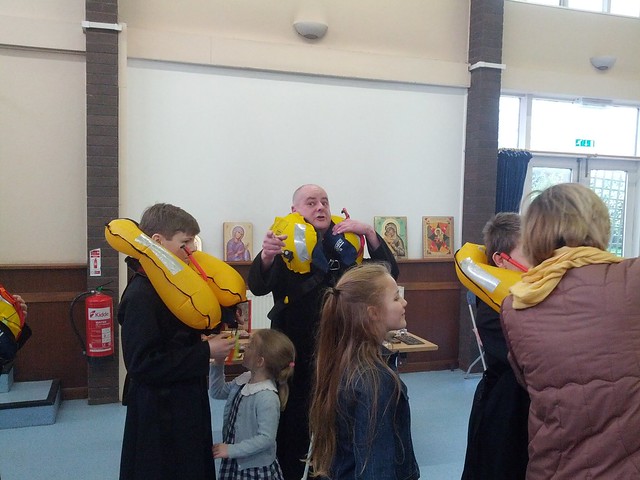
Getting ready for the FLOOD in Blackfen (“fen” means “swamp”, right?)

Typical Sunday at mighty Blackfen where His Hermeneuticalness, Fr. Tim Finigan, with the help of Mulier Fortis, are getting ready for the flood.

Go see the video.

[NB: fire existinguisher in the background… pretty dangerous in Blackfen… or fun!]


Posted in Lighter fare |
16 Comments

Card. Burke on the application of can. 915

Raymond Card. Burke, Prefect of the Apostolic Signatura, is probably the expert on can. 915.

I picked this up from EWTN:

Cardinal says no communion for Irish politicians who support abortion

As the Irish parliament considers legalizing some abortions, Cardinal Raymond Burke says that local Catholic politicians who support the procedure should be refused Holy Communion in hopes of inspiring their conversion.

“There can be no question that the practice of abortion is among the gravest of manifest sins,”Cardinal Burke told the Irish newspaper Catholic Voice in an interview published Feb. 1.
Once “a Catholic politician has been admonished that he should not come forward to receive Holy Communion,” the cardinal added, “as long as he continues to support legislation which fosters abortion or other intrinsic evils, then he should be refused Holy Communion.”
The American cardinal heads the Apostolic Signatura, the Vatican’s highest legal tribunal that rules on canon law.
Cardinal Burke said that the local bishop and parish priests [and parish priests] must ensure that Holy Communion is properly received to avoid “the grave sin of sacrilege” from those like Catholic politicians who receive Communion in spite of “grave moral evil.” The bishops and clergy must also prevent the “scandal” caused by this kind of reception because it “gives the impression that the Church’s teaching on the intrinsic evil of abortion is not firm.” [and not only abortion]

[…]

The cardinal said Catholic politicians have the duty to support all legislation that will “most reduce the evils which attack human life and the integrity of marriage.” [not only abortion]

Politicians cannot vote for any legislation which would confirm or advance “evil,” but a politician may support legislation to reduce such evils if he acknowledges these evils and the need for his voters to work to eliminate them.

Cardinal Burke stressed that the Catholic Church’s rules on the need to receive communion worthily are based on Christians’ relationship with Jesus Christ.

Someone who persists in “manifest grave sin” should not receive Holy Communion “because of his love of our Lord and his sorrow for the grave sin which he is committing against our Lord and His Holy Church.”

Recognizing this “grave offense” against God will “most inspire a conversion of heart” in Catholic politicians who support abortion, the cardinal said. He cited St. Paul’s admonition in the First Letter to the Corinthians that those who receive communion unworthily “eats and drinks judgment upon himself.”

[…]


Canon 915.

CLICK TO BUY CAN. 915 STUFF

Posted in 1983 CIC can. 915, Emanations from Penumbras, One Man & One Woman, Our Catholic Identity, The Drill, The future and our choices | Tagged , , , ,
49 Comments

Why don’t priests follow rubrics? Fr. Z cheerfully rants.

My friend Fr. Ray Blake, distinguished p.p. of St. Mary Magdalen in Brighton, has a post sure to prick the consciences of some not yet liberally heart-hardened priests and bishops.

He starts off with a comment about the lack of liturgical continuity from one place to another and that many priests ignore liturgical laws as they please.  He raises the question of whether liturgical renewal is possible.   That is an important question to me, of course.  In my view, no initiative in the Church toward a “new evangelization” or anything else is possible to sustain without a revitalization of our liturgical worship.

That said, Fr. Blake then posts this, in turn from Fr. Gary Dickson… well into his blog entry.  Read the rest there, but… my emphases and comments:

We have spent fifty years ‘advising and encouraging’ clergy at all levels -from Cardinals down to associate pastors and deacons- to follow liturgical norms, but we have had very little success with such exhortations. Why? [I have my own idea.  Let’s see where he goes…] I think because if we were to follow even the norms that are in place now for the Missanormativa of Paul VI, we would have a very different kind of liturgy than we currently have in most parishes. [Aaaaaand…?] Some questions we can ask ourselves about the liturgy in our own parish to see if we are following norms or not are the following.  All of these questions should be responded to with a ‘Yes’ if we are following norms; a negative response means we are not following the norms (according to the General Instruction and Redemptionis Sacramentum).

  • Do we ever use Latin for the Ordinary of the Mass? (cf. RS #112; GIRM #41)
  • Do we retain use of the Communion Plate? (cf. RS #93)
  • Do we use Extraordinary Ministers only in exceptional circumstances? (cf. RS #151)
  • Does the celebrant stay within the sanctuary at the Sign of Peace? (cf. RS #72)
  • Do we omit the chalice if the greater proportion of the congregation does not receive from it? (cf. RS #102)
  • Do we allow/encourage Communion kneeling and on the tongue? (cf. RS #92)
  • Do we keep the Church and adjoining rooms quiet before and after Mass? (cf. GIRM #45)
  • Do we omit hymn singing to have an organ voluntary at the end of Mass? (cf. Celebrating the Mass, Bishops Conference of England & Wales, #225)

These may seem paltry things to some, but if they are so paltry, why refuse to follow them? [Getting back to the question, ut supra…] It takes so little to put them into place, other than a sense of humility and obedience.

[…]

I return to a long-stated opinion here: if the Novus Ordo were celebrated exactly in accord with the Missal as provided by Pope Paul VI in 1970 in accord with liturgical continuity and the actual decrees of Vatican II, ie., altar-facing (rubric 133) with Latin (Sacrosactum concilium of Vatican II #54,116) and Communion on the tongue while kneeling (1970 GIRM 247) we would see significantly less hostility to the Church’s ancient form of Mass.

Okay.  Let’s drill.

First, one of the reasons why priests and bishops don’t follow the norms is because with the Novus Ordo, there was no longer in the norms published in the missal itself, in the forward or praenotanda, the stern reminder that certain serious faults and flaws in celebration of Mass were mortal sins.

Rubrics and their implications are a matter of moral theology.  The older, pre-Conciliar missal is clear that when a priest violates some points of the rubrics, he commits a sin.

When sin was detached from observance of the norms, priests and bishops – who often have pride problems like everyone else – were off the leash.

I am not talking about slips or momentary lapses. I do not include in this, before someone adds it, genuflecting to the Eucharistic Lord in a tabernacle when passing before it. I am not talking about tiny variations.  I am talking about serious things, such as changing prayers or the form of consecration, purposeful disregard for important points.  I am also talking about seriously confusing the roles of lay people and the ordained.  I am talking about things that can risk profanation of the Eucharist.

The rubrics of the older Mass are a powerful leash indeed.  When a priest obeys the rubrics of the older form of Mass, he is kept under tight control.  He cannot impose too much of himself on the Mass and on the congregation.

On top of that, the mania of turning altars around – in no way asked for or required by the Council – poured gasoline on already fired up priestly pride.  No sin, no leash, plus look at me!  At best, Father felt the huge psychological pressure of all those eyes on him all the time and – even when well-motivated – caved into the suggestion implicit within the new “versus populum” arrangement, that he personally had to take charge or entertain.

A lot of water has passed under the bridge since the Council.   We now have really bad liturgical habits far and wide.  Many older priests are set in their ways and won’t change, even though over the last decade or so there have been clarifications and deeper discussions about liturgy.  These guys know they are violating the rubrics as written and they just don’t give a damn. They know better than the “official” Church!

I fear men like that will go to hell.

Another point about that suggestion, above, that were we to celebrate the Novus Ordo in conformity to the norms then resistance to the older form of Mass might fade.

This raises a question.  If the Novus Ordo – the “normative” Mass? – is all the better the more it is faithful to the Roman Rite as it has developed over the centuries, then why don’t we just use the older form?  Perhaps the older form is the true norm, in a broader view.  Rubrics and fidelity to norms are supposed to protect continuity with what we have always done, no?  Except when they don’t, some traddies will point out.

Since I am ranting, …. on my planet,

  • the concept of sin for violation of rubrics would be reintroduced in the praenotanda of even the Novus Ordo
  • De Benedictionibus would never have existed
  • all seminarians would be required to be able to use the older books before I would ordain them (would there even be any newer books on my planet? – a connundrum!)
  • all fortune cookies would have an actual fortune in them instead of a stupid platitude
  • all priests would need to participate in continuing education to learn the older forms if they didn’t know them already  (again, Star Trek like space-time paradoxes enter in)
  • heck, so would bishops for that matter
  • players would have to pay to play for the New York Yankees instead of getting paid
  • Communion in the hand would be banned under pain of suspension a divinis for deacons and priests and, heck, bishops too (remember – this is my planet we are on)
  • there would be latae sententiae excommunication for answering a mobile phone during Mass
  • ad orientem worship would be restored as the norm – allowances made for some few historic Roman churches or odd circumstances
  • etc. according to my whim

We must reconnect in the heads of priests that one day they will die and go to their judgment.  Since the celebration of Mass is perhaps the most important thing priests do,  how they celebrated Mass during life will be part of their judgment.

Fathers, consistently violating important rubrics is sinful.  Your priestly state in life requires that you know the rubrics.  You cannot claim inculpable ignorance.

If you are sincerely a little fuzzy on the rubrics, I implore you to review them and make some changes.  If you are purposely violating important norms, for the love of all that’s holy knock it off.

Have a beautiful rest of your day.

Posted in "How To..." - Practical Notes, Liturgy Science Theatre 3000, Mail from priests, The Drill, The future and our choices, Wherein Fr. Z Rants | Tagged , , , ,
69 Comments

Phoenix Legatus Summit G’Bye!

Alas I must leave the Legatus Summit a day early. I must be home for Sunday duties.

The people I met were wonderful, the organization and their goals are outstanding. There was a wonderful pro-life and pro-marriage and pro-freedom of religion spirit running through the whole time.

Many thanks to all involved in Legatus, especially the Chicago chapter!

A couple last views.

20130209-095126.jpg

20130209-095135.jpg

20130209-095145.jpg
And now my view

20130209-095241.jpg

Posted in On the road, What Fr. Z is up to | Tagged ,
9 Comments

Tough talk about the Second Vatican Council – not pretty

Sandro Magister has an intriguing piece today about the Second Vatican Council and the possibility of reconciliation of the SSPX.

It might upset some people.

I think that some parts make sense.

A few bits from the larger piece…

The Impossible “Road Map” of Peace with the Lefebvrists
A leading representative of the traditionalist camp lays down the conditions for healing the schism. There are four of them, but three appear impracticable. Fr. Divo Barsotti’s criticisms of Vatican Council II

[…]

Fr. Barsotti wrote:

“I am perplexed with regard to the Council: the plethora of documents, their length, often their language, these frightened me. They are documents that bear witness to a purely human assurance more than two a simple firmness of faith. But above all I am outraged by the behavior of the theologians.”

“The Council is the supreme exercise of the magisterium, and is justified only by a supreme necessity. Could not the fearful gravity of the present situation of the Church stem precisely from the foolishness of having wanted to provoke and tempt the Lord? Was there the desire, perhaps, to constrain God to speak when there was not this supreme necessity? Is that the way it is? In order to justify a Council that presumed to renew all things, it had to be affirmed that everything was going poorly, something that is done constantly, if not by the episcopate then by the theologians.”

“Nothing seems to me more grave, contrary to the holiness of God, than the presumption of clerics who believe, with a pride that is purely diabolical, that they can manipulate the truth, who presume to renew the Church and to save the world without renewing themselves. In all the history of the Church nothing is comparable to the latest Council, at which the Catholic episcopate believed that it could renew all things by obeying nothing other than its own pride, without the effort of holiness, in such open opposition to the law of the gospel that it requires us to believe how the humanity of Christ was the instrument of the omnipotence of the love that saves, in his death.”

[…]

How does Radaelli see the healing of this opposition? In his judgment, “it is not the model of Church obedient to dogma that must once again submit to the pope,” but “it is rather the model obedient to the pope that must once again submit to dogma.”

In other words:

“It is not Ecône [editor’s note: the community of the Lefebvrists] that must submit to Rome, but Rome to Heaven: every difficulty between Ecône and Rome will be resolved only after the return of the Church to the dogmatic language that is proper to it.”

In order for this goal to be reached, Radaelli presupposes two things:

– that Rome would guarantee to the Lefebvrists the right to celebrate the Mass and the sacraments exclusively according to the rite of St. Pius V;

– and that the obedience required for Vatican II would be brought back within the limits of its “false-pastoral” language, and therefore be subject to criticisms and reservations.

But before this culmination – Radaelli adds – two other requests would have to be granted:

– the first, advanced in December of 2011 by the bishop of Astana in Kazakistan, Athanasius Schneider, is the publication on the part of the pope of a sort of new “Syllabus,” which would strike with anathemas all of the “modern-day errors”;

– The second, already proposed by the theologian Brunero Gherardini to the supreme magisterium of the Church, is a “revision of the conciliar and magisterial documents of the last half century,” to be done “in the light of Tradition.”

[…]

Posted in Our Catholic Identity, The Drill, The future and our choices, Vatican II | Tagged , ,
43 Comments

The Death Penalty – being “vindictive” in the Church’s Magisterium

Fr. George Rutler has a fascinating and mind-concentrating bit at the site of Crisis.  I hope it will encourage both you and others.   Go check out Crisis for sure, but lest anyone in laziness not click over there, here is the piece so that you have less excuse to let your short attention span wander away from this interesting topic concerning the dignity of life… and getting to heaven even after you have been very naughty.

I hope you will read this carefully and think about it.  I really hope you will think for a while before posting comments.  For example, think about what you are going to do with your spare time after I ban you from commenting when you leap to conclusions about my view of capital punishment based the mere fact that I posted this thought provoking and informative piece.

Hanging Concentrates the Mind

by Rev. George W. Rutler

Capital punishment does not inspire roaring humor in healthy minds, so wit on the subject tends to be sardonic.  Two of the most famous examples, of course, are: “In this country it is wise to kill an admiral from time to time to encourage the others,”  and “Depend upon it, sir, when a man knows he is to be hanged in a fortnight, it concentrates his mind wonderfully.”

The first, “pour encourager les autres,”  is in “Candide” where Voltaire alludes to the death by firing squad of Admiral John Byng in 1757 for having let Mincorca fall to the French.  The second was Samuel Johnson’s response to the hanging of an Anglican clergyman and royal chaplain William Dodd for a loan scam.  Byng’s death was the last instance of shooting an officer for incompetence, while Dodd’s was the last hanging at Tyburn for forgery. Dodd’s unsuccessful appeal for clemency was ghostwritten by Dr. Johnson.

It is not my concern here to take a position on capital punishment which the Catechism (# 2266) acknowledges is not an intrinsic evil and is rightly part of the state’s authority. This is nuanced by the same Catechism’s proposition that its use  today would be “rare, if not practically non-existent. (#2267)”  As a highly unusual insertion of a prudential opinion in a catechetical formula, this would seem to be more mercurial in application than the doctrine of the legitimacy of the death penalty.  What is oddly lacking, however, is reference to capital punishment as medicinal as well as punitive. Tradition has understood that the spiritual aspect of the death penalty is to “concentrate the mind” so that the victim dies in a state of grace.  Simply put, the less I believe heartily in eternal life, the more disheartened I shall be about entering “a far, far better rest that I go to than I have ever known.”

That finale to “A Tale of Two Cities” appeared thirteen years after “Pictures from Italy” in which Dickens described an execution he watched in Rome during the pontificate of Gregory XVI with its chaotic judicial system: “It was an ugly, filthy, careless, sickening spectacle, meaning nothing but butchery,” But Dickens noted the presence of monks accompanied by trumpets  holding a crucifix draped in black before the twenty-six year old highwayman who had killed a Bavarian countess making a pilgrimage to Rome.   The execution was delayed until his wife was brought to him and he at last received absolution.  Back in London three years after writing that account, he witnessed in  Southwark the hanging of Fredrick and Marie Manning, the last husband and wife jointly to be executed in England. His reaction was similar to that in Rome save that he thought the crowd of 30,000 more unruly and there was no mention of a religious tone.

[And now let’s get into the Church and capital punishment… and I am aware that The Bitter Pill has something on the death penalty in their current number.] In Rome in 1817, Pius VII reigning, Lord Byron saw three robbers beheaded in the Piazza del Popolo, and he  also noted the priests attending those about to die, with banners and prayers in procession. The swift fall of the guillotine was an improvement upon the “vulgar and ungentlemanly” gallows in England.  Although Dr. Joseph Ignace Guillotin had promoted the use of the “Guillotine,” first called the “Louisson,” for its relative painlessness, a precursor was in use in Edinburgh in the mid sixteenth century. Regarded as a humane improvement, it was common in many European countries and was used in the Papal States for 369 executions from 1814 to 1870. Giovanni Battista Bugatti was the official papal executioner from 1796 to 1865, having used an axe before the French introduced the guillotine during their occupation of Rome. Under papal rule, there were three normal sites for executions: the Piazza di Ponte Angelo, Piazzo del Popolo, and Via del Cerchi.  Shooting was a common form of punishment in the brief Austrian receivership of Rome under the Hapsburg Queen Maria Carolina.  Thus we have the firing squad scene in the last act of  “Tosca.”  While the harshest punishment, hanging and drawing and quartering is often thought of as peculiar to England, it was more common in the Papal States. The last to be killed that way in England were some Jacobite officers in 1745. The sentence was imposed  on several Chartist rioters in 1839 but they were given the option of transportation to Australia, which they accepted.  When the pope regained possession of the Papal States in 1814, hanging, drawing and quartering was imposed eleven times until it ended in 1817.  For particularly heinous crimes, crushing the head with a mallet, the “mazzatello” continued until 1870.   [Nah… it continued well into the 1980’s and ’90’s in liberal seminaries.]

The nickname of the papal executioner Bugatti was Mastro Titta,  a slang for Master of Justice (Maestro di Giustizia.)  He wore a red cloak and showed ceremonial deference to his victims. Pope Pius IX [of blessed memory] let him retire at the age of 85 with a considerable pension. This pope, beatified by John Paul II in 2000, was unflinching in the importance with which he invested public executions as an “encouragement” to others. On June 12, 1855 a deranged hat maker and political subversive  named Anotonio De Felici chased the Cardinal Secretary of State with a large fork. Cardinal Antonelli escaped unscathed and appealed to the Pope to commute the sentence from beheading to life imprisonment on the grounds of the man’s mental imbalance but was refused. Mastro Titta had been retired four years and replaced by his apprentice Antonio Balducci when the final executions in Rome took place on November 24, 1868.  Giuseppe Monti and Gaetano Tognetti had been convicted to killing twenty-five Zouave soldiers in the Borgo. The executions ceased, not out of any policy of penal reform, but because of the loss of the Papal States.  Agatino Bellomo was the last to be executed in the Papal States, in Palestrina, on July 9, 1870.  When Blessed Pius IX was asked to grant a stay of execution for those condemned in 1868, the Pope firmly replied, “I cannot, and I do not want to.”  He certainly could have by law, which he embodied as state sovereign with ”plenitudo potestatis,”  but by enigmatically saying that he could not, he probably was declaring this a high matter of conscience in the interest of Augustinian tranquility of order as explained by such as Bellarmine, Liguori, Thomas More and Suarez.  [The famed tranquilitas ordinis… I wonder what George Weigel, who was here at the Legatus Summit, would opine.]

When a papal butler was recently arrested, [and for weeks people ran around like guillotined chickens] many were surprised that the Vatican City even had a jail. The Lateran treaty of 1929 provided for the execution of anyone attempting to assassinate  the Pope within the Vatican.  In 1969 capital punishment was quietly removed from the “fundamental law” of the Vatican, without comment and only in Latin,  and did not come to public attention until 1971.

The grandson of St. Elizabeth Anne Seton,  Archbishop Robert Seton, long-lived but less loved, wrote that during the course of a holiday in France as a boy, the ceremonious spectacle of a man being beheaded inspired him greatly to think of the dignity of life.  He was especially close to Leo XIII and St. Pius X who in 1905 reiterated the Roman Catechism of St. Pius V with reference to capital punishment:  “Far from being guilty of breaking this commandment (to do no murder) such an execution of justice is precisely an act of obedience to it. For the purpose of the law is to protect and foster human life.”  [This is part of the the Magisterium.]

The medicinal reason for inflicting punishment, [PAY ATTENTION…] goes beyond preventing the criminal from repeating his crime and protecting society, to encouraging the guilty to repent and die in a state of grace. The vindictive reasoning also has this interest in mind: for by expiating the disorder caused by the crime, the moral debt of the guilty is lessened. [Latin vindico does not have to do only with being “vindictive” or “vengeful”.  It is also “to set free, emancipate”.] In the early years of the nineteenth century. St. Vincent Pallotti frequently assisted the condemned to the scaffold, as St. Catherine had done in Siena. He was edified by the many holy deaths he saw, while helping the Archfraternity of San Giovanni, under the patronage of his friend the English Cardinal Acton.  Headquartered in the Church of San Giovanni Decollato (St. John the Beheaded),  [I was once involved in a Mass there on the feast itself and have decided ever since that it, too, should be one of my name-day feasts.] their rule  was to urge the condemned to a good confession, followed by an exhortation and Holy Communion followed by the grant of a plenary indulgenceThe whole population of Rome was instructed to fast and pray for the intention of the criminal’s soul.  [Can you imagine such a thing today?  Can you see such an announcement on Fox News?  “Everyone is urged to pray in a particularly intense way this evening in a vigil until Midnight, Central Time, before the execution of X.  He confessed his sins, received Communion and the plenary indulgence.”  What would Twitter do with that?]

All other considerations of the machinery of death aside, this paramount regard for the human soul is quaint only if belief in eternal life is vague. Pope Pius XII was so eager for vindictive penalties that he lent the help of a Jesuit archivist to assist the prosecutors at the Nuremberg trials. He personally told the chief United States prosecutor, Robert Jackson:  “Not only do we approve of the trial, but we desire that the guilty be punished as quickly as possible.”  This was not in spite of, but issuing from, his understanding of the dual role of healing and vindication. This is essential doctrine on the subject and, in the “development of doctrine” on its application, it is the Type,” as Newman would say, that is to be preserved.   All this should not be remaindered as historical curiosities, for, as [Venerable] Pope Pius XII said, “the coercive power of legitimate human authority” has its roots in “the sources of revelation and traditional doctrine” and so it must not be said “that these sources only contain ideas which are conditioned by historical circumstances” for they have “a general and abiding validity.” (Acta Apostolica Sedis, 1955, pp.81-82).

Posted in New Evangelization, Our Catholic Identity, The Drill, The future and our choices, The Last Acceptable Prejudice | Tagged , , , , ,
73 Comments