Is anyone having a problem with the blog’s RSS feed?
A couple people have written about it, by I am not seeing the trouble.
Is anyone having a problem with the blog’s RSS feed?
A couple people have written about it, by I am not seeing the trouble.
 The Lord’s Coming is a fearful thing to ponder. The First Coming of the Lord, prophesied by Jeremiah in Sunday’s 1st Reading, and His Sacrifice renewed daily on our altars, mean that His Second Coming, described by the Lord in the Gospel reading from Luke 21, and our impending judgment need not raze the thoughtful soul in abject terror. During the offertory of Mass the priest, on our behalf, raises to God the elements to be consecrated together with all our gifts of praise and prayers of need. We seek to please and to appease God, whom we rejected by our sins.
The Prayer over the Offerings for this 2nd Sunday of Advent is the Secret for this same Sunday in older, traditional form of the Roman Rite. If the ancient, elegant sound of this prayer made you think that it was in Gelasian Sacramentary you were right on target.
Placare, Domine, quaesumus, nostrae precibus humilitatis et hostiis, et, ubi nulla suppetunt suffragia meritorum tuae nobis indulgentiae succurre praesidiis.
Succurro means “to run or hasten to aid”. Its root curro, “to run”, lends succurro an element of haste, which is a theme in the prayers of Advent. Placare looks like an infinitive but it is actually the passive imperative of placo, “to reconcile” and also “to soothe, assuage, appease”. Think of English “placate.” Suppeto is “to be sufficient for”. A suffragium is “a voting tablet” and, therefore, “a vote, voice, suffrage” (as in “suffragettes”, who wanted voting rights for women). It is also “a favorable decision, assent, approbation, applause.” In ecclesiastical lingo a “suffrage” is a recommendation or intercessory prayer as, for example, when pray for the Poor Souls in Purgatory. Plural suffragia means something like “points in our favor”. Unless Christ makes our works His own we have no good marks (nulla meritorum suffragia) on our side of the merit column.
LITERAL VERSION:
Be appeased, O Lord, we beseech You, by the prayers of our humility and by our sacrificial offerings, and, where no favorable points of merits suffice for us, succor us by the helps of Your indulgence.
OBSOLETE ICEL (1973):
Lord, we are nothing without you. As you sustain us with your mercy, receive our prayers and offerings.
Wow.
CURRENT ICEL (2011):
Be pleased, O Lord, with our humble prayers and offerings, and, since we have no merits to plead our cause, come, we pray, to our rescue.
This prayer reminds us that we are going to receive God’s justice whether we want it or not. We beg, therefore, His mercy. Our Lord will always show us love and mercy, but we have to ask for it. Never presume you have forgiveness and mercy. Ask for it and then do penance.
We can get lazy about God and assume He is automatically pleased with us all the time. But we are not robotically forgiven for our transgressions and omissions. We must ask for and obtain God’s mercy and then attend to justice and do penance. Nothing we do on our own merits the great gift of redemption (cf CCC 2007). It’s all gift. We are saved solely by the merits of Christ’s Sacrifice.
We will see in weeks to come that a constant feature of the Latin Prayer over the Offerings is the desire to appease God. “Appease” is not a fashionable word for us sophisticated moderns. But there it is. What we pray has a reciprocal relationship with what we believe. We must also appease God while we petition and praise. The Lord’s appeasing Sacrifice on Calvary, renewed on our altars, is our lifeline.
Above, I used the phrase “favorable points of merits”. Never imagine God as a celestial accountant keeping books on what we do or haven’t done. Salvation is not based on a ledger’s bottom line. In our personal and then final judgment God will show us what our good works merited and how they balance against our sins. Until then, it’s a great mystery. In fact, the Church now hazards to offer indications of only “partial” or “full” indulgences for works we perform. The only thing we can be sure of is that we must not be lax or presumptuous.
If we want salvation, we appease God by our prayers, works and sacrifices, all of which must be joined to Christ’s Sacrifice. At Holy Mass join all that you do and are and love and need to the propitiatory Sacrifice renewed by the priest. Father raises the paten with host. He raises the chalice of wine with blended drops of water, symbolizing our little humanity being taken up by Christ with His divinity. Place yourselves and your needs in that chalice, like those drops, and on that paten, like that pure host, to be transformed.
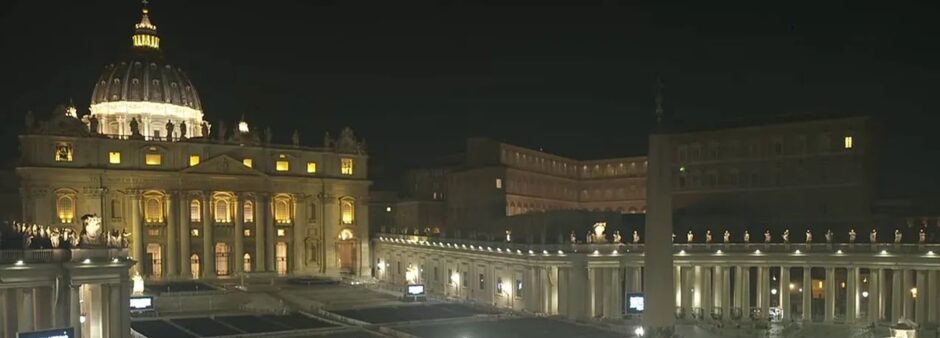
I am not a fan of huge outdoor Masses, even… especially… in St. Peter’s Square… which is a parking lot.
Today, however, it is more than a parking lot.
I am not making this up.
You can’t make this up.
There is a carnival ride set up in St. Peter’s Square. You can view cams HERE.

And….

My mind is spinning with quips about the Curia and the Merry-Go-Round.
UPDATE
In related news, the Holy Father has his annual meeting with members of the Roman Curia:

All in all, it seemed to go pretty well. Business as usual.

FROM THE ARCHIVE. (Since a couple people have recently asked about this through email.)
From a reader:
If I had to guess, there are probably many priests throughout the US who are refusing to celebrate the Mass according to the new translation.
My question is, “Is the Mass invalid if a priest uses the old words of consecration?” I am sure we can all agree that it would be illicit, but is it invalid? I am asking this because I am wondering what I should do if I encounter a Mass where the priest uses the old translation.
The consecration is NOT invalid if the priest uses the obsolete, incorrect words for the consecration as they were in the obsolete, incorrect and now illicit-to-use old ICEL version. If the priest says, for example the incorrect and now illicit, “for all”, purposely, he is probably committing a sin if he is doing so out of contempt for authority and because he thinks he knows better. It would, nevertheless, be a valid consecration.
What should you do?
If you are just dropping by that parish and you don’t have regular ties there, think twice before doing something. You are not there often enough to know if the priest is simply making a mistake because of an old habit – it happens! – or whether he is defying the Church’s authority and causing scandal at the most solemn moment of Holy Mass.
If are at your regular parish, then I suggest you consult my tips for writing to bishops or offices of the Holy See.
I suggest, first, a conversation with the priest if possible. Then follow up that conversation with a writing letter about what was said. If that doesn’t bear fruit, then send copies to the local bishop. If that doesn’t bear fruit, send copies to the Congregation for Divine Worship in Rome. I think it is always best to work on these things at the lowest possible level of authority, (parish – diocese – congregation). The same applies if the priest is a member of a religious order in one of their chapels or churches or institutions.
At the end of Redemptionis Sacramentum we read:
6. Complaints Regarding Abuses in Liturgical Matters
[183.] In an altogether particular manner, let everyone do all that is in their power to ensure that the Most Holy Sacrament of the Eucharist will be protected from any and every irreverence or distortion and that all abuses be thoroughly corrected. This is a most serious duty incumbent upon each and every one, and all are bound to carry it out without any favouritism.[184.] Any Catholic, whether Priest or Deacon or lay member of Christ’s faithful, has the right to lodge a complaint regarding a liturgical abuse to the diocesan Bishop or the competent Ordinary equivalent to him in law, or to the Apostolic See on account of the primacy of the Roman Pontiff. It is fitting, however, insofar as possible, that the report or complaint be submitted first to the diocesan Bishop. This is naturally to be done in truth and charity.
Again, priests can slip up out of habit. I knew a priest who – once in a while – used to say “Paul, our Pope” during the Canon… in the ’90’s! Words repeated every day of a priest’s life can become ingrained and pop out unexpectedly. If a priest is doing something all the time, that is another issue.
But if he slips here and there, cut him a little slack.
 In another entry I mentioned a new book by Fr. Robert Sirico called A Field Guide for the Hero’s Journey.
US paperback HERE and Kindle HERE.
UK paperback HERE Kindle HERE.
Here is a blurb from the book:
Do you feel like something big is missing from your life? Do you feel trapped, bored, stuck in a meaningless routine? It may be you think you’re too ordinary to ever do something special. Perhaps you’re afraid that if you try, you’ll fail. The startling truth is this: Just about anyone can do great things, can live a life that’s remarkable, purposeful, excellent, and yes, even heroic. If you want to be a hero, you can be. How? That’s what this book is all about. Will you choose to do it? Will you decide to journey heroically, instead of spending your life merely marking time? If so, this is the book for you. Welcome to your heroic journey.
The book is not overtly Catholic, and you could give it to anyone. It should have a wide appeal. If we read it with a Catholic lens, we will see that the book is also making an appeal to us to live a life of heroic virtue.
The book is a collection of short pieces on certain perennial human questions and challenges. Each section is followed with some questions and suggestions.
Here is part of the Table of Contents, so you can see what is going on:
Introduction: Calling All Heroes (Could This Mean You?)
1. The First Step 1
My First Step—Jeff Sandefer 2
Asking Life’s Deep Questions—Rev. Robert Sirico 3
The Man in the Arena—Theodore Roosevelt 5
Can’t—Edgar A. Guest 6
Things Not Done Before—Edgar A. Guest 7
The Lark and Her Young Ones—Aesop 8 [I love that throughout they included Aesop! 7 times!]
Psalm of Life—Henry Wadsworth Longfellow 92. Who Am I, and Who Do I Want to Become?
[…]3. The Importance of Setting Guardrails
[…]4. What Companions Do You Want with You on Your Journey?
[…]5. Stones in the Road
[…]6. The Giant of Despair
[…]7. Rest
[…]8. Fighting the Dragon
[…]9. Coming Home
[…]
The fact is, every single person born into this world is called to holiness. We should strive for holiness and a life of virtue even to a heroic degree. As I wrote elsewhere:
“But Father! But Father!”, some of you are about to say. “Heroic virtue? Really? How can any of us aspire to such a thing! That’s sounds terribly difficult!”
It isn’t easy, but it is possible.
We are all called to be saints. God wouldn’t ask something of us that isn’t possible. And when He asks things that are hard, He also provides the means and the occasions. Even in your suffering, for example, or your obscurity, you can serve Him. God knew you before the creation of the material universe. He called you into being now, in this world. Of all the possible worlds God could have created, He created this world, into which you would be born. He has a plan and purpose your you, if you will embrace it.
The “heroism” to which we are called does not consist mainly in great or famous or dramatic acts or accomplishments. It might include those, but it does not mainly consist of those. Every person has the possibility of this sort of heroism, even if he does nothing spectacular. When it comes to the causes of saints, very often people with more dramatic or famous lives comes to the attention of others, and therefore they are more likely to be the subjects of causes.
Living a virtuous life even in the tedium of routine or the obscurity of everyday living can be heroic.
Accepting God’s will, living in conformity with God’s will is the true test of a Christian. That is the essence of “heroic” virtue, not what appears outwardly to be heroic (though that may also be heroic, as in the dramatic case of the martyr).
Furthermore, people don’t, except by a rare gift from God, instantly or easily attain the state of living a life of virtue heroically. Virtues are habits. Some virtues, the theological virtues, are infused into us by God with baptism and sacraments. They “dwell” in us “habitually” (“dwell” and “habit” are etymologically related… think of a “habitat” where critters “dwell”). Virtues are habits, good practices and attitudes which are in us to a degree that it is easy for us to do them rather than hard. This usually takes time and maturity. We don’t suddenly, except by a special grace, become virtuous. It can take a whole lifetime and many stumbles along the way.
Okay… I am digressing, but not really
US paperback HERE and Kindle HERE.
UK paperback HERE Kindle HERE.
 I will also remind you of a book I mentioned a while back, put together by another priest, Fr. Richard Heilman, Church Militant Field Manual: Special Forces Training For The Life In Christ.
Fr. Heilman, started a men’s group called The Knights of Divine Mercy. This book is their “field manual” to help them get “God Strong”. We belong to the Church militant after all. Book HERE Kindle HERE.
FOLLOW UP:
3 December: His account is up and running: @Pontifex
Please use the sharing buttons! Thanks!
 On Monday we will find out what the Pope’s new Twitter handle is.
There will be a press conference in Rome on Monday to reveal more details about what His Holiness of our Lord is going to be doing (read: what some others will be doing for him).
Were I still in the press corps there I would ask: “How often will the Holy Father be tweeting? How much does he intend to compose the tweets himself? Will he write them long hand and then have someone do it for him? Will they be simultaneously in other languages? What details did you have to work out with Twitter before this could happen?”
I am pretty sure Pope Benedict doesn’t use a smart phone. Didn’t someone give him an iPad? I think Vatican Radio gave him an iPod.
I have other questions.
 Pope Benedict has sent one tweet already, for the launch of the site news.va. The new venture will be from his own, official account.
I suspect the Pope won’t be tweeting in Latin, though that would be great. Maybe his first Tweet? But it would have to followed by the same text in the usual languages. Babel redivivus. Latin is denser, however. Something to consider. Latin for “tweet, v.” should be something like pipio or titio, and “tweet, n.” pipiatum or titiatum, and Twitter pipiatio or titiatio. I prefer the “p” line of thought, to the “t” here. I had a post and a poll on this, by the way, HERE.
Here is the POLL again.
One can only speculate about what handle he will use.
I will add, finally, that I don’t think Popes should tweet. There, I said it. Yes, I know about social media and the New Evangelization. They didn’t ask me my opinion. So, if it is going to happen, I might as well embrace it.
Choose your best answer and give your reasons in the combox. You don’t have to be registered to vote, but you do have to have an approved registration to post.
My old pastor, the late Msgr. Schuler used to say that “You can go into the ditch on either side of the road, left or right. Either way, you are still in a ditch.”
This has been my concern about some members and followers of the SSPX. Can they wind up stuck in the ditch, but on the opposite side of the road from where the LCWR and NCR and Tablistas are mired? I think that is possible, yes.
I don’t think it is all that easy to get yourself into the ditch, since Holy Church is pretty flexible when it comes to some things. Not so much in others, of course. And it is easier by far to go off the road to the left. The shoulder tilts over there and the Enemy of the Soul, it seems to me, is generally ignored on that side, to the peril of all who stray thither.
When in December 2005 the Holy Father spoke to the Roman Curia about a “hermeneutic of discontinuity and rupture” – one of the most important acts of his pontificate, by the way – he was actually talking about modern theologians, not the traditionalists who refuse it the “left”, to stick with the political label for brevity. In fact, I think the Pope was actually carrying on a polemic against Rahner and his allies and legacy. But the fact is, discontinuity and rupture can also take place with the refusal of new authentic magisterial teachings. The road has a ditch on both sides.
From the UK’s best Catholic weekly, The Catholic Herald, comes this, with my emphases and comments.
Prefect of the CDF says seeing Vatican II as a ‘rupture’ is heresy
By Carol Glatz
Traditionalist and progressive camps that see the Second Vatican Council as a “rupture” both espouse a “heretical interpretation” of the Council and its aims, the prefect of the Congregation for the Doctrine of the Faith (CDF) has said. [That’s sure to win hearts far and wide! But it is refreshing to see the word “heretical”.]
Archbishop Gerhard Müller said that what Pope Benedict XVI has termed “the hermeneutic of reform, of renewal in continuity” is the “only possible interpretation according to the principles of Catholic theology”. [I can see now what some on the left are going to do with this. They will say that Muller says that if you don’t agree with the Pope on Vatican II, then you are a heretic. They won’t make any distinctions about the actual texts in question. Thinking they have scored a point against traddies, they will lose sight of the fact that they themselves are pretty far from the Pope’s view of Vatican II. Moreover, the Holy Father’s interpretation of Vatican II texts isn’t right merely because it is the interpretation of the Holy Father. That helps, of course, when it comes to revealed truth. But there are sound ways to interpret the Church’s documents and bad ways. This Pope is right because he grasps the correct way of interpretation apart from the fact that he is also given the graces of the Petrine Office.]
“Outside this sole orthodox interpretation unfortunately exists a heretical interpretation, that is, a hermeneutic of rupture, [found] both on the progressive front and on the traditionalist” side, the archbishop said.
[And now what I have been saying for years here…]What the two camps have in common, he said, is their rejection of the council: “The progressives in their wanting to leave it behind, as if it were a season to abandon in order to get to another Church, and the traditionalists in their not wanting to get there”, seeing the council as a Catholic “winter”. [Sadly, heresy and other problems creep in through stressing points that are true. In a sense, we have to get on with things, a liberals want. But in truth that is because Vatican II, over now for close to 50 years, wasn’t nearly as important in the list of Councils as they think it was. On the other side, since the Vatican II wasn’t nearly as important as many think, those on the traditionalist side must absorb it, stop insisting that it either isn’t a Council or that it must be interpreted in the most negative light possible, and move along with the rest.]
A “Council presided over by the successor of Peter as head of the visible Church” is the “highest expression” of the Magisterium, he said, to be regarded as part of “an indissoluble whole”, along with Scripture and 2,000 years of tradition. [That doesn’t mean that everything issued by the Council is of equal weight or value.]
The doctrinal chief’s remarks were published in the Vatican newspaper, L’Osservatore Romano, to present the seventh volume of The Complete Works of Joseph Ratzinger. The volume collects both published and unpublished notes, speeches, interviews and texts written or given by the future pope in the period shortly before, during and just after Vatican II.
Archbishop Müller specified that by “continuity” Pope Benedict meant a “permanent correspondence with the origin, not an adaption of whatever has been, which also can lead the wrong way”.
The term “aggiornamento” or updating – one of the watchwords of the Council – “does not mean the secularisation of the faith, which would lead to its dissolution”, but a “making present” of the message of Jesus Christ, he said. [Hear that, Fishwrap?]
This “making present” is the “reform necessary for every era in constant fidelity to the whole Christ”, he said.
“The tradition of apostolic origin continues in the Church with help from the Holy Spirit,” he said, and leads to greater understanding through contemplation and study, intelligence garnered from a deeper experience of the spiritual, and preaching by those who through the “apostolic succession have received an assured charism of truth”.
To my mind, just as deadly, if not more deadly, is a ignorance of the Faith of which Pope Benedict spoke to French bishops during their “ad limina” visit. HERE. This is something of which the people in the left-side ditch are far more guilty than those in the right-side ditch.
BOTTOM LINE:
If we want the Holy Father and the Congregation for the Doctrine of the Faith to correct liberals who are going into the ditch on the left, then we must also want correction for those straying to the right side of the road as well.
That is the trend I am seeing since the new Prefect has taken up his office at the Holy Office.
Moreover, were I a liberal, I’d be far more worried than any traditionalist needs to be.
I recently posted about Sr. Joan Chittister and the Council of Elders. HERE.
Judging from my email feedback about that post, I realize that many of my visitors have never heard of the Council of Elders. Many would never have heard of Sr. Joan Chittister without reading about her here.
I have recently written about Richard McBrien, Charles Curran, Bernard Häring….
Who?
As it turns out, younger people, younger committed Catholics, simply don’t know who these liberals are.
I guess there is a generation gap on Fr. Z’s Blog.
Consider this. When Sr. Joan and the civil-rights era, war-protesting era “Council of Elders” went to help out the Occupiers near Wall Street, the Occupiers had no idea who they were.
Here is the site of the Fellowship of Reconciliation (Remember them? No?) which conveys their lament:
These leaders and all of the Elders constitute the best of the best in respect to shaping progressive social thought and redemptive nonviolent action.
But there were two problems:
- Large numbers of Occupiers “don’t know much about history” and therefore had no idea who was in their midst, and…
- They found it possible to treat the Elders’ declaration and direct involvement as not worthy of their notice.
Nobody under the age of 40 knows who these people are.
Furthermore, they don’t care about who these people ever were.
I was talking with a priest friend today about the fact that virtually all the American seminarians we know were not educated by women religious. Neither is the National Catholic Reporter on their radar screens. The NCR was ubiquitous back in the day… lo those many years ago. They and their ilk had a strangle-hold. Now-aging-liberals propped it up in parishes and seminaries and religious houses, squelching other voices such as The Wanderer and alternative Catholic news sources and opinions. In those days only one interpretation of Vatican II was licit, nay rather, was all holy! Dissident from their dissent was forbidden, dangerous to a seminarian’s vocation or a priest’s career.
The Biological Solution is taking care of that. It is taking care of The Wanderer too, I’m afraid, because they haven’t adapted their print media to the needs of a new digital age and skyrocketing printing and mailing costs. But that is another kettle of chowder.
It is sometimes hard for me to remember that younger people, I mean younger committed Catholics, certainly seminarians, younger priests and now a rapidly growing number of bishops, don’t give a damn about anything the Fishwrap says. They don’t share the narrow vision of a still widespread but rapidly weakening discontinuity and rupture.
Young people have nothing invested in that agenda. The few that do are exceptions to the rule.
Seminarians I know, if they see the NCR, just shake their head, marveling. Perhaps they smile a little.
The indifference this new generation of priests has concerning the liberal catholic agenda will inevitably have a huge knock-on effect in the parishes they will lead and the classrooms they will teach in.
Meanwhile, it is sometimes hard for me to remember that I, too, am in certain ways now on the other side of the generational gap.
Don’t get me wrong. I will still write about the Fishwrap with all good cheer! They don’t get to have a free ride. And, face it, posts about their quirky ideas and dissident hijinx practically write themselves.
But in the future I had better keep in mind that I am still suffering from the post-traumatic stress disorder of those times. I still remember that the aging-liberals were once relevant. Younger, committed Catholics don’t have those memories.
From NASA’s Astronomy Pic of the Day:

Explanation: Did you see the big, bright, beautiful Full Moon Wednesday night? That was actually a Micro Moon! On that night, the smallest Full Moon of 2012 reached its full phase only about 4 hours before apogee, the most distant point from Earth in the Moon’s elliptical orbit. Of course, earlier this year on May 6, a Full Super Moon was near perigee, the closest point in its orbit. The relative apparent size of November 28’s Micro Moon (right) is compared to the famous May 6 Super Moon in these two panels, matching telescopic images from Bucharest, Romania. The difference in apparent size represents a difference in distance of just under 50,000 kilometers between apogee and perigee, given the Moon’s average distance of about 385,000 kilometers. How long do you have to wait to see another Full Micro Moon? Until January 16, 2014, when the lunar full phase will occur within about 3 hours of apogee.
Mark your calenders!

Coat of Arms by D Burkart









A Daily Prayer for Priests


They find you a pro-life agent in your area who commits to giving a portion of the fee to a pro-life group!

PLEASE subscribe via PayPal if it is useful. Zelle and Wise are better, but PayPal is convenient.
A monthly subscription donation means I have steady income I can plan on. I put you my list of benefactors for whom I pray and for whom I often say Holy Mass.
In view of the rapidly changing challenges I now face, I would like to add more $10/month subscribers. Will you please help?
For a one time donation...



Help Monks in Wyoming (coffee – UPDATED LINK) and Norcia (beer) and the wonderful "Soap Sisters" of Summit, NJ!


Please follow me on Twitter!










Visits tracked by Statcounter
since Sat., 25 Nov. 2006:

