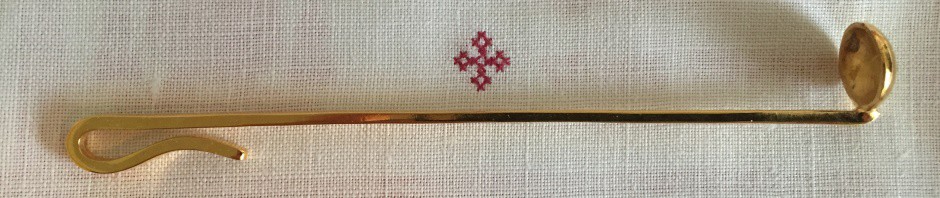
The confessional Fulton Sheen used at St Patrick’s, Soho Square, London.

Do everybody a huge good deed and go to confession. Sin hurts everyone. Reconciliation helps everyone.
The confessional Fulton Sheen used at St Patrick’s, Soho Square, London.
Do everybody a huge good deed and go to confession. Sin hurts everyone. Reconciliation helps everyone.
NB: In a comment below, a participant posted some points about when the paschal candle may be used in the Extraordinary Form. Don’t just read my answer and then move on without also reading that comment. You will know which it is.
From a priest:
May the pascal candle be used at EF baptisms?
Well… sure! Why not?
The older Rite doesn’t say anything about it. But, hey! Nice candle! Let’s light it!
At a certain point a lighted candle is handed over. Why could it not be ignited from the big pretty paschal candle?
The paschal candle in the older Rite is plunged into the Baptismal water. Other candles are set to burn from it.
BTW… the maniple can be used during for Mass with the Novus Ordo too.
Via the Laudator:
Robert Southey (1774-1843), To a Goose:
If thou didst feed on western plains of yore;
Or waddle wide with flat and flabby feet
Over some Cambrian mountain’s plashy moor;
Or find in farmer’s yard a safe retreat
From gipsy thieves, and foxes sly and fleet;
If thy grey quills, by lawyer guided, trace
Deeds big with ruin to some wretched race,
Or love-sick poet’s sonnet, sad and sweet,
Wailing the rigour of his lady fair;
Or if, the drudge of housemaid’s daily toil,
Cobwebs and dust thy pinions white besoil,
Departed Goose! I neither know nor care.
But this I know, that we pronounced thee fine,
Season’d with sage and onions, and port wine.
Ah this reminds me of geese I have known… under my carving knife… greasy…
My favorite way of preparing goose is with sauerkraut. Yum.
I almost… almost… look forward to winter after this.
I wonder what this winter will bring.
Or near future winters.
Will we have the chance, or necessity, to make a Christmas goose? With pickle cabbage?
Old world food.
 From a reader:
Lately my mind has been getting assaulted by the remembrance of my past life and all my sins; it was rooted in egoism and hedonism- not a pretty sight, and I wish it would all go away.
I know I’ve been forgiven, and that there is no sin so serious that God can’t forgive, but the guilt feels like it’s weighing me down all of a sudden.The usual, “Be happy! Jesus died for your sins! You’re Forgiven!” only makes me feel more guilty.
What advice, if any, can you give a person such as myself who is now suffering and grieving over their past life?
I feel for you!
I think that we all feel this way, when we consider our past … our sins.
We will always have the memory of our sins.
We will always, as Catholics, believe that our sins are truly forgiven!
Our post-baptismal sins are forgiven in the Sacrament of Penance.
The Lord Himself forgives your sins through Holy Church and the priest.
Go to confession as often as these things well up in you.
Try not to beat yourself over the head too much.
Yes, you are going to beat yourself over the head. And you should. But… not too much.
At a certain point we go on. We get on with living.
As I have written before, there is a phrase from a mediocre book by Bernard Malamud, turned into a great baseball movie, The Natural. Roy Hobbs, down and wounded, regrets past decisions. His redemptive character, the woman he loved when he was young (before he made stupid, life-changing mistakes), says to him that we have two lives, the life we learn with and the life we live afterward.
I sure feel that way myself. I feel that way almost every day of my life, as a matter of fact.
But I believe in Christ’s promises.
Put your sense of shame, for that is what this is, into the chalice during Mass with the little drops of water – our humanity – that are mingled with the wine.
It will all be taken up by Our Lord and transformed.
Then, get involved with corporal works of mercy. Do some concrete things. Get your hands busy and a little dirty. Perhaps your parish has something to do. Perhaps there is a neighborhood food shelf or group… you get the idea. Action is needed to counterbalance the introspection.
Do something.
 Very cool… er um… hot back then.. no.. cool… but…
Just read:
NASA Telescopes Spy Ultra-Distant Galaxy
PASADENA, Calif. — With the combined power of NASA’s Spitzer and Hubble space telescopes, as well as a cosmic magnification effect, astronomers have spotted what could be the most distant galaxy ever seen. Light from the young galaxy captured by the orbiting observatories first shone when our 13.7-billion-year-old universe was just 500 million years old.
The far-off galaxy existed within an important era when the universe began to transit from the so-called cosmic dark ages. During this period, the universe went from a dark, starless expanse to a recognizable cosmos full of galaxies. The discovery of the faint, small galaxy opens a window onto the deepest, most remote epochs of cosmic history.
“This galaxy is the most distant object we have ever observed with high confidence,” said Wei Zheng, a principal research scientist in the department of physics and astronomy at Johns Hopkins University in Baltimore who is lead author of a new paper appearing in Nature. “Future work involving this galaxy, as well as others like it that we hope to find, will allow us to study the universe’s earliest objects and how the dark ages ended.”
Light from the primordial galaxy traveled approximately 13.2 billion light-years before reaching NASA’s telescopes. In other words, the starlight snagged by Hubble and Spitzer left the galaxy when the universe was just 3.6 percent of its present age. Technically speaking, the galaxy has a redshift, or “z,” of 9.6. [What a great variable!] The term redshift refers to how much an object’s light has shifted into longer wavelengths as a result of the expansion of the universe. Astronomers use redshift to describe cosmic distances. [And, now, the greatness of faithful Catholic blogs? Fishwrap… z=-100?]
[…]
Read the rest there.
VERY cool.
We almost need the Star Wars crawl for this.
Whew!
Pork dumplings in hot soup! That red is indeed suggestive of the flavors. The green is cilantro. Excellent. Whew!
The Jasmine tea is very good.
There is something in this soup I can’t put my finger on (lest it melt off). It is really hot, sour with some vinegar, but it isn’t suan la tang. Sichuan pepper for sure. Garlic: check! What is that?!? (Stoopid iPhone… makes sending these posts in a little tricky….)
Whew! My upper lip is sweating…

 So another feminist opportunist of the Elaine Pagels ilk, whose purpose in life is to make money while making the lives of real scholars and real believers more difficult, is talking about a fragment of papryus which, she claims, states that Jesus had a wife.
Yes, folks, Jesus had a wife. Let’s call her Mrs. Christ. Rather, Ms. Christ. Or maybe Ms. Christ-Magdalen?
The fragment may have been written before the 5th century, it may be Gnostic, it may be from a sermon, and it may be a forgery. No, wait! Two over-paid scholars from Ivy League schools have said it isn’t a forgery and therefore… well… it’s not!
The MSM will treat this curious ancient tid-bit as if it is an established fact: Jesus was married. Based on the HuffPo endorsed version of this now fact, someone at the Fishwrap will conclude, again, that priests should be married! Ms. Christ, moreover, was a also priest, nay rather an apostle! – a bishop! – and, ergo….
The only fact for which less evidence is required is a “plausible accusation” of sexual abuse of a minor made against a priest.
 Under the entry about our obligation to attend Holy Mass, someone posted this comment (I removed it to here):
I’ve always had a fantasy where I make wallet sized Catholic obligation cards. These would have check boxes or punch boxes for all holydays of obligation for the calendar year and one for the communion and confession.
Why not just put a qr code on people’s hands or foreheads and scan them on the way in and out of church? Easy, right?
Cf. Rev. 13:16.
Back in the day, something like what you suggested was actually done in some parishes in the USA. It would be over 20 years ago now, but I remember some old folks putting $1 in every envelope and turning them all in so that they would have them recorded. They remembered the days when, if people didn’t have all their envelopes in, there could be problems when it came to little things like a proper burial. In short, they were afraid.
I have used old confessionals which had a small slot under the grate. The old pastor once explained that, back in the day, people would people would slide through to the priest a card on which he would affirm that they fulfilled their Easter Duty.
Finding the balance between urging people to take responsibility for themselves and imposing stricter obligations is very tricky.
Paul VI blew it when he changed the obligations for doing penance and abstaining on Fridays. Sorry, that was a bad move. Does anyone do penance now? FAIL. Our bishops blew it big time by intermittently repressing Holy Days of Obligation. Now people don’t go to Mass when the obligation is not repressed. They got the message: going to Mass isn’t very important after all. FAIL. Shortening the Eucharistic Fast to an hour before Communion? Another brilliant outcome, do you think? Do people now pay attention to fasting at all? Do they have a sense of participation in the Eucharist as involving sacrifice? We creatures of body and soul need preparation that is both physical and spiritual, fasting and being in the state of grace. Is there any concept of mortification as salutary among the people of God? Do lots of people really give deep consideration to what they do when receiving Communion?
Cf. 1 Corinthians 11:27. FAIL.
You can understand the thought behind urging people to responsible for themselves. It is better to choose to do what we do from love rather than merely obligation. Consider, for example, in the traditional Act of Contrition the distinction between attrition and contrition. Attrition means you are sorry for your sins because you fear punishment. That’s enough! more perfect, however, is being sorry for your sins because of true contrition, for love of God. People should want to do penance and take on mortifications because they love God. That is a more perfect motive.
But our human nature is wounded. When the obligations are removed, we go all wobbly. The fact is that, when the obligations are removed, the great majority of people find it hard to maintain their discipline. Without that discipline, some rebel by throwing off all practices, others, lose their good habits and, by so losing them, lose also their identity as Catholics.
Again, we can understand that perhaps we once may have stressed too much the points of obligation, and may have underscored too often or too harshly the Four Last Thing, or may have dwelt on the reality of sin without also the concomitant dimension of mercy.
On the other hand, given our human nature, perhaps it would be better to err on the one side than the other.
Our Catholic identity has, far and wide, been devastated. Our Marshall Plan to revitalize our Catholic lives across the broad span of the Church must include remedies, and remedies are rarely pleasant.
The great Doctor of Grace, St. Augustine, speaking about Christ as Doctor, described His sometimes not so gentle corrections in the stark terms of the medicine of the early 5th century: the doctor doesn’t stop cutting just because the patient is screaming for him to stop.
The fact is, dear reader, one day you and I are going to die and go to our judgment, and that -as they say – will be that. We get to work now on where we would like to wind up, because after we die, we can no longer change our minds. Now is the time to prepare for our judgment. Heaven is not automatic.
In times of trial, and I think our Church and we as Catholics, will be facing a time of trial soon, people usually rise to the occasion. Most people try to “do their bit”. Let’s start doing that bit sooner, rather than too late.
Since the Year of Faith is coming up, perhaps you readers would do your bit by taking on a year of some mortifications, extending the Eucharistic Fast a little longer, committing to to Holy Day Masses even when the obligation has been lifted, using regularly the Sacrament of Penance, affirming to Father those sermons which deal with the Four Last Things and the need for penance, making your Catholic identity known to people, always in the proper spirit.
Cf. 1 Peter 3:15:
In your hearts reverence Christ as Lord. Always be prepared to make a defense to any one who calls you to account for the hope that is in you, yet do it with gentleness and reverence.
Please, dear readers, say your prayers, say the Rosary every day, and go to confession, think about your death and judgment, consider your Catholic habits, and do not just drift.
From a reader:
Is it a rule that the priest is the only one in the sanctuary during the consecration?
No, there is no such rule.
Surely the deacons (subdeacons) and other servers must be there near to the altar, within the sanctuary. The proper place of clergy is also within the sanctuary, even if they are not serving.
However, there is another point the question stresses. Should the sanctuary be reduced to a place just like every other place in the church?
NO! Quod Deus avertat!
The clergy in the sanctuary, who are “in choir” vest in special garb befitting their rank, and servers wear clerical garb because they substitute for clergy. Should there be a gaggle of lay people in street clothes in the sanctuary?
NO! Extra omnes!
The church architectural form helps us understand Christ’s will for the Church with a hierarchical structure. The church has a nave, a place for the baptized, and the church has a sanctuary, the place where the priest/mediator is in his role as Head of the Body (the congregation). Should that distinction be blurred and the roles of clergy and laity muddled, should the dignity of lay people be denigrated by forcing them into the priest’s domain?
NO! Absit!
In short, no, there is no such rule.

Coat of Arms by D Burkart









A Daily Prayer for Priests


They find you a pro-life agent in your area who commits to giving a portion of the fee to a pro-life group!

PLEASE subscribe via PayPal if it is useful. Zelle and Wise are better, but PayPal is convenient.
A monthly subscription donation means I have steady income I can plan on. I put you my list of benefactors for whom I pray and for whom I often say Holy Mass.
In view of the rapidly changing challenges I now face, I would like to add more $10/month subscribers. Will you please help?
For a one time donation...



Help Monks in Wyoming (coffee – UPDATED LINK) and Norcia (beer) and the wonderful "Soap Sisters" of Summit, NJ!


Please follow me on Twitter!










Visits tracked by Statcounter
since Sat., 25 Nov. 2006:

