More on priests and formation in both the Extraordinary and the Ordinary Form

This continues a couple different entries (HERE and HERE).

From a priest:

I am also a young priest (30), and an alumnus of your alma mater. [Neither “alma” nor “mater” in my day, I’m afraid.] Though I have received training in the EF, I do not offer it publicly or privately. I am pleased at its widespread use, and am glad to see elements of the EF making their way into the OF, but I have no particular preference for it in my own celebration of the Mass. I chose to receive training that I could ofer the EF should the need arise.

I am under the impression that priests of the FSSP do not receive training in the Ordinary Form. Are they likewise, “lacking fundamental tools?” Are they “properly trained” if they cannot, at a moment’s notice, offer any of the rites in either form a faithful Catholic might desire?

What’s good for the goose is good for the gander, after all.

Good question! I was waiting for it.

This is what I call “turning the sock inside out”.

In short, YES, if a priest of the Roman Rite is unable to say the Ordinary Form, I think he lacks a “fundamental tool” as a priest of the Roman Rite.

Priests should be able to say the Ordinary Form and the Extraordinary Form. I say, “able”. I do not say that they therefore MUST. I say they must be able.

Some points now need to be clarified.

Priests of the FSSP have a constitution which they follow. They belong to a group governed by their own bylaws. They have an apostolate and an ethos. They, with the permission of the Holy See, may determine among themselves if they will use the Ordinary Form or not. Yes or no, I think they should be able to use it. They should be taught how to say Mass with the newer Missale Romanum.

As far as the training for the Ordinary Form is concerned, let’s be honest.  That would take very little. The Ordinary Form is no great challenge to learn. It should take an afternoon. The men can be told, “When you come to point X, don’t make the sign of the Cross” and “When you come to point Y, don’t genuflect to Your Lord present on the altar”, etc. Yes, it is a little more complicated than that, but you get my drift.

Furthermore, many of the men will have grown up in Ordinary Form parishes and will have served Mass.  Most of them already know how to say it, even though they never have.

Yes, I think the priests of the Roman Rite should be able to say Mass in the Roman Rite.  That means both the Ordinary and the Extraordinary Form.

Combox moderation is on.

Posted in "How To..." - Practical Notes, ASK FATHER Question Box, Benedict XVI, Brick by Brick, Linking Back, Liturgy Science Theatre 3000, Mail from priests, New Evangelization, Our Catholic Identity, Priests and Priesthood, SUMMORUM PONTIFICUM, The future and our choices | Tagged , , , , ,
23 Comments

Detroit: 13 October – Call To Holiness Conference

Once again the Call To Holiness Conference will be held near Detroit. Here is the information so that you can mark your calendar.

Celebrating Vatican II in the Modern Era

The 50th anniversary of Vatican II is the topic for the 14th Call to Holiness Conference to be held Saturday, October 13th from 8:00 a.m. to 5:00 p.m. at Immaculate Conception School, 29500 Westbrook Ave. in Warren, Michigan near Detroit.

Speakers addressing various topics from Vatican II include: Bishop Alexander Sample, Dr. Monica Miller, Fr. John Trigilio, Fr. Zuhlsdorf, Fr. Frank Phillips, Louie Verrecchio, Fr. Brian Harrison, and Peggy Stanton.

Conference attendees are invited to a specially scheduled 6:00 p.m. Divine Liturgy at St. Josaphat Ukrainian Catholic Church. Following the liturgy there will be a separately priced dinner with Fr. Zuhlsdorf speaking.

A youth conference for teens will also be held Saturday, October 13th with most of the speakers from the main conference addressing the youth.
Additional information and online registration is available at the website www.CalltoHoliness.com or call 313-451-4659 to request a brochure to be mailed to you.

I will add that the next day, on Sunday, Bp. Sample will be celebrant for a Pontifical Mass in the Extraordinary Form at Assumption Grotto!

Posted in The Campus Telephone Pole | Tagged ,
5 Comments

QUAERITUR: Is baptism by a priest who does odd things still valid?

From a reader:

Thank you father for the time you devote to this blog. I have found it very educational as has my husband.

I would appreciate your thoughts as an outside observer to this question.

We were parishioners for about 5 years at our geographical parish up the street. We were uncomfortable with some of the liturgical actions and choices but my husband believed that you should support your most local parish.

We formally transfered to our school parish two or three years ago after a lot of prayer and discernment. We gave the reason that we wished to support our school and have our children with their schoolmates, but the underlying reason was that the parish up the street was beginning to incoorporate some very weird new-age things into the masses including liturgical dance and other odd practices.

3 of our 4 children were baptised in this parish, 1 of them was baptised by a priest that was touted in a fishwrap for his progressive inclusive views and being out as a homosexual priest.

As a mother, I have been worrying about the validity of their baptisms. We made sure to ask to use the form straight from the missal, and other than the inclusion of our older children at the font, the baptism seemed to follow all the proscribed forms.

Do I need to worry about their baptisms? Is my youngest child still validly baptised if the priest who did the baptism might be in questionable standing before God by his actions?

I’m sure I’m just an overworried mother but I wasn’t raised Catholic, so what might be a silly question seems potentially serious to me.

If the priest used the form for baptism as it is printed in the book, then it doesn’t make a difference how bizarre the priest is: it is valid.

The validity of the sacraments do not depend on the holiness of the minister.  Christ is the true minister of all sacraments.  He is the only Holy One.  If the priest or bishop is a sinner or an idiot, the sacraments conferred are still valid so long as they intend to do what the Church intends.  If they follow the proper form (words) and use the proper matter, then the presumption is that they intend to do what the Church intends.

I don’t think you have to worry about the validity of sacraments.  That is a pretty rare thing.


Posted in "How To..." - Practical Notes, ASK FATHER Question Box, Liturgy Science Theatre 3000, Our Catholic Identity | Tagged , ,
Comments Off on QUAERITUR: Is baptism by a priest who does odd things still valid?

10 yr-old boy donates his film earnings to Mother Theresa’s sisters

The UK’s best Catholic weekly, The Catholic Herald, usually provides us with the service each day of alerting us to a few interesting news items.  I check it every day. Here is one the editor, Luke Coppen, found on UCANews (a Catholic news agency covering mostly Asia and the Pacific).

Boy donates film earnings to MC sisters
Young Bengali actor’s generosity inspires

Anne Nigli, Kolkata
India
August 29, 2012

When Akash Mukherjee wrote his first check recently, his hand trembled.

It was not just the presence of Sister Mary Prema, superior general of the Missionaries of Charity (MC), and his parents that made the 10-year-old nervous.

He wanted to “get it right” because he was gifting the entire amount – nearly 100,000 rupees (US$1,810) he received for playing the lead role in a film in Bengali language – to the charity group.

Sister Prema blessed, thanked and praised the fifth grader of the Jesuit-managed St. Xavier’s Primary School in Kolkata for the gift.

After accepting the check on August 27, the German nun accompanied him on “a grand tour” of her congregation’s headquarters, including Blessed Teresa’s room.

“So small! How did she live there?” the bespectacled boy blurted out after seeing the 5’x12’ room where the celebrated nun lived most of her life.

The only child of Manisha and Gora Mukherjee, Akash was born August 26, a birthday he shares with the Nobel laureate nun.

Akash’s association with the MCs started on his fifth birthday when his parents took him to Nirmal Hriday (Pure Heart), a home for the dying that Blessed Teresa started more than 60 years ago.

“We wanted him to grow up with a sense of awareness of the world around him and the importance of sharing and giving,” Akash’s mother Manisha explained.

Visiting MC homes on Akash’s birthday has become a tradition in the Mukherjee family. They take him to Shishu Bhavan (Children’s Home) where he cuts and shares his birthday cake, besides donating books, toys and clothes.

[…]

Read the rest there.

Posted in "How To..." - Practical Notes, Just Too Cool, Our Catholic Identity | Tagged , , ,
3 Comments

FEEDBACK: If a priest cannot say Mass in the Extraordinary Form, is he properly trained?

A young priest took exception to what I wrote the other day about seminarians who are not given training by seminaries for the use of the Extraordinary Form.

I am a young priest (age 30). Thank you for demeaning my priesthood in your blog post on Aug. 28, 2012.

Not all of us are blessed to be able to go to seminaries that teach the Extraordinary Form, but that does not make us malformed priests. [“Malformed” is your word, not mine. I referred to training. Read more closely and then think it through.] Even if I had learned it, I could not make use of it (at least not at this time) because it would mean I would have no one at Mass. [Is that so?] I am weaning my people off “All are Welcome”, which is/was the least of the liturgical problems at the parish I am at (for only five months now). If I were to start the EF Mass, I would have to close the parish. [But that is really a different issue, isn’t it? What you can do, practically, in parish X doesn’t mean that you can’t know how to celebrate the EF.]

Thank you for undermining the dignity of my priesthood (which was part of your concern in your rant) [Father, you need to develop some critical reading skills – together with learning the EF.] by telling the world that I am a malformed priest. [“malformed” is your word, not mine.]

First, the original post concerned the responsibility of those who must attest that the men are properly trained, not the responsibility of the ordinands.

Second, you didn’t have EF training in the seminary in your day? Boo hoo. I wonder what you would have thought of the seminary I went to in the ’80’s. Sonny, you have no idea.

Third, I taught myself. Later, I found help to polish the rough edges.

Clearly, you were upset by this. Now, get over it. Step back and think it through.

I’m right.

You seem to understand that having had the EF training in the seminary would have been a good thing. So you didn’t have it. So, we priests move forward and try to fill in the blanks in our formation. I had to. You have to.

Do yourself a favor. Teach yourself. It’ll take some time and work. People out there will help you get the resources. People here will pray for you.

UPDATE:

From a reader:

If the young priest who wrote you wants to learn the EF but doesn’t feel he has the funds to buy the necessary text, please let me know. I would be more than happy to help.

I don’t want money to be a barrier for him.

UPDATE:

From a reader:

Peace be with you! Thank you for your blog post to the priest who wrote you about his training in seminary.

I, too, will help this priest as much as I can outside (and including) prayer.

UPDATE:

From a priest:

Just a quick note of thanks and encouragement. After I read the young priest’s rant this morning I wanted to offer some words of encouragement and thanks. I too am a young priest (29 years old), and I was not taught the EF in seminary. Thanks to your blog I have grown to understand the riches of the EF and I went to Low Mass training a year ago with the FSSP. I have been blessed to offer low and high Masses at neighboring parishes, and low Masses on my day off. Like the young priest who wrote to you, I am not in a parish where I could offer the EF publically. The people would probably not mind, but the pastor (I am an assistant) and the staff would be furious. After training I sent my availability to various parishes that offer the EF and they have been eager to sign me up when my schedule allows.
Learning the EF on my own and offering it as often as I can has influenced the way that I offer the OF. The people who composed the OF had attended the EF all their life, so they had a context to understand the OF. Priests today who don’t know the EF don’t know the context for the OF Mass they celebrate daily. Priests who aren’t trained in the EF are not properly trained. (It goes without saying this is no indictment of their personal holiness, or effectiveness in serving our Lord, it is simply to say that they are missing out on a piece of what could help them as priests.) Thanks for your blog. Fr.

UPDATE:

From a reader:

Running a day late and a dollar short – as usual – so only just read yesterday’s posts. Re: the feedback for “is a priest properly trained”, and noting your updates, might I ask you to remind your readers that Una Voce America has for several years offered “scholarships” to priests who wish to attend weeklong course offered by the F.S.S.P. ….

Thanks again for all of your good work – perhaps one of these years we can chat about fixing the Red Sox and the Twins over a martini or two!

I think that conversation may take more than two.

Posted in Linking Back, Mail from priests, Priests and Priesthood, SUMMORUM PONTIFICUM | Tagged , ,
Comments Off on FEEDBACK: If a priest cannot say Mass in the Extraordinary Form, is he properly trained?

The Catholic League on efforts to silence Archbishop Cordileone

I bring to your attention something from The Catholic League about the recent DUI incurred by Archbishop Cordilone, newly appointed to San Francisco.  Liberals are dancing around their bonfires as if Cordilone’s head is already on a stick.

I’ve been watching the story and thinking about it. The CL piece touches on some of the things I have noticed.

TRYING TO SILENCE BISHOP CORDILEONE

Catholic League president Bill Donohue comments on the DUI arrest of Oakland Bishop Salvatore Cordileone, the archbishop-elect of San Francisco:

Bishop Cordileone was stopped at a DUI checkpoint in San Diego last weekend; he was arrested after it was determined that his blood-alcohol level was above the legal limit. He has since apologized.

This won’t be the end of this story, but not because of what happened. What counts is who it happened to. It just so happens that Cordileone holds orthodox Catholic positions on sexuality, the kind of views hated by both secularists and left-wing Catholics. Consider Michael Sean Winters of the dissident weekly, the National Catholic Reporter. [aka Fishwrap.]

Winters, like a lot of embittered Catholic “progressives,” is obsessed with homosexuality. That is why he was unable to write one paragraph in his screed against Cordileone without mentioning this subject. The context? Winters wants the bishop to “think with greater compassion about the complicated lives we all lead today.” He also wants the bishop to show an “approriate [sic] humility and humanness.” All of this is code for “shut up and leave the culture to us.” [More simply, it’s code for “shut up”.]

Gay blog sites have also picked up on this theme. Why? San Francisco is a city where men [read: gays] are free to walk around naked in the street in front of women and children. They can even walk into McDonalds totally nude and park themselves next to Ronald McDonald, provided, the law says, they place a towel on their seat (hygiene matters). Next month homosexuals will whip each other in the street and have sex in public at the Folsom Street Fair. This is the city that Cordileone will soon inherit.

Winters, and his ilk, want nothing more than to intimidate Bishop Cordileone. They know he is bright, courageous and faithful to the teachings of the Catholic Church. That is why they would like to silence him, especially on sexual issues. We stand with Bishop Cordileone and urge him not to break stride. We are confident he will not.

Now that this PR tornado has stuck, various approaches to the clean up of the wreckage are possible.  I am sure that Archbp. Cordileone will, over time, find the right words and actions to deal with the new circumstances.  I am also pretty sure that his plan will include always having a driver.  Why, by the way, do bishops drive themselves around?  I know that drivers are expensive, and I know that some people would accuse bishops of looking like elitists (the “poor” don’t have drivers, after all).  Neither am I suggesting that having a driver would give any bishop an excuse to over indulge.  This is about closing as many chinks in the armor as possible.  Given the world as it is, bishops are going to have to reduce their exposure to attacks.

There are going to be more and more attacks.  It will get to the point that if … when… a bishop runs over some old lady’s cat, the Church’s enemies will start a conga line.

In Rome, the Holy See has a pool of drivers for the prefects and secretaries of dicasteries precisely to diminish the risk of what can and does happen in life.  It is decidedly not an elitist thing.  If I am not mistaken, some US dioceses – and again I am working from memory which could be faulty – some dioceses which are “corporation sole” need to have a driver for the bishop precisely so that, should some accident take place, the assets of the diocese cannot be attacked.

Overly cautious?  Paranoid?   Uh huh.  Paranoids have enemies too.  And tell me more about how I am overly cautious.  As the saying goes, a stitch in time, saves nine.  As the saying goes, an ounce of prevention is worth a pound of cure.  As the saying goes, for want of a nail…

For want of a nail the shoe was lost.
For want of a shoe the horse was lost.
For want of a horse the rider was lost.
For want of a rider the message was lost.
For want of a message the battle was lost.
For want of a battle the kingdom was lost.
And all for the want of a horseshoe nail.

Simply put, attacks on the Church through her human shepherds are going to increase.  They are increasing.  We would do well to consider ways to limit our exposure.

But nobody asked me.

In the meantime, we know that the people who are going to howl the loudest and the longest hated him to begin with and are unlikely to come around no matter what Cordileone does.

The people CL describes are rather like ancient Donatists: there is no real forgiveness possible and they will beat you with a human mistake or fault until you are dead dead dead.

You might say a prayer for Archbp. Cordileone.

The combox is moderated.

Posted in "How To..." - Practical Notes, Biased Media Coverage, Liberals, The Drill, The future and our choices, Wherein Fr. Z Rants | Tagged , , ,
47 Comments

Holy Communion services mistaken to be “as good as Mass”

My friend Fr Ray Blake, parish priest in Brighton, has a good analysis of the phenomenon of lay people – lay women – leading Communion services in the absence of priests. Many of us have had the experience of hearing some ignorant but well-meaning person refer to “Sister’s Mass”, when talking about a Communion service led by a women religious parish employee.

Thus, Fr. Blake with my emphases and cuts:

There is a very interesting piece from the Irish Independent entitled “It’s Mass by any other name as women lead faithful in prayer”. It and the comments following it seem to show a very serious problem in Irish Catholicism. It is about a Sunday lay led Liturgy of the Word with the distribution of Holy Communion. Today too, the Archbishop of Liverpool commissioned some lay people to conduct funeral services in the absence of a priest.

Increasingly in the Europe we are going to be faced with not having enough priests to celebrate Mass on Sundays. There are it strikes me several possibilities.

What happened in this particular parish, a deacon or lay led Liturgy of the Word with the distribution of Holy Communion.
Some other liturgical action takes place such as the singing of the Divine Office, and people “fast” from the Eucharist because their community does not have a priest. [I like this idea.] Or some other liturgical action takes place such as the singing of the Divine Office, and Holy Communion is distributed.  [Perhaps simple Exposition without Communion?]
Nothing happens in a particular church and people are expected, if they can, to travel to the nearest Church where there is Mass.

The problem is well illustrated by this story, the deacon or lay led Liturgy of the Word celebrations with the distribution of Holy Communion are mistaken for something “as good as Mass” by both journalists and ordinary lay people. This underlines the serious implications of the loss of an understanding of a sacrificial understanding of the Mass, and consequently the priest as being no more than the compere or community leader, indeed someone whose place can be taken by a deacon or lay-person with little or no loss. [When priesthood is reduced to what one does, then why shouldn’t anyone be able to do liturgical functions?  Find the person who can do them the best.  But, on the contrary, priesthood is about who a man is: sacramentally conformed by Christ to Christ to act as Christ in renewing the Sacrifice of the Cross and the forgiveness of sins.]
The form and structure of such lay led services, which mirror the Mass in everything but the Eucharistic Prayer, only seem to add to the confusion.
The use of women as leaders of such services circumvents the debate we should have, and which most Protestant communities have had, as to whether the Catholic and Apostolic faith actually allows for the oversight, the episkope, of lay women. It is not something which has ever happened in either the East or West, it is something new, we seem to be making a huge theological leap without much thought or debate.
Well, maybe that is not quite correct, I am sure that many liberal theologians have thought this through quite seriously and see it as indeed a way of introducing female priests through the back door. [Rem acu tetigisti.]

Posted in "How To..." - Practical Notes, Liturgy Science Theatre 3000, Mail from priests, New Evangelization, Our Catholic Identity, Priests and Priesthood, The Drill, The future and our choices | Tagged ,
48 Comments

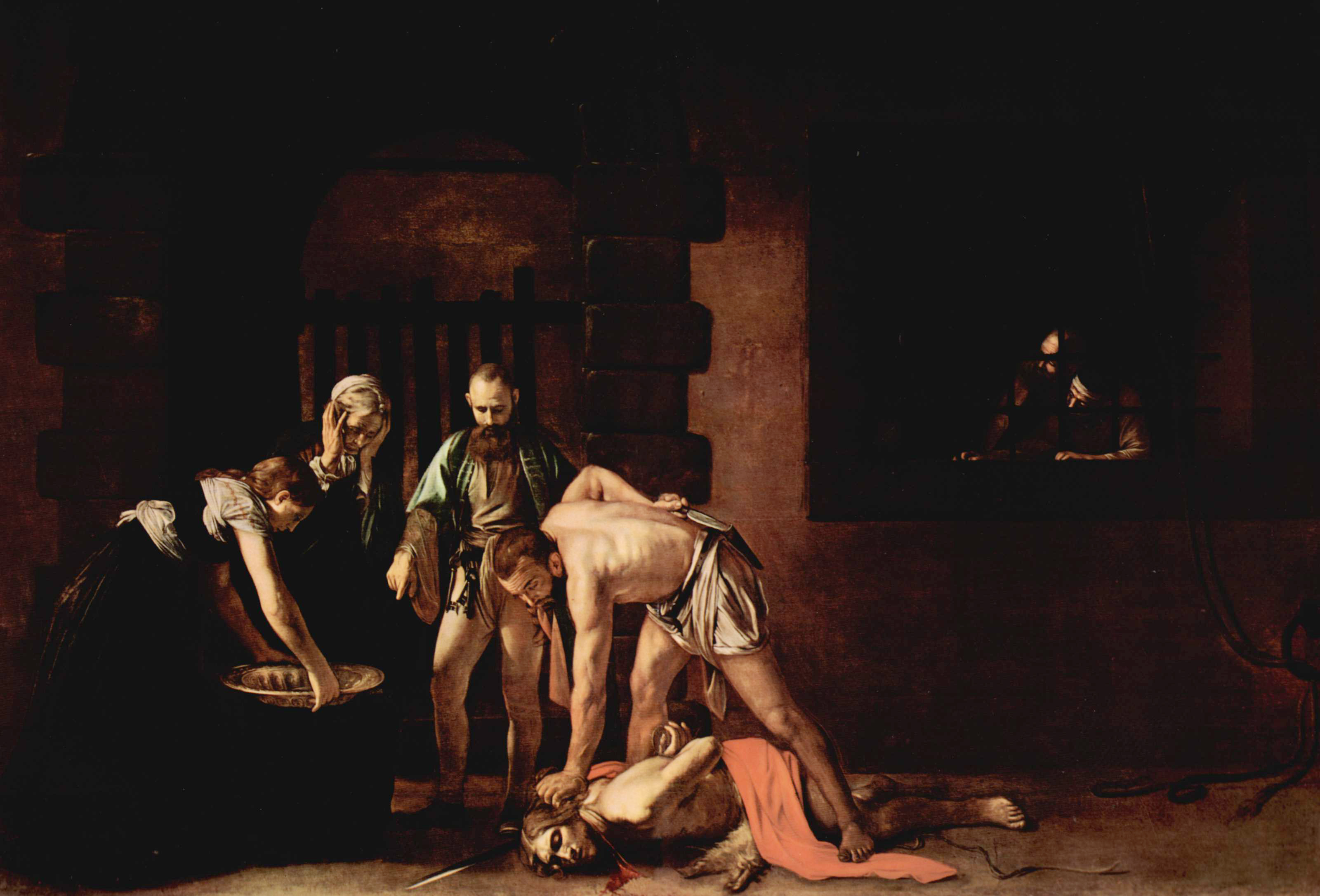
29 August – Beheading of St. John the Baptist: diminishing returns

Today is the feast of the Beheading of John the Baptist.

I consider this (also) my name day, and in so many ways it is more appropriate for me than the Nativity of John in June.

Here is the Roman Martyrology entry for ” the greatest man born of woman”, as the Lord called him:

Memoria passionis sancti Ioannis Baptistae, quem Herodes Antipas rex in arce Macherontis in carcere tenuit et in anniversario suo, filia Herodiadis rogante, decollari praecepit; ideo, Praecursor Domini, sicut lucerna ardens et lucens, tam in morte quam in vita testimonium perhibuit veritati.

The memorial of the suffering and death of St. John the Baptist, whom King Herod Antipas held in the prison in the citadel of Macheron and, on his birthday, since the daughter of Herodias was making the request, ordered to be beheaded; thus, the Precursor of the Lord, like a bright shining lantern, gave witness to the truth in death as much as he did in life.

There is a tradition that John was forgiven the guilt of Original Sin before He was born, at the sound of Mary’s voice when she came to visit Elizabeth and John lept in her womb.

St. Augustine spoke often of St. John the Baptist, “the voice” of Christ’s “Word”.

Here is a piece of s. 380, preached in a year we can’t quite figure out. As a matter of fact, it might not be an actual sermon, but something assembled from other pieces. Still, it is Augustinian:

8. So let us recognize these two things in the very differences of [Christ’s and John’s] deaths. We read that John suffered martyrdom for the truth; was it for Christ? It wasn’t for Christ if Christ isn’t Truth. It certainly wasn’t for His Name, and yet it was for Truth itself. I mean the reason John was beheaded, after all, was not that he had confessed Christ. But he was urging self-control, he was urging justice; he was saying, “It is not lawful for you to have your brother’s wife” (Mk 6:18). The law, you see, which had commanded this, had also commanded about those who died without children, that brothers should take the wives of their brothers, and raise up seed for their brothers. Where this reason was lacking, the only motive was lust. It was this lust that John was rebuking, a chaste man rebuking an incestuous one; because this too is what he represented: “It is necessary for him to grow, but for me to diminish” (Jn 3:30).

The commandment had already been given that if anyone died without seed, his closet relation should take his wife and raise up seed for his brother. After all, why had God commanded this if not to signify in this way that the brother’s seed was to be raised up to the brother’s name? The commandment, you see, was that the child to be born would have the name of the deceased. Christ was deceased, the apostles took His spouse, the Church. Those whom they begot of her they did not name Paulians or Petrians, but Christians.

So let both their deaths also speak of these two things: “It is necessary for him to grow, but for me to diminish.” The one grew on the Cross, the other was diminished by the sword. Their deaths have spoken of this mystery, let the days do so too. Christ is born, and the days start increasing; John is born, and the days start diminishing. So let man’s honor diminish, God’s honor increase, so that the honor of man may be found in the honor of God.

Augustine makes the connection between the change of seasons and the births of John the Precursor and Christ the Messiah. Very nice.

In nature, in the northern hemisphere, the days are now quite obviously getting shorter, a cycle reflected in our feasts.

Finally, I am amused by the fact that the dictionary.com “word of the day” today is “truncate”.

Posted in Classic Posts, Linking Back, Liturgy Science Theatre 3000, Saints: Stories & Symbols | Tagged , , , , ,
10 Comments

A tribute to Fr. Thwaites

Fr. Sean Finnegan has a fine tribute to the late Fr. Hugh Thwaites, SJ, who died recently.  Here is how Fr. Finnegan’s piece concludes:

There are so many of us who owe Fr Hugh so much. I will never forget him and the lessons I learnt from him. Especially:

1) That hell is real, and a greater possibility for us who are pastors of the Lord’s flock.
2) That all souls are created in the image and likeness of God, and have equal value.
3) That prayer is much more than the acquisition of a technique; it is not something one has to be ‘good at’; it is something one simply must do.
4) The importance of the rosary
5) The importance of acquiring the virtue of humility.

I feel I want to close with the customary ‘May his soul rest in peace’. But, like Cæsar Baronius after the death of St Philip Neri, there is something that sticks in my throat about it in this instance. I have already begun to ask his prayers, and have already begun to receive an answer in one case……

Posted in "How To..." - Practical Notes, Mail from priests, Our Catholic Identity, Priests and Priesthood | Tagged ,
3 Comments

QUAERITUR: At which parish should I register?

From a reader:

I used to live in a dense part of the city with lots of churches (10 within a 1 mile radius). Partly because we were too tall to fit in the pews, and partly because we wanted to support the efforts of a pastor celebrating the TLM, we registered at the neighboring TLM parish instead of our geographical parish. I always attended daily mass where I work (at lunch), so I never went to my geographical parish .

About 7 months ago we moved to another part of the city that is not quite so dense with churches, and so going to one outside of your proper boundaries is not quite as normal. In the past three weeks I have been attending daily mass in the morning at my current geographical parish due to lots of lunch time meetings. I finally introduced myself to the pastor last week. He asked me about registering and was bristled by the fact that I have been living in his boundaries for so long while still registered and attending mass at the TLM parish.

What is the right thing to do in this situation? My geographical parish is struggling in attendance, finances, and general liveliness.

I can see why the pastor would be upset to “lose” two of “his” people to another parish. The TLM parish isn’t exactly thriving either. It’s mostly elderly Italians. The TLM is mostly people who travel from somewhere else.

I appreciate your guidance on this.

Okay, let’s look at the big picture.

Why are there parishes?

Parishes are established by the bishop (not the Lord) to provide pastoral care for the faithful (can. 515), proclamation of the word of God to the unbaptized and unchurched (can. 528.1), and sanctification of the world (can. 528.2 and 529).

The faithful have a right to worship according to the proper rituals of the Church (can. 214), the right to apostolic activity (can. 216), the right to Christian education (can. 217), and corresponding obligations to “assist with the needs of the Church so that the Church has what is necessary for divine worship, for the works of the apostolate and of charity, and for the decent support of its ministers.” (can. 222) and the obligation to remain in communion (can. 209) and be obedient to their pastors (can. 212). By “pastors,” pastores, the Code means bishops, not parish priests.

These rights and obligations are normally, and properly exercised in parishes, which “as a general rule” are territorial (can. 518), but a bishop can establish parishes “by reason of the rite, language, or nationality of the Christian faithful of some territory or even for some other reason.”

Now that the big picture is established, let’s look at the specifics.

What’s missing?

Any mention of “registration” – something that seems to have been a creation of North American pastors for various reasons.

Canon law does not recognize any impact of the notion of “registering” in a parish, which is largely unheard of in other parts of the world.

One becomes a member of a parish in one of two ways: by where one lives, or by fitting the category the bishop has laid out for a personal parish.

It is entirely possible for a person to have more than one parish. One might live in St. Ermengild Parish territory, and, by virtue of one’s Cornish nationality, also be a member of St. Tudwal’s-on-the-Slough. If one had a vacation home in Our Lady Queen of Hermits parish, one could even acquire membership in a third parish, by virtue of quasi-domicile.

One need not (canonically) register in any parish, unless the bishop has issued particular law requiring this (which has been done in the Diocese of Honolulu).

Now, lest the pastors (parish priests and bishops!) rise up in anger, there are some very good, practical reasons for registering in a parish.

First, one gets envelopes, which assists one in fulfilling the serious obligation to provide support.

Also, one gets “counted,” which can be important when the bishop sits down and attempts to assign the thirty newly ordained priests each year. If St. Winwaloe has 300 registered parishioners, and St. Venantius has 5000 registered, which parish is more likely to get an associate pastor?

In large parishes, registering gives one a point of connection with the pastor and parish staff.

Registration also makes the parish secretary (who is usually a sweet person, though less likely to have been trained in the niceties of canon law and not always cognizant of the impact of one’s domicile or quasi-domicile) happy. We should all want to make the parish secretary happy.

That said, if one has multiple parish memberships – and especially if one partakes regularly in the material benefits of such – going regular to Mass and confession, picking up a bulletin, enjoying the coffee and doughnuts, calling on the assistance of the pastor to bless one’s house, one’s car, one’s herbs (on Assumption, of course) – one has the corresponding obligation to the best of one’s ability to support those multiple parishes.

It is reasonable (though canon law is mute on this topic) that the percentage of one’s financial support be somehow proportionate both to one’s financial condition, and also to one’s use of a parish’s resources. We are not talking some specific figure or percentage here.  We are not dealing with a consumer good. Still, it is a matter of common sense that if you go to daily Mass six days a week in one parish, confession biweekly in another parish, and Sunday Mass in a third parish, but you only put in an envelope to support my “Sunday parish,” you might need to examine my giving habits.

Now if one could, technically, be a member of two or more parishes, but one chooses to exclusively use the “services” of one of those parishes, it follows that one’s financial support should be directed toward the parish one attends.

Those are some guiding points.  I hope this helps.

Posted in "How To..." - Practical Notes, ASK FATHER Question Box, Our Catholic Identity | Tagged , , , , , , , , , ,
65 Comments