A moment in Holy Mass in the traditional Carmelite Rite.
The priest stands with his arms outstretched in cruciform.

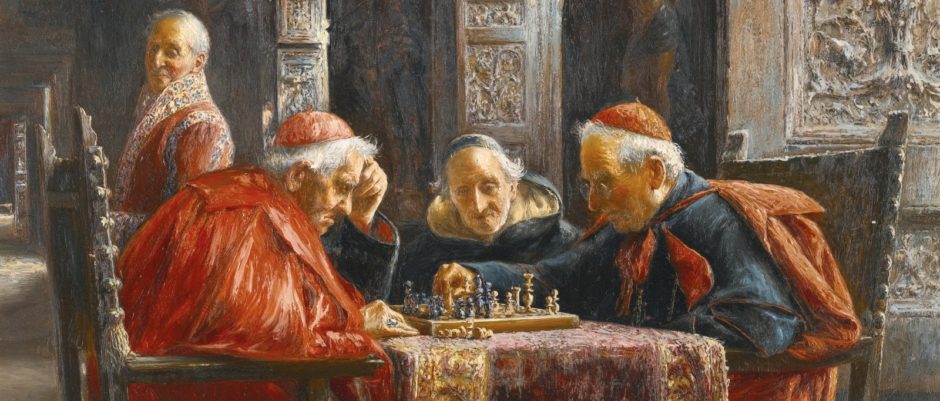
A moment in Holy Mass in the traditional Carmelite Rite.
The priest stands with his arms outstretched in cruciform.
 The Holy Father’s Angelus address from last Sunday.
There is something intriguing here. The full text of Pope Benedict’s Angelus message is below with my emphases and comments:
Dear brothers and sisters!
In the past few Sundays we have meditated on the “Bread of Life” discourse that Jesus pronounced in the synagogue of Capernaum after feeding thousands of people with five loaves and two fishes. Today, the Gospel presents the disciples’ reaction to that speech, a reaction that Christ Himself knowingly provoked. First of all, John the Evangelist – who was present along with the other Apostles – reports that “from that time many of His disciples drew back and no longer went about with Him” (Jn 6:66). Why? Because they did not believe the words of Jesus when He said: “I am the living bread which came down from heaven. He who eats my flesh and drinks my blood will live forever” (cf. Jn 6,51.54). This revelation, as I have said, remained incomprehensible to them, because they understood it in a material sense, while in these words was foretold the Paschal Mystery of Jesus, in which He would give Himself for the salvation of the world: the new presence in the Holy Eucharist.
Seeing that many of His disciples were leaving, Jesus addressed the Apostles, saying: “Will you also go away?” (Jn 6:67). As in other cases, it is Peter who replied on behalf of the Twelve: “Lord, to whom shall we go? – and we too can reflect: to whom shall we go? – You have the words of eternal life and we have believed and know that You are the Holy One of God” (Jn 6:68-69). On this passage we have a beautiful commentary of St. Augustine, who says in one of his homilies on John 6: “Do you see how Peter, by the grace of God, by the inspiration of the Holy Spirit, has understood? Why did he understand? Because he believed. You have the words of eternal life. You give us eternal life by offering your risen body and your blood, your very self. And we have believed and understood. He does not say we have understood and then we believed, but we believed and then we understood. We have believed in order to be able to understand; if, in fact, we wanted to understand before believing, we would not be able either to understand or to believe. What have we believed and what have we understood? That You are the Christ, the Son of God, that is, that You are that very eternal life, and that You give in Your flesh and blood only that which You are” (Commentary on the Gospel of John, 27, 9). So Saint Augustine said in a homily to his faithful people. [Nisi credideritis non intelligetis!]
Finally, Jesus knew that even among the twelve apostles there was one that did not believe: Judas. Judas could have left, as many of the disciples did; indeed, he would have left if he were honest. [Get that? Had he been honest he would have gotten out. He would have left.] Instead he remained with Jesus. He did not remain because of faith, or because of love, but with the secret intention of taking vengeance on the Master. Why? Because Judas felt betrayed by Jesus, and decided that he in turn would betray Him. Judas was a Zealot, and wanted a triumphant Messiah, who would lead a revolt against the Romans. [He wanted to reduce the Lord and His mission to the worldly.] Jesus had disappointed those expectations. The problem is that Judas did not go away, and his most serious fault was falsehood, which is the mark of the devil. This is why Jesus said to the Twelve: “One of you is a devil” (John 6.70). We pray to the Virgin Mary, help us to believe in Jesus, as St. Peter did, and to always be sincere with Him and with all people.
Those who reduce the Church’s mission to the worldly, who reduce the supernatural to the natural, are like Judas.
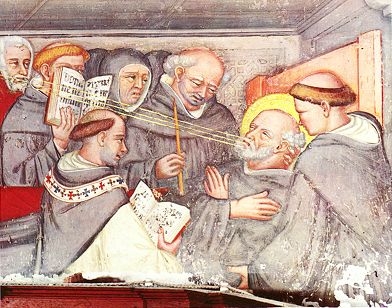 Yesterday, I posted about the bones of St. Monnica, the mother of St. Augustine of Hippo. Today we move to the mortal remains of her sainted son.
Augustine died on 28 August 430.
Sometime before the early 8th century, Augustine’s remains were translated from N. Africa to Sardinia for fear of desecration. It is possible that St. Fulgentius of Ruspe took Augustine’s body to Sardinia. Fulgentius had run afoul of the Arian Vandal overlords in N. Africa and was driven out. If you want to know more about St. Fulgentius, I have a PODCAzTabout him.
 During the 8th century Augustine’s remains were in danger again, but this time by another gang of vandals called Arabs, who were swarming all over the Mediterranean as pirates and brigands.
Sometime between 710 and 730 King Liutprand of the Lombards translated Augustine a second time. On some 11 October, Luitprand had him interred in Pavia in the church of San Pietro in Ciel d’Oro.
It is thought that Liutprand had to pay a huge ransom the bones from some Muslim thug. (Hard to believe, I know.)
With the passage of time people simply forgot where the saints bones actually physically were in the church.
Eventually, the church itself came to be controlled by two different Augustinian groups, the Canons Regular and the Hermits. Let’s just say their relations were strained and leave it at that. Then something happened that set off the war between them.
In 1695 a group of workman were excavating under the altar in the crypt of the church. They found a marble box containing human bones. The box apparently had some charcoal markings spelling the part of the word “Augustine”, though those markings disappeared. Great chaos ensued.
The memory of just where the relics of Augustine were placed in the church had been lost through the passing of the years. Finding them again set off a rather unedifying battle for their control between the Augustinian Hermits and the Canons Regular.
Ultimately, Rome had to step in to resolve things. That’s what Pope’s do.
Pope Benedict XIII, a Dominican who changed his numbering from XIV to XIII so as to avoid counting an anti-pope, got involved personally. He was very interested in saints and canonized the huge number of 18! At least that was a huge number before the pontificate of John Paul II.
This was also at the time when the future Pope Benedict XIV, Propsero Lambertini, published his fourth and final volume On the beatification of the servants of God and of the canonization of the blessed. Pope Lambertini would give us the legislation for the canonical processes of canonizations that has lasted with some few changes to today.
In any event, Benedict XIII sent a letter to the Bishop of Pavia telling him to get their act together and figure out the questions of authenticity and control.
Additional studies were made under someone appointed by Benedict and by 19 September of 1729 things were wrapped up.
Processions were held, solemn proclamations made about the authenticity of the relics, a great Te Deum was sung and there was a fireworks display, and anyone who decided to disagree and start the bickering again would be excommunicated. The good ol’ days.
The next year under Pope Clement XII the Cardinal Secretary of State (and a patron of the Canons Regular) commissioned the carving of the large main altar with its reliefs, completed in 1738, and which you can see today in the church where Augustine’s tomb is even now.
So, when you travel to northern Italy, be sure to stop in the interesting city of Pavia (Pav-EE-a), south of Milan. There you will find the bones of the mighty north African Doctor of the Church, St. Augustine of Hippo.
Our friends at Rorate noticed a piece at Vatican Insider in which His Eminence Walter Card. Brandmüller expressed himself about the Novus Ordo, aka “the Mass of Paul VI” and “the Ordinary Form”. He says what we know is true but few people are willing to say openly: the Novus Ordo is NOT the Mass of the Council. That is to say, the Council Fathers mandated a reform, but what we got was NOT the reform they mandated.
Sacrosanctum Concilium was never properly implemented.
Let’s have a look at what Card. Brandmüller had to say with some of my usually emphases and comments:
Q: The Second Vatican Council was a Pastoral Council that also provided dogmatic explanations. Had there ever been anything like it previously in the history of the Church?
[Brandmüller:] It does in fact seem as though Vatican II marked the beginning of a new type of Council. The language that was used during it and the completeness of the texts show that the Council fathers was not as much motivated by the need to pass judgement on controversial new ecclesiastical and theological issues, but rather by the wish to turn their attention to public opinion within the Church and the entire world, in the spirit of the annunciation.
Q: Shouldn’t a Council be declared a failure if fifty years on it has not been warmly received by the faithful? Benedict XVI warned against a misleading interpretation of the Council, particularly in terms of the hermeneutics of [rupture]…
[B:] This is one of those cliché questions that stem from a new existential sentiment; that feeling of confusion that is typical of our times. But what is fifty years after all?! Cast your mind back to the Council of Nicaea in 325. [Card. B is an historian. He gets it. Furthermore, a sound historical perspective informs us that Vatican II was not nearly as important as many other Councils of the past.] The disputes surrounding the dogma of this Council – about the nature of the Son, that is, whether he was made of the same substance as the Father or not – continued for more than a hundred years. St. Ambrose was ordained Bishop of Milan on the occasion of the fiftieth anniversary of the Council of Nicaea and had to fight hard against the Arians who refused to accept the Nicene provisions. Briefly afterwards came a new Council: the First Council of Constantinople of 381 […]
Q: Let us talk now about the fruits which the Vatican II produced. Can you comment on this?
[B:] First of all of course the “Catechism of the Catholic Church” in comparison with the Tridentine Catechism: after the Council of Trent, the Catechismus Romanus was launched in order to provide parish priests, preachers etcetera with guidelines on how to preach and announce the Gospel or evangelize.
Even the 1983 Code of Canon Law can be considered a consequence of the Council. [Here we go! …] I must emphasise that the form of the post-conciliar liturgy with all its distortions, is not attributable to the Council or to the Liturgy Constitution established during Vatican II which by the way has not really been implemented even to this day. [Do I hear an “Amen!”?] The indiscriminate removal of Latin and Gregorian Chants from liturgical celebrations and the erection of numerous altars were absolutely not acts prescribed by the Council. [And the distortion of the reform goes beyond those points.]
With the benefit of hindsight, let us cast our minds back in particular to the lack of sensitivity shown in terms of care for the faithful and in the pastoral carelessness shown in the liturgical form. One need only think of the Church’s excesses, reminiscent of the Beeldenstorm (the statue/image storm) which occurred in the 18th century. Excesses which catapulted numerous faithful into total chaos, leaving many fumbling around in the dark.
Just about anything and everything has been said on this subject. Meanwhile, the liturgy has come to be seen as a mirror image of Church life, subject to an organic historical evolution which cannot – as did indeed happen – suddenly be changed by decreepar ordre de mufti. [Or even by the order of Paul VI for that matter!] And we are still paying the price today.
[…]
We sure are.
But, brick by brick, we are rebuilding.

From CNA:
HHS revises mandate third time; foes say it misses the point
Washington D.C., Aug 28, 2012 / 03:58 am (CNA/EWTN News).- A slight revision of the federal contraception mandate offers some additional protection for certain religious employers but is not sufficient to ease religious freedom concerns, said a lawyer who is working to challenge the mandate in court.
Hannah Smith, senior counsel at the Becket Fund for Religious Liberty, told CNA on Aug. 27 that the Obama administration is governing by “sloppy executive fiat” and is failing to address the underlying problem with the controversial mandate.
She explained that for the third time in seven months, the federal government has rewritten the guidelines for the “safe harbor” that offers a one-year reprieve from the mandate to some non-profit religious organizations that object to its demands.
“They’re making it up as they go along,” she said. “They haven’t really thought through these issues carefully.” [Or they are stalling. Cunctando regitur mundus. In the meantime, the White House of the First Gay President can shrug and say “Hey! WE are trying but THEY are not working with us!]
The Becket Fund is representing Wheaton College, a Christian liberal arts college in Illinois, in a lawsuit challenging the mandate. The controversial rule requires employers to offer health insurance that covers contraception, sterilization and early abortion drugs, even if doing so violates their consciences.
[…]
November 2012!
From a reader:
At ordination, the rector of the seminary is asked if the candidate is fully prepared for priestly duties. If a priest cannot say Mass in the E F, should that be considered not being prepared to assume his duties?
I have written about this many times.
I have a hard time understanding how a man who doesn’t know the rites his Church calls him to celebrate can be considered properly trained. The Roman Rite has two forms, Ordinary and Extraordinary. A priest should be able to celebrate both. If he cannot, he knows half his Rite.
How is half-trained for Mass and the sacraments, properly trained?
Furthermore, the 1983 Code of Canon Law says that all seminarians must be very well trained in Latin. I am not making this up. The CIC can. 249 requires… it doesn’t suggest… it requires that all seminarians be very well-versed in Latin and also any other language useful for their ministry: “lingua latina bene calleant“. Not just calleant, but bene calleant. Calleo is “to be practised, to be wise by experience, to be skilful, versed in” or “to know by experience or practice, to know, have the knowledge of, understand”. We get the word “callused” from this verb. We develop calluses when we do something repeatedly. So, bene calleant is “let them be very well versed”. Let is also review Sacrosanctum Concilium 36 and Optatam totius 13!
How often does some fellow stand up in front of the bishop and say that the men to be ordained are properly trained even though they cannot say the Extraordinary Form and they don’t know any Latin?
“But Father! But Father!”, some of you might be ready to exclaim. “Latin is hard! The Extraordinary Form is too haaaard for men today!”
Boo hoo!
I’ll tell you what’s hard. What’s hard is ordaining men who don’t have these fundamental tools. It’s hard on the people of God and hard on the men themselves in the long run.
Yes, it takes work and time to learn the Extraordinary Form and Latin. It take about 5 minutes to learn to say the Ordinary Form in your native language. Whoop-Dee-Doo! Saying Mass in the older, traditional form is an accomplishment. You don’t just get up and do it. It is not like learning to do brain surgery, but it does take training and practice. The newer form? Big deal. Just about anyone could come straight up from the pews and do what Father does…. which probably has led in some places to everyone coming up from the pews and doing what Father does.
And we wonder why respect for the clergy has decreased over the decades. What’s so special about what he is doing if it seems like anyone could do it?
Yes, I’m ranting. I’ll stop now.
 From a reader:
Some churches in my diocese have recently begun the practice of having no altar cloth. I.e., only when Mass is said is there a small cloth unfolded on the altar beneath the paten and chalice — otherwise the table altar is bare. Is this permitted under Church law or whatever governs such things?
What you describe has nothing to do with our Roman tradition. Moreover, I refer you to the General Instruction of the Roman Missal.
GIRM 304. Out of reverence for the celebration of the memorial of the Lord and for the banquet in which the Body and Blood of the Lord are offered, there should be, on an altar where this is celebrated, at least one cloth, white in color, whose shape, size, and decoration are in keeping with the altar’s structure. When, in the Dioceses of the United States of America, other cloths are used in addition to the altar cloth, then those cloths may be of other colors possessing Christian honorific or festive significance according to longstanding local usage, provided that the uppermost cloth covering the mensa (i.e., the altar cloth itself) is always white in color.
Thus, it is not enough just to put a corporal on a bare altar. There should be at least one altar cloth.
Traditionally, we Romans use three cloths on our altars.
And it ain’t Marvin the Martian.
First, here is a very cool hi-def telephoto shot taken by Curiosity, the newest of the Mars rovers.

The image of nearby Mt. Sharp was taken with a 100-millimeter telephoto lens and the 34-milllimeter wide angle lens of the Mast Camera (Mastcam) instrument. Curiosity is headed in that direction, I think.
About that voice.
An audio message was sent from Earth to the rover on Mars, and then played back from there. Not exactly “One small step for a man, …” but it’s not nothing. It is the first time a human voice has made the trip from another planet. It was the NASA director. I’m just glad it was not Pres. Obama’s voice.
I FIXED THE POLL WIDGET
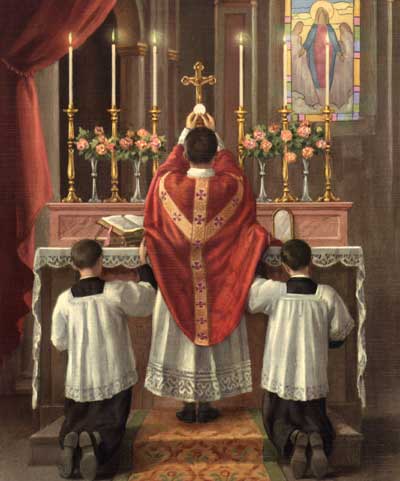
Several people have written to me about the length of time a priest does/should elevate the Host and the chalice after the consecration.
The length of time I elevate the Host is, of course, ideal. If asked, your parish priest will say the same about the length he chooses.
Keeping in mind that Mass is not the time for sustained adoration of the Blessed Sacrament, as if Mass were Exposition, and keeping in mind that part of the genius of the Roman Rite is the deprivation of our senses of sight and hearing during certain moments, and keeping in mind that bells are secondary to the Blessed Sacrament, how long do you think the priest should extend the elevation?
Please give your best answer and then use the combox.

Coat of Arms by D Burkart









A Daily Prayer for Priests


They find you a pro-life agent in your area who commits to giving a portion of the fee to a pro-life group!

PLEASE subscribe via PayPal if it is useful. Zelle and Wise are better, but PayPal is convenient.
A monthly subscription donation means I have steady income I can plan on. I put you my list of benefactors for whom I pray and for whom I often say Holy Mass.
In view of the rapidly changing challenges I now face, I would like to add more $10/month subscribers. Will you please help?
For a one time donation...



Help Monks in Wyoming (coffee – UPDATED LINK) and Norcia (beer) and the wonderful "Soap Sisters" of Summit, NJ!


Please follow me on Twitter!










Visits tracked by Statcounter
since Sat., 25 Nov. 2006:

