
 From a reader…
QUAERITUR:
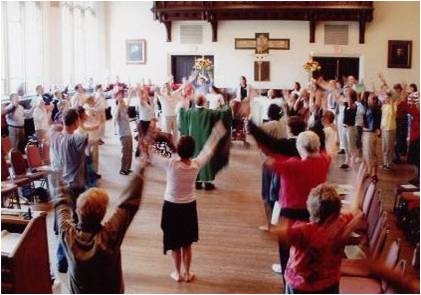
Hello, Father! As a high school religion teacher, our department has been discussing the impact talking in church has made on our young people. On an average Sunday morning, most people mill about the church building, talking to friends and neighbors with no discernable difference in the way they speak anywhere else. I think our students see this, because they do the same thing after school Masses. This to me also seems connected to the students’ lack of zeal in prayerful participation at Mass – if our experience of the divine is nothing more than an on/off construct of our own imagination and initiative, the objective reality of God’s Real Presence in the Blessed Sacrament seems to be lost, no matter what kind of catechesis I do in the classroom, or the amount of piety or personal devotion I recommend the students to partake of. Am I wrong? How do we get the kids to not only “be quiet” but also engage in the spiritual realities our Church passes on? How can we build up this culture in our school and church?
Thank you, Father! I greatly enjoy your blog and use it frequently.
Thanks for that.
The beset catechesis on sacred worship, liturgy, is sacred worship itself.
Therefore, I renew what I say often: We need more and more celebrations of the older, traditional form of Mass.
Lack of liturgical decorum? Young people don’t know what’s up? Reason #8 for Summorum Pontificum.
Classroom? Give them the straight stuff! Give them the basics of hard identity Catholicism. Make the memorize, too: it sinks in that way.
Teach them about what Sacraments are. Teach them that Mass is first and foremost SACRIFICE and what that Sacrifice did for us. Teach them about the distinction of the sacred and the profane/secular. Teach them what Sacramentals are, and what blessing and consecrations do. Teach them that the church building itself is a sacred place. Talk to them about mystery and the transcendent. Find stories and saying of the saints about Holy Mass.
Teach the basics, stuff that every Catholic needs to know.
That’s the classroom.
That said, clearly the way Mass is celebrated in both forms is a huge contributing factor here.
In the older or newer forms, the way Father says Mass has incalculable effect… a knock-on effect. The priest’s ars celebrandi will have a lasting effect on the way people in the congregation participate. This must, per force, expand outward into their overarching perception of the sacred, which must also come to embrace a recognition that there are sacred things, people, times and places. A church is a sacred place. We must not behave in church in the same way we behave in our living room or at a public swimming pool.
At the same time, as their elders behave, so too shall the young. Lack of decorum is rampant now. We are all children of our times and these times are marked by a cretinous lack of attention to dignity and behavior that rests on the good, true and beautiful. It cannot be helped.
That said, I think that preaching and direct catechesis can help. Friendly reminders in the bulletin and from the pulpit are in order. The good examples of congregants can contribute. But decorum in church depends a great deal on the choices made for the ars celebrandi of the place. Therefore a great deal depends on the priest himself.
If Father is a rube and celebrates Mass as if he were David Letterman, if the music is unworthy of a circus calliope, if the vestments, vessels, decorations, gestures betray the premise that what is being done there isn’t about the transcendent in contact with the human, but rather is all about the horizontal, the human merely, then… good luck with decorum in church, friend.
Reason #8 for Summorum Pontificum, that valuable tool for the New Evangelization.
Want decorum? ¡Vaya lío! Work for the implementation of Summorum Pontificum where you are.




 ThePapalCount on WDTPRS – 9 November: Feast of the Dedication of St. John Lateran, Rome’s Cathedral: “Fr Z — this is an excellent piece. Great teaching. Thanks for this.”




























