Pope Francis out for a spin … and a March for Life in Rome

Did you see this?

From CNA:

Vatican City, May 13, 2013 / 08:25 am (CNA/EWTN News).- Pro-lifers who had just finished the third annual Italian March for Life on Sunday were surprised to see Pope Francis coming toward them in the popemobile.

“It was a great joy for us because we didn’t expect this at all, we just expected his message,” said March for Life organizer Virginia Coda Nunziante.

“It was extraordinary because I met the people who unexpectedly saw him coming,” she told CNA on May 13.

The popemobile brought the Pope down the first block of Via della Conciliazione after he finished his first canonization Mass and the weekly Regina Caeli prayer on Sunday.

May 12 was also the day that around 20,000 pro-lifers from Italy and beyond converged on Rome to defend the unborn and call for an end to abortion in the country.

Their route took them from the Coliseum to Castel Sant’ Angelo, which sits on the end of Via della Conciliazione. A large number of the pro-lifers then continued down the street to be present for Pope Francis reciting the Regina Caeli.

Before praying the Marian prayer, the Pope acknowledged the presence of the group.

“I greet the participants of the March for Life which took place this morning in Rome and invite everyone to stay focused on the important issue of respect for human life, from the moment of conception,” he said.

[…]

Posted in Emanations from Penumbras, Francis, Just Too Cool, Lighter fare, New Evangelization | Tagged , ,
11 Comments

QUAERITUR: I found a Host at my mother’s house. Wherein Fr. Z rants a little.

From a reader:

While visiting my parents’ home (they are not Catholic; I am a convert), I was invited up to look at something on Mom’s prayer table.

I forget what it was … but out of the corner of my eye, something white caught my eye. Turning to look, I realized with shock that it was a Host. I asked how It had got there; Mom said she had gone to a Catholic church near her home and they had “handed these out” to everyone as they came up. So she took one too, but, not knowing what to do with it, she placed in on her prayer table near a picture of Jesus. (She’s a bit syncretistic in her religion.) So, what is the right thing for a Catholic to do after discovering such a situation?

What I did was, first knelt down to adore … stopped to explain to Mom that Communion is only meant to be received by Catholics …

adored some more, and finally, consumed the Host.

Did I do right? Should I have called the church or asked for a priest?

Reason #65665 for Summorum Pontificum.

First, allow me to observe that your mother, though not Catholic and not really understanding what the score was, seems to have had a greater sense of respect for the Host she was given than many cradle Catholics who blithely troop up for Communion as if they are getting their parking ticket validated.

You probably did the right thing.

Your mother’s explanation indicates that she brought that Host from Communion time during Mass.  Therefore, there was little doubt that It was properly consecrated.

In a case like this, consuming the Host directly or calling the parish priest are both decent options.  Another option would be carefully to wrap up the Host and take it to the parish, so that the priest could place it in the ablution cup.  The Host can then be dissolved and the liquid poured down the sacrarium.

Communion in the hand has created all sorts of problems.   It has decreased reverence for Catholics for the Blessed Sacrament and it has made it easier for people, for whatever reason, to take Hosts from churches.  For the most part, people who might walk out with a Host are not doing so out of malice or ill-intent.  They just don’t know what to do.  Then the Host winds up thrown away or casually tumbled about until it is broken up.

There are other people, however, who take Hosts for nefarious reasons.

Also, I should remind people that there is an automatic excommunication


for throwing away the Blessed Sacrament or selling or giving It for bad purposes.  In this case, however, you have to know that what you are doing is a mortal sin and then do it anyway with a free will in order to incur the censure.  The censure can only be lifted by a confessor who receives the special faculty to lift it directly from the Holy See’s Sacra Penitenzieria Apostolica.  Furthermore, the Congregation for the Doctrine of the Faith treats as graviora delicta, “taking away or retaining the consecrated species for sacrilegious ends, or the throwing them away”.
In any event, we hear these tales of people finding Hosts from papal Masses glued into scrapbooks, Hosts under pews in church, Hosts in the pages of the missalette, Hosts stuck to gum on the bottoms of pews, Hosts on sidewalks outside church after Mass….I add this information here not because I think your mother incurred some kind of penalty (she wouldn’t have) but for the sake of being complete.   It may be that there is some parish “minister” out there pouring “extra” Precious Blood down the drain after Mass, maybe even at the direction of some stupid priest or deacon.  If so… knock it off!


I’ve said it before and I’ll say it again: let’s get rid of Communion in the hand.

We need more and deeper preaching and teaching about the Eucharist, and we need a revitalization of our celebration of the Eucharist… from clew to earring, as Preserved Killick would say.

Fathers!  This is the Year of Faith.  How about trying to move people to receive on the tongue while kneeling?

Posted in "How To..." - Practical Notes, ASK FATHER Question Box, Liturgy Science Theatre 3000, New Evangelization, O'Brian Tags, Our Catholic Identity, Preserved Killick, SUMMORUM PONTIFICUM, Year of Faith | Tagged , , , , ,
43 Comments

Rail by rail!

One for the Brick by Brick file.

I had a note from a friend in the Diocese of Kansas City-St. Joseph, where the great Bishop Robert Finn presides.

At St. Andrew the Apostle on the north side of KC, Fr. Vince Rogers has installed a new brand new Communion rail!

My friend wrote:

He has installed altar rails in most of not all of the parishes in which he has served over the past 15-20 years.

He noted in his homily this morning, “So, why do I do this everywhere I go? It started when I was a seminarian at the NAC. Mother Teresa came to visit and when time came for communion, she went first and knelt on the marble floor and received. We all looked at each other and went up and knelt to receive our blessed Lord. From that moment forward……”

“The largest denomination in the US is fallen away Catholics. Why? Because we have forgotten what the Eucharist really is. If it’s only bread we are like pigs at a trough. If it is the body, blood, soul and divinity of Jesus Christ, then let’s act accordingly.

Prior to the rail, he had a double prie-dieu in front of the altar. Maybe 30-40% received kneeling. This morning, the first Sunday Mass with the rail, all but a dozen or so at the 8 a.m. Mass received kneeling. Several still received in the hand but many more received kneeling, reverently and on the tongue – likely for the first time. What happened to their heart, only time will tell.

Fr. Z kudos to Fr. Rogers.

Posted in "How To..." - Practical Notes, Fr. Z KUDOS, Liturgy Science Theatre 3000, New Evangelization, Our Catholic Identity, Priests and Priesthood | Tagged , , , ,
19 Comments

Of flower petals, firefighters, dedication, and holes in the roof

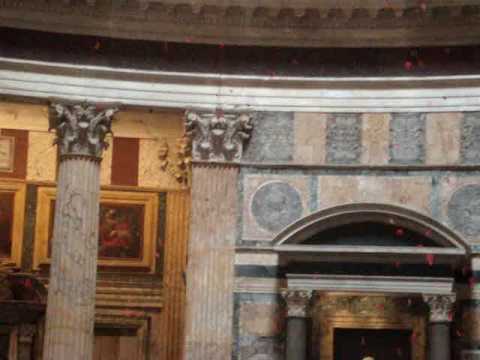
Today is the anniversary of the Dedication of the Roman church Santa Maria “ad Martyres“, which took place in 609.  This church is also called the Pantheon.

Since on upcoming Pentecost, Roman firefighters will be dropping red rose petals through the oculus of the mighty building, I figured we could review what I have posted in the past.

In Rome on Pentecost, in the Pantheon, now a minor basilica called S. Maria ad martyres there is a beautiful custom.

Rose petals are dropped through the circular oculus opening at the top of the dome, which is the widest is all of Rome, for all its antiquity.  The petals fall to the crowds below, reminiscent of the coming of the Holy Spirit like tongues of flame.

I posted photos taken over two different years here.  Some show the event from the inside of the Pantheon, and some show the mechanics from the outside.  My windon of my room in Rome was perfectly situated to see the dome of the Pantheon.

Here is how they get it done!  Notice the fire truck parked in front of the Pantheon.


The firemen, waiting on top of the dome, for the signal to drop the flower petals…

The moment arrives!

From within…

This is one of those lovely customs which we have only in Rome.

YouTube thumbnailYouTube icon

Posted in Linking Back, Liturgy Science Theatre 3000 | Tagged , ,
11 Comments

Pope Francis canonizes the Martyrs of Otranto, slain by Islamic invaders

Today Pope Francis conducted for the first time the venerable rite for the canonization of saints.

Among the new saints are the Martyrs of Otranto.  In his sermon, Francis said:

Today the Church proposes for our veneration a group of martyrs who were called together to the supreme witness to the Gospel in 1480. About 800 people, who survived the siege and invasion of Otranto, Italy, were decapitated on the outskirts of that city. They refused to deny their faith and they died confessing the risen Christ. Where did they find the strength to remain faithful? Precisely in faith, which permits us to see beyond the limits of our human vision, beyond the confines of earthly life, it permits us to contemplate “the heavens opened up,” as St. Stephen says, and the living Christ at the Father’s right hand. Dear friends, let us maintain the faith that we have received and that is our treasure, let us renew our fidelity to the Lord, even in the midst of obstacles and misunderstandings; God will never let us lack strength and serenity.

As we venerate the Martyrs of Otranto, let us ask God to sustain many Christians who, in our own time and in many parts of the world, now still suffer from violence, and to give them the courage of fidelity and to answer evil with good.

[…]

This is certainly a strong or “hard Catholic identity” message, rather than “soft identity”.

From the wikipedia entry:

On 28 July 1480 an Ottoman force commanded by Gedik Ahmed Pasha, consisting of 90 galleys, 40 galiots and other ships carrying a total of around 150 crew and 18,000 troops, landed beneath the walls of Otranto. The city strongly resisted the Ottoman assaults, but the garrison was unable to resist the bombardment for long. The garrison and all the townsfolk thus abandoned the main part of the city on 29 July, retreating into the citadel whilst the Ottomans began bombarding the neighbouring houses.
When Gedik Ahmed asked the defenders to surrender, they refused, and so the Ottoman artillery resumed the bombardment. On 11 August, after a 15-day siege, Gedik Ahmed ordered the final assault, which broke through the defences and captured the citadel. In the massacre which followed, all men over 15 years old were killed and all the women and children were enslaved. According to some historical accounts, a total of 12,000 were killed and 5,000 enslaved, including victims from the territories of the Salentine peninsula around the city.[2]
Some survivors and the city’s clergy took refuge in the cathedral to pray with their elderly archbishop Stefano Pendinelli. Gedik Ahmed ordered them to convert to Islam, but received a flat refusal and so broke into the cathedral with his men and killed all those inside. This included Pendinelli, who encouraged the survivors to turn to God at the point of death but was skewered and cut to pieces with scimitars before having his head cut off, put on a pike and carried round the city. Gedik Ahmed then turned the cathedral into a stable and sawed the garrison commander Francesco Largo to pieces whilst still alive.

Castle of Otranto
The townsfolk’s leader was now the old tailor Antonio Pezzulla, known as Il Primaldo, who also refused to convert to Islam. On 14 August Gedik Ahmed tied up the survivors and transported them to the nearby colle della Minerva, where at least 800 were beheaded, with their parents and families forced to assist in and attend the executions. Primaldo was the first to be beheaded – tradition holds that his decapitated body remained standing until the final person was beheaded, despite his executioners’ efforts to push him over. The chronicles record that an Ottoman Turk called Bersabei saw how bravely the Otrantines were dying, converted to Christianity and was impaled by his own comrades.
After thirty months Otranto was recaptured by an Aragonese force under Alfonso of Aragon, son of the king of Naples.

The relics of these martyrs were eventually translated to the church of Santa Caterina a Formiello in Naples, under the altar of the Our Lady of the Rosary which commemorated the victory over the Ottomans at Lepanto in 1571.

Posted in Francis, Modern Martyrs, New Evangelization, Our Catholic Identity, Saints: Stories & Symbols | Tagged , , , , , , ,
26 Comments

Beati qui…

Someone shared with me a graphic that indicates the amount different states of these USA tax your beer.  From TaxProf:

Did you that the last voice in the mighty Lewis & Short Dictionary is for a form of Egyptian beer?


Posted in Lighter fare | Tagged , ,
8 Comments

QUAERITUR: People who walk away with Hosts

From a reader:

twice in a month I have seen two examples of people receiving the Body of Christ but not consuming it in my diocese. Thankfully both Priests were strict in how they dealt with this. In the first instance, a young man walked away with the host and the Priest made him consume it. The other occasion an elderly lady took the host and when the Priest called her to come back he took the host and simply gave her a blessing, were they both correct?

It seems very worrying that this should occur, although I know of some of the abuses which have resulted from the practice of receiving in the hand.

First, I would be say that the priest was “strict”.  I would say that he was “diligent”.  This is what priests are supposed to do.

It could have been that the two people in question were non-Catholics who did not really know what to do, but, yes, this is a problem that results from Communion in the hand.

It is also a result of decades of poor catechesis and shabby liturgical worship which weakened reverence for the Eucharist.

How to change this?

We need better and more frequent preaching about the Eucharist and the sacrificial dimension of Mass.  We need clear statements in parish bulletins about how to receive Communion and who may receive.  We need to persuade people to move away from receiving in the hand.

Posted in "How To..." - Practical Notes, ASK FATHER Question Box, Liturgy Science Theatre 3000, New Evangelization, Our Catholic Identity, Priests and Priesthood | Tagged
38 Comments

WSJ on “The Trials of Father MacRae” – IMPORTANT

Falsely-accused Fr. MacRae blogs at These Stone Walls.

I bring to your attention this important article in the Wall Street Journal:

Rabinowitz: The Trials of Father MacRae
He was convicted when it was obligatory—as it remains today—to give credence to every accuser charging a priest with molestation.

By DOROTHY RABINOWITZ

Last Christmas Eve, his 18th behind bars, Catholic priest Gordon MacRae offered Mass in his cell at the New Hampshire state penitentiary. A quarter-ounce of unfermented wine and the host had been provided for the occasion, celebrated with the priest’s cellmate in attendance. Sentenced to 33½-67 years following his 1994 conviction for sexual assault against a teenage male, Father MacRae has just turned 60.

The path that led inexorably to that conviction would have been familiar to witnesses of the manufactured sex-abuse prosecutions that swept the nation in the 1980s and early 1990s and left an extraordinary number of ruined lives in its wake. Here once more, in the MacRae case, was a set of charges built by a determined sex-abuse investigator and an atmosphere in which accusation was, in effect, all the proof required to bring a guilty verdict. But now there was another factor: huge financial payouts for victims’ claims.

That a great many of the accusations against the priests were amply documented, that they involved the crimes of true predators all too often hidden or ignored, no one can doubt.

Neither should anyone doubt the ripe opportunities there were for fraudulent abuse claims filed in the hope of a large payoff. Busy civil attorneys—working on behalf of clients suddenly alive to the possibilities of a molestation claim, or open to suggestions that they remembered having been molested—could and did reap handsome rewards for themselves and their clients. The Diocese of Manchester, where Father MacRae had served, had by 2004 paid out $22,210,400 in settlements to those who had accused its priests of abuse.

The paydays did not come without effort. Thomas Grover—a man with a long record of violence, theft and drug offenses on whose claims the state built its case against Father MacRae—would receive direction for his testimony at the criminal trial. A conviction at the priest’s criminal trial would be a crucial determinant of success—that is, of the potential for reward—in Mr. Grover’s planned civil suit.

The 27-year-old accuser found that direction from a counselor at an agency recommended by his civil attorney. During Mr. Grover’s testimony, this therapist could be seen (though not by the jury) standing in the back of the courtroom. There, courtroom observers noted, and it is a report the state disputes, she would periodically place her finger at eye level and slowly move it down her right cheek—a pantomime of weeping. Soon thereafter Mr. Grover would begin to cry loudly, and at length.

Thomas Grover’s allegations were scarcely more credible than those of the 5- and 6-year-olds coaxed into accusations during the prosecutions of the day-care workers—children who spoke of being molested in graveyards and secret rooms. The accuser’s complaints against Father MacRae were similarly rich, among them allegations that few prosecutors would put before a jury. In a pretrial deposition, Mr. Grover alleged that Father MacRae had “chased me through a cemetery” and had tried to corner him there. Also, that Father MacRae had a gun and was “telling me over and over again that he would hurt me, kill me if I tried to tell anybody.” The priest had, moreover, chased him down the highway in his car.

Though jurors would hear none of these allegations, which spoke volumes about the character of this case, there was still the problem, for the prosecutors, of the spectacular claims Mr. Grover made in court—charges central to the case. Among them, that he had been sexually assaulted by Father MacRae when he was 15 during five successive counseling sessions. Why, after the first horrifying attack, had Mr. Grover willingly returned for four more sessions, in each of which he had been forcibly molested? Because, he explained, he had come to each new meeting with no memory of the previous attack. In addition, Mr. Grover said, he had experienced “out of body” episodes that had blocked his recollection.

In all, not the sort of testimony that would bolster a prosecutor’s confidence, and there was more of the kind, replete with the accuser’s changing stories. Not to mention a considerable history of forgery, assault, theft and drug use that entered the court record, at least in part, despite the judge’s ruling that such facts were irrelevant. In mid-trial, the state was moved to offer Father MacRae an enticing plea deal: one to three years for an admission of guilt. The priest refused it, as he had turned down two previous offers, insisting on his innocence.

Still, the jury trial would end with a conviction in September 1994, and a sentence equivalent to a life term handed down by Judge Arthur Brennan. That would not be all. The state threatened a new prosecution on additional charges unless the priest pleaded guilty to those, in exchange for no added prison time. Without funds and unable to hire a new lawyer, already facing a crushing sentence and certain, given the climate in which he would face a second trial, that he could only be convicted, Father MacRae accepted the deal.

In due course there would be the civil settlement: $195,000 for Mr. Grover and his attorneys. The payday—which the plaintiff had told the court he sought only to meet expenses for therapy—became an occasion for ecstatic celebration by Mr. Grover and friends. The party’s high point, captured by photographs now in possession of Father MacRae’s lawyers, shows the celebrants dancing around, waving stacks of $50 bills fresh from the bank.

The prospect of financial reward for anyone coming forward with accusations was no secret to teenage males in Keene, N.H., in the early 1990s. Some of them were members of that marginal society, in and out of trouble with the law, it fell to Father MacRae to counsel. Steven Wollschlager, who had been one of them—he would himself serve time for felony robbery—recalled that period of the 1990s in a 2008 statement to Father MacRae’s legal team. That it might not be in the best interest of a man with his own past legal troubles to give testimony undermining a high-profile state prosecution did not, apparently, deter him. “All the kids were aware,” Mr. Wollschlager recalled, “that the church was giving out large sums of money to keep the allegations from becoming public.”

This knowledge, Mr. Wollschlager said, fed the interest of local teens in joining the allegations. It was in this context that Detective James McLaughlin, sex-crimes investigator for the Keene police department, would turn his attention to the priest and play a key role in the effort to build a case against him. The full history of how Father MacRae came to be charged was reported on these pages in “A Priest’s Story,” April 27-28, 2005.

Mr. Wollschlager recalled that in 1994 Mr. McLaughlin summoned him to a meeting. As a young man, Mr. Wollschlager said, he had received counseling from Father MacRae. The main subject of the meeting with the detective was lawsuits and money and the priest. “All I had to do is make up a story,” Mr. Wollschlager said, and he too “could receive a large amount of money.” The detective “reminded me of my young child and girlfriend,” Mr. Wollschlager attests, and told him “that life would be easier for us.”

Eventually lured by the promise, Mr. Wollschlager said, he invented some claims of abuse. But summoned to a grand-jury hearing, he balked, telling an official that he refused to testify. He explains, in his statement, “I could not bring myself to give perjured testimony against MacRae, who had only tried to help me.” Asked for response to this charge, Mr. McLaughlin says it is “a fabrication.”

Along with the lure of financial settlements, the MacRae case was driven by that other potent force—the fevered atmosphere in which charges were built, the presumption of innocence buried. An atmosphere in which it was unthinkable—it still is today—not to credit as truthful every accuser charging a Catholic priest with molestation. There is no clearer testament to the times than the public statement in September 1993 issued by Father MacRae’s own diocese in Manchester well before the trial began: “The Church is a victim of the actions of Gordon MacRae as well as the individuals.” Diocesan officials had evidently found it inconvenient to dally while due process took its course.

A New Hampshire superior court will shortly deliver its decision on a habeas corpus petition seeking Father MacRae’s immediate release on grounds of newly discovered evidence. The petition was submitted by Robert Rosenthal, an appellate attorney with long experience in cases of this kind. In the event that the petition is rejected, Father MacRae’s attorneys say they will appeal.

Those aware of the facts of this case find it hard to imagine that any court today would ignore the perversion of justice it represents. Some who had been witnesses or otherwise involved still maintain vivid memories of the process.

Debra Collett, the former clinical director at Derby Lodge, a rehabilitation center that Mr. Grover had attended in 1987, said in a signed statement for Father MacRae’s current legal team that she had been subject to “coercion and intimidation, veiled and more forward threats” during the police investigation because “they could not get me to say what they wanted to hear.” Namely, that Mr. Grover had complained to her of molestation by Father MacRae. He had not—though he had accused many others, as she would point out. Thomas Grover, she said, had claimed to have been molested by so many people that the staff wondered whether “he was going for some sexual abuse victim world record.”

For Father MacRae’s part, he has no difficulty imagining any possibility—fitting for a man with encyclopedic command of the process that has brought him to this pass: every detail, every date, every hard fact. Still after nearly two decades this prisoner of the state remains, against all probability, staunch in spirit, strong in the faith that the wheels of justice turn, however slowly.

Ms. Rabinowitz is a member of the Journal’s editorial board.

A version of this article appeared May 11, 2013, on page A13 in the U.S. edition of The Wall Street Journal, with the headline: The Trials of Father MacRae.

Posted in "How To..." - Practical Notes, Mail from priests, Priests and Priesthood, The Last Acceptable Prejudice | Tagged , ,
29 Comments

Tulips

20130511-110254.jpg

Not quite like my view of a couple years ago…

At that time our frequent contributor “Andrew” wrote:

Quemadmodum vero tulipae, quae sub vesperam ingruentem se claudunt, sole illustri panduntur; ita virtus et eruditio, post Dei benedictionem, floret laetius.

Posted in My View | Tagged
5 Comments

Card. O’Malley to boycott Boston College when they honor pro-abortion Irish PM

I wrote HERE about Jesuit-run Boston College’s plan to have anti-Catholic catholic, pro-abortion Prime Minister of Ireland Enda Kenny speak at commencement and then confer on him an honor.

Outrageous. Shades of Notre Shame.

Now I read at the site of the Cardinal Newman Society (see their feed on the side bar) that the local Archbishop, Sean Card. O’Malley, will boycott the event.

Cardinal Sean O’Malley Will Boycott Boston College Commencement

Archdiocese of Boston’s Cardinal Sean O’Malley said today that he plans to boycott Boston College’s commencement ceremony May 20 because it will feature Irish Prime Minister Enda Kenny as its commencement speaker. The College is scheduled to award Kenny an honorary Doctor of Laws degree. Kenny supports loosening the country’s legislation against abortion.

“Since the university has not withdrawn the invitation and because the Taoiseach (prime minister) has not seen fit to decline, I shall not attend the graduation,’’ O’Malley said in a statement released this afternoon. “It is my ardent hope that Boston College will work to redress the confusion, disappointment and harm caused by not adhering to the Bishops’ directives,” he added, referencing the U.S. Conference of Catholic Bishops instruction that Catholic institutions not honor those whose views are inconsistent with the Church’s teachings.

Traditionally, the Boston archbishop delivers the final benediction at Boston College’s commencement each year.

Continued Cardinal O’Malley’s statement:

The Irish Bishops have responded to that development by affirming the Church’s teaching that “the deliberate decision to deprive an innocent human being of life is always morally wrong” and expressed serious concern that the proposed legislation “represents a dramatic and morally unacceptable change to Irish law.”

“Boston College invited Prime Minister Kenny a year ago to speak at our commencement to celebrate its heritage and relationship with Ireland and our desire to recognize and celebrate our heritage,” Boston College Spokesman Jack Dunn told the Boston Globe. “Our invitation is independent of the proposed bill that will be debated in the Irish parliament this summer.”

[…]

Read the rest there.

Fr. Z kudos to Card. O’Malley for this.

Bishops need to rise up and give Boston College a piece of their minds.

UPDATE:

There is a petition HERE

Posted in Emanations from Penumbras, Fr. Z KUDOS, Liberals, Linking Back, Our Catholic Identity, Pò sì jiù, The Drill, The future and our choices | Tagged , , , , ,
49 Comments