QUAERITUR: Will I go to heaven if I die in the state of grace?

From a reader:

Would it be accurate to say that if one were in the state of grace at death, one can be assured of reaching heaven after being purified in purgatory?

If you die in the state of grace, that is, in God’s friendship, you will either immediately or after a time in the state of purification be admitted to the bliss of the Beatific Vision in heaven.

Your happiness in heaven cannot be surpassed. You will be in God’s presence for eternity with all the angels and saints and God will be all in all.  There will no sorrow or sense of loss or inadequacy.  There will be no remorse or lack of peace. None of us can imagine what God has prepared for those who love Him.

It can be done.  It isn’t so hard as all that. God gives all the graces we need and forgiveness when we ask.  God gave us Holy Church and the sacraments to help us get there.

Be good to people.  Say your prayers.  Go to confession.  Receive Communion well.  Believe what Holy Church teaches. Trust in Christ’s promises.  Try to be virtuous.

This life is short.  But the next life is forever.

You can do this.

Everyone of us can do this.

Posted in "How To..." - Practical Notes, ASK FATHER Question Box, Just Too Cool | Tagged , , ,
24 Comments

The Pope, The Pill, and the Renewed Babylonian Captivity of the Church

Robert Mickens has shared the angst of his publication The Tablet (aka The Bitter Pill) about a piece of clothing.  Not just any clothing, papal clothing.

Pope Benedict, Yes, Benedict XVI wore over his choir dress a stole decorated with the papal tiara.

Imagine!  The Pope of Rome wore a stole with traditional symbol Popes used for centuries!  But, Pope Benedict wore it, and … I can hardly bring myself to type this … in Germany and… with…  Lutherans.

Let’s have a look.

And now Mr. Mickens for The Tablet.

The Pope and his tiara
Posted by Robert Mickens in Erfurt, 24 September 2011, 9:00

Pope Benedict XVI and his closest liturgical aides — Mgr Guido Marini, [obviously the bad guy of the episode] the master of ceremonies, and Mgr Georg Gaenswein, his personal secretary — pay careful attention to what type of vestments he wears and for which occasions. [It would be mighty strange if they didn’t!]

So it was interesting to note that on Friday, during an ecumenical prayer service in the former Augustinian church (now Protestant) where Martin Luther was ordained [Ooooo.] and celebrated his first Mass, [It was a Catholic church, after all.] the Pope wore a stole that depicted his personal coat of arms topped by the triple-crown tiara. [Ooooo.] Talk about sending a message! [Right!  Let’s do!] If there is anyone who railed against the imperial papacy, it was surely Luther. [And therefore, the Pope should not have worn his stole.  Get it?  Get it?  I wonder what changes a rabbi would have to make were he to visit Erfurt?  After all, Luther wasn’t too keen on Jews either.]

You might remember that much was made of the fact that, upon his election, Benedict XVI was the first pope ever to relinquish the tiara for his coat of arms and replace it with a bishop’s mitre. [Ehem,… apparently there are exceptions!] But [Here we go…] since Mgr G. Marini [BOOOO!] was hired he he has worn any number of vestments that include his arms topped with the triple-crown. [Ooooo!] And, of course, the Pope publicly received a tiara that was given to him as a gift [Ahhhhh!] and once hung a tapestry below his window [EEEEK!] overlooking St Peter’s Square showing his papal shield with the tiara.

Aides justify all this is as being part of that “hermeneutic of continuity”. But sometimes there is a good reason to throw things out or put them on the shelf for good. [A couple newspapers come to mind…] Not everything that was deemed necessary in the past is good for the present – or helpful in moving into the future.

Here is more grist for The Pill’s Marini Mill.

Have they forgotten that, almost exactly one year ago, Pope Benedict walked into another former Catholic Church, Westminster Abbey, wearing a stole of Pope Leo XIII?  Leo XIII, successor to Leo X, taught definitively in Apostolicae curae about the invalidity of Anglican orders.

But back to Erfurt a year later…

As a former Lutheran, I understand the shock, the horror, the outrage at the lack of Petrine sensitivity redounding through the Lutheran world at the sight of that tiara.  After all, they have – for the most part – stopped calling the Pope the Anti-Christ and the Roman Church the Whore of Babylon.

That tiara must have reminded those Lutherans that Benedict XVI is the Pope of Rooooome, bringing all those anti-Catholic sentiments back to the surface.  They might even break off dialogue!

I suspect even now, because of that stole and the nefarious un-ecumenical machinations of Msgr. Marini, Lutherans are dashing off pamphlets called the ReNewed Babylonian Captivity of the Church!

Soon to be published by …. The Tablet Publishing Company, perhaps?

It’s time to repost this, just for fun!

Posted in Lighter fare, New Evangelization, Our Catholic Identity, Picture Me In My Grief, The Drill | Tagged , , , , , , ,
29 Comments

“For you and for many for the forgiveness of sins.”

In the consecration of the Precious Blood the priests says:

“For you and for many for the forgiveness of sins.”

From the Meditations and Devotions of Bl. John Henry Newman.

I cannot penetrate Thy secret decrees, O Lord! I know Thou didst die for all men really; but since thou hast not effectually willed the salvation of all, and since Thou mightest have done so, it is certain that Thou doest for one what Thou dost not do for another.

I cannot tell what has been Thy everlasting purpose about myself, but, if I go by all the signs which Thou hast lavished upon me, I may hope that I am one of those whose names are written in Thy book.

But this I know and feel most entirely, what I believe in the case of all men, but know and feel in my own case, that, if I do not attain to that crown which I see and which is within my reach, it is entirely my own fault.

Thou hast surrounded me from childhood with Thy mercies; Thou hast taken as much pains with me as if I was of importance to Thee, and my loss of heaven would be Thy loss of me. Thou hast led me on by ten thousand merciful providences; Thou hast brought me near to Thee in the most intimate of ways; Thou hast brought me into Thy house and chamber; Thou hast fed me with Thyself. Dost Thou not love me? really, truly, substantially, efficaciously love me, without any limitation of the word?

I know it. I have an utter conviction of it.

Thou art ever waiting to do me benefits, to pour upon me blessings.

Thou art ever waiting for me to ask Thee to be merciful to me.

(XIII. The Ascension (4) Our Advocate Above)

Bl. John Henry Newman

Posted in SESSIUNCULA | Tagged , , , ,
Comments Off on “For you and for many for the forgiveness of sins.”

Benedict XVI before the Pietà of Etzelsbach

Etzelsbach PietaHere is the text of the homily delivered by Benedict XVI in Etzelsbach, Germany at a pilgrimage church where a wooden statue of the Pietà is honored.

Whereas in his other talks Pope Benedict has been a little more “intellectual”, in this he appeals more to the “affective”, our emotions.

Highlight:

In most representations of the Pietà, the dead Jesus is lying with his head facing left, so that the observer can see the wounded side of the Crucified Lord. Here in Etzelsbach, however, the wounded side is concealed, because the body is facing the other way. It seems to me that a deep meaning lies hidden in this representation, that only becomes apparent through silent contemplation: …

My emphases and comments.

Dear Brothers and Sisters,

Now I am able to fulfil my wish to visit Eichsfeld, and here in Etzelsbach to thank Mary in company with you. “Here in the beloved quiet vale”, as the pilgrims’ hymn says, “under the old lime trees”, Mary gives us security and new strength. During two godless dictatorships, which sought to deprive the people of their ancestral faith, the inhabitants of Eichsfeld were in no doubt that here in this shrine at Etzelsbach an open door and a place of inner peace was to be found. The special friendship with Mary that grew from all this, is what we seek to cultivate further, not least through this evening’s Vespers of the Blessed Virgin Mary.  [At Erfurt, the Holy Father spoke about “brown” and “red” dictatorships.  Godless dictatorship sought to close the doors, and the shrine is an open door.  The Church’s doors are open.]

When Christians of all times and places turn to Mary, they are acting on the spontaneous conviction that Jesus cannot refuse his mother what she asks; and they are relying on the unshakable trust that Mary is also our mother – a mother who has experienced the greatest of all sorrows, who feels all our griefs with us and ponders in a maternal way how to overcome them. How many people down the centuries have made pilgrimages to Mary, in order to find comfort and strength before the image of the Mother of Sorrows, as here at Etzelsbach!

[He works from the bare facts of the statue first…] Let us look upon her likeness: a woman of middle age, her eyelids heavy with much weeping, gazing pensively into the distance, as if meditating in her heart upon everything that had happened. On her knees rests the lifeless body of her son, she holds him gently and lovingly, like a precious gift. We see the marks of the crucifixion on his bare flesh. The left arm of the corpse is pointing straight down. Perhaps this sculpture of the Pietà, like so many others, was originally placed above an altar. The crucified Jesus would then be pointing with his outstretched arm to what was taking place on the altar, where the holy sacrifice that he had accomplished is made present in the Eucharist.

A particular feature of the holy image of Etzelsbach is the position of Our Lord’s body. In most representations of the Pietà, the dead Jesus is lying with his head facing left, so that the observer can see the wounded side of the Crucified Lord. Here in Etzelsbach, however, the wounded side is concealed, because the body is facing the other way. It seems to me that a deep meaning lies hidden in this representation, that only becomes apparent through silent contemplation: [We move from observables to things that cannot be observed.  Similarly, Mary heard the words of an angel and them pondered them in her heart.] in the Etzelsbach image, the hearts of Jesus and his mother are turned to one another; they come close to each other. They exchange their love. [Cor ad cor loquitur?] We know that the heart is also the seat of the most tender affection as well as the most intimate compassion. In Mary’s heart there is room for the love that her divine Son wants to bestow upon the world.  [Christ’s heart was opened in wounding to allow us to enter.]

Marian devotion focuses on contemplation of the relationship between the Mother and her divine Son. The faithful constantly discover new dimensions and qualities which this mystery can help to disclose for us, for example when the image of the Immaculate Heart of Mary is seen as a symbol of her deep and unreserved loving unity with Christ[And Mary in her sorrow is often depicted with one or seven swords piercing her heart.] It is not self-fulfilment that truly enables people to flourish, according to the model that modern life so often proposes to us, which can easily turn into a sophisticated form of selfishness. Rather it is an attitude of self-giving directed towards the heart of Mary and hence also towards the heart of the Redeemer.

“We know that in everything God works for good with those who love him, who are called according to his purpose” (Rom 8:28), as we have just heard in the Scripture reading. With Mary, God has worked for good in everything, and he does not cease, through Mary, to cause good to spread further in the world. Looking down [there the “downward” image again…] from the Cross, from the throne of grace and salvation, Jesus gave us his mother Mary to be our mother. At the moment of his self-offering for mankind, he makes Mary as it were the channel of the rivers of grace that flow from the Cross. At the foot of the Cross, Mary becomes our fellow traveller and protector on life’s journey. “By her motherly love she cares for her son’s sisters and brothers who still journey on earth surrounded by dangers and difficulties, until they are led into their blessed home” (Lumen Gentium, 62). Yes indeed, in life we pass through high-points and low-points, but Mary intercedes for us with her Son and conveys to us the strength of divine love.

Our trust in the powerful intercession of the Mother of God and our gratitude for the help we have repeatedly experienced impel us, as it were, to think beyond the needs of the moment. [Q:] What does Mary actually want to say to us, when she rescues us from our plight? She wants to help us grasp the breadth and depth of our Christian vocation. With a mother’s tenderness, she wants to make us understand that our whole life should be a response to the love of our God, who is so rich in mercy. “Understand,” she seems to say to us, “that God, who is the source of all that is good and who never desires anything other than your true happiness, has the right to demand of you a life that yields unreservedly and joyfully to his will, striving at the same time that others may do likewise.” Where God is, there is a future. Indeed – when we allow God’s love to influence the whole of our lives, then heaven stands open. Then it is possible so to shape the present that it corresponds more and more to the Good News of our Lord Jesus Christ. Then the little things of everyday life acquire meaning, and great problems find solutions. Amen.

Clearly the fruit of many years of reflection from a man who loves our Blessed Mother.

There is a tradition that at the place of the shrine there was a village wiped out by plague.  A farmer found the statue in a field and built a chapel which became a pilgrimage place.

Posted in SESSIUNCULA | Tagged , , , ,
7 Comments

Benedict XVI’s sermon at Holy Mass in Erfurt

Pope Benedict celebrated Holy Mass in Erfurt, Germany.  Here is the sermon.

A highlight:

“you have had to endure first a brown and then a red dictatorship”

And:

“We have no wish to hide in a purely private faith….”

My emphases and comments:

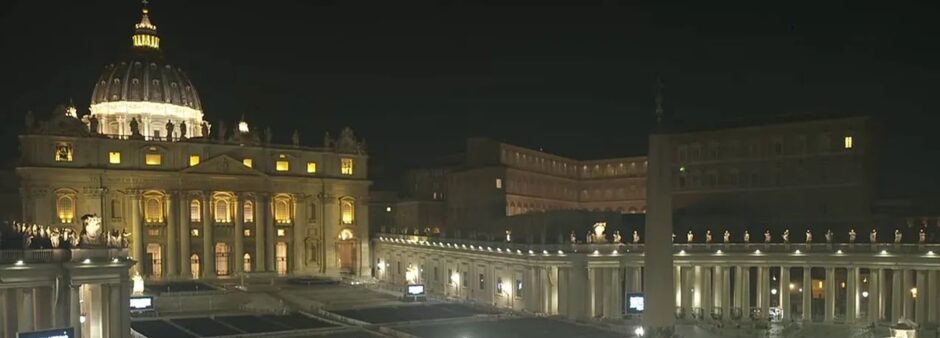
“Praise the Lord at all times, for he is good.” These are the words that we sang just before the Gospel. Yes, we truly have reason to thank God with our whole hearts. If we think back thirty years to the Elizabeth Year 1981, when this city formed part of the German Democratic Republic, who would have thought that a few years later, the wall and the barbed wire at the border would have come down? And if we think even further back, some 70 years, to the year 1941, in the days of National Socialism, who could have predicted that the so-called “thousand-year Reich” would turn to dust and ashes just four years later?

Dear Brothers and Sisters, here in Thuringia and in the former German Democratic Republic, you have had to endure first a brown and then a red dictatorship, which acted on the Christian faith like acid rain. [A clever use of an image in an age of environmentalist activism.] Many late consequences of that period are still having to be worked through, above all in the intellectual and religious fields. Most people in this country since that time have spent their lives far removed from faith in Christ and from the communion of the Church. Yet the last two decades have also brought good experiences: a broader horizon, an exchange that reaches beyond borders, a faithful confidence that God does not abandon us and that he leads us along new paths. “Where God is, there is a future”.  [Therefore a “New Evangelization” is needed?]
We are all convinced that the new freedom has helped bring about greater dignity and a great many new possibilities for people’s lives. [But it has also had detrimental effects, as we have seen in Poland and Russia.  Freedom, but without roots in Christianity, can become license.  Think of the London riots.] On the part of the Church, we can point gratefully to many things that have become easier, whether it be new opportunities for parish activities, renovation and enlargement of churches and community centres, or diocesan initiatives of a pastoral or cultural nature. But have these opportunities led to an increase in faith? [Implicit in that question is also the question of whether what the Church in former Eastern Germany been effective?] Are not the deep roots of faith and Christian life to be sought in something very different from social freedom? It was actually amid the hardships of pressure from without that many committed Catholics remained faithful to Christ and to the Church. [And so it has ever been.] They accepted personal disadvantages in order to live their faith. Here I should like to thank the priests and the men and women who assisted them during that period.

I would like to remember especially the pastoral care of refugees immediately after the Second World War: many priests and laypersons achieved great things in order to relieve the plight of those driven from their homes, and to provide them with a new home. Sincere thanks go not least to the parents who brought up their children in the Catholic faith in the midst of the diaspora and in an anticlerical political environment. With gratitude we remember, for example, the Religious Weeks for Children during the holidays and the fruitful work of the Catholic youth centres “Saint Sebastian” in Erfurt and “Marcel Callo” in Heiligenstadt. Especially in Eichsfeld, many Catholic Christians resisted the Communist ideology. May God richly reward their tenacity in the faith. That courageous witness and that patient trust in God’s guidance are like a precious seed that promises rich fruit for the future.  [This is a call to resist the Dictatorship of Relativism.]

God’s presence is seen especially clearly in his saints. Their witness to the faith can also give us the courage to begin afresh today. Above all, we may think of the patron saints of the Diocese of Erfurt: Saint Elizabeth of Thuringia, Saint Boniface and Saint Kilian. Elizabeth [NB] came from a foreign land, from Hungary, to the Wartburg here in Thuringia. She led an intense life of prayer, linked to the spirit of penance and evangelical poverty. She regularly went down from her castle into the town of Eisenach, in order to care personally for the poor and the sick. Her life on this earth was only short – she was just twenty-four years old when she died [Died before her time, in an earthly perspective.] – but the fruit of her holiness was vast. Saint Elizabeth is greatly esteemed also by Protestant Christians. She can help us all to discover the fullness of the faith that has been handed down to us and to translate it into our everyday lives.

The foundation of the diocese of Erfurt in 742 by Saint Boniface reminds us of the Christian roots of our country. This event at the same time forms the first recorded mention of the city of Erfurt. [NB] The missionary bishop Boniface had come from England and he worked in close association with the successor of Saint Peter. [And Benedict is Successor of Peter.] We honour him as the “Apostle of Germany”; he died as a martyr. [Died before his time in earthly terms.] Two of his companions, who also bore witness by shedding their blood for the Christian faith, are buried here in the Cathedral of Erfurt: Saints Eoban and Adelar.

Even before the Anglo-Saxon missionaries [NB], Saint Kilian, an itinerant missionary from Ireland, was at work in Thuringia. Together with two companions he died in Würzburg as a martyr, [Died before his time in earthly terms.] because he criticized the moral misconduct of the Duke of Thuringia whose seat was in that place. Nor must we forget Saint Severus, the patron saint of the Severus Church here on the Cathedral Square: he was Bishop of Ravenna in the fourth century and his remains were brought to Erfurt in 836, in order to anchor the Christian faith more firmly in this region. [Also came from outside. A foreigner.  And arrived already dead.]

[Quaeruntur…] What do these saints have in common? How can we describe the particular qualities of their lives and make them fruitful for ourselves? The saints show us that it is truly possible and good to live our relationship with God in a radical way, to put him in first place, not as one concern among others. The saints help us to see that God first reached out to us, he revealed and continues to reveal himself to us in Jesus Christ. Christ comes towards us, he speaks to every individual with an invitation to follow him. This was an opportunity that the saints acted on, they as it were reached out to him from deep within themselves in the ongoing dialogue of prayer, and in return they received from him the light that shows where true life is to be found.  [And all the saints Benedict mentioned came from somewhere other than Thuringia and the all died early or arrived early.  They were fruitful because they had a missionary spirit, a clear identity, and died.]

Faith always includes as an essential element the fact that it is shared with others. [Benedict speaks in first person now…] In the first place I have God to thank for the fact that I can believe, for God approaches me and so to speak “ignites” my faith. [God gave him grace.] But on a practical level, I also have to thank my fellow human beings for my faith, those who believed before me and who believe with me.[Someone passed along the faith to Benedict.  When we discuss “faith”, we have to distinguish the faith by which we believe and the faith in which we believe: fides, quae and fides, qua.  The first is the grace, the theological virtue given by God.  The second is what we learn, formulas we can memorize and doctrines we can study. We need both.  And there is a fascinating relationship between them.  We have a phrase, based on a variation in Scripture, by St. Augustine: nisi credideritis non intelligetis… unless you will have first believed you will not understand.  Somethings we can study are mysterious.  We need the faith by which we believe to get them.  On the other hand, learning things can open us to the gift of faith by which we believe.] This “with”, without which there can be no personal faith, is the Church. [The day before, in Erfurt with the Lutherans, Pope Benedict spoke about the spread of a thin, non-doctrinal shapeless form of “Christianity”.  These evangelical, fundamentalists (and more ecclesial Protestants), have a sola Scriptura approach to faith.  I am mindful of Augustine in Contra epistolam Manichaei 5,6: “Ego vero Evangelio non crederem, nisi me catholicae Ecclesiae commoveret auctoritas… I would not believe the Gospel if the authority of the Catholic Church did not compel me.”] And this Church does not stop at national borders, as we can see from the nationalities of the saints I mentioned earlier: Hungary, England, Ireland and Italy. Here we see the importance of spiritual exchange, which encompasses the entire universal Church. If we open ourselves up to the whole of the faith in all of history and the testimony given to it in the whole Church, then the Catholic faith also has a future as a public force in Germany. At the same time the saints that I mentioned show us the great fruitfulness of a holy life, of this radical love for God and neighbour. Saints, even if there are only a few of them, change the world[He circled around to the points I made, above. But he stressed how a small person, someone small in earthly terms, makes a huge impact.  We can all make a huge impact.  But we need our faith to be strong and clear.  Clear from the point of view of the quae and the qua: we should not by our personal sins place obstacles against the gifts God wants to give and we should apply our own elbow grease to know our faith well so that we can articulate it when necessary.]

Thus the political changes that swept through your country in 1989 were motivated not just by the demand for prosperity and freedom of movement, but also decisively by the longing for truthfulness. This longing was kept awake partly through people completely dedicated to serving God and neighbour and ready to sacrifice their lives. [Like the martyrs Benedict mentioned.  Remember: the cultural identity of the people there in Erfurt also depends on the influence of those saints echoing down through the centuries.  The identity of the people there is grounded in the Catholic Christian Faith (fides quae/quae creditur).] They and the saints I mentioned before give us courage to make good use of this new situation. [NB] We have no wish to hide in a purely private faith, but we want to shape this hard-won freedom responsibly.

Like Saints Kilian, Boniface, Adelar, Eoban and Elizabeth of Thuringia, we want to engage with our fellow citizens as Christians and to invite them to discover with us the fullness of the Good News. [This is fantastic!] Then we will resemble the famous bell of the Cathedral of Erfurt, which bears the name “Gloriosa”, the “glorious”. It is thought to be the largest free-swinging medieval bell in the world. It is a living sign of our deep rootedness in the Christian tradition, but also a summons to set out upon the mission. It will ring out once more at the end of today’s solemn Mass. [When bells are consecrated, we call that consecration a “baptism” of the bell.  Bells move. Bells speak with a voice.  They communicate message.  They tell us when to pray (e.g., Angelus and “resurrection” bells, what is going on in the church (when the consecration takes place of a funeral begins or what Mass is to start), they are rung against storms and in times of joy or danger.  Bells are given names at their baptism.  Bells in Europe ring from churches which often, in cities, face on public squares.  We have to have a voice in the public square and ring out clearly in times of danger, and joy and, always, prayer.] May it inspire us, after the example of the saints, to ensure that witness to Christ is both seen and heard in the world in which we live. Amen.
1989
Posted in SESSIUNCULA | Tagged , , , , , , , ,
7 Comments

A fun commercial back on the air

These days a slightly shortened version of this fantastic commercial has found its way back onto TV.

One of the best commercials I have seen in years.  I think it was a big Super Bowl commercial.

[wp_youtube]R55e-uHQna0[/wp_youtube]

I don’t watch much TV and I generally record so that I don’t have to watch commercials at all, but I have noticed that some old ads are re-circulating into the incessant cycle.

And… ad rem… I haven’t driven a Passat, but I have driven a Jetta TDI which was pretty impressive.

Posted in Lighter fare | Tagged
13 Comments

Fr. Blake of Brighton taking flak from bullies for being Catholic

bullyingMy friend Fr. Ray Blake, the parish priest at St. Magdalen in Brighton, England, is taking heat from homosexual activist(s).  Check Fr. Blake’s blog here.

Here is the pattern.

  • Father teaches Catholic doctrine clearly.
  • No matter how charitable Father is someone “takes offense”.
  • That “offended” someone sends threats to Father by email and/or phone calls.
  • That someone threatens to involve Father’s bishop/superior.

This is bullying.  This is what catholic liberals do in the face of Catholic teaching. That is what anti-Catholics  do.

We are going to see this pattern more and more often.

I encourage all my readers to drop in at Fr. Blake’s blog and even leave him a comment of support.  Give him a promise of your prayers.

Posted in Mail from priests, New Evangelization, One Man & One Woman, Our Catholic Identity, The Drill, The future and our choices, The Last Acceptable Prejudice, Throwing a Nutty | Tagged , , , , ,
6 Comments

Question for readers on iPhone stuff (jailbreak, unlock, dual sims, then what…?)

Do any of you iPhone users have experience of using a dual SIM in 3gs or 4?

Also, yesterday I did a jailbreak and unlock on my 3gs.  Very cool and a lot easier than I thought it would be.  And now I can do lots more things with it than I know what to do with.

Except… I can now use my British and Italian SIMS in it!

In any event, there was just one slightly tricky moment in process of jailbreaking the 3GS, a timing issue in pressing buttons in the right sequence.  But once I got it right… the adventure started!

20110923-041108.jpg

20110923-041118.jpg

Once it was over and my home screen came up, I put my British Vodaphone chip in.

20110923-041140.jpg

Doink!  Nothing

20110923-041207.jpg

Then I realized I had to install ultasnOw…

… network detection joy!

20110923-041218.jpg

YAY!

Note that Vodaphone in the USA connects to ATT.  It is the Vodaphone chip in this phone, not an ATT chip.  But it is on roaming here, so I’ll keep it on airplane mode.

If all goes well, I can get off the plane in London or Rome and use an iPhone instead of my old Motorola Razor… which I still miss in a way.

20110923-041336.jpg

Now I have Cydia.  I don’t really know what to do with it, but… I will.

Today I have started to get into it:

20110923-041621.jpg

So… anyone out there have tips or hints or cautions?

Posted in "How To..." - Practical Notes, Just Too Cool | Tagged , , ,
33 Comments

Benedict XVI with Lutherans in Erfurt: “It is not strategy that saves us and saves Christianity, but faith.”

During his State Visit to Germany, the Holy Father gave this address at Erfurt during an ecumenical gathering at the Lutheran church.  Erfurt is, of course, where Martin Luther’s Augustinian convent was.

A highlight:

Faced with a new form of Christianity, which is spreading with overpowering missionary dynamism, sometimes in frightening ways, the mainstream Christian denominations often seem at a loss. This is a form of Christianity with little institutional depth, little rationality and even less dogmatic content, and with little stability.

My emphases and comments.

Ladies and Gentlemen,

As I begin to speak, I would like first of all to thank you for this opportunity to come together with you. I am particularly grateful to Pastor Schneider for greeting me and welcoming me into your midst with his kind words. At the same time I want to express my thanks for the particularly gracious gesture that our meeting can be held in this historic location. [Graciousness is important in all ecumenical matters.  Graciousness does not mean that we have to water down our doctrine.]

As the Bishop of Rome, it is deeply moving for me to be meeting representatives of Council of the Lutheran Church of Germany here in the ancient Augustinian convent in Erfurt. This is where Luther studied theology. This is where he was ordained a priest in 1507. Against his father’s wishes, he did not continue the study of Law, but instead he studied theology and set off on the path towards priesthood in the Order of Saint Augustine. On this path, he was not simply concerned with this or that. What constantly exercised him was the question of God, the deep passion and driving force of his whole life’s journey. “How do I receive the grace of God?”: this question struck him in the heart and lay at the foundation of all his theological searching and inner struggle. For him theology was no mere academic pursuit, but the struggle for oneself, which in turn was a struggle for and with God.

“How do I receive the grace of God?” The fact that this question was the driving force of his whole life never ceases to make an impression on me. [NB:] For who is actually concerned about this today – even among Christians? What does the question of God mean in our lives? In our preaching?  [Indeed!]

Most people today, even Christians, set out from the presupposition that God is not fundamentally interested in our sins and virtues. He knows that we are all mere flesh. Insofar as people today believe in an afterlife and a divine judgement at all, nearly everyone presumes for all practical purposes that God is bound to be magnanimous and that ultimately he mercifully overlooks our small failings. [NB:] But are they really so small, our failings? Is not the world laid waste through the corruption of the great, but also of the small, who think only of their own advantage? Is it not laid waste through the power of drugs, which thrives on the one hand on greed and avarice, and on the other hand on the craving for pleasure of those who become addicted? Is the world not threatened by the growing readiness to use violence, frequently masking itself with claims to religious motivation? Could hunger and poverty so devastate parts of the world if love for God and godly love of neighbour – of his creatures, of men and women – were more alive in us?  [These are not small things.  They are huge.  And they result in a systemic way because of the failures, the sins of omission and commission, of individuals.]

I could go on. No, evil is no small matter. Were we truly to place God at the centre of our lives, it could not be so powerful. The question: what is God’s position towards me, where do I stand before God? – this burning question of Martin Luther must once more, doubtless in a new form, become our question too. In my view, this is the first summons we should attend to in our encounter with Martin Luther. [Keep in mind that Luther isn’t the only person who ever asked questions like this.  So, this is not a huge concession on the part of the Roman Pontiff.  But this is a good opportunity to pose the questions again to a new audience.]

Another important point: God, the one God, creator of heaven and earth, is no mere philosophical hypothesis regarding the origins of the universe. This God has a face, and he has spoken to us. He became one of us in the man Jesus Christ – who is both true God and true man. Luther’s thinking, his whole spirituality, was thoroughly Christocentric: “What promotes Christ’s cause” was for Luther the decisive hermeneutical criterion for the exegesis of sacred Scripture. This presupposes, however, that Christ is at the heart of our spirituality and that love for him, living in communion with him, is what guides our life.

Now perhaps you will say: all well and good, but what has this to do with our ecumenical situation? Could this just be an attempt to talk our way past the urgent problems that are still waiting for practical progress, for concrete results? [Nice and direct.  Consider for a moment whether Pope John Paul II would have said this, thought this way.  I think not.  Pope Benedict is the right person to pose this question to this group now.  And he can do so in his native tongue.  Of coure, Benedict XVI is also the Pope of Christian Unity.]

I would respond by saying that the first and most important thing for ecumenism is that we keep in view just how much we have in common, not losing sight of it amid the pressure towards secularization – everything that makes us Christian in the first place and continues to be our gift and our task. [This is something that the Orthodox know too: the enemy of my enemy is my friend.  These are not the days of Mortalium animos, though what Pius XI wrote was not wrong.  We do have to be careful not to compromise our doctrine.  But these are the days of near total collapse of the Christian ethos in Europe, in the West.] It was the error of the Reformation period that for the most part we could only see what divided us and we failed to grasp existentially what we have in common in terms of the great deposit of sacred Scripture and the early Christian creeds. The great ecumenical step forward of recent decades is that we have become aware of all this common ground and that we acknowledge it as we pray and sing together, as we make our joint commitment to the Christian ethos in our dealings with the world, as we bear common witness to the God of Jesus Christ in this world as our undying foundation.

The risk of losing this, sadly, is not unreal. I would like to make two points here. [1] The geography of Christianity has changed dramatically in recent times, and is in the process of changing further. Faced with a new form of Christianity, which is spreading with overpowering missionary dynamism, sometimes in frightening ways, the mainstream Christian denominations often seem at a loss. This is a form of Christianity with little institutional depth, little rationality and even less dogmatic content, and with little stability. This worldwide phenomenon poses a question to us all: what is this new form of Christianity saying to us, for better and for worse? In any event, it raises afresh the question about what has enduring validity and what can or must be changed – the question of our fundamental faith choice.  [He is surely talking about the missionary activity of the zillion evangelical or fundamentalist splinter groups. However, rather than just say that they must be resisted, he says that maybe the phenomenon requires an examination of conscience on our part and a review of our own Evangelization.  We need a New Evangelization.  I also think we need a Marshall Plan, grounded in renewal of our most perfect form of communication with the world, liturgical worship.  Also, keep in mind how Papa Ratzinger has always been able to find a good kernel buried even in dangers theological errors. For example, he started off in one of his books on liturgy using a point of, of all things, Liberation Theology.  Of course Ratzinger understood liberation theology better than liberation theologians.  But consider Christ as the one who liberates the human person from sins and, through revealing man more fully to himself, freeing him from error about who man is.  Christ is truly Liberator.  Use that as a starting point for what Christ, the true Actor, does for us in our liturgical worship.  So, we can find even in errant groups some points for our own edification.  But I digress.]

The second challenge to worldwide Christianity of which I wish to speak is more profound and in our country [Germany] more controversial: [2] the secularized context of the world in which we Christians today have to live and bear witness to our faith. God is increasingly being driven out of our society, and the history of revelation that Scripture recounts to us seems locked into an ever more remote past. [QUAERITUR:] Are we to yield to the pressure of secularization, and become modern by watering down the faith? Naturally faith today has to be thought out afresh, and above all lived afresh, so that it is suited to the present day. Yet it is not by watering the faith down, but by living it today in its fullness that we achieve this[In my rantings about a “Marshall Plan” I make the distinction about ad intra and ad extra.  We have to know who we are and live who we are in order to have anything to say to the whole world.  If we don’t have a clear identity, why should the world listen to us?  At the same time, if we cave in to the world, the world (under its Prince) will crush us out of the public square.]

This is a key ecumenical task. [We have a common task.] Moreover, we should help one another to develop a deeper and more lively faith. It is not strategy that saves us and saves Christianity, but faith – thought out and lived afresh; through such faith, Christ enters this world of ours, and with him, the living God. As the martyrs of the Nazi era brought us together and prompted the first great ecumenical opening, [Common persecution.] so today, faith that is lived from deep within amid a secularized world is the most powerful ecumenical force that brings us together, guiding us towards unity in the one Lord. [An interesting parallel, no?  Those who attack the Church from a secularist position are doing what the Nazis did.  That’s it, isn’t it?]

Erfurt, September 23, 2011

Posted in SESSIUNCULA | Tagged , ,
36 Comments

Of things astronomic and thanks to readers on the Autumnal Equinox

Firstly, as I reported before there is a huge piece of flaming hurtling death-inflicting space junk falling to earth even as I write.  I calmly explained the facts here in my post entitled “RUN! RUN FOR YOUR LIVES! FALLING BURNING SPACE BUS! AAAAH!“.  Go to confession, do your penance, make some Mystic Monk Coffee just wait for it to happen.

Second, I understand from a friend in Rome who sent a story from ANSA that the flaming hurtling space junk may hit Northern Italy.  If that is the case, to all my Italian friends in the north I issue a blanket question: When the time comes, can I have all your stuff?  Thanks in advance!

Also, I received from one of you readers today, without a packing slip so I don’t know who you are, J.L.  Heilbron’s book on churches and cathedrals as solar observatories called The Sun In The Church.   This book is so cool that I almost hyperventilated during my first cursory glance through.  Some of the math is now beyond me, but this book is… way cool.  Way cooler is the fact that it came on the Autumnal Equinox!  I will jot down within the book’s cover as I make the book my own.  Thank a million to the kind reader who sent it.  UK link HERE.  As I flipped through, I saw this:

“Leibnitz, who noticed everything, kept track of the development of the astronomical apologetics of the Jesuits.”

Heilbron puts the whole thing in the context of what was going on theologically in the Church.

“Also, thanks to the reader who sent the groovy Yorkshire Pudding pans.  UK link here.

In other news, I read at The Daily Telegraph, the speed of light isn’t as fast as we thought.

Speed of light ‘broken’ at CERN, scientists claim
It was Albert Einstein, no less, who proposed more than 100 years ago that nothing could travel faster than the speed of light.

By Nick Collins, Science Correspondent

But last night it emerged that the man who laid the foundations for the laws of nature may have been wrong.

The science world was left in shock when workers at the world’s largest physics lab announced they had recorded subatomic particles travelling faster than the speed of light.

If the findings are proven to be accurate, they would overturn one of the pillars of the Standard Model of physics, which explains the way the universe and everything within it works.

Einstein’s theory of special relativity, proposed in 1905, states that nothing in the universe can travel faster than the speed of light in a vacuum. But researchers at the CERN lab near Geneva claim they have recorded neutrinos, a type of tiny particle, travelling faster than the barrier of 186,282 miles (299,792 kilometers) per second.

The results have so astounded researchers that American and Japanese scientists have been asked to verify the results before they are confirmed as a discovery.

Pretty cool.  Not much application to daily life yet, but pretty cool.

Wasn’t there an episode of Star Trek Voyager in which a guy goes faster than Warp 10 and then mutates into a nasty critter?   We had better be careful with this stuff.

I also received an iTunes card.  Thanks!  I will use it to get some good music.

Posted in Global Killer Asteroid Questions, Just Too Cool, Lighter fare, Look! Up in the sky! | Tagged , , , , , ,
13 Comments