The Catholic Herald on how to report on the Pope … NOT… (and a great deal on the digital edition)

Over at the UK’s best Catholic weekly, The Catholic Herald, there is some amusing but serious faux advice to secular journalists about how to report on the Pope.  Check it out!

Covering the Pope: a guide for journalists

Milo Yiannopoulos sheds some light on the arcane world of Catholicism, for the benefit of befuddled mainstream reporters

Also, there are only a few days left to make use of the super discount on an annual subscription to the digital version of The Catholic Herald.

£12

Go HERE and use the promo code CHPROMO. This gives you the entire paper as it appears in the print edition, without waiting for the mail, and it gives you access to a vast archive of back issues.  The price will go up soon.   I am trying to get them to to set up a FATHERZ promo code, btw.. we shall see.  But get your digital edition now!  The offer ends at the end of the month.

Posted in "How To..." - Practical Notes, Just Too Cool | Tagged
6 Comments

QUAERITUR: Can a miscarriage be a sin?

From a reader:

I was wondering if it was possible for a natural miscarriage to be a sin. The doctors couldn’t tell me why it happened, but statistically miscarriages are more likely when the mother is obese, as I am/was.
And while I never intended the miscarriage to happen, I am clearly responsible both for my weight and the act of becoming pregnant. Ought I to confess it? And since it deals with such a grave issue as human life, is it a mortal sin?

I know you are busy but I am longing for peace of mind on this issue.

A final question, if the miscarriage itself is not a sin, does that mean blaming myself anyway is a sin? I’m not sure I can forgive myself the mistake, even if my intentions were never wrong.

Firstly, I am very sorry for the loss and pain you have had.

It is hard to imagine how a miscarriage could be a sin, unless a woman tries to provoke it or unless she was purposely negligent of her health knowing she was pregnant. While I don’t know all the circumstances or your situation, from what you wrote you don’t have to confess a miscarriage.  All sorts of things can happen which are entirely out of your control.  Put that out of your mind now.

It is true that we are responsible for our health.  Mistreating our bodies is wrong, for , as John Paul II’s “theology of the body” stressed, we are our bodies.  Our bodies are not meat machines in which our real selves ride around.  Our bodies are not our possessions, as if they were things apart from our real selves.  We cannot do anything we want to our bodies, treating them like a mobile phone or a car or a potted plant.   The argument, “It’s my body and I can do what I want to it!”, as if your body were something apart from you which you can possess as an object, is a very dangerous line of thought.  If you can do anything you want to your body, and in so doing you aren’t really hurting yourself, then anyone else could do something to your body and not really hurt you yourself.  Once our bodies are reduced to objects which we can possess, we are open to all manner of objectifcation.

Also, when it comes to mortal sin, there are acts which are objectively wrong considered in themselves, but we can have greater or lesser culpability for those acts to the extent that our minds and wills are engaged in the commission of those acts.  For example, once a person is deeply addicted to something, nearly without human control, her culpability is somewhat attenuated when it comes to individual acts.  However, her behavior which led to that addiction, if she was aware of what was going on, could very well have been, probably was, culpable.  Addiction stems in part from repetition and that repetition started voluntarily.

So, it is possible that a woman can be culpable for getting into an unhealthy physical condition.  However, once she is in that condition, and then tries to take care of her health so that she can bring her pregnancy to term, it is hard for me to imagine how her miscarriage can be a “sin”.  It’s sad, but it isn’t sin.

We should take care of ourselves, always tuning our self-care according to our state in life, our vocations.

For example, women of child-bearing age who are married should always have in mind that they could conceive.  They should have that in mind and keep themselves in shape.  But we can turn the sock inside out too.  There is a real shortage of priests today.  Therefore, priests today have an even greater responsibility to take care of their health for the sake of God’s people who depend on the sacraments only priests can provide.  Just as an officer commanding are large force is obliged to keep himself safe so that he can attain the objective and keep casulties as low as possible, so too a priest has an obligation to see to his own well-being for the sake of his flock.  And if that is the case for a priest, how much more for a bishop or a pope?  The process for naming a bishop is complex.  During the time of an empty see, people are without their bishop.  I remember the controversy stirred when Pope John Paul II insisted that a swimming pool be build at Castel Gandolfo.  He had great resistance.  Popes, apparently, didn’t swim… never mind Peter throwing himself into the water and swimming to shore… but I digress.  In any event, the Pope said “A pool is easier than a conclave.”  The point was that he wanted to keep himself in good health for the sake of the Church.

Thus, while a priest can wax eloquent about how women should take care of their health, it would behoove that priest to follow his own advice regarding his own health.

Thanks, therefore, for the question.  It was a good reminder.  A friend of mine has recently started on a serious plan get into shape and reduce some risk factors.  Sometimes, when we are feeling great, we forget how old we are or what we might face down the line.  Time to take stock and make some plans of my own!

Posted in "How To..." - Practical Notes, ASK FATHER Question Box, Our Catholic Identity | Tagged , , , , ,
21 Comments

The Holy Father’s address at the Konzerthaus in Freiburg im Breisgau

The Holy Father’s address at the Konzerthaus in Freiburg im Breisgau to Catholics active in the Church and Society.

Here is a highlight:

“The Church must constantly renew the effort to detach herself from the ‘worldliness’ of the world.”

And…

“The Christian faith is a scandal … to believe all this is to posit something truly remarkable.”

My emphases and comments.

Dear Brother Bishops and Priests,

Ladies and Gentlemen,

I am glad to be here today with all of you who work in so many ways for the Church and for society. [Remember the distinction ad intra and ad extra?  The Church speaks to herself and communicates herself both to herself and to the world.  The liturgy is our highest communication and Christ is the Perfect Communicator.] This gives me a welcome opportunity personally to thank you most sincerely for your commitment and your witness as “powerful heralds of the faith in things to be hoped for” (Lumen Gentium, 35 – validi praecones fidei sperandarum rerum). In your fields of activity you readily stand up for your faith and for the Church, something that is not always easy at the present time.

For some decades now we have been experiencing a decline in religious practice [since the ’60’s, as a matter of fact] and we have been seeing substantial numbers of the baptized drifting away from church life. This prompts the question: should the Church not change? Must she not adapt her offices and structures to the present day, in order to reach the searching and doubting people of today?  [Have you noticed how, during the last days, the Holy Father frames the issues in terms of questions?]

Blessed Mother Teresa was once asked what in her opinion was the first thing that would have to change in the Church. Her answer was: you and I.

Two things are clear from this brief story. On the one hand Mother Teresa wants to tell her interviewer: the Church is not just other people, not just the hierarchy, the Pope and the bishops: we are all the Church, [Is “We are the Church” a liberal phrase in German speaking countries?  Papa Ratzinger has a long-time M.O.: he suborns errors, extracts the good point, and turns their socks inside out.] we the baptized. And on the other hand her starting-point is this: yes, there are grounds for change. There is a need for change. Every Christian and the community of the faithful are constantly called to change[Conversion always implies motion, change.]

What should this change look like in practice? Are we talking about the kind of renewal that a householder might carry out when reordering or repainting his home? [Repair… cosmetic…] Or are we talking about a corrective, designed to bring us back on course and help us to make our way more swiftly and more directly? Certainly these and other elements play a part. As far as the Church in concerned, though, the basic motive for change is the apostolic mission of the disciples and the Church herself.

The Church, in other words, must constantly rededicate herself to her mission. The three Synoptic Gospels highlight various aspects of the missionary task. [cf. Matthew 28:19] The mission is built upon personal experience: “You are witnesses” (Lk 24:48); it finds expression in relationships: “Make disciples of all nations” (Mt 28:19); [Yep… there it is!] and it spreads a universal message: “Preach the Gospel to the whole creation” (Mk 16:15). Through the demands and constraints of the world, however, the witness is constantly obscured, the relationships are alienated and the message is relativized. [This is an age of rapid social communication.  We need as a Church a better theology of communication.  Perhaps the Holy Father will set us on this course more energetically if he desires a New Evangelization.] If the Church, in Pope Paul VI’s words, is now struggling “to model itself on Christ’s ideal”, this “can only result in its acting and thinking quite differently from the world around it, which it is nevertheless striving to influence” (Ecclesiam Suam, 58). In order to accomplish her mission, she will constantly set herself apart from her surroundings, she needs in a certain sense to become unworldly or “desecularized”[In other to influence the word, we have to have a clear and strong identity.  And that identity depends in large part on the character of our liturgical worship.]

The Church’s mission has its origins in the mystery of the triune God, in the mystery of his creative love. Love is not just somehow within God, he himself is love by nature. And divine love does not want to exist in isolation, it wants to pour itself out. [communicate] It has come down to men in a particular way through the incarnation and self-offering of God’s Son. [Christ is the Perfect Communicator.  The incarnation was communication.] He stepped outside the framework of his divinity, he took flesh and became man; and indeed his purpose was not merely to confirm the world in its worldliness and to be its companion, leaving it completely unchanged. The Christ event includes the inconceivable fact of what the Church Fathers call a commercium, an exchange between God and man, in which the two parties – albeit in quite different ways – both give and take, bestow and receive. The Christian faith recognizes that God has given man a freedom in which he can truly be a partner to God, and can enter into exchange with him. At the same time it is clear to man that this exchange is only possible thanks to God’s magnanimity in accepting the beggar’s poverty as wealth, so as to make the divine gift acceptable, given that man has nothing of comparable worth to offer in return.  [Frankly, this is sounding rather like some of the things I said in my talk at Catholicon in Houston… but.. back to Pope Benedict.  This is, as you can tell by now, an important talk.]

The Church likewise owes her whole being to this unequal exchange. She has nothing of her own to offer to him who founded her. She finds her meaning exclusively in being a tool of salvation, in filling the world with God’s word [communication] and in transforming the world by bringing it into loving unity with God. [ad extra] The Church is fully immersed in the Redeemer’s outreach to men. She herself is always on the move, she constantly has to place herself at the service of the mission that she has received from the Lord. The Church must always open up afresh to the cares of the world and give herself over to them, in order to make present and continue the holy exchange that began with the Incarnation.

In the concrete history of the Church, however, a contrary tendency is also manifested, namely that the Church becomes settled in this world, she becomes self-sufficient and adapts herself to the standards of the world. She gives greater weight to organization and institutionalization than to her vocation to openness[This is also a problem in liturgical inculturation.]

In order to accomplish her true task adequately, the Church must constantly renew the effort to detach herself from the “worldliness” of the world. In this she follows the words of Jesus: “They are not of the world, even as I am not of the world” (Jn 17:16). One could almost say that history comes to the aid of the Church here through the various periods of secularization, which have contributed significantly to her purification and inner reform. [This is certainly what is going on in this time of purification.  I wonder if this isn’t going to result in a “creative minority” of which the Holy Father has spoken.]

Secularizing trends – whether by expropriation of Church goods, or elimination of privileges or the like – have always meant a profound liberation of the Church from forms of worldliness, for in the process she has set aside her worldly wealth and has once again completely embraced her worldly poverty. In this the Church has shared the destiny of the tribe of Levi, which according to the Old Testament account was the only tribe in Israel with no ancestral land of its own, taking as its portion only God himself, his word and his signs. At those moments in history, the Church shared with that tribe the demands of a poverty that was open to the world, in order to be released from her material ties: and in this way her missionary activity regained credibility.

History has shown that, when the Church becomes less worldly, her missionary witness shines more brightly. Once liberated from her material and political burdens, the Church can reach out more effectively and in a truly Christian way to the whole world, she can be truly open to the world. [kenosis] She can live more freely her vocation to [To what Holy Father?  To what?] the ministry of divine worship and service of neighbour. The missionary task, which is linked to Christian worship and should determine its structure, becomes more clearly visible. The Church opens herself to the world not in order to win men for an institution with its own claims to power, but in order to lead them to themselves by leading them to him of whom each person can say with Saint Augustine: he is closer to me than I am to myself (cf. Confessions, III, 6, 11). [I love that quote.] He who is infinitely above me is yet so deeply within me that he is my true interiority. This form of openness to the world on the Church’s part also serves to indicate how the individual Christian can be open to the world in effective and appropriate ways. [ad intra and ad extra]

It is not a question here of finding a new strategy to relaunch the Church. Rather, it is a question of setting aside mere strategy and seeking total transparency, not bracketing or ignoring anything from the truth of our present situation, but living the faith fully here and now in the utterly sober light of day, appropriating it completely, and stripping away from it anything that only seems to belong to faith, but in truth is mere convention or habit[In my talking about Benedict XVI as “Pope of Christian Unity”, I sometimes would mention that he would give up things, but never essentials.]

To put it another way: for people of every era, not just our own, the Christian faith is a scandal. That the eternal God should know us and care about us, that the intangible should at a particular moment have become tangible, that he who is immortal should have suffered and died on the Cross, that we who are mortal should be given the promise of resurrection and eternal life – to believe all this is to posit something truly remarkable.

This scandal, which cannot be eliminated unless one were to eliminate Christianity itself, has unfortunately been overshadowed in recent times by other painful scandals on the part of the preachers of the faith. A dangerous situation arises when these scandals take the place of the primary skandalon of the Cross and in so doing they put it beyond reach, concealing the true demands of the Christian Gospel behind the unworthiness of those who proclaim it.

All the more, then, is it time once again for the Church resolutely to set aside her worldliness. That does not mean withdrawing from the world. A Church relieved of the burden of worldliness is in a position, not least through her charitable activities, [Cf. Deus caritas est.] to mediate the life-giving strength of the Christian faith to those in need, to sufferers and to their carers. “For the Church, charity is not a kind of welfare activity which could equally well be left to others, but is a part of her nature, an indispensable expression of her very being” (Deus Caritas Est, 25). [Yep… there it is.] At the same time, though, the Church’s charitable activity also needs to be constantly exposed to the demands of due detachment from worldliness, if it is not to wither away at the roots in the face of increasing erosion of its ecclesial character. Only a profound relationship with God makes it possible to reach out fully towards others, just as a lack of outreach towards neighbour impoverishes one’s relationship with God.

Openness to the concerns of the world means, then, for the Church that is detached from worldliness, bearing witness to the primacy of God’s love according to the Gospel through word and deed, here and now, a task which at the same time points beyond the present world because this present life is also bound up with eternal life. As individuals and as the community of the Church, let us live the simplicity of a great love, which is both the simplest and hardest thing on earth, because it demands no more and no less than the gift of oneself.

Dear friends, it remains for me to invoke God’s blessing and the strength of the Holy Spirit upon us all, that we may continually recognize anew and bear fresh witness to God’s love and mercy in our respective fields of activity. Thank you for your attention.
Posted in New Evangelization, Our Catholic Identity, SESSIUNCULA, The Drill, The future and our choices | Tagged , , , , , , ,
5 Comments

Your good news and sermon notes.

Can you share some of your good news with the readers?

And also give us some point from the Sunday sermon you heard.

Posted in SESSIUNCULA |
34 Comments

The West Wing and the 2008 Presidential Election

Just as a new TV series has a pilot I have often wondered at the amazing parallels between the last two seasons of The West Wing, which ended in 2006, and the 2008 presidential election.  It is almost as if The West Wing was the pilot, the test run as it were, for the election. I am not the only one who has noticed the parallel.

Also, this administration makes the liberal democrats of the Bartlett White House in The West Wing seem like Tea Party members.

I was interested in a post on an English blog named Bridges and Tangents by Fr. Stephen Wang of the Diocese of Westminster, London, Dean of Studies at Allen Hall Seminary (now on my sidebar though I’m not on his… but I digress), which talks about The West Wing and the 2008 election.

I admit it: I’m a West Wing junkie. I made the mistake, when I was staying with some friends one holiday, of watching the first two episodes of Season Two, the two-parter when the President has just… Oh dear, I’m about to reveal some plot; and if there is just the slightest chance that you haven’t seen the cliffhanger at the end of Season One, then I’d better leave you to that moment of TV heaven without spoiling it.

I know, some of the haircuts from the first few years are already dating, and we have had plenty of great TV since then. But it’s still, to my mind, one of the most dazzling and thought-provoking shows of all time. My heart still hasn’t healed from trauma of discovering that they were not carrying on into Season Eight.

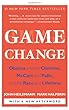
He goes on to talk about a book called Race of a Lifetime by John Heilemann and Mark Halperin, which covers the Primaries leading up to the 2008 Presidential election, and the election itself.   It seems that Race of a Lifetime has been reprinted, at least in the US, as Game Change: Obama and the Clintons, McCain and Palin, and the Race of a Lifetime.

In any event, I truly enjoy the witty dialogue of The West Wing and the development of the characters.  Also, the series is a real civics lesson.  Before all sorts of right-wing conservatives have a spittle-flecked nutty – a figure of speech I happy stole from The West Wing’s Ainsley Hayes – I hate the political slant of the series.  I really appreciate intelligent TV.  The West Wing is smart.  Yes yes… I know that the Catholic Pres. Bartlett is squishy on abortion and homosexual marriage. But who can forget the sight on prime time TV of the President of the United States saying the Rosary in the Oval Office and then, after making a bad decision, making his confession to an priest he called in for consultation.  We mustn’t let the perfect be the enemy of the good!

Anyway, if you are looking for some intelligent, adult TV that does not involve Cylons or green energy rays, try The West Wing.  That link (yes… there, to the left… click it… you know you want to) is for the entire series, now reduced in price pretty dramatically.  I think they start to hit their stride toward the end of Season One.

In any event, Fr. Wang has inspired me to watch through the series again.   The next time I am in London, I will offer to buy him a pint, since in London you don’t find much Mystic Monk Coffee.

BTW… I see that the number of seminarians in formation at Allen Hall is up.

Posted in SESSIUNCULA |
17 Comments

Archbishop by Archbishop in Winnipeg!

From a Canadian Catholic newspaper The Prairie Messenger comes this great story for your Brick By Brick file.

My emphases and comments.

Latin mass celebrated in Winnipeg

By Brenda Suderman

WINNIPEG — The pews of Winnipeg’s St. Ann’s Roman Catholic Church were filled to near capacity for mass on Sept. 4, with parishioners keen to worship in a language that most did not even understand.

The now weekly 10 a.m. mass is being said in Latin, with Rev. Jeffrey Burwell, SJ, presiding. [And a Jesuit to boot!]

“Following the liturgy, even with the help of the missal, can be a grace-filled challenge for those who either have no prior experience or have not attended the Latin mass since the 1960s,” says Burwell. “It is nevertheless clear that those attending have a real desire to actively participate. [And that, for the baptized, is the key to true active participation.] With such dedication, they will soon understand the liturgy in its fullness.”

The Extraordinary Form of the Roman Rite is the term used for the traditional Latin mass. After the Second Vatican Council ended in 1965, Roman Catholics were granted permission to celebrate the liturgy in their own languages, called the Ordinary Form.

“The church’s language is officially Latin. Other religions have sacred languages, Islam has Arabic, Judaism has Hebrew, and Hindu has Sanskrit,” says Burwell, 36, who teaches Catholic studies at the University of Manitoba and studied Latin during his undergraduate days at the University of Regina.

“There’s something about the sacred language. It roots us in our tradition.”

Parishioner Kateri Muys was eager to participate in the mass, having experienced it while studying at Our Lady Seat of Wisdom Academy in Barry’s Bay, Ont.,

“There isn’t anything really like it,” explains the 21-year-old Oak Bluff resident. “Once you worship in Latin, you don’t want to go back.”

The first two Sundays of the Latin mass featured the 75-minute high mass, but from then on the hour-long low mass is being celebrated, with the high mass being reserved for feast days, says Burwell,

Winnipeg’s first official Latin mass in nearly five decades comes about with the support of the archdioceses of Winnipeg and St. Boniface after Pope Benedict XVI declared that those who want to worship using the traditional Latin liturgy should be given the opportunity, says Winnipeg Archbishop James Weisgerber[Do I hear an “Amen!”?]

“We’ve been encouraged to expose them to that, to continue this tradition of the church,” explains Weisgerber. “Archbishop LeGatt (of St. Boniface) and I are co-operating on this because we want to make it accessible to the whole community.”  [WDTPRS Kudos to them.  BTW.. how many Archbishops are there in Winnipeg?  Quite a few, if memory serves.]

Ordained while Latin was still widely used, Weisgerber says he’ll consider dusting off his Latin and pinch-hitting for Burwell on Sunday mornings if necessary. [WDTPRS ultra-kudos.]

Attending Latin masses in London, England and St. Louis, Miss. convinced Winnipegger John Cortens to join the group at St. Ann’s on Sunday mornings.

“It is very, very moving and prayerful and reverent in those places,” recalls Cortens. “We’re just sort of a ragtag group trying to do the same in a small way.”

For Anselm Ragelti, worshiping in Latin also means an opportunity to learn the liturgy in a new way, since he is serving as an altar boy at St. Ann’s. Unlike the Ordinary Form in which the people respond to the priest in the liturgy, the six altar boys recite the responses in the Latin mass.

“I found it really beautiful,” says Ragelti, 14, of his previous experiences with the Extraordinary Form while attending a Catholic boys’ camp in South Dakota. “Latin is very beautiful and it translates into music easily.”

Burwell’s homily is delivered in English, as are the readings from Scripture. He is confident his new parishioners will become more comfortable with Latin and will soon know the difference between the Gradual and a genuflection.

“Those who attend the Extraordinary Form of the liturgy at St. Ann’s will find themselves nourished both by a beautiful celebration of the eucharist on the altar as well as a community of prayerful friendship that is developing in the pews,” Burwell says.

WDTPRS kudos all around!

See?  It doesn’t have to be agony.

Posted in "How To..." - Practical Notes, Brick by Brick, Fr. Z KUDOS, Our Catholic Identity, SUMMORUM PONTIFICUM, The Drill | Tagged , , ,
20 Comments

Things are not always what they seem at first glance

Four people, count ’em, four, have sent me a link to a video with Polish titles and voice over from the Vatican TV feed of the Pope’s visit in Germany.  What you see is the Pope moving along a line of prelates and monsignori with his hand out, rather robotically, offering it to be shaken.  Several of the prelates do not shake the Pope’s hand.  The people who wrote to me either ask about or express their dismay that the Pope is being shown disrespect, is being snubbed.

Here are two of the comments I received in email:

I found this video of the Pope with the German bishops and it looks that several of them refused to shake his hand as a minimal level of courtesy and respect. The film seems to come from Poland. I haven’t seen it commented on anywhere else. I was shocked and greatly disturbed by it. Its a short film.

and

I really hope and pray that these bishops are not treating the Holy Father with so much disrespect. I hope that the video isn’t what it seems and that I’m overlooking some sort of protocol or aspect of foreign culture. I wonder if you have any thoughts about this, especially as it relates to what the Holy Father is trying to do with respect to the New Evangelization and Reform of the Reform.

The video is HERE.  I will attempt to embed.

Play

Friends, don’t read too much into this video.  The Pope is NOT being snubbed.  He may be introducing people to the German President.  Some shake the Pope’s hand, others don’t.  It isn’t a snub.

The men who don’t shake the Pope’s hand are close collaborators and his friends.  For example, you see Card. Brandmüller, a good friend of the Pope.  There is Bp. Josef Clemens, the Pope’s former personal secretary and now Secretary of the Pontifical Council for Laity.  There is Msgr. Guido Marini and the rest of the papal MCs.  On the other hand, Card. Kasper did move to shake the Pope’s robotically outstretched hand.  So does the Archbp. Woelki of Berlin, who doesn’t see the Pope all the time and who hasn’t been a close collaborator.

Poor Pope Benedict.  Imagine how much of this he must endure.  His collaborators spare his sore hand.  Also, many people think that a handshake is NOT the best way to honor the Vicar of Christ.

So, do not read anything into this video.

Posted in SESSIUNCULA | Tagged
13 Comments

US Catholic gets nutty about Bp. Olmsted of Phoenix and Communion under both kinds

US Catholic ‘s Bryan Cones became a little hysterical about Bp. Olmsted’s decision to apply the Church’s laws concerning Communion under both kinds in the Diocese of Phoenix.

As I understand it, the 1975 edition of the Missale Romanum gave 14 instances when Communion could be distributed under both kinds.  Since 1975 in some regions – including the USA – experimental privileges, not rights, were granted for the distribution of Holy Communion under both kinds. These privileges, not rights, expired in 2005.  These privileges, not rights, were not renewed by the Holy See.  Therefore the General Instruction of the Roman Missal (GIRM) for the 3rd edition of the Missale Roman and the 2011 Norms for the Distribution and Reception of Holy Communion Under Both Kinds for the Dioceses of the United States of America are now to be applied.  However, diocesan bishops can to a certain extent lawfully establish other instances, such as important local feasts, etc., for Communion under both kinds.  This is what Bp. Olmsted intends to do.  He will implement the Church’s law.

This is how Mr. Cones reacted.  First, the title of his piece.

Truthiness in Phoenix about communion from the cup
Thursday, September 22, 2011
By Bryan Cones

Truthiness” (I had to look it up) suggests Mr. Cones is writing for aficionados of Comedy Central.   Indeed, his schtick does produce some chuckles.

This next bit, however, is not funny.

(Note that Cones writes in absolutes: “deeply … incredibly… narrow…. utterly… universal…. entire… every.”   Tiring.

The deeply dishonest q&a provided by the diocese–basically a collection of half-truths–provides an incredibly narrow reading of church law on this matter, utterly disregarding the universal practice of the ancient church [Noooo.] (still the practice of the Eastern Catholic churches), which was that the entire assembly received the eucharist under both kinds at every celebration of the eucharist.

Cones says that Bp. Olmsted and his staff in Phoenix are liars (“dishonest… half-truths”).

Furthermore, and let the comedy begin, Cones thinks Latins ought to be more like Eastern Catholics.

I love it when Latin liberals cite Eastern Catholic practices!

My understanding is that Eastern Catholics do not receive the Eucharist every time they attend the Divine Liturgy.  Am I wrong?

Eastern Catholics only rarely admit women to read at Divine Liturgy.  They still have the subdiaconate.  The congregation can’t see what is going on because clergy shut the doors on them. They have unaccompanied chant without guitars. There is no Communion in the hand… ehvurrrr.

Yah!  Bring it on!  Let’s be like our Eastern brothers! Oh yes, and sisters… because women play a huge role in the governance of Eastern Churches.

The East! That’s the ticket!  Maybe they don’t have guitars and saxophones – as in the Papal Mass in Berlin – but the priests do have spiffy hats!  Eastern bishops wear crowns! Ad Orientem!

But I digress.  Let’s skip down to another bit in Mr. Cone’s piece.

This decision is no less than an abuse of power by the bishop, a withdrawal from the faithful what they have a right to by their baptism. (Yes, baptized people have a right, in canon law, to the eucharist in its fullest form.) It may be that reception of the bread alone is “sufficient,” [I should think it is more than “sufficient” considering that the Host alone is the Body, Blood, soul and divinity of Christ, whole and entire.] but I haven’t the foggiest idea why we should settle for “sufficient” when we can have the fullness of the eucharistic symbol.

Perhaps Mr. Cones is under the impression that he receives “more Eucharist” by receiving under both kinds. Dunno.  In any event, Cones should be getting worked up over what the Holy See and all the bishops of the USCCB have issued, not over what Bp. Olmsted is doing.

No.  Bp. Olmsted is not a bully and people don’t have a right to Communion under both kinds all the time.  Which canon in the 1983 Code gives people the right to Holy Communion under both kinds?

Holy Church determines how the sacraments are received, not individuals.  The Church has determined that there are some occasions when it can be done, others when it cannot.

Another point.

Isn’t it interesting how an experiment in a trial period becomes the norm?  How a temporary option becomes the iron-bound obligation of the ages?

The conditions for Communion under both kinds were matters for a test period.  Communion under both kinds is now assumed, by some, to be an absolute right all of the time.  On the other hand, conditions for the use of the Extraordinary Form are not matters of experimentation or a test period.  The provisions of Summorum Pontificum, clarified in Universae Ecclesiae, are not temporary trial runs.  They are actual laws for the whole Latin Church.  Stable groups have the right to make a request and pastors have an obligation personally to respond positively or to find another way to see to their needs.

If Cones and US Catholic are so concerned about rights and celebration of the Eucharist in ways that are centuries old, when they show the same high dudgeon when stable groups of the faithful are denied the Extraordinary form by their pastors?

When stable groups are straight-armed by their priests and bishops, will US Catholic and Mr. Cones write pieces saying that the excuses for not celebrating the Extraordinary Form are – just how did Cones put it again? – a “collection of half-truths” providing “an incredibly narrow reading of church law on this matter, utterly disregarding the universal practice of the ancient church”?

When Catholics are forced to the back of the bus because of their desire for the Extraordinary Form, or for the Ordinary Form in Latin and with Gregorian chant as Sacrasanctum Concilium mandated, will Mr. Cones come to their aid?  When a bishop denies Catholics their legitimate aspirations for traditional, abuse-free liturgical worship in either Form will Mr. Cones write in US Catholic that it’s – just how did he put it again? – “an abuse of power by the bishop”?

But let’s move on.

Let’s consider for a moment basic conditions for Communion under both kinds, even during the period since 1975.  The foundational conditions, before any others are considered, require that:

  • The faithful have been well instructed (especially on the Mystery of the Holy Eucharist), and
  • There is no danger of the profanation of the Sacrament or that the rite would be difficult to carry out on account of the number of participants, or for some other reason.

Don’t those conditions apply to any manner of reception of Communion, under both kinds or just one?

I wonder what might result from a brief quiz of the congregants participating at Masses where Communion under both kinds has been the practice for a while. After all, isn’t the “fullness” supposed to be… what… edifying? Instructive?  Shouldn’t we be able to argue that a long experience of Communion under both kinds has made congregations more devout?  Better Catholic Christians?  More eager to receive in a worthy manner and to give witness to their Faith in their lives?

It would be interesting to hear these congregants explain their understanding of the Church’s teachings about the Eucharist, or about what Mass is.  It would be interesting to know if they have been to confession lately.  It would be interesting to know if married couples receiving under both kinds are also using contraception.  I would be fascinating to learn if anyone receiving under both kinds for a long time now dissents from any defined teachings, or can even explain what a “sacrament” is.

Perhaps we should promote worthy reception of the Eucharist rather than froth about reception under both kinds.

Given what Bp. Olmsted has been doing, I’ll wager that Phoenixians are coming to a clearer, not fuzzier, understanding of the Church’s teachings and practices about a wide range of matters important to our Catholic identity in an ever more secular society.  You have to know your Faith and practices before you can live and observe them.

Long-time lax catholics may not enjoy the resection and sutures Doctor Olmsted is applying, but, as St. Augustine once preached, a doctor doesn’t stop cutting just because the patient screams for him to stop (cf. s. 80, 3).

In any event, I’ll bet Bp. Olmsted is losing sleep because Mr. Cones and US Catholic think he is a dishonest abuser of power.  I have just sent His Excellency a “Say The Black – Do The Red” coffee mug as a consolation.

Posted in Liturgy Science Theatre 3000, SESSIUNCULA, SUMMORUM PONTIFICUM, The Drill, Throwing a Nutty, Universae Ecclesiae | Tagged , , , , ,
52 Comments

The music at Pope Benedict’s Mass in Berlin

I put together a medley from excerpts of music from Pope Benedict’s Mass in Berlin.

I am not making this up. Mind you: I wasn’t all drek. A lot of it was.

You can watch whole Mass on demand through a video player from Vatican Radio: HERE. Go to Sept 22.

A selection before Mass and the offertory and night club stuff for Communion time. I included for contrast the Ite, just to show how people can sing Latin responses and there is a “Großer Gott wir loben dich” as well. What was not included in the on demand video was the supremely horrendous music after the final hymn to help people whistle a tune on the way home. As I watched and heard the post-Mass horror (not included in my recording below), it occurred to me that there was no way that anyone, listening to that music, could have had their mind on the mystery of the Eucharist celebrated for them by the Vicar of Christ. But I had that same sense during the pre-Mass and offertory as well. You decide for yourselves.

It is about 22 minutes long. Feel free to skip forward.

Posted in SESSIUNCULA |
30 Comments

SSPX German Superior Fr. Schmidberger on Benedict XVI in Germany: Coincidence?

During an interview the SSPX Superior for Germany, Fr. Franz Schmidberger, made and interesting comment about the Holy Father’s visit in Germany.    Original German.

He gave an opinion about the style of the Papal Masses.

The following is from the translation provided by our friends at Rorate who are deeply tapped into SSPX veins.

Q: What do you as the District Superior think of a celebration of the Eucharist in a football stadium with a colorful opening act and with both boys and girls serving as altar servers?

Fr. Schmidberger: All those mass meeting have in them the danger of an “event”, that is they lack the sacral character, dignity and sanctity. And also, in the whole history of the Church, there have never been any female altar servers, simply because this service at the altar is connected in a remote way to that of the Priest, and according to the will of our Lord this is reserved for men. Female altar servers is an invention made by liberal churchmen, for whom the spirit of the times is more important than the faith and the consciousness of the Church, the “sentire cum Ecclesia”.

This is a rather clever answer, given the Communiquè of the Holy See: Meeting between CDF and the SSPX during which the “Doctrinal Preamble” was consigned.  In that we read this:

This preamble enunciates some of the doctrinal principles and criteria of interpretation of Catholic doctrine necessary for guarantying fidelity to the Magisterium of the Church and to the sentire cum Ecclesia, while leaving open to legitimate discussion the study and theological explanation of expressions and particular formulations present in the texts of the Second Vatican Council and of the Magisterium which followed.

[wp_youtube]IRoh62wRgkc[/wp_youtube]

I think Fr. Schmidberger has a good point.

Posted in Pope of Christian Unity | Tagged , , , , , ,
25 Comments
























