Archbp. Dolan on the consequences of contrary-to-nature unions

From WaPo:

NY archbishop worried polygamy, infidelity will be next step in redefinition of marriage

NEW YORK — New York Archbishop Timothy Dolan says he’s worried that the next step in the marriage debate will be another redefinition to allow multiple partners and infidelity. [Not to mention marry their dogs.]

Writing on his blog Thursday, Dolan also lamented the anti-Catholic venom that surfaced in the gay marriage battle, saying he’s worried that “believers will soon be harassed, threatened, and hauled into court” for their convictions.

He also apologized to those in the gay community who may have been offended by the church’s stance, saying he’s honored that so many gays are at home in the Catholic Church and that his goal from the start was “pro-marriage, never anti-gay.”

New York became the sixth and largest state to legalize gay marriage on June 24.

Posted in One Man & One Woman, Our Catholic Identity | Tagged ,
25 Comments

Crystal cathedral to Catholic cathedral?

I harbor doubts about a trend I have seen in some church architecture.  Am I wrong, or has there been an uptick in the use of Eastern or Byzantine elements in the design or the redecoration of Latin Church churches?   Assuming for a moment that I am right, it seems to me that Latin Church Christians have their own fine tradition of architecture and ornament.  Yes, in some places there is a fusion such as in Venice.  It may be that in our laudable efforts finally to recover a sense of the transcendent and sacred in our churches, we Latins have turned to the East.  To compensate for the auto-repair garages or municipal airport terminals we have been building, we have started filling them with icons and so forth.  Please understand that I very much like Eastern churches and their ornaments… especially in Eastern churches.  If Holy Church has two lungs by which we breathe, they don’t have to become confused.

That said, I wonder what people will think about the idea of a Catholic Diocese taking over a vast protestant/evangelical mega-church not just for use as a church, but as the diocesan cathedral.  Byzantine is one thing… but American mega-church?  Can you spell “inculturation”?

From CNA with my emphases and comments.

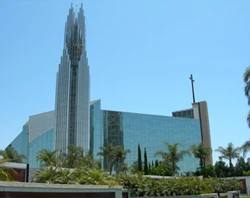
Orange, Calif., Jul 8, 2011 / 03:04 am (CNA).- The Diocese of Orange says it is potentially interested in buying a 3,000-seat glass church in Southern California that faces bankruptcy.

The diocese announced on July 7 that it’s currently looking for a building to meet the needs of the1.2 million Catholics in Orange County, the 11th largest diocese in the nation.

Although it’s been planning for over 10 years to build a new, 2,500-seat cathedral in Santa Ana, the diocese has only hired an architect for the project and is now considering converting the bankrupt church in Garden Grove into a Catholic cathedral.  [Economic factors must play their part in a time of economic contraction.  ]

“While we continue to develop plans for a cathedral in Santa Ana, it is prudent to evaluate the opportunity to engage in the pending auction of this property and to mitigate the chance that it cease to function as a place of worship,  [sort of] if acquired by others,” Bishop Tod D. Brown said on Tuesday.

The Crystal Cathedral –  an architectural landmark made with over 10,000 panes of glass and designed by the late Philip Johnson – would be an instant solution to the diocese’s building needs and would cost roughly half the $100 million price tag for the planned cathedral.

“I have authorized our advisors to contact the appropriate parties in the proceedings to determine a possible course of action,” Bishop Brown said.

“If the Diocese of Orange can prevent the loss of this important Christian Ministry and what the Crystal Cathedral has represented to so many for so long – and meet its own priorities for a new cathedral, we have a duty to at least review the options.”

At the same time, Bishop Brown cautioned that no official plans have been made.

“This is solely an exploratory consideration, not binding upon any party involved in the proceedings,” he said. “There is no change of course concerning development of the existing Cathedral site or other parishes in the community.”

The Crystal Cathedral, founded by pastor Robert H. Schuller, filed for bankruptcy last October. The church decided to file for Chapter 11 after some of its creditors sued for payment, according to church officials.

Documents from the U.S. Bankruptcy Court in Santa Ana show that hundreds of creditors could be owed between $50 million and $100 million, the Los Angeles Times reports.

The Diocese of Orange said that Bishop Brown has followed the news of the Crystal Cathedral bankruptcy proceedings with “concern” and is interested in the “landmark church remaining a functional part of the liturgical landscape for the region.”

Construction on the Crystal Cathedral began in 1977 and was completed in 1980 at a cost of $18 million.

Any thoughts?  I am not sure what to make of all this.

Posted in Liturgy Science Theatre 3000, Our Catholic Identity | Tagged , , , ,
76 Comments

“Ineffable” sighting!

I have not seen yet a copy of the YouCat, the catechism prepared for young people.  That said, I was amused by an excerpt, a paragraph from the same, a reader sent today:

183. Why is there music at liturgies, and what kind of music must it be to be suitable for liturgy?

Where words are not enough to praise God, music comes to our aid. [1156–1158, 1191]

When we turn to God, there is always something ineffable and unsaid left over. Then music can help out. In rejoicing, language becomes song—that is why the angels sing. Music in a worship service should make prayer more beautiful and more fervent, move more deeply the hearts of all in attendance and bring them closer to God, and prepare for God a feast of melody.

Someone thought young people are smart enough to understand “ineffable”.

Posted in Lighter fare | Tagged ,
27 Comments

Bill Donohue on liberal elite scolding of bishops over contrary-to-nature unions.

There is a good commentary by Bill Donohue of the Catholic League on the liberal commentary aimed at the US Catholic Bishops over contrary-to-nature unions and legislation to promote them.

Here is Mr. Donohue with my emphases and comments:

Responding to growing attacks on Catholic bishops over the issue of same-sex marriage is Catholic League president Bill Donohue:

The passage of a same-sex marriage bill in New York, over the objections of the Catholic hierarchy, [Some people may think the bishops should have objected more strenuously, but they did object.] has led to a storm of criticism of the state’s bishops. The most extreme condemnation comes from a July 5 editorial in the National Catholic Reporter (NCR).  [What a surprise.]

The Catholic hierarchy, says NCR, “has lost most of its credibility with the wider culture on matters of sexuality and personal morality, just as it has lost its authority within the Catholic community on the same issues.” The bishops are guilty of engaging in everything from “wholesale excommunications” to “open warfare” with dissidents[ROFL!  Let’s count up the number of excommunications issued by US bishops in the last, say, 5 years over any issue.  “Warfare”?  NCFishwrap thinks there has been “warfare”?  They should pray that the bishops don’t go to war.  They haven’t yet, not by a long shot.  And those bishops who have been outspoken on the matter of contrary-to-nature unions have been careful to distinguish between the sinners and the sins.  Sinners, people, require charity and concern.  Sin merits condemnation.  When did contrary-to-nature sexual activity cease being a sin?]

[This next part is very useful.] The popular “out-of-touch” criticism of the bishops on gay marriage rests on two faulty assumptions: (a) there is a divide between the bishops and the faithful on this issue, and (b) the bishops should take their cues from the laity.  [Excellent.  First, depending in part on which part of the country you are looking at, it is hard to imagine that the “silent majority” is in favor of contrary-to-nature sex and legal unions.  Polls will show this or that number, but when common sense is applied, it is simply too hard to imagine, and rightly so.  Second, remember that liberals want to supplant the bishops and set up their own “magisterium”.  I suspect they really don’t care what “the laity” think.  They are really saying that bishops should submit to the agenda points of the liberal Catholic elite.]

To begin with, there is a profound difference between the views of practicing Catholics and nominal ones. [This is an important distinction.  Catholics who actually go to church, practice their Faith poll differently on a variety of questions than do CINOs.] There is also a divide between what the public tells a pollster and the results in a ballot box. In the 31 states where the voters were given the opportunity to decide on gay marriage, many of the polls going into the election showed that the supporters would carry the day. The final tally was 31-0 against gay marriage. New Yorkers were denied a ballot initiative. Moreover, a Siena College poll taken just before the vote in the legislature showed only a minority of Catholics in favor of this idea.

More important, the bishops have a different charge: they are obligated to do what is morally right. [NB: Even if they have in some instances failed in that regard in the past, that failure does not diminish the duty of the bishops to teach properly.  Sure, their task is harder because of those failures and the bishops as a body have a long row to hoe to recover respect and confidence from many.  But they won’t do so by doing nothing or biting their tongues.   They probably won’t do it by “warfare” either.  But watch this next point… ] But if NCR wants the bishops to follow the laity, is it prepared to have the hierarchy junk its rejection of the death penalty[EXACTLY!  The opinion the liberal Catholic elite wants bishops to follow is not actually that of the people in the pews.  When it suits their own agenda, liberals use the populist argument against the teaching authority of the Church.  When the opinion of the people doesn’t coincide, then they look for other blunt instruments.] After all, two-thirds of Catholics want those guilty of a capital offense to be fried, so why not the bishops? Will NCR now campaign for the death penalty, lecturing the bishops to get in line with the rank-and-file? Its hypocrisy is stunning.

WDTPRS KUDOS to Mr. Donohue.  Good argument.

Posted in Biased Media Coverage, Fr. Z KUDOS, One Man & One Woman, Our Catholic Identity, The Drill, The future and our choices, Throwing a Nutty |
13 Comments

Really cool nun video

Here is a great video which I pick up from the best Catholic weekly in the UK, The Catholic Herald.

What a delightful lady. Keep your ears tuned for what she says is her constant prayer.

[wp_youtube]fLzIr16FZPA[/wp_youtube]

Posted in Just Too Cool, Non Nobis and Te Deum, Our Catholic Identity | Tagged , , ,
16 Comments

QUAERITUR: Hymns at Low Mass (Extraordinary Form)

I am focused on a myriad of things at the moment, and so I will open this to the readership to obtain sound and documented answers to this priest’s questions about the Extraordinary Form.

Note that there are two issues.

First, it is permitted.  Next, is it a good idea?  While the first can be resolved with relative ease, the second will involve some thought and discussion.  Of course the circumstances of the individual parish of the priest questioner cannot be considered, because I have anonymized this.  Still, some discussion could be helpful.

Is it tolerable to have hymns at Low Mass (namely, at offertory and after Holy Communion).

If singing is tolerated at Low Mass, why not encourage the singing of some of the antiphons in Psalm tones?

Posted in "How To..." - Practical Notes, ASK FATHER Question Box, Mail from priests, The Drill | Tagged ,
34 Comments

What does the gowk really say?

A scene from The Fortune of War (6th in the series), which includes the wonderful word “gowk”.

At this time our friends Capt. Aubrey, Dr. Maturin and some of the crew from HMS Leopard are on their way back to England via HMS La Fleche, carrying dispatches.  Dr. Maturin and the officers of are in the gun room.

[The Leopards] found a fellow-spirit in the master, and presently their end of the table was in a fine flow of conversation, reminiscence, anecdote, and laughter – former shipmates recalled, other commissions compared. Stephen laid out some pains in being agreeable to McLean, who sat by him, eating voraciously with a good deal of noise; but until half way through the meal there was little or no response. Then at last persuaded that Dr Maturin was neither going to snub or scorn him, McLean said, ‘I hae your bukes,’ adding something that Stephen could not catch, the accent being so strong, the voice so lowered in embarrassment. But judging by the young man’s expression, the words were obliging, so Stephen bowed, murmuring, ‘You are very good, too kind. I believe, sir, you are a naturalist yourself?’  Yes. As a wee bairn McLean first skelpit a mickle whaup his Daddie had whangit wi a stane, and then ilka beastie that came his way; comparative anatomy had been his joy from that day to this, and he named some of the beasties whose inward parts he had compared. But since the scoutie-allen, the partan, the clokie-doo and the gowk seemed not to convey any precise idea, he followed them with the Linnaean names; Stephen did the same for the creatures he referred to, and from this it was no great way to Latin descriptions of their more interesting processes. McLean was fluent in the language, having been to Jena, and Stephen found him far more comprehensible; presently they were talking away at a great rate, with barely a word of English but Och aye, and Hoot awa. They were deep in the caecum of Monodon monoceros when Stephen, becoming aware of a silence on his right, looked up and met the delighted grin of Babbington and Byron.  ‘We had just been boasting about you, sir,’ said Babbington. ‘We said you could talk Latin to beat a bishop, and these fellows would not believe it.’

Later La Fleche will burn at sea and explode.  The survivors are finally and after great suffering picked up by HMS Java in time for her battle with USS Constitution.  Following an interlude in early 19th c. Boston, we read about the battle between HMS Shannon and USS Chesapeake.

Want an unabridged recording?  The best reading of the series is, without a doubt, by Simon Vance on Blackstone Audio.  Here.

Those who know the Aubrey/Maturin series need no explanations.  All I can say to those who have not yet read them is that I envy you the pleasure of their discovery.

Posted in O'Brian Tags, Puir Slow-Witted Gowk | Tagged , , ,
13 Comments

The live dog or the dead lion? About the saints, our prayers, and their intercession.

I just finished writing a column for The Wanderer.  In this week’s burnt offering I was looking at the intercessions made after the consecration during the 3rd Eucharistic Prayer.  Here is something of what I wrote:

There is one mediator between God and man, the man God Jesus Christ our Savior (cf. 1 Tim 2:5).  When we speak of intercession, we give the greatest prominence to what Christ has done and is doing for us now.

Nevertheless, because we in this vale of tears (the Church in its Militant guise) belong to a Church which includes the angels and saints (the Church in its Triumphant aspect), we also ask the intercession of other members of the Church, those yet living in this world, those who have gone before us, and those persons without material being, the holy angels.  We therefore call upon their help from our confident trust in the solidarity of their charity toward us.  From charity they desire what is best for our salvation and, in that love, they are willing to help us according to God’s will.

The great translator and sometimes irascible St. Jerome (+420) has a succinct explanation of why we call on the saints for help and why they respond to our prayers. Jerome is carrying on a polemic against a priest named Vigilantius, who had provoked Jerome on a number of fronts.  Vigilantius claimed that once we are dead we cannot pray for the living.  Jerome responded:

If Apostles and martyrs while still in the body can pray for others, when they ought still to be anxious for themselves, how much more must they do so when once they have won their crowns, overcome, and triumphed? A single man, Moses, oft wins pardon from God for six hundred thousand armed men; and Stephen, the follower of his Lord and the first Christian martyr, entreats pardon for his persecutors (Acts 7:59-60); and when once they have entered on their life with Christ, shall they have less power than before? The Apostle Paul says that two hundred and seventy-six souls were given to him in the ship (Acts 27:37); and when, after his dissolution, he has begun to be with Christ, must he shut his mouth, and be unable to say a word for those who throughout the whole world have believed in his Gospel? Shall Vigilantius the live dog be better than Paul the dead lion? (Contra Vigilantium 6).

There’s one in the eye for poor Vigi.  What might St. Jerome have been like in the age of the weekly newspaper columns, cable news, and the blogosphere?

The affirmation of one mediator between God and man does not exclude that we beg help from the saints and angels.

Whatever merit we have for our salvation is from Christ, who, as St. Augustine (+430) explains, crowns His own merits within us (cf. ep. 194, 19 and, in the 2002 Missale Romanum, the Preface “de sanctis”).

However, even when we pray in our liturgical worship for the intercession of one or more of the “elect” in heaven, we raise the prayer through Christ Jesus our Lord.

Posted in "How To..." - Practical Notes, Our Catholic Identity, Patristiblogging, Saints: Stories & Symbols, The Drill, WDTPRS | Tagged , , , , ,
15 Comments

What is your good news?

Folks, I am in need of some good news.  Do you have any for me and for the other readers?

Posted in SESSIUNCULA |
72 Comments

The Tablet equates striking the breast during the Confiteor with child abuse.

At The Tablet aka The Bitter Pill, there is a piece by one Melanie Lately, a guest contributor, which deserves our attention – and not because of its excellence.

Commentators in the combox over there have dealt with the obvious problems, so I won’t dwell on them.

I don’t intend to go over every possible misstep, for it is one of the dumbest things I have read for a long time.  I’ll touch a few things that I didn’t see covered elsewhere and then do some ranting of my own at the end.

As you read, consider that liberals intend now to vilify what they don’t like by linking it to clerical sexual abuse of children.  It doesn’t matter what it is that they don’t like, if they don’t like it, it must have something to do with child abuse.  So, you sometimes have to look beyond the facile – though sometimes admittedly agile – introduction of their new blunt instrument, for their real points.

My emphases and comments.

New Missal translation – rated 18
Posted by Melanie Lately, guest contributor , 1 July 2011, 9:00

At Mass we have cards in the pews so we can follow the revised translation of the Mass. The options for different parts are there. This week our parish priest used the homily to speak about it. When he read out the words of the Confiteor, with the changes in bold, he was greeted with gales of laughter and even he had to smile.

I confess to almighty God
and to you, my brothers and sisters,
that I have greatly sinned
in my thoughts and in my words,
in what I have done
and in what I have failed to do,
[All strike their breast]
through my fault, through my fault,
through my most grievous fault;

No-one today in their right mind – unless perhaps they have just murdered someone – is going to harp on about “my fault, my fault, my own most grievous fault” while beating their breast, especially if they are reflecting on ordinary everyday thoughts or words that most Mass-goers might be expected to have. The picture the words give of breast-beating illiterate peasants with cloth caps and mud-clotted boots is like something out of Monty Python.  [What it actually reflects is belief in the reality of sin.  Keep in mind that liberals don’t believe in personal sins.  They believe only in structural sin.]

Among consenting adults [Notice that she wants to sexualize this.] at Mass it matters little. But it is completely different when it comes to the children. As an educator with children in Catholic schools I wonder if Vox Clara group who came up with this translation have thought about the educational side[The writer implies, apparently, that children don’t sin. I beg to differ.  And neither Vox Clara nor ICEL, had to concern themselves about the “educational side”, whatever that means.  They were concerned with “sacred tradition” and the actual meaning of the words of the prayer.]

[Now she gets to her real point.] Imagine what would happen if the Government of Britain or the US, Canada or Australia were to bring something like this into state schools with little or no public consultation, and have children learn such words by heart and repeat them over and over for 12 years – there would be a public outcry. [The writer’s fundamental problem here is a lack of recognition of a difference between a state school and a Catholic school, at least one not paid for by the state.] And yet the equivalent of this is being foisted on Catholic children in English-speaking lands. Surely if Catholic children are cajoled by teachers at the behest of the Catholic hierarchy to beat their breasts on regular solemn occasions [I think she means Mass.] and pronounce themselves inwardly filthy, [Good grief.  Is that what the Confiteor says?  Perhaps she has a better grasp of Lutheran anthropology than Catholic] we should be shown the psychological impact study they carried out. Or did they not do one?  [This is simply loony.  Perhaps we should have a psychological impact study on Christianity?  After all, some people think that Christianity is in itself bad for people.  The writer may be one of them, as a matter of fact.  Think about the psychological impact of being told about a God who tells a father to kill his kid on a rock with a knife and burn his body.  That same God, in the guise of a “Father”, then purposely sends His Son to tortured until He dies.  Maybe the writer’s New South Wales, paying for the Catholic school the writer accepts a check from should do a psychological impact study on that.  After all, publicly funded Catholic schools have to be held to account for what is taught, right?  Imagine the state wanting in this day and age exalt say… virginity.]

With all the to-do about child abuse in the Catholic Church, [Do you suppose there is any child abuse in other state schools in NEw South Wales?] you would have thought that it would have led to some consciousness-raising among priests and bishops and someone in Vox Clara or among their apologists might have asked, “Do you think the solemn formal repetition of words like this for 12 years is good for the children? Might this not be seen as a form of psychological child abuse?” [What was she smoking?] Certainly, in our publically [sic] funded Catholic schools it could be seen this way.  [Then perhaps they shouldn’t be publicly funded, so that actual Catholic doctrine can be taught in these schools]

[And now we arrive at what The Tablet really wants to push…] Priestly prestige and power are on the wane in countries where there are good levels of sanitation, education, food, water, and long life expectancy, [The implication is that having a hierarchy in the Church is a throw back to primitive times.  Remember her Monty Python tour de force at the top?] and the changes of the liturgy are about retrieving this lost prestige and power. [For liberals, liturgy is about who has power, who is at the center of attention.  For Catholics. however, liturgy is about worship of the transcendent God, our mysterious origin, goal and salvation.] But it is a very underhand way of going about it. The real grievous sin, if we are to speak this language, [She doesn’t like the concept of “sin”.] is in fact this underhand [again?] manipulation of the Catholic people, with total disregard for their children[Total disregard for children would be an avoidance of instruction about sin and denial of the proper liturgy of the Church.]

Melanie Lately is a lay Catholic [How could she be anything else but a lay person?] based in New South Wales with children in Catholic schools.

This is what The Tablet thinks is worthy commentary.  But remember: it is less about the translation than the problem of accepting the Church’s teaching about sin.

Reflect on the suggestion that the liturgical beating of one’s breast is tantamount to child abuse.  I wonder what she thinks of showing children a piece of wood with a man nailed to it.

Since the writer doesn’t care about two millennia of Christian tradition, consider that Jews traditionally beat their breasts at the confession of having sinned.  Observant Jews strike their breast over their hearts to remind themselves of the fact of their transgressions.  They have done this for a long time.  By her reasoning, the Jews who passed on the traditional of teaching children to beat their breasts or think about sin and penitence are child abusers.  And they aren’t even members of the oppressive and backward Catholic hierarchy!

But back to Christian tradition, which Catholics do care about.  St. Augustine says that when the words “forgive us our sins/trespasses” were pronounced, the congregation struck their breasts so hard that it made a great noise in the Church.

Hmmm… now that I think of it, didn’t the Lord teach a prayer about sinning?  He even repeats the baaad idea of sin, or trespasses.  It is important for us to repeat and to ritualize what is important.  The three-fold repetition – aside from the fact that its in the Latin original – has a “psychological impact”, which needs no study.  The repetition helps us to hear it.  The striking of the breasts makes us own it.  And that is what she doesn’t like, because, for liberals, sin is structural and not personal.

We Catholics don’t go to Mass – sorry… “solemn formal occasions” because we are okay just the way we are.  We go because we are not okay.  A recognition of who we are and who we are not is a necessary starting point for authentic Christian worship.

The future Pope Benedict XVI wrote in Spirit of the Liturgy (p. 207):

“We point not at someone else but at ourselves as the guilty party, [which] remains a meaningful gesture of prayer. … When we say mea culpa (through my fault), we turn, so to speak, to ourselves, to our own front door, and thus we are able rightly to ask forgiveness of God, the saints, and the people gathered around us, whom we have wronged.”

To conclude, I will repeat what I offered at the top, in case you missed it.

Liberals intend now to vilify what they don’t like by linking it to clerical sexual abuse of children.  It doesn’t matter what it is that they don’t like, if they don’t like it, it must have something to do with child abuse.  So, you sometimes have to look beyond the facile – though sometimes admittedly agile – introduction of their new blunt instrument, for their real points.


Posted in Liturgy Science Theatre 3000, Puir Slow-Witted Gowk, The Drill, Throwing a Nutty, Wherein Fr. Z Rants |
91 Comments