The Holy Father’s sermon for Mass at Westminster Cathedral.
The setting is a Mass of the Precious Blood in a Cathedral dedicated to the Precious Blood. The sermon depends on the motif that Christ is the High priest and that therefore the Church is also the High Priest, which suffers and offers suffering.
Dear friends in Christ,
I greet all of you with the joy in the Lord and I thank you for your warm reception. I am grateful to Archbishop Nichols for his words of welcome on your behalf. Truly, in this meeting of the Successor of Peter and the faithful of Britain, “heart speaks unto heart” as we rejoice in the love of Christ and in our common profession of the Catholic faith which comes to us from the Apostles. I am especially happy that our meeting takes place in this Cathedral dedicated to the Most Precious Blood, which is the sign of God’s redemptive mercy poured out upon the world through the passion, death and resurrection of his Son, our Lord Jesus Christ. In a particular way I greet the Archbishop of Canterbury, who honours us by his presence. [A gracious gesture.]
The visitor to this Cathedral cannot fail to be struck by the great crucifix dominating the nave, which portrays Christ’s body, crushed by suffering, overwhelmed by sorrow, the innocent victim whose death has reconciled us with the Father and given us a share in the very life of God. The Lord’s outstretched arms seem to embrace this entire church, lifting up to the Father all the ranks of the faithful who gather around the altar of the Eucharistic sacrifice and share in its fruits. The crucified Lord stands above and before us as the source of our life and salvation, “the high priest of the good things to come”, as the author of the Letter to the Hebrews calls him in today’s first reading (Heb 9:11).
It is in the shadow, so to speak, of this striking image, that I would like to consider the word of God which has been proclaimed in our midst and reflect on the mystery of the Precious Blood. For that mystery leads us to see the unity between Christ’s sacrifice on the Cross, the Eucharistic sacrifice which he has given to his Church, and his eternal priesthood, whereby, seated at the right hand of the Father, he makes unceasing intercession for us, the members of his mystical body.
Let us begin with the sacrifice of the Cross. The outpouring of Christ’s blood is the source of the Church’s life. St John, as we know, sees in the water and blood which flowed from our Lord’s body the wellspring of that divine life to the Hebrews draws out, we might say, the liturgical implications of this mystery. Jesus, by his suffering and death, his self-oblation in the eternal Spirit, has become our high priest and “the mediator of a new covenant” (Heb 9:15). These words echo our Lord’s own words at the Last Supper, when he instituted the Eucharist as the sacrament of his body, given up for us, and his blood, the blood of the new and everlasting covenant shed for the forgiveness of sins (cf Mk 14:24; Mt 26:28; Lk 22:20).
Faithful to Christ’s command to “do this in memory of me” (Lk 22:19), the Church in every time and place celebrates the Eucharist until the Lord returns in glory, rejoicing in his sacramental presence and drawing upon the power of his saving sacrifice for the redemption of the world.
The reality of the Eucharistic sacrifice has always been at the heart of Catholic faith; called into question in the 16th century, [indeed] it was solemnly reaffirmed at the Council of Trent against the backdrop of our justification in Christ. Here in England, as we know, there were many who staunchly defended the Mass, often at great cost, [martyrdom] giving rise to that devotion to the Most Holy Eucharist which has been the hallmark of Catholicism in these lands. [In the Cathedral there is, for example, the body of St. Robert Southwell, hanged, drawn and quartered at Tyburn correction… St. John Southworth.]
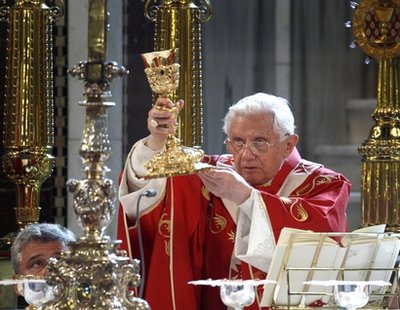
The Eucharistic sacrifice of the Body and Blood of Christ embraces in turn the mystery of our Lord’s continuing passion in the members of his Mystical Body, [This is an important image/motif for what follows.] the Church in every age. Here the great crucifix which towers above us serves as a reminder that Christ, our eternal high priest, daily unites our own sacrifices, our own sufferings, our own needs, hopes and aspirations, to the infinite merits of his sacrifice. Through him, with him, and in him, we lift up our own bodies as a sacrifice holy and acceptable to God (cf Rom 12:1). In this sense we are caught up in his eternal oblation, completing, as St Paul says, in our flesh what is lacking in Christ’s afflictions for the sake of his body, the Church (cf Col 1:24). In the life of the Church, in her trials and tribulations, Christ continues, in the stark phrase of Pascal, to be in agony until the end of the world (Pensees, 553, ed. Brunschvicg). [So… the Pope is driving at what we do with our suffering.]
[] We see this aspect of the mystery of Christ’s precious blood represented, most eloquently, by the martyrs of every age, who drank from the cup which Christ himself drank, and whose own blood, shed in union with his sacrifice, gives new life to the Church. It is also reflected in our brothers and sisters throughout the world who even now are suffering discrimination and persecution for their Christian faith. [This "Christian" must be intentional. Other Christians suffer because they are Christians. The Pope is widening the circle.] Yet it is also present, often hidden in the suffering of all those individual Christians who daily unite their sacrifices to those of the Lord for the sanctification of the Church and the redemption of the world. My thoughts go in a special way to all those who are spiritually united with this Eucharistic celebration, and in particular the sick, the elderly, the handicapped and those who suffer mentally and spiritually. [The whole Church.]
[From that springboard…] Here, too, I think of the immense suffering caused by the abuse of children, especially within the Church and by her ministers. Above all, I express my deep sorrow to the innocent victims of these unspeakable crimes, along with my hope that the power of Christ’s grace, his sacrifice of reconciliation, will bring deep healing and peace to their lives. I also acknowledge with you the shame and humiliation which all of us have suffered because of these sins; [I + You = We.] and I invite you to offer it to the Lord with trust that this chastisement will contribute to the healing of victims, [Suffering is propitiatory and healing.] the purification of the Church and the renewal of her age-old commitment to the education and care of young people. I express my gratitude for the efforts being made to address this problem responsibly, and I ask all of you to show your concern for the victims and solidarity with your priests. [He is saying this to lay people and to bishops, who are present. The Pope asks for solidarity with priests. The Pope reminded everyone that they are a priestly people who are enabled and charged to unite their sufferings with those of the Lord. We share in the priesthood of Christ by sharing in their sufferings. The abuse of children is one of the way in which we are all suffering now. When one of us suffers, we all suffer. People can suggest that Popes and bishops and superiors should have done more. We don’t deny that. But this is the sin of the whole Church. We can’t make this an us v. them issue. We are all in this together. We all share in the sin of a member. There are corporate consequences to personal sin. This is a reason why in confession we must be reconciled to the whole Church. The news media will say "POPE FEELS SHAME!". What Benedict is saying is "WE FEEL SHAME". Yes, of course HE feels it and HE personally expresses sorrow. But in a second move, he widens the circle and points to the corporate dimension of the responsibility and the solution: suffering and healing.]
 Dear friends, let us return to the contemplation of the great crucifix which rises above us. [This from a Pope who wants ad orientem worship and, in lieu of that, the Crucifix front and center on the altar. The Cross is central to his reflection on mystery.] Our Lord’s hands, extended on the Cross, also invite us to contemplate our participation in his eternal priesthood and thus our responsibility, as members of his body, to bring the reconciling power of his sacrifice to the world in which we live. [Sin is a corporate reality. Responsibility is a corporate reality.] The Second Vatican Council spoke eloquently of the indispensable role of the laity in carrying forward the Church’s mission through their efforts to serve as a leaven of the Gospel in society and to work for the advancement of God’s kingdom in the world. [On many occasions the Pope has said that we must raise our voices in the public square. We need a strong identity to persevere in doing that. However, today he is adding another dimension. As a priestly people we also suffer in the public square. Bearing witness = martyrdom.] The Council’s appeal to the lay faithful to take up their baptismal sharing in Christ’s mission echoed the insights and teachings of John Henry Newman. May the profound ideas of this great Englishman continue to inspire all Christ’s followers in this land to conform their ever thought, word and action to Christ, and to work strenuously to defend those unchanging moral truths which, taken up, illuminated and confirmed by the Gospel, stand at the foundation of a truly humane, just and free society.
How much contemporary society needs this witness! [Martyrdom.] How much we need, in the Church and in society, witnesses of the beauty of holiness, witnesses of the splendour of truth, witnesses of the joy and freedom born of a living relationship with Christ! One of the greatest challenges facing us today is how to speak convincingly of the wisdom and liberating power of God’s word to a world which all too often sees the Gospel as a constriction of human freedom, instead of the truth which liberates our minds and enlightens our efforts to live wisely and well, both as individuals and as members of society. [In his "inauguration" sermon in 2005 he said: "Are we not perhaps all afraid in some way? If we let Christ enter fully into our lives, if we open ourselves totally to him, are we not afraid that He might take something away from us? Are we not perhaps afraid to give up something significant, something unique, something that makes life so beautiful? Do we not then risk ending up diminished and deprived of our freedom? And once again the Pope said: No! If we let Christ into our lives, we lose nothing, nothing, absolutely nothing of what makes life free, beautiful and great."]
[The Holy Father now speaks to reinvigorate the Catholic identity of the flock in England.] Let us pray, then, that the Catholics of this land will become ever more conscious of their dignity as a priestly people, called to consecrate the world to God through lives of faith and holiness. And may this increase of apostolic zeal be accompanied by an outpouring of prayer for vocations to the ordained priesthood. [He has been speaking about how all the people are a priestly people. Now he underscores the priesthood of the ordained.] For the more the lay apostolate grows, the more urgently the need for priests is felt; [Lay apostolates are not, in themselves, enough. They must have the support of the indispensable ordained priesthood.] and [More about our identity…] the more the laity’s own sense of vocation is deepened, the more what is proper to the priest stands out. [The roles must not be confused. They are different and complimentary.] May many young men in this land find the strength to answer the Master’s call to the ministerial priesthood, devoting their lives, their energy and their talents to God, thus building up his people in unity and fidelity to the Gospel, especially through the celebration of the Eucharistic sacrifice. [It is refreshing to read such clear words about vocations to the priesthood, without priesthood being blended in to generic "vocation".]
Dear friends, in this Cathedral of the Most Precious Blood, I invite you once more to look to Christ, [Crucified, bleeding] who leads us in our faith and brings it to perfection (cf Heb 12:2). I ask you to unite yourselves ever more fully to the Lord, sharing in his sacrifice on the Cross and offering him that “spiritual worship” (Rom 12:1) which embraces every aspect of our lives and finds expression in our efforts to contribute to the coming of his Kingdom. I pray that, in doing so, you may join the ranks of faithful believers throughout the long Christian history of this land in building a society truly worthy of man, worthy of your nation’s highest traditions. [The last line again brings together Benedict’s message of how Catholics must have a strong identity in order to contribute to society.]
Powerful and clear.
This will bear reading and rereading.
I note that the press is getting something wrong about this. For example, the BBC wrote: "Pope Benedict XVI has expressed his "deep sorrow" for the "unspeakable crimes" of child abuse within the Catholic Church." Yes, he did, but not in the way that the BBC leads.
In a first move Benedict spoke very properly and necessarily of his own sorrow. In a second move, he blends in the "we". This is not just Benedict‘s issue. If belongs to everyone. This surely goes beyond formal membership in the Catholic Church as well.
But the Holy Father today blended into his already strong tonic a bitter-sweet tincture of suffering. To be Catholic means not only being clear about our teachings, or practicing our devotions, and being able to give reasons for the faith that is in us. Being Catholic disciples of the Lord means involvement in suffering, our own and that of others.
If we are members of Christ the High Priest, we are also members of Christ the Victim for Sin.
Bearing witness to our Lord in the public square (in the family home, in the workplace, in the isolation of privacy) means also involvement in the Cross of the Lord, in the Precious Blood of the Lord shed to heal and give final meaning to the mysterium iniquitatis.






 Benedict XVI has beatified John Henry Card. Newman.
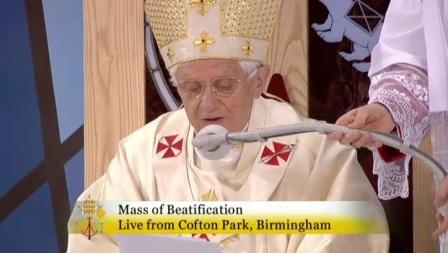 England has a long tradition of martyr saints, whose courageous witness has sustained and inspired the Catholic community here for centuries. Yet it is right and fitting that we should recognize today the holiness of a confessor, a son of this nation who, while not called to shed his blood for the Lord, nevertheless bore eloquent witness to him in the course of a long life devoted to the priestly ministry, and especially to preaching, teaching, and writing. He is worthy to take his place in a long line of saints and scholars from these islands, Saint Bede, Saint Hilda, Saint Aelred, Blessed Duns Scotus, to name but a few. In Blessed John Henry, that tradition of gentle scholarship, deep human wisdom and profound love for the Lord has borne rich fruit, as a sign of the abiding presence of the Holy Spirit deep within the heart of God’s people, bringing forth abundant gifts of holiness.
 The definite service to which Blessed John Henry was called involved applying his keen intellect and his prolific pen to many of the most pressing "subjects of the day". His insights into the relationship between faith and reason, into the vital place of revealed religion in civilized society, and into the need for a broadly-based and wide-ranging approach to education were not only of profound importance for Victorian England, but continue today to inspire and enlighten many all over the world. I would like to pay particular tribute to his vision for education, which has done so much to shape the ethos that is the driving force behind Catholic schools and colleges today. Firmly opposed to any reductive or utilitarian approach, he sought to achieve an educational environment in which intellectual training, moral discipline and religious commitment would come together. The project to found a Catholic University in Ireland provided him with an opportunity to develop his ideas on the subject, and the collection of discourses that he published as The Idea of a University holds up an ideal from which all those engaged in academic formation can continue to learn. And indeed, what better goal could teachers of religion set themselves than Blessed John Henry’s famous appeal for an intelligent, well-instructed laity: "I want a laity, not arrogant, not rash in speech, not disputatious, but men who know their religion, who enter into it, who know just where they stand, who know what they hold and what they do not, who know their creed so well that they can give an account of it, who know so much of history that they can defend it" (The Present Position of Catholics in England, ix, 390). On this day when the author of those words is raised to the altars, I pray that, through his intercession and example, all who are engaged in the task of teaching and catechesis will be inspired to greater effort by the vision he so clearly sets before us.


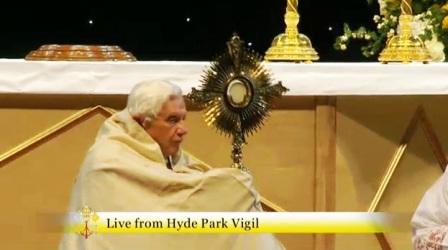
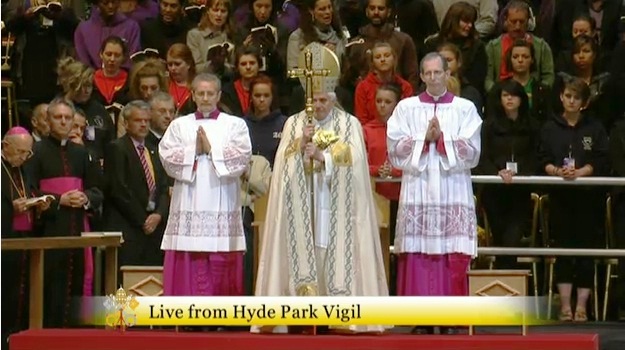
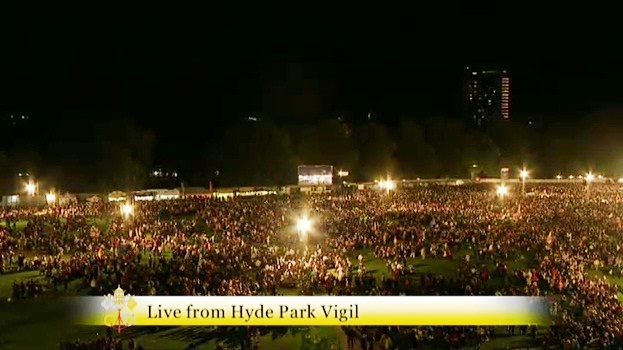
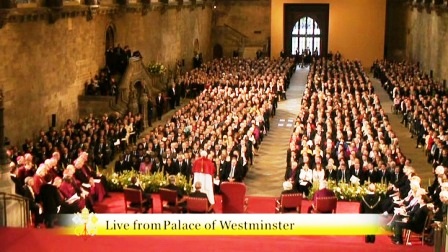
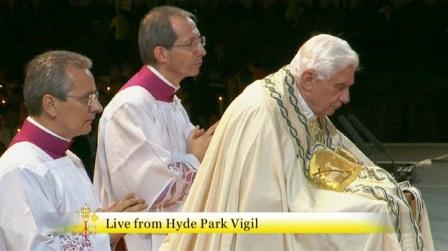 Benedict XVI used Hyde Park for his soap box tonight, and gave this address.
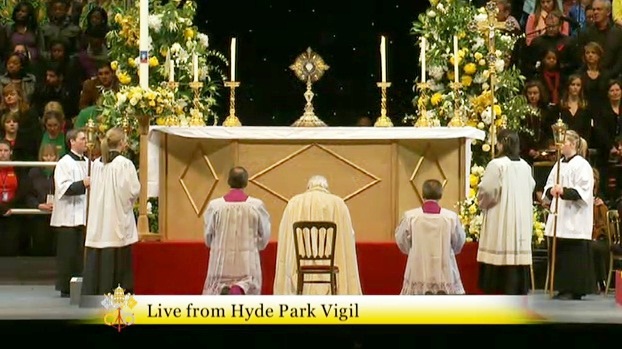 Let me begin by recalling that Newman, by his own account, traced the course of his whole life back to a powerful experience of conversion which he had as a young man. It was an immediate experience of the truth of God’s word, of the objective reality of Christian revelation as handed down in the Church. This experience, at once religious and intellectual, would inspire his vocation to be a minister of the Gospel, his discernment of the source of authoritative teaching in the Church of God, and his zeal for the renewal of ecclesial life in fidelity to the apostolic tradition. At the end of his life, Newman would describe his life’s work as a struggle against the growing tendency to view religion as a purely private and subjective matter, a question of personal opinion. [We return to a major theme of this Pope’s pontificate and this Visit. There are many people who would forcibly eject any Christian voice from the public sphere. This is especially true in the case of a Catholic voice. Even many Catholics who are not entirely faithful to the Church’s teachings are complicit in this.] Here is the first lesson we can learn from his life: [1]

 in our day, when an intellectual and moral relativism threatens to sap the very foundations of our society, Newman reminds us that, as men and women made in the image and likeness of God, we were created to know the truth, to find in that truth our ultimate freedom and the fulfilment of our deepest human aspirations. In a word, we are meant to know Christ, who is himself "the way, and the truth, and the life" (Jn 14:6). [The British Humanist Association needs to get this part straight.]
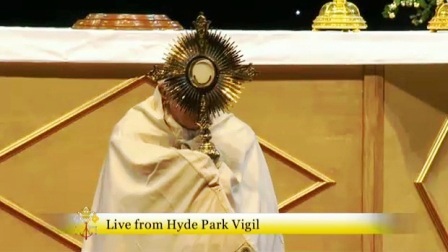 Newman’s life also [2] teaches us that passion for the truth, intellectual honesty and genuine conversion are costly. [Bearing witness – martyrdom] The truth that sets us free cannot be kept to ourselves; it calls for testimony, [Martyrdom.] it begs to be heard, and in the end its convincing power comes from itself and not from the human eloquence or arguments in which it may be couched. Not far from here, at Tyburn, great numbers of our brothers and sisters died for the faith; the witness of their fidelity to the end was ever more powerful than the inspired words that so many of them spoke before surrendering everything to the Lord. [NB] In our own time, the price to be paid for fidelity to the Gospel is no longer being hanged, drawn and quartered but it often involves being dismissed out of hand, ridiculed or parodied. And yet, the Church cannot withdraw from the task of proclaiming Christ and his Gospel as saving truth, the source of our ultimate happiness as individuals and as the foundation of a just and humane society.
 One of the Cardinal’s best-loved meditations includes the words, "God has created me to do him some definite service. He has committed some work to me which he has not committed to another" (Meditations on Christian Doctrine). Here we see Newman’s fine Christian realism, the point at which faith and life inevitably intersect. Faith is meant to bear fruit in the transformation of our world through the power of the Holy Spirit at work in the lives and activity of believers. [Here is some realism for you:…] No one who looks realistically at our world today could think that Christians can afford to go on with business as usual, ignoring the profound crisis of faith which has overtaken our society, or simply trusting that the patrimony of values handed down by the Christian centuries will continue to inspire and shape the future of our society. We know that in times of crisis and upheaval God has raised up great saints and prophets for the renewal of the Church and Christian society; we trust in his providence and we pray for his continued guidance. But each of us, in accordance with his or her state of life, is called to work for the advancement of God’s Kingdom by imbuing temporal life with the values of the Gospel. Each of us has a mission, each of us is called to change the world, to work for a culture of life, a culture forged by love and respect for the dignity of each human person. As our Lord tells us in the Gospel we have just heard, our light must shine in the sight of all, so that, seeing our good works, they may give praise to our heavenly Father (cf. Mt 5:16).
 Here I wish to say a special word to the many young people present. Dear young friends: only Jesus knows what "definite service" he has in mind for you. Be open to his voice resounding in the depths of your heart: even now his heart is speaking to your heart. Christ has need of families to remind the world of the dignity of human love and the beauty of family life. He needs men and women who devote their lives to the noble task of education, tending the young and forming them in the ways of the Gospel. He needs those who will consecrate their lives to the pursuit of perfect charity, following him in chastity, poverty and obedience, and serving him in the least of our brothers and sisters. He needs the powerful love of contemplative religious, who sustain the Church’s witness and activity through their constant prayer. And he needs priests, good and holy priests, men who are willing to lay down their lives for their sheep. Ask our Lord what he has in mind for you! Ask him for the generosity to say "yes!" Do not be afraid to give yourself totally to Jesus. He will give you the grace you need to fulfill your vocation. Let me finish these few words by warmly inviting you to join me next year in Madrid for World Youth Day. It is always a wonderful occasion to grow in love for Christ and to be encouraged in a joyful life of faith along with thousands of other young people. I hope to see many of you there!
 First, I am so very happy for Catholics in England who had the privilege of being addressed with this sermon.
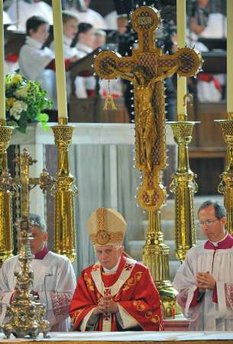 Dear friends, let us return to the contemplation of the great crucifix which rises above us. [This from a Pope who wants ad orientem worship and, in lieu of that, the Crucifix front and center on the altar. The Cross is central to his reflection on mystery.] Our Lord’s hands, extended on the Cross, also invite us to contemplate our participation in his eternal priesthood and thus our responsibility, as members of his body, to bring the reconciling power of his sacrifice to the world in which we live. [Sin is a corporate reality. Responsibility is a corporate reality.] The Second Vatican Council spoke eloquently of the indispensable role of the laity in carrying forward the Church’s mission through their efforts to serve as a leaven of the Gospel in society and to work for the advancement of God’s kingdom in the world. [On many occasions the Pope has said that we must raise our voices in the public square. We need a strong identity to persevere in doing that. However, today he is adding another dimension. As a priestly people we also suffer in the public square. Bearing witness = martyrdom.] The Council’s appeal to the lay faithful to take up their baptismal sharing in Christ’s mission echoed the insights and teachings of John Henry Newman. May the profound ideas of this great Englishman continue to inspire all Christ’s followers in this land to conform their ever thought, word and action to Christ, and to work strenuously to defend those unchanging moral truths which, taken up, illuminated and confirmed by the Gospel, stand at the foundation of a truly humane, just and free society.


 Kathleen10 on Daily Rome Shot 1117 – A *POLL* about 2026-27: “Fr Z thanks so much for 2 reminders. 1. Using your Amazon link! For heaven’s sake it costs us nothing…”




























