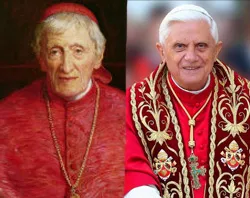
Hyde Park Litany… of the… Sacred Heart

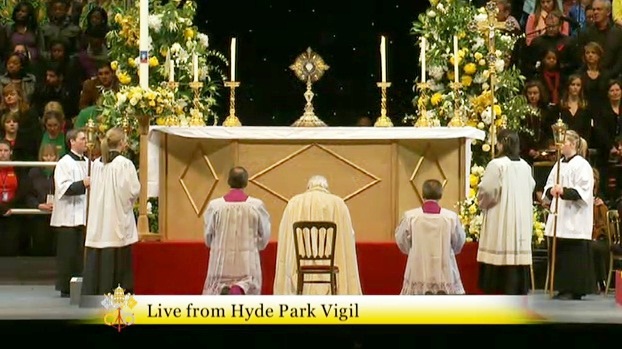
Hyde ParkWhen the Holy Father was at Hyde Park in London, there was a species of The Litany of the Sacred Heart.

It was curtailed and there were interpolated intercessions, very contemporary, very much suggesting the ramifications of the clerical sexual abuse crisis as well as – though perhaps less so – anti-Catholic sentiment.

I wrote at the time:

"Don’t know about that…"

I am ambivalent.  I think it is proper to make litanies current and relevant.  That is why most of them developed: a pressing need or catastrophe loomed and people needed help.

Also, the Holy Father can add to or take from litanies as it pleaseth him.  John Paul II officially added to the Litany of Loreto.

But what happened at Hyde Park struck me as odd.  

First, there was the fact of various readers for the intercessions.  It didn’t seem liturgical.  It seemed terribly self-conscious.  It seemed – as so much does in contemporary liturgy – to be an effort to get as many people of different ethnic backgrounds or states of life involved as possible.

I picked this up from the blog Countercultural Father.

Liturgical infantilism v. liturgical wisdom

Others have commented on the re-writing of the Litany of the Sacred Heart. I noticed something else.

The Litany was split up with different readers reading a few invocations each.

That struck me as indicative of one of the problems with liturgy in this country, which I call liturgical infantilism, and was in stark contrast to the Holy Father’s approach.

When the Holy Father is engaged in a liturgical action, it is all about Christ: hence his insistence on a crucifix on the altar. He switches modes, very deliberately, from his interactions with the faithful, before and after Mass, when the focus is on relating to them, to focus on the serious business of adoration, contrition, thanksgiving, supplication… The person of the celebrant almost disappears; he becomes transparent, so we see Christ through him. It is not all about the front-man.

But liturgists in the UK don’t seem to understand this, and the Litany was a glaring example of the problem. By splitting the Litany up – presumably so as to ‘include’ more people, and possibly with the intention of making something long ‘less boring’ they distract from the focus on the Sacred Heart and draw attention to the reader: who is it now? who is it next? How well was that read? Why did they choose him? and so on…

But what the Holy Father did brilliantly was to demonstrate by example that worthy and reverent liturgy is hugely attractive and intensely prayerful. Let us hope and pray that our bishops noticed: I look forward to their copying his example, not least in the manner of the distribution of Holy Communion…


WDTPRS Kudos.

Posted in "How To..." - Practical Notes, Fr. Z KUDOS, Liturgy Science Theatre 3000 | Tagged , ,
15 Comments

BLOG PROBLEM REPORT

There were attacks today.   I am not sure what kind.  Perhaps generic.

In any event.  The time has come for changes.

I have switched to the WP default theme for a bit while I ponder options.

I am told that a bigger machine is needed. 

Frustrated with this, and would appreciate prayers.

NB: With this default theme, the right side bar has a large "gap" in it. Scroll down for more useful items.

If there is a WP theme designer out there…

Posted in SESSIUNCULA |
29 Comments

QUAERITUR: Can I buy a relic?

From a reader:

I wanted to know if it is permissible to buy relics. I know that Canon Law says that it is absolutely wrong to sell them. But what about buying them? Also, how do I go about confirming the authenticity of the relic. I feel that the documentation can be easily forged.


It is not permissible to sell relics, which is a terrible sin and sacrilege.  It is similarly sinful to traffic in relics by buying them for anything other than the motive of saving them from profanation.  It is permissible to buy a relic to "rescue" it from mistreatment or other unworthy purposes.

When a person seeks to obtain a relic, from an approved source such as the Vicariate of Rome of the HQ of a religious order or institute or, perhaps, a postulator of a cause, there can often be an expense involved.  The expense is not for the relic, but for the purchase of the reliquary, the preparation of the relic, a document, etc.

Again, buying and selling relics, trafficking in relics, is thoroughly wicked and deserves our deepest pity-filled contempt.

It is laudable, however, to "rescue" relics from mistreatment.

As far as documentation is concerned, it can be difficult today to obtain documents even from approved sources for relics.  This is especially the case with relics of saint from the distant past.  However, reliquaries when opened usually reveal a waxen seal, embossed by the entity that handled the relics.  It could be possible to hunt down the source of the relic, which can help to authenticate that it was prepared under the aegis of Church authority.

Some might argue that by "rescuing" a relic, you create a market for them, inspiring the unethical to do sacrilegious things for profit.

If you are in doubt, bring your concern to your local bishop and ask for advice.   If that does not produce swift results, you can write to the Congregation for Causes of Saints for advice, sending a copy of your correspondence.

Posted in "How To..." - Practical Notes, ASK FATHER Question Box, Saints: Stories & Symbols | Tagged
7 Comments

BLOG PROBLEMS

I have receive quite a few e-mails asking me if there are blog problems.

Yes.  There are blog problems, and I am not sure what is causing them.

The fact that I posted this means that the blog is running… sort of.  It is very slow and sometimes doesn’t cooperate at all.

I am stuck at the moment, and must wait for some support.

In the wake of Facebook killing my page in the midst of the Papal Visit, I am wondering if Old Scratch isn’t exacting some revenge.

So!  Please say a pray to which ever angel guardian might be available to look at the server and help sort things, at least through a nudge or inspiration to the right place or person!

UPDATE:

Something developed that will require some major changes quite soon.

For now it is running again.

Many thanks to the now tired J for the help.

Posted in SESSIUNCULA |
13 Comments

By Jove! Sky watching alert!

From Spaceweather.com

JUPITER AT ITS BEST: Tonight, Sept. 20-21, Earth and Jupiter converge for their closest encounter in decades. The giant planet will soar across the sky at midnight, outshining everything except the Moon itself.  Although big, bright Jupiter will remain close to Earth for weeks to come, tonight is the closest of all.  Check http://spaceweather.com for images and more information.

Posted in Just Too Cool |
2 Comments

Filipino liturgists react against Summorum Pontificum

The Archdiocese of Manila has posted on their website a statement made after a meeting of liturgists from the Philippines under the aegis of the bishops conference of the Philippines.

Included in this short statement is the following:

Liturgical Inculturation. The interest in recent times to revive the Tridentine Liturgy should not draw the attention, especially of the Church leaders, from the unfinished agenda of liturgical inculturation. We are of the persuasion that liturgical renewal, as envisioned by the Constitution on Liturgy of Vatican II, entails liturgical inculturation and that our rich cultural heritage has much to offer to make the Roman liturgy truly Filipino.

You can sense the paw print of Ansgar Chupungco here.

I wonder what the Pontifical Commission "Ecclesia Dei" thinks of this.

Posted in SUMMORUM PONTIFICUM | Tagged
18 Comments

The Mail: Every Englishman should be proud of John Henry Newman’s beatification

From The Mail comes this piece about the Bl. John Henry Newman by Conrad Black.

Why today’s beatification of John Henry Newman is something every Englishman should be proud of, by CONRAD BLACK

By Conrad Black

Pope Benedict XVI’S beatification today of Cardinal John Henry Newman on English soil should underline in the minds of us all that Newman must rank among the very greatest Englishmen of any time or faith.

This process, which is rigorous and laborious, [As someone who has been through the Studium of the Cong. for Causes of Saints, I can attest to that.] and far from the hocus-pocus pop-chart rise the Church’s detractors might imply, would make him the first Englishman born since the 17th century recognised by the Roman Catholic Church as a saint; pretty thin canonical gruel for a country whose Roman Catholics still whisper about it as ‘the Dowry of Mary’, just as France describes itself (with scarcely greater plausibility) as the ‘eldest daughter of the Church’.

Newman’s beatification today rests not just on his accepted possession of saintly and miraculous powers. It rests also on his moral and intellectual courage, his worldwide influence as a writer, educator and theological philosopher, and his personification of many of the most universally admired characteristics of the English people, as perceived by the English themselves and by foreigners, not least of which was stoicism. [As in the "stiff upper lip"? No… his beatification does not rest on those things. If someone is not a martyr, he or she is declared blessed because they possessed heroic virtues. They were holy.  They also, after their deaths, had the fama sanctitatis, they had a strong reputation of holiness.  This needs to be determined before a person is called venerable.  Yes, the miracle moves the Venerable to the next stage, as it were.  But the foundation for beatification is not intelligence, or worldly fame, or "intellectual courage", but holiness.]

He was always seen as an outsider. During the early years he spent as a clergyman in the Church Of England, Newman did his best to justify the Church’s theological claim to be part of the ‘One, holy, Catholic and Apostolic Church’. He understood the Church Of England to be a half-way house between Rome and popular Protestantism, between what Protestants traditionally regard as Rome’s exaggerated claim to authority, and the non-conformist view of spontaneous religiosity.

This Orthodox Anglican view of the Church’s doctrine found little favour in the corridors of power and he was attacked by the Anglican bishops for what was perceived as the Popish tendencies [Sound like many chanceries and seminaries in years past…] in his theological pamphlet, Tract 90 where he challenged the 39 articles, the overriding principles, of the Church Of England. It was an intellectual position that changed his life and, aged 40, he was effectively cast out and violently attacked throughout Protestant Britain as a papist agent.

Four years later, in 1845 at the age of 44, he became a Roman Catholic. But it was a hard conversion and at first he was mistrusted in much of the Roman world. He was seen as an exotic and tempestuous itinerant, from a country that was apostate, and whose Roman Catholic community had endured 300 years of fluctuating but almost unbroken discrimination.

He had gone from the Anglican pulpit at St Mary’s, Oxford, and the high table at Oriel College, to the Spartan obscurity of the church at Littlemore, in Oxford and then, after a sojourn in Rome at the Oratory of St Philip Neri, he moved into relative seclusion in Edgbaston in Birmingham where he established the first order of Oratorians in England.

It was from this base in Birmingham that he sent a detachment of his community to build a house in London, in what was eventually to become the Brompton Oratory, in Knightsbridge. The Brompton Oratory was Newman’s greatest physical monument, though he rarely visited it, died before it was completed, and did not like it. He personally chose, in Italy, the statues of the saints that adorn it, but found Birmingham, and the comparative ordinariness of the Midlands, oddly congenial.

Newman made Catholicism respected in Britain by his refusal to join the ranks of reactionary Catholics or to be less conspicuously English in his attitudes. He [NB] believed in a version of papal infallibility himself (as it is generally defined now, of applying to what has been universally and durably accepted within the Church), but not the version accorded to Pius IX, a dogmatic carte blanche consolation prize for the loss of the papal states to the Italian Risorgimento unification movement.

More than Acton or Ripon (the leading lay Catholics of England at the time), Newman de-fanged the widely believed English caricature of the grasping, insidious, alien papist monster. He changed the widespread impression in England of Catholics from a rag-tag of drunken, priest-ridden, proliferating Irish labourers and a few respectable ancient recusant families, to an intellectually distinguished and patriotic pillar of the nation.

They were no longer seen as aliens by the majority nor as outcasts by themselves. He fought the battle of faith on behalf of all Christians and provided the greatest, most rigorous Christian argument for the existence of God since Thomas Aquinas, and is frequently called ‘the English Aquinas’. Thus our conscience, God speaking to us, he believed, was ‘powerful, peremptory, unargumentative, irrational, minatory and definitive’.

Newman’s version of faith was accessible to everyone.

‘Lead kindly light… lead thou me on… One step enough for me,’ he wrote while still an Anglican in 1833, and becalmed in the Straits Of Bonifacio in the Mediterranean.

I believe that he was, with Abraham Lincoln, the most elegant writer of English non-fiction prose of the 19th century. [!] He wrote not only with burning expressions of faith, surer of God’s existence ‘than that I have hands and feet’.

But also with sudden lurches into the secular, as in the closing pages of Grammar Of Assent when he quoted ‘the great man who so swayed the destiny of the nations of Europe in the early years of this century’ – Napoleon, the defeat of whose navy at Trafalgar Newman well remembered as a boy of four in 1805. (Napoleon effectively was claimed to have held that Christ had to be divine because although he was a mere travelling provocateur and died the death of a ‘miscreant’, he was vastly more renowned than Alexander The Great, Julius Caesar, or Napoleon himself.)

His Idea Of A University and Apologia Pro Vita Sua (A Defence Of One’s Life) were particularly, but not uncharacteristically, brilliant. Though often ill-tempered, Newman was not vain, and his writing, a colossal volume of work spanning 70 years, never sought to dazzle the reader.

Like the greatest 20th-century writers, such as Joseph Conrad or George Orwell, his prose was spare and simple, stirred to adjectival or polysyllabic climaxes only by the gravity or intensity of his thought. His effort to found a Catholic university in Dublin was hampered by the very parties who had most to gain from it, the narrow-minded custodians of insular Irish victim-Catholicism, which are not extinct, even today. [Do I hear an "Amen!"?]

Yet it produced Newman’s educational concepts, luminously written and a beacon for all subsequent educators in every land. His effort to establish an Oratory at Oxford was sabotaged by his fellow Catholics, whose every declared purpose should have motivated them to support such an initiative.

Cardinal Manning, his talented but devious rival, who tried to prevent his elevation to the College Of Cardinals, obstructed almost everything he did for 30 years, and then eulogised him in the Brompton Oratory as ‘my friend and mentor of 50 years’. (On Newman’s death, Manning privately called him ‘a great hater’, an exaggeration, perhaps motivated by the fact that Newman had prevailed against all Manning’s obstructions.)

For almost an entire century he was the unflagging champion of intellectual and intuitive Christian faith, who revealed the inconsistencies of the Established Church, yet was a force for Christian reconciliation, and always dissented from what was trendy and opportunistic. He was a bridge to the universal and premier church, but always an Englishman. He was as representative of the highest form of the English character as Samuel Johnson or the Duke Of Wellington.

The same man who opposed the Crimean War, as besmirching British integrity by propping up the Ottomans, who rendered unto the Pope what was his, once said he ‘could not imagine being or wanting to be anything but English‘.

When he died in his 90th year, the whole Christian world mourned him. Today, there is a Cardinal Newman school in almost every community in the once-Christian world. [Not far off the mark!  At least in the anglophone world.]

Pope Benedict XVI is one of the greatest intellects who has held that office in several centuries, a man of great philosophical scholarship, rigour and originality, as well as an accomplished writer, linguist, practical administrator and musician.

His visit to Britain today is to render homage to a man endowed with a character of comparably exceptional quality, which he believes, on the evidence of ecclesiastical scrutiny, has been recognised and amplified by divine blessings. [Benedict XVI did not beatify John Henry Newman because he had "a character of comparably quality".  It was determined that Newman had live a life of holiness, which no doubt shaped that exceptional character.  But this article was written less for Catholics and more for the average English reader.  The writer appeals to those aspects with which they will quickly resonate.]

Those who share his faith are uplifted by Newman’s intelligence and character. Those British who do not should at least be aware that in his lifetime and in the 120 years since his death, Newman has carried the colours of this country in his spheres of endeavour with a brilliance, panache and durability that has put him in, or close to, the company of history’s most distinguished Englishmen.

John Henry Newman is being elevated for a rare fusion of genius and virtue [There it is.] that does great honour to the whole nation.

A good article!  I hope this helps to dispel something of the bilious cant of the blinkered secularists who in recent time have shown their colours.
Posted in Saints: Stories & Symbols, The Drill | Tagged ,
13 Comments

Doctor of the Church…. Newman?

Fr. Lombardi suggests that John Henry Newman could be made "Doctor of the Church".

Doctors of the Church must be saints and they must embody in their lives, in a significant way, something about who the Church is as teacher.

This should spark some discussion.

CNA has this.

Vatican ‘confident’ about future canonization of Newman

Doctor of the ChurchBirmingham, England, Sep 19, 2010 / 08:50 am (CNA/EWTN News).- Speaking to journalists less than an hour after Blessed John Henry Cardinal Newman’s beatification, Vatican spokesman Fr. Lombardi expressed confidence in his being canonized. There is a "concrete possibility," also, that he will be made a "doctor of the Church."
The Vatican spokesman was asked if Pope Benedict had it in mind to canonize Blessed John Henry Newman considering his enthusiasm to have him beatified.

Responding frankly, he said that official procedure calls for further measures before that can happen and the Pope is "very respectful" of the rules. A papal decree verifying a second miracle has to be made for the Blessed to become a fully-fledged saint.

"But," he said, "we are confident that there will also be the canonization."

Fr. Lombardi commented that after the beatification, especially because it was presided over by the Pope himself, there will be a lot of attention and devotion to the Blessed. He thought that there would be many people who would pray for graces through Cardinal Newman’s intercession and said he was "optimistic" about the process for his canonization advancing to fulfillment.

As far as the possibility Blessed Newman being declared a "doctor of the Church," he said that on the plane on the way over to the U.K. from Rome the Pope himself used that very qualification. The Pope had made the reference on the base of the weight of Newman’s thought.

In this context, he said that the possibility would be "spontaneous" after his canonization. And, with the diffusion of the understanding of the importance of the Blessed and his work, Fr. Lombardi thought that there was "a concrete possibility that the Pope will proceed in this sense."

Posted in Saints: Stories & Symbols |
20 Comments

“I can’t waste that gift”

Some people like to pit big stage life, such as papal visits to the UK, against "real" life, such as average people who need to pay bills.

Both are real life.

But, in the wake of the real life experience of the papal visit to Scotland and England, I found this story on CNS:

Real lifeFacing crash, Vancouver man sacrifices self to save pregnant wife
Vancouver, Canada, Sep 19, 2010 / 05:06 pm (CNA).- Brian Wood, a 33-year-old resident of Vancouver, B.C., was killed in an auto collision on September 3, when the driver of an oncoming SUV lost control of the vehicle and crossed the road into his lane. His wife, Erin Wood, said that Brian acted just in time to save her, and their unborn child expected to be born in November, by sacrificing himself.

Evidence from the crash, which also killed two passengers in the other vehicle’s back seat, supported Ms. Wood’s description of her late husband’s final act: unable to avoid the errant SUV, Brian Wood slammed the brakes and swerved his side of the car toward the oncoming vehicle, ensuring his certain death but protecting his wife, pregnant with their first child.

[…]

Erin Wood told the Today Show that the final sacrifice made by her husband of five years was in keeping with the way he had lived, “It’s not a surprise at all. He was very excited for this baby, and always … incredibly loving towards me, and putting me first.”

His final act of love, she said “breaks my heart, and it also fills me with gratefulness.” Ms. Wood received only a black eye and a relatively minor blow to her head. The unborn child, a boy, was not harmed
.

[…]

“I’m just trying to draw a lot of strength right now from knowing that he made that choice to save me and the baby, and so I can’t waste that gift,” she explained. “I’m just trying to focus on what I need to do right now … and just do my job as a mom.” She said that in spite of the tragedy, she is anticipating “the joy that we’ll have once this baby is born.”

A fund, the Brian Woof Memorial Trust, has been established to assist Erin Wood and her child, at www.brianwoodmemorialtrust.com.


Life is being lived.  Big scale.  Small scale.  Big scale within our small scale is still big.

Don’t waste it.

Posted in Just Too Cool |
24 Comments

Benedict XVI addresses the Bishops of the UK

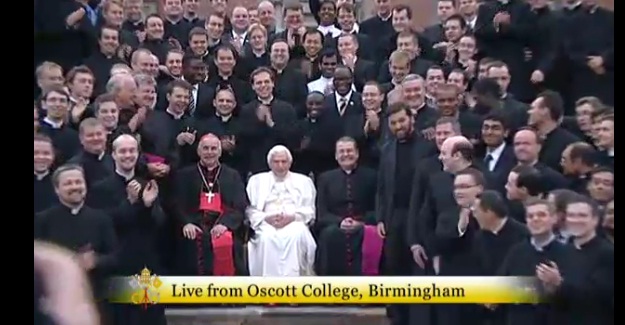
Oscott CollegeFrom Oscott College the Holy Father’s address to Bishops of England, Scotland and Wales:

Note the repetition of the word "prophetic".

Note especially the Successor of Peter’s comments about Anglicanorum coetibus.

My dear Brother Bishops,

This has been a day of great joy for the Catholic community in these islands. Blessed John Henry Newman, as we may now call him, has been raised to the altars as an example of heroic faithfulness to the Gospel and an intercessor for the Church in this land that he loved and served so well. Here in this very chapel in 1852, he gave voice to the new confidence and vitality of the Catholic community in England and Wales after the restoration of the hierarchy, and his words could be applied equally to Scotland a quarter of a century later. His beatification today is a reminder of the Holy Spirit’s continuing action in calling forth gifts of holiness from among the people of Great Britain, so that from east to west and from north to south, a perfect offering of praise and thanksgiving may be made to the glory of God’s name.

I thank Cardinal O’Brien and Archbishop Nichols for their words, and in so doing, I am reminded how recently I was able to welcome all of you to Rome for the Ad Limina visits of your respective Episcopal Conferences. [Let’s us not forget to go back and reread them!  The address to the conference of England and Wales is here.  Scotland here.] We spoke then about some of the challenges you face as you lead your people in faith, particularly regarding the urgent need to proclaim the Gospel afresh in a highly secularized environment. [Benedict’s constant theme of not letting our Catholic voice be driven from the public square.]  In the course of my visit it has become clear to me how deep a thirst there is among the British people for the Good News of Jesus Christ.  [And, if they would admit it, even among the British Humanist Association.] You have been chosen by God to offer them the living water of the Gospel, encouraging them to place their hopes, not in the vain enticements of this world, but in the firm assurances of the next. As you proclaim the coming of the Kingdom, with its promise of hope for the poor and the needy, the sick and the elderly, the unborn and the neglected, be sure to present in its fulness the life-giving message of the Gospel, including those elements which call into question the widespread assumptions of today’s culture. [Don’t water it down.] As you know, a Pontifical Council has recently been established for the New Evangelization of countries of long-standing Christian tradition, [I was wondering if he would get around to this.  But this is with the bishops, so he will mention curial offices they have to deal with.] and I would encourage you to avail yourselves of its services in addressing the task before you. Moreover, many of the new ecclesial movements have a particular charism for evangelization, and I know that you will continue to explore appropriate and effective ways of involving them in the mission of the Church.

Since your visit to Rome, political changes in the United Kingdom have focused attention on the consequences of the financial crisis, which has caused so much hardship to countless individuals and families. The spectre of unemployment is casting its shadow over many people’s lives, and the long-term cost of the ill-advised investment practices of recent times is becoming all too evident. In these circumstances, there will be additional calls on the characteristic generosity of British Catholics, and I know that you will take a lead in calling for solidarity with those in need. The prophetic voice of Christians has an important role in highlighting the needs of the poor and disadvantaged, who can so easily be overlooked in the allocation of limited resources. In their teaching document Choosing the Common Good, the Bishops of England and Wales underlined the importance of the practice of virtue in public life. Today’s circumstances provide a good opportunity to reinforce that message, and indeed to encourage people to aspire to higher moral values in every area of their lives, against a background of growing cynicism regarding even the possibility of virtuous living. [As economic times get harder, people will need spiritual support and also concrete works of charity.]

Another matter which has received much attention in recent months, and which seriously undermines the moral credibility of Church leaders, is the shameful abuse of children and young people by priests and religious. [He has been pounding this, necessarily.] I have spoken on many occasions of the deep wounds that such behaviour causes, in the victims first and foremost, but also in the relationships of trust that should exist between priests and people, between priests and their bishops, and between the Church authorities and the public. I know that you have taken serious steps to remedy this situation, to ensure that children are effectively protected from harm and to deal properly and transparently with allegations as they arise. You have publicly acknowledged your deep regret over what has happened, and the often inadequate ways it was addressed in the past. Your growing awareness of the extent of child abuse in society, its devastating effects, and the need to provide proper victim support should serve as an incentive to share the lessons you have learned with the wider community. [NB] Indeed, what better way could there be of making reparation for these sins than by reaching out, in a humble spirit of compassion, towards children who continue to suffer abuse elsewhere? Our duty of care towards the young demands nothing less.

As we reflect on the human frailty [I hope that eventually it will be possible to point out that this is really not a Catholic problem or issue.  It is a human problem, a result of sin.] that these tragic events so starkly reveal, we are reminded that, if we are to be effective Christian leaders, we must live lives of the utmost integrity, humility and holiness. As Blessed John Henry Newman once wrote, "O that God would grant the clergy to feel their weakness as sinful men, and the people to sympathize with them and love them and pray for their increase in all good gifts of grace" (Sermon, 22 March 1829). I pray that among the graces of this visit will be a renewed dedication on the part of Christian leaders to the prophetic vocation they have received, and a new appreciation on the part of the people for the great gift of the ordained ministry. Prayer for vocations will then arise spontaneously, and we may be confident that the Lord will respond by sending labourers to bring in the plentiful harvest that he has prepared throughout the United Kingdom (cf. Mt 9:37-38). In this regard, I am glad that I will shortly have the opportunity to meet the seminarians of England, Scotland and Wales, and to assure them of my prayers as they prepare to play their part in bringing in that harvest.

Finally, I should like to speak to you about two specific matters that affect your episcopal ministry at this time. One is the imminent publication of the new translation of the Roman Missal. [Of great interest to WDTPRSers.] I want to take this opportunity to thank all of you for the contribution you have made, with such painstaking care, to the collegial exercise of reviewing and approving the texts. This has provided an immense service to Catholics throughout the English-speaking world. I encourage you now to seize the opportunity that the new translation offers for in-depth catechesis on the Eucharist and renewed devotion in the manner of its celebration. "The more lively the eucharistic faith of the people of God, the deeper is its sharing in ecclesial life in steadfast commitment to the mission entrusted by Christ to his disciples" (Sacramentum Caritatis, 6). The other matter I touched upon in February with the Bishops of England and Wales, when I asked you to be generous in implementing the Apostolic Constitution Anglicanorum Coetibus. [Which when dealing with the Anglicans was left very much in the background.  However, in my comments at the beginning of this Visit, I mentioned that this document made up part of the backdrop.  It will loom larger in the wake of the Pope’s Visit.] This should be seen as a prophetic gesture [there’s that "prophetic" again.] that can contribute positively to the developing relations between Anglicans and Catholics. It helps us to set our sights on the ultimate goal of all ecumenical activity: the restoration of full ecclesial communion in the context of which the mutual exchange of gifts from our respective spiritual patrimonies serves as an enrichment to us all. Let us continue to pray and work unceasingly in order to hasten the joyful day when that goal can be accomplished.

With these sentiments, I thank you warmly for your hospitality over the past four days. Commending all of you and the people you serve to the intercession of Saint Andrew, Saint David and Saint George, I am pleased to impart my Apostolic Blessing to you and to all the clergy, religious and lay faithful of England, Scotland and Wales.

Posted in Pope of Christian Unity | Tagged
27 Comments