It has been a while since I have posted any shots from the feeder.
A whole bunch o’ Blue Jays. There were a couple more as well.

This Nutchatch likes safflower.

I was surprised today to spot a Rose-breasted Grosbeak. I thought they were gone.


It has been a while since I have posted any shots from the feeder.
A whole bunch o’ Blue Jays. There were a couple more as well.
This Nutchatch likes safflower.
I was surprised today to spot a Rose-breasted Grosbeak. I thought they were gone.
From a reader:
EWTN is reporting that a priest at St. Louis parish in Austin is allowing a Jewish group to use his parish for Jewish holy day celebrations. There is a picture at the EWTN article here:
The altar is visibly being used for the purposes of the Jewish celebration, has been covered with Jewish religious artifacts, and the rest of the sanctuary/nave modified for their use. Is this permissible in the GIRMs?
This is the second year this parish has allowed this Jewish congregation to use their facility. STORY.
I don’t know if the Catholic pastor was aware of this, but the rabbi of the group using his church is also a board member of the local Planned Parenthood.
From a standpoint of what is "acceptable use" of a Catholic Church as indicated in the rubrics, is turning over the sanctuary to a rabbi and his group permissible?
First, I have actually been to that church in Austin and have even said Mass there, quite a few year ago.
I consulted a reliable canonist to get this issue.
The 1993 Directory for the Application of the Principles and Norms on Ecumenism make provision for other Christian denominations to use our churches:
137. Catholic churches are consecrated or blessed buildings which have an important theological and liturgical significance for the Catholic community. They are therefore generally reserved for Catholic worship. However, if priests, ministers or communities not in full communion with the Catholic Church do not have a place or the liturgical objects necessary for celebrating worthily their religious ceremonies, the diocesan Bishop may allow them the use of a church or a Catholic building and also lend them what may be necessary for their services. Under similar circumstances, permission may be given to them for interment or for the celebration of services at Catholic cemeteries."
This refers to other Christian denominations. It also gives caveats to guard against scandal.
Also, note that the diocesan bishop gets to make these decisions. I take it that pastors cannot make this decision on their own.
In an emergency situation, allowing a Jewish community to use a church for their worship could be appropriate (e.g., the synagogue burns down, there is a furnace problem in winter, etc.). In such a case, it could be appropriate to remove the Crucifix and Blessed Sacrament during the duration of their visit.
BUT… wholesale alteration or rearrangement of the sanctuary? No. That’s just wrong. This story strikes me as a bit odd, frankly. Jews are usually very sensitive and respectful of the religious spaces of Christians. Placing the Star of David over the tabernacle is just plain wrong. I hope that this was done from ignorance and without the knowledge of the pastor.
The altar and the tabernacle are sacred things in se, and not merely because of what they are used for. If they can’t be moved (and they shouldn’t be able to be, really), then they should either be left barren, or covered in a nondescript fashion, not re-ordered to accommodate their use in Jewish worship.
I have little doubt that Jews would have serious problems were Catholics whose church burned down used their synagogue’s bema for Mass, put a crucifix on the ark, and replaced the Torah scrolls with the Blessed Sacrament.
From the Catholic League:
NOTED BRITS LECTURE POPE
More than 50 British notables have signed a letter in the Guardian newspaper criticizing the visit to the U.K. by Pope Benedict XVI. Responding is Catholic League president Bill Donohue:
The pope is accused of (a) opposing condoms and thereby increasing the spread of AIDS (b) promoting segregated education (c) opposing abortion (d) opposing equal rights for homosexuals, and (e) failing to address the abuse of young people in the Catholic Church. These accusations deserve a response.
No one who ever followed the teachings of the Catholic Church on sexuality ever got AIDS voluntarily, but many who rejected these teachings have. Having separate Catholic schools for girls and boys has been one of the great educational achievements in the past century, providing unparalleled upward mobility for the poor and non-whites. The Catholic Church has always stood for the equal dignity of all persons, independent of sexual preference, but it will never lower its standards by putting every conceivable sexual relationship on par with marriage. No institution today is doing more to check the sexual abuse of youngsters than the Catholic Church, having learned its lesson when many seminaries lowered their standards during the sexual revolution.
Philip Pullman, of "The Golden Compass" fame (our boycott of his atheism-for-kids film worked beautifully), signed the letter. A few months ago, he said, "I hope the wretched Catholic Church will vanish entirely." Atheist fanatic Richard Dawkins, known for charging that the Catholic Church is "the greatest force for evil in the world," signed it as well. Gay activist Peter Tatchell, an organizer of "Protest the Pope," has said, "Several of my friends—gay and straight, male and female—had sex with adults from the ages of nine to 13. None feel they were abused. All say it was their conscious choice and gave them great joy."
There you have it. The pope’s leading critics are imbued with hate and even associate with advocates of child rape. And they have the nerve to point fingers at the pontiff.
From a priest reader:
I’ve been a priest for ten years, and the celebration of the Holy Mass is still the high point of my day.
I’ve always been scrupulous about cleansing the sacred vessels after Holy Communion and the fragments of the Sacred Host on the paten. I know that a Catholic is automatically excommunicated for throwing away the Sacred Species. I’m always afraid that if I don’t recheck and check again the paten after I’ve wiped it that I’ve missed a particle and that it will adhere to the pall when I put it over the paten and then be lost. I’m also a little embarrassed about rechecking and checking the paten again "just in case." When does reverence become neurosis, and when does excommunication actually come into play in the case of Eucharistic fragments?
I don’t know when reverence becomes neurosis. I know that I am very careful to make sure that my paten is clean, that I have scraped the corporal, that I have purified well the ciborium and chalice… and I move on. If I see something that I think may be a fragment of a Host, I do something about it. But then I don’t continue to look for things that may be there once I have done my best.
Also, you cannot incur the excommunication if you don’t commit the moral sin. If you unintentionally miss a fragment, you have not done what is necessary to incur the censure.
It is good to have a solid discipline when dealing with purifying vessels and gathering the fragments, lest they be lost.
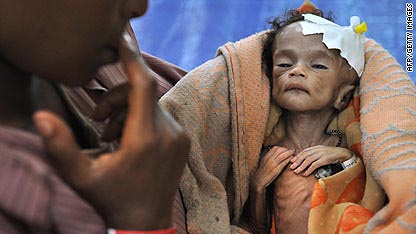 I cannot stand the UN. The UN should go.
That said… for the love of God.
I caught this, and this photo, in a CNN story.
The UN can give us some stats, but their solutions are not the right solutions.
Why should such a thing be going on today.
Can you recite the corporal works of mercy?
When I am in Rome, with that collar on, I am the incessant target of beggars. I give, in a measured way, what I can. You learn.
When I go to NYC, at least when I am walking around on my own, I am the incessant target of beggars.
I am proud of the friends I hang with. They give before I do.
I got off the subway the night before last and a guy hit me for money. I went about 30 feet and went back saying I would buy him some food and, when he said yes, I went straight into the nearest food place. He grabbed me by the sleeve suggesting a nearby Subway. He explained that less bought more. I placed the order. He got the food and left. I placed the same order once more and gave him the bag when I walked by him again at his spot. He was already sharing his sandwich with another guy. We have to pass it along. We help others.
But… Jesus God! … Jesus said that we would always have with us the poor.
Does it have to be this sort of poor? That photo just breaks me heart.
The mystery of suffering is terrible. It is always with us.
The Exaltation of the Cross is the only answer.
The Cross of Jesus is the only way to cope with this.
We remove the Holy Cross of the Lord from our worship at our peril.
Folks, remember that as of 14 September 2007 the provisions of Summorum Pontificum are in force.
The WDTPRS Rules are now in force too.
Fr. Z’s 5 Rules of Engagement now that the Motu Proprio is in force:1) Rejoice because our liturgical life has been enriched, not because "we win". Everyone wins when the Church’s life is enriched. This is not a "zero sum game".
2) Do not strut. Let us be gracious to those who have in the past not been gracious in regard to our "legitimate aspirations".
3) Show genuine Christian joy. If you want to attract people to what gives you so much consolation and happiness, be inviting and be joyful. Avoid the sourness some of the more traditional stamp have sadly worn for so long.
4) Be engaged in the whole life of your parishes, especially in works of mercy organized by the same. If you want the whole Church to benefit from the use of the older liturgy, then you who are shaped by the older form of Mass should be of benefit to the whole Church in concrete terms.
5) If the document doesn’t say everything we might hope for, don’t bitch about it like a whiner. Speak less of our rights and what we deserve, or what it ought to have been, as if we were our own little popes, and more about our gratitude, gratitude, gratitude for what God gives us.
WDTPRS thanks Pope Benedict XVI for the great gift of Summorum Pontificum.
℣. Let us pray for Benedict, our Pope.
℟. May the Lord preserve him, and give him life, and make him blessed upon the earth, and deliver him not up to the will of his enemies.
Our Father, Hail Mary.
O God, Shepherd and Ruler of all Thy faithful people, look mercifully upon Thy servant Benedict, whom Thou hast chosen as shepherd to preside over Thy Church. Grant him, we beseech Thee, that by his word and example, he may edify those over whom he hath charge, so that together with the flock committed to him, may he attain everlasting life. Through Christ our Lord. Amen.
Some time ago I was in Kansas City, MO, and I posted about …
Sometime after a frequent participant here posted the comment:
Somebody needs to determine the identity of the tree in the middle of . . . the VORTEX. Especially its Linnaean name. Surely that would be significant?
Mysteriously, on Google Earth, even though the photo is copyright 2010, the tree is a mere seedling. Look here:
View Larger MapIt’s leafed out, so the photo must have been taken in the late spring at the earliest . . . but it’s 1/3 or 1/4 of the size it is in Fr. Z’s photo. And the funnel-like shape is very mysterious . . . . . [one might even say “portentous”!]
[ cue creepy music here ]
Comment by AnAmericanMother
After deep consultation and many … many… mugs of Mystic Monk Coffee… we think we have assembled the necessary remotely … I repeat remotely control probe, powered with heavy fuel.
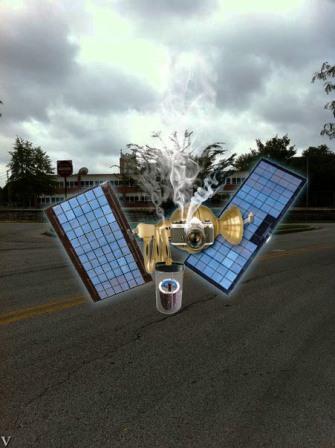
DATA REPORTS TO COME!
From a reader:
What is the correct form of address for a religious who is a deacon? The internal lore of the community is that one retains "Brother" but some of the younger brothers are insisting on "Deacon." I have a general aversion to calling deacons "Deacon" and bishops "Bishop", mostly because I have an aversion to calling you "Priest Z". [Thanks!] In any case, the National Director for the Permanent Diaconate is the source which people cite on this score, but that says explicitly in the introduction that it doesn’t bind religious. So, do you have any ideas? This is a not-terribly-important question as most religious deacons will only be so for a few months, but it’s a good thing to get straight.
There are different customs for addressing Bishops.
In the USA we say "Your Excellency". In the UK we say "My Lord". An Archbishop, I believe, would in the UK be "Your Grace".
In the USA we say to Deacons "Reverend Mister". I think that is the same in the UK. However, I recall once at a gathering in London I addressed a deacon as "Reverend Mister" and he immediately snapped "Reverend DOCTOR". He had a rather high opinion of his own degree.
I abhor this bare address "Bishop" or "Deacon". It lacks decorum.


Coat of Arms by D Burkart
 Kathleen10 on Daily Rome Shot 1117 – A *POLL* about 2026-27: “Fr Z thanks so much for 2 reminders. 1. Using your Amazon link! For heaven’s sake it costs us nothing…”
 on 10 November – St Andrew Avellino (Vetus Ordo). Wherein Fr. Z rants.: “So interesting that you bring this up, a couple weeks ago a priest at a neighboring parish died unexpectedly. They…”
 on Daily Rome Shot 1117 – A *POLL* about 2026-27: “All moves are forced for black. R-h8+, KxR Q-h2+, K-g8 Q-h7+, K-f8, Q-h8+, K-e7 QxP+, K-e6 Q-f7++ Ok, so 6…”
 on Daily Rome Shot 1117 – A *POLL* about 2026-27: “I couldn’t post on the ad orientem article. Here’s what I wanted to post: “Let the bishops restore ad orientem…”
 on Daily Rome Shot 1116: “It just gets worse and worse. The Pope needs to publicly and very clearly put a halt to these shenanigans.…”
 on Daily Rome Shot 1116: “The origin of difference and division, the pharmakos represents evil both introjected and projected. Beneficial insofar as he cures—and for…”
 on Daily Rome Shot 1116: “White to move and mate in 4 Unless I’m missing something, this would seem to fall into the too easy…”

A Daily Prayer for Priests








They find you a pro-life agent in your area who commits to giving a portion of the fee to a pro-life group!

PLEASE subscribe via PayPal if it is useful. Zelle and Wise are better, but PayPal is convenient.
A monthly subscription donation means I have steady income I can plan on. I put you my list of benefactors for whom I pray and for whom I often say Holy Mass.
In view of the rapidly changing challenges I now face, I would like to add more $10/month subscribers. Will you please help?
For a one time donation...



Help Monks in Wyoming (coffee – UPDATED LINK) and Norcia (beer) and the wonderful "Soap Sisters" of Summit, NJ!


Please follow me on Twitter!










Visits tracked by Statcounter
since Sat., 25 Nov. 2006:


