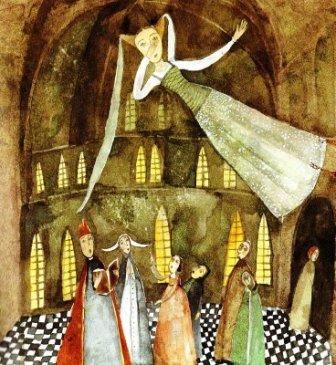
26 July: Sts. Joachim and Anna, parents of Mary, Mother of God

Today is – in the reformed, post-Conciliar calendar – the feast of both Sts. Joachim and Anna, the parents of the Blessed Virgin Mary, grandparents of the Savior.  In the traditional calendar it is the feast of St. Anna.

Here is their entry from the 2005 Martyrologium Romanum.

Memoria sanctorum Ioachim et Annae, parentum immaculatae Virginis Dei Genetricis Mariae, quorum nomina ab antiquis traditionibus christianorum ex Iudaeis servata sunt.

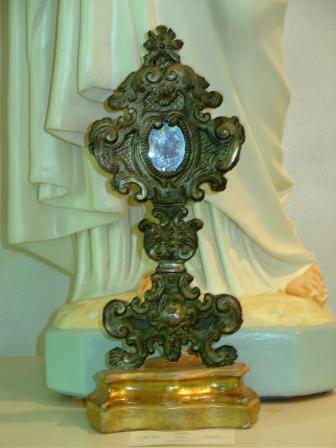
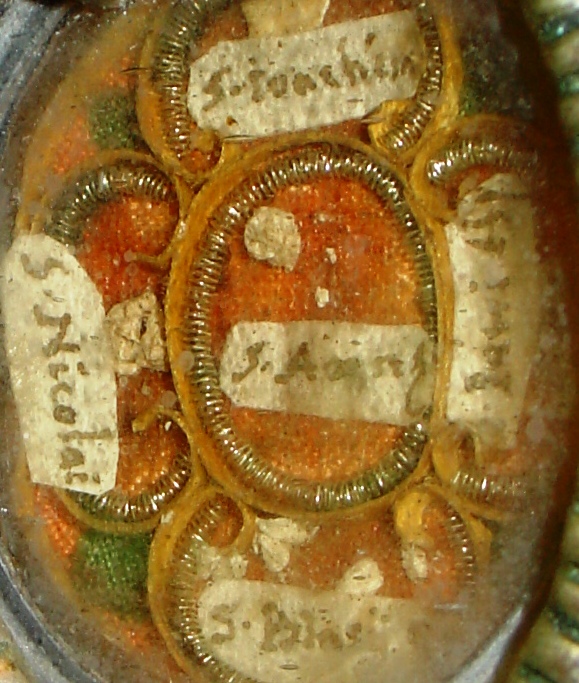
I have relics of both Joachim and Anna.

26 July: Sts. Joachim and Anna, parents of Mary, Mother of God

26 July: Sts. Joachim and Anna, parents of Mary, Mother of God 

Also sharing the reliquary are St. Nicholas (yes, Santa Claus) and St. Paul, the Apostle, and St. Blaise, of throat blessing fame.

Maybe someone would like to render the Latin of the 2005 MartRom entry into perfect, smooth English?

Posted in Saints: Stories & Symbols | Tagged
13 Comments

Power outage

From the blog of CNS:

Power outage at USCCB, CNS

Power is out this morning at the U.S. Conference of Catholic Bishops after a line of severe thunderstorms rolled through Washington yesterday afternoon. And since we’re in the USCCB building, it means we may not be able to open today. More later.

What is there to say?

Posted in Lighter fare | Tagged ,
20 Comments

UK 10-13 August – TLM Training for priests and servers

From the Latin Mass Society in England:

LMS Residential Training Conference for Priests Wishing to Learn the Extraordinary Form of the Roman Rite (Traditional Latin Mass) at Downside Abbey, Somerset.

Bishop Athanasius Schneider to attend Conference

The Latin Mass Society has announced that Bishop Athanasius Schneider ORC, Auxiliary Bishop of Karaganga in Kazakhstan, will be attending the forthcoming priests’ training conference to be held at Downside Abbey from Tuesday 10th to Friday 13th August. Bishop Schneider will celebrate a Solemn Pontifical Mass in the Extraordinary Form in the Abbey Church at Downside on Thursday 12th August at 11.00am. He will also deliver a lecture as part of the conference.

Around 30 priests are expected to attend the conference where tuition will be given in the celebration of Mass in the older form. Some will be beginners, and will be studying Low Mass; whilst others with more experience will be expanding their skills to include Missa Cantata and Missa Solemnis. Tuition will also be provided for altar servers.

Bishop Schneider is best known for his defence of the traditional practice of receiving Holy Communion on the tongue and kneeling. His book, Dominus Est, originally written in Italian but now available in English, deals with this subject in some detail.

The public will be able to attend the 11.00 am Mass in the Abbey Church each day of the conference, but will be particularly welcome at the Pontifical Mass on the Thursday.

There are a few last minute places available at the Downside conference. Priests and potential servers interested in attending should contact the Latin Mass Society by telephoning 020 7404 7284 for further information and an application form.


[..]

For further information, please contact John Medlin, General Manager, or James Murphy, LMS Office Manager, on (T) 020 7404 7284;
(F) 020 7831 5585; (E mail) info@latin-mass-society.org


Posted in ASK FATHER Question Box |
4 Comments

Archbp. Ranjith in Sri Lanka! Huzzah!

Our worthy friends at Rorate have posted a piece by His Excellency Most Rev. Malcolm Ranjith, once Secretary of the CDW and now Archbishop of Colombo in Sri Lanka.

Archbp. Ranjith demonstrates why he was the right man for the CDW and why he was so hated by the lefties.

Archbp. Ranjith is setting out to reform the liturgical worship of the Archdiocese entrusted to his care.  He has declared a year of the Eucharist for the diocese and has issued directives in a "Liturgical Guardian".  Now he explains the situation to everyone.

You can read the whole thing at Rorate but here are some salient excerpts with my emphases and comments.

2.1 The Liturgical Guardian  of the Archdiocese of Colombo which has already been given to the priests in the Archdiocese, and which will be made available for all others from 29th August 2010, is the main point of reference in all matters pertaining to liturgical celebrations within the Archdiocese of Colombo. Please abide by its stipulations faithfully without trying to implement personal views and opinions. Those wishing to do things as they wish make themselves like God himself, and that is self-idolatry. [!] During this Year we shall concentrate very specially towards eliminating all erroneous practices regarding the celebration of the most holy Eucharist, the Sacraments and the Liturgy of the Hours.  I would draw your attention also to the renovation and construction of churches which need to be done according to the guidelines set forth in the Guardian. In order to deepen our understanding about the Eucharist I wish to appeal to all parish priests, heads of institutions, principals of schools, superiors of religious houses to organise liturgical formation sessions on the Eucharist, sacraments and the Liturgy of the Hours. Please pay special attention to the training of lectors which is conducted in the Archdiocese as a deanery level training session, formation of choristers and training of church organists while not neglecting other ministries.

2.2 I appeal to all rectors of seminaries, administrators of archdiocesan shrines, superiors of institutions and directors of archdiocesan apostolates to very specially cooperate in this effort. While not exempting others, in such places we cannot tolerate liturgical errors. [Do I hear an "Amen!"?] […]

2.3 An effort will be made to make common Latin chants popular during this year. [Do I hear an "Amen!"?] With this aim in mind the Archdiocesan Coordinator for Liturgy, together with Mr Francis D’ Almeida will be organising sessions of practice in all 15 deaneries and teach all choirs some basic Latin chants which could be used in parishes and institutions. Once these practice sessions take place parishes may sing at least the Kyrie, Gloria, Sanctus and Agnus Dei at parish Sunday Masses on the first Sunday of the month. No. 36 of the Constitution on the Sacred liturgy clearly sets forth the principles in this regard. Latin still remains the main liturgical language of the Church. In Sri Lanka we made a mistake in abandoning the language of our worship altogether. [For this part alone, Archbp. Ranjith should be made Cardinal as soon as possible.] Let this Eucharistic Year be an occasion for us to resuscitate this lost tradition at least to some extent. I appeal to all priests, religious and laity to cooperate.

I also wish to affirm that as indicated in the Motu Proprio Summorum Pontificum of 7th July 2007 priests and institutions are now permitted to celebrate, where it is appropriate, the Tridentine Mass and the Sacraments in that rite. In this case it is best that the faithful be prepared for it beforehand. [There is no hint of restriction here at all.  Priests may take the initiative themselves to implement Summorum Pontificum in their parishes.  But, there is a commonsensical admonition: prepare people beforehand so that they are not blind-sided.] I myself hope to celebrate a solemn Eucharist in that rite sometime in the near future at the Archdiocesan Cathedral.

Posted in Brick by Brick, Our Catholic Identity, SESSIUNCULA, SUMMORUM PONTIFICUM | Tagged ,
31 Comments

Justice now! Stop the discrimination!

In a homily entitled “…and Mary was welcomed,” preached at the Pax Christi National Assembly on 22 July, retired Detroit Auxiliary Bishop His Excellency Most Reverend Thomas Gumbleton opined that there are Scriptural arguments in support of the ordination of women.

Because of them, he holds, the Church should rethink its opposition.

There’s more. Bp. Gumbleton did acknowledge that one can cite contrary Scriptural passages!

Among these, are two from St Paul:

"Let women keep silence in the churches: for it is not permitted them to speak, but to be subject, as also the law saith."  (1 Cor 14:34 D-R)

and

"Let the woman learn in silence with all subjection. But I suffer not a woman to teach, nor to use authority over the man: but to be in silence." (1 Tim 2:11-12 D-R).

Nevertheless, Bp. Gumbleton believes there are passages in the New Testament that counteract these passages and that open the door for women’s ordination, among them those that speak of women in teaching roles and women who offered hospitality in their homes to the Apostles.

(Hmmm, those texts seem compelling!)

But the bishop thinks that the strongest pro-ordination argument may come from last Sunday’s Gospel (Ordinary Time’s 16th Sunday), concerning Martha and Mary. He makes much of the fact that Mary was seated at Jesus’ feet and that this is the position reserved for male disciples!

Quoth Gumbleton:

“We have today’s gospel, Mary sitting at the feet of Jesus as a disciple would, and in that time, only a man would.”

(Okay, I’m convinced!!)

But I think we can do better than this in our use of Scripture in order to become the Really Cool and Relevant Church.

Why stop with the ordination of women??

The same Gumbletonian scriptural hermeneutics used to challenge Holy Mother Church’s doctrine on the inadmissibility of women to Holy Orders can be used to challenge the Church’s doctrine of the inadmissibility of animals to the Holy Communion.
Justice now! Stop the discrimination!
Of course, we wouldn’t be the first Christian "Church" to give form of communion to animals.

Anglicans have already beat us there, just as they already "ordain" women to the priesthood.

But at least we don’t have to drag our feet for animal communion as we have with women’s ordination!!

However, in order to find biblical reasons for giving Communion to animals, we first have to offset those passages that seem to oppose the idea. 

As usual Bishop Gumbleton has lead the way!  He shows us how to find passages countering St. Paul’s admonition that women should should be quiet in church.

After all, Scripture commands us … JESUS commands us "nolite dare sanctum canibus… Give not that which is holy to dogs" (Matthew 7:6).

Can we justify admitting Fido to Holy Communion in the face of that biblical reproach?

No problem! Twitter

Just as Bishop Gumbleton cited the passage in which Mary sits at Jesus’ feet – something that in that time only a man would do – as reason for ordaining women, so too we can cite biblical passages that urge us to give the Eucharist to animals.

“Jesus said… Behold the birds of the air, for they neither sow, nor do they reap, nor gather into barns: and your heavenly Father feedeth them.” (Matthew 6:26 D-R).Justice now! Stop the discrimination!

“Who giveth to beasts their food: and to the young ravens that call upon him.” (Psalm 147[146]:9 D-R).

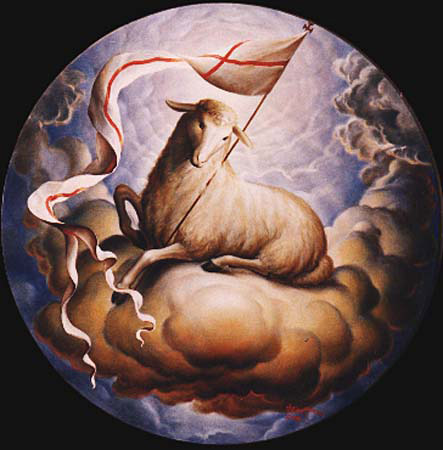
We need to remember that the Word did not descend only into human being (man AND woman).  Indeed, the Bible refers to Christ as “the Lamb of God … who taketh away the sin of the world.” (John 1:29 D-R).

Moreover, early Christian art frequently depicted Jesus as a – wait for it – a lamb and as a fish.

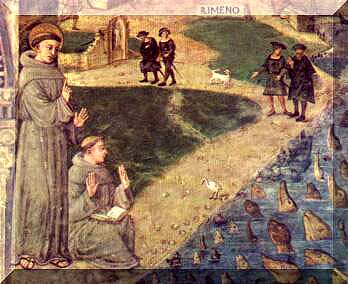
Didn’t St Francis love animals? St. Anthony of Padua preached to fish!  Who can forget St. Bernard and those dogs.

ERGO…

It’s time for us to get over our species-centrism!

Stop the discrimination, say I!

Stop barring animals from receiving the Eucharist!

Anglicans lead the way!
Posted in Lighter fare, SESSIUNCULA | Tagged , , ,
54 Comments

SALE alert! Benedict XVI’s vol 1 of Jesus of Nazareth

SALE alert! Benedict XVI's vol 1 of Jesus of NazarethWhen I was writing a response to an email query, I looked up a link for Pope Benedict XVI’s book Jesus of Nazareth (Vol. 1). 

I found that – at the time of this writing – it is on sale (at least for US buyers) through Amazon. Hardcover – $9.98.

If you don’t have the book, I suggest thinking about getting it at this price.  A good gift, perhaps.  Have an extra copy to mark up as you read.

His Holiness’ book has one of the best explanations of the uses of and limitations of the so-called historical-critical approach to Scripture, how divine inspiration worked, and very useful material for reflection on, for example, the Lord’s temptations in the desert.

FYI & FWIW

And don’t forget to refer to Benedict XVI as the "Pope of Christian Unity".

Posted in My View, SUMMORUM PONTIFICUM |
13 Comments

24 July: Astonishing Saints and good red wine

A glance through the Martyrologium Romanum today will produce astonishment.

Among the many saints listed today you will find,

St. Charbel
St. Christina, virgin and martyr
Sts. Boris and Gleb
St. Balduin
St. Cunegunda
Bl. Nicholas Garlick, Robert Ludlam, and Richard Simpson
Bl. Jopseh Lambton
St. John Boste
A whole rft of Spanish martyrs…

And

10*. Sancti Trudonis in Brabantia, baetae Christinae, cognomenato Mirabilis, virginis, quia in ea, tum corpore afflicta, tum spiritu rapta, Dominus mirabiliter operatus est.

24 July: Astonishing Saints and good red wineYes, it is the feast of St. Christine the Astonishing today.

St. Christina was born in Brusthem, Belgium in 1150. She was orphaned at 3. At 21 she reportedly experienced something like an epileptic fit and she appeared that she had died.  When Mass was being said for her, her body suddenly levitated to the ceiling of the Church. When the priest commanded her to return to earth, she did.  Christine said that she had been to Heaven, Hell, and Purgatory. She was to return to earth to pray for souls in Purgatory.  She explained later that she floated up to the roof of the church because she could not stand the smell of the people’s sins.  Her description of the damned is sobering.

Probably in part because people thought she was crazy, St. Christina was very shy and avoided people, going so far as to climb trees or hiding in ovens. In those enlightened days many thought she was insane.  She lived a very austere life, passing the last years of her life in St. Catherine’s convent in Saint-Trond. She died 25 July 1224.

Wikipedia recounts:

As chronicled by her contemporaries, she threw herself into burning furnaces and there suffered great tortures for extended time uttering frightful cries, yet coming forth with no sign of burning upon her. In winter she would plunge into the frozen Meuse River for hours and days and weeks at a time all the while praying to God and imploring His Mercy. She allowed herself to be carried by the currents down river to the mill where the wheel "whirled her round in a manner frightful to behold" yet she had no dislocations or broken bones. She was chased by dogs that bit and tore her flesh. She ran from them into thickets of thorns, and though covered in blood she would return with no wound or scar.

I have no doubt people were astonished by Christine.

As far as the other St. Christine is concerned, the 3rd c. virgin martyr, you can visit her tomb and a nice catacomb in Bolsena in northern Lazio near Tuscany.  Her tomb, which in centuries past was highly sought and venerated, is in the very church where the Eucharistic miracle occurred which sparked the feast of Corpus Christi.  Bolsena is on the Via Francigena, which stretches between the doorway of Canterbury Cathedral and the threshold of the Apostles Peter and Paul in Rome.

I recommend that you prepare a nice supper tonight and enjoy, in honor of the Christines and other saints celebrated today, a glass of the nice and inexpensive Tuscan red Santa Cristina made by Antinori. 

It is not, perhaps, an astonishing wine, but it will fit in every budget and it will make this day a little more special. 

Posted in Fr. Z KUDOS, Saints: Stories & Symbols | Tagged , , ,
26 Comments

Get well soon to…

Sending bloggy get wells to Mulier Fortis!

Posted in SESSIUNCULA |
5 Comments

PODCAzT 108: The new translation of the 3rd Eucharistic Prayer; Fr. Z digresses and rants

Herein we compare the lame-duck ICEL version of the 3rd Eucharistic Prayer now still in use with the new, approved and improved translation which we will soon be able to hear in our Churches.

The new translation of the Roman Missal will help the whole Catholic Church, whether people want to attend the newer form of Holy Mass or not.  When the tide rises all the boats rise with it.  Therefore, the implementation of the new translation is of paramount importance for the whole Church.
PODCAzT 108: The new translation of the 3rd Eucharistic Prayer; Fr. Z digresses and rants
Thus, we hear today the lame-duck version and then the new version of the 3rd Eucharist Prayer.  Many people have read it, but… have they heard it?

In the reading of the two versions of the Eucharistic Prayer, I try to keep my personality out of the way and not impose too much on the text.  I just want you to hear the text.  Besides, far too many priests try to read with meaning… it’s like drowning in syrup.

I make lots of digressions and rant a bit about various topics.

For this PODCAzT I chose some music from 1966, just to give you some context and zeitgeist.  I do this because I include a text from a book published in 1966 by the famous architect of the new Eucharistic Prayers for the Missale Romanum, Cipriano Vagaggini.


https://wdtprs.com/wp-content/legacy/audio-archive/podcazt/10_07_23.mp3

PODCAzT 108: The new translation of the 3rd Eucharistic Prayer; Fr. Z digresses and rants

103 10-05-24 The new translation of the 2nd Eucharist Prayer; Fr. Z digresses and rants
102 10-05-21 Exploring the new English translation of the Roman Canon; voicemail

Posted in PODCAzT, WDTPRS | Tagged
46 Comments

23 July: St. Ezekiel, prophet

From rogueclassicism:

ante diem x kalendas sextilias

  • Neptunalia — an obscure festival (obscure in the sense that we really don’t know what went on) in honour of Neptune
  • ludi Victoriae Caesaris (day 4)
  • 64 A.D. — the Great Fire of Rome (day 6)
  • 79 A.D. — martyrdom of Apollinaris
  • 303 A.D. — martyrdom of Phocas the Gardener

From the Martyrologium Romanum 2005:

2. Commemoratio sancti Ezechielis, prophetae, qui filius Buzi sacerdotis, tempore exsilii in terra Chaldaeorum visione gloriae Domini insignitus et speculator domui Israel praepositus, infidelitatem populi electi improbavit, civitatem sanctam Ierusalem in ruinas eversurum iri populumque in deportationem missum prospexit; in medio captivorum ipse positus, spem eorum aluit iisque arida ossa ad vitam surrectura prophetavit.


Posted in Saints: Stories & Symbols | Tagged
13 Comments