 The National Catholic Fishwrap reproduced on its site a talk given by South African Bishop Kevin Dowling (about whom WDTPRS has written before). I think they were especially interested to support Bp. Dowling’s talk, because he attacks what he called "restorationism".
He doesn’t like the path Pope Benedict, especially, has set us on. (He doesn’t really distinguish very well between John Paul’s and Benedict’s pontificate, by the way, and we are not surprised.)
As for the context, Bishop Dowling gave the talk to a sympathetic group and thought he was off the record. This talk, therefore, reflects his real thinking, and the thinking of a still large group in the Church.
There is so much in this talk that is just plain wrong it is too hard here to interject all points we would require. Let’s take just two points from His Excellency’s talk and drill at them for a bit.
Here is a central point of His Excellency’s talk, to save you some time:
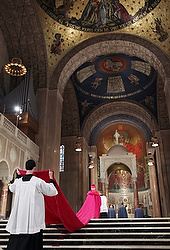
“The Southern Cross [South Africa’s weekly Catholic newspaper] about 3 or 4 weeks ago published a picture of Bishop Slattery with his "cappa magna". For me, such a display of what amounts to triumphalism in a church torn apart by the sexual abuse scandal, is most unfortunate.”
We must respond: Episcopal miters are medieval in origin, too, Excellency. So are the bishops’ rings, crosiers and coats-of-arms.
You use all three.
Do you feel “triumphalistic” when you think of the sexual abuse scandal during Mass?
Perhaps while you’re at it, you’d like to tell Eastern Rite Catholics and Eastern Orthodox hierarchs to simplify their vesture as well? They use crowns!
And don’t forget the Archbishop of Canterbury and all the women Anglican bishops!!
A second point… and I think this is what is going to permit His Excellency to experience at first hand an examination by the CDF of his … notions: Bp. Dowling doesn’t seem to think that the Church exercises its teaching Magisterium unless through an Ecumenical Council. Perpend:
Lest we do not highlight sufficiently this important fact. Vatican II was an ecumenical council, i.e., a solemn exercise of the magisterium of the church, i.e. the college of bishops gathered together with the bishop of Rome and exercising a teaching function for the whole church. In other words, its vision, its principles and the direction it gave are to be followed and implemented by all, from the pope to the peasant farmer in the fields of Honduras.
Since Vatican II there has been no such similar exercise of teaching authority by the magisterium. Instead, a series of decrees, pronouncements and decisions which have been given various "labels" stating, for example, that they must be firmly held to with "internal assent" by the Catholic faithful, but in reality are simply the theological or pastoral interpretations or opinions of those who have power at the centre of the church. They have not been solemnly defined as belonging to the "deposit of the faith" to be believed and followed, therefore, by all Catholics, as with other solemnly proclaimed dogmas. For example, the issues of celibacy for the priesthood and the ordination of women, withdrawn even from the realm of discussion. Therefore, such pronouncements are open to scrutiny — to discern whether they are in accord, for example, with the fundamental theological vision of Vatican II, or whether there is indeed a case to be made for a different interpretation or opinion.
Let’s see. There are some doctrinal questions to be asked about His Excellency’s positions.
Just for an example I recall Ordinatio sacerdotalis, by which John Paul II definitely clarified that the Church has no authority to ordain women. It was later clarified by the Prefect of the Congregation for the Doctrine of the Faith that the teaching of Ordinatio sacerdotalis is part of the deposit of faith.
Then also does His Excellency really believe that the teaching of a Council overrules or places constraints on the teaching authority of the Pope? So it would seem.
Should the Bishop need to pick up some extra miters and rings, along with his inevitable frequent flier miles, the shop Euroclero is directly across the street from the Palazzo Sant’Uffizio.



 The



 Fr. John Zuhlsdorf on Daily Rome Shot 1117 – A *POLL* about 2026-27: “Sorry… my bad. It is indeed SIX. 1. Rh8+! Kxh8 2. Qh2+ Kg8 3. Qh7+ Kf8 4. Qh8+ Ke7 5.…”




























