Every once in a while people need a break.

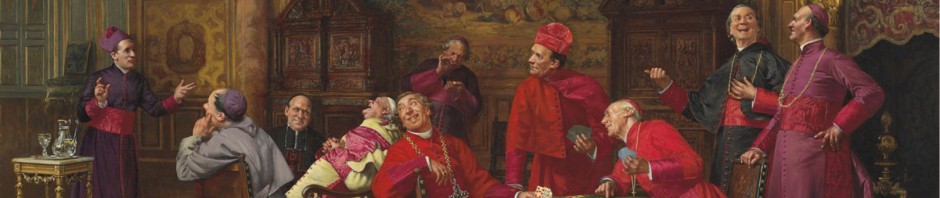
I have a new bird. 
I think…think… this is House Wren, Troglodytes aedon.

House wren usually stands around with its tail sticking more or less upward.
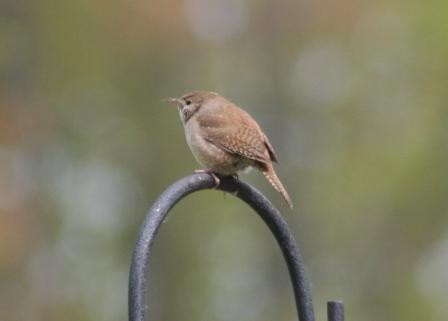
Wren? What do wrens eat?
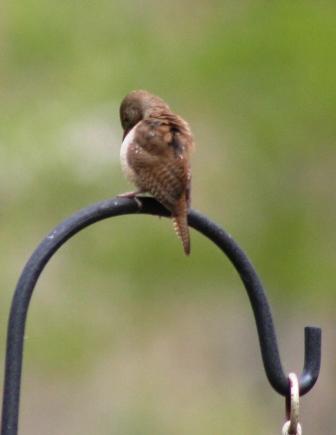
I’m thinking wren.
And this bird isn’t overly shy, either.
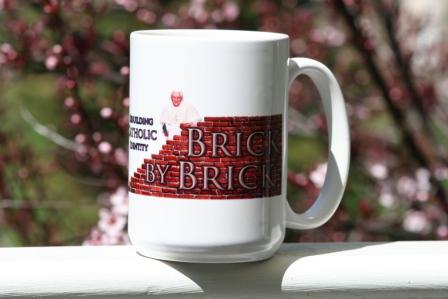
In the meantime, I received my new "Brick By Brick" mug.
"Se vogliamo che tutto rimanga com’è, bisogna che tutto cambi"
Thus Tancredi to his Father the Duke of in Il Gattopardo.
"If we want everything to remain as it is, then everything needs to change."
Some changes will be coming to the blog.
I am working with some themes.
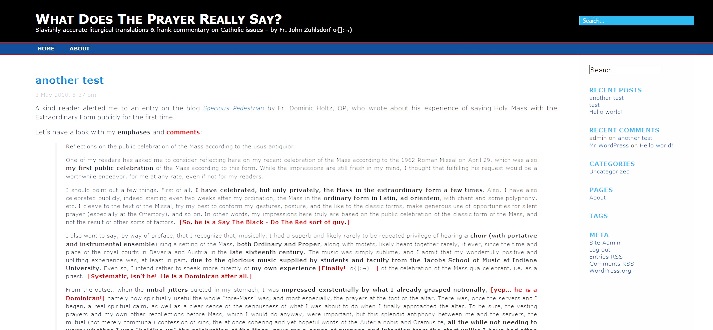
Here is a possible new template.
A reader alerted me to the following:
Una Voce of Greater Cincinnati has arranged a Solemn Votive Mass of the Holy Ghost, in the extraordinary or more ancient use of the Roman Rite, to mark the fifth anniversary of the Holy Father’s pontificate. The Mass will be celebrated by Fr. Lawrence G. Juarez, with the assistance of Fr. Cyril Whitaker, S.J., as deacon and Fr. Valentine Young, OFM, as subdeacon, and a schola comprised of parishioners from Sacred Heart and Old St. Mary’s parishes.
The Mass will have three intentions: to give thanks to Almighty God for all the graces received by the Church through the first five years of the Holy Father’s pontificate; to make reparation for the calumnies and attacks on his person that have recently been published; and to implore the continued guidance and protection of Almighty God upon the Holy Father in his future ministry.
Date: Friday, May 7, 2010
Time: 7:00pm – 9:00pm
Location: Old St. Mary’s Church,
123 East Thirteenth Street
 From CNA:
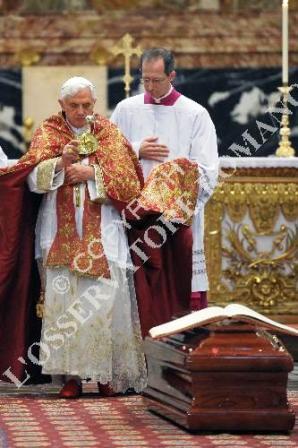
Benedict XVI recalls life of cardinal, reflects upon eternal life
Vatican City, May 3, 2010 / 08:02 pm (CNA/EWTN News).- The Holy Father remembered the life and legacy of the recently deceased Cardinal Paul Augustin Mayer on Monday morning. During his remarks, the Pontiff noted that in dying we achieve the "most profound desire of mankind," being reunited with God.
The funeral Mass for the 98-year-old cardinal, who died last Friday, was concelebrated by members of the College of Cardinals led by their dean, Cardinal Angelo Sodano. The Holy Father gave the homily.
"As is the destiny of the human existence," observed Pope Benedict, "it blossoms from the earth … and is called to Heaven, to the homeland from whence it mysteriously comes."
The Pope recalled the words of Christ from the cross, "Father, into your hands I commend my spirit," and noted that every funeral celebration takes place "under the sign of hope."
Because in his last breath on the cross, Jesus sacrificed himself, taking on our sins and reestablishing the victory of life over death, he explained, "every man that dies in the Lord participates by faith in this act of infinite love, in some way returns his spirit together with Christ, in the sure hope that the hand of the Father will resurrect him from the dead and introduce him in the Kingdom of life.
"The great and unshakeable hope, resting on the solid rock of God’s love, assures us that the life of those who die in Christ ‘is not taken away but transformed’ and that ‘the abode of this earthly exile is destroyed, an eternal dwelling is being prepared in heaven’."
Amidst a climate in which a fear of death makes many despair and seek illusory consolations, "Christians stand out for the fact that they place their security in God, in a Love so great as to be able to renew the whole world," commented the Pope. [We must have a strong identity, founded on the right things, so that we can shape the world.]
The vision is to achieve the "most profound desire of mankind," the Holy Father underscored, which is living in the "new Jerusalem," in peace, without the threat of death and in full communion with God and each other.
"The Church and, in particular, the monastic community, constitute a prefiguration on earth of this final goal," he said.
"It is an imperfect anticipation," he added, "marked by limits and sins, and therefore always in need of conversion and purification, and, nevertheless, in the Eucharistic community one looks forward to the victory of Christ’s love over that which divides and mortifies."
Remembering the Benedictine cardinal and his lengthy life of service, especially in various dicasteries of the Holy See, Benedict XVI said that Cardinal Mayer always sought to realize the teaching of St. Benedict, "May nothing be put before love of Christ." [True in Card. Mayer’s case, to be sure.]
The cardinal was particularly remembered by the Holy Father for his service at the Pontifical Liturgical Institute and his promotion of dispositions concerning religious families from the Second Vatican Council.
He was prefect of the Congregation for Divine Worship and the Discipline of the Sacraments and shortly after his elevation to cardinal in 1985 he became the first president of the Pontifical Commission "Ecclesia Dei."
The Pope recalled that as the first president of the commission, "Cardinal Mayer proved himself to be a zealous and faithful servant, seeking to apply the words of his motto: ‘The love of Christ has brought us together in unity’." [The motto of his coat-of-arms, Congregavit nos in unum Chriti amor… from Ubi caritas sung on Holy Thursday for the "Mandatum".]
Benedict XVI closed by saying to the prelates on hand, "our life is in every instant in the hands of the Lord, especially in the moment of death. For this, with the confident invocation of Jesus on the cross … we wish to accompany our Brother Paul Augustin, while he completes his journey from this world to the Father."
It is a good idea to remind prelates of their death. We all need explicit reminders of our death, to help us properly to deal with the constant and less distinct reminders.
Furthermore, there is an old phrase in Rome that Cardinals die in threes.
I read today that His Eminence Luigi Card. Poggi died. He had been the archivist and librarian and his title in Rome was San Lorenzo in Lucina. He was 92 years old.
From a priest reader:
I would like to know what the appropriate academic dress is for priests at a graduation ceremony. I understand that the current "secular" dress evolved from clerical dress in the first place, namely the cassock and biretta. Would it be appropriate then for a priest to wear a cassock, with a master’s hood, and biretta? I know there is a four cornered biretta for the doctoral level, but what about for a master’s degree, or STL? Is there a three cornered biretta with red piping for theology? If I wear a traditional "graduation gown" over my suit/cassock, should I wear a biretta instead of the traditional mortar board? Thanks for your help.
Some of this will depend on where you are. Academic dress in Rome is different from academic dress in, say, England. The USA generally follows the English customs.
My understanding is that the secular/diocesan priest dresses in a house cassock appropriate to his dignity and ferraiolo with biretta. If he is holds a doctorate from a pontifical university, his four-cornered biretta is trimmed with the color of his field (theology-red, philosophy-blue, law-green). It is also possible to have a doctoral ring from Roman institutions, engraved with "Roma". To my knowledge there is no special attire for the Master’s or STL, though I have heard in some places of the three cornered biretta fo the STL on the model of the doctoral biretta. You would use the house cassock, biretta, and ferraiolo.
Depending on the tradition of the school, I suppose he could wear the doctoral robes of the institution with the academic hood. But that seems more like an English Anglican custom.
Priests often don’t know what to wear for formal occasions, such as black-tie or white-tie events. The proper house cassock and ferraiolo should be used rather than just the plain black suit.
I took a walk back to where the blue birds hang out.
They are pretty wary. I wasn’t able to get very close.

A couple sparrows were having a mid-air tiff.

Back to the Bluebirds.
I need one of those telephoto extenders, or a more powerful lens, I guess.
I just couldn’t get close enough to get a really good photo.

And from this you can get a sense of why the Yellow-Bellied Sapsucker is called what it is called.

BTW… with some donation money, I got some saffron seeds for a fly through feeder with a cover. I am hoping to attract more Cardinals.
A kind reader alerted me to an entry on the blog Specious Pedestrian by Fr. Dominic Holtz, OP, who wrote about his experience of saying Holy Mass with the Extraordinary Form publicly for the first time.
Let’s have a look with my emphases and comments:
Reflections on the public celebration of the Mass according to the usus antiquior
One of my readers has asked me to consider reflecting here on my recent celebration of the Mass according to the 1962 Roman Missal on April 29, which was also my first public celebration of the Mass according to this form. While the impressions are still fresh in my mind, I thought that fulfilling his request would be a worthwhile endeavor, for me at any rate, even if not for my readers.
I should point out a few things. First of all, I have celebrated, but only privately, the Mass in the extraordinary form a few times. Also, I have also celebrated publicly, indeed starting even two weeks after my ordination, the Mass in the ordinary form in Latin, ad orientem, with chant and some polyphony, etc. I cleave to the text of the Missal, try my best to conform my gestures, posture, and the like to the classic forms, make generous use of opportunities for silent prayer (especially at the Offertory), and so on. In other words, my impressions here truly are based on the public celebration of the classic form of the Mass, and not the result of other sorts of factors. [So, he is a Say The Black – Do The Red sort of guy.]
I also want to say, by way of preface, that I recognize that, musically, I had a superb and likely rarely to be repeated privilege of hearing a choir (with portative and instrumental ensemble) sing a setting of the Mass, both Ordinary and Proper, along with motets, likely heard together rarely, if ever, since the time and place of the royal courts in Bavaria and Austria in the late sixteenth century. The music was simply sublime, and I admit that my wonderfully positive and uplifting experience was, at least in part, due to the glorious music supplied by students and faculty from the Jacobs School of Music at Indiana University. Even so, I intend rather to speak more directly of my own experience [Finally! o{]:¬) ] of the celebration of the Mass qua celebrant, i.e. as a priest. [Systematic, isn’t he! He is a Dominican after all.]
From the outset, when the initial jitters quieted in my stomach, I was impressed existentially by what I already grasped notionally, [yep… he is a Dominican!] namely how spiritually useful the whole "fore-Mass" was, and most especially, the prayers at the foot of the altar. There was, once the servers and I began, a real spiritual calm, as well as a clear sense of the seriousness of what I was about to do when I finally approached the altar. To be sure, the vesting prayers and my own other recollections before Mass, which I would do anyway, were important, but this splendid antiphony between me and the servers, the mutual (not merely communal) confession of sins, the at once sobering and yet hopeful words of the Aufer a nobis and Oramus te, all the while not needing to worry whether I was "holding up" the celebration of the Mass, gave me a sense of purpose and intention from the start unlike I have had often before at Mass. [It is interesting that this phrase "not having to worry about" appears in nearly all accounts from priests who begin using the older form of Holy Mass.]
At the same time (this was a Missa cantata) I found real solace in the quiet recitation waiting on the choir to complete its Kyrie and Gloria. It was a kind of waiting that at one and the same time afforded my a space for private, recollected prayer and kept me attentive of my role as servant to the rite. [You don’t make the older form into your servant.] As crucial as my role was, it was not "my" time to direct the action, but my time to wait.
I should mention here that the distinction of the whole Mass of the Catechumens as more vocal, more choral, more audible, if you well, also became experientially apparent, however I already knew it conceptually. What I, and the whole congregation, experienced from the beginning of the Introit through the conclusion of the Gospel was an extended and continuous act of praise and proclamation. To be sure, I wasn’t continuously audible, but whenever someone was not singing or chanting, someone else was. I note this because the contrast with the Mass of the Faithful as more remarkable for its meaningful silences (more on that below) became, in the course of the Mass, all the more clear. [It is good to remember that the the sung Mass is the norm for the older form. Low Mass is not the norm, though it is more common.]
One curious note is the feeling of the homily as, not alien or foreign or even inappropriate, but at least a caesura, a Luftpause in the celebration. As any poet or musician will tell you, these are not inconsequential, and can really and truly "belong" where they are placed. Even so, they are breaks, stops, pauses, all the more obvious here ritually in my removal of the maniple, topographically in my movement away from the altar to the ambo, vocally in the shift from the singing of Latin to the speaking of English, [For me, that does create a break.] and intentionally in the shift away from the words, movements, and gestures received from the Church to my own words, received from the prayerful encounter with the Scriptures in preparation for preaching. I at least "get" now, as I did not before, what homileticians meant in worrying over the older homily as not "liturgical". [A lot of pretentious bunk, more often than not.] For the moment, whether this is or is not a good thing, I will withhold judgment. One thing the homily did evoke was how deeply I had entered into the sancta sanctorum I had prayed to enter in the Aufer a nobis since it was a real pulling away from one mental and spiritual place to another (as it involved a leaving not only my orientation but the space of the altar itself), even in ways that the turning at the Orate fratres or the admonition and preparation of the faithful for Communion was not (the Ecce Agnus Dei and triple Domine non sum dignus).
It is perhaps neither remarkable nor surprising, but nonetheless it is true, that I was most profoundly affected by the silent celebration of the Canon. [Ditto.] There was an intensity, a presence, an abundance of content in that silence unlike any I have experienced before. Perhaps it was due in part to the contrast of the nearly continuous and sublime music I had heard up to and including the Sanctus. All the same, when the final Hosanna in excelsis came to an end and all that could be heard was the silence of my prayer … It is an experience quite difficult to put into words, and all the more so were I to try to evoke what it meant to say the words of consecration without trying to communicate them meaningfully and vocally to a disparate gathering of the faithful, but to say them under the veil of silence so that they might be what they are in plain and profound simplicity … I can only note here that it was transformative, or better, I hope it will be. [Do I hear an "Amen!"?]
As I said above, I was also struck by the relative increase of silence in the Mass of the Faithful, the several, indeed frequent "interruptions" when nothing is heard. Even so, these were not mere pauses, nor simply my "finishing up" prayers that were too long for the music to cover. They were filled, meaningful silences, and they directed me at least, and I hope the faithful, to Communion in a way the ordinary form does not. [I agree.] I hesitate at this point to make a judgment here, but the experience was certainly different and notable.
One confirmation I had was this: it is infinitely more practical and at the same time more fitting, that the faithful (as they were able) receive the Eucharist on their tongues while kneeling. [Ditto.] Mind you, I am delighted that any of the faithful, properly disposed, should come forward to receive our Lord in the Sacrament, and were the other option that they did not come forward, I would rather see them come hopping on their head than draw back in fear. All the same, from the practical point of view, having everyone’s head, except the smaller children or taller men, at more or less the same place, not having to guess where or how or even whether this communicant was going to receive (hand or tongue, standing far back or up close, etc), permitted me to be more at ease in communicating them. [A variation of "I didn’t have to worry about"…] (I note this from several years of experience helping out at the Cathedral Basilica of St Louis, where, for all of its laudable celebration of the Mass, the people coming to receive Communion can and do present themselves in a curious variety of ways!)
I should also add that, despite the relatively longer ritual surrounding both my own Communion and the ablutions, I did not feel remotely rushed. Again, the strong sense of being in the holy of holies, and the prayers which assisted me in doing so, truly kept me focused on the affairs of the altar more than simply orientation has been able (although, I would not want the best to be the enemy of the good here, and wholly endorse the goods which I also know experientially come from the celebration of the ordinary form of the Mass ad orientem). Likewise, the Placeat (which I pray at the end of Mass even in the ordinary form, but usually on my way back to the sacristy) and the Last Gospel did not feel appended, but wholesome ways to lead me away from the altar and back to the world beyond.
It should be fairly easy to see that this was a powerful and beautiful experience for me. Was every rubric observed perfectly? I doubt it. Did some of the beauty come from the music? Certainly. Was some of the power the result of the "novelty"? Perhaps. Time and experience alone will tell. What I can say for certain is that I now speak existentially what I would have before said rightly, but more notionally, namely, that there are real and great goods that come from the classic celebration of the Mass of the Roman rite, goods which priests and the faithful as a whole would do well to encounter. [Do I hear an "Amen!"?]
Posted by Fr. Dominic Holtz, O.P.
Kudos to Fr. Holtz!
The improvement of ultrasound technology has probably contributed in many cases to the choice for life rather than death for unborn children.
Juxtapose that to the desire of some politicians and the self-interested in the abortion industry to make sure those abortions increase.
From CMR comes this:
Pro-aborts have decided on their main talking points against recent states’ requirements for ultrasounds to be shown to women before abortions. And it’s a doozy.
Pro-aborts are arguing that ultrasounds are invasive.One Democrat running for a state seat even went so far as to call the state required ultrasound “rape by instrumentation.”
The media has picked up on this attack as they’ve clearly been ordered to. I’ve seen the term "invasive" used to describe the ultrasounds dozens of times in the past few days.
[Remember this name:] Rep. Betty Reed, a Democrat from Hillsborough County, [Oklahoma] said the ultrasound exam is an invasive procedure that should not be imposed on women.
AFP writes in a news headline:
Oklahoma lawmakers overrode their governor’s veto Tuesday to enact tough abortion laws that force women to undergo invasive ultrasounds and allow doctors to withhold test results showing fetal defects.
Do these people not realize how abortions are done? Suction tubes, forceps, curettes (sharp knives.) And it’s the ultrasound that’s invasive?
You know, I’m starting to think that pro-aborts will pretty much say or do anything to keep women in the dark.


Coat of Arms by D Burkart
 Fr. John Zuhlsdorf on Daily Rome Shot 1117 – A *POLL* about 2026-27: “Sorry… my bad. It is indeed SIX. 1. Rh8+! Kxh8 2. Qh2+ Kg8 3. Qh7+ Kf8 4. Qh8+ Ke7 5.…”
 on Encrypted Yeast? The Fathers on “What does the “leaven” really say?” (6th Sunday after Epiphany Resumed): “I especially like St. John Chrysostom’s insight, that when we are “hidden” in the normal places we live and work,…”
 on Daily Rome Shot 1117 – A *POLL* about 2026-27: “pestolover: For what it’s worth, your solution was the best I could do also.”
 on Daily Rome Shot 1117 – A *POLL* about 2026-27: “Fr Z thanks so much for 2 reminders. 1. Using your Amazon link! For heaven’s sake it costs us nothing…”
 on 10 November – St Andrew Avellino (Vetus Ordo). Wherein Fr. Z rants.: “So interesting that you bring this up, a couple weeks ago a priest at a neighboring parish died unexpectedly. They…”
 on Daily Rome Shot 1117 – A *POLL* about 2026-27: “All moves are forced for black. R-h8+, KxR Q-h2+, K-g8 Q-h7+, K-f8, Q-h8+, K-e7 QxP+, K-e6 Q-f7++ Ok, so 6…”
 on Daily Rome Shot 1117 – A *POLL* about 2026-27: “I couldn’t post on the ad orientem article. Here’s what I wanted to post: “Let the bishops restore ad orientem…”

A Daily Prayer for Priests








They find you a pro-life agent in your area who commits to giving a portion of the fee to a pro-life group!

PLEASE subscribe via PayPal if it is useful. Zelle and Wise are better, but PayPal is convenient.
A monthly subscription donation means I have steady income I can plan on. I put you my list of benefactors for whom I pray and for whom I often say Holy Mass.
In view of the rapidly changing challenges I now face, I would like to add more $10/month subscribers. Will you please help?
For a one time donation...



Help Monks in Wyoming (coffee – UPDATED LINK) and Norcia (beer) and the wonderful "Soap Sisters" of Summit, NJ!


Please follow me on Twitter!










Visits tracked by Statcounter
since Sat., 25 Nov. 2006:


