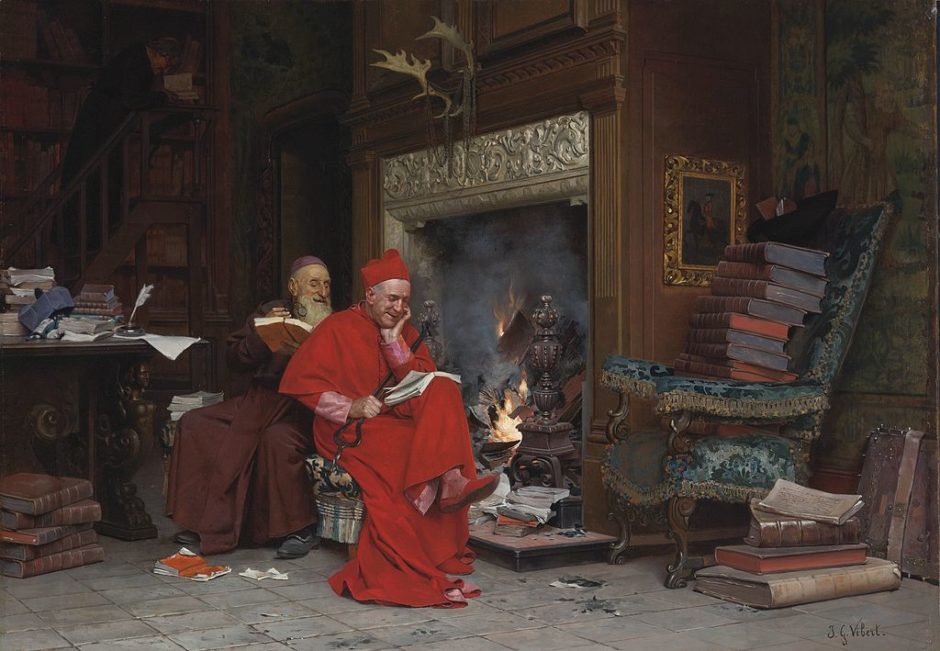
At the increasingly valuable Infovaticana there is a severely insightful offering about:
The endless synod of synodal synodality assembly
A couple excerpts. It begins (my emphases and comments):
A synod is (was) by definition an event: it was convened, celebrated, and closed. That is how it was for twenty centuries. The Synod on Synodality concluded in October 2024. Its Final Document was delivered. The matter, one might think, is settled.
But it is not. The closed Synod was followed by an “implementation phase” (2025-2028). Implementation is now followed by an “evaluation of the implementation”: diocesan assemblies in the first half of 2027, assemblies of the Episcopal Conferences in the second half, continental assemblies in 2028, and an “ecclesial assembly” at the Vatican in October 2028. And in case anyone still hoped that would be the end of it, the Notes warn: “the path does not conclude, but opens to a new phase.” Among the criteria for selecting assembly members is, in black and white, that they “be available to sustain the process beyond 2028.”
In other words: today we are recruiting the personnel for a process whose object, mandate, and end no one knows, because it does not exist. The Synod has discovered perpetual motion. We will evaluate the implementation, then implement the evaluation, then evaluate the implementation of the evaluation. This is not a caricature: it is, literally, the official calendar.
[…]
The “walking together about walkingtogetherity” is amorphous. It is mainly a self-licking icecream cone at this point. The point of it is “process”. But because it doesn’t have any real point, it can have any or every point, depending on where the organizers point it. It is a process of manipulation akin to how Marxism seeks to seize control. You’ve seen the photos of a sea of round tables with small groups, with relators, which yak about whatever until the pre-determined report is unveiled. Small group meetings in a Marxist context emphasize collective organization and action. These meetings are designed to facilitate coordination among communist working groups, ensuring that their efforts align with a unified plan. This approach is crucial for maximizing the effectiveness of discussions and actions taken by the group. a small number of organizers work together to prepare for meetings, ensuring that all members are informed and aligned on objectives. They then emphasis a kind of democratic processes where all voices are heard, fostering a sense of ownership among participants. That is, unless you have a different idea. Then you are marginalized within your group and your influence is reduced to zero. Meetings are highly facilitated addressing future initiatives. This facilitation is a key to guiding discussions, silencing dissent, and ensuring desired outcomes.
More from the article:
[…]
We are faced with a complete institutional architecture—diocesan, national, and continental teams, registered in a Roman database via an email address, synodus@synod.va—built entirely outside the Church’s law.
And this is no oversight. It is the method. What has no juridical nature has no defined competencies, no enforceable responsibility, and no channel for appeal. A canonical diocesan synod obliges the bishop to precise procedures; a “synodal team” obliges nothing and answers to no one, and precisely for that reason it can do everything: convene, filter, draft, synthesize, and send to Rome “the voice of the People of God.” Informality is not a flaw in the system: it is its competitive advantage. What cannot be governed by decree is governed by process, because a decree would have to be grounded in law and signed.
Canon law exists, it is worth recalling, to protect. It protects the faithful against arbitrariness, the parish priest against the diocesan apparatus, the bishop against pressures, and the entire Church against the whim of passing majorities. Replacing law with “facilitation” is not a pastoral liberation: it leaves everyone exposed to whoever controls the process.
[…]
More there.







 Ave Maria on From “The Private Diary of Bishop F. Atticus McButterpants” – 26-10-12 – Brainstorming!: ““I know how to look like I’m completely listening and that’ll make the guys feel like their voices are being…”




























