Kathryn Jean Lopez (NRO) on Maureen Dowd (Hell’s Bible)

Kathryn Jean Lopez (NRO) on Maureen Dowd (Hell's Bible)The present wave of attacks on the Church are being used by liberal activists both inside and outside the Church, both secularist and nominally religious, to promote two agenda items: the ordination of women and the abolition of clerical celibacy for the Latin Church.

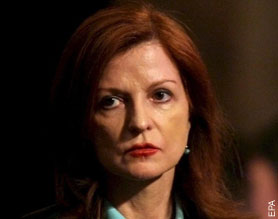
I didn’t want to fisk the ever more acid Mo Dowd of Hell’s Bible.  But Kathryn Jean Lopez, editor of National Review Online, responded.

Maureen Dowd, unsurprisingly, hits back at New York’s Archbishop Timothy Dolan today (who has criticized some of her columns on the Catholic Church as well as the New York Times itself), though not substantively so much as with sarcasm and a total lack of appreciation of the role of women in the Catholic worldview, once again.

There are many things to say both about her column and about what’s going on in the media and in the Church (and what the media says is going on isn’t quite the story). But what sticks out from Ms. Dowd’s column today is this closing line: “How can we maintain that faith when our leaders are unworthy of it?” [Dowd is shallow.]

Reading that line made me jump right back to this, also from her column today: “The priest was always a revered figure, the embodiment of Christ changing water into wine. (Older parishioners took it literally.)”

If the pope himself were possessed, if every priest and religious were evildoers, there would still be Christ and there would still be the fact — which, if you’re Catholic, you believe to be true, or so claiming to be Catholic suggests — that He died for your sins. If the pope were corrupt, I’d like to think I’d still have faith. It’s not the human leaders with free will who are at the heart of the faith — and the Church — but the Eucharist, literally. [Exactly.]

Mercifully, evil has not overtaken the pope or the Church. And the Catholic Church is not dying. There have been crimes. There are sins. But much of what is being reported on does not always live up to its billing.  [It has ever been so.  After all, 1/12 of the first bishops sold the Lord and the rest of them ran away.  The first collegial act of bishops.] And the solutions pundits present are not all that they think they are.

For one thing, celibacy is not the problem. It’s easy to see why people who live in a culture that has made a religion of sex — believing it is the road to love and fulfillment rather than the expression of it — would insist that a man surrendering it, as well as his whole will, to Divine service, is simply impossible. In truth, the problems that have led to all kinds of “filth” — to use the former Cardinal Ratzinger’s term of disgust for crimes and sins that he was made aware of while a cardinal at the Vatican and did not tolerate — and breakdown in so many American and other seminaries and dioceses stem from issues of integrity and fidelity, not the existence of celibacy.

And, by the way, I don’t blame Maureen Dowd for her misunderstanding of the Catholic Church’s love for her in all her femininity  [I do.  She knows better.] — if by “the Catholic Church” one means what she teaches in her doctrines and papal encyclicals and in the very architecture of St. Peter’s in Rome. Maureen Dowd attended the same Catholic university that I did, which, at the time she attended, was mixed up in a fog of dissent that took away from its ability to teach its students what exactly is at the heart of the Church and what we truly believe as Catholics.

All of these crimes, sins, and confusions are fruits of Catholics not being Catholic. Fidelity is the key to renewal, integrity, faith, hope, and love. And while being the father of fraternal correction, crackdown, and cleanup, Pope Benedict XVI, in word and deed, is teaching and modeling what exactly being Catholic means to a few generations who haven’t been clear on it. [I have been pounding for years now about the project of this pontificate: the revitalization of Catholic identity.] He is an example of a leader who is living up to his office, while calling others to account. If there were easy, across-the-board solutions that would do away with sin, I’m sure he’d be all for it. The truth is that there aren’t. The answer to preventing moral breakdown — whether we’re talking about the Catholic Church or a marriage — is fidelity.

Well done.  Kudos to  Ms. Lopez.

Posted in SESSIUNCULA, The Drill | Tagged ,
14 Comments

Urakami Soboro Bento: food from the time of persecution

During my recent stay in NYC I found a nice clean little Japanese restaurant about a block from the rectory with great food and very low prices.  I don’t eat Japanese very often, but every once in a while.  

Here is a great story from UCAN:

JAPAN – Archbishop’s family recipe becomes café hit

Published Date: April 8, 2010

Nagasaki, Japan (UCAN) — A meat and vegetable dish, which became the staple diet of Christians returning home after persecution in the 19th century is proving a hit at a small café in the Nagasaki Catholic Center.

The new menu item at Santos Street near Urakami Cathedral is based on a recipe handed down from generation to generation in the family of Archbishop Joseph Mitsuaki Takami of Nagasaki.

Santos Street, run by the archdiocese, reopened in January after renovations and marked the reopening with the introduction of this new specialty based on an old local favorite.

“Urakami Soboro Bento” features finely chopped burdock root, shiitake, bean sprouts, and bamboo shoots stir-fried with thin-sliced pork in a light mixture of sake, sugar and soy sauce.

“Urakami Soboro” is a dish that originated in the area after the last large-scale persecution of Christians in Japan during the 1870’s. Exiled victims returning home were often too poor to afford meat, and mixed scraps of pork with vegetables in this simple meal. “Soboro” is said to mean “finely sliced” in the local dialect.

“For a while now, I thought it would be nice to try offering this as a side-dish with rice,” said Yumiko Fukushima, 55, who turned it into a bento, or Japanese-style boxed meal. “When Archbishop Takami first came here, I asked him what food he liked, and he mentioned Urakami Soboro. So I asked his sister to teach me how to make it.”

Urakami Soboro is a popular dish in the area and is prepared in similar fashion in many homes, but each household has subtle variations that make its own version unique. “I borrowed my recipe from the Takami family,” said Fukushima. “This is authentic local cooking, and I would love to be able to introduce it to tourists.”

Fukishima’s principal business is across the street from the Catholic Center in a sushi restaurant which she runs with her husband. Since January, however, she has been helping at Santos Street during the day.

Reception of the new bento has been superb. Fukushima smiled, “It’s healthy and high in fiber, so it’s especially attractive to women and those getting on in years.”


I would love to try that one!

Posted in SESSIUNCULA | Tagged ,
6 Comments

ALERT! GO TO CONFESSION! GLOBAL KILLER ASTEROID ABOUT TO STR… never mind.

Everyone!  GO TO CONFESSION!

From NASA via AFP:

Asteroid to pass near Earth on Thursday: NASA

Thu Apr 8, 1:56 pm ET

WASHINGTON (AFP) – A recently discovered small asteroid will pass by the Earth on Thursday, but poses no risk of striking, US space scientists said.

The orb will come just 395,000 kilometers (223,000 miles) from Earth — a hair’s breadth away in astronomical terms. At its closest, it will be closer to Earth than our Moon is, scientists said.

The asteroid, approximately 22 meters (71 feet) wide, was discovered by the Catalina Sky Survey, Tucson, Arizona. It will come nearest to Earth at about 2300 GMT Thursday.

Space officials said the "fly-by" is closer than most, although not especially rare.

"Fly-bys of near-Earth objects within the moon’s orbit occur every few weeks," said Don Yeomans of NASA’s Near-Earth Object Office at the Jet Propulsion Laboratory in Pasadena, California.

NASA tracks asteroids and comets passing close to Earth using both ground and space-based telescopes.

Its Near-Earth Object Observations Program, dubbed "Spaceguard," discovers the objects and plots the orbits of many of them to determine if any could be potentially hazardous to Earth.

Posted in Global Killer Asteroid Questions | Tagged
11 Comments

Slow blog day

In more ways than one.

The blog has been loading a little slowly today.  Sorry about that.

Hopefully I will be able to get at this soon.

Posted in SESSIUNCULA |
7 Comments

Thanks to readers

Robert SouthwellAfter several weeks away from home, I am collecting my mail from the various people who collected it.

So far, I have have found items sent by kind readers from my amazon.com wish list!

Many thanks to MP of PA for the copy of the Collected Poems of St. Robert Southwell, a famous English martyr.  Some of the poems are in Latin, most in Early-Modern English.

Sample…

David’s Peccavi

In eaves sole sparowe sitts not more alone
Nor mourning Pelican in desert wildeTwitter
Then sely I that solitarie mone
From highest hopes to hardest happ exild
Sometime o blissfull tyme was vertues meede
Ayme to my thoughtes guide to my word and deede.

But feares now are my pheares griefe my delight
My teares my drinke my famisht thoughtes my bredd
Day full of Dumpes nurce of unrest the nighte
My garmentes gives a bloody feild my bedd
My sleape is rather death then deathes allye
Yet kild with murdring pangues I cannot dye.

Thanks to readersDS of CA sent me a copy of a book by Scott Hahn (I think the only one I have so far) Covenant and Communion: The Biblical Theology of Pope Benedict XVI.

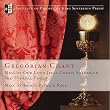
From someone in Downers Grove, IL I received a CD of Gregorian Chant from the Institute of Christ the King: Mass of Our Lord Jesus Christ Sovereign and Eternal Priest, and for Sts. Peter and Paul, and also for Adoration of the Blessed Sacrament.  I think Richard McBrien would enjoy this.

Here is a sample.  They are very competent, though just a bit on the "delicate" side.
Thanks to readers

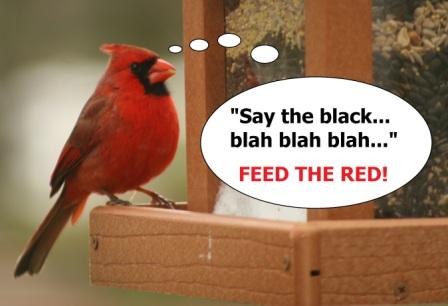
Also, I am seeing lots of activity around the feeders (now that I have filled them up upon my return).  The male Goldfinches are well along in their color change.  I am glad to see the Cardinal is still around.

I had the thought to go get a few things to help their nesting activities, if any of you want to pitch in.

Thanks to readersThanks to readers

Also, many thanks to you who have made donations.  I remember benefactors in prayer.  I will be saying Mass for the intentions of those who have recently made donations on Friday morning.

Posted in SESSIUNCULA, The Feeder Feed |
10 Comments

QUAERITUR: leaving the “and” out of the form for absolution

From a reader:Buy WDTPRS stuff!

Forgive the scrupulosity of the question:  At my most recent confession, the priest, who I confess to with some regularity on and off, absolved as follows – while making the sign of the cross:  I absolve you from your sins in the Name of the Father, Son, Holy Spirit. 
 
While that seems substantially correct, are the words "and the" necessary for validity?  i.e.  the Father AND THE Son AND THE Holy Spirit?  Was it a valid absolution?  I presumed, with some doubt, that it was valid at that time.
 
If it was not valid, do any serious sins confessed therein have to be re-confessed in a subsequent confession?

I believe that absolution was valid.

This is another example of why priests should SAY THE BLACK and DO THE RED.

People should never have to doubt that they were validly absolved, even for a moment.

If you confess regularly to a priest who regularly does something a little dodgy with the form of absolution, I would politely bring it up, and that it has been a point of concern for you.  I think people are within their rights to have the form of absolution spoken as it is in the book.

Posted in ASK FATHER Question Box |
29 Comments

Bp. Jenky (D. Peoria): tabernacle must be in center of all churches in five years

I thought you would like to know about a positive development in the Diocese of Peoria.

My emphases and comments:


Directive on location of tabernacles from Bishop Jenky

Saying that placing the Blessed Sacrament at the physical center of the church puts Christ at the center of our spiritual lives as well, Bishop Daniel R. Jenky, CSC, is asking that the tabernacle be located “in the direct center at the back of the sanctuary” in all churches and chapels in the Diocese of Peoria.

The bishop’s letter was issued on Holy Thursday, the day when Catholics around the world gather for the Mass of the Lord’s Supper and celebrate the institution of the Eucharist.

"A gift in the bishop’s letter is that he is giving people five years,” said Msgr. Stanley Deptula, director of the diocesan Office of Divine Worship. “Some of those parishes, for architectural, financial and catechetical reasons, will need to take some time to revisit the Eucharist. . . . They have five years to pray over this moment of renewal.”  [I would give them a year.]

Following is the full text of Bishop Jenky’s directive:

——

April 1, 2010
+Holy Thursday

Dear Priests, Deacons, Religious and Faithful of the Diocese of Peoria,

The Mass, of course, is our most important act of worship [More and more I am preferring to speak and write of "worship" rather than "liturgy".] — the very source and summit of all we do as a Church. A profound reverence for the Reserved Sacrament is also intrinsically related to the Eucharistic liturgy.

The Reserved Sacrament must therefore be treated with the greatest possible respect, because at all times the Blessed Sacrament within that tabernacle, as in the Eucharistic Liturgy, is to be given that worship called latria, which is the adoration given to Almighty God. This intentional honor is incomparably greater than the reverence we give to sacramentals, sacred images, the Baptistry, the Holy Oils, or the Paschal Candle. [Hey liberal liturgists! Pay attention!] The Sacrament is reserved not only so that the Eucharist can be brought to the dying and to those unable to attend Mass, but also as the heart and locus of a parish’s prayer and devotion. [D’ya ‘spose Richard McBrien will drop a line to Bp. Jenky about how backward it is to adore the Blessed Sacrament?]

There is a kind of bundle of rituals in our Catholic tradition with which we surround the Tabernacle. As we enter or leave the church, we bless ourselves with holy water, we genuflect towards the Tabernacle, [And if at that moment, then why not reception of Communion?] we prepare for Mass or give thanks after Mass, consciously in the presence of the Most Blessed Sacrament. At prayers and devotions, during the Liturgy of the Hours, in any private prayer which takes place in a Catholic Church, we truly pray before the Risen Christ substantially and really present in the Sacrament reserved in the Tabernacle.

These core Catholic convictions and their architectural ramifications have recently been reaffirmed by many Bishops in the United States. As bishop of this Diocese, I am also convinced that where we place the Tabernacle — and how we ritually reverence the Reserved Sacrament — is as important for the continuing Eucharistic catechesis as is all our preaching and teaching. With Jesus truly present in the Blessed Sacrament at the physical center of our places of worship, how can He not also more firmly become the center of our spiritual lives as well?

After consultation with my Presbyteral Council, I am therefore asking that those few parish churches and chapels where the tabernacle is not in the direct center at the back of the sanctuary, that these spaces be redesigned in such a way that the Reserved Sacrament would be placed at the center. In some cases, this change can be easily achieved, but given financial and design restraints, plans for redesign may be submitted to the Office of Divine Worship at any time during the next five years. Monastic communities whose chapels are open to the faithful as semi-public oratories may also request a dispensation from this general regulation according to the norms of their particular liturgical tradition. There may also be some very tiny chapels where a change could be impossible. These requests should be submitted in writing to my office.

I would also like to remind everyone in our Diocese that at Mass, in accord with the General Instruction of the Roman Missal, the Tabernacle should only be reverenced at the beginning and end of the liturgy or when the Sacrament is being taken from or returned to the Tabernacle. At all other moments and movements in the liturgy it is the Altar of Sacrifice that is to be reverenced.  [I don’t especially like that.  It is wrong-headed, in my opinion. But it is, sadly, the law.]

It is my conviction that Eucharistic Liturgy and Eucharistic devotion are never in competition but rather inform and strengthen our shared worship and reverence. May all in our Diocese grow in greater love and appreciation of the gift of the Eucharist.

Sincerely yours in Christ,

Most Reverend Daniel R. Jenky, C.S.C.
BISHOP OF PEORIA 

WDTPRS Kudos to Bp. Jenky.

Posted in Brick by Brick |
47 Comments

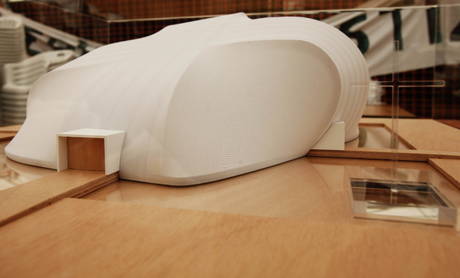
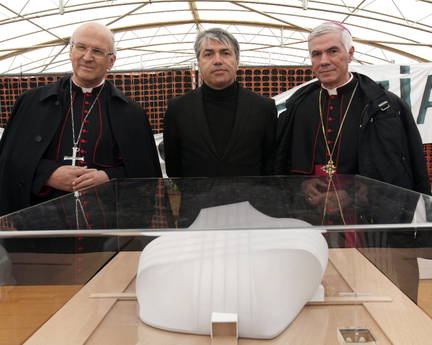
Perhaps the worst ever design for a church

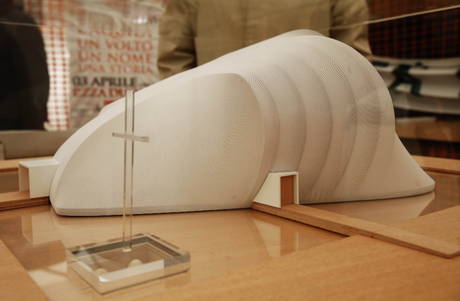
If they actually build this monstrosity in L’Aquila, Italy, the Roj Mahal in Los Angeles will no longer be the ugliest church I have ever seen.

I think the locals might actually have to pray for another earthquake.

Perhaps the worst ever design for a church

Perhaps the worst ever design for a church

Perhaps the worst ever design for a church

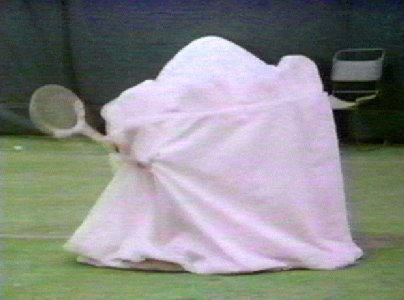
And now for something entirely similar…

Perhaps the worst ever design for a church

Posted in SESSIUNCULA | Tagged
101 Comments

President Obama’s personal “domestic security force”

Someone sent me a link to second Youtube video.

But first watch this one:

Play video

http://www.youtube.com/watch?v=IM-JiGGYJ5w&feature=player_embedded

Posted in Global Killer Asteroid Questions | Tagged
31 Comments

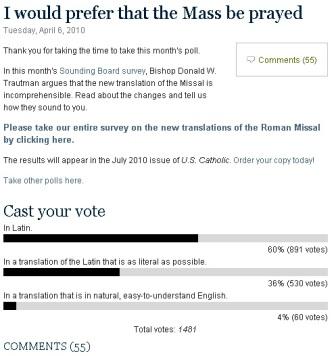
POLL ALERT! US Catholic and Bp. Trautman team up on liturgical language

POLL ALERT!

POLL ALERT! US Catholic and Bp. Trautman team up on liturgical languageH.E. Most. Rev. Donald W. Trautman, Bishop of Erie, inveterate champion of inclusive language and die-hard proponent of ever-shifting "dynamic equivalence" for liturgical translations, has a piece in US CATHOLIC.  There is also a US CATHOLIC POLL & SURVEY about what you prefer for liturgical language.

Before reading this, keep in mind that at the last USCCB meeting in November, even Roger Card. Mahony shot down Bp. Trautman’s ideas.

Remember… there is a POLL and then a SURVEY.

My emphases and comments.

Lost in translation
American Catholics shouldn’t have to suffer through a liturgy that isn’t even prayed in proper English.

By Bishop Donald W. Trautman, S.T.D., S.S.L., the bishop of Erie, Penn. and former chair of the USCCB Committe on the liturgy.

Please respond to the questionnaire that immediate follows this essay.

I was leading a group discussion on the merits of the renewed liturgy of Vatican II when John, a middle-aged businessman, commented, “I can’t imagine my life without the liturgy; it strengthens me each week—but I never understood the Mass until we had it in English.” Some in the group said the liturgy was why they became Catholic; others said the liturgy was why they stayed in the church. All of these individuals had experienced the power of the liturgy to transform lives. That liturgy is about to undergo a face-lift with a new translation of the texts for the Mass.

What prompts this new translation? In 2000 Pope John Paul II authorized a new edition of the Roman Missal, the book that contains the texts for the celebration of the Mass. The new translation of it will be ready for use as early as next year.

In 2001 the Congregation for Divine Worship and the Discipline of the Sacraments issued new principles and directives for translating from the original Latin into the vernacular in a document called Liturgiam authencam. [sic… it should be authenticam]  Following these new norms, the translation of the new Missal has intentionally employed a “sacred language,” which tends to be remote from everyday speech and frequently not understandable. For example, the Preface, or opening of the Eucharistic prayer, of the Assumption says of Mary’s delivery of Jesus, “She brought forth ineffably your incarnate Son.”  [This is the big problem for Bp. Trautman.  He does not think that sacred liturgy should have a sacred language.  But we must reject the premises he worked – not very slyly – into that statement.   Sacred language does not have to be "remote" or "hard to understand".  On the other hand liturgical language shouldn’t be banal to the point of being intellectually offensive and it must accurately convey the content of the original.  And it should not be everyday speech.]

When the bishops at Vatican II made the historic decision that the liturgy of the church should be in the vernacular,  [Year in and year out Bp. Trautman purposely leaves out the other side of the story: the Council said that Latin was to be retained.  He purposely leaves that out.] there was no mention of sacred language or vocabulary. [Nor does the Bible have the word "Trinity" in it.  Had you suggested to the Council Fathers that liturgical language didn’t have to be "sacred" in style, they would have laughed at you.]The council’s intent was pastoral—to have the liturgy of the church prayed in living languages.  Translated liturgical texts should be reverent, noble, inspiring, and uplifting, but that does not mean archaic, remote, or incomprehensible. [He is back to the premises you should be rejecting.] While the translated texts of the new Missal must be accurate and faithful to the Latin original, they must also be intelligible, proclaimable, and grammatically correct. Regrettably the new translation fails in this regard.

Did Jesus ever speak to the people of his day in words beyond their comprehension? Did Jesus ever use terms or expressions beyond his hearer’s understanding? [ALL THE TIME!  He had to go back constantly and explain things!  But the Church also has a teaching office, right?  We can explain what is hard.]  Jesus did explain the parable of the sower privately to his disciples in Mark (4:10-12) and Luke (8:9-10). In John 6 many of Jesus’ disciples found his Bread of Life discourse hard to accept. In these instances it is the message—not its vocabulary—that requires further explanation.  [Which is why there have always been problems with translation down through history, right your Excellency?]

[Okay… I have a flight to catch.  you WDTPRSers can do this too.

UPDATE 1801 GMT… now working from my seat on the airplane… somewhere over… probably Pennsylvania… maybeeee…. Erie?]

Vatican II’s Constitution on the Sacred Liturgy showed pastoral wisdom [This phrase should set off an alarm.   Liberals of a certain age will invariably set "pastoral" against anything they don’t like.  If they don’t like something, it isn’t "pastoral".  Very often anything that requires thought, effort, etc., isn’t pastoral.  The "intellectual" is always, in these cases, not "pastoral". ] when it specified that liturgical texts should “be within the peop le’s powers of comprehension and normally not require much explanation” (#34). [His Excellency has repeatedly suggested that people in the pews are not smart enough to understand the new translation.  I think he is wrong.   Just my opinion, of course.] But in the new Missal, there are whole prayers that are extremely difficult to understand. For example, in the Votive Mass of the Holy Spirit, the prayer after communion reads, “Let the outpouring of the Holy Spirit, O Lord, cleanse our hearts and make them fruitful within by the sprinkling of his dew.” In the epiclesis, or the invocation of the Holy Spirit, in Eucharistic Prayer II the celebrant will pray at the epiclesis: “Make holy, therefore, these gifts, we pray, by sending down your Spirit upon them like the dewfall.” [For several years, His Excellency has been going on about dew.  Perhaps it will be possible to preach about what this figure means?  Dunno… it’s biblical, after all.] What will people understand by “the sprinkling of the Holy Spirit’s dew” and “dewfall”? The words are pregnant with poetry and scriptural meaning, [Wait a minute!  You mean to say that the words are actually gravid?  They are going to have a baby? Or is this a figure of speech…. like … say "dew"?] but if they fail to be understood by the average worshipper, they fail pastorally. Or consider the opening prayer on the Monday of the fifth week of Lent: “May we bring before you as the fruit of bodily penance a cheerful purity of mind.” What do these words mean?

Some proponents [Who could he mean?  Hmmm….] of the new translation maintain that obscure words present a catechetical moment for the homilist to explain. But should the homily be used for unraveling technical, archaic, and unusual words? The Constitution on the Sacred Liturgy says that the homily should be rooted in the biblical readings of the Mass (#24) and should proclaim God’s magnificent works in the history of salvation (#35, 52). [I see.  Sooo… you should never mention anything that isn’t specifically about the magnalia Dei?  So…never tell a story from your own life or, gasp, a joke.  Never cite poetry or mention music, or sports.  Never… well… it’s best just not to preach, I guess, except maybe to reread the readings themselves.  For pity’s sake, that was a little embarrassing.] 

[Okay… I am on board this flight, but the browser is screwing up my formatting…  Sorry… I will eventually correct this.]

A major defect of the translated Missal is the number of lengthy, cumbersome sentences. Translated liturgical texts involve public proclamation and must be intelligible to the assembly on first hearing. The prayer after the third reading at the Easter Vigil (#26) has one sentence of 65 words in 10 lines. [Reminds me of the Emperor in Amadeus.] In the Preface of Christ the King there are 13 lines and 88 words in one sentence. Eucharistic Prayer III begins with 70 words in one sentence. How will this promote intelligible and meaningful prayer? How can the assembly remember what is being prayed for?

[Landing soon…  must sign off soon.]

In almost all instances the opening prayers, prayers over the gifts, and prayers after communion follow a single-sentence format with one or more clauses. Again and again proclaimability and comprehension are sacrificed for the sake of maintaining the Latin single-sentence structure.  [His problem is with Liturgiam authenticam in this matter.]

But Latin word order is not English word order. Rigidly following an artificial word order undermines the natural rhythm and cadence of the English language, thereby stifling comprehension and diminishing participation in the Eucharist. [I don’t think that is what was done, for the most part.]

American Catholics have every right to expect the translation of the new Missal to follow the rules of English grammar.  [American Catholics have every right to expect accurate translations which don’t betray a secularist tinge.]

The new translation of the Nicene Creed is a good illustration of flawed English. Presently the creed is divided into four parts, each headed by the phrase “we believe.” In the new translation there is only one introductory phrase (“I believe”). This results in incomplete sentences for the different articles of faith.

For example, the newly-translated creed reads: “He will come again in glory to judge the living and the dead, and his kingdom will have no end.” This sentence ends with a period, but the very next article of faith simply begins: “And in the Holy Spirit, the Lord, the giver of life.” Another article of faith begins in the same fashion: “And one holy Catholic and apostolic Church.” Neither is a sentence since they lack a subject and predicate, and they are respectively 26 and 32 lines distant from “I believe.” Such formulations hurt clarity and intelligibility.

The American bishops in 2006 approved and sent to Rome the text of the creed that repeated “I believe” for each article of faith, since that repetition clarified the prayer and provided proper sentence structure. Rome eliminated this recommendation of the United States Conference of Catholic Bishops.  [I guess Rome must have a reason.]

Should we pray a text that is grammatically flawed? [Is he advocating that people refuse to use the new translation?] Should we teach our people to pray with incorrect English? Spanish-speaking Catholics pray the new translation of the Nicene Creed repeating “Creo,” “I believe,” four times, but English-speaking Catholics will pray the same new translation saying “I believe” only once. Where is the consistency?

Vatican II specified a pastoral approach [There it is again.] in the Constitution on the Sacred Liturgy: “Both texts and rites should be drawn up so that they express more clearly the holy things which they signify. The Christian people, as far as possible, should be able to understand them easily” (#21). Paragraph 34 of the constitution offers an even stronger statement, that rites and texts “should radiate a noble simplicity. They should be short, clear, free from useless repetition. They should be within the people’s powers of comprehension, and normally should not require much explanation.”  [The Second Vatican Council also said that pastors of souls should be sure that their flocks can both sing and speak the parts pertaining to them in Latin.]

These statements of the council constitute a pastoral principle for judging the translation of the new Missal. [See my comment, above.] As texts of a conciliar constitution, they trump all instructions on translation and should be the guiding norm for the translation of the new Missal.  [His Excellency is obviously in error on this point, otherwise Rome would not be preparing the translations of the antiphons.]

But this pastoral style [All a bit vauge… right?  "Pastoral style"?] is missing in the new translation, which is especially evident in Eucharistic Prayer III. Presently we pray: “Welcome into your kingdom our departed brothers and sisters and all who have left this world in your friendship.” This is a clear, straightforward, hope-filled, understandable prayer. However in the new Missal it now reads: “To our departed brothers and sisters and to all who are pleasing to you at their passing from this life, give kind admittance to your kingdom.”

Contrast the phrasing: “welcome into your kingdom” versus “give kind admittance.” The first is inspiring, hope-filled, consoling, memorable. It conveys the thought, “Lord, welcome, open your arms”; “give kind admittance” is dull and lackluster, reminding one of a ticket-taker at the door. At the funeral of your loved one, do you want to pray, “Lord, welcome into your kingdom my loved one,” or do you want to pray, “Lord, give kind admittance to my loved one”?  [Is His Excellency suggesting that the sentiments of people who have lost their grandmother should be the criteria for how we prepare a translation?]

When the Holy Father gives approval to the complete text of the new Missal, the real task begins. It will then be incumbent on bishops and pastors of the church, along with others in liturgical and educational ministries, to catechize and convince the people that the new Missal is an improvement on the current one. Is that completely true?  [It will be when bishops and priests explain is in a positive light.]

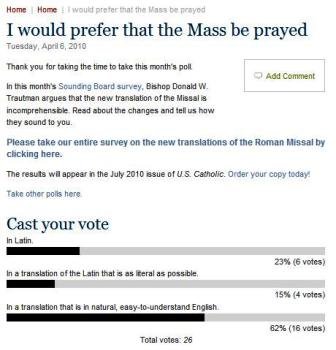
POLL… Pay attention to the US Catholic POLL on liturgical language.

I voted.

Will you vote?

Results at the time of this first posting….

POLL ALERT! US Catholic and Bp. Trautman team up on liturgical language


UPDATE 23:57 GMT:

Look what happened!

POLL ALERT! US Catholic and Bp. Trautman team up on liturgical language

UPDATE 8 April 1536:

POLL ALERT! US Catholic and Bp. Trautman team up on liturgical language

UPDATE 9 April 1958:

POLL ALERT! US Catholic and Bp. Trautman team up on liturgical language

Play video

Posted in Brick by Brick, SESSIUNCULA |
131 Comments