Rabbi Bemporad: media coverage of Church abuse scandal one-dimensional

From CNA:

Rabbi calls media coverage of Church abuse scandal one-dimensional

Carlstadt, N.J., Apr 7, 2010 / 03:05 am (CNA).- In an interview with CNA on Tuesday, Rabbi Jack Bemporad commented on the recent media onslaught concerning the Holy Father, calling the coverage “one dimensional” and saying that the depiction of the Church in the media has not been given “proper context.”

Rabbi Bemporad, director of the New Jersey-based Center for Interreligious Understanding, was recently quoted [wait for it] as a lone voice in an Associated Press article in which other Jewish leaders denounced the papal preacher, Fr. Raniero Cantalamessa, for his comments likening the media depiction of the Church to anti-Semitism.

In the AP article released on April 2, and in a follow up interview with CNA, Rabbi Bemporad defended the papal preacher. Although the rabbi believes Fr. Cantalamessa used a “poor example,” ultimately, the preacher’s “point is correct.”

What the preacher intended to indicate through his homily, Rabbi Bemporad said, was that “you can’t collectively condemn the church for what some priests and some individuals in the Church may have done.”

Addressing those who have criticized Pope Benedict in recent days, Rabbi Bemporad stated that “you’ve got to have a sense of compassion, charity, and saying ‘how can we help you do this properly?’ Instead of condemning him and saying, ‘See, you’re not doing enough.’”

“We’re so quick to judge, we’re so quick to condemn,” he stressed. “There’s no charity, there’s no compassion, no sympathy, and no, by the way, self-criticism.”

A lot of sex abuse involving children is going on, the rabbi noted. “It’s not simply a Catholic problem.” [And, I think we must add, there is not a lot going in the Church now!]

“I do think that the pope is trying to do the best he can,” he added.

The rabbi also took a jab at the media coverage of the Pope, calling it “very one dimensional” and charging that many of the reports have not placed Vatican actions “in the proper context.”

“The tragedy of the media,” Rabbi Bemporad stated, “is that it has a capacity to educate, instead what it does is cater to the worst element in human beings. The most voyeuristic element.”

“We shouldn’t be so quick to grab at headlines which are virulent, and in my opinion, hysterical,” he asserted.

The New Jersey rabbi also praised Pope Benedict for his efforts in helping advance the relationship between the two faiths, saying the pontiff has “tried to be a friend” and has done whatever he can “to show the close relationship between Catholics and Jews.”

“All I am asking for is charity,” and “that we should think about how we can help one another not condemn one another,” said the rabbi.

Posted in The Drill |
5 Comments

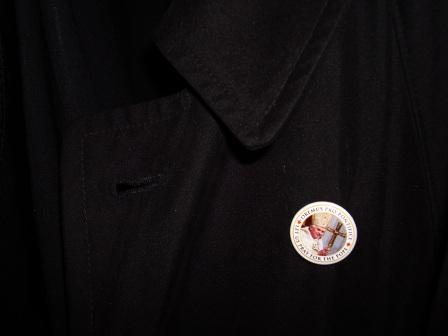
Oremus pro Pontifice button

A friend here in NYC gave me one of the "Oremus pro Pontifice" small buttons!

Oremus pro Pontifice button

Posted in Pope of Christian Unity | Tagged
8 Comments

WDTPRS POLL: Card. George gives award to Fr. Pfleger

Sooo… Cardinal George of Chicago is going to give an award to Fr. Pfleger.

"But Father! But Father!", you might be saying.  "What for?"

For:

service in pursuit of dismantling racism, injustice and inequalities on behalf of African Americans and all people of color.

Hmmmm….

{democracy:52}

Explain your anonymous vote in the combox.

PLEASE keep the flames to yourself.  Just cogent, balanced comments, please.

Posted in "But Father! But Father!", POLLS | Tagged , ,
93 Comments

“How does Benedict fix this mess?”…. Can he “fix” it?

John XXIII, when confronted by problems, at a certain point famously said, "Sometimes I just kneel down and say, Lord, it’s your Church, I am going to bed". 

Much of what is going on today involves Christ being crucified once again.  Anti-Christian, anti-Catholic secularists simply have to attack the Catholic Church.  In doing so, they attack Christ.  Others are probably working from the more reptilian part of their brain stems.  Still others are seeking justice, often in pain.  And another group, seems to be attacking, but are actually like the ancient doctors to whom St. Augustine referred in saying "The doctor doesn’t stop cutting just because the patient is screaming for him to stop."

There is an interesting piece by Rod Dreher writing on BeliefNet.  I wonder what you think.

My E and C.

How does Benedict fix this mess?
Tuesday April 6, 2010

Here’s a story about how complicated the whole abusive priest situation is . Indian priest serving in Minnesota allegedly abuses girl, [for a change] who goes to police after he is back in India. Charges are filed. Extradition is sought. The Minnesota bishop in charge of this priest does the right thing, warning Vatican that girls back in India are at risk from this priest. Then:

    In 2006, the Vatican recommended that the priest simply be monitored, a document shows. An attorney for the Holy See said in a statement that the Vatican had recommended that the priest be defrocked, but that canon law specifies that the decision rests with the local bishop. The bishop in India sentenced the priest to a year of prayer in a monastery rather than seeking his removal from the priesthood, according to documents and interviews.

When a second victim came forward with more serious allegations against the Indian priest, the American bishop wrote to the Vatican twice more, trying to make them understand what a menace this priest was. Reportedly the Vatican is now cooperating with prosecutors in Minnesota.  [This leads you to wonder, even conclude, that the Holy See’s recommendations to the bishop were probably pretty severe and pointed.  That would be my guess.]

OK, look. There are over 400,000 Catholic priests on the planet. Do you know how many priests are on the staff of the Congregation for the Doctrine of the Faith, which has oversight in these matters? Something like 40. It is inevitable that the Vatican will have to rely on local bishops to attend to most of these matters. I can’t think of another church or religious organization that has comparable global reach, and which is centrally administered. I’m not trying to let the Vatican off the hook here, but I am trying to understand how difficult it is for the CDF to do proper oversight with such paltry resources. If it’s true that canon law reserves the right to defrock to the local bishop — and I don’t know that that’s true, given how we’ve read many stories about American bishops who wanted to defrock allegedly problematic priests, but who weren’t allowed to because the CDF didn’t think the bishop had proved his case — then there is quite possibly a problem with canon law that needs reform. [I am pretty sure it isn’t simply "up to the bishop".  But the bishop does have to be involved, of course.  It is a priest of the diocese entrusted to his care, after all.  There is supposed to be a relationship between priest and bishop, of co-worker, a paternal rapport.  In fact it is often more like indentured servant.  But in theory… well… you get the idea.  The bishop has to be involved in the process, though the Holy See always can move on its own.] In any case, this is yet another example of how the Vatican sees clerical sexual abuse as a moral problem requiring moral reform measures (e.g., prayer) and not a criminal problem.  [I think that if a guy broke the law, then he should be subject to the process of the law.]

Serious question: how is the Vatican, with its extremely limited resources, supposed to handle this problem? Again, I’m not trying to excuse Vatican inaction, but I don’t see how Rome is going to get a handle on this at the level of monitoring particular priests. [Rome can’t.] The pope has to be able to trust local bishops to do the right thing. It sounds like the American bishop in question did, but the Indian bishop, following Vatican advice, did not, and doesn’t intend to.

The Catholic Church faces an unprecedented problem, one particular to its global reach, and an era of globalized media. Four years ago, The Dallas Morning News published a shocking investigative series showing how priests accused of sex crimes in the US were fleeing abroad, where they were being sheltered by religious orders, and even in one case, a prominent cardinal. The stories get really complicated, in part because bishops in dioceses half a world away miscommunicate, or possibly deliberately deceive each other. [Quite the allegation.] The news didn’t make nearly the splash it should have, because by 2006, when the story appeared, the American media had long since gotten sick of the abusive priest story. [It’s not sick now… though its consumers may be.] But the reports the DMN published were substantial and scandalous, revealing how clerical sex criminals could count on an international church network to evade accountability and continue to work with children.

How Benedict fixes this, God only knows. He theoretically has the power to order wholesale reforms. In truth, it’s far, far more complicated (what’s he going to do if bishops refuse to obey him, [THAT, friends, is the problem.] send in the Swiss Guards?). The quandary he’s in is that he’s got responsibility for all of this stuff, without the practical means to police it effectively. It is an administrative nightmare.

Good piece.

But the Pope is not without a special resource:  those who are willing to pray for him.

"How does Benedict fix this mess?".... Can he "fix" it?

Posted in Pope of Christian Unity, SESSIUNCULA | Tagged
35 Comments

Did Vatican II bring about a “new Pentecost”? Are we still waiting?

From Celebration via NCR.

My emphases and comments:

Clericalism and the Liturgy
Whatever became of the ‘new Pentecost’?
Apr. 05, 2010
By Paul Philibert  [OP]  [Fr. Paul Philibert is a Dominican friar living in Raleigh, N.C., where he is freelancing as a lecturer and writer after many years as a professor of theology. His translation of Yves Congar’s liturgical writings, At the Heart of Christian Worship, will be published this summer by The Liturgical Press.]

For the three years preceding the Second Vatican Council, and all during that council, Roman Catholics added to the prayers after Mass (does anyone remember those?) [of course… I do them all the time…] Pope John XXIII’ s “Prayer to the Holy Spirit” for the council’s success. Day after day the church prayed, “O Holy Spirit, renew thy wonders in this our day, as by a new Pentecost.”

Pope John dreamed that through the council the Holy Spirit’s gifts would flow abundantly upon the whole church for the benefit of the entire world, because the Spirit alone has the capacity to change hearts from within, not by external force but by interior persuasion.

Today, however, the church is divided over just how much of a Pentecost Vatican II actually turned out to be. [Sure is.] It is likewise divided over what kind of church we are. This article will explore some of the consequences of this ambiguity.

The church’s focus

Now, 45 years after Vatican II (1962-1965), this Easter season has reached its climax. We transition from celebrating the new life of Christ’s resurrection to celebrating the new life poured out upon the world by the Holy Spirit. Pentecost is the church’s movement from mystagogy to vocation, from contemplation to mission. [You can tell that the writer is wholly committed to "spirit" of Vatican II.]

The first Pentecost ushered in the age of the church in which the Holy Spirit turned Christ’s disciples into missionaries. The Spirit is the church’s living memory, anointing believers in faith to allow them to live the events of their salvation in the present. As the Catechism of the Catholic Church explains: “The paschal mystery of Christ is celebrated, not repeated. The celebrations … are repeated, and in each celebration there is an outpouring of the Holy Spirit that makes the unique mystery present [to us].” (#1104). Consequently every one of the faithful becomes a dynamic source for the Spirit’ s contact with and action upon the world.

This is an essentially apostolic vision of the church. We find its origin in the Acts of the Apostles, where the gift of the Spirit immediately led people to bear witness: Acts 2:4, “All of them were filled with the Holy Spirit and began to speak in other languages, as the Spirit gave them ability”; and Acts 4:31, “They were all filled with the Holy Spirit and spoke the word of God with boldness.”

Reflecting on the unmistakable energy of the Spirit revealed in these passages, Pope Paul VI asked, “In our day, what has happened to that hidden energy of the good news, which is able to have a powerful effect on [our] conscience?” (Evangelii Nuntiandi 4). The answer, in part, is that our church’s leadership has shifted its focus from mission to maintenance, from evangelization to ritual sanctification. The active players are no longer (or not often) imagined to be the baptized, but the ordained.  [I was sorely tempted simply to cut some of that dross for the sake of keeping this entry shorter rather than make it burdensome.  In the end, I leave it in to show how clerics of certain generation still cling to the liberal narrative of Vatican II.  For the last year, there is a rising effort on the part of liberals to regain control of the narrative about Vatican II, and all its various promises, and all its pomps.  Therefore, when we find this tired old story book hauled out and dusted off, we will inevitably also hear and read some cliches from decades past.  Let’s see what we run into down the line….]

The return of clericalism

[And our first cliche is….] A type of clericalism has been revived over the last 20 or 25 years that is subduing the apostolic vision of the church sketched by Vatican II. It is overemphasizing the part played by the ordained in the life of the church. There are many symptoms, from cardinals unpacking their 15-foot trains of scarlet silk — cappa magnas (ceremonial capes) — to seminarians and young priests living full time in cassocks; [GASP!] from the disappearance of inclusive language in church texts and preaching, to the nearly exclusive focus upon clerical vocations in diocesan letters.  [Because that is where the energy is needed.] Seminarians are in short supply, and officials fear ["fear"] that the generalized secularization of the culture and particularly the promotion of laypersons to ministries of service in the church will have the effect of discouraging vocations to the ordained priesthood. [And they will.  And it is an old liberal canard to suggest that people who don’t advance their horizontal, role blurring agenda, are "fearful" of the … I dunno… promptings of the "spirit", etc.] The consequent demotion of the spiritual dignity of the faithful and a chilling of social relations between clergy and people are all too clear among some church leaders. These details are debatable; they vary from place to place. Far more significant is the underlying vision and practice of what goes on in the local church.  [Chilling? Based on what evidence?  Wherever I go, to various more traditionally inclined parishes, the rapport of clergy and parishioners is wonderful!]

I am trying to describe here an implicit popular theology of the church that appears to be widespread. [Go back and read that vague sentence again.] These ideas represent not only people’s general understanding of what the church is about, but also much in pulpit preaching and in church documents as well. Here is a brief description of the problem:

(a) In this popular theology, the priest represents Christ, while the people represent those to whom Christ ministered. During this “Year for Priests,” we have heard lots about how important the figure of the priest is. However, I have yet to hear anyone echo the clear teaching of St. Paul that each of the baptized is an alter Christus — another Christ — and has a vocation to share the church’s mission through an apostolic life in the ordinary world.  [Sigh… this is the Year of the Priest.  PRIEST.  Not the Year of the Baptized.  Right?  I hope there is no confusion in the writer’s mind about the qualitative way priests are priests and the way the baptized share in Christ’s priesthood.]

[Here is another liberal sign post… ] (b) In this popular theology, the ordained presbyter (priest) [when you see "presbyter", start reading closely] is understood to be the one who is active in the Eucharist as the agent of reenacting Holy Thursday and Good Friday, [another cliche coming] while the people are sacramentally passive as recipients of the priest’s sacred action.  [The writer has a rather narrow understanding of "active participation" it seems.] Some of those who [note how condescending his following description is…] buy into this vision of the Eucharist are hungry to hear Gregorian chant, Renaissance polyphony and Latin texts while they are edified by the priest’s awesome rites. [Gosh… whose ideas might he be attacking here?] This reduction of the laity to passive bystanders instead of active participants in Catholic worship is the most characteristic manifestation of clericalism.  [On the other hand, what the writer fails to grasp is that when you "clericalize" the laity, when you instruct them to do what is proper to the priest and deacon, installed acolyte or lector, you are telling them that they – in themselves – aren’t good enough.  Their affirmation comes from them aping what clergy do.  I think that is a far worse clericalism, for it denies that lay people have their own real dignity unless they are doing what clergy are to do.  And his notions of active participation are simply worn out.]

(c) One additional aspect of this implicit popular theology has to do with the Holy Spirit. It imagines that if the Spirit is bestowed on the faithful, it will come exclusively through the ministry of the ordained. It presupposes that the faithful are directly dependent upon bishops and priests for their sanctification. This ignores the rich teaching of Romans and First Corinthians that baptism gives the faithful the power to live and act under the impulse of the Holy Spirit and to be powerful witnesses to God’s action in the world.  [Uh huh.  And we can all tell when the Holy Spirit is at work.]

The Vocation of the faithful

[If you had any doubt that we are walking through a theological and liturgical Jurassic Park…] Speaking through the council fathers, the Spirit at Vatican II left no doubt [?!?] that all three of these theological manifestations of clericalism are wrong. [Boy… he sure has those fear-filled Spirit-rejecting clericalizing baddies on the run now!] In the “Decree on the Ministry and Life of Priests,” we read: “Jesus gave his whole mystical body a share in the anointing of the Spirit with which he was anointed. In that body all the faithful are made a holy and kingly priesthood, they offer spiritual sacrifices to God through Jesus Christ … therefore there is no such thing as a member who does not have a share in the mission of the whole body” (Presbyterorum Ordinis 2). Put another way, each of the faithful, positioned in some way at the church’s periphery, has the potential to initiate a more dynamic expression of the living church, calibrated precisely to the real existing possibilities for life that are always emerging there.  [Let’s decipher this: lay people have a role to play.]

To the idea that the priest celebrates the Eucharist and that the faithful are nourished from afar, the council insisted on the contrary: “The eucharistic celebration is the center of the assembly of the faithful over which the priest presides. Hence priests [must] teach the faithful to offer the divine victim to God the Father in the sacrifice of the Mass and with the victim to make an offering of their own lives” (Presbyterorum Ordinis 5). [The same Spirit filled Council Fathers, in a much weightier document, also mandated – surely under the influence of the same Spirit – that pastors of souls make sure that their flocks can sing and speak the parts of Mass pertaining to them in both the mother tongue and LATIN, that Gregorian Chant and polyphony (which the writer takes to be marks of the presence of clericalism) have pride of place.   Why does the writer think that only his favorite passages of the documents were inspired by the Spirit.  And… big question here… who says that the documents were written under the inspiration of the Holy Spirit?] By offering themselves and their apostolic action in the world, the faithful bring the fruit of their baptismal priesthood (which is essentially non-liturgical and lived out in the world) to the church’s fundamental act of sacrifice and self-offering to God at Mass. When this role of the faithful is denied, then Sunday Mass becomes the place where people assemble not as a priestly people offering their lives to God, but as individuals praying private devotions as they watch the priest offer sacred rites on a distant altar.  [I think that their proper role is denied more sharply when they are presented with confused ideas about their role.  Should they be made to act like faux-clerics?  Should they be allowed to be lay people with their own dignity?]

To the idea that the faithful are sanctified uniquely through the ministries of the ordained, the “Constitution on the Church” clearly says: “The baptized, by regeneration and the anointing of the Holy Spirit, are consecrated a spiritual house and a holy priesthood, that through all their Christian activities they may offer spiritual sacrifices and proclaim the marvels of him who has called them out of darkness into his wonderful light” (Lumen Gentium 10). In other words, the vocation that the church offers to the faithful is not a secondary role as clients of clerical ministries, but a [Here we go again…] Spirit-filled participation as pioneers in the church’s role as herald of the kingdom of God.  [Yah… right.  Okay.  I think that the proper role of lay people is to shape the world around us and that clerics should give them the spiritual support they need in that role.  Instead, liberals want the lay people to do the priestly liturgical and sacramental things and want the priests to be social workers.  The result is that, too often, few people – confused lay people and clerics alike – do anything all that well.]

Thoughts for reflection

The three examples of clericalism just given are never articulated in these terms. However, before offering this essay for publication, I checked out these ideas with a number of people to see if they ring true to their experience. All of them assured me that this is what they see in the new clericalism, expressed not in so many words, but in actions and attitudes. The fundamental problem with clerical condescension is that it appeals to and reinforces a passive clericalism on the part of the laity who are used to being put down and quite unused to being reminded of or commissioned for an apostolic role.

The laity is supposed to be the link between the church and the world. ["link between"… hmmm]  Pope Paul VI describes laypeople as those whose vocation places them in the midst of the world, in charge of the most varied temporal tasks. He goes on to say: “Their primary and immediate task is … to put to use every Christian and evangelical possibility latent but already present and active in the affairs of the world. Their own field of evangelizing activity is the vast and complicated world of politics, society and economics, but also the world of culture, of the sciences and the arts, of international life, of the mass media” (Evangelii Nuntiandi 70). A church that forgets this and fails to commission the laity to this irreplaceable dynamic role in the culture has let go of the great commission that Christ left to the church as his last mandate: “Go into all the world and proclaim the good news to the whole creation” (Mark16:15; Matt 28:19). It is a church that has forgotten that it is baptizing and confirming missionaries “to make the church present and fruitful in those places in circumstances where it is only through them that it can become the salt of the earth” (Lumen Gentium 33).  [Which means we don’t clericalize them and we don’t confuse our liturgical roles.  It also means that when they come to church for revitalizing worship, something that actually explains why they do what they do for their vocations, they should an an encounter with the transcendent.]

Finally, we should also note that there has never been a moment in which the irreplaceable role of the ordained minister has been more important. [Whenever I hear the term "ordained minister" I get red flags and sirens in my head.  In the ultra-liberal hole of a seminary I was in we were pretty much forbidden to use the word "priest" (the P-Word).  We had to refer to ordained ministers and non-ordained ministers.  After all, everyone’s a minister, right!?] We need a ministerial priesthood at the service of the common priesthood of the baptized (Catechism of the Catholic Church 1547), we need presbyters [priests… let’s keep the sacrificial dimension in this…] who can teach the faithful to offer their own lives along with the divine victim in the sacrifice of the Mass (Presbyterorum Ordinis 5), we need ministers of the Gospel who recognize that “the distinct character of [their] activities is the aim to proclaim the Gospel of God” (Evangelii Nuntiandi 68) in ways to draw people effectively to the heart of Christ. But this ordained ministry cannot be the condescension of a patriarchal master, [a penchant of liberals, who clericalize the laity] but only the loving service of an apostolic brother. The very nature of the church demands it. The parish is not about giving passive Christians spiritual comfort; it is rather the recruiting center for an apostolic priestly people. The Spirit is waiting. The people are waiting. What are you waiting for?

An instructive piece.

I admit I have been a little hard on this presentation.  But I think we need to keep our ears tuned for certain currents of old ways of thinking about the Council… ways that really didn’t work.

 

Posted in SESSIUNCULA |
49 Comments

Huge gain for religious feminism!

Thanks to Sancte Pater I learned … and you are learning… about the great leap in modern ecclesiastical feminism.

From RNS.

Just in time for the upcoming "consecration" of a lesbian bishopette in Los Angeles. 

April 5, 2010

barbieNEWS FEATURE

Barbie gets ordained, and has the smells-and-bells wardrobe to match
By Leanne Larmondin

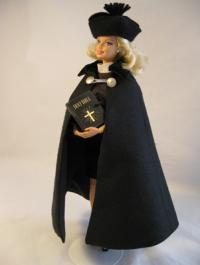
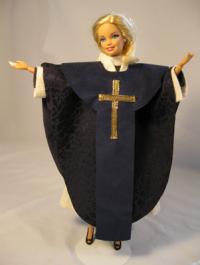
(RNS) With her careers as veterinarian, astronaut and U.S. president behind her, Barbie has at last found her true calling: as a second-career Episcopal priest.

The 11.5-inch-tall fictional graduate of Church Divinity School of the Pacific in Berkeley, Calif., has donned a cassock and surplice and is rector at St. Barbara’s-by-the-Sea in (where else?) Malibu, Calif.

She arrived at the church fully accessorized, as is Barbie’s custom. Her impeccably tailored ecclesiastical vestments include various colored chasubles (the sleeveless vestments worn at Mass) for every liturgical season, black clergy shirt with white collar, neat skirt and heels, a laptop with prepared sermon and a miniature, genuine Bible.

Huge gain for religious feminism!Apparently a devotee of the “smells and bells” of High Church tradition, the Rev. Barbie even has a tiny thurible, a metal vessel used for sending clouds of incense wafting toward heaven.
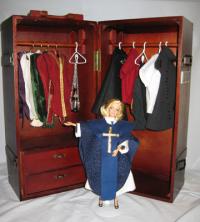
The Rev. Barbie, who in less than a week had drawn nearly 3,000 friends on her Facebook page, spends most of her time in the office of the Rev. Dena Cleaver-Bartholomew, rector of Christ (Episcopal) Church, in Manlius, N.Y., near Syracuse.

The doll, her wardrobe and portable sacristy were a gift from Cleaver-Bartholomew’s friend, the Rev. Julie Blake Fisher, a priest in Kent, Ohio.

“I got a phone call from my husband who said a large package had arrived;Julie had told me that she was making something for me. She used to be a dressmaker and she makes gorgeous stoles, so I thought she was making me a stole,” said Cleaver-Bartholomew. “When I came home and there was this enormous box, I knew it wasn’t just a stole!”

Huge gain for religious feminism!Fisher had made Episcopal Priest Barbie and a few vestments two years ago for the children in her parish to dress.
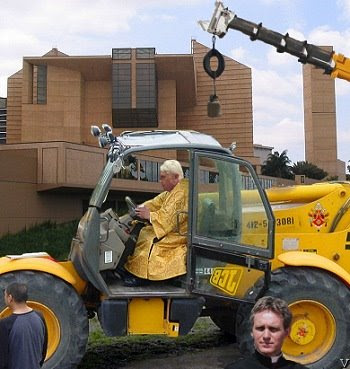
“I thought the children would like to practice playing with the vestments and learning what they are,” said Fisher. The Rev. Barbie was a hit with both the children and a local group of women clergy, including Cleaver-Bartholomew.

When Cleaver-Bartholomew later got called to her parish in New York, Fisher knew the perfect gift for her friend.

“I thought, `I don’t have time to make her one of her own; I’ll just send her Episcopal Priest Barbie for her farewell gift,”’ said Fisher. “But then, when I sat down to start to package everything up, I thought `What if I added this? What if I added that? What if I made this? It would just take one more day.“‘

One more day turned into 100 hours of painstaking labor, and “before I knew it, it was Episcopal Church Barbie—High Church Edition,” Fisher said.

Barbie’s clergy garb is the real deal, made from dress patterns that were crafted or adapted by Fisher. Barbie’s collared blouse was cut down from the fabric of a genuine clergy shirt; the chasubles and alb are made from real silk and linens. Her capa nigra (black funeral cloak) sports pewter buttons. Her nearly-complete Bible was originally sold as a keychain. The thurible was crafted from a teeny tea ball.

Episcopal Church Barbie’s popularity exploded after she got a shout-out on the popular blog, BeautyTipsforMinisters.com. A “Friends of Episcopal Priest Barbie” Facebook group has grown exponentially since its March 31 inception.

Many of the Rev. Barbie’s online admirers asked about her career aspirations.

“How long till she is Bishop Barbie?” asked one.

Fisher has found a calling of her own: She responded that her next project will be Episcopal Priest Barbie: Cathedral Edition. She promises an African-American Bishop Barbie, a Hispanic Ken doll who will be cathedral dean (rector) and his African-American friend, Stephen, will be a deacon. Barbie’s little sister, Kelly, will be an acolyte.

For her part, Cleaver-Bartholomew thinks Barbie could be a tool for evangelism for the Episcopal Church—particularly for conveying that “we have a sense of humor, we can be fun.

“Barbie’s very versatile that way,” said Cleaver-Bartholomew. “She’s open to new possibilities, so evangelism is definitely in her future.”

Sr. Joan Chittister, last seen rummaging through some of her old doll boxes, was unavailable for comment.

Posted in SESSIUNCULA | Tagged ,
56 Comments

Record number of confirmations in one US diocese

I enjoyed this story from CNA:

Record number confirmed in Baltimore, despite recent media attacks on Church

Baltimore, Md., Apr 6, 2010 / 07:02 am (CNA).- Despite the recent media attacks on the Church and Holy Father regarding clergy sex abuse scandals, one U.S. archdiocese set a record for confirming the most individuals in its history to the Catholic faith.

On Saturday, the Archdiocese of Baltimore confirmed a record 1,090 adults to the faith at the Easter Vigil Mass in parishes throughout the area, breaking the archdiocesan record for a second year in a row,  reported the Baltimore Sun on April 4.

“We’re on a roll, I guess,” said Archbishop Edwin O’Brien to the Baltimore Sun. Although the bishop said he would like to credit the archdiocesan staff for the record numbers, “the rubber hits the road in the parishes,” he explained. “It’s there where we find the real life of the Church.”

Local parishioner Rich Foster, 59, told the Baltimore Sun that the recently surfaced sex abuse scandals within the Church in the U.S. and Europe and the subsequent media attack on the Holy Father did not affect his decision to become Catholic.

“It reflects the frailties of all of us humans,” Foster said on Sunday. “We all have sinned … Part of what the church teaches us is reconciliation, redemption, and forgiveness.” An attendee of New All Saints Church in Baltimore, Foster described his church as “a congregation that I see doing wonderful work in terms of giving back to the community, being open and welcoming to both church members and the outside community.”

“I think that outweighs to me any concerns that may arise in this current controversy,” he added. “I trust my church will go forward in a righteous manner, dealing with these issues directly.”

The record 1,090 individuals confirmed on Saturday surpasses the 984 confirmed in 2009. According to Sharon Bogusz, coordinator of evangelization and adult catechesis for the Baltimore Archdiocese, approximately one quarter of those confirmed were the newly baptized. Others were baptized Catholic as infants but did not receive further sacraments and the majority of those confirmed were from others Christian backgrounds whose baptisms the Church recognizes.

“It’s wonderful,” Bogusz told the Baltimore Sun, “our parishes are really doing a lot of hard work and sharing news and welcome.”


I am very pleased about this good news.   At the same time, I think I would like to chat with some of those newly confirmed to find out what they know about their faith.   Still, this is a very good thing.  I hope it is the beginning of a trend.

Posted in Brick by Brick | Tagged
29 Comments

ALERT: Successor in Los Angeles!

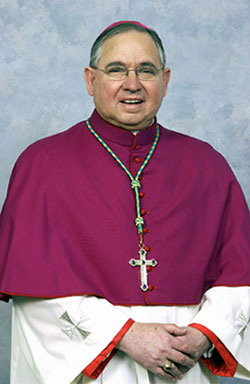
In the brick by brick file…. ALERT: Successor in Los Angeles!

From VIS.

From CNA:

Archbishop Gomez appointed to Archdiocese of LA

Vatican City, Apr 6, 2010 / 05:53 am (CNA/EWTN News).- This morning the Holy Father appointed current San Antonio Archbishop Jose H. Gomez as Coadjutor Archbishop of Los Angeles, California, the largest diocese in the United States. The prelate will serve alongside current Cardinal Roger Mahoney, and will take over his position when he retires.

Archbishop Gomez was born in 1951 in Monterrey, Mexico to Dr. José H. Gomez and Esperanza Velasco, both who are now deceased.

The prelate earned bachelor’s degrees in accounting, philosophy and theology and was ordained an Opus Dei priest in 1978. In 1980, he obtained a doctorate in theology from the University of Navarre’s Pamplona, Spain campus.

From 1987 to 1999, then-Father Gomez was in residence at Our Lady of Grace Catholic Church in San Antonio where he assisted with the parish’s pastoral work. It was during this time that he became a regional representative to the National Association of Hispanic Priests (ANSH). In 1995 he was named president, then took on the role of executive director in 1999.

Archbishop Gomez played a central role in establishing the Hispanic Seminary of Our Lady of Guadalupe in Mexico City which opened in 2000.

Then in 2001, he was ordained an auxiliary bishop for the Archdiocese of Denver, where he served in several areas, including outreach to the Hispanic community. He also organized the establishment of Denver’s Centro San Juan Diego for Family and Pastoral Care, a place for formation of lay leaders and a base to provide welcoming services to immigrants.

ALERT: Successor in Los Angeles!In 2005, the year he was appointed Archbishop of San Antonio, he was named one of Time Magazine’s 25 most influential Hispanics in the United States, and in 2007 he was on a CNN’s list of “Notable Hispanics” in a web special celebrating “Hispanic Heritage Month.”

While the Archbishop of San Antonio, Most Rev. Gomez created the The Catholic Community Foundation for the Roman Catholic Church of the archdiocese and was key in bringing together Hispanic leaders for the Catholic Association of Latino Leaders (CALL).

Archbishop Gomez was also appointed in 2008 as a consultant to the Pontifical Commission for Latin America. He also serves in various roles for the United States Catholic Conference of Bishops including: chair of the task force on the Spanish Language Bible for the Church in America, chair of the Committee on Cultural Diversity in the Church, member of the Committee on Doctrine, and member of the Subcommittee on Hispanics and the Liturgy.

According to the Archdiocese of Los Angeles, in his new role, Archbishop Gomez will lead 4,329,267 Catholics (as of 2005), 530 diocesan priests, 640 religious priests, and 1,710 religious sisters.

The news coincides with things I have heard for a few months.

I picked up the image, above, at Sancte Pater.

I am pretty sure that this is not a "win" for Card. Mahony.

Posted in Brick by Brick | Tagged , ,
112 Comments

Manhattan blognic is UNDERWAY!

Good sized group came to Mass and now we are at the pub.

Manhattan blognic is UNDERWAY!

Manhattan blognic is UNDERWAY!

Manhattan blognic is UNDERWAY!

Manhattan blognic is UNDERWAY!

Manhattan blognic is UNDERWAY!

Manhattan blognic is UNDERWAY!

Manhattan blognic is UNDERWAY!

Posted in SESSIUNCULA |
29 Comments

Out and about again

It is another fine day in NYC for this Easter Monday, opening day (go Twins! go Red Sox!).

I am waiting for the Statten Island Ferry.

Out and about again

Out and about again

Out and about again

Out and about again

Out and about again

Out and about again

Out and about again

Out and about again

Out and about again

Out and about again

Out and about again

Out and about again

At the grave of Alexander Hamilton… the grave marker reads:

The Patriot of incorruptible Integrity.
The Soldier of approved Valour.
The Statesman of consummate Wisdom:
Whose Talents and Virtues will be admired
by
Grateful Posterity
Long after this Marble shall have mouldered into
DUST.
He died July 12th 1804. Aged 47.

Out and about again

Out and about again

Out and about again

Out and about again

Out and about again

Posted in SESSIUNCULA |
16 Comments