Bp. Finn (D. Kansas City-St.J) on vocations

This is the Year of Priests.  I think it is fair, especially during this year, when talking about the Year of Priests, we talk about vocations to the priesthood.

Let us not forget that every person has a vocation.  All vocations need to be fostered, for each person has something unique to contribute in God’s plan.

I found this on the site of The Catholic Key, newspaper of the Diocese of Kansas City-St. Joseph, MO.

My emphases and comments.

Vocations are Still a “Super-Priority”

By Bishop Robert W. Finn
Kansas City-St. Joseph

In my first months as bishop of the diocese I said Vocations were a “Super Priority.” [Do I hear an "Amen!"?] While we have had a meaningful increase in vocations to priesthood, the diaconate, and some new vocations to consecrated life, I still offer this intention for more vocations to priesthood and Consecrated Life with fervor in my daily prayer. I hope you do also.

We are reaching the midpoint of the Year for Priests, inaugurated by Pope Benedict XVI last June. How proud I am of our priests who do so much for you, God’s people. Still, they need more help, particularly as the pastoral needs seem always to increase. This year, please God, we will ordain four new priests; and it remains possible that in 2012 we could celebrate the ordination of eight or nine new priests at once. I haven’t figured out how we will get everyone in the Cathedral; a pleasing dilemma!  [Do I hear an "Amen!"?]

Am I greedy to suggest that we need more priests? [Heck NO!  MORE! We want MORE!] I believe that God is calling more men to this wonderful vocation, and we have to listen carefully and prepare well so that your sons can hear and answer that call. [NB: You have a role in all vocations to the priesthood.]

What kind of life awaits the priest? To be sure, there are many joys, and also challenges. The priest is helped by God to give himself to many people. He shares in the greatest joys of people’s lives and is with them in times of hardship and sorrow. He is a pastor, a shepherd, a teacher, and spiritual father. He stands in the place of Jesus Christ, particularly in the Sacrifice of the Mass and in the Sacrament of Reconciliation.

How does a man discern a possible vocation to priesthood? The healthy man (healthy in body, mind and soul), as he matures, wants to give himself in an honest and generous way. It is important and normal that he sees the beauty of marriage, and its central meaning and purpose in society. At the same time, he realizes he has a spiritual dimension to his life and he wants to listen to the promptings of the Holy Spirit and follow God’s call wherever it may take him. He works hard at every task before him, and finds joy in generously reaching out to others. He studies with zeal. He prays. He establishes caring friendships, and determines to live a moral life, growing in the frequent reception of the sacraments, particularly of Confession and Holy Eucharist.

As a man experiences this spiritual depth to his life, he does not seek a vocation that makes him materially rich or famous. Instead, having realized something of the cost and demands of authentic human love, he is ready to trust God and give himself to others out of love for God. He realizes that the Father in heaven has loved him a lot, and the awareness of this love and mercy makes him want to follow God’s plan in his life. Our seminarians are responding to this vocation to the priesthood. Our priests are living this out with dedication. Keep praying for them to persevere.

The role and support of parents is very important to those who are discerning God’s call. Your sons (and daughters) look up to you for approval. They should. Your love for them is unconditional and unselfish. I do not suggest that you should urge your sons to go to seminary, but pray for them, that they do whatever God wants for them. Support them in their search. I pledge once again to our parents that if we receive their sons as our seminarians we will do all in our power to see they get good formation.  [This is the sort of things which, in my day, I couldn’t dream of.]

Over the course of my priesthood, I have also had occasion to meet many outstanding men and women Religious. I was taught by and have worked closely with several Orders of Religious Women. There is a real renewal taking place in these vocations today. I have established an office for Consecrated Life, and we stand ready to direct young women and men who may be drawn to Religious life as priests, sisters or brothers.

Our Vocation Director, Fr. Richard Rocha, and the Director of our Office of Consecrated Life, Sr. Connie Boulch, will be pleased to receive your call (816-756-1850) or go to our diocesan website www.diocese-kcsj.org and look for the Vocations tab. Let us never cease to do as Jesus urged us: “Beg the Lord of the Harvest to send laborers for His harvest.” (Lk 10:2)

[And for those of you in Kansas City!] Don’t forget the Support Our Seminarians (S.O.S.) Dinner Auction coming up Friday, January 29, 2010. Your participation and/or donations are greatly appreciated. For information, call the vocation office at 816-756-1850.

Posted in SESSIUNCULA | Tagged ,
14 Comments

POLL: Sen. Reid v. Sen. Lott – a double standard?

You citizens of the USA have probably by now heard about the comments made by Senate Majority Leader Harry Reid (D-NV) about then-candidate Barak Obama.  Pretty much everyone says that Sen. Reid’s comments were "racist".  Sen. Reid acknowledges that his comments were improper.

However, you also will recall, or have heard the story dredged up on the news a zillion times by now, that Sen. Trent Lott (R-MS) once praised late Sen. Strom Thurmond who once ran on a segregation ticket.

Just one story of many can be found here if you want background. 

Sen. Lot was forced out of his position as Senate Majority Leader because he was charged with racist remarks.

Sen. Reid made self-admittedly racist remarks, but he is not being asked by his own party to step down as Majority Leader.

Here is a POLL question.

n

{democracy:40}


Posted in POLLS, SESSIUNCULA | Tagged ,
21 Comments

Palin… in comparison, and in the news

In the news in more way than one.

I just heard that former Alaska Gov. Sarah Palin is going to be a Fox News contributor and even as a host!

That should be interesting!

Posted in SESSIUNCULA | Tagged
19 Comments

Card. Razafindratandra, RIP

Armand Gaétan Cardinal Razafindratandra, Archbishop Emeritus of Antananarivo, Madagascar, has died at 84.

For some years I did the Christmas cards for my old boss H.E. Card. Mayer, now the oldest living cardinal.  Every Cardinal in the College got a card. 

I remember carefully typing out this name and practicing the pronunciation, together with his see.

Posted in SESSIUNCULA |
6 Comments

QUAERITUR: removing gloves before Communion in the hand

From a reader:

One question:  does any document specifically state one must remove gloves prior to receiving on the hand?  I have always taught this to be the case as I was taught, but presently cannot find a citation to rest the case with those who disagree. 

I don’t think there is a document that states that you must remove gum from your mouth before receiving either.

If you are wearing gloves, for the love of God, receive on the tongue!  Or take them off?

Is this hard?

Posted in ASK FATHER Question Box |
20 Comments

FEEDBACK: “I am 59 years old and like the current liturgy.”

There is a Latin phrase: repetita iuvant…. repeated things help… or… repetition of things helps you you to remember them.

In discussions about the older, traditional form of Mass or about the position of the altar in relation to the priest and congregation, repetita iuvant.  We mustn’t forget that some people are new to the discussions and don’t yet know the facts.  Also, liberals in particular conveniently forget facts.   So… we should repeat them.

From a reader:

I am 59 years old and like the current liturgy.  I was an alter boy and served with both old and new liturgies.  I prefer contemporary Mass music but am okay with chants and some of the 15th to 19th century music that is in our hymnal.  Some of each of these types of music is good quality and some is bad.
 
It is fine with me that some like the Mass from, I believe, 1570.  However, I do not think we all need to go back to that Mass.
 
Our church, built in 1889, is built on a corner, so it probably could have been built in a different alignment.  The people face south and the priest faces north.  I am sure that any true prayers of the congregation and the priest are heard just fine by God.

First, I note that this has more to do with what his preferences and likes are concerned than perhaps about what the Church’s liturgy requires.  It is perfectly okay to like some things more than others.  But out liturgical choices are not to be grounded solely in our likes, which are not only subjective, but shifting.   Thus, it is nice that he is "okay" with chants.  The Church says that Gregorian chant has pride of place. 

It is great that the writer "likes" the current liturgy.  His liking it, however, is not our standard of measure.  There are those who don’t like it, to one degree or another.

Also, "some like the Mass from, I believe, 1570".  If he knew that date, he probably knew a little more besides.  But let that pass.  The 1962 Missale Romanum is now in use, not the missal of 1570.


When the Holy Father first celebrated ad orientem in the Sistine Chapel, liberals rushed to point out that, gasp, he was not in fact facing geographical East!  Imagine!  They conveniently forget that while geographical eastward orientation was important to the ancients, when we speak of East now, we are speaking of an ideal whereby priest and people together are "oriented" in the same direction (geographical East ideally), toward the Lord who will return (from the East, as the ancients believed).  Liturgical "East" doesn’t have to be East on the compass, though that is great when it happens!

Finally, we know that God hears our prayers.  I wonder if we hear our prayers.   I suspect not, otherwise we would have pressed for a new translation a long time ago.  We hope to derive something more from Mass than the nebulous suspicion, or even confident assurance, that God heard our prayers.

Posted in SESSIUNCULA |
57 Comments

RECENT POSTS OF INTEREST

Here are some links to some recent posts of interest just to make them a little easier to find.  

RECENT POSTS OF INTERESTDon’t forget to help WDTPRS by using the Google Thingy on the side bar and voting in an award site.


Posted in SESSIUNCULA |
Comments Off on RECENT POSTS OF INTEREST

QUAERITUR: baptism of Catholic’s child in a non-Catholic service

From a reader:

My brother-in-law (to-be), her CATHOLIC brother, is having a baby in a few months and is planning to have the child baptized in a Presbyterian service.  I was told at one point that it might be a cooperation in Moral evil (schism) to attend services of another denomination.  I was also told at another time that in support of a family member, this would possibly be permissible.  So I ask you Father, ought we go to the baptism?  Assuming that the "Creator, Redeemer and Sanctifier" mumbo-junko doesn’t make an appearance?

What about attending a CATHOLIC cousin’s protestant wedding?  Would that be recommended?  I assume that there’s no hard and fast rule here… But as your spiritual children, what would you advise us?

I forgot to mention Father, that her brother has asked us to be the godparents…  What do you think about that?


There is information lacking here, of course.  First, we can only guess at the dynamics of the family ties here.  Also, we don’t know the religious affiliation of the wife of the Catholic brother in law to be.

Still, you cannot be godparents to a child of a Catholic who is choosing to have the child baptized in a non-Catholic denomination.   He is demonstrating that he doesn’t have the will to raise the child in the Catholic faith. 

Second, your closest spiritual father is really your pastor at your parish.  You should ask him what to do about this.  In the meantime, I repeat that I don’t know the circumstances well enough to counsel on what you should do.   It may be that the Catholics involved in making these fairly bad decisions might have had such a bad formation that they truly have no idea that what they are doing is wrong.  Your reactions will therefore leave them puzzled.

My general view is that you should not attend the weddings of Catholics who have chosen not to marry in the Church, particularly when they know that it is wrong to do so.  You have to make some allowances for the possibility that your not going would truly harm your possible good influence in the future.  But for the most part, when people attend such services they give the impression that they are okay with what is going on.

Again, I cannot give you an iron-clad rule in this.  I urge you to seek your pastor at your parish and ask his advice after explaining all the different angles.

Folks, be a little careful about these situations.  They are very delicate.  Consider what is truly for the good of the people involved, in charity and truth, and not only what will make you feel proud of yourself at the moment.

Posted in ASK FATHER Question Box |
8 Comments

The kerfuffle in Thiberville, France seems to be resolved, for now

I read on Fratres that the dust up in France over the replacement of a pastor (who coincidentally celebrated Mass with the 1962 Missale Romanum) is, for the time being resolved… in favor of the people who wanted the pastor to remain.

I am informed by the Forum Catholique article that Bishop Nourrichard has backed off, after having seen the Apostolic Nuncio, Archbishop Luigi Ventura, recently appointed to France by the Pope. This Nuncio was previously in Canada, and this much-loved prelate was known to our Canadian TAC Bishops, as Bishop Peter Wilkinson has told me.  

The new priestly team appointed by Bishop Nourrichard will not minister in Thiberville and the 12 other churches of the parish group, and Fr. Michel is to be allowed to continue his ministry.  

Bishop Nourrichard spent the day last Thursday in Paris with the Nuncio. The scandal of Thiberville had taken on international dimensions.  

Many priests in France in France and elsewhere have refused to be moved from their parishes. What is now happening is that Benedict XVI wants parishes and the stability of their priests to be respected by diocesan bishops.  

The tide has turned. Deo gratias! And may this be an encouragement for us all.

Posted in Linking Back | Tagged ,
46 Comments

Msgr. Guido Marini on liturgical issues: the “Benedictine arrangement”

Again, I am pleased to link you to the site of NLM which posted the full text of a presentation by the papal MC Msgr. Guido Marini delivered to the wonderful clergy conference for the Year of the Priest which took place in Rome.

The text is long and I won’t give it all here.    

I said I would pull out a few sections in different entries and comment on them.  I did that here on active participation.

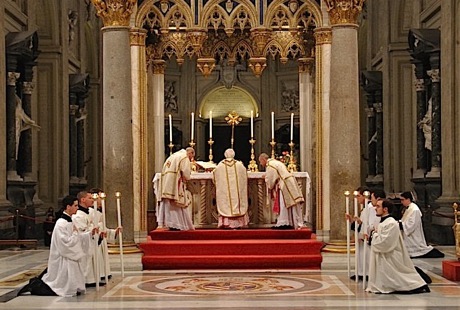
Here is Msgr. Marini on an issue we have dealt with many times on WDTPRS, namely, the so-called "Benedictine arrangement", that is, in lieu of the real goal of ad orientem worship, there should at least be a crucifix at the center of the altar so that it and not the congregation, not the priest, will be the center of focus.

My emphases and comments.

2. The orientation of liturgical prayer.

Over and above the changes which have characterised, during the course of time, the architecture of churches and the places where the liturgy takes place, one conviction has always remained clear within the Christian community, almost down to the present day. I am referring to praying facing east, a tradition which goes back to the origins of Christianity.

What is understood by “praying facing east”? It refers to the orientation of the praying heart towards Christ, from whom comes salvation, and to whom it is directed as in the beginning so at the end of history. The sun rises in the east, and the sun is a symbol of Christ, the light rising in the Orient. The messianic passage in the Benedictus canticle comes readily to mind: “Through the tender mercy of our God; * whereby the Orient from on high hath visited us”

Very reliable and recent studies have by now proven effectively that, in every age of its past, the Christian community has found the way to express even in the external and visible liturgical sign, this fundamental orientation for the life of faith. This is why we find churches built in such a way that the apse was turned to the east. When such an orientation of the sacred space was no longer possible, the Church had recourse to the Crucifix placed upon the altar, on which everyone could focus. In the same vein many apses were decorated with resplendent representations of the Lord. All were invited to contemplate these images during the celebration of the Eucharistic liturgy.  [We are getting a precis of Joseph Ratzinger’s writing on this topic.]

Without recourse to a detailed historical analysis of the development of Christian art, we would like to reaffirm that prayer facing east, more specifically, facing the Lord, is a characteristic expression of the authentic spirit of the liturgy. [Does it therefore stand to reason that if we don’t  pray facing the East in our liturgical prayer, then we are not praying according to the authentic spirit of the liturgy?] It is according to this sense that we are invited to turn our hearts to the Lord during the celebration of the Eucharistic Liturgy, as the introductory dialogue to the Preface well reminds us. Sursum corda “Lift up your hearts,” exhorts the priest, and all respond: Habemus ad Dominum “We lift them up unto the Lord.” [Quaeritur: Does this dialogue, when we are a) baptized and b) actively participating constitute an adequate interior orientation? Such that we don’t therefore need exterior orientation?] Now if such an orientation must always be adopted interiorly by the entire Christian community when it gathers in prayer, it should be possible to find this orientation expressed externally by means of signs as well. [Of course it should be possible.  We know that it is possible.  However… there is a question still hanging in the air.] The external sign, moreover, cannot but be true, in such a way that through it the correct spiritual attitude is rendered visible.  [And since we are both body and soul this is a highly desirable way to pray.  Put this another way.  If we don’t think people need to face the liturgical East, then are we effectively denying the bodily dimension of the congregation’s humanity?  Do we ask of people to do something that is unrealistic?]

Hence the reason for the proposal made by the then Cardinal Ratzinger, and presently reaffirmed during the course of his pontificate, to place the Crucifix on the center of the altar, in order that all, during the celebration of the liturgy, may concretely face and look upon Lord, in such a way as to orient also their prayer and hearts. [What we commonly call the "Benedictine Arrangement".  However, His Holiness also, when writing of this, indicated that this would be a – how to put this – a second best choice.  The better choice would be ad orientem worship by which congregation and priest actually face the same direction.] Let us listen to the words of his Holiness, Benedict XVI, directly, who in the preface to the first book of his Complete Works, dedicated to the liturgy, writes the following: “The idea that the priest and people should stare at one another during prayer was born only in modern Christianity, and is completely alien to the ancient Church. The priest and people most certainly do not pray one to the other, but to the one Lord. Therefore, they stare in the same direction during prayer: either towards the east as a cosmic symbol of the Lord who comes, or, [Nota bene…] where this is not possible, [get that?] towards the image of Christ in the apse, towards a crucifix, [thus the "Benedictine Arrangement"] or simply towards the heavens, as our Lord Himself did in his priestly prayer the night before His Passion (John 17.1) In the meantime the proposal made by me at the end of the chapter treating this question in my work ‘The Spirit of the Liturgy’ is fortunately becoming more and more common: rather than proceeding with further transformations, simply to place the crucifix at the center of the altar, which both priest and the faithful can face and be lead in this way towards the Lord, whom everyone addresses in prayer together.” (trans. from the Italian.)  [There it is.  But remember… the "Benedictine Arrangement" is proposed when the it is not possible for both priest and people to face the same direction.  But there is a preference.]

Let it not be said, moreover, that the image of our Lord crucified obstructs the sight of the faithful from that of the priest, for they are not to look to the celebrant at that point in the liturgy! They are to turn their gaze towards the Lord! In like manner, the presider of the celebration should also be able to turn towards the Lord. [Note that he uses both "priest" and "presider".] The crucifix does not obstruct our view; rather it expands our horizon to see the world of God; the crucifix brings us to meditate on the mystery; it introduces us to the heavens from where the only light capable of making sense of life on this earth comes. Our sight, in truth, would be blinded and obstructed were our eyes to remain fixed on those things that display only man and his works.

In this way one can come to understand why it is still possible today to celebrate the holy Mass upon the old altars, when the particular architectural and artistic features of our churches would advise it. [This would be an understatement, right?  If it is best to pray ad orientem then when where it is possible, it is desirable.  The architecture always "advises it".] Also in this, the Holy Father gives us an example when he celebrates the holy Eucharist at the ancient altar of the Sistine Chapel on the feast of the Baptism of our Lord.  [And anywhere else there is a main altar for ad orientem worship, right?]

In our time, the expression “celebrating facing the people” has entered our common vocabulary. If one’s intention in using this expression is to describe the location of the priest, who, due to the fact that today he often finds himself facing the congregation because of the placement of the altar, in this case such an expression is acceptable. [The expression might be, but the arrangement is sub-optimal.] Yet such an expression would be categorically unacceptable the moment it comes to express a theological proposition. Theologically speaking, the holy Mass, as a matter of fact, is always addressed to God through Christ our Lord, [And the point is, our actual physical orientation should reflect that.] and it would be a grievous error to imagine that the principal orientation of the sacrificial action is the community.  [I like that "grievous error" part.] Such an orientation, therefore, of turning towards the Lord must animate the interior participation of each individual during the liturgy. It is likewise equally important that this orientation be quite visible in the liturgical sign as well. [Because we are not angels and we do not deny the physical dimension of our human nature.]

Here is an example of where the architecture does not make it possible that priest and people face the same direction. 

Msgr. Guido Marini on liturgical issues: the "Benedictine arrangement"

The "Benedictine Arrangement" is perfect for this situation.  However, in those churches where the main altar exists, or it could be repaired, the better option should be adopted.

Msgr. Guido Marini on liturgical issues: the "Benedictine arrangement"


Posted in Brick by Brick, Our Catholic Identity, SESSIUNCULA, SUMMORUM PONTIFICUM | Tagged , ,
15 Comments























