Where’s the Latin?

I had a question from a reader about why the Pope doesn’t seem to use the papal "we" in his new encyclical.

We responded that we would wish to see the Latin text before we commented.

I looked for the Latin:

Where's the Latin?

Since the Latin office of the Secretariat of State is short-staffed at the moment, due to the absence of Fr. Foster, I am not entirely surprised that this encyclical, with its many modern concepts hard to render clearly into Latin, might not yet be ready.

But I hope it will be soon.

I hope that in the meantime, there is no significant tinkering with the text before the Latin version appears in the Acta or, tomorrow, in L’Osservatore Romano.  Although… does anyone want to be that tomorrow the version in L’Osservatore will be the Italian and not the Latin?

Posted in SESSIUNCULA |
30 Comments

Musing as I head off to sleep

One of the criticisms the SSPX has about the Second Vatican Council (and those initiatives and documents subsequently based on documents and the event of the Council) center on the documents being man-centered rather than God-centered. 

As a young but already prominent theologian Fr. Joseph Ratzinger wrote commentaries on Council documents.  He criticized Gaudium et spes on just such a point, that it was overly anthropocentric rather than Christocentric.  However, he found in Gaudium et spes key paragraphs which provided the proper interpretive key for reading the rest of the document.  For example, GS 22, one of the most famous paragraphs – and rightly so, helps us to read the whole of Gaudium et spes in the proper light. 

22. The truth is that only in the mystery of the incarnate Word does the mystery of man take on light. For Adam, the first man, was a figure of Him Who was to come, namely Christ the Lord. Christ, the final Adam, by the revelation of the mystery of the Father and His love, fully reveals man to man himself and makes his supreme calling clear. …

In order to deal with social questions of burning urgency, we have to have the proper starting point, the proper anthropology.  Our view of man must never be separated from Christ. 

As Catholic Christians we learn who we are by considering who Christ is.  Man’s proper end becomes clearer and our worldly aims take on deeper meaning and efficacy when Christ holds the proper place.  Our consideration of Christ, and what He did for us and asks us to do for each other and the world must form the core of our search for solutions for the ills of the world and the proper development of peoples.

Without the right lens, we can get a distorted vision of nearly anything!

I am just musing to myself, in a way.  But you might want to look over that section of Gaudium et spes before reading the Holy Father’s new encyclical. 

BTW… look up GS 27 while you are at it.

Posted in SESSIUNCULA |
21 Comments

How it gets done

"But Father! But Father!", ring the incipits of some e-mails. "How do you get everything done?  You seem to read a lot and post a lot." 

How it gets done

This is how it gets done, sometimes.

I multitask.

For example, this is how I read a 28K word encyclical.

How it gets done

Posted in My View, SESSIUNCULA |
29 Comments

The Problem With Toning Down the Rhetoric – And Why We Probably Won’t Do It

The Problem With Toning Down the Rhetoric – And Why We Probably Won’t Do It

Some of my Catholic friends have been urging me and others on the Catholic right to tone down the rhetoric when it comes to discussing issues related to the Notre Dame scandal, or Notre Shame as time is showing it to have been.  They want us to tone down our “harsh rhetoric” on issues such as abortion, President Obama and other Catholics who support him. These friends insist that they respect my right to my point of view, and they assure me that they, too, oppose abortion. However, they argue that many tactics of the Catholic pro-life movement are “negative” (e.g. showing pictures of aborted fetuses) and therefore counter-productive. They argue further that these tactics – which include protesting Notre Dame’s bestowing an honorary doctorate of law on President Obama – actually exacerbate tensions and divisions within the Catholic Church and within society at large.  Finally, they charge that such tactics are spiteful and otherwise uncharitable.  We on the right would say “sinful,” but these friends of mine don’t use that language.

I am not impervious to these criticisms. I don’t like being thought of in these terms, though I confess I sometimes accept their judgment with a touch of mischievous relish. I don’t know anyone on the Catholic or Christian right who wants to be thought of as using language that is counter-productive, divisive and spiteful.

Okay, maybe Ann Coulter, bless her.

But when it comes to their suggestion to tone down the rhetoric, I think we shouldn’t, and I doubt we will.

First of all, there’s history. No matter how earnestly these Catholic friends of mine insist that they oppose abortion, when I think about what they want us not to do, I am forced to conclude that they just don’t see the symmetry between the abortion issue and other moral tragedies in recent history, such as the Holocaust and racial segregation. Would my Catholic friends today not applaud those German, Austrian and Italian Catholics who risked their lives to speak out in the strongest terms against the racial policies of Hitler and Mussolini, even though in doing so they used language that their friends thought was counter-productive, divisive and spiteful?

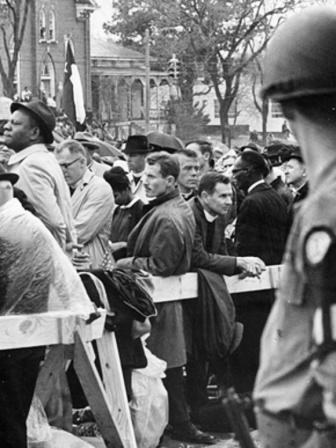
The Problem With Toning Down the Rhetoric – And Why We Probably Won’t Do ItAnd why can’t these friends of mine cast themselves in the role of American whites who, during the civil rights struggles of the 1960’s, urged those few outspoken Catholic priests, sisters, and laypeople who rode freedom buses and were arrested during sit-ins to tone down the rhetoric, because it was counter-productive and divisive?

Is it me, or is the outrage of these Catholic friends of mine over the recent murder of the abortionist George Tiller, and the blame they hurl at the “extreme rhetoric” of pro-lifers for his death, not analogous to the anger of those white Catholics in the 60’s who blamed civil rights activists for instigating the Watts and Detroit riots?

My second reason for not toning down the rhetoric on abortion follows from the first. When and why did the abortion issue cease to be a “justice and peace” issue? Answer: when it became a women’s issue.

Have you noticed that there’s something about opposition to abortion that gives the creeps to “progressive” Catholics?

By the way, they hate to be called “liberals” or “left-wing” Catholics; they think of themselves as just plain, ordinary Catholics.  We aren’t to label them, but they freely label us.  This is what “liberal” now means.  For liberals, pro-lifers are “single-issue Catholics” or “single-issue voters”, a label intended to accuse us of ignoring all the other life issues in the “seamless garment” that makes up their precious “consistent life ethic.”

QUAERUNTUR: When was the last time you saw a “consistent life ethics” Catholic instead of simply assuring you that, yes, they too oppose abortion, actually speak out loudly against abortion? Do you know any “consistent life ethic” Catholics who seriously weigh a candidate’s position on abortion when deciding how to vote in an election?

No. For progressive Catholics it’s okay, even respectable, not to get upset about abortion to the point of voting against legislators who support it. Abortion is the issue that gets left off of “peace and justice” agendas. Progressivist Catholics associate abortion with sexual ethics, not with human life ethics. They complain that pro-lifers do not care about the other “life issues” such as capital punishment, war, poverty and health care. Never mind that no one really knows what pro-life Catholics think about these issues! But “peace and justice” Catholics only mention abortion when they are clucking their tongues at the pro-life movement.

I suspect that behind this “peace and justice” Catholic vs. pro-life Catholic tension is the divide between Democrat and Republican Catholics. I’m not saying that all pro-life Catholics vote for Republicans. I know a few who don’t. But let’s be honest, it’s hard to find pro-life Democrats holding public office. Progressivist Catholics know this too. Their loyalty to the aims and leadership of the Democrat party accounts for part of their opposition to the rhetoric of pro-life Catholics.

My third reason for not wanting us to tone down the rhetoric is a sense I have, a feeling not easy to pin down.

I am sensing a kind of Zeitgeist in the air which censures the use of “harsh rhetoric.”

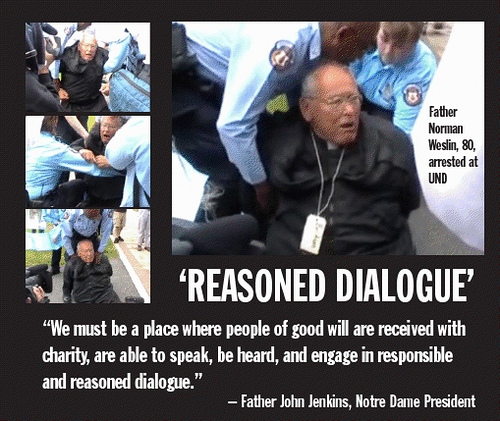
The Problem With Toning Down the Rhetoric – And Why We Probably Won’t Do ItI’ve been told by my progressivist Catholic friends that people today are turned off by the kind of angry, abrasive, “us v. them” rhetoric that reached a fever pitch during the Notre Dame controversy.  Just think!  American bishops were publicly critical of Notre Dame’s president. Pro-life protesters disrupted the graduation ceremony while President Obama was present, and some of them – “outsiders” as they were called – were arrested for trespassing on Notre Shame’s property.

Can you hear on the wind, on the waves, that whiny “why can’t we all just get along” mantra, scolding us for disrupting the feeling of harmony and comity we’re all supposed to be feeling in this Obama, post-political era?

These friends of mine praise Pres. Obama for his search for a “common ground” and his insistence on “dialogue,” even as they accuse pro-life Catholics of engaging in juvenile, discourteous rhetoric and of pursuing short-sighted, unrealistic and divisive political goals. What’s worse, in their eyes we are dragging this political conflict over abortion into the Church itself, where everybody should feel welcome, regardless of their views on abortion. Priests who preach about abortion are accused of alienating people in the pews. The new sin is making someone, anyone, feel uncomfortable because of his or her views or “lifestyle”.

But the net effect of this unrelenting censorship from the left is that the pro-life (yes, read: anti-abortion) message is ground down, silenced under the rubric of “it’s all right that we agree to disagree about this issue.”

Homosexual activists have a saying, “silence equals death.”  What they know, what the Catholic left doesn’t, is that all rhetoric aimed at effecting social and political change must, above all, be heard.

In the meantime, how many progressivist Catholic media shills will complain next week that this week’s G8 summit in L’Aquila, Italy, was disrupted by protesters advocating on behalf of the global poor or the environment?

You see, it’s not all acerbic rhetoric that merits labeling as counter-productive, divisive and uncharitable. It’s just pro-life rhetoric.

And that, in the end, is why we probably won’t tone it down.

Posted in Caption Call, Classic Posts, SESSIUNCULA, The future and our choices | Tagged , , , , , , , ,
168 Comments

New SSPX church to be built in Kansas

New SSPX church to be built in KansasFrom a reader:

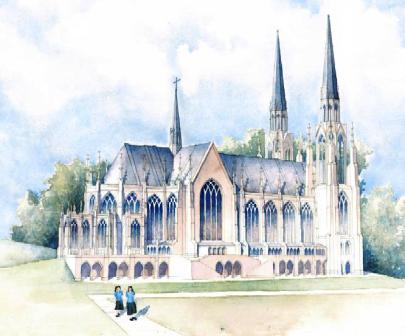
Fr.  I don’t know if you’ve seen it or not, but the SSPX is building a new church in St. Mary’s, KS.  It will seat 1,300 people, and will be a Gothic style church.  For an image of the planned church, you can see http://www.anewimmaculata.org/  The reason I’m writing is because they’re in the initial phase right now (taking down the existing ruins) and have released a press release (I’ve attached the press release).  Also, later this morning there is supposed to be a webcam posting the entire demolition.  Thought you might find it interesting.

Wow!  Yes, interesting!  More than interesting, I would say!  This sort of thing gives me hope.

It is wonderful that in this age people are stepping up to build beautiful churches for the sake of religion.

Brick by brick.

I look forward to the day when the Archbishop of Kansas City canonically appoints a pastor for that beautiful church!

Posted in Brick by Brick, SESSIUNCULA |
51 Comments

Pope Benedict reminds us about the Precious Blood of Christ

July is a month especially dedicated to our devotion to the Precious Blood of Christ.

The 1st of July remains the Feast of the Precious Blood in the traditional Roman calendar.  For a long time, from the time of Bl. Pius IX it was the 1st Sunday of July.

This is from VIS:

DEVOTION TO BLOOD OF CHRIST

VATICAN CITY, 5 JUL 2009 (VIS) – At midday today, before praying the Angelus, Benedict XVI recalled how the first Sunday of July was once dedicated to devotion to the Most Precious Blood of Christ, a tradition confirmed "by Blessed John XXIII who, in his Apostolic Letter ‘Inde a primis’ of 30 June 1960, explained its significance and approved its litanies".

  Addressing the faithful gathered in St. Peter’s Square, the Pope pointed out that "the theme of blood, associated with that of the Pascal Lamb, is of primary importance in Sacred Scripture", and he recalled Christ’s words at the Last Supper: "this is my blood of the covenant, which is poured out for many for the forgiveness of sins".

  "It is written in Genesis that the blood of Abel killed by his brother Cain calls to God from the earth. Unfortunately, today as yesterday, this cry has not ceased as human blood continues to flow because of violence, injustice and hatred. When will men learn that life is sacred and belongs only to God? When will they understand that we are all brothers? To the cry for spilt blood which rises from so many parts of the earth, God responds with the blood of His Son Who gave His life for us. Christ did not respond to evil with evil, but with good, with His infinite love.

  "The Blood of Christ is the pledge of God’s faithful love for humankind. By gazing at the wounds of the crucified Christ each man, even in conditions of abject moral poverty, can say: ‘God has not abandoned me, He loves me, He gave his life for me’, and thus rediscover hope".

  After praying the Angelus, the Holy Father spoke of the recent train accident in the Italian city of Viareggio which killed twenty-two people and injured many others. "I join the suffering of those who have lost loved ones, of the injured and of poeple who have suffered material loss", he said. "While raising heartfelt prayers to God for everyone involved in this tragedy, I express the hope that such incidents may not be repeated and that safety in the workplace and in daily life may be guaranteed".

  The Pope concluded by deploring "this morning’s attack in Cotabato, Philippines, where the explosion of a bomb in front of the cathedral during the celebration of Sunday Mass left a number of dead and many injured, including women and children. As I pray to God for the victims of this ignoble act, I once again raise my voice to condemn the use of violence, which is never a just solution to problems".

Posted in SESSIUNCULA |
13 Comments

Magister helps us with the “Cottier article” and Pres. Obama’s meeting with journalists

Magister helps us with the "Cottier article" and Pres. Obama's meeting with journalistsThe gentlemanly Sandro Magister of chiesa has posted an examination of the piece published in 30 Giorni under the name of Georges Card. Cottier, designed to color in advance the upcoming meeting of Pres. Obama with Pope Benedict. 

I did my own examination of the rather sloppy 30 Giorni piece.

Magister posts long sections of the Cottier article translated into English, which will help a lot of folks understand what is going on.  He also alerts us that the entire English version is online in 30 Days.

Magister calls the piece "enthusiastic", "very friendly", and "gushy", and adds – properly – "points of conflict remain".  Understatement!

Neither was he taken in by the Cottier piece.  Magister opines:

Cardinal Cottier seems almost to exalt Obama as a new Constantine, the head of a modern empire that is also generous toward the Church.

Also very useful is Magister’s coverage of the meeting Pres. Obama had with a group of journalists on Friday, 10 July at the White House.  He point out that the following day, Avvenire (the daily of the Italian bishops’ conference) published it almost in its entirety, "giving it strong emphasis".

Magister presents "the passages from the interview dealing with the most controversial issues, from abortion to homosexuality. In his replies, Obama offers an olive branch to the Church, as he tried to do on May 17 with his speech at the Catholic University of Notre Dame. But he also notes the points on which there is no agreement, and never will be."

Here is the section from the Magister piece which concerns the interview with Pres. Obama at the White House (in Italian in Avvenire) with emphases by yours truly as well as comments.

2. "I will always forcefully defend the right of the bishops to criticize me…" 

Interview with Barack Obama

Q: On respect for life and on marriage, the American Catholic bishops have expressed criticisms and concerns about your positions. How do you intend to address such criticisms? Or do you think that you will end up ignoring them?

A: Number one, one of the strengths of our democracy is that everybody is free to express their political opinions. There will never be a time when I decide to ignore the criticisms of the Catholic bishops, because I’m the president of all Americans, not just the Americans who happen to agree with me. I take people’s opinions seriously, and the American bishops have a profound influence in their communities, in the Church, and beyond.  [And that is why he won’t ignore them.  Note the reference to "communities"… which if the bishops really wanted to, they could organize.  One of the techniques Saul Alinsky taught was to give the impression of openess to your opponents and draw them into your agenda by earnestly listening to them.] What I would say is that although there have been criticisms leveled at me from some of the bishops, there have been a number of bishops who have been extremely generous and supportive even if they don’t agree with me on every issue. So in that sense the American bishops represent a cross section of opinion just like other groups do.  [A telling phrase, no?  What sort of impression have the body of American bishops left with the President?  I would pick up from this that they can be divided.] I will always forcefully defend the right of the bishops to criticize me, even in strenuous terms. And I would be happy to host them here at the White House to talk about the issues that unite us and those that divide us, in a series of roundtable discussions.  [Enter Saul Alinsky… stage left….] I think there are going to continue to be areas where we have profound agreements and there are going to be some areas where we disagree. That’s healthy. 

Q: You have appointed a working group composed of pro-life representatives and others who defend the right to abortion, with the purpose of finding common positions. What realistic expectations do you have about the results of their work?

A: The group will have to submit a final report to me by the end of the summer, and I’m not pretending that it will be able to eliminate the differences through debate alone. [Ummm… how else would one go about eliminating the differences?  But pay attention to this next part…] I know there are points on which the conflict cannot be resolved. ["cannot be resolved"] I can tell you, though, that on the idea of helping young people make smart choices so that they are not engaging in casual sexual activity that can lead to unwanted pregnancies, on the importance of adoption as a option, an alternative to abortion, on caring for pregnant women so that it is easier for them to support children, those are immediately three areas where I would be surprised if we don’t have some pretty significant areas of agreement. But [but] there are some elements, like contraception, on which the differences are profound. I personally think that combining good sexual and moral education needs to be combined with contraception in order to prevent unwanted pregnancies. I recognize that contradicts Catholic Church doctrine, so I would not expect someone who feels very strongly about this issue as a matter of religious faith to be able to agree with me on that, but that’s my personal view. We may not be able to arrive at perfectly compatible language on that front. I would be surprised if those who believe abortion should be legal would object to language that says we should try to reduce the circumstances in which women feel compelled to obtain an abortion. [If put that way, fine.  But if Pres. Obama were sincere in this, why is he also aggressively pushing to extend abortion rights even overseas through pressure on the UN?] If they took that position, I would disagree with them. I don’t know any circumstance in which abortion is a happy decision, and to the extent that we can help women avoid being confronted with a circumstance in which that’s even a consideration, I think that’s a good thing. But again, that’s my view.

Q: Some Catholics praise your contribution in promoting issues of social justice, others criticize you for your positions on issues of life, from abortion to research on embryonic stem cells. Do you see this as a contradiction?

A: This tension in the Catholic world existed well before my arrival at the White House. [Another telling phrase.  He again mentions the divisions among Catholics.] When I started to get interested in social justice, in Chicago, the Catholic bishops were talking about immigration, nuclear weapons, the poor, foreign policy. Then, at a certain point, the attention of the Catholic Church shifted to abortion, and this had the power to move the opinion of Congress and of the country in the same direction. [This is his way of criticizing the greater focus on abortion.  He is playing the "single issue" card here.] These are issues I think about a lot, but now, as a non-Catholic, it’s not up to me to try to resolve those tensions. Cardinal Joseph Bernardin, whom I met in Chicago, was strongly pro-life, never shrank away from talking about that issue, but was very consistent in talking about a seamless garment and a range of issues that were part and parcel of what he considered to be pro-life, [The "consistent life" idea which is used to minimize the fundamental primacy of the abortion issue.  Remember: people can disagree about this or that solution for a large range of social ills.  But the issue of the right to life is not something about which Catholics may disagree.] that meant that he was concerned about poverty, he was concerned about how children were treated, he was concerned about the death penalty, he was concerned about foreign policy. And that part of the Catholic tradition is something that continues to inspire me. And I think that there have been times over the last decade or two where that more holistic tradition feels like it’s gotten buried under the abortion debate. ["more holistic"… again, he plays the "single issue" card.] Whereas I would like it to stay front and center in the national debate.

Q: Many people, and not only doctors, who work in nongovernmental institutions are very concerned about being unable to make objections of conscience in ethically sensitive areas. Your administration’s position on this is not entirely clear . . .

A: My underlying position has always been consistent, which is I’m a believer in conscience clauses. I was a supporter of a robust conscience clause in Illinois for Catholic hospitals and health care providers, [at the same time as you, Mr. President, were voting to deny medical care to children who survived attempted abortions…. but I digress…] I talked about this with Cardinal Francis George at a recent Oval Office meeting, and I repeated it in my speech at the University of Notre Dame. I understand that there have been some who keep on anticipating the worst from us, and it’s not based on anything I’ve said or done, but is rather just a perception somehow that we have some hard-line agenda that we’re seeking to push. [Perception?  Read this and this.]  I think that the only reason that my position may appear unclear is because it came in the wake of a last-minute, eleventh-hour change in conscience clause provisions that were pushed forward by the previous administration that we chose to reverse because they had not been properly reviewed. [uh huh… that’s why it appeared unclear] But we are reviewing the question, and we have asked for opinions on this from the public, receiving hundreds of thousands of them. I can assure that when this review is complete there will be a robust conscience clause in place. It may not meet the criteria of every possible critic of our approach, [go figure] but it certainly will not be weaker than what existed before the changes were made.

Q: How do you reconcile your Christian faith with the promises you made to homosexuals during the electoral campaign?  [great question]

A: As for the gay and lesbian community of this country, I think that it is wounded by some of the teachings of the Catholic Church and by Christian doctrine in general. [?  QUAERITUR: Is it possible, truly, to be "wounded" by God’s will?] As a Christian, I struggle constantly between my faith and duties, [ah yes!  The overarching primacy of "the struggle".  Once you’ve "struggled", you can do as you please.] and my concerns toward gays and lesbians. And I often discover that there is a great deal of heat on both sides of the debate, even among those I consider to be great people. On the other hand, I stand firm on what I said in Cairo: any position that automatically dismisses the religious convictions and creed of others as intolerance does not understand the power of faith and the good that it does in the world. In any case, as people of faith we must examine our convictions and ask ourselves whether we sometimes cause suffering for others. [QUAERITUR: Are the tenets of Christianity, a Judeo-Christian morality and view of homosexual behavior just "convictions"?] I think that all of us, whatever our faith, must recognize that there have been times when religion has not been put to the service of the good.  [abusus non tollit usum] And it is up to us, I think, to undertake a profound reflection and be willing to ask whether we are acting in a way that is consistent not only with the teachings of the Church, but also with what our Lord Jesus Christ has called us to do: to treat others as we would like to be treated. [Is he proposing that the Lord would want Christian "convictions" to change because some people’s feelings are hurt?  We can all strive to be more perfect in charity, but charity does not permit us to alter the truth.]


I am always intensely interested to read what the President has to say.  His off the cuff or spontaneous remarks like these are revelatory.

And about that "Golden Rule" thing Pres. Obama wrapped up with, and people being "hurt".  If you asked around, do you think anyone, including the President, would want to be dismembered or burned with a solution or have a something shoved through his or her head? 

I’m just askin’…

In any event, folks, look at some of the sites I have linked, above, and do some close reading.

Posted in SESSIUNCULA |
30 Comments

Reminder: The future and our choices

The future and our choices

Posted in The future and our choices |
Comments Off on Reminder: The future and our choices

Fr. Z asks a favor… for fun

Please do me a favor… just for kicks.

Mulier Fortis, a friend of mine in England and good blogger, is interested in what sort of stat spike we can create.

Go POUND her site to bits.  All it takes is a click.

Are you a blogger? Pick this up and drive traffic.

Just as a tease…. here is a sample of her style…

Chris plays the organ at the 9am Mass. He apparently asked, "Shall I play Colours of Day during Communion?" I’m pretty sure he was joking. "Yes," came the reply, "do that… and I’ll send the boys round to break both your legs, and you can follow on with I watch the sunrise (through my hospital window)."

Posted in Lighter fare |
10 Comments

Video of the Pontifical TLM of Card. Canizares at the Lateran

Gloria TV has a video of the 21 April Pontifical TLM at the Lateran Basilica.

Posted in Brick by Brick, SUMMORUM PONTIFICUM |
11 Comments