Encycli-bites for reading “Caritas in veritate”

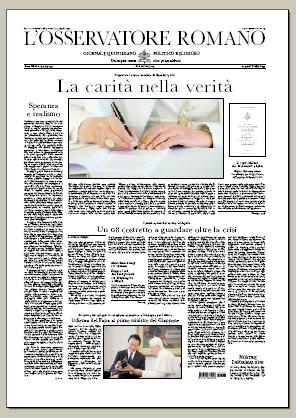
Encycli-bites for reading "Caritas in veritate"L’Osservatore Romano of 8 July has a few articles pertaining to the new encyclical.

Here is one of them.  Some folks helped to ferret out the corresponding English.

These bullet points were offered to help a reading of the encyclical. 

Call them… call them…. "encycli-bites".

  1. It is not a case of two typologies of social doctrine, one pre-conciliar and one post-conciliar, differing from one another: on the contrary, there is a single teaching, consistent and at the same time ever new. (12)
  2. The Church forcefully maintains this link between life ethics and social ethics,… (15).
  3. Only when it is free can development be integrally human; only in a climate of responsible freedom can it grow in a satisfactory manner. (17)
  4. Once profit becomes the exclusive goal, if it is produced by improper means and without the common good as its ultimate end, it risks destroying wealth and creating poverty. (21)
  5. “The scandal of glaring inequalities” continues. Corruption and illegality are unfortunately evident in the conduct of the economic and political class in rich countries, both old and new, as well as in poor ones. Among those who sometimes fail to respect the human rights of workers are large multinational companies as well as local producers. (22)
  6. The global market has stimulated first and foremost, on the part of rich countries, a search for areas in which to outsource production at low cost with a view to reducing the prices of many goods, increasing purchasing power and thus accelerating the rate of development in terms of greater availability of consumer goods for the domestic market. (25)
  7. Through the combination of social and economic change, trade union organizations experience greater difficulty in carrying out their task of representing the interests of workers… (25)
  8. Being out of work or dependent on public or private assistance for a prolonged period undermines the freedom and creativity of the person and his family and social relationships, causing great psychological and spiritual suffering. (25)
  9. The primary capital to be safeguarded and valued is man, the human person in his or her integrity. (25)
  10. The problem of food insecurity needs to be addressed within a long-term perspective, eliminating the structural causes that give rise to it and promoting the agricultural development of poorer countries. (27)
  11. It is necessary to cultivate a public conscience that considers food and the access to water as a universal right of all humans, without distinction or discrimination. (27) (Cf. Benedict , Message for the 2007 World Food Day: (2007), 933-935.)
  12. One of the most striking aspects of development in the present day is the important question of respect for life, which cannot in any way be detached from questions concerning the development of peoples. (28)
  13. In economically developed countries, legislation contrary to life is very widespread, and it has already shaped moral attitudes and praxis, contributing to the spread of an anti-birth mentality; frequent attempts are made to export this mentality to other States as if it were a form of cultural progress. (28)
  14. Further grounds for concern are laws permitting euthanasia as well as pressure from lobby groups, nationally and internationally, in favour of its juridical recognition. (28)
  15. Charity does not exclude knowledge, but rather requires, promotes, and animates it from within. Knowledge is never purely the work of the intellect. (30)
  16. Moral evaluation and scientific research must go hand in hand, and charity must animate them in a harmonious interdisciplinary whole, marked by unity and distinction. (31)
  17. Human costs always include economic costs, and economic dysfunctions always involve human costs. (32)
  18. Lowering the level of protection accorded to the rights of workers, or abandoning mechanisms of wealth redistribution in order to increase the country’s international competitiveness, hinder the achievement of lasting development. (32)
  19. In the list of areas where the pernicious effects of sin are evident, the economy has been included for some time now. (34)
  20. Without internal forms of solidarity and mutual trust, the market cannot completely fulfil its proper economic function. And today it is this trust which has ceased to exist, and the loss of trust is a grave loss. (35)
  21. The poor are not to be considered a “burden”[91], but a resource, even from the purely economic point of view. (35) (John Paul II, Encyclical Letter Centesimus Annus, 28: loc. cit., 827-828.)
  22. Economic activity cannot solve all social problems through the simple application of commercial logic. This needs to be directed towards the pursuit of the common good, for which the political community in particular must also take responsibility. (36)
  23. In commercial relationships the principle of gratuitousness and the logic of gift as an expression of fraternity can and must find their place within normal economic activity. (36)
  24. Every economic decision has a moral consequence. (37)
  25. Alongside profit-oriented private enterprise and the various types of public enterprise, there must be room for commercial entities based on mutualist principles and pursuing social ends to take root and express themselves. It is from their reciprocal encounter in the marketplace that one may expect hybrid forms of commercial behavior to emerge, and hence an attentiveness to ways of civilizing the economy. (38)
  26. In order to defeat underdevelopment, action is required not only on improving exchange-based transactions and implanting public welfare structures, but above all on gradually increasing openness, in a world context, to forms of economic activity marked by quotas of gratuitousness and communion. (39)
  27. Business management cannot concern itself only with the interests of the proprietors, but must also assume responsibility for all the other stakeholders who contribute to the life of the business: the workers, the clients, the suppliers of various elements of production, the community of reference. (40)
  28. Yet it is not right to export these things merely for the sake of obtaining advantageous conditions, or worse, for purposes of exploitation, without making a real contribution to local society by helping to bring about a robust productive and social system, an essential factor for stable development. (40)
  29. The broader conception of business activity favors cross-fertilization between different types of business activity, with shifting of competences from the “non-profit” world to the “profit” world and vice versa, from the public world to that of civil society, from advanced economies to developing countries. (41)
  30. To consider population increase as the primary cause of underdevelopment is mistaken, even from an economic point of view. (44)
  31. The economy needs ethics in order to function correctly — not any ethics whatsoever, but an ethics which is people-centered. (45)
  32. “Ethical financing” is being developed, especially through micro-credit and, more generally, micro-finance. These processes are praiseworthy and deserve much support. (45)
  33. In recent decades a broad intermediate area has emerged between the two types of enterprise. It is made up of traditional companies which nonetheless subscribe to social aid agreements in support of underdeveloped countries, charitable foundations associated with individual companies, groups of companies oriented towards social welfare, and the diversified world of the so-called “civil economy” and the “economy of communion.” (46)
  34. Today the subject of development is also closely related to the duties arising from our relationship to the natural environment. The environment is God’s gift to everyone, and in our use of it we have a responsibility towards the poor, towards future generations and towards humanity as a whole. (48)
  35. The international community has an urgent duty to find institutional means of regulating the exploitation of non-renewable resources, involving poor countries in the process. (49)
  36. The technologically advanced societies can and must lower their domestic energy consumption. (49)
  37. In order not to produce a dangerous universal power of a tyrannical nature, the governance of globalization must be marked by subsidiarity, articulated into several layers and involving different levels that can work together. (57)
  38. Cooperation for development must not be concerned exclusively with the economic dimension: it offers a wonderful opportunity for encounter between cultures and peoples. (59)
  39. Greater solidarity at the international level is seen especially in the ongoing promotion — even in the midst of economic crisis — of greater access to education. (61)
  40. Every migrant is a human person who, as such, possesses fundamental, inalienable rights that must be respected by everyone and in every circumstance. (62) (Cf. Pontifical Council for the Pastoral Care of Migrants and Itinerant People, Instruction Erga Migrantes Caritas Christi (3 May 2004): AAS 96 (2004), 762-822.)
  41. No consideration of the problems associated with development could fail to highlight the direct link between poverty and unemployment. In many cases, poverty results from a violation of the dignity of human work. (63)
  42. The global context in which work takes place also demands that national labour unions, which tend to limit themselves to defending the interests of their registered members, should turn their attention to those outside their membership, and in particular to workers in developing countries where social rights are often violated. (64)
  43. Hence the consumer has a specific social responsibility, which goes hand-in- hand with the social responsibility of the enterprise. (66)
  44. In the face of the unrelenting growth of global interdependence, there is a strongly felt need, even in the midst of a global recession, for a reform of the United Nations Organization, and likewise of economic institutions and international finance, so that the concept of the family of nations can acquire real teeth. (67)
  45. A particularly crucial battleground in today’s cultural struggle between the supremacy of technology and human moral responsibility is the field of bioethics, where the very possibility of integral human development is radically called into question. (74)
  46. Following his lead, we need to affirm today that the social question has become a radically anthropological question, in the sense that it concerns not just how life is conceived but also how it is manipulated, as bio-technology places it increasingly under man’s control. (75)
  47. There cannot be holistic development and universal common good unless people’s spiritual and moral welfare is taken into account, considered in their totality as body and soul. (76)

 

Posted in SESSIUNCULA | Tagged , ,
38 Comments

L’Osservatore Romano trying to redeem itself before Pres. Obama’s visit? Taking aim at the President?

As you know, L’Osservatore Romano embarrassed itself and the Holy See several times in the last couple months either through direction by the Secretariat of State, or extreme Euro-naivete, or both, as it helped grease the skids for a meeting between Pope Benedict and Pres. Obama during the time of the G8 in Rome.

Now, just days before Pope Benedict admits the American President to his presence, L’OssRom uses the occasion of a new encyclical which interprets and proposes anew Paul VI’s magisterium, to represent Paul VI’s defense of human life as a clear and irrevocable teaching of the Church.

There can be no rupture between Paul VI’s magisterium on human life and Pope Benedict’s. 

When Pres. Obama comes to Pope Benedict, he will be in the presence of the universal shepherd and teacher, Christ’s Vicar, the greatest defender of human life on earth.

Pres. Obama should have no illusions about what faithful Catholics believe or that he can suborn them for his agenda.

Here is the L’OssRom piece with my emphases.

Progress and the defense of life

29 June 1978, the Solemnity of Peter and Paul.  For the 15th anniversary of his coronation Paul VI pronounced a homily which constitutes a true and proper net result (proprio bilancio) of his whole pontificate.  It is the last great public speech of Pope Montini and in one passage – which we are including below – recalls some points of Populorum progressio and of Humanae vitae to which in today’s Caritas in veritate there are explicit and continual references.

We consider as binding the defense of human life.  The Second Vatican Council recalled with the gravest words that "God, the Lord of life, entrusted to men the highest mission of the protection of life!" (Gaudium et spes 51).  And we, who consider our consigned instruction ("consegna") absolute fidelity to the teachings of the same Council, made as a program for our pontificate the defense of life, in all its forms in which it can be threatened, disturbed or even suppressed.

We call to mind also here those most significant points which can attest to our intention.

We have above all underscored the obligation to favor the technical-material promotion of people on the road of development, with the encyclical Populorum progressio (26 March 1967).

But the defense of life must begin from the very origins of human existence.  This was the weighty and clear teaching of the Council, which, in the pastoral Constitution Gaudium et spes, warned that "life, once conceived, must be protected with the greatest care; and abortion, as infanticide, are abominable crimes" (51).  We did nothing other than accept this consigned instruction ("consegna") when, ten years ago, we issued the encyclical Human vitae (25 July): inspired by the untouchable biblical and evangelical teaching, which confirms the norms of natural law and irrepressible dictates of conscience in respect to life, the transmission of which was entrusted to responsible fatherhood and motherhood, that document became today of new and even more pressing topicality for the wounds inflicted by public legislation on the indissoluble holiness of the matrimonial bond and the inviolability of human life from the mother’s womb.  From here the repeated affirmations of the doctrine of the Catholic Church on the harmful reality and the most distressing effects of divorce and of abortion, contained in our ordinary magisterium as in particular acts of the competent Congregations.  We have expressed these, moved solely by the supreme responsibility of being the universal teacher and shepherd, and for the good of the human race.

As I said, the context of the new encyclical makes it is perfectly natural to propose anew what Paul VI said about human life right now.

But President Obama is also coming for an audience with Pope Benedict.

What do you think?

Coincidence?  Is this a shift?

Posted in SESSIUNCULA | Tagged , , , ,
11 Comments

No Latin yet

Well…, it seems my guess was right.

Tomorrow’s L’Osservatore Romano.  No Latin text yet.

No Latin yet

Posted in SESSIUNCULA |
18 Comments

How about you?

What is the good newsHow about you? in your life right now?

Let us know.


Posted in SESSIUNCULA |
66 Comments

An important paragraph in “Caritas in veritate”

I am still absorbing the encyclical, and I don’t want simply to toss snippets around.   But I am being hammered in e-mail to make some comments about the encyclical.

First, perhaps not much new is in the first part.  The Holy Father is offering some hooks to hang ideas on before moving into the next section. 

For immediate reflection look at par. 56 with my emphases and comments:

56. The Christian religion and other religions  [by "other" he surely means Islam] can offer their contribution to development only if God has a place in the public realm, specifically in regard to its cultural, social, economic, and particularly its political dimensions. The Church’s social doctrine came into being in order to claim “citizenship status” for the Christian religion.135 Denying the right to profess one’s religion in public and the right to bring the truths of faith to bear upon public life has negative consequences for true development. The exclusion of religion from the public square [he is referring to secularism and materialists] — and, at the other extreme, religious fundamentalism [which imposed one religious voice in the public square – he probably means Islam here] — hinders an encounter between persons and their collaboration for the progress of humanity. Public life is sapped of its motivation and politics takes on a domineering and aggressive character. Human rights risk being ignored either because they are robbed of their transcendent foundation or because personal freedom is not acknowledged. Secularism and fundamentalism exclude the possibility of fruitful dialogue and effective cooperation between reason and religious faith. Reason always stands in need of being purified by faith: [This has long been a topic of interest for the theologian Joseph Ratzinger, the relationship of faith and reason.] this also holds true for political reason, which must not consider itself omnipotent. For its part, religion always needs to be purified by reason in order to show its authentically human face. [As he said in the Regensburg Address.] Any breach in this dialogue comes only at an enormous price to human development.  ….  [We make man the center and goal of our discourse and progress at man’s own peril.]

135John Paul II, Encyclical Letter Centesimus Annus, 5: loc. cit., 798-800; Benedict XVI, Address to the Participants in the Fourth National Congress of the Church in Italy, Verona, 19 October 2006.

I can hear it now… "But Father! But Father!", some are already quipping.  "Why this paragraph?  Don’t you want to talk about how God is still love?"

Indeed, there is time for more talk about God and love.

On this blog for a long time now I have been yammering away about our Catholic identity. 

Without a strong Catholic identity, in keeping with our tradition, an identity well-informed, well-integrated, we will endanger our souls by being confused under the onslaught of secularism and relativism and we will be silenced, shoved from the public square. 

For Holy Church to have an influence in the public square, on the burning questions of our day, we all must have a clear and strong identity. 

I think this is a key to understand the pontificate of Pope Benedict: he is working to revitalize our Catholic identity.  He did so with a huge step (liturgically) in Summorum Pontificum on 7 July 2007.  He is doing the same in this encyclical on 7 July 2009.  Other milestone indicators were the Dec 2005 Address to the Roman Curia and the Sept 2006 Regensburg Address.

It seems to me that par. 56 is an important paragraph in the encyclical.

Also, when reading Pope Benedict on anything think what he is saying ad intra and ad extra.

In the first section, in the midst of his representation of God and love, Pope Benedict also makes a case – to Catholics but also a wider listening world (ad intra and ad extra) – for how the Catholic Church is uniquely positioned in the world to point towards mankind’s proper and best trajectory, even in the realm of economics, etc.

The Catholic Church ought, in fact, to have not just a voice but even a privileged voice in the public square precisely because of her relationship to Christ and who man is, who man’s ultimate goal is. 

Christ is divine Logos (word, mind, reason, etc.) even as he is love, charity, etc.  Man, in God’s image, must be directed to Christ, Logos/Agape, and in his worldly workings directed by Christ, Logos/Agape.  Reason cannot be excluded because the proper view of man as image of God cannot be excluded.

Pope Benedict is presenting ad intra and ad extra a case for the Church’s voice in the public square.  This is a logical consequence of the proper view of Christ and of man.  Even so, other religions also have a role to play, provided they admit of the dimension of the Logos in man’s very nature.   But they must adhere to the proper relationship of faith with reason to do so.  Otherwise, what they give to the public square does more harm than good.  And they still can’t do this as well as the Catholic Church can!

If we exclude this constitutive dimension of man, little will go right in man’s endeavors.  We err in excluding God from man’s endeavors and we err in imposing the wrong notion of God and man and will inevitably make the wrong choice in the face of challenges.

This encyclical is part of Benedict’s plan to rebuild our Catholic identity in the face of secularism, relativism, and a fundamentalist religious view which doesn’t admit of the proper role of reason.  He is trying to get us out into the public square, keep our voice audible.  He is also trying to penetrate the opposition to God in the public square. 

This is a great concern of his pontificate.

Posted in Our Catholic Identity, SESSIUNCULA, The Drill | Tagged , , , ,
33 Comments

Some recent entries

Some recent entriesTo some of you who are newcomers or haven’t been to the blog lately, you might check these recent entries:

These entries have generated a little buzz and interesting comments.
Some recent entries

Posted in SESSIUNCULA |
Comments Off on Some recent entries

Yes, I know that George Weigel wrote about the encyclical

You can stop sending me notes that George Weigel wrote about the new encyclical.   I am not sure what his beef is with Caritas in veritate, other than that it cites Paul VI and Populorum progressio.  That’s all about that for now.

Posted in SESSIUNCULA | Tagged , , ,
Comments Off on Yes, I know that George Weigel wrote about the encyclical

The new encyclical

Some sites are posting little excerpts of the encyclical.  Fine.  I want to wait and absorb this a little and think about it before posting too much.  There is a lot going on in the encyclical.  I would rather offer something substantive.

Be patient… I’ll get there. 

You can stop sending me e-mails telling me there is a new encyclical out.  o{]:¬)  I know.

Posted in SESSIUNCULA |
45 Comments

French site Golias out Tablets the Tablet on a possible SSPX solution

This morning I posted an response to a query about the validity of marriages witnessed by an SSPX priest (short answer: they are invalid because of defect of form since the priest is suspended a divinis).

Synchoronicitously…. if that is a word… a reader sent the following from the French site Golias which is, as the sender wrote "more Tablet than the Tablet".

A scary thought but a good way to approach what Golias wrote. 

It looks like this might have come from the vigilant CathCon Here is what Golias wrote (not my translation):

SSPX developments sooner than expected?

From Golias the "more Tablet than the Tablet" French left-wing Catholic journal.

Lefebvrists: Canonical support for fool’s bargain [There’s a broad hint at what their attitude is!]

Before writing a Motu proprio on the Lefebvrists, the Curia are now in the process of thinking about an immediate solution with a view to the final reintegration of the fundamentalists. [I think that Golias intends the reader to view "fundamentalists" as "bad".  What do you think?]

According to information, or our informants, [which? LOL!]  Rome would, following the controversy about the ordinations celebrated recently by the SSPX, like to find a compromise solution, even before the completion of theological discussions.

This would clear the ground and initiate things faster. It is quite likely that the Curia had planned, [That would be the PCED, probably in conjunction with the CDF] under the good care of Monsignor Mario Marini, [buon anima] secretary of the Ecclesia Dei Commission, now deceased, a document, additional to the lifting of the excommunication of the four holy bishops consescrated by Archbishop Lefebvre, lifting the suspension imposed a divinis on the priests and brothers [I don’t think that non-clergy can be suspended a divinis.  But… get that?  Lift the suspension a divinis?  Hmmm… that would not, however, give them faculties to say Mass, preach and hear confessions.  But it would open the way to the next step: granting them faculties.] of the SSPX. Bish op Bernard Fellay, the superior of the Fraternity of Saint Pius X, showed reluctance (because this form also showed a commitment to respect the authority of local bishops) that Rome then gave up on a similar project of transitional canonical regularisation. Now it is exhumed from oblivion.  [I made a suggestion along this line some while back: give them temporary faculties, contingent on the progress of the theological discussions.]

The idea is obviously clever, [What they mean is "sneaky"] even if from a canon, and especially theological, it is not without posing formidable problems.  [INSERT CRICKET SOUNDS HERE….?!?]  Indeed, it puts in a certain fashion, if only precariously, the cart before the horse in assuming things are resolved when they are not. 

In the spirit of Pope Benedict and Cardinal Dario Castrillon Hoyos, for very short time again in charge of the case, it would be well to take account of multiple oppositions which would become less easy of the SSPX was in canonical good standing (albeit for a time) and not, in the words of Abbé Claude Barthe, in a state of " canonical weightlessness." This initiative would establish Roman legitimacy (and the undeniable validity of SSPX confessions and marriage services) of the sacraments celebrated by priests of the SSPX.  [Well… no… it wouldn’t.  Lifting the suspension a divinis is not the same step as the granting of faculties.  The lifting of the suspension could open the way to delegation, etc.]

In addition, it is a clear encouragement to reluctant bishops, like those of Germany. This idea could lead revitalise even in Rome herself very strong opposition, for example from Cardinals Levada (Congregation for the Doctrine of the Faith)  [This is wishful thinking.  Does anyone seriously think that if the Pope is behind such a move, the Prefect of the CDF would rise against it?  Piffle.] and Re (bishops) [Approaching retirement age… d’ya think he would fight the one who can accept his resignation?] and Bishop Francesco Coccopalmerio, President of the Council for the Interpretation of Legislative Texts [Again… if the Pope is backing this, is it likely that the head of this dicastery, which participated in the review of the lifting of the excommunications of the SSPX bishops, would rise in opposition?]  due to the violation of the law and its spirit that it entails, [Yah… can’t have unity, now, can we!]  ultimately not affecting the subject (the SSPX can stick to its position) and would be an expedient, an artifice that is temporary solution and ad hoc on a weak basis. Its only advantage is the benefit of the SSPX because it would be a way to support the fraternity.  [Well… yes.  It would be better to bring the whole shootin’ match in, rather than bring in individuals.]

If the Pope were to adopt such a solution, which is possible, it could create an uproar which would be proof of an unbelievable complacency.  [Rubbish.]

 Read this over again.  It is a lesson in "liberal reasoning".

Posted in SESSIUNCULA, The Drill | Tagged , , , , ,
8 Comments

QUAERITUR: validity of SSPX marriage

From a priest reader:

Dear Father,

I have become acquainted with a family in my parish (Diocesan sponsored EF twice a week) and the parents were married in a SSPX chapel.  My question to you, after having posed this to three solid, traditionally minded priests, is this: What is the canonical status of that marriage?  Is the marriage considered valid but illict?  Is it similar to a protestant marriage that needs to be canonically regularized within Holy Mother Church? Or, is it considered invalid because those in SSPX are under different canonical standards than a non-Catholic?  Or, is it simply valid, end of story? 

Perhaps you have already addressed this issue and can direct me to a answer. Either way, your insight would be much appreciated. 

I have addressed this before, but repetita iuvant, as they say.

The marriage would be (most likely) invalid not because of a lack of form, but rather a defect of form.

Even though canonical form was followed, there was a defect affecting validity because the priest who officiated lacked delegation (c. 1111) from the parish priest or local ordinary.

Moreover, the priest (if he was a priest of the SSPX) is suspended a divinis.  He therefore cannot be delegated to officiate at a wedding (cc. 1109 and 1333).
 
Some argue that c. 144 (on common error and probable doubt) applies.  This argument is without merit, since it does not cover willful ignorance.
 
The couple in question should seek a sanatio in radice (retroactive convalidation). They can apply for this through the diocesan tribunal.

Posted in "How To..." - Practical Notes, ASK FATHER Question Box | Tagged , , , ,
49 Comments