Cool photo of the Space Shuttle Atlantis transiting the Sun!


Fascinating post on the blog In The Footsteps of Joseph Rock about a Catholic Church in western China on the Tibet/China border. Great photos and interesting story.
A reader alerted me to an article on kreutz.net which deals with Communion in the hand at celebrations of Holy Mass with the 1962 Missale Romanum, and the employment of altars girls.
I don’t have time to translate it from German right now.
Apparently a canon lawyer named Wolfgang F. Rothe, has put out a study of Summorum Pontificum Liturgische Versöhnung.
The book has a preface by Msgr. Camille Perl, Vice President of the Pontifical Commission “Ecclesia Dei“.
Perhaps someone who has a little time can drill into this and help the readers.
It has been a super busy day at the feeder.
We have seen the usual suspects, that is Team Goldfinch and Team Siskin, as well as the never elusive Chickadee and Nuthatch, sundry Sparrows. But there are others on view.
Since I changed the feeder setup, things are really picking up!
Here are some shots.
Mrs. Grosbeak

One of the many Messers Grosbeak. I have, I think, four pairs now.

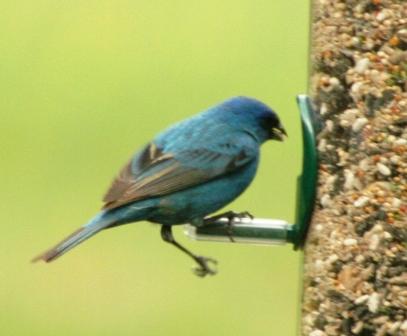
Indigo Bunting

Red-winged Black Bird

Downy Woodpecker
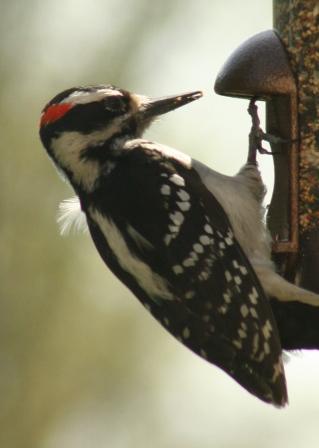
Cowbird

Mrs. Oriole, digging into orange goodness.


Mrs. Grosbeak

Mr. House Finch

Mr. Oriole getting serious about some grape jelly.
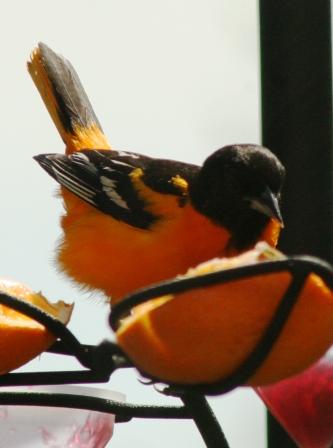
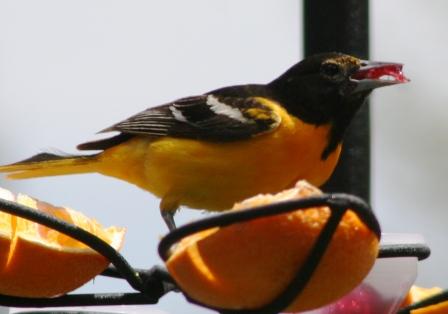

Auditioning for the Hitchcock’s next reimagining…

This Indigo Bunting is about to have a rude visitor.

Some relative sizes

I saw a Red-Bellied Woodpecker today on a nearby tree.



This is a new visitor. I believe we have here Brown Thrasher.

And this might be … I am not sure who this is, frankly. But he … she showed up today.
I think it might be Mrs. Cowbird, but I am not sure.


The Dove and the Trasher did not get along at all. The Dove was always seeking to drive the other away.

The enemy.

oopps

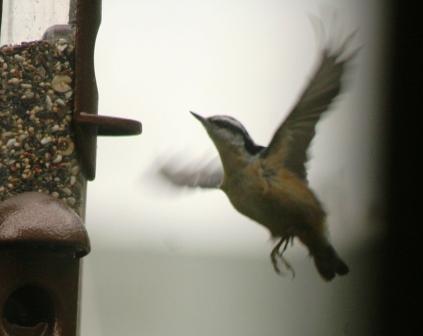
Here is Red-breasted Nuthatch.


Bunting again..

UPDATE: Slightly revised and corrected.
During a lunch break I saw a segment on a cable news network about the Notre Dame dust up.
There was a representative of Catholic Democrats, a liberal group, soft on abortion, which seeks to politicize the controversy at Notre Dame.
The group Catholic Democrats, and adherents to Catholic-lite and the corrosive Kmiec Compromise, will use similar talking points.
On the other side of the issue (the correct side) I am hearing the talking heads use more and more consistent language, some of which has slowly but surely been crafted here. Wonks are reading. The blogosphere is useful for shaping the conversation!
Get familiar with the talking points and be ready to respond when you have conversations about this.
1. Pres. Obama’s approach to abortion is more in keeping with the Catholic Church’s teachings because what he proposes to do will decrease the number abortions.
The problem with this position is that, while people of good will can disagree about how to better the social and economic circumstances of poorer people who might chose abortion as a solution to a problem (and there is really no way to quantify that), Catholics may not disagree about the intrinsic evil of abortion. We cannot simply gloss over or turn a blind eye to an evil because something good might be done in another sphere.
2. Since the Catholic Church has effectively lost on the abortion issue, we have to compromise and cooperate on a range of other social justice issues to improve the lot of those who, because of economic disadvantage, might choose abortion.
Catholics have no problem cooperating with anyone in improving people’s lives. However, it is not permissible to cooperate in an intrinsically evil act. If those who are soft on abortion are saying that we must press to help people participate more fully in society through an improved socio-economic standard of living, we must respond that no one participates in anything if he is dead. Abortion is wrong. People must have a right to live before they have a right to liberty and the pursuit of happiness. We cannot condone or look aside from abortion for the sake of other important, and yet logically secondary issues.
3. Opponents of Notre Dame’s decision don’t want to permit dialogue. They don’t want to "engage" the President or permit his view to be heard.
That is a distortion of the issue. Catholics object not because the President was invited to speak (something which is not without its own difficulties) but rather because Notre Dame desired to bestow an honor on President Obama. You honor those whom you believe to have laudable views, positions, past actions, etc. Pres. Obama has been one of the most aggressive proponents of abortion on the American stage. It is unthinkable that a Catholic institution would honor such a person for his positions and actions.
Leaving aside whatever may be the President’s personal political agenda for this event, opponents of the decision to bestow an honor on this aggressive pro-abortion public figure are angry that a Catholic University has chosen in such a blatant way to abandon its Catholic identity and instead pander to secular power.
4. Opponents of Notre Dame’s decision are really just siding with the Republican party against a Democrat President.
False. This has nothing to do with party politics. The core of the objection raised to Notre Dame is not so much about the President himself, but about the choice of a Catholic University to bestow an honor on this President. The problem rests in Notre Dame’s betrayal of their Catholic identity. This is not a matter of partisan politics no matter what groups such as Catholic Democrats claim.
Furthermore, the supporters of Notre Dame’s decision are the sole political partisans in this debate. They are in lockstep with the Democratic Party. They are the ones who distribute talking points to their adherents precisely recommending to politicize the issue! As a democrat party operative wrote in a letter, with talking points:
It is good to frame the debate that this ND "scandal" is about supporting the Republican platform’s view of life issues.
Again, opponents of Notre Dame’s decision are not in this case objecting because of political party affiliations. The true problem is Notre Dame’s betrayal of Catholic identity.
5. Polling suggests that a majority of Catholics are not in favor of Notre Dame’s rescinding the invitation. Most ND students don’t object to the President speaking at Notre Dame’s commencement. A majority of Catholics voted for President Obama in the election. Therefore, only a hard-core minority of bishops and Catholics object and most Catholics don’t even know about this issue.
The truth is not determined by polling. When a majority of the world thought that the world was flat, that majority opinion did not make the world flat. When a majority of Germans in the 1920’s and 30’s brought the National Socialist Party to power, they were not therefore doing a good thing.
That a majority of Catholics are either unaware or unconcerned about what Notre Dame did is tragic, but that majority in no way changes the Church’s teachings or the fact that Notre Dame has abandoned Catholic identity.
Adherents of Catholic-lite and the corrosive Kmiec Compromise are in the final analysis deeply impressed by polling. Because they do not give the Magisterium of the Church its due and, by their own personal authority, they determine which teachings they will adhere to on this day or that, they therefore seek to justify their choices by pointing to crowds of people around them who choose the same errors.
6. Pope Benedict has met with world leaders.
That is what Popes do. That is what Catholics do. We will meet and engage in dialogue. But when, for example, Paul VI met with Idi Amin Dada or John Paul II met with Fidel Casto or Yassir Arafat, those Popes did not them bestow a formal honor on them.
7. Pro-abortion French President Nicholas Sarkozy was made an honorary canon of the Pope’s own Cathedral, the Lateran Basilica. If that can happen in Rome, then no one can object if Notre Dame gives an honor to the President.
On the surface, this point seems compelling. But the analogy isn’t good enough to support the position that Pres. Obama should therefore be honored at Notre Dame. The President of France has, ex officio, the right to be a canon of the Lateran, no matter what his stance on abortion may be. He takes that place as a matter of course. The Holy Father could, of course, rescind that, but there would be diplomatic repercussions between states: this has been the right for the French head of state since the time of King Henry IV (+1610). Henry in 1604 gave to the Lateran chapter the ownership of the Benedictine Abbey of Clariac. The Pope therefore made the French head of state ex officio an honorary canon of the Lateran. Thus, this "honor" comes automatically. It does not come after a decision of the Pope or the Lateran chapter. Though I remember reading that Notre Dame has a standing invitation to Presidents to speak at their commencement, Pres. Obama does not have an ex officio right to do so. Nor does the President have the right to be recognized with an honorary doctorate of law. Notre Dame made a decision to give an honor to Pres. Obama.
Moreover, even though Pres. Sarkozy is known to be pro-abortion, I doubt very much that he would have twice voted in a provincial assembly against a law that would require life-saving measures to be applied to a baby who had survived attempts to abort it. There is the issue of Pres. Obama’s extreme position.
There is also the policy of the USCCB for Catholic institutions. The USCCB said that Catholic institutions should not give these platforms to such politicians. Notre Dame ignored, even defied, the USCCB. The USCCB is less important that some would hope to make it. What is far more important is the still unimplemented Ex corde Ecclesiae.
Those are a few of the talking points off the top of my head.
Get familiar with the talking points and be ready to respond when you have conversations about this.
An excerpt from an article I wrote for The Wanderer, to which you may subscribe in print and in an online version:
We know with holy and Catholic Faith that what was not assumed, was not redeemed (St. Gregory of Nazianzus – +389/90). Our humanity, body and soul, was taken by the Son into an unbreakable bond with His divinity. When Christ rose from the tomb, our humanity rose in Him. When He ascended to heaven, so also did we ascend. In Christ, our humanity now sits at the Father’s right hand. His presence there is our great promise and hope here. It is already fulfilled, but not yet in its fullness. That hope informs our trials in this life.
Be clear. Not only Christ’s humanity but our humanity ascended into heaven. Preaching on 1 June 444 St. Leo I, “the Great” (+461) taught (my emphasis), “Truly it was a great and indescribable source of rejoicing when, in the sight of the heavenly multitudes, the nature of our human race ascended over the dignity of all heavenly creatures, to pass the angelic orders and to be raised beyond the heights of archangels. In its ascension it did not stop at any other height until this same nature was received at the seat of the eternal Father, to be associated on the throne of the glory of that One to whose nature it was joined in the Son.”
Leo says in another sermon of 17 May 445, “This Faith, reinforced by the Ascension of the Lord and strengthened by the gift of the Holy Spirit, has not been terrified by chains, by prison, by exile, by hunger, by fire, by the mangling of wild beasts, nor by sharp suffering from the cruelty of persecutors. Throughout the world, not only men but also women, not just immature boys but also tender virgins, have struggled on behalf of this Faith even to the shedding of their blood. This Faith has cast out demons, driven away sicknesses, and raised the dead.”
The liturgical celebration of Ascension by the Latin Church has become a little confused in recent years. In the post-Conciliar calendar used with the Novus Ordo editions of the Missale Romanum for this Sunday we ought to be observing the 7th Sunday of Easter. Ascension Thursday was a few days back, appropriate on Thursday. However, by the same logical that dislocated Epiphany from its proper place twelve days after Christmas (“Twelfth Night”), some years ago the Holy See allowed conferences of bishops to transfer the celebration of Ascension Thursday to the following Sunday. I call this liturgical quirk “Ascension Thursday Sunday”.
Those who are participating at Holy Mass with the 1962MR avoid this folderol.
Folks, I know the argument. The bishops hope to expose more people to the mystery of the Ascension of the Lord. Because it is too hard to go to Mass also on Thursday, they moved the feast to Sunday. Well… in most places they moved it to Sunday. What is even more confusing is that it isn’t transferred in some dioceses. In the 1983 Code of Canon Law c. 1246, Ascension Thursday is indicated as one of the few Holy Days of Obligation. Again, I know the laudable reason for moving the feast. However, perhaps it is the influence of reading so much St. Augustine over the years, but my present view of human nature suggests to me that when Holy Mother Church’s pastors lower expectations regarding the liturgy, people get the hint: it just isn’t that important. Maybe none of it is important. Thus, I am left with the opinion that the option to dislocate such an important and ancient feast is an arrogant novelty.
The celebration of Ascension on a particular Thursday is rooted in Scripture and reflects the ancient practice of the Church in East and West alike. We read in Holy Scripture that nine days, not six, intervened between the Lord’s physical ascent to the Father’s right hand and the descent of the Holy Spirit at Pentecost. Ascension Thursday was fixed at the 40th day after Easter from about the end of the 4th century. In the Latin West, St. Augustine of Hippo (+430) called it Quadragesima (“fortieth”) Ascensionis. In the Greek East, St. Gregory of Nyssa spoke of it in 388. That’s only a 16 century tradition. Eastern Christians haven’t transferred Ascension.
What must the Easterners think of us Latins?
But let’s be more positive. With the third, 2002 edition of the Missale Romanum we have once again a Mass for the Vigil of Ascension. This wasn’t in the 1970 or 1975 editions. Moreover, there are now proper Masses for the days (nine? six?) after Ascension until Pentecost, most having alternative collects depending on whether or not in that region Ascension is transferred to Sunday. As I mentioned last week, in the new printing of the 3rd edition there will also be an option for a longer celebration of the Vigil of Pentecost, in keeping with the ancient use similar to the Vigil of Easter, with various readings. There is a parallel between Easter and Pentecost for the sacraments of baptism and confirmation, which in the Latin Church were of old conferred in the same rite.
Drop to your knees and thank God for Pope Benedict and the provisions by which he liberated the use also of the pre-Conciliar liturgy through Summorum Pontificum. Whether you prefer the older form of Mass or the newer, Pope Benedict is working to heal the rupture that took place after the Council in our worship of Almighty God. The older use will exert a “gravitational pull” on the celebration of the newer forms and the whole Church will benefit.
A reader alerted me to this interesting piece of information from ICEL about musical settings with the new translation.
Music for the Roman Missal
The International Commission on English in the Liturgy, while working on a new translation of the Roman Missal, assembled a small committee of expert musicians to prepare musical settings of the texts that are set to music in the 2002 Latin edition of the Missal. They were directed to follow as closely as practical the Gregorian melodies given with the Latin text. The Music Committee has worked closely with the translators. ["Gregorian melodies"]
The Commission has now approved settings for those parts of the Order of Mass that received recognitio from the Holy See in June 2008, in accord with Cardinal Arinze’s expressed wish that the publication of these texts ‘facilitate the devising of musical settings’. The Commission is now making these settings available on a secure website, accessible by a password, which has been communicated to the Chairmen of the Liturgy Commissions in each of ICEL’s Member and Associate-member Conferences. They will distribute the password as they see fit. [!]
The Introduction, giving a rationale for the choices made, is accessible to all.
Work continues on music for the remainder of the Missal. This will be made available when the final texts are known.
From the Introduction:
MUSIC FOR THE ENGLISH LANGUAGE
ROMAN MISSAL
AN INTRODUCTION
For the forthcoming English translation of the Roman Missal (sometimes called the Sacramentary), the International Commission on English in the Liturgy (ICEL) will offer to the Conferences of Bishops of the English-speaking world chants for everything that is set to music in the Missale Romanum, editio typica tertia (2002):
In some cases, following the example of the Missale Romanum, both simple and solemn settings have been provided.
Principles
ICEL’s work in preparing chant settings of the English translation has been guided by several principles:
- To preserve and recover the tradition of unaccompanied singing in the Roman Rite, since the liturgy “is given a more noble form when . . . celebrated solemnly in song” (Second Vatican Ecumenical Council, Constitution on the Sacred Liturgy Sacrosanctum Concilium, 1963 [hereafter SC] 113);
- To facilitate “full and active participation by all the people,” which is “the aim to be considered before all else” (SC 14);
- To take full account of the accentuation of the English language, since “the nature and laws of each language must be respected” in the adaptation of traditional melodies (Sacred Congregation for Rites, Instruction on Music in the Liturgy Musicam Sacram, 1967, 54);
- To retain vernacular chants now in use where possible, since “there must be no innovations unless the good of the Church genuinely and certainly requires them” (SC 23).
The Commission’s musical consultors have undertaken a detailed analysis of the Latin settings, creating tables of accent patterns and musical formulas. Likewise for the new English translation, tables of the accent patterns have been created, in order to arrive at the best solution where the English text has accent patterns not found in Latin. The musicians have found it helpful to look at the work of other vernacular chant adaptations such as Spanish, French, and German. German-language scholarship has proven helpful, both because German-speaking scholars began investigating vernacular chant adaptation as early as the 1920s, and also because the German language has some similarities to English, for example, in the accent often falling on the final syllable of a phrase. The musicians also examined the previous work of English language chant adaptation in the liturgical books of 1966, 1970, 1971, and 1973. With all this in mind, their uppermost concern has been the actual celebration of the liturgy by worshiping communities and ministers.
Some of the Most Commonly Sung Chants
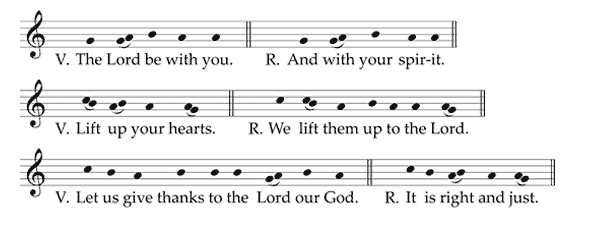
Preface Dialogue
For the Preface Dialogue at the beginning of the Eucharistic Prayer, the setting currently used in most of the English-speaking world is retained, with appropriate adjustments for the revised text:
Take a look and discuss!
A note of interest to Iowans, and others…
Una Voce-Cedar Rapids is very pleased to announce that the Traditional Latin Mass (Missa Cantata) will be offered every Sunday at 7:00am at St. Wenceslaus Catholic Church in Cedar Rapids, Iowa beginning Sunday May 24, 2009.
Mass in the Extraordinary Form will be offered by the pastor of St. Wenceslaus, Fr. Christopher Podhajsky. We are greatly indebted to Fr. Podhajsky who took it upon himself to learn the TLM out of his pastoral zeal for the good of souls. This is another success story for the FSSP/EWTN/UVA training DVD, because Fr. Podhajsky said that the DVD was a godsend to him which enabled him to learn to offer the TLM.
St. Wenceslaus Catholic Church
1224 5th St. S.E.
Cedar Rapids, Iowa 52401
From a reader:
I generally go to the Extraordinary Form of the Mass on Sundays but pray the Liturgy of the Hours.
I live in Los Angeles, CA, one of the areas where Ascension Thursday is moved to Sunday in the Ordinary form.
Since the EF doesn’t move Ascension Day to Sundays and I generally prefer to make use of the traditional calendar whereever possible, can I follow the LotH as written (i.e., Ascension Day on this coming Thursday) or am I obliged to follow what our local Ordinary has instructed (Ascension Thursday Sunday)?
Yes, there is rather a lot of confusion over the decision to transfer Ascension Thursday to become Ascension Thursday Sunday.
Lay people have no obligation to recite the Office, that is, the Liturgy of Hours or the Breviarium Romanum or any of the monastic variations, etc.
You may do as you wish in this regard if you are a layman.
I would also say that even clerics and religious who are bound to the Office can freely choose to use whichever office on Ascension Thursday, the office for the day in the Novus Ordo calendar or Ascension Thursday with the Breviarium Romanum. We have two uses of the Roman Rite and we may avail ourselves of them.
Polls of of ultimate importance to liberals and squishy Catholics. They are more interested in polls than the Magisterium. They incessantly cite polls about how many Catholics don’t follow Church teaching, blah blah, approve of Notre Dame bestowing an honor on Pres. Obama, yadda yadda.
Take a look at this Gallup Poll. Heh heh…
A new Gallup Poll, conducted May 7-10, finds 51% of Americans calling themselves "pro-life" on the issue of abortion and 42% "pro-choice." This is the first time a majority of U.S. adults have identified themselves as pro-life since Gallup began asking this question in 1995.
The new results, obtained from Gallup’s annual Values and Beliefs survey, represent a significant shift from a year ago, when 50% were pro-choice and 44% pro-life. Prior to now, the highest percentage identifying as pro-life was 46%, in both August 2001 and May 2002.
There’s more.
I liked this one too.
"Pro-Life" Up Among Catholics and Protestants
One of the more prominent news stories touching on the abortion issue in recent months involves President Barack Obama’s commencement speech and the bestowal of an honorary doctorate degree on him at the University of Notre Dame — a Roman Catholic institution — on Sunday. The invitation has drawn criticism from conservative Catholics and the church hierarchy because of Obama’s policies in favor of legalizing and funding abortion, and the controversy might have been expected to strengthen the pro-life leanings of rank-and-file Catholics.
Nevertheless, the swelling of the pro-life position since last year is seen across Christian religious affiliations, including an eight-point gain among Protestants and a seven-point gain among Catholics. [!]
Read there… discuss here.


Coat of Arms by D Burkart
 Kenneth Wolfe on Pope Leo XIV airplane interview: remarks about relaxing Traditional Latin Mass restrictions: “It is important to digest the pope’s initial answer of “No, not right now.” That is not an answer one…”
 on Pope Leo XIV airplane interview: remarks about relaxing Traditional Latin Mass restrictions: “It’s really remarkable the extent to which the Holy Father has swallowed the “party line” about TLM folks being divisive…”
 on Pope Leo XIV airplane interview: remarks about relaxing Traditional Latin Mass restrictions: “Frosty, not frothy. There’s a remark to be made about beer there as well.”
 on Pope Leo XIV airplane interview: remarks about relaxing Traditional Latin Mass restrictions: “Father, I wonder why you are translating an answer from Italian that he gave in English? Because, having watched the…”
 on Pope Leo XIV airplane interview: remarks about relaxing Traditional Latin Mass restrictions: “Dear Fr. John Zuhlsdorf o{]:¬) You are precious in the sight of God.”
 on Pope Leo XIV airplane interview: remarks about relaxing Traditional Latin Mass restrictions: “Advaticanum also reported : The Holy Father’s answer concerning the possible loosening of TC, was prefaced with “No, not now.””
 on Pope Leo XIV airplane interview: remarks about relaxing Traditional Latin Mass restrictions: ““…people have used the liturgy as an excuse for advancing other topics. It’s become a political tool, and that’s very…”
 on Pope Leo XIV airplane interview: remarks about relaxing Traditional Latin Mass restrictions: “NB: Some of you might have a tendency immediately to get frothy about this. Keep in mind that we’ve been…”

A Daily Prayer for Priests








They find you a pro-life agent in your area who commits to giving a portion of the fee to a pro-life group!

PLEASE subscribe via PayPal if it is useful. Zelle and Wise are better, but PayPal is convenient.
A monthly subscription donation means I have steady income I can plan on. I put you my list of benefactors for whom I pray and for whom I often say Holy Mass.
In view of the rapidly changing challenges I now face, I would like to add more $10/month subscribers. Will you please help?
For a one time donation...



Help Monks in Wyoming (coffee – UPDATED LINK) and Norcia (beer) and the wonderful "Soap Sisters" of Summit, NJ!


Please follow me on Twitter!










Visits tracked by Statcounter
since Sat., 25 Nov. 2006: