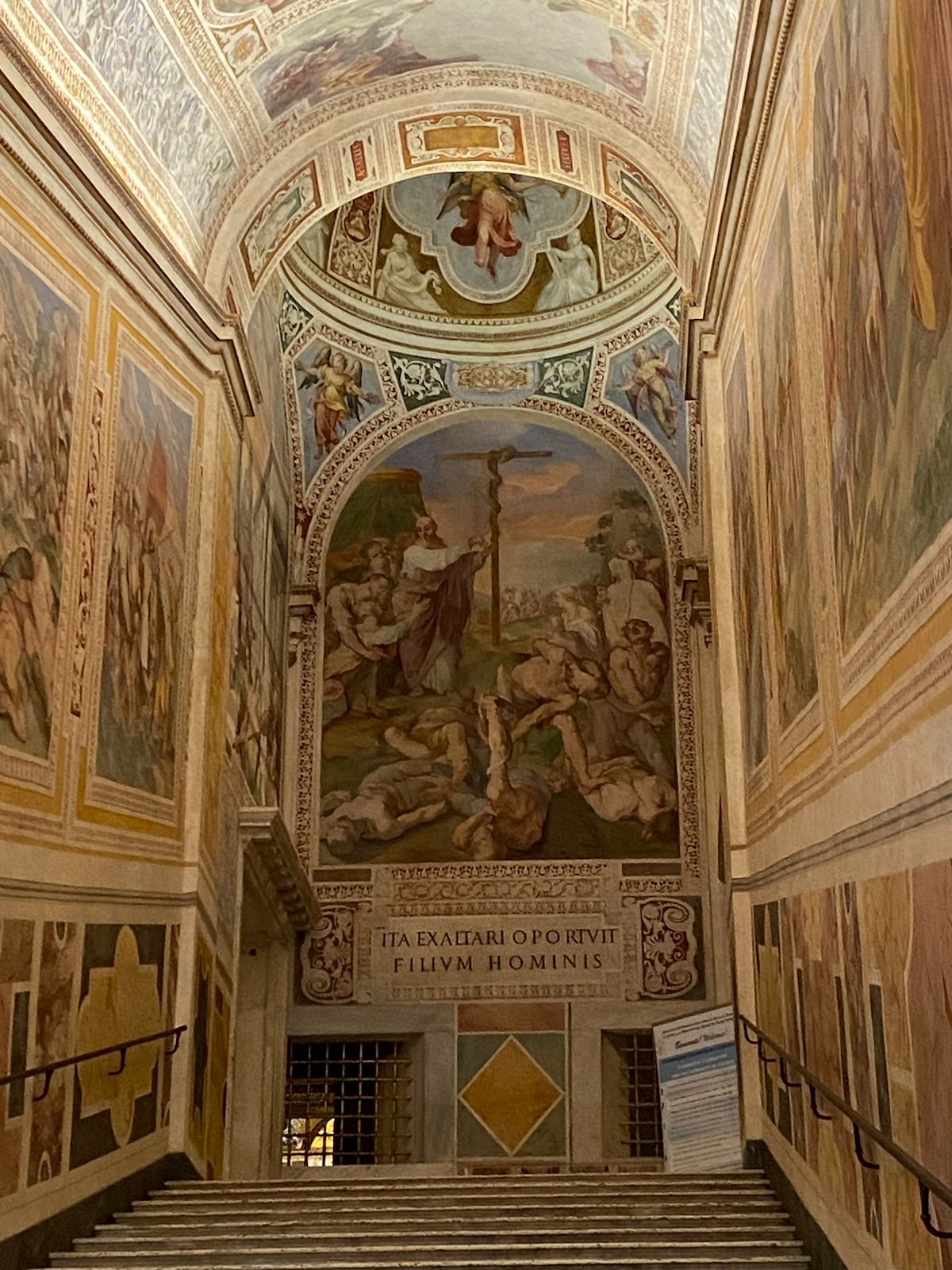
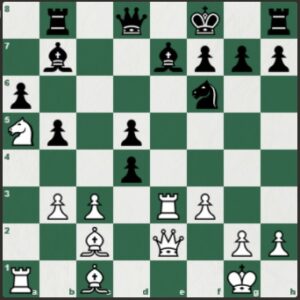
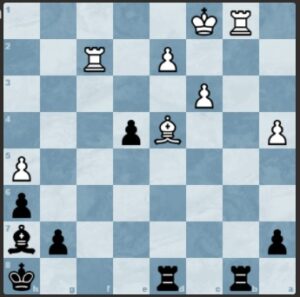
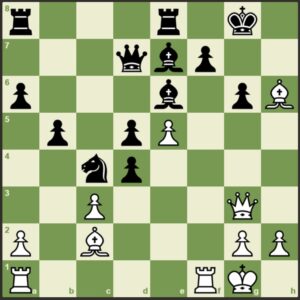
Something I picked up on eBay years ago for laughs, had half forgotten about, and came across in the closet this evening. I’m pretty sure it’s the only board game in the world that actually has a Nihil Obstat and Imprimatur (no joke!) pic.twitter.com/qD75iIZ0ip
NB: I’ll hold comments with solutions ’till the next day so there won’t be “spoilers” for others.
Please remember me when shopping online. Thanks in advance. US HERE – UK HERE These links take you to a generic “catholic” search in Amazon, but, once in and browsing or searching, Amazon remembers that you used my link and I get the credit.
Here is the O Antiphon for 19 December: O Radix Jesse
Again Our Lord is presented as the Liberator.
LATIN: O Radix Jesse, qui stas in signum populorum, super quem continebunt reges os suum, quem gentes deprecabuntur: veni ad liberandum nos, iam noli tardare.
ENGLISH: O Root of Jesse, that stands for an ensign of the people, before whom the kings keep silence and unto whom the Gentiles shall make supplication: come, to deliver us, and tarry not.
Scripture References:
Isaiah 11:10
Romans 15:12
Revelation 5:5
Relevant verse of Veni, Veni Emmanuel:
O come, O Rod of Jesse free,
Thine own from Satan’s tyranny;
From depths of hell Thy people save,
And give them victory o’er the grave.
What urgency there is in this antiphon.
Our Lewis & Short says that radix is “a root, ground, basis, foundation, origin, source”.
Ironically, roots are underground and invisible, but standards, ensigns are raised high in the air.
Something that lies below the earth (a root) stands high into the heavens like a banner!
Vexilia Regis Prodeunt we sing in Lent. The little root of Advent becomes by Lent grows into the Tree of our salvation.
The one from above takes our mortal clay into an indestructible bond. He raises us to the heavens.
Isaiah 11:10 gives us imagery for our reflection today.
The great prophet of Advent tells us that the kingdom of David would be destroyed, but not entirely destroyed. A root would remain. Jesse is David’s father. David is Jesse’s root. David leads to Christ. Christ is the David King Messiah Priest.
After the destruction there remains a root.
No matter what the exigencies of life present to us or how turbulent the vicissitudes of the passing world may be, when we cling to the root we are sure to be victorious in the end. The root bears up on high to the heavens.
Per aspera ad astra. Succisa virescit.
Life includes patterns of destruction and rebuilding, pruning and regrowth, transplantation and rerooting. So long as we are grafted into the Root, we survive and grow.
Exitus. Conversio. Reditus.
Let’s hear the wonderful community at Le Barroux sing this antiphon with the Magnificat.
Because I continue to get question in my email about bizarre things that priests do to the FORM OF ABSOLUTION, it is good to remind everyone that in 2023 the Novus Ordo form of absolution in English is to change. There has been an official tweak of the English translation of the Latin.
In 2021 the US Bishops voted for the new translation. Rome approved it in April 2022. It goes into effect in 2023.
I can foresee an ACTION ITEM by lay people. Make sure that priests who are doing dodgy things with the form of absolution are informed about the correct form precisely because this change is going into effect.
It is an OPPORTUNITY to help some priests stop screwing about with the form of absolution. If the priests resist, get authorities involved if they keep up their shenanigans.
New translation of the prayer of absolution incoming next year.
God, the Father of mercies,
through the death and resurrection of his Son
has reconciled the world to himself
and poured out[Latin: effudit] the Holy Spirit among us for the forgiveness of sins;
through the ministry of the Church may God grant[Latin: tribuat] you pardon and peace,
and I absolve you from your sins
in the name of the Father, [sign of the cross] and of the Son,
and of the Holy Spirit.
And here’s what the prayer was before:
God, the Father of mercies,
through the death and resurrection of his Son
has reconciled the world to himself
and sent the Holy Spirit among us for the forgiveness of sins;
through the ministry of the Church may God give you pardon and peace,
and I absolve you from your sins
in the name of the Father, [sign of the cross] and of the Son,
and of the Holy Spirit.
Use Latin and there is ZERO question of validity.
The Latin for the post-Conciliar form:
Deus, Pater misericordiarum, qui per mortem et resurrectionem Filii Sui mundum Sibi reconciliavit et Spiritum Sanctum effudit in remissionem peccatorum, per ministerium Ecclesiae indulgentiam tibi tribuat et pacem. Et ego te absolvo a peccatis tuis in nomine Patris, et Filii, et Spiritus Sancti.
Priests of the Latin Church should know this Latin form of absolution by heart… yes, in Latin.
Fr, I went to confession at a Catholic church in France that gets pilgrims from around the world. Because of the many languages of the penitents there was a checklist in the confessional with a wide variety of sins translated across many languages. You checked off your sins and handed the sheet to the priest, who would then absolve you in French.
Because the confession was not auricular was it still valid? I’m honestly unsure. . .
There are couple of issues here. Firstly, we are obliged to confess our sins in kind (the type of sin) and in number (how many times or an indication of frequency even if approximated). A checklist would have kind but did it have number? I’m guessing not. That’s the first problem.
Next, no indication of a penance?
There are, perhaps, some holes in the background information in the question, above.
We find that those who are not able to speak, but who nevertheless have to make a confession are permitted to write their confession. This must be done with great care because, as the phrase goes scripta manent, written things last. Hence, whatever is written ought to be destroyed as soon as possible.
So, we know that it is possible to provide the matter for the sacrament without speaking. The revelation of the sins in writing or by some signs (sign language, for example) is possible.
We find also that if the penitent and confessor do not share any common language, then, again, the sins can be communicated through sins of some kind, at least in a general way. Perhaps that could be done by pointing to the numbers of commandments on a picture. Perhaps that could be done with a checklist in the penitents native tongue which corresponds with a list that the confessor has. The check list should be retained by the penitent and then destroyed. In this case the checklist serves as a kind of interpreter. And it is possible to make a confession through a living interpreter, though with great caution. Should the interpreter then be destroyed? Probably not.
Provided you made a sincere revelation of your sins that absolution was probablyvalid, provided that he said the valid form. There is the problem of number and kind. There is the problem of perhaps not assigning a penance.
This was an “extraordinary” circumstance, for sure. This should not be anyone’s regular experience.
Here’s a notice about ZedNet for Sunday 18 Dec ’22 – evening at 2000hEST. (0100h ZULU Monday).
Last week we had 11 check-ins. There were some glitches, but it was working. I experimented with three modes, DMR, Echolink (which is working well) and Allstar (which I am told sounded the best).
We now have the site running: http://zednet.xyz I have to get that updated.
Fellow hams who have access locally to a Yaesu System Fusion repeater, a repeater on the BM network, or a multi-mode hotspot registered with BM can get on and have a rag chew…. 24/7/365
Want to get involved? WBØYLE provided a Bill Of Materials, with links, for what you need. HERETHIS WAS UPDATED on by WBØYLE and Fr Z on 4 Dec 2022.
I created a page for the List of YOUR callsigns. HERE Chime in or drop me a note if your call doesn’t appear in the list.
For an image of what the Zednet “interconnections” are, click HERE.
LATIN:O Adonai, et Dux domus Israel, qui Moysi in igne flammae rubi apparuisti, et ei in Sina legem dedisti: veni ad redimendum nos in brachio extento.
ENGLISH:O Lord and Ruler the house of Israel, who appeared to Moses in the flame of the burning bush and gave him the law on Sinai: come, and redeem us with outstretched arms.
Scripture References: Exodus 3
Micah 5:2
Matthew 2:6
Relevant verse of Veni, Veni Emmanuel:
O come, O come, thou Lord of might,
Who to Thy tribes on Sinai’s height
In ancient times didst give the law
In cloud and majesty, and awe.
“Adonai” is “LORD.” It was the Hebrew word that the Jews used when they found the four-lettered word for God’s name which they held to be too sacred to pronounce aloud. The four letter word for God’s Name, the Tetragrammaton, is still venerated by us to the point that Holy Church asks us not to use it in liturgical song.
Christ is Lord, Lord of Creation. We sang this yesterday in the antiphon “O Sapientia“. Christ is also Lord of the Covenant with the People He chose.
The Lord made covenants with Noah, Abraham, and Moses. He guided them and all the People. He gave them Law. He protected and feed them. The Lord delivered them from bondage to Pharaoh and unending slavery. He went before them with arm outstretched.
This was all a pre-figuring of the great work of redemption that Christ would work on the Cross. He redeemed us His People from Satan and the eternal damnation of hell.
He once appeared clothed in the burning bush that was not consumed by fire.
He is about to appear again clothed in flesh in our liturgical celebration of Christmas.
He will appear again one day in the future to judge the living and the dead.
He appears to us each day in the person of our neighbor.
What amazing contrasts we find in our Lord! He came in thunder and lightening to give the Law on Mt. Sinai. He comes now in swaddling clothes. He will come again in glory. He comes humbly in the appearance of Bread and Wine.
He still goes before us with outstretched arm and our foes are put to flight at the sight of His banner!
Shall we hear the Benedictines of Le Barroux sing the O Antiphon and Magnificat?
NB: I’ll hold comments with solutions ’till the next day so there won’t be “spoilers” for others.
Please remember me when shopping online. Thanks in advance. When you are ready to shop, come back and click one of these links, then Amazon will remember that you entered with my affiliate link. By the way, I can’t control what you might initially see when you get there. Alas.
On December 17th we enter into that final stretch of our Advent preparation. In the Church’s solemn prayer of the hours, at Vespers, the great “O Antiphons” are sung. Today we have the first.
Years ago, I made a little webpage for the O Antiphons. It might be useful.
By way of introduction, here are a few points every Catholic should know.
First, the song Veni, veni Emmanuel is a musical presentation of the themes of the O Antiphons.
Second, the first letters of the “addressee” of the Antiphon, arranged backward spell out “Ero cras… I will be (there) tomorrow”. So, there is a clever “count-down” in the antiphons.
Third, each of the “O Antiphons” carries Old Testament biblical figures. At the same time each one carries an element of the New Covenant. These two characteristics are juxtaposed and a third dimension emerges which serves as a point of meditation when considering the Incarnate Word, the Son of God made flesh.
Today’s O Antiphon is O Sapientia.
LATIN: O Sapientia, quae ex ore Altissimi prodidisti, attingens a fine usque ad finem, fortiter suaviter disponensque omnia: veni ad docendum nos viam prudentiae.
ENGLISH: O Wisdom, who came from the mouth of the Most High, reaching from end to end and ordering all things mightily and sweetly: come, and teach us the way of prudence.
Scripture References:
Proverbs 1:20; 8; 9
I Corinthians 1:30
Relevant verse of Veni, Veni Emmanuel: O come, O Wisdom from on high,
who orders all things mightily,
to us the path of knowledge show,
and teach us in her ways to go.
In today’s “O Antiphon” – “O Sapientia” – we are drawn into the Old Testament’s wisdom literature. Wisdom is a divine attribute. The divine Wisdom is personified. Wisdom is the beloved daughter who was before Creation, Wisdom is the breath of God’s power, Wisdom is the shining of God’s (transforming) glory. (See Sirach 24:3 and Wisdom 8:1.)
Wisdom is also something which we deeply desire. It is also a human attribute, not just a divine attribute, though authentic human wisdom is never separated from a relationship with God. Fear of the Lord is the beginning of wisdom, as we learn from the psalms as well as the school of personal hard-knocks. From this convergence of awesome respect for God with the experience of learning through life’s mysterious calendar, we understand (if we are wise) that wisdom is more than mere knowledge. It is something more than love. It is something more than just a special astuteness regarding how to get along in life, a certain kind of savior faire. Rooted as it is in fear of the Lord, true human wisdom is both love and that knowledge of God that seeks to understand, the knowledge that is completed by faith.
The Prologue of John’s Gospel refers to the “Verbum caro factum...the Word made flesh”. He is the divine Logos… the eternal thought/word/reason. Through Him all things were made. Without Him nothing can be. So, the New Testament image in the Prologue of John brings to completion the imagery of Wisdom. He, the Word, is the archetype of the material universe. All things are ordered in and to Him.
Our lives, to be happy, need order. Our individual private lives and our collective lives in larger society must have structure and order. They must be disposed in such a way that the real and genuine good of all is fostered and promoted. Thus, in human governance we struggle to find the proper balance of exercise of power (without which governance and order is not possible) and gentle concern for the individual and community (without which there is mere imposition and tyranny and exploitation for some end material or ideological). Wisdom permits the balance of these.
This first “O Antiphon” shows us the Creator of all that is invisible and visible, the whole of spiritual and material creation. Creation is moving according to an eternally disposed plan of divine Providence toward an inexorable end: that God may be all in all. In this end the blessed elect will participate. We have had the way opened for us toward this end by the Word (divine) made flesh (human). Our humanity now sits in transformed glory at the right hand of the Father in an indestructible bond with the Son’s divinity. The risen Christ is the new Adam…the new Creation. With unspeakable sweetness He orders our salvation. With irresistible power all things exist and move according to His will. Our lives have meaning only in Him, according to His guidance, who handles us “suaviter et fortiter“.
Our Old Testament and New Testament figures and images merge into a new point of reflection for our lives which today’s “O Antiphon” underscores as “prudence” – “Come…Teach us the way of prudence!”
“Prudence” comes from the Latin “to see/look ahead”. It is one of the four “cardinal” virtues, the one upon which the other virtues depend. Prudence is a habit of the intellect that allows us to see in any circumstance what is virtuous and what is not. Prudence helps us to seek what is virtuous and avoid what is not. Prudence perfects the intellect (rather than the will) in practical decisions. It determines which course of action must be taken. It indicates what the golden mean is hic et nunc…here and now. This mean is at the core of every virtue. Without the virtue of prudence courage becomes foolhardiness… rushing in to the wrong danger in the wrong way at the wrong time. Without the governing of prudence mercy devolves into slackness and enervated weakness, spinelessness.
But this is still a kind of prudence which is merely human prudence, not looking beyond the issues of daily life. We must also look beyond this vale of tears. In addition to the prudence which grows out of the school of hard-knocks and which becomes a sound and good habit through repeated acts, there is another prudence, an “infused” prudence. This kind of prudence is a grace given us by God out of His merciful love. This greater prudence, which governs other grace-filled virtues, cannot be separated from the life of grace. It is exercised in the state of grace. Mortal sin is its enemy. This higher kind of prudence helps us to determine the proper things that help us to salvation. It helps us to avoid things that slam the door that Christ opened (mortal sin). Thus, prudence cannot be separated from charity, which is in the soul as a characteristic of sanctifying (habitual) grace.
Today in the opening “O Antiphon” we sing to Emmanuel who is coming. We plead with Him, for He orders all things “sweetly and strongly.” He teaches us how to avoid things that harm us, both in material concerns and in our pursuit of the happiness of heaven. He teaches us true prudence.
Take stock: is there something going on in my life that needs to be examined in prudence? Am I doing something which is going to be an obstacle to the happiness of heaven? Christ is coming, both at Christmas as the infant King and the end of the world as the Judge and King of fearful majesty. This is a cause to rejoice. But it is also cause to prepare prudently and well the way of the Lord and make straight His paths before He comes, as we heard about on “Gaudete” (“Rejoice!) Sunday of Advent.
Listen to the monks at Le Barroux sing this antiphon and the Magnificat with which it is inextricably bound:
I’m banging my head against something I am trying to write about the Vetus Ordo Epistle for Sunday’s Mass, the 4th Sunday of Advent. It happens. A losing battle against the clock? No, I always get there.
So, while keeping an eye on Magnus v. MVL in the Speed Chess Championship, insane, I spotted a video that forced a click and another distraction, just as a zugwang forces you into something you would rather not do, but have to to anyway.
Anyway, one video reminded me of the state of the Church right now and our role in it.
Sam: “..folk in those stories had lots of chances of turning back, only they didn’t. They kept going. Because they were holding on to something.”
Frodo : “What are we holding onto, Sam?”
Sam : “That there’s some good in this world, Mr. Frodo… and it’s worth fighting for.”
That’s the Peter Jackson film version. That speech isn’t in the book. I don’t like those movies, in the main, but that was a good movie moment and fully in keeping with Sam’s true nature. Some could argue that Sam is the main hero of the whole thing.
That led to me finding this video of one of my favorite vocal groups.
The Jackson movies had songs at the end. The first movie had one by Enya… I remember seeing Enya with Clannad wayyyyy back in the early 80’s when they were touring dives in these USA.
Anyway, Voces 8 does that song which has these words:
May it be an evening star
Shines down upon you
May it be when darkness falls
Your heart will be true
You walk a lonely road
Oh! How far you are from home
Mornië utúlië (Darkness has come)
Believe and you will find your way
Mornië alantië (Darkness has fallen)
A promise lives within you now
May it be the shadow’s call
Will fly away
May it be you journey on
To light the day
When the night is overcome
You may rise to find the sun
Mornië utúlië (Darkness has come)
Believe and you will find your way
Mornië alantië (Darkness has fallen)
A promise lives within you now
By the way, here’s the parallel from the actual hold in your hand book:
‘Yes, that’s so,’ said Sam. `And we shouldn’t be here at all, if we’d known more about it before we started. But I suppose it’s often that way. The brave things in the old tales and songs, Mr. Frodo: adventures, as I used to call them. I used to think that they were things the wonderful folk of the stories went out and looked for, because they wanted them, because they were exciting and life was a bit dull, a kind of a sport, as you might say. But that’s not the way of it with the tales that really mattered, or the ones that stay in the mind. Folk seem to have been just landed in them, usually – their paths were laid that way, as you put it. But I expect they had lots of chances, like us, of turning back, only they didn’t. And if they had, we shouldn’t know, because they’d have been forgotten. We hear about those as just went on – and not all to a good end, mind you; at least not to what folk inside a story and not outside it call a good end. You know, coming home, and finding things all right, though not quite the same – like old Mr Bilbo. But those aren’t always the best tales to hear, though they may be the best tales to get landed in! I wonder what sort of a tale we’ve fallen into? ‘
`I wonder,’ said Frodo. ‘But I don’t know. And that’s the way of a real tale. Take any one that you’re fond of. You may know, or guess, what kind of a tale it is, happy-ending or sad-ending, but the people in it don’t know. And you don’t want them to.’
‘No, sir, of course not. Beren now, he never thought he was going to get that Silmaril from the Iron Crown in Thangorodrim, and yet he did, and that was a worse place and a blacker danger than ours. But that’s a long tale, of course, and goes on past the happiness and into grief and beyond it – and the Silmaril went on and came to Eärendil. And why, sir, I never thought of that before! We’ve got – you’ve got some of the light of it in that star-glass that the Lady gave you! Why, to think of it, we’re in the same tale still! It’s going on. Don’t the great tales never end? ‘
‘No, they never end as tales,’ said Frodo. `But the people in them come, and go when their part’s ended. Our part will end later – or sooner.’
‘And then we can have some rest and some sleep,’ said Sam. He laughed grimly. ‘And I mean just that, Mr. Frodo. I mean plain ordinary rest, and sleep, and waking up to a morning’s work in the garden. I’m afraid that’s all I’m hoping for all the time. All the big important plans are not for my sort. Still, I wonder if we shall ever be put into songs or tales. We’re in one, or course; but I mean: put into words, you know, told by the fireside, or read out of a great big book with red and black letters, years and years afterwards. And people will say: “Let’s hear about Frodo and the Ring! ” And they’ll say: “Yes, that’s one of my favourite stories. Frodo was very brave. wasn’t he, dad?” “Yes, my boy, the famousest of the hobbits, and that’s saying a lot.”‘
`It’s saying a lot too much,’ said Frodo, and he laughed, a long clear laugh from his heart. Such a sound had not been heard in those places since Sauron came to Middle-earth. To Sam suddenly it seemed as if all the stones were listening and the tall rocks leaning over them. But Frodo did not heed them; he laughed again. ‘Why, Sam,’ he said, ‘to hear you somehow makes me as merry as if the story was already written. But you’ve left out one of the chief characters: Samwise the stouthearted. “I want to hear more about Sam, dad. Why didn’t they put in more of his talk, dad? That’s what I like, it makes me laugh. And Frodo wouldn’t have got far without Sam, would he, dad? ” ‘
`Now, Mr. Frodo,’ said Sam, ‘you shouldn’t make fun. I was serious. ‘
`So was I,’ said Frodo, ‘and so I am. We’re going on a bit too fast. You and I, Sam, are still stuck in the worst places of the story, and it is all too likely that some will say at this point: “Shut the book now, dad; we don’t want to read any more.” ‘
`Maybe,’ said Sam, ‘but I wouldn’t be one to say that. Things done and over and made into part of the great tales are different. Why, even Gollum might be good in a tale, better than he is to have by you, anyway. And he used to like tales himself once, by his own account. I wonder if he thinks he’s the hero or the villain?
Please remember me when shopping online. Your use of my Amazon affiliate link is a major part of my income. It helps to pay for insurance, groceries, everything. Thanks in advance.
“This blog is like a fusion of the Baroque ‘salon’ with its well-tuned harpsichord around which polite society gathered for entertainment and edification and, on the other hand, a Wild West “saloon” with its out-of-tune piano and swinging doors, where everyone has a gun and something to say. Nevertheless, we try to point our discussions back to what it is to be Catholic in this increasingly difficult age, to love God, and how to get to heaven.” – Fr. Z
Luciano on YOUR URGENT PRAYER REQUESTS: “May Saint Joseph intercede for the confirmation of an important job that will enable me to continue paying for my…”
UncleBlobb on I’m sort of panicking: laptop issues: “FWIW, years ago I had a laptop that was overheating, and gave the blue screen of death. I had to…”
Federated Computer… your safe and private alternative to big biz corporations that hate us while taking our money and mining our data. Have an online presence large or small? Catholic DIOCESE? Cottage industry? See what Federated has to offer. Save money and gain peace of mind.
“Until the Lord be pleased to settle, through the instrumentality of the princes of the Church and the lawful ministers of His justice, the trouble aroused by the pride of a few and the ignorance of some others, let us with the help of God endeavor with calm and humble patience to render love for hatred, to avoid disputes with the silly, to keep to the truth and not fight with the weapons of falsehood, and to beg of God at all times that in all our thoughts and desires, in all our words and actions, He may hold the first place who calls Himself the origin of all things.”
Everyone, work to get this into your parish bulletins and diocesan papers.
The most evident mark of God’s anger and the most terrible castigation He can inflict upon the world are manifested when He permits His people to fall into the hands of clerics who are priests more in name than in deed, priests who practice the cruelty of ravening wolves rather than the charity and affection of devoted shepherds.
St. John Eudes
Your support is important. Thanks in advance.
To donate monthly I prefer Zelle because it doesn't extract fees. Use
frz AT wdtprs DOT com
Donate using VENMO
GREAT BEER from Traditional Benedictine Monks in Italy
Good coffee and tea. Help monks.
I use this when I travel both in these USA and abroad. Very useful. Fast enough for Zoom. I connect my DMR (ham radio) through it. If you use my link, they give me more data. A GREAT back up.
Help support Fr. Z’s Gospel of Life work at no cost to you. Do you need a Real Estate Agent? Calling these people is the FIRST thing you should do!
They find you a pro-life agent in your area who commits to giving a portion of the fee to a pro-life group!
Don’t rely on popes, bishops and priests.
“He [Satan] will set up a counter-Church which will be the ape of the Church because, he the devil, is the ape of God. It will have all the notes and characteristics of the Church, but in reverse and emptied of its divine content. It will be a mystical body of the anti-Christ that will in all externals resemble the mystical body of Christ. In desperate need for God, whom he nevertheless refuses to adore, modern man in his loneliness and frustration will hunger more and more for membership in a community that will give him enlargement of purpose, but at the cost of losing himself in some vague collectivity.”
“Who is going to save our Church? Not our bishops, not our priests and religious. It is up to you, the people. You have the minds, the eyes, and the ears to save the Church. Your mission is to see that your priests act like priests, your bishops act like bishops.”
“The modern habit of doing ceremonial things unceremoniously is no proof of humility; rather it proves the offender's inability to forget himself in the rite, and his readiness to spoil for every one else the proper pleasure of ritual.”
- C.S. Lewis
This blog has to earn its keep!
PLEASE subscribe via PayPal if it is useful. Zelle and Wise are better, but PayPal is convenient.
A monthly subscription donation means I have steady income I can plan on. I put you my list of benefactors for whom I pray and for whom I often say Holy Mass.
In view of the rapidly changing challenges I now face, I would like to add more $10/month subscribers. Will you please help?
For a one time donation...
To donate monthly I prefer Zelle because it doesn't extract fees. Use
frz AT wdtprs DOT com
As for Latin…
"But if, in any layman who is indeed imbued with literature, ignorance of the Latin language, which we can truly call the 'catholic' language, indicates a certain sluggishness in his love toward the Church, how much more fitting it is that each and every cleric should be adequately practiced and skilled in that language!" - Pius XI
"Let us realize that this remark of Cicero (Brutus 37, 140) can be in a certain way referred to [young lay people]: 'It is not so much a matter of distinction to know Latin as it is disgraceful not to know it.'" - St. John Paul II
Let us pray…
Grant unto thy Church, we beseech Thee, O merciful God, that She, being gathered together by the Holy Ghost, may be in no wise troubled by attack from her foes. O God, who by sin art offended and by penance pacified, mercifully regard the prayers of Thy people making supplication unto Thee,and turn away the scourges of Thine anger which we deserve for our sins. Almighty and Everlasting God, in whose Hand are the power and the government of every realm: look down upon and help the Christian people that the heathen nations who trust in the fierceness of their own might may be crushed by the power of thine Arm. Through our Lord Jesus Christ, Thy Son, who liveth and reigneth with Thee in the unity of the Holy Ghost, God, world without end. R. Amen.