St. Thomas and the beating, living, healing, Heart of Love.

St. Thomas and the beating, living, healing, Heart of Love.Here is something that I wrote a while back. Since today in the Vetus Ordo calendar is the Feast of St. Thomas the Apostle, I figured that it might be good to share for those who haven’t seen it.


[…]

Christ showed [the Apostles in the locked room] His hands and feet and side, to demonstrate that He had a real body and that it was also is His Body. He didn’t pick up some unwounded, perfect Body that He was now inhabiting. We are our bodies, as we are our rites. The fact that the wounds remained in His Body’s hands, feet and side provided continuity with His Body before and during His Passion. He isn’t a mere shade of the Lord. Nor has he exchanged Himself for an unwounded version. In this way Christ began to show them the traits of the risen Body, traits which we, too, will share in the Resurrection: clarity (reflecting God’s glory), impassibility (incapable of suffering), agility (ease and speed of movement), subtlety (unhindered by barriers).

[…]

We don’t know why Thomas wasn’t with the other ten Apostles in the room for that first appearance of the Lord. I like to imagine that it was his turn to get the “take out” for the rest of them.

Thomas, who had doubted, put his trust in the Lord at this point. In fact, he literally handed his trust to Him where the point of the lance had left its mark on the Lord’s glorious Risen Body, a wound from a Roman lance large enough to insert his hand. The Lord told Thomas to “thrust” (Greek bále) his hand “eis ten pleurán… into (His) side”. If we want to be picky, we might note that the Greek word “cheír”, insofar as our anatomy is concerned, can mean “hand”, but it can also mean “finger” or “hand and arm”, the later so much so that in some contexts additional words are added to denote “hand” as distinct from the arm (cf. Liddell-Scott-Jones, A Greek-English Lexicon aka LSJ – “???? , ?”).

This is significant for depictions in art, as in the famous painting by Caravaggio, wherein Thomas puts his finger into Christ’s side and peers into it, which smacks of the spirituality of St. Bonaventure who wrote about how Thomas the Apostle looked through the Lord’s visible wounds and saw His invisible wound of love. It also affects depictions of the crucifixion of the Lord and of His risen Body, with the holes of the nails in the hands. Some maintain that Christ would have been crucified with nails through the wrists so that the ulna and radius bones would sustain His Body’s weight rather than tearing through the flesh of His hands.

Christ tells Thomas to explore with his finger (dáktylos) the spike holes of His “hands/wrists”, which would be more or less the size of a large finger. However, he tells Thomas to use his hand for the wound in His side. The Greek suggests to me that the Lord instructed Thomas to push, thrust His hand into the wound channel left by the Roman lance, which had gone so far as to lacerate the Lord’s Sacred Heart.

We don’t have in the Gospel account of this stunning moment, to which John was eyewitness, a precise statement by John that Thomas physically did it. All it says is that Thomas responded, “My Lord and my God!” Christ responded with a “beatitude” (v. 29): “Jesus said to him, “Have you believed because you have seen me? Blessed are those who have not seen and yet believe.”

Was Thomas so overwhelmed that He could not touch the Lord in that way? All He could utter was that amazing witness to belief in the divinity of Christ? The clearest and most exultant of any in the Gospels?

Christ refers to Thomas seeing Him, but He did not say, “because you have touched me”. Nevertheless, it seems to me that if the Risen Christ tells you to do something, you do it. Furthermore, John immediately concludes this chapter with something so definitive that it feels like the end of the whole work (vv. 30-31):

Now Jesus did many other signs in the presence of the disciples, which are not written in this book; but these are written that you may believe that Jesus is the Christ, the Son of God, and that believing you may have life in his name.

There follows chapter 21 and the account of the reconciliation of Peter at the Sea of Galilee. We moderns count that as chapter 21. Remember, the Gospels were not written with chapters and verses and not even word breaks. Those were imposed centuries later. Yet, one has the sense that what happened between Christ and Thomas was so amazing that John penned something like a conclusion to his Gospel after Thomas’s cry of faith, arguably the climax of John’s account.

Given the various meanings of “hand” in Greek, and that word “thrust”, and the fact that the wound from the lance remained, therefore remained all the way to His Heart, perhaps Our Lord required Thomas not merely to touch His side but even to feel the breath, the ruach, in His torn lung. Did Thomas, while feeling the ruach on his wrist, touch with his hand the physical, risen, subtle, impassible, agile, blazing bright Heart of Jesus?

By the way, in art, statues and painting, the Apostles are usually depicted with the instruments of their martyrdom. St. Thomas is often depicted with a lance.

On this Sunday we emphasize the mercy of God and the institution of the Sacrament of Penance, perhaps the greatest encounter we have with incarnate Mercy, Holy Communion notwithstanding.

Christ told Thomas to do what He did before witnesses so that they too would understand about the traits of His risen Body and that it was truly His own. Knowing full well that we would one day read this, He inspired the disciple He most loved to write his Gospel account, an account that connects Thomas to the inspiration of the Spirit and the mercy of Christ’s Heart in a way that other Apostles didn’t experience on that first Easter evening appearance.

When we go to confession, we enter into Mercy in order to be breathed upon by the Spirit and to feel the beating, living, healing, Heart of Love.

Posted in Linking Back, Liturgy Science Theatre 3000, Saints: Stories & Symbols | Tagged
1 Comment

20 December – Happy Birthday United States SPACE FORCE!

Semper Supra – “Always Above”

20 December - Happy Birthday United States SPACE FORCE!

Posted in SESSIUNCULA | Tagged
Leave a comment

WDTPRS The O Antiphons: 20 December – O Clavis David

WDTPRS The O Antiphons: 20 December - O Clavis DavidWe continue our look at the O Antiphons with today’s O Clavis David

Again we hear the theme of Christ as the Liberator.

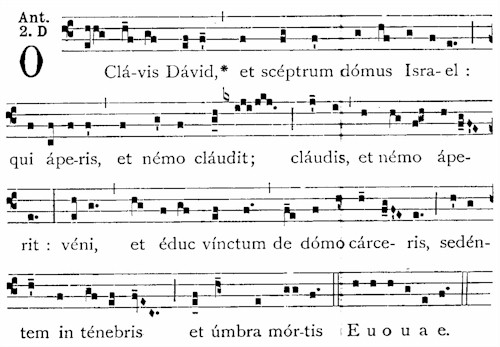
LATIN: O clavis David, et sceptrum domus Israel: qui aperis, et nemo claudit; claudis, et nemo aperit: veni, et educ vinctum de domo carceris, sedentem in tenebris.

ENGLISH: O Key of David, and scepter of the house of Israel, who opens and no man shuts, who shuts and no man opens: come, and bring forth the captive from his prison, he who sits in darkness and in the shadow of death.

Scripture Reference:

Isaiah 22:22
Revelation 3:7

Relevant verse of Veni, Veni Emmanuel:

O come, thou Key of David, come,
And open wide our heavenly home;
Make safe the way that leads on high,
And close the path to misery.

Do not fall into the trap of thinking that the we are dealing with events isolated solely in the past. Even taking just the image of the key in Scripture, we see how God’s plan is still in effect for us today, and we are all still players in his plan for salvation. The Old Testament reference from Isaiah helps us see this.

In Isaiah we read how the Lord said to Shebna, who was the master of the household of King Hezekiah:

“And it shall come to pass in that day, that I will call my servant Eliakim the son of Helkias, and I will clothe him with thy robe, and will strengthen him with thy girdle, and will give thy power into his hand: and he shall be as a father to the inhabitants of Jerusalem, and to the house of Juda. And I will lay the key of the house of David upon his shoulder: and he shall open, and none shall shut: and he shall shut and none shall open. And I will fasten him as a peg in a sure place, and he shall be for a throne of glory to the house of his father”.

God established in the House of David an office to be handed down through a succession, an office of jurisdiction.  The vicar of the Davidic King would exercise the King’s authority.

This same language and image was used by our Lord when in Matthew 16 He conferred His own authority on Peter to exercise as a office to be handed down in a succession.  The Lord, the David King Priest Messiah, gave His keys to Peter.  His clear intent, clear from the David key image He used, was to establish an office with a succession.

In Revelation 3:7 the Lord is described as He who still wields David’s key. Even as Peter holds the keys on earth, it is the Lord’s own hand which holds Peter’s hand.

Truly the Lord who came to us at Bethlehem is with us always in His Church until His ultimate Coming at the end of the world.  He is, in a real sense, the Key itself which Peter wields to open doors and to shut, to bind chains and to loose.

Let’s sing about the Key with the help of the terrific Benedictine monks of Le Barroux.   NB: They don’t use the flat “ti”.

WDTPRS The O Antiphons: 20 December - O Clavis David

Posted in Linking Back, Liturgy Science Theatre 3000 |
3 Comments

Daily Rome Shot 610

Daily Rome Shot 610

Meanwhile…

Daily Rome Shot 610Daily Rome Shot 610

NB: I’ll hold comments with solutions ’till the next day so there won’t be “spoilers” for others.

Priestly chess players, drop me a line. HERE

Your use of my Amazon affiliate link is a major part of my income. It helps to pay for insurance, groceries, everything. Please remember me when shopping online. Thanks in advance.

US HERE – UK HERE

Daily Rome Shot 610

Posted in SESSIUNCULA |
6 Comments

Pachamama Bishop convicted

This is Archbp. Emmanuel Lafont of French Guiana, retired, during the Amazonian Synod (“Walking Together”). He is “walking together” with the demon idol Pachamama, carrying it ceremonially and scandalously in procession into the Roman church Santa Maria in Traspontina.

Pachamama Bishop convicted

We read in La Crock that he was convicted of sexual abuse.  HERE  He was consequently banned from public ministry and required to live in a monastery in France to conduct a life of prayer and penance.

He was NOT dismissed from the clerical state, it seems.

And again, outside the Synod (“walking together”) Hall.

Pachamama Bishop convicted

Posted in The Coming Storm | Tagged
8 Comments

ASK FATHER: “I absolve you from THESE sins…”. Valid?

ASK FATHER: "I absolve you from THESE sins...". Valid?From a reader…

QUAERITUR:

I went to confession and the words said by the priest for absolution were “I absolve you from these sins” etc. Would this absolution be valid?

Thank you for going to confession.  KEEP GOING.

This is disturbing.  The reason is that, in the Sacrament of  Penance, if you have genuinely forgotten some sins, and therefore didn’t confess them, the forgotten sins are absolved along with the confessed sins.

“I absolve you from these sins” applies only to those sins that you confessed and not to any that you failed to confess because you sincerely forgot them.

I strongly suspect that that was an INVALID absolution.

If you have regular contact with that priest, bring to his attention: he is using a doubtfully valid form of absolution.  If he reacts badly or brushes you off, then inform the local bishop and/or the priest’s superior if he is a religious.

It is appalling that a priest would screw around with the forms of sacraments, alter them in any way according to some puffed up notion that he knows better or that he has to tweak something to make it more meaningful or that he has to put his own touch on it.  Change words and you change meanings.   The result is confusion in the minds of penitents.

It’s an absolutely horrid thing to do to penitents, leave them in doubt about being forgiven.   That’s a stupid and wicked thing for a priest to do and it is so easily avoided.

SAY THE FORM AS IT IS WRITTEN!

Mind you, in 2023 the English FORM used in these USA will change slightly.  I wrote about that HERE.

Posted in "How To..." - Practical Notes, ASK FATHER Question Box, GO TO CONFESSION | Tagged ,
5 Comments

ASK FATHER: Father says part of the consecration inaudibly and the rest audibly. Valid?

ASK FATHER: Father says part of the consecration inaudibly and the rest audibly. Valid?From a reader…

QUAERITUR:

Our parish priest speaks in a very distinct way. He chants the Novus Ordo from “For on the night he was betrayed he himself took bread, and giving you thanks he said the blessing, broke the bread and gave it to his disciples, saying:”
And he speaks distinctly, no longer chanting
“TAKE THIS”
But then *inaudibly*
ALL OF YOU,
And then quite audibly
“AND EAT OF IT:
FOR THIS IS MY BODY WHICH WILL BE GIVEN UP FOR YOU.”

Servers have said yes, he does say the “all of you” but those in attendance cannot hear it, except perhaps at daily mass in the front row.

I am used to the priest saying things inaudibly in the Mass of the Ages; my hearing is not relevant. In the NO we are expected to participate not just with our prayers but with our voices. [We won’t get into that here.]

But surely it is not the case that if the parishioners in the NO do not hear something actually said then the mass is invalid? The priest hears. The angels hear. Correct?

Surely it is NOT the case that if the parishioners in the Novus Ordo do not hear something then the mass is invalid!

If that were so, then what might the experience of Mass be for the hard of hearing?  Valid for some and not for others?

No, your being able to hear has zero to do with the validity of the consecration.

I’m sure that the consecration was valid, but what you describe is weird.  It sounds like yet another case of the priest being full of himself and having to impose some selfish personal preference on everyone.

Priests!   SHEESH!

Alas, the Novus Ordo is prone to this sort of oddball improvisation.

Posted in "How To..." - Practical Notes, ASK FATHER Question Box, You must be joking! | Tagged
3 Comments

Daily Rome Shot 609

Send Fr. Z your snail-mail 2022 CHRISTMAS CARDS!

Daily Rome Shot 609

Speaking of board games….

Meanwhile,…

Daily Rome Shot 609
White to move.

Daily Rome Shot 609

NB: I’ll hold comments with solutions ’till the next day so there won’t be “spoilers” for others.

Daily Rome Shot 609

Please remember me when shopping online. Thanks in advance. US HERE – UK HERE  These links take you to a generic “catholic” search in Amazon, but, once in and browsing or searching, Amazon remembers that you used my link and I get the credit.

Posted in SESSIUNCULA |
6 Comments

WDTPRS The O Antiphons: 19 December – O Radix Iesse

WDTPRS The O Antiphons: 19 December – O Radix IesseHere is the O Antiphon for 19 December: O Radix Jesse
Again Our Lord is presented as the Liberator.

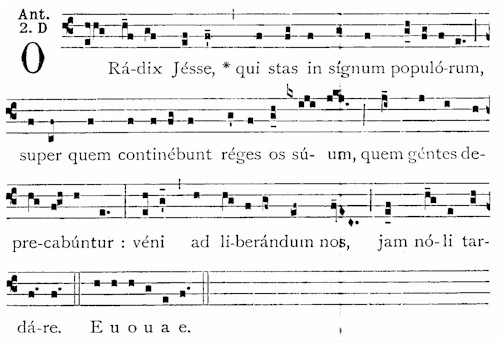
LATIN: O Radix Jesse, qui stas in signum populorum, super quem continebunt reges os suum, quem gentes deprecabuntur: veni ad liberandum nos, iam noli tardare.

ENGLISH: O Root of Jesse, that stands for an ensign of the people, before whom the kings keep silence and unto whom the Gentiles shall make supplication: come, to deliver us, and tarry not.

Scripture References:

Isaiah 11:10
Romans 15:12
Revelation 5:5

Relevant verse of Veni, Veni Emmanuel:

O come, O Rod of Jesse free,
Thine own from Satan’s tyranny;
From depths of hell Thy people save,
And give them victory o’er the grave.

What urgency there is in this antiphon.

Our Lewis & Short says that radix is “a root, ground, basis, foundation, origin, source”.

Ironically, roots are underground and invisible, but standards, ensigns are raised high in the air.

Something that lies below the earth (a root) stands high into the heavens like a banner!

Vexilia Regis Prodeunt we sing in Lent. The little root of Advent becomes by Lent grows into the Tree of our salvation.

The one from above takes our mortal clay into an indestructible bond. He raises us to the heavens.

Isaiah 11:10 gives us imagery for our reflection today.

The great prophet of Advent tells us that the kingdom of David would be destroyed, but not entirely destroyed. A root would remain. Jesse is David’s father. David is Jesse’s root. David leads to Christ.  Christ is the David King Messiah Priest.

After the destruction there remains a root.

No matter what the exigencies of life present to us or how turbulent the vicissitudes of the passing world may be, when we cling to the root we are sure to be victorious in the end.  The root bears up on high to the heavens.

Per aspera ad astra.  Succisa virescit.

Life includes patterns of destruction and rebuilding, pruning and regrowth, transplantation and rerooting.  So long as we are grafted into the Root, we survive and grow.

Exitus.  Conversio.  Reditus.

WDTPRS The O Antiphons: 19 December – O Radix Iesse

Let’s hear the wonderful community at Le Barroux sing this antiphon with the Magnificat.

Posted in Liturgy Science Theatre 3000 |
Leave a comment

ACTION ITEM! Form of absolution to CHANGE in 2023. OPPORTUNITY: Inform priests who have been screwing around with the form of absolution.

ACTION ITEM! Form of absolution to CHANGE in 2023. OPPORTUNITY: Inform priests who have been screwing around with the form of absolution.Because I continue to get question in my email about bizarre things that priests do to the FORM OF ABSOLUTION, it is good to remind everyone that in 2023 the Novus Ordo form of absolution in English is to change.  There has been an official tweak of the English translation of the Latin.

In 2021 the US Bishops voted for the new translation.  Rome approved it in April 2022.  It goes into effect in 2023.

I can foresee an ACTION ITEM by lay people. Make sure that priests who are doing dodgy things with the form of absolution are informed about the correct form precisely because this change is going into effect.

It is an OPPORTUNITY to help some priests stop screwing about with the form of absolution.  If the priests resist, get authorities involved if they keep up their shenanigans.

New translation of the prayer of absolution incoming next year.

God, the Father of mercies,
through the death and resurrection of his Son
has reconciled the world to himself
and poured out [Latin: effudit] the Holy Spirit among us for the forgiveness of sins;
through the ministry of the Church may God grant [Latin: tribuat] you pardon and peace,
and I absolve you from your sins
in the name of the Father, [sign of the cross] and of the Son,
and of the Holy Spirit.

And here’s what the prayer was before:

God, the Father of mercies,
through the death and resurrection of his Son
has reconciled the world to himself
and sent the Holy Spirit among us for the forgiveness of sins;
through the ministry of the Church may God give you pardon and peace,
and I absolve you from your sins
in the name of the Father, [sign of the cross] and of the Son,
and of the Holy Spirit.

Use Latin and there is ZERO question of validity.

The Latin for the post-Conciliar form:

Deus, Pater misericordiarum, qui per mortem et resurrectionem Filii Sui mundum Sibi reconciliavit et Spiritum Sanctum effudit in remissionem peccatorum, per ministerium Ecclesiae indulgentiam tibi tribuat et pacem. Et ego te absolvo a peccatis tuis in nomine Patris, et Filii, et Spiritus Sancti.

Priests of the Latin Church should know this Latin form of absolution by heart… yes, in Latin.

Posted in ACTION ITEM!, GO TO CONFESSION, Hard-Identity Catholicism, Liturgy Science Theatre 3000, Save The Liturgy - Save The World | Tagged ,
5 Comments