2018 March For Life – Plenary Indulgence

CNA reports that those who participate in the March For Life in Washington DC can gain a plenary indulgence.

Participating in the March for Life? There’s an indulgence for that.

Washington D.C., Jan 7, 2018 / 04:01 pm (CNA/EWTN News).- Catholics participating in the 45th annual March for Life in Washington, D.C., Jan. 19 will be able to receive a plenary indulgence for doing so, the local Church has announced.

“In virtue of the authority granted by our Holy Father, Pope Francis… a plenary indulgence can be obtained under the usual conditions…by the Christian faithful who are truly penitential and compelled by charity, if they take part in the sacred celebrations, along with the great assembly of people, throughout the whole course of the annual event that is called ‘March for Life,’” announced a Dec. 20 letter from the Archdiocese of Washington and the Diocese of Arlington.

The document was signed by Cardinal Donald Wuerl of Washington and Bishop Michael Burbidge of Arlington, who together encouraged their brother bishops with the hope “that you will share this information with those entrusted to your pastoral care.”

Individuals who wish to obtain the plenary indulgence must engage in the events hosted by the March for Life in Washington, D.C.: the youth rally, Mass at Capital One Area, the adult and family rally at St. Matthews Cathedral, or the Prayer Vigil for Life at the National Shrine of the Immaculate Conception.

In addition, the usual conditions for a plenary indulgence must be met: that the individual be in the state of grace by the completion of the acts, have complete detachment from sin, and pray for the Pope’s intentions. The person must also sacramentally confess their sins and receive Communion, up to about twenty days before or after the indulgenced act.

The letter also noted that “the aged, sick and all those who due to grave reason are not able to leave home” are also able to receive the plenary indulgence so long as they “spiritually join themselves to the holy ceremonies, while also having offered prayers and their sufferings or the ailments of their own life to the merciful God.”

An indulgence is the remission of the temporal punishment due to sins which have already been forgiven.

The March for Life, an annual peaceful protest against abortion, has taken place for the past 44 years in the nation’s capital, Washington, D.C., to publicly oppose the Supreme Court’s 1973 Roe v. Wade decision which legalized abortion across the country.

The march remains one of the largest political protests in the United States today.

Last year, hundreds of thousands of pro-life individuals were gathered in solidarity and prayer in the fight against abortion. Vice President Mike Pence spoke at the 2017 event, making him the highest ranking White House official to ever speak at the March for Life.

This year, the theme for the 45th annual March for Life is “Love Saves Lives.”

The March will take place at the National Mall Jan. 19 and include speakers such as Pat Tebow, the mother of professional football and baseball player Tim Tebow. Other keynotes include former NFL player Matt Birk, U.S. Rep. Dan Lipinski, U.S. Rep. Chris Smith, and Sr. Bethany Madonna of the Sisters of Life.

“May the efforts of all across this great nation to lift up the value and dignity of each life continue to bear fruit,” the letter said, adding, “May we all experience God’s blessings in this noble undertaking.”


Posted in "How To..." - Practical Notes, Emanations from Penumbras, Events | Tagged ,
5 Comments

ASK FATHER: Can modern architecture churches have “ad orientem” worship?

AD ORIENTEM SHIRT 01

click

From a reader…

Dear Father, I been trying to find and answer to a question about Ad Orientem worship facing west. Is it licit? Can churches hampered by modern architecture still worship Ad Orientem? Thanks in advance.

From the earliest days, and in keeping with the prayer practices of the Jews (cf. Ratzinger),  our forebears thought Christ would return in glory from the East.  Moreover, if I remember correctly, after her apparitions at Fatima, Our Lady disappeared into the East.

Celebrating “towards the East… ad orientem” is symbolic.  It doesn’t have to be the literal geographic East.  It is ideal to be able to face the literal geographic East, but we can create a liturgical East in any direction.  So long as you are all facing the same direction, you are symbolically facing the East.  Thus, we turn to the Lord who is coming.

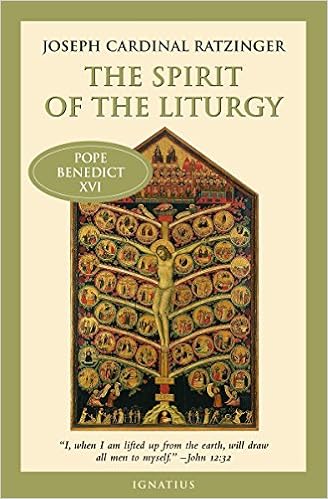
You might try a few reading sources.  First, there’s the indispensable The Spirit of the Liturgy, by Pope Benedict XVI, aka Joseph Ratzinger.

US HERE – UK HERE

In this he has a deep reflection on the meaning of worship ad orientem.

Also useful is  “Turning Toward the Lord: Orientation in Liturgical Prayer” by my friend the Oratorian Father Uwe Michael Lang.

US HERE – UK HERE

And one should also read Card. Sarah’s important London speech.  He talks about the importance of ad orientem worship.  He asked priests – not officially of course – to consider saying Mass ad orientem.  HERE

Card. Sarah made the invitation and Lib World threw an authentic spittle-flecked nutty, thus proving the solid-gold value of his vision.

Click!

Posted in "How To..." - Practical Notes, ACTION ITEM!, Liturgy Science Theatre 3000, The Coming Storm, The future and our choices, Turn Towards The Lord | Tagged
17 Comments

The “Gay” (I hate that word) Priest Problem

Why is there a picture of three beavers here?
Keep reading!

I’ll batten the hatches for another round of hate mail and “block parties” and alert the readership of a good piece at The Catholic Thing by Fr. Jerry Pokorsky.

He tackles the “gay” (I hate that word) priest problem.

Confronting the Gay Priest Problem

Recently, a priest who was prominent in the pastoral care of those with sex addictions received his fifteen minutes of fame when he revealed to his congregation at a Sunday Mass and to the National Catholic Reporter[aka National Sodomitic Reporter] that he was “gay.” According to news reports, his self-congratulation was met with thunderous applause. In a television interview, he proclaimed there is “nothing wrong with being gay.”

The game plan of a gay priest “coming out” was quite predictable and is politically effective. In revealing his homosexuality, the Midwestern priest was careful to assemble a string of ambiguous assertions that cannot be immediately assailed on grounds of orthodoxy, but when bundled together are morally subversive. Here is the template:

  • Claim that sexual transparency is a matter of personal integrity.
  • Remind the public that you are a Catholic priest in good standing.
  • Proudly proclaim that you are “gay.”
  • Cultivate the adulation of your congregation by claiming victim status and the freedom that comes from such an honest revelation.
  • As a pre-emptive strike against disciplinary actions by ecclesiastical authorities claim that your self-revelation is truly courageous.
  • Feign humility and presume you have become a necessary role model for others.
  • Remind us that you and all gays (and members of the alphabet soup of sexual perversion) are created in the image of God (implying our sinful neglect).
  • Commit to celibacy (i.e., not to marry), but carefully avoid the term “Christian chastity.

Each of these assertions, standing alone, would likely withstand ecclesiastical censure. But when woven together, the gay agenda promoting the acceptance of the homosexual lifestyle within the Church comes into a clear focus.  [the “gay” agenda doesn’t end at “acceptance of the homosexual lifestyle”.  The next brass ring is the lowering of the age of consent.]

[…]

Faithful and orthodox Catholics are at a political disadvantage in our gay-friendly culture. We realize that same-sex inclinations – as with all seriously sinful inclinations – cause great suffering and, unrestrained, can become a true slavery that endangers others including adolescents and even young children. But our opposition to the gay agenda is often crudely characterized as hateful and unreasonable. So a brief sketch of natural law in Catholic sexual morality may be helpful.

Male and female sex organs differ and have a unique reproductive function. The body of every human being contains a self-sufficient digestive or respiratory system. But it only contains half of a reproductive system and must be paired with a half-system belonging to a person of the opposite sex in order to carry out its function. These are undeniable biological facts.

“To engage in sex” is a relational term that implies male and female complementarity. Only a male and a female truly “engage in sex.” In contrast, same-sex “relations” involve the exercise of one’s sexual power, but not according to its self-evident nature. Sodomy is not really relational “sex.” It is merely a masturbatory use of sexual powers. Similarly, there is no such thing as “sexual relations” with a “sex robot” (alas, an emerging technology).

When a priest claims to be “gay and proud,” he is revealing that he has assented to his same-sex attraction. Free and deliberate thoughts have moral implications, as Jesus asserted: “But I say to you that every one who looks at a woman lustfully has already committed adultery with her in his heart.” (Mt 5:28) The difference between internal assent and external action is only a matter of a sinful opportunity. [NB] An unabashed and proud “gay” priest has already committed sodomy in his heart[To the applause of the Fishwrap and certain Jesuits.]

So how might an ecclesiastical superior defend Church teaching if one of his priests (or religious) claims a special dignity by “coming out” as gay? The superior should invoke immutable Christian moral principles in dealing with a self-described gay priest:

[…]

With that cliff-hanger, I’ll send you to read the rest there.

I applaud Fr. Pokorsky for his clarity.  Fr. Z kudos.

I have known a few priests who were/are homosexuals.  A couple of them told me they were.  The rest were obvious or otherwise out.  With a couple exceptions, all of those whom I have known are now dead.   To be clear, I know a lot of priests.  I have known very few who were/are homosexuals.  I sincerely believe it is a myth that there are lot of homosexual priests.

I also strongly think that men with strong homosexual inclinations should stay out of seminary or leave the seminary before ordination.  I strongly believe that homosexual men who are now ordained must never reveal that they have this appetite or attraction.  I strongly believe that if they suffer as a result and remain chaste, they will win a glorious crown in heaven and their place among the saved will be very high indeed.  If their suffering is greater than others, then their graces too will be greater and the rewards will be as well.

“But Father! But Father!”, you Fishwrap rattlers are keening. “It is an incontrovertible FACT that God wants people to be homosexuals.  He makes them that way.  And if that’s so, then homosexuality is just as normal as all the other kinds of sexuality and identity that anything can imagine!  As a matter of fact, God didn’t really make human beings male and female.  God made at least … ummm…. 53 genders!  Facebook says so!  And Facebook knows more than YOU do.  You…. you… HATER!   YOU HATE GAYS!  And you HATE VATICAN II!”

I have such respect for “gays” (I hate that word) and Vatican II that I won’t lie about them.

I like Father’s reminder, above, of natural law.

Homosexual acts are clearly wrong. Our parts are intended by God to fit a certain way.  They are ordered to each other in a complimentary way.  God made us to live the human life in a properly ordered way, according to our human nature which He created.  We can choose not to live that way.  If we have inclinations not to live as God made us, that doesn’t mean that God made the aberrant inclination.   God makes all people.  People with disordered inclinations are, of course, people and, hence, God made them.   But God didn’t make them to be people with disorders.  God foresees and allows disorders, but that doesn’t make the disorders the norm.  All human beings are intended to live the human life in a properly ordered way.  Those who have some disorder have a harder time doing that.

We believe, however that overcoming that disorder, which will entail suffering, will bring them great merit and beautiful rewards in heaven, if not on earth.

Same-sex attraction is a disordered attraction.   God doesn’t make disordered attraction.  He foresees and permits disorders, according to His plan.  But it is not part of the normal ordering of living the human life.

All analogies limp a little, but let’s look at this another way.

If we study, say, 10000 beavers, we get a good picture of what beavers are made by God to do, what Beaver Life™ is.  Beavers are semi-aquatic. They gnaw down trees, make dams and lodges out of branches, logs, stones and mud. They work at night and slap the water with their tails when there is danger. They do not hibernate, so they stockpile food for the winter. They eat plants and bark and roll up lily pads like cigars to munch on. They mate for life, live in colonies, and they make little beavers during the winter.

That’s pretty much it. That’s what living the Beaver Life™ is. God makes all beavers and makes the Beaver Life™ which all rightly, beaverly, ordered beavers live.

However, say that among the 10000 beavers we have studied to determine what Beaver Life™ is, we find a beaver who, instead of gnawing trees and building dams, collects discarded aluminum cans out of which he constructs abstract art. Instead of stockpiling food before the winter, he lounges in the sun. Instead of rolling up lily pads before eating them, he eats frogs.  Instead of using his tail as a rudder and to signal danger, he swims backwards and ignores danger completely.

You would have to say that God made that beaver, but you wouldn’t say that that beaver was living Beaver Life™ properly. You would probably say that this beaver has a disorder of some kind. He’s doing the wrong things. Furthermore, if other beavers start to imitate the beaver with the disorder, there could be a problem for the survival of that colony.  You would hope that that beaver would correct his ways, stop giving a bad example to the other beavers, and cease to undermine Beaver Life™ which God intended for all beaverkind.

Frankly, a beaver like that wouldn’t last very long in the wild.  A beaver with that disordered inclination would probably win the Darwin Award, so to speak, and leave the gene pool.

Living Human Life™ as God intended is more complicated than living Beaver Life™ as God intended.  We aren’t governed by instincts as critters are.  We have reason and will, unlike brute beasts.  Still, natural law holds for us as it does for beavers.  Our natures are written into us by God.

Homosexual acts are wrong in themselves.  They are intrinsically disordered.  They are sinful in themselves.  They can never be right.  Never.   They are identified as intrinsically wrong by reason, observation of nature, and because of divine revelation.

The inclination to disordered acts is a disordered inclination.

Sodomy (homosexual acts) is rightly identified as one of the sins that “cries out to heaven” for vengeance, along with murder, oppression of the poor and defrauding a works of his just wages.   Dante places those who committed sinful homosexual acts… in the 7th circle of the Inferno, with the violent, with murderers, suicides, blasphemers and usurers.  It is a form of violence against another. And note that Dante treated the representative for sodomy, his friend Ser Brunetto Latini, with great dignity. Dante saw sins like this as tearing apart the bonds of society, so in the Inferno they are among the violent.  In Purgatorio 26 homosexuals are being purified alongside heterosexuals and are, thus, categorized according to the vices, rather than violence against nature.  But I digress.  Dante get’s me going.

Having an attraction to, an appetite for someone of the same-sex is disordered, contrary to the complimentarity which God wrote into our human nature as males and females.  God makes order, not disorder.  He foresees and permits that their be disorders and sins and even defects all through nature, and somehow they can serve to His greater glory.  But the disorders and the sins and the defects are not God’s will.

We will see how that all works out only in the general judgment after all things are submitted to the Father and God is all in all.

In sorting out questions about why some people have same-sex appetites, we have to understand something about God’s positive or ideal will and God’s permissive will.

God is perfect, infinitely good. God can only will that which is good, true, beautiful and holy.

So why is there evil in the world? Why are there disorders?

God willed that Adam and Eve remain holy. But because He willed that they have a free will, as He has a free will, He permitted them to fall. He did not will them to fall. He permits that sins be committed, he does not will them to be committed. Because of the nature of… well… nature, he permits that there be defects or weaknesses. He does not will them.

God doesn’t make people sin. He permits it. He foresees and uses it. But God the perfect Orderer cannot be the cause of disorder.

I suspect that in most cases, homosexual relationships that involve genital, etc., acts are really a twisting and warping of friendship.  But that might be a topic for a different entry.


Posted in Fr. Z KUDOS, Mail from priests, Sin That Cries To Heaven | Tagged , , , , ,
17 Comments

ASK FATHER: The “Ultima” chant

From a reader…

QUAERITUR:

When my father died, about 11 years ago, the priest who offered his funeral Mass ended it by chanting what he called “the Ultima”. The priest who did it is a very good friend of mine, and this is the only instance I’ve ever heard him chant in Latin during a Mass. I had never heard of this chant before my father’s funeral and I haven’t heard it since.

Over the years I would try to research this chant to find information on it but have not had any sucess till recently. I found the words and notation on a website along with a translation that was done in 2006 but I still don’t know much about the chants use or history.

My priest friend has not been helpful. He is usually the type to scoff at all things traditional, which is why I was shocked at his chanting latin at my father’s funeral. Would you be able to shed some light on this for me, please?

Thank you for all your hard work at this blog. You are in my prayers.

The chant in question is called “The Ultima”, from the more complete “Ultima in hora mortis”.

This is something from the Benedictine tradition.  It is a chant, to the Blessed Virgin, invoking her as a good Mother and Queen of Heaven, to help souls to a good death and to take care of them afterward.

You can find it online, for example, HERE.

The American Cassinese Benedictines have a version, which includes three languages.  HERE [UPDATED link: to their new server… help them out and CLICK!]

The text seems to be cobbled up from lines taken from a sequence written by a Cardinal Archbishop of Cologne at the time of Pius IX’s proclamation of the dogma of the Immaculate Conception.  Hence, it is not an ancient text, but it reflects the piety and faith of millennia of Christian experience of Mary and of death.

Usually the first part is sung, and it has been set for four voices, etc.

Ultima in mortis hora
Filium pro nobis ora
Bonam mortem impetra
Virgo, Mater Domina

Literally:

In the last hour/moment of death
pray to Your Son for us
obtain (for us) a good death
O Virgin, Mother Lady.

We should contemplate death often and pray for a good death.

Last night I blessed Epiphany Water, which rite includes the Litany of Saints, during which we pray to be saved from a sudden and unprovided death, that is, death with the the sacraments, the chance to make a good confession.

Baring extraordinary graces, I think people die as they have lived.  Habits get baked into over the years.  We have to develop habits of dying while we are still living, so that when we die, we die as well as possible.  Death is a great mystery, but we can ready ourselves, much as soldiers – and we belong to the Church Militant – ready for the struggle through constant and long drills.


Posted in "How To..." - Practical Notes, ASK FATHER Question Box, Four Last Things, Our Solitary Boast | Tagged , ,
9 Comments

WDTPRS – Epiphany Collect: Liturgy should be “epiphany”, wherein we encounter transforming mystery.

In the Novus Ordo calendar Epiphany (which is supposed to be 12 days after Christmas – the reason it is called “Twelfth Night”) is sometimes moved to the Sunday.  I suppose that they reasoned that more people would celebrate the important feast that way.

I say that

1) that signals that bishops think that our obligations according to the religion of virtue aren’t that important,

2) the liturgical year isn’t that important, and

3) parishes lose a collection.

In the ancient Western Church and in the East, Epiphany was more important than the relative latecomer Christmas.  Epiphany is from the Greek word for a divine “manifestation” or “revelation”.  There are many “epiphanies” of God in the Scripture.  Think, for example, of the burning bush encountered by Moses.

The Latin Church’s antiphons for Vespers reflect the tradition that Epiphany was thought to be not only the day the Magi came to adore Christ, but also the same day years later when He changed water into wine at Cana, and also when He was baptized by St. John in the Jordan.  In each mysterious event, Jesus was revealed to be more than a mere man: He is man and God.

The Epiphany Collect was in the 1962 Missale Romanum and in ancient sacramentaries.

Deus, qui hodierna die Unigenitum tuum stella duce revelasti, concede propitius, ut qui iam te ex fide cognovimus, usque ad contemplandam speciem tuae celsitudinis perducamur.

Stella duce is an ablative absolute.  The adjective hodiernus means “of this day, today’s”.  In older Latin, celsitudo is “lofty carriage of the body”. In later Latin it is used like the title “Highness”.  In our liturgical context it is a divine attribute, God’s transcendent grandeur, glory.

SUPER LITERAL VERSION:

O God, who on this very day revealed your Only-begotten, a star as the guide, graciously grant, that we, who have already come to know You by faith, may be led all the way unto the beauty of Your glory to be contemplated.

OBSOLETE ICEL (1973):

Father, you revealed your Son to the nations by the guidance of a star. Lead us to your glory in heaven by the light of faith.

NEW CORRECTED ICEL (2011):

O God, who on this day revealed your Only Begotten Son to the nations by the guidance of a star, grant in your mercy, that we, who know you already by faith, may be brought to behold the beauty of your sublime glory.

In Latin prayers species (three syllables) often means “beauty”. It is also a technical, philosophical term about the way the human intellect apprehends things.  Species has to do with the relationship between the thing known and our knowing power.  A species transforms the mind of the one perceiving a thing.  The object we consider acts upon our power of knowing.  Simultaneously, the knowing power acts upon the object known.  Our knowing power’s active and passive aspects meet in the species and the object of our consideration is known directly, without intermediaries.  Easy. Right?

This is what we are praying for, hoping for, living our earthly lives for: to see God face to face, directly and immediately (without intermediaries).

In this life we know God only indirectly, by faith, our reason aided by the authority of revelation and by grace.  This is St. Paul’s “dark glass” (1 Cor 13:12) through which we peer toward Him in longing.

Christ is the visible image of the invisible God.

He is the Father’s Beauty.

He is Truth and Beauty and Glory itself.

St. Hilary of Poitiers (d 367) conceived God’s divine attribute of glory as a transforming power which divinizes us by our contact with it.  After Moses talked with God in the tent of the Ark, he wore a veil over his face, which became too bright to look at.

We pray today, literally, to be brought “all the way to the beauty of glory (species celsitudinis)” of God “which is to be contemplated”.

His beauty will act on us, increase our knowledge of Him and, therefore, our love for Him … for all eternity.   We will be, all the more, the images He intended.

Christ could be understood to be the species celsitudinis of this prayer. Contemplate His truth and beauty.  Christ is the true speaker and spoken truth of every prayer of every Mass.

If eternal Beauty transforms us, “divinizes” us, then beauty in this life changes us too.

Could a fostering of beauty in our churches help us reach people today in a way that arguments or other appeals may not?

Our liturgical worship of the Most High God must lead us to encounter beauty, truth, transcendent mystery.

Holy Mass requires the finest architecture, vestments, music – everything – we can summon from human genius, love and labor.  What we sing and say and do in church, and the church itself, ought to presage the liturgy of heaven, where the Church Triumphant enjoys already the Beatific Vision.  Liturgy should be “epiphany”, wherein we encounter transforming mystery.

Let us celebrate every Mass in such a way that we become shoeless Moses before the burning bush which is never consumed.

Let Mass make us Magi with sight and mind fixed in longing upon the beautiful, true and yet speechless Word, in whom transcendent glory was both hidden and revealed.

As we read today from Leo the Great in the Office of Matins:

Honorétur ítaque a nobis sacratíssimus dies, in quo salútis nostræ Auctor appáruit: et quem Magi infántem veneráti sunt in cunábulis, nos omnipoténtem adorémus in cælis. Ac sicut illi de thesáuris suis mýsticas Dómino múnerum spécies obtulérunt, ita et nos de córdibus nostris, quæ Deo sunt digna, promámus.

Let all observance, then, be paid to this most sacred day, whereon the Author of our salvation was made manifest, and as the wise men fell down and worshipped Him in the manger, so let us fall down and worship Him enthroned Almighty in heaven. As they also opened their treasures and presented unto Him mystic and symbolic gifts, so let us strive to open our hearts to Him, and offer Him from thence some worthy offering.

Posted in Christmas and Epiphany, Liturgy Science Theatre 3000, Patristiblogging, WDTPRS | Tagged , , , , ,
3 Comments

ASK FATHER: Are blessings, sacramentals from SSPX priests efficacious?

From a reader…

QUAERITUR:

Are blessings made by SSPX priests efficacious? Like when they bless sacramentals, water, salt etc, are these really blessed?

Let’s see.

SSPX bishops validly ordain and confirm.

SSPX priests validly confect the Eucharist.

SSPX priests (now) validly absolve sins.

I think that they validly bless sacramentals and that they are efficacious.

In the case of Epiphany Water, the priest should have the faculty from the local bishop. However, that would be for liceity rather than for validity. When it comes to rites like the exorcism of persons, however, if I were an SSPX priest I wouldn’t touch that with a ten foot aspergilum without the explicit faculty of the local bishop.

Posted in "How To..." - Practical Notes, ASK FATHER Question Box, SSPX | Tagged ,
Comments Off on ASK FATHER: Are blessings, sacramentals from SSPX priests efficacious?

“The solution is staring the bishops in the face”

The pastor of the parish where I came into the Church was downright disgusted with the Archdiocese’s approach to vocations and the priest shortage crisis that would follow. He used to compare the geniuses of the vocations office et al. to those who during a potato famine sat around talking about how they were going to die from starvation rather than planting other crops and going fishing.

Today I read in the newest number of the Catholic Herald an article about a way to save the Catholic Church in England.

The subtitle:

The solution is staring the bishops in the face

Indeed it is.

The writer presents some cold facts and then gets to it.  Let’s jump in media res with my emphases:

[…]

Without denying that church closures are often inevitable, they are not always the only solution to too many churches. Indeed, several dioceses in north-west England are quietly pioneering another model, of which other “church rich, but priest-and-parishioner poor” bishops might well take heed.

The basic model is simple: lift a surplus-to-requirements church out of the normal parish system and give it to a niche group that can do something distinctive with it. Some of the original parishioners will stay and adjust (and be quite happy to do so); others will go off to provide a welcome boost to the numbers of nearby parishes. By allowing this group to spread its wings, and do something distinctive, it can then attract like-minded people from the surrounding area. Perhaps in any one parish there might be only two, or three, or five people for whom this is “their thing”, but over a wide area – especially in a large town or city – those few soon add up.

After all, most people already drive to church and a significant number of Mass-goers frequent a church that is not, strictly speaking, their own. This happens most obviously in places like London (how many of those attending the Oratory do you suppose actually live within its parochial boundaries?). But it is a perfectly common practice throughout the whole country.

Take my own home town of Preston, in the Diocese of Lancaster. Three grand old churches have recently been given over to the traditionalist Institute for Christ the King (St Walburge’s and English Martyrs) and the Syro-Malabar Church (St Ignatius, or rather the Cathedral of St Alphonsa as it is now). While these three are only a mile apart, there are more than a dozen other Catholic churches within a three-mile radius. So there’s no shortage of options for these churches’ original worshippers, looking for what they’re liturgically used to. I have visited St Walburge’s on a number of occasions, and it is genuinely thriving. In fact, they’re now setting up a school. I’ve also been to the Archdiocese of Liverpool’s own experiment in this area: St Mary’s, Warrington, entrusted to another traditionalist order, the FSSP. It too is doing just champion, as we say in Lancashire.

This basic model is, I’ll wager, worth exploring further, and with other groups. If it can work in Preston with both Extraordinary Form (EF) devotees and Keralan-diaspora Syro-Malabars, with whom else might it work? (As a curious side note, while I’ve seen the idea of EF communities criticised for being cliquey and divisive, I’ve never heard the same allegations against dedicated churches for Eastern Catholic groups.)

[…]

He goes on to talk about the possibility of reviving ethnic, personal parishes as well as the Ordinariate.

It is staring bishops in the face.  I think there are some bishops who would burn the diocese to the ground and sew the land with salt before they would let a parish go entirely Extraordinary Form.

So, let’s start planning how to starve together rather than growing crops and going fishing.

Reason #10 for Summorum Pontificum.


Posted in ¡Hagan lío!, "How To..." - Practical Notes, Hard-Identity Catholicism, Liturgy Science Theatre 3000, SUMMORUM PONTIFICUM, The Coming Storm, The future and our choices | Tagged , ,
8 Comments

UPDATED – Wherein faithful canonist Ed Peters guts papolatrous dilettante Stephen Walford

We’ve seen Stephan Walford before. HERE

He is, in essence, papolatrous.  He’s also pretty nasty, when it comes right down to it.  He blasts away at La Stampa against anyone who dares to have quizzical thoughts about Amoris laetitia.

Canonist Ed Peters looks at Walford’s comments on canon law. It’s kinda gory… and fun. I remember one crisp November day sitting on a bench in Central Park and eating a sandwich from Pastrami Queen while up in a tree a large hawk of some sort ripped the guts out of a squirrel. HERE (for Peters’ article, not the squirrel thing). Nearby a dad told his kids that birds didn’t go to the store for meat in plastic packages. At which point the hawk drew out a nice long bit of intestine, eliciting a vigorous, “EEEEWWWWW!”

But I digress.  Let’s see Ed Peters’ version of hawk and squirrel … with my emphases and comments:

Nooo, Canon 17 does not let us undercut Canon 915 and what it protects

A professional knows the limits of his knowledge. An amateur does not know the limits of his knowledge. A dilettante does not know that there are any limits to his knowledge.

Based on the biographical interview he granted to the Catholic Herald, it seems that Stephen Walford is a professional pianist and an amateur theologian (one’s dearth of formal education in a complex discipline being an obstacle, but not a complete bar, to one’s achieving some knowledge of at least some topics within that discipline), rather as I am a professional canonist and an amateur, I dunno, Latinist or woodwind player. Nothing wrong with being a professional, of course, or an amateur; but dilettantes are something else. If, having watched “Searching for Bobby Fisher” and knowing how the horsey moves, I started opining publicly on the Sicilian [Defense] opening, what would I be? A dilettante. And chess, mind, is a little thing. [There are only 288+ billion possible positions after four moves apiece, btw.]

Now, in regard to canon law, which Walford repeatedly invokes in the course of trashing as “dissenters” anyone who questions the text and certain applications of Amoris laetitia and its progeny, Walford is simply a dilettante unaware that most of his purported explanations of canon law have little or no connection to what the law really means—and sometimes, not even to what it says. And canon law, mind, not to mention the doctrine it works to protect, is a big thing. [Ultimately, law is in the service of the salvation of souls.  A Big Thing™.]

It is difficult to discuss law, of all things, with people who not know what it actually says. For an example of Walford’s misstating what the law (here, Canon 915) says, see his claim that “canon 915 refers to ‘obstinate’ and ‘persevering’ manifest grave sinners.” Of course, John Paul II’s Canon 915—aware that the Church cannot and does not judge souls or determine who is personally culpable for sin or if so by how much—does no such thing. Rather, this papal norm responds to objectively reckoned and publicly observable situations of sin and, in an unbroken line of practice going back to Scripture, directs ministers of holy Communion to withhold that most august Sacrament from persons who, by their public conduct, have placed themselves within the purview of the canon.

Confusing “sinner” and “sin” is, I grant, quite common in this debate and even several ranking prelates seem to think that externally-made assessments of personal culpability (however that oxymoronic task is to be accomplished) are relevant to the operation of Canon 915. But what can I say that has not been said before? Treating “sinner” and “sin” as equivalents is something a professional would avoid, while an amateur, intrigued by the distinction once he saw it, would, hopefully, stop treating the terms as synonyms. [Eeeeewww!]

It is not, however, Walford’s mistaking the plain text of Canon 915 that attracts my attention, but rather his attempt to explain what Canon 17—a norm little noticed in this debate, for good reason—means and allegedly how, by reading Pope Francis’ words in Amoris through in its light, “a path maybe opened to reception of Holy Communion” for divorced-and-remarried Catholics.

As we are talking about canon law, I suggest we start with the canon. The whole canon.

[…]

There’s more gut-ripping available at Ed Peters’ blog In The Light Of The Law.  If you don’t have some squirrel handy, you might make popcorn.

UPDATE:

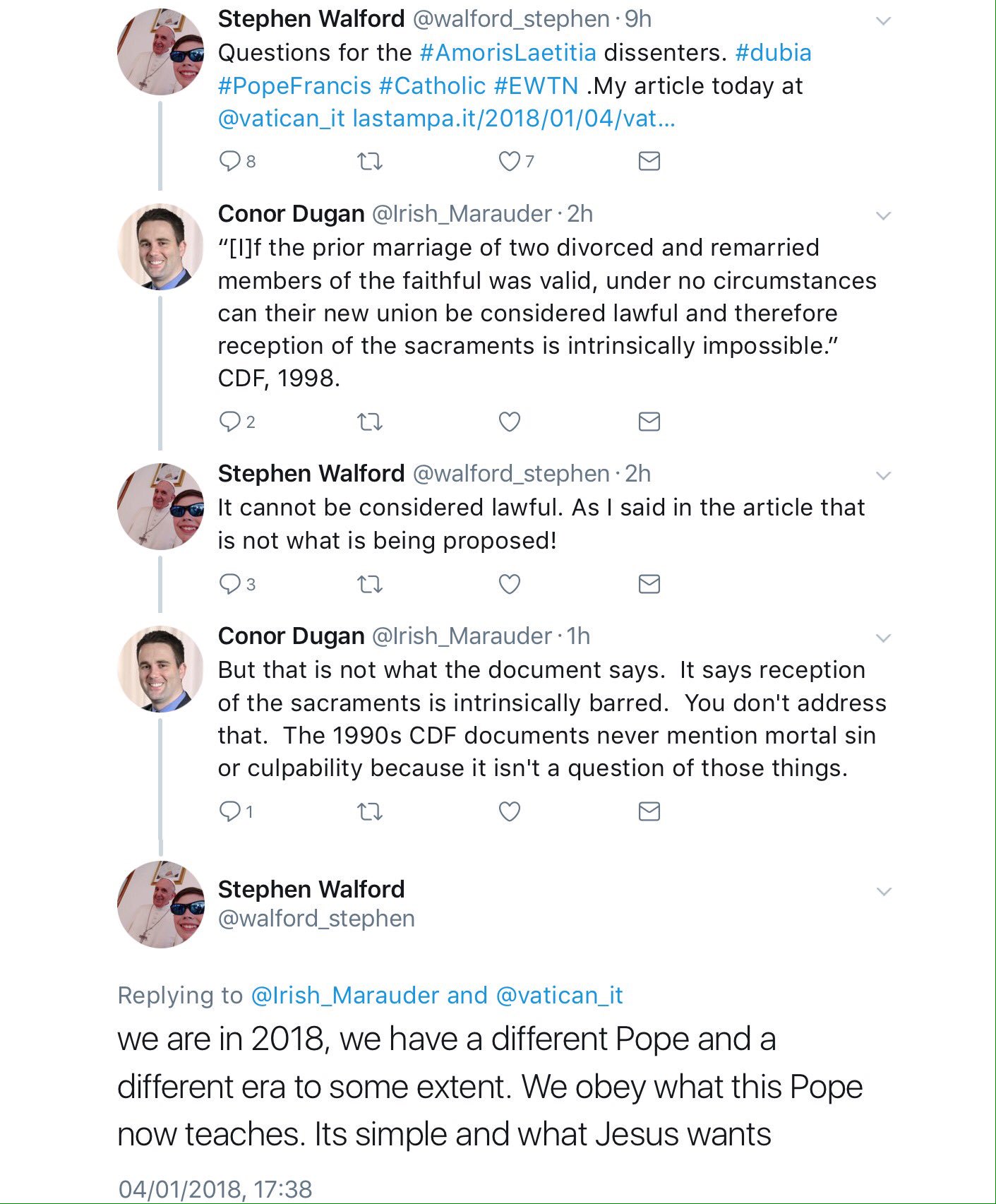
Meanwhile… watch this tweet exchange, to which I was alerted…

Do you see what poor Walford did there?  Poor thing.

Also…. this…

Once again…. his seriously thin skin aside, do you see what Stephen “the poor thing” Walford did there?


Posted in ¡Hagan lío!, "How To..." - Practical Notes, Canon Law, The Drill | Tagged , , ,
8 Comments

“The world needs proud warriors, animated by their faith” – OORAH!

There was a meeting in Chicago this week of Catholic young people.  Something called SLS18.

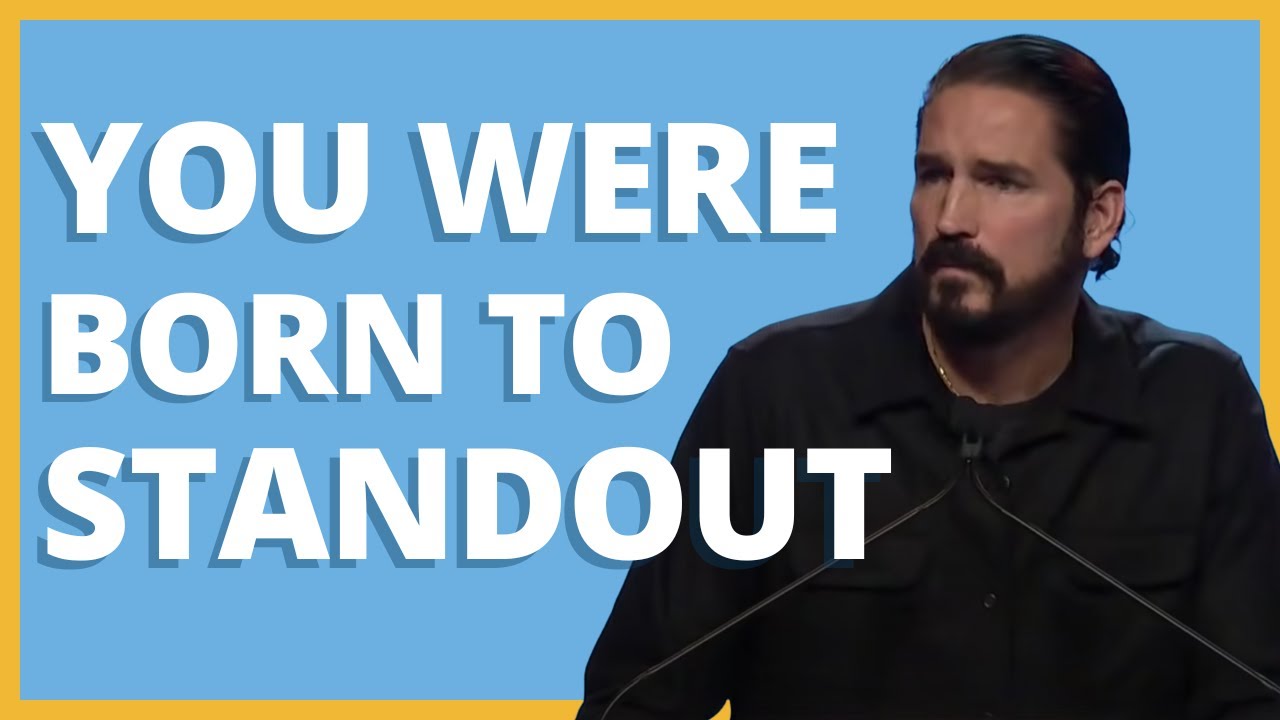
As it happens, the actor Jim Caviezel made a surprise appearance and gave a heck of a short speech about courage.

He talks about “happy talk”.  He tells these young people to be bold, to be warriors.

Rev. Mr. Kandra posted a video some participant shot with a mobile phone of the large screen at the conference.  VIDEO UPDATED (Higher quality)

¡Hagan lío!

YouTube thumbnailYouTube icon

I think the Chicago meeting has something to do with Focus.  It looked pretty good. On Twitter I opined that this might be a real Catholic universe in opposition to the “bearded Spock” parallel universe of the annual Three Days of Darkness in LA.

Posted in ¡Hagan lío!, Fr. Z KUDOS, Just Too Cool, Our Catholic Identity, Si vis pacem para bellum!, The Coming Storm, The future and our choices | Tagged
9 Comments

“To be deep in history is to cease to be Protestant.”

As convert I read with interest the stories of other converts at the Coming Home Network run by Marcus Grodi.  His is, I think, also the best of the shows at EWTN.

Today a story at CHN caught my eye partly because the writer references the great phrase of Bl. John Henry Newman:

“To be deep in history is to cease to be Protestant.”

The post is worth a few minutes of your time.  It is instructive and edifying.  The writer, formerly a Baptist, started looking into early Church writings on baptism and BAMMO.

Also, that great phrase is on some of my swag HERE

Here is a shot of the regular sized coffee mug… I’ll bet you could put your yogurt and granola in it too.

To be deep in history
And the larger one.


T

There is also now a MEGA-size.  Very handy.  I use that size all the time now.

Anyway…

One of the benefits I derive from sales of these mugs, etc., is that I can use the credit to send mugs to priests and bishops who do great things!


Posted in Just Too Cool | Tagged , ,
1 Comment