From a reader…
QUAERITUR:
The people in the chapel I attend – lay people and even the priests – insist on saying that the rules for indulgences include praying for the pope. [No.] I have tried and failed to instruct them that the proper rules are to pray for the pope’s intentions, [Yes.] not the pope himself, although that is also good to do, of course.
My question is, can praying for the pope merit the indulgences or are they negating their prayers’ indulgence graces by not using the exact form?
The Church gets to prescribe, with Christ’s own authority, how the treasury of the merits of Christ and the Saints are to be applied. Hence, we do it the way the Church says to do it, not the way we make up.
The Church says that we are to pray for the intentions which the Pope designates, not for the Pope himself.
To be crystal clear, when we read “for the Pope’s intentions”, that means to gain indulgences we do not pray for the Pope, we pray for the intentions which are designated by the Pope.
Since the time of, I believe, Paul VI, Popes have designated intentions each month of the year, usually a “general” and a “missionary” intention. These days, there seem to be one intention only. They are posted at the beginning of a calendar year. For 2019, the USCCB posted Francis’ intentions for the year. HERE
If you don’t know the specific intention for some month, just pray for the designated intentions in a general way.
If a person in true inculpable ignorance prays for the Pope rather than the intentions designated by the Pope, does that person gain an indulgence? I hope so. I don’t know, but I trust that God will be … ehem… indulgent.
However, there is a problem of culpable ignorance. Priests cannot claim inculpable ignorance about these matters because, by their office, they have a responsibility to know these things. It is incumbent on priests and bishops constantly to review, broaden, deepen their knowledge about the Faith. If it is important for, say, dentists to do this about dentistry, how much more important is it for priests, who deal with souls, not mere teeth? Priests ought to know these things. Period. And they should strive also to find out what they don’t know so that they can know it!
This is a big problem these days. Many wonks and pundits out there don’t know what they don’t know. But I digress.
A priest who tells people the wrong thing – pray for the Pope in the matter of indulgences rather than for his designated intentions – is not only not gaining indulgences on his own but is racking up for himself a longer term in purgatory… where he will long for people to get it right about indulgences when praying for him! (IF… IF… they remember him kindly at all.)
Also, for the sake of those who are legitimately impeded from performing the prescribed work, and it could be either a physical impediment or a moral impediment, confessors (priests who have faculties to receive sacramental confessions) are able to commute – change to something else – both the work prescribed and the conditions required except, for plenary indulgences in particular, detachment from even venial sin. Authors are divided somewhat on the question of whether any confessor can commute a work for any person outside of the confessional. It is best to deal with this with one’s own regular confessor in the confessional.
Say a person is somehow physically impeded through illness, distance, weather, whatever, from going to a cemetery or a parish church for some action, work, designated to gain the indulgence. The confessor can commute that aspect to something else.
Say a person – and this might be more and more the case these days – has a serious problem with the intentions the Pope has designated. That would be a moral impediment, rather than a physical impediment. One’s regular confessor could commute that part of the designated work to some other work, for example, praying for intentions consistent with what Popes have always designated and what tradition has enshrined.
I can hear the bleating of the papalatrous even now, “But Father! But Father!”, they squee like fangirls, “You are doing something horrible! How dare you suggest that everything that this Pope…. this Pope designates isn’t the embodiment of perfection? His immaculate authority has been demonstrated through the wisdom of synodality and … and non-judgmentalism! His expansive foresight and unbounded perspicacity is revealed even in his embrace of Mother Earth in the shape of Pachamama! But YOU… with your judgmental Earth-despising patriarchalist climate-change denial, clinging to those outdated ‘indulgences’ that the Pope mercifully allows you to … to… to… cling to – for now – can’t see his expansiveness because YOU HATE VATICAN II!”
Now that that’s out of the way,
What might such commuted intentions look like… theoretically?
Say, for example… and this is entirely theoretical… a person is truly stymied by Francis’ intention last September 2019: “That politicians, scientists and economists work together to protect the world’s seas and oceans.” Yes, that really was the intention. One might legitimately wonder why that has anything to do with what Popes have traditionally designated.
So, you get into the confessional and talk with your confessor about this. You really want to get an upcoming indulgence for your late grandfather, but…. OCEANS? He calms you down and says that he can commute that aspect of the work to be performed to pray for some other intention, something which the Church perennially designated to gain indulgences. Eagerly, you ask what they might be! Happily, the priest has been broadening his knowledge and has a good idea.
There are also the traditional intentions that were perennially designated.
Click
Because we are Unreconstructed Ossified Manualists, and we love our old dependable compendia of theology with their sober and thorough analyses, we turn to the manual by Prümmer.
Prümmer says that the intentions of the Holy Father for which we are to pray have a tradition of five basic categories which were fixed:
1. Exaltatio S. Matris Ecclesiae (Triumph/elevation/stablity/growth of Holy Mother Church)
2. Extirpatio haeresum (Extirpation/rooting out of heresies),
3. Propagatio fidei (Propagation/expansion/spreading of the Faith)
4. Conversio peccatorum (Conversion of sinners),
5. Pax inter principes christianos (Peace between christian rulers).
These five categories were also listed in the older, 1917 Code of Canon Law, which is now superseded by the 1983 Code.
They remain good intentions, all. I’ll leave it to you to determine whether or not the more recent intentions in any way resemble the classic intentions.
In the theoretical scenario I sketched, above, it could be that the confessor would tell that penitent,
“To fulfill the work to gain the indulgence you desire, pray for the extirpation of heresy from the local seminary. Can you do that?”
“Oh, yes, Father! Gladly!”
“And for your penance, say one chaplet of the Rosary using the Sorrowful Mysteries because it’s a Friday. Can you do that?”
“Yes, Father. Thank you.”
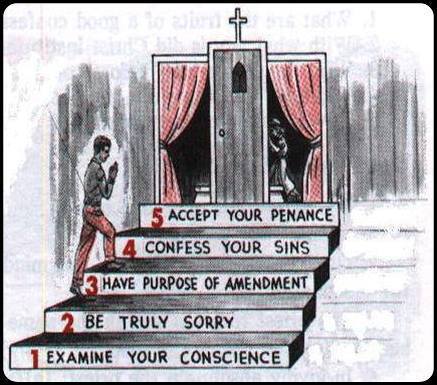
“Very good. Make an act of contrition for all your sins and be resigned to the holy will of God in order to gain the plenary indulgence.” ‘O my God…'”.
“Father, can I say it in my native Bulgarian?”
“Of course. Направи акт на скръб за всичките си грехове и се примири със светата воля Божия, за да спечелиш пленарното снизхождение. Боже мой ….”
We should be diligent in performing the works described by the Church. We also can be more at ease in accomplishing good works through the flexibility Holy Church provides in her laws.