Crowd-funding project to restore a Roman painting of Our Lady of Mount Carmel

On this Feast of Our Lady of Mount Carmel, an interesting project has crossed my radar which you might like to participate in, to the honor of the Mother of God.

There is a crowd-funding project to restore a painting of Our Lady of Mount Carmel in one of the Roman Basilicas, San Pancrazio, which happens to be the last of the Roman Stations to end the Easter Octave. The church is under the care of the Discalced Carmelites.

HERE

The Ecstasy of Saint Teresa of Avila by Palma the Younger

There is a good description of the painting and its history, what needs to be done with it and how the costs break down.

Even a small amount will help. That’s how crowd-funding works!

Our Lady of Mount Carmel, pray for us!

Posted in ¡Hagan lío!, Events, Our Solitary Boast, The Campus Telephone Pole | Tagged
2 Comments

CQ CQ CQ #HamRadio Saturday: UPGRADE and the aftermath of Zuhlsdorf’s Law

phantom ham radio operatorLast week I posted about the long delay for my Amateur Extra license upgrade to be posted on the FCC site.  It FINALLY came through.  So, that’s take care of.

Last week I also posted on my struggles under the influence of Zuhlsdorf’s Law.  That struggle continued into this week.  I had my car in to the shop.  My phone developed problems which resulted in huge frustration and scrambling for solutions.  Etc. I write on that here because, after all, the mobile phone is a hand held radio that hits local repeaters.

What happened with the iPhone is that, on my way to Milwaukee to get my new radio (because the old one died), it got very warm and the power, the charge, simply dropped.  For the days that followed, it charged slowly, and you could practically see the battery percentage drop as you gazed at it.  I tried everything I could find on these interwebs to deal with this.  I was on the phone with Apple.  No joy.  I eventually stopped in at my provider store to explore my options and I chose to invoke my insurance to replace the phone.  I must say that the replacement came swiftly. Then I had to go through the set up and restoration from my backup which was a slow process.   In any event, that’s over… for now.

Interesting note: my old phone developed its problems a month before it was eligible for upgrade.  Coincidence?

Hopefully Zuhlsdorf’s Law is done with me for the time being. Remember… Murphy was an optimist.

Also, I posted the bad news that the ham radio shop in Milwaukee was closing down.  The good news is that Ham Radio Outlet is going to take it over.

Meanwhile, I am again working on my Morse Code.  Each day I do something with it.

My practice key, which I bought at Rocket Radio in Tokyo, Akihibara.

If you want to learn a language, the key – ehem – is to do something each and every day without fail.

Also, I am assembling some parts for a little “home brew” project.

I created a page for the List of YOUR callsigns.  HERE  Chime in or drop me a note if your call doesn’t appear in the list.


Posted in Ham Radio | Tagged , , ,
3 Comments

Canon 212 in the 1983 Code and the Internet: edgy new Catholic news aggregator page

There is an edgy new Catholic news aggregator page available.  Canon 212.com

Canon 212 in the 1983 CIC for the Latin Church is an important canon in the section on the obligations and the rights of the faithful

Can. 212 §1. Conscious of their own responsibility, the Christian faithful are bound to follow with Christian obedience those things which the sacred pastors, inasmuch as they represent Christ, declare as teachers of the faith or establish as rulers of the Church.

§2. The Christian faithful are free to make known to the pastors of the Church their needs, especially spiritual ones, and their desires.

§3. According to the knowledge, competence, and prestige [scientia, competentia et praestantia] which they possess, they have the right and even at times the duty to manifest to the sacred pastors their opinion on matters which pertain to the good of the Church and to make their opinion known to the rest of the Christian faithful, without prejudice to the integrity of faith and morals, with reverence toward their pastors, and attentive to common advantage and the dignity of persons.

That last part is important.

First, not everyone has knowledge, competence or prestige (excellence, preeminence).  There are a lot of people out there in the interwebs who don’t know that they don’t know what they don’t know.

Second, there is a way to “manifest to the sacred pastors” concerns, needs, etc.  When it comes to disagreement with doctrine, there are channels, so as not to create scandal.  When it comes to disagreement with personal opinions or tastes or, simply put, errors, this canon does not exonerate anyone from being charitable and prudent.

So, we have another quick glance source for news.  Let’s hope that it bears good fruit.

Posted in The Campus Telephone Pole | Tagged
19 Comments

The Polish translation of GIRM 299 on the position of the altar

16_07_01_PontMass_31The personal appeal made by His Eminence Robert Card. Sarah to priests to begin reading Holy Mass ad orientem has once again stirred debate about the correct translation of GIRM 299, about the position of the altar and about the position of the priest at the altar.  The Latin has been explained in a response by the CDW to a dubium.

The official English translation is WRONG.  Some continue to deny that, despite the fact that they are WRONG.

Some have responded, “But Father! But Father!”, they squeak, “the Italian translation of 299 also says that Mass must be ‘facing the people’!  We don’t have to know Latin to know what the Spirit of Vatican II wants us to do.  But you HATE VATICAN II!”

So much for the quality of their arguments.

In any event, under another entry on this matter one of the commentators here said that the Polish translation of 299 gets it right.  I asked for the Polish version and the commentator sent this by email:


You can find the Polish text on: kkbids episkopat pl/?id=201#id=225 (two dots removed to get past spam filter) – the official site of Polish “commission for divine worship and discipline of the sacraments”.

And here’s my try on overly literal translation of the first part of #299 into English:

The altar should be built in a distance from the wall, so it would be easy to walk around it and celebrate at it towards the people. It is proper to emplace it in such manner everywhere, where it is possible.

Or with wording similar to the actual English text:

The altar should be built apart from the wall, in a way that it is possible to walk around it easily and celebrate at it facing the people. It is desirable to put it in such a way wherever possible.


Note that one sentence of the original Latin has been split into two, [I never thought I would appreciate parataxis.] and the second sentence explicitly refers to the placement. No “quod” that may work differently depending on the language, and no way to misinterpret it.

Oh, by the way, one priest in my city has already said he’ll remove the table altar from his parish church, leaving only the high altar in the sanctuary.

Kudos to that priest and thanks for your effort!

The Poles got it right.

Meanwhile, on the topics of Cardinal Sarah and 299 see these.

Fr. Hunwicke HERE

We have reached a turning point at which every priest knows that if he heeds Cardinal Sarah’s exhortation, he makes it easier for his brother priests also to do the same; and that that if he opts for a quiet life, it will be that bit easier for the Tablet and ACTA to pick off his bolder brother clergy by clamouring for their episcopal persecution. There is no reason why a start cannot be made, after catechesis, by introducing versus Orientem ‘provisionally’ on alternate Sundays, or even just on the first Sunday of each month. Advent, when priest and people go forward together to meet the Lord who Comes to us, is indeed a highly suitable occasion.

In the Veni Sancte Spiritus we ask God the Holy Spirit to water what is parched, to heal what is wounded, to bend what is rigid, to warm what is cold, to govern that which strays from the way.

Prof. DeVille HERE

Many Orthodox have been appalled, as many Eastern Catholics have also been, less by the well-known if rather rare liturgical shenanigans one forever hears about (clown Masses, prancing ladies wafting incense from flea-market crockery, etc.) and more by the profound estrangement of Latin Catholics from their own tradition—indeed, appalled at their open disdain for their own tradition, and that of the universal and undivided Church.

True to form, critics of Sarah’s proposal give every evidence of this, insouciantly defending a disoriented priest celebrating Mass backwards and refusing with indecent haste (as in Westminster) to tolerate any other “tradition” than this one. That is a sign of deep internal pathology bordering on self-hatred, and does not bode well for East-West unity.

At a stroke, Cardinal Sarah’s wise proposal would accomplish two things. First, it would contribute to the slow but on-going process of the Latin Church’s healing and recovery of parts of her tradition that were perversely junked after Vatican II by shady operatives (see Louis Bouyer’s memoirs for evidence of this) playing duplicitous games with a credulous Pope Paul VI. Second, it would contribute to the slow but on-going process of the East and West drawing closer to one another by both drawing closer to Christ, the rising Son of God whom we worship by the first light of dawn in the East.

Prof. Huizenga HERE

I’d also like to remind readers that the issue of ad orientem posture isn’t merely a minor matter of moment for fastidious liturgical nerds, as if the Mass were a mere matter of aesthetics cordoned off safely on Sundays. Rather, liturgy breaks the bounds of the sanctuary and affects all that we do and indeed the wider culture as it brings God’s people to God. The cultivation of culture—first, among Catholics themselves, and then outwards from there—depends on a proper cultus, a liturgy in which God is sought and found. As Pope Benedict XVI made clear in his 2008 address at the Collège des Bernardins, Benedictine monasticism (for example) generated many of the glories of later western Christian civilization as a secondary result because its primary aim was quaerere Deum, seeking God. Restoring ad orientem posture to the ordinary form of the Mass would go a long way to putting God back at the center, and help shape Catholic culture and Catholic witness and service thereby.

Posted in Linking Back, Liturgy Science Theatre 3000 | Tagged ,
25 Comments

Excommunicated women’s ordination advocates meet with official of Secretariat of State

It is possible that some wywympryst wannabes, representatives of the militant women’s association Women’s Ordination Worldwide (WOW), are supposed to meet with someone in the Vatican. Via Eponymous Flower and Katholisches.info.

I think most of these wymyn and those who aid them are excommunicated.  Rightly so.

This news should make everyone scratch their heads.  What is there to talk about other than “publicly renounce your theological errors and repent!”?

Moreover, I hope this reporting is accurate.  If it isn’t, these excommunicates will crow that the reporting got something wrong in order to discredit anyone who resists women’s ordination.

Come to think of it, that’s the same thing we have going with terrorists, right?  Think about it.   We have to get everything right all the time in order to keep the terrorists from fulfilling their nefarious aims.  Terrorists only have to get it right once.

“But Father! But Father!”, Fishwrap types will sputter in a rage, “How DARE you draw a moral equivalency between the promoters of women’s ordination and terrorists!   WE are the only ones who are permitted to make wild and unfounded accusations for the sake of smearing our opponents.  Besides… you hate VATICAN II!”

What I hate is obdurate denial of the truth of Ordinatio sacerdotalis.  What I hate is the scandal of persistent public dissent.

I also hate calumny and defamation.  But I digress.

I remind the readership that during his presser on the way back from Armenia (HERE) Pope Francis has slapped down hard the question about studying the issue of deaconettes (easier to say than “deaconesses”).

Cecile Chambraud (Le Monde): Asks a question about deaconesses.

Pope Francis: There is a president in Argentina who advised presidents of other countries: “When you want something not to be resolved, make a commission.” But, the first to be surprised by this news was me… The dialogue with religious was recorded and published on L’Osservatore Romano and something else… And we had heard that in the first centuries there were deaconesses. One could study this and one could make a commission. Nothing more has been requested. They were educated, not just educated, beloved of the Church. And I recounted that I knew a Syrian, a Syrian theologian who had died, the one who wrote a critical edition of Saint Ephrem, in Italian, and once speaking of deaconesses, when I came and was staying at Via della Scrofa, he lived there, at breakfast speaking…  but he did not know well if they had ordination. [On a personal note, I lived in that residence for years and I regularly ate lunch with this Syrian scholar.  We were on the same time table.  His name was Georges Gharib, an Archimandrite of the Greek-Melchite Church.  He was, above all, a Marian scholar as well as an expert on images of Christ.  He was the editor of the Byzantine version of the breviary.  The topic of “deaconesses” came up with the same Syrian scholar occasionally.  As it would. He said that, while he didn’t know for sure, he thought that they weren’t ordained, in the sense men were.  But this was not his major field of interest. By the way, I also had numerous meals with His Holiness at that same table when he, as a Cardinal, came from Buenos Aires.] Certainly there were these women who helped the bishop, and helped in three things: In the baptism of women, because there was the baptism of immersion; second, in the pre-baptismal unction for women, third – this makes me laugh –  when there was a woman who went to complain to the bishop because her husband beat her, the bishop called one of these deaconesses, who looked at the woman’s body to find bruises… this is why it was done for this. [Nothing about domestic abuse of women makes me laugh.  None of those functions requires ordination in the sacramental sense.  Furthermore, some of these women had the task of standing at the doors of churches, I suppose rather like porters or bouncers, in case there were those who demonstrated unlady-like behavior.]

But, one can study, if it is the doctrine of the Church and if one might create this commission. They said: “The Church opens the door to deaconesses.” Really? I am a bit angry because this is not telling the truth of things. I spoke with the prefect of the [Congregation for the] Doctrine of the Faith, and he told me, “look, there is a study which the international theological commission had made in 1980.” And I asked the president to please make a list.  [And there is the International Theological Commission’s study on Diaconate in 2002. More below.]

Give me a list of who I can take to create this commission. He sent me the list to create this commission, but I believe that the theme has been studied a lot, and I don’t think it will be difficult to shed light on this argument. …

The 2002 study of the ITC has quite a bit of text about women and the diaconate.  The ITC does not come right out and say definitely (as if they could) that women were or were not ordained in the same sense that men were, it strongly implies that they were not.  And there are some questions that remain which could be studied.  I don’t think any answers will be reached easily about them, but they could be studied, for a loooong time.  For example, what was meant by “ordain” in the context of the ancient church when it came to women in some sort of diaconal service? Did the verb mean “ordain” (as we know it now) or “bless” (as we know it now).  I think it meant “bless”.  Connected to this is question of whether the verb “ordain” meant the same thing for men as it did for women.  Also, when and where were these “blessings/ordinations” carried out?  It’s complicated.  Does it need more study?  Maybe, but I don’t think it’ll get very far.

If such a commission is ever assembled, serious scholars will be needed and not ideological hacks.

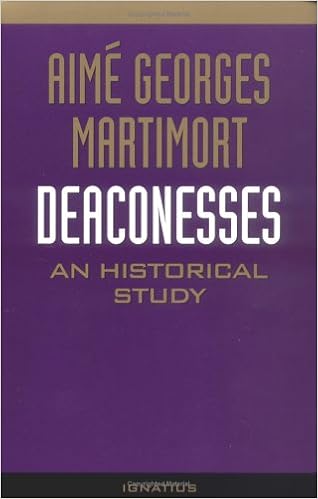
If you want to know more, read Deaconesses: An Historical Study by Aime G Martimort. UK HERE  It is the best thing available right now.


Posted in Liberals, You must be joking! | Tagged , , ,
7 Comments

The Pink Sisters

From KIII TV in Texas. These sisters are a sister order to that of a holy sister with whom I worked in Rome.

CORPUS CHRISTI (Kiii News) –
In a time when our world is thirsty for hope and peace, one group of local women have agreed to give up their traditional ways of living as an action of love and faith. This sisterhood gave up family ties, material items and many freedoms just to pray specifically for total strangers.

Find out why they have decided to talk to the media for the very first time in a 3News Special Report: Pink Life.

Note the element of Adoration.

KiiiTV.com South Texas, Corpus Christi, Coastal Bend

These sisters spend time in adoration and interceding for us. Who knows how many things have been averted through their prayers.

We need much more of this.

Posted in Hard-Identity Catholicism, Women Religious | Tagged ,
9 Comments

Death in the Streets of Nice, and You.

Yet again we have cause to mourn the murdered.  Yet again, in France.

We have serious decisions to make about our future.  This is a war.

I strongly urge you to consider that this, friends, is coming our way, courtesy of terrorists of the Islamic State and practitioners of the Religion of Peace.

16_07_14_Nice_street

Deus, qui conteris bella, et impugnatores in te sperantium potentia tuae defensionis expugnas: auxiliare famulis tuis, implorantibus misericordiam tuam; ut, inimicorum suorum feritate depressa, incessabili et gratiarum actione laudemus.

O God, who bringest wars to nought and shieldest by Thy power all who hope in Thee, overthrowing those that assail them; help Thy servants who implore Thy mercy; so that the fierce might of their enemies may be brought low, and we may never cease to praise and thank Thee.

Please, everyone, give thought to what I have constantly asked: situational awareness.

Earlier today I posted about this Pokemon Go thing, which results in noses glued to screens and oblivion to surroundings.  That is an exaggerated example of recklessness.  But many people wander about with hardly less thought about their circumstances.  One of the things I have suggested in the past is to seek out some training which might include situational awareness elements.  Concealed carry weapon license training includes that, whether you would ever be interested in carrying a weapon or not, one way or another.  That’s not the main point.  The important thing is to learn to watch and to think and to react, to evade, to deescalate, to survive.  If CCW training is the easiest way to start this process, then do it.  It’s helpful.  Will it prevent an attack with a truck on a street?  It might help you to notice that it’s coming before it’s too late for you and those around you.

Also, GO TO CONFESSION.  We don’t know when it will be our turn, no matter how situationally aware we are.  Ask God to preserve us from a sudden and unprovided death.

A subitanea et improvisa morte… From a sudden and unprovided death, spare us O Lord.”

A sudden death can be a blessing. A sudden and unprovided death – unprovided in the sense of having no recourse to the sacraments when you are not in the state of grace – is a horrifying prospect. Make plans for, provide for, the needs of both body and soul for yourselves and those in your charge. You don’t know when your death will come, natural or not.

A while back I read a book, Defeating Jihad: The Winnable War by Sebastian Gorka. (UK HERE)

In this book, Gorka describes one of the reasons why these people choose terror.

According to the Pakistani general, there is only one target of importance in war: the soul of the enemy. The infidel foe must be converted to Islam or crushed. Lastly, since the only target that matters in war is the soul of the infidel, Malik concludes that the most effective weapon in war is terror. Here we see the relevance of his book to groups like Al Qaeda and ISIS. The enemy’s belief system must be utterly destroyed, and terror is the most effective way to do that. That is why 9/ 11 was so important. It is the highly symbolic suicide attacks, the crucifixions, the beheadings, the bombings of civilian crowds, and the videos of immolations that will destroy the will of the infidel to go on.

According to the Quranic concept of war, and because these terrorists are inspired to bring about the eschatological fulfillment of their religion, they wage war on the souls of the non-Muslim or, in their view, insufficient-Muslim.  Their war has an eschatological view.  They must destroy the spirit of their enemy.  This is why they use terror and why they commit atrocities which they record and broadcast.

Gorka says that we have to discredit their “brand“, or this will go on and on.

Again, I ask you to kneel on those increasingly calloused knees and pray for the souls of the murdered and their poor families.  Also, pray for our leaders – around the world – to find their RESOLVE.

This is war.

Do not lose heart.  Do not be afraid.  We might not know how our part in this story ends, but we do already know how the story ends.

Sts. Nunilo and Alodia, pray for us.
St. Lawrence of Brindiso, pray for us.
St. Pius V, pray for us.
Our Lady of Victory, pray for us.

Posted in "How To..." - Practical Notes, The Religion of Peace | Tagged , , ,
34 Comments

For those of you consciously engaged as the Church Militant…

I was sent this image.  I had to share it.

firey darts of the devil

I could, wag that I am, replace those darts with the names of a few liberal tweeters.  But that might be just a tad bit mischievous.

Keep smiling.  Keep that shield up.  Keep that sword sharp.  Keep that chin-strap tight. And keep…

GOING TO CONFESSION!

Posted in ¡Hagan lío!, Be The Maquis, GO TO CONFESSION, Hard-Identity Catholicism | Tagged
7 Comments

Concerning #PokemanGo – Wherein a puzzled Fr. Z inquires.

pokemonI am not entirely sure what Pokeman is.  Not my generation.   However, apparently this is now a thing you do with your mobile phones, rather like geocaching.  I heard one talking TV head praise it because at least it got young people outside for a while.

Even as I am typing this out, I had an SMS from a priest that some nitwit designated his parish as a place as a “gym” to do this Pokeman thing.  People are now trespassing here and there on parish property.  There was a group “training” in the “gym”.  They were drinking.  The police helped them to leave.  He even had someone wander into Mass with his nose buried in his smartphone.  “I don’t want to be liable for some underage person drinking and then falling off a wall and breaking his or her arm.”

This new thing could be a serious annoyance with legal ramifications.

QUAERITUR: Is there any benefit that can come from it for “evangelization”?

I rather doubt it, since the players will also probably have ear buds in and will be oblivious to context and decorum.

Arlington Cemetery tweeted: “We do not consider playing ‘Pokemon Go’ to be appropriate decorum on the grounds of ANC. We ask all visitors to refrain from such activity.”

That said, back when I was a seminarian in Rome I was involved with a Gregorian chant schola.  I persuaded the rector of the basilica where I was assigned for weekends to let them sing at Sunday Mass.  He was skeptical, but he acquiesced.  There was nothing to lose, since there were generally about 4 people in church for Mass.  Since the basilica is along a tourist route, we left the doors open.  People wandered in.  They heard the music.  They stayed.  Slowly but surely regular attendance at Sunday Mass grew.   The point is, once they were inside the place, there was something to get their attention.  (As an aside, the rector thought it was his preaching.  The choir politely smiled.)

Meanwhile, my priest friend writes: “If I was programming it, I’d make sure all the wandering included the center lane of the closest interstate.  Don’t these chuckleheads have a job?  Society has its bread and circuses while everything collapses.”

Father is clearly annoyed.

So, ….Pokeman on your stoopid phone.

Good thing?

Bad thing?

Potential?

Utter waste?

UPDATE:

I received a note:

I cannot say how responsive the company is on this issue, but they do have a form available to report a Pokemon Go location that is on private property:
https://support.pokemongo.nianticlabs.com/hc/en-us/requests/new?ticket_form_id=319928

Posted in Lighter fare, New Evangelization | Tagged
60 Comments

My spidey-sense tells me that Card. Sarah’s speech marks a turning point.

LatinMassOn 5 July 2016, in London, Robert Card. Sarah, Prefect of the Congregation for Divine Worship and the Discipline of the Sacraments, gave a powerful address at a conference on liturgy.   Card. Sarah appealed to priests to say Mass ad orientem. Let’s call it the… Sarah Appeal™.

I fully expect that there will soon be a tremendous backlash unleashed on all who support the Cardinal’s proposal.

Frankly, when the other day I saw in the Bolletino that Card. Sarah had been granted an audience with Pope Francis, I wondered if the Cardinal might not have in his stars the same lot as Card. Burke.  Francis wanted a different direction for the Signatura so he moved Card. Burke to be the Patron of the Knights of Malta.  Now that Card. O’Brien is over 75 and has, therefore, no doubt offered his resignation to His Holiness as Master of the Equestrian Order of the Holy Sepulcher, that group of Knights might be opening up.  Who knows?  In a light-hearted exchange with a priest friend it was quipped that if the Holy Sepulcher isn’t a possibility, perhaps the Knights Who Say “Ni!” are available.

You’ve gotta look for some humor in life in the Church these days, friends.  That’s how you know that you not a liberal.  But I digress.

It is early to tell, very early, but my spidey-sense tells me that Card. Sarah’s speech marks a turning point.

Through history, there have been short speeches with long effects.  Sometimes they are delivered to small crowds, such as the Gettysburg Address. Sometimes they are broadcast to many, as in Churchill’s 13 May 1940 radio call-to-arms.  Sometimes they are given by the famous, as in Martin Luther King’s 28 August 1963 speech at the Lincoln Memorial. Sometimes the speech-maker is relatively unknown, as in Sojourner Truth’s “Ain’t I A Woman?” speech at the Women’s Convention, Akron, Ohio.   You can make your own list of short history-changing oratory.

Every once in a while, a Cardinal makes an important speech that both reveals the state of the Church and the speech leaves an enduring mark.

For example, on 12 May 1879, John Henry Card. Newman gave his formal “Biglietto” Speech, when he was given the red hat.   He spoke about liberalism in religion.  “Liberalism in religion is the doctrine that there is no positive truth in religion.”  He talked about the replacement of revelation by natural virtues as “a great apostasia.”

On 3 August 1941 Clemens Card. von Galen gave a speech, a sermon, in the Cathedral of Münster against the Nazi euthanasia program.  As a result, Hitler suspended the program which had already killed a hundred thousand people.  Hitler couldn’t touch von Galen physically, but he retaliated by having three priests beheaded. They had distributed von Galen’s sermon. Von Galen gave three sermons against Nazism.

On 18 April 2005, Joseph Card. Ratzinger delivered a sermon at Mass “pro eligendo Romano Pontifice, which probably was a major factor that catapulted him in to the See of Peter.  This is the sermon in which he said:  “Today, having a clear faith based on the Creed of the Church is often labeled as fundamentalism. Whereas relativism, that is, letting oneself be “tossed here and there, carried about by every wind of doctrine”, seems the only attitude that can cope with modern times. We are building a dictatorship of relativism that does not recognize anything as definitive and whose ultimate goal consists solely of one’s own ego and desires.”

You can probably come up with examples of your own.

It seems to me that Card. Sarah’s London ad orientem appeal will prove to be a catalyst that will set in motion significant change.  As often happens with catalysis, however, violent reactions can occur.  And, if I remember my college chemistry rightly, catalysts remain even after the reaction occurs, so that reactions can keep on occurring down the line.  Catalysts have an enduring effect.

Each priest who takes up Card. Sarah’s catalytic call will in turn become a catalyst in his parish or wherever he serves.  The way priests say Mass has a knock-on effect in congregations.

Carefully review what Card. Sarah said (read the whole this HERE).  In part:

I want to make an appeal to all priests. You may have read my article in L’Osservatore Romano one year ago (12 June 2015) or my interview with the journal Famille Chrétienne in May of this year. On both occasions I said that I believe that it is very important that we return as soon as possible to a common orientation, of priests and the faithful turned together in the same direction—Eastwards or at least towards the apse—to the Lord who comes, in those parts of the liturgical rites when we are addressing God. This practice is permitted by current liturgical legislation. It is perfectly legitimate in the modern rite. Indeed, I think it is a very important step in ensuring that in our celebrations the Lord is truly at the centre.

And so, dear Fathers, I humbly and fraternally ask you to implement this practice wherever possible, with prudence and with the necessary catechesis, certainly, but also with a pastor’s confidence that this is something good for the Church, something good for our people. Your own pastoral judgement will determine how and when this is possible, but perhaps beginning this on the first Sunday of Advent this year, when we attend ‘the Lord who will come’ and ‘who will not delay’ (see: Introit, Mass of Wednesday of the first week of Advent) may be a very good time to do this. Dear Fathers, we should listen again to the lament of God proclaimed by the prophet Jeremiah: “they have turned their backs to me and not their faces” (2:27). Let us turn again towards the Lord! Since the day of his Baptism, the Christian knows only one direction: the Orient. “You entered to confront your enemy, for you intended to renounce him to his face. You turned toward the East (ad Orientem), [NB] for one who renounces the devil turns towards Christ and fixes his gaze directly on Him” (From the beginning of the Treatise on the Mysteries by Saint Ambrose, Bishop of Milan). [De mysteriis 2,7 – Ingressus igitur, ut adversarium tuum cerneres, cui renuntiandum in os putaris, ad orientem converteris; qui enim renuntiat diabolo, ad Christum convertitur, illum directo cernit obtutu.

I very humbly and fraternally would like to appeal also to my brother bishops: please lead your priests and people towards the Lord in this way, particularly at large celebrations in your dioceses and in your cathedral. Please form your seminarians in the reality that we are not called to the priesthood to be at the centre of liturgical worship ourselves, but to lead Christ’s faithful to him as fellow worshippers united in the one same act of adoration. Please facilitate this simple but profound reform in your dioceses, your cathedrals, your parishes and your seminaries.

We bishops have a great responsibility, and one day we shall have to answer to the Lord for our stewardship. We are the owners of nothing! Nothing belongs to us! As St Paul teaches, we are merely “the servants of Christ and the stewards of the mysteries of God. Now it is of course required of stewards that they be found trustworthy” (1 Cor. 4:1-2). We are responsible to ensure that the sacred realities of the liturgy are respected in our dioceses and that our priests and deacons not only observe the liturgical laws, but know the spirit and power of the liturgy from which they emerge. I was very encouraged to read the presentation on “The Bishop: Governor, Promoter and Guardian of the Liturgical Life of the Diocese” made to the 2013 Sacra Liturgia conference in Rome by Archbishop Alexander Sample of Portland in Oregon in the USA, and I fraternally encourage my brother bishops to study his considerations carefully.

All liturgical ministers should make a examination of conscience periodically. For this I recommend part II of the Apostolic Exhortation Sacramentum Caritatis of Benedict XVI (22 February 2007), “The Eucharist, a Mystery to be Celebrated.” It is almost ten years since this Exhortation was published as the collegial fruit of the 2005 Synod of Bishops. How much progress have we made in that time? What more do we need to do? We must ask ourselves these questions before the Lord, each of us according to our responsibility, and then do what we can and what we must to achieve the vision outlined by Pope Benedict.

At this point I repeat what I have said elsewhere, that Pope Francis has asked me to continue the extraordinary liturgical work Pope Benedict began (see: Message to Sacra Liturgia USA 2015, New York City). Just because we have a new pope does not mean that his predecessor’s vision is now invalid. On the contrary, as we know, our Holy Father Pope Francis has the greatest respect for the liturgical vision and measures Pope Emeritus Benedict XVI implemented in utter fidelity to the intentions and aims of the Council Fathers.

Card. Sarah put his finger directly on a huge wound that must be dealt with before true renewal can take place: Holy Church’s all important liturgical worship.  He identified something that would be a great contribution to that renewal: ad orientem worship.

That means that he must be attacked, discredited.  Those who support his proposal must be intimidated, silenced, crushed.  They must not be allowed to create effective, enduring changes.

One of the reasons why I think there will be an attack on priests who support the Sarah Appeal™ is because the liberal elite hear in it a criticism of their projects perpetrated in the name of the reforms called for by the Council Fathers in Sacrosanctum Concilium.  They think the suggestion that, perhaps, we could say Mass as our forebears did for so long is an accusation that they were wrong all along.  In fact, the versus populum thing was built precisely on a sandy foundation of incorrect scholarship which experts such as Louis Bouyer and Joseph Jungmann eventually repudiated.  However, by the time they did that, the fix was in.

Another reason why there will be harsh blow-back for anyone who supports the Sarah Appeal™ is because ad orientem worship is an invitation to conversion.  In another post, I alerted you to a priest who touched on the moral dimension that ad orientem invokes.  HERE Ad orientem worship is itself an implicit call to right conduct.  That’s certainly a reason for Satan to hate it, to move his agents to stomp it and those who support it into the dust whence Adam came.  That’s why the Enemy will move his pawns, bishops and … queens… into action.  NB again what Card. Sarah quoted, above, from St. Ambrose De mysteriis.

Speaking of “mysteries”, another reason why ad orientem worship will be ferociously resisted is because it is yet another corrective toward producing during Holy Mass the apophatic conditions in which the worshiper might have an encounter with Mystery.  This encounter is both alluring and frightening.  It is alluring because we who are in the image and likeness of God are restless to be with God, who in this life is utterly mysterious, whom we can only glimpse darkly, as if in a glass or perhaps through the crack in the rock as He passes on the other side. It is frightening because it moves us to deal with the reality of death, the knowledge that one day we will cross over.  Holy Mass must prepare us for death.   But if we are too afraid to deal with this, then we fill our liturgical worship with myriad distractions.  We eliminate silence.  We reduce music and ornament to the lowest sort of thing.  We banalize the language and eliminate anything too challenging.  We do all that we can to eliminate the difficult, challenging apophatic conditions that are the necessary propaedeutic for that alluringly frightening encounter.  If Holy Mass is not helping you to get ready for your own death, it isn’t fulfilling one of its most important purposes.

Card. Sarah placed his finger directly on a huge wound.  His speech will some day be recognized as an important turning point, a healing point.  But remember that, as Augustine once pointed out, the doctor doesn’t stop cutting just because the patient screams for him to stop.  Things will get mighty noisy and ugly before this is over, my friends.

Therefore, clean your house.

Examine your consciences, look over your vocation and your duties, and GO TO CONFESSION!

And please, I beg you, pray for me.  I can feel it on the horizon.  Pray for all priests and bishops.  Pray that their minds and hearts be opened and that their actions reflect a loving balance of prudence and courage.
Posted in ¡Hagan lío!, Hard-Identity Catholicism, Liturgy Science Theatre 3000, New Evangelization, Si vis pacem para bellum!, The Drill, The future and our choices | Tagged , ,
66 Comments