“They paved paradise and they put up a….”

Right now I am in the midst of making daily podcasts and, in them, mentioning the Roman Station church of the day.  I provide a little history of the churches.  Thus, I am daily reminded that churches can come and go.  They are built, used for a time, torn down because of damage or need for another structure.  Time marches on.  And yet we revel in our most ancient churches, don’t we?  We lament the passing of a church building.

I saw an article from my native place about the older church in the city which is, sadly, facing destruction.

The story:

MINNEAPOLIS (WCCO) — Plans for a high-rise in northeast Minneapolis took a step forward this week, but not everyone is happy. The apartment tower would go up where Nye’s Polonaise Room is located, after it closes this summer.

The Neighborhood Association approved the plans Wednesday night with overwhelming support, but the new construction could have a big impact on an old church.

The call to Our Lady of Lourdes Catholic Church has rang loud and clear for more than 160 years. Built in the 1850s, the historic frame is showing its age. But there’s real concern time isn’t the biggest threat.

“It’s important to us to say we’re opposed to the design of this particular project,” Deacon Thom Winninger said.

Winninger is worried about plans to build a 29 story apartment building next door once Nye’s Polonaise shuts down this summer. The close proximity to the church property is one thing, but the real worry is construction’s impact on the building’s integrity.

[…]

For the sake of… what?

Posted in Our Catholic Identity, The Drill | Tagged ,
8 Comments

Renaissance triumphalist crowing both in bad taste and divisive

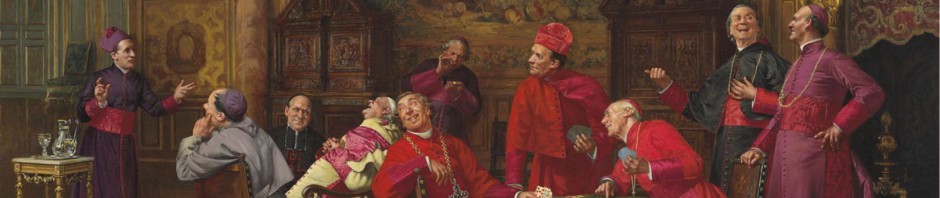
I saw a mordantly amusing comment from Fr. Hunwicke over at his blog HERE.  He mused about the recent 50th anniversary of Paul VI going to a Roman parish to say Mass in Italian.   Perpend.  My emphases and added links:

I was surprised to get back home to my computer to discover that in Rome there is going to be a special Mass to commemorate fifty years since the first Mass entirely in the Italian Language. Surely, this sort of rather Renaissance triumphalist crowing is both in bad taste, and sadly divisive? Will the Mass be a Requiem to pray for the souls of those whose faith was disastrously weakened by those of the post-Conciliar changes which were praeter Concilium seu contra Concilium, and which proliferated during this half-century?

If you are a no-longer-fertile Mexican grandmother possessing shares in the Ignatius Press, whose newly ordained narcissistic grandson possesses a semi-Pelagian biretta and works in the deeply flawed Roman Curia, you must be in sore need of something to cheer you up. This event may not be precisely what you’ve been waiting for.

LOL!

That’s called “turning the tables”.

Posted in Liberals, Lighter fare, Liturgy Science Theatre 3000, Mail from priests | Tagged , , , , ,
9 Comments

ASK FATHER: Confession and absolution via text message? Phone? VOIP?

A question pops up once in a while and I have dealt with it before.  Can you be absolved over the phone or by internet?  NO.  That would be INVALID.

I was alerted to this post at the site of Fox San Antonio:

Mysterious ‘priest’ taking digital confessions

SAN ANTONIO – The religious sacrament of confessing your sins is about to enter the digital age… Well, sort of. [No… not like this!]

A press release sent to Fox San Antonio last week claims an ordained priest in the San Antonio area [Who knows what that means? Anyone can “claim” to be ordained.] will be the first to begin accepting confessions over the social media app ‘Snapchat.’ [Anyone can “accept” confessions, by the way.  However, only a properly ordained priest with faculties can give valid absolution.  Everyone else just shoots blanks.]

The release states the confessions will be accepted by @priestDavid from March 2nd through March 16th.

The priest’s true identity is a mystery. [This is probably a fraud.] The release only describes the priest as having been a “man of the cloth for 23 years” but his last name and church affiliation were not included out of privacy concerns. [Ditto.]

Deacon Pat Rodgers with the Archdiocese of San Antonio says the Church is not involved in any way with the Snapchat confessions. He says confessions must be done face-to-face [NO! It is NOT necessary that confessions be “face to face”.] and a digital confession goes against the Church’s teachings.

[…]

Were this person to be found to be Catholic, I would recommend a canonical case against her immediately.

This leads to the larger question.

Could a validly ordained priest with faculties absolve you through some electronic means?

NO.

Absolution long-distance via technology is invalid.  Many years ago there was a response given to a question about absolution communicated via telegraph (which shows how long ago it was).  Such an absolution would be invalid.  Some time later, I don’t have the reference, there was a question about telephone.  The answer was the same.  Invalid.

If such a question were submitted today, the answer would be the same.   You cannot receive absolution via skype or internet chat or video phone calls, etc. That includes text messages.  INVALID.

By the way, anyone can confess via phone or by megaphone or by microphone and amplifier with stratocaster accompaniment. You can confess by long-distance technology, but you cannot receive absolution via long-distance technology.  Similarly, you can confess to anyone you desire, but only priests with faculties can forgive your sins through sacramental absolution.

There is a possibility of contracting marriage long distance, or even via proxy, but not any other sacrament.  And that is another and more complicated question which we will not delve into here.

There are practical reasons: certainty about the person of the confessor, the penitent, issues of faculties across even continents, security of not being overheard, etc.

There are theological reasons: the penitent must accuse himself of sins in the presence of the minister of the Church acting in the person of Christ who is judge, there is the personal nature of the encounter with the Lord who is Mercy itself, etc.

No confession by long-distance.  It must be a real, and personal meeting of penitent and confessor.

Of course there are situations where people who are physically present to the confessor may have to use some artificial means to speak.  Also, a priest could use an sound amplifier for a person who is present who is also hard of hearing.  That’s not a problem.  It also could be that the person is not immediately close to the confessor, but is still within view or earshot.  In that case the person is still “morally” present and absolution is valid. However, it a penitent is both physically and morally completely separated from the confessor, artificial means cannot be used validly to impart absolution.

Bottom line:

GO TO CONFESSION.  You can’t “mail it in”.


Posted in "How To..." - Practical Notes, ASK FATHER Question Box, GO TO CONFESSION, Liturgy Science Theatre 3000 | Tagged , , , ,
26 Comments

ASK FATHER: Stole-less confession. Okay?

Molteni Giuseppe La confessioneFrom a reader…

QUAERITUR:

Does a priest have to wear a stole during confession? I surprised a priest and asked for confession and he did without a stole.

No, a priest does not have to wear a stole.

The stole is a powerful symbol of the authority and power granted by Christ the High Priest through His Church’s legitimate shepherds, successors of the Apostles, to forgive sins.  The stole is a sign of that the priest is – in your tribunal – sitting in the place of the one who is both Justice and Mercy.  But wearing the stole is not, in itself, necessary for validity or even for liceity of absolution.   You do you part as best you can and confession every mortal sin you can remember (after a good examination of conscience) in both kind and number and then Father, having faculties to do so, will do his part, and give you absolution.

Many priests carry a stole all the time.  I, for example, have one in the spare mag pouch of my 5.11’s along with my oil stock.  The form of absolution and of anointing and of the Apostolic Pardon are in my head.  The stole’s leather envelope/case was made by one of you readers.  HERE

Walk up to Father while he is wearing a polo shirt, washing his car… no problem.  Run into Father on the running path around the lake… no sweat (well… lots of sweat).  Encounter a priest at the airport while you are heading somewhere and he is his black suit… good to go, stole or not.

WHAMO!  All your sins will be forgiven, taken away, gone, eradicated, washed clean in the Blood of the Lamb.

Though your sins be red as scarlet, they will become as white as snow.

There is no sin so horrible that we little mortals can commit that God will not forgive provide you ask for forgiveness.

Ask!

Examine your consciences, GO TO CONFESSION… and ask.

Sacramental confession is the way Christ Himself gave us to approach Him for forgiveness of sins.

Don’t leave anything to chance.  GO TO CONFESSION.  That way you’ll know what just happened.


Posted in "How To..." - Practical Notes, ASK FATHER Question Box, GO TO CONFESSION, Liturgy Science Theatre 3000, Our Catholic Identity | Tagged , , ,
12 Comments

UPDATE: D. Madison: Bp. Morlino and the surge of priestly vocations (Parts 1 & 2)

NewPriestsI updated this with Part 2 from the WSJ, below.  Read about a seminarian who will say the TLM.

To make a donation to the Diocese of Madison and to earmark it for seminarians, click HERE.

Once you click the “one time” or “monthly” button, you’ll get a menu. The St. Joseph Fund is for seminarians. Otherwise, there is a diocesan fundraising project going on that Part 1 of the WSJ article explains. Thanks in advance!

___ Original Published on: Mar 1, 2015 @ 10:14 ___

In Madison there has been over the last few years a surge in vocations to the priesthood.  The Madison State Journal has the first part of an article on the phenomenon.

Here is a sample of part 1, with my emphases and comments:

As number of seminarians surges, Madison diocese seeks $30M to fund priest training

Midway through the Sunday Mass at St. Joseph’s Catholic Church in Dodgeville, the service took a sharp turn toward fundraising.

Monsignor Daniel Ganshert, the parish priest, told parishioners that for years, people in the Madison Catholic Diocese had been praying for more men to be called by God to the priesthood. The Holy Spirit has responded, Ganshert announced jubilantly.

There are now 33 seminarians, or priests-in-training, up from six in 2003 when Bishop Robert Morlino arrived. [!  And the diocesan foundation for seminarians was set up for the 6, not the 33.] But that increase comes with responsibility, Ganshert said.

The diocese needs $30 million to educate current and future seminarians — “a serious chunk of money,” he acknowledged.

Ushers distributed pledge cards. The assembled were asked to dig deep.

The same scene is playing out across all 134 worship sites in the 11-county diocese. The effort, which began last fall and will continue through the end of this year, is the first diocesan-wide capital campaign in more than 50 years. [50 years!]

So far, the faithful have responded with vigor. Although the campaign has yet to expand to all churches, parishioners already have pledged more than $28 million.

“I couldn’t be more pleased,” Morlino said in an interview, giving immense credit to the diocese’s 110 priests who’ve been rolling out the campaign in their parishes. “They love the priesthood and they love the church, and this is the Holy Spirit working through them.”

A priest’s training, called “formation,” doesn’t come cheap, and the diocese picks up much of the tab.

The diocese declined to pinpoint a per-seminarian cost. But back-of-the-envelope calculations, based on interviews and available data, suggest the diocese spends $250,000 to $300,000 to train each new priest, figures diocesan officials did not contest.

Behind the rise

Priestly ordinations are on the uptick nationally after bottoming out in the 1990s, though there is great variation across dioceses, said Anne Hendershott, who has researched the topic as co-author of “Renewal: How a New Generation of Faithful Priests and Bishops is Revitalizing the Catholic Church.”

The Madison diocese has a “remarkable” number of seminarians for its size, she said.

[Quaeritur…] Why the local success? Morlino has made priestly vocations — the spiritual call to serve — a priority. He increased the position of director of vocations to full time, and he routinely promotes the priesthood at functions.

But there could be more to it. [Here we go!] The very traits that have made Morlino controversial may be the reason he’s successful at recruiting new priests, Hendershott’s research suggests.

[Keep going…] Bishops who are unambiguous about church doctrine and don’t tolerate dissent tend to inspire the greatest number of vocations, said Hendershott, who references Morlino positively in her book. [Notice how the writer worked in the concept of “tolerance”.  It’s not that he defends or teaches sound doctrine, is’s that he doesn’t “tolerate dissent”.  What is the reader supposed to take away from that?  Watch where the article goes next…]
“I’d hesitate to call them culture warriors, but they know what they stand for,” [Remember… amongst liberals it’s a bad thing to be a cultural warrior.] said Hendershott, a sociology professor at Franciscan University of Steubenville, Ohio. “If you are considering the priesthood, you’d want to see that. [NB]You don’t want to commit yourself to something that’s backed only halfway.” [Exactly.  It’s common sense.  But wait!  There’s more…]

Morlino’s traits can cut both ways. Members of the Madison chapter of Call to Action, [HA HA HA HA HA!  They had to find someone to sound the sour note.] a national group of progressive Catholics, find him rigidly doctrinaire and lacking in pastoral empathy. [That’s because they have never met him and they are stuck on … probably… sex.] They’ve worried in the past that the seminarians recruited under his tenure will be carbon copies.  [How likely is that?  On the other hand, the men are going to be faithful to the Church’s Magisterium.]

Jim Green, a leader of the local chapter, said by email the group had decided not to comment collectively or individually on the fundraising campaign. He added, “We will not be donating to the aforementioned cause however.”  [Isn’t that typical?]
When asked if he thought the campaign was a referendum on his tenure, Morlino said, “I hope not.” [HA HA HA HA HA!]
Parishioners need to consider the far-distant health of the church, he said, not just one bishop’s leadership.  [Seminarians!  That’s why Bp. Morlino’s tenure in Madison will exercise a profound influence for decades to come.]

[…]

Read the rest there.  And, make popcorn – unless you gave it up for Lent – and watch the combox over there explode into spittle-flecked nutties.

After all, Madison – which elected Tammy Baldwin to Congress – has been described at 77 square miles surrounded by reality and this is the local paper.

Meanwhile… Fr. Z kudos once again to Bp. Morlino, the Extraordinary Ordinary.

And may I remind the readership that, a couple years back, His Excellency told all the seminarians that he wanted them to learn the Extraordinary Form before ordination?

UPDATE 2 March:

Part two of the two-parter is out.  HERE

Samples with my patented treatment:

For young priest-in-training, days of classes, prayer and hypothetical confessions

WSJ GernetzkeST. PAUL — Alone in his seminary dorm room on a recent afternoon, Chris Gernetzke imagined he was standing before a flock of the Catholic faithful.

He cleared off his computer desk, the one with the mini-fridge underneath, and placed a wine chalice on the makeshift altar.

For the next hour, he rehearsed the prayers, blessings and rites that constitute the Roman Catholic Mass, something he does every day. [I wouldn’t put all the money in my pocket on it, but I’d wager that Rev. Mr. G – whom I know pretty well – usually practices the TLM.  Come to think of it… what’s to practice with the Ordinary Form?  – UPDATE – I noted that in the photo description at the WSJ it says: “Chris Gernetzke, a seminarian from Evansville, raises a chalice while practicing the Latin Mass in his dorm room”. Yep. He even heads over to the FSSP parish in Minneapolis from time to time.]

“There’s a spiritual aspect to it, of course,” said Gernetzke, 26, who is in his final semester at The St. Paul Seminary School of Divinity in St. Paul, Minnesota. “But there’s also just the mechanics of it that you have to get down.”

Gernetzke is one of 33 men studying to be priests in the Madison Catholic Diocese and one of five who will graduate this spring and return to the diocese for a parish assignment. They are part of a wave of new recruits since Bishop Robert Morlino arrived in 2003 and made vocations — or discerning a call to the priesthood — a priority.  [As a matter of fact, Bp. Morlino has postponed building a cathedral in order to support seminarians.  The cathedral burned down some year back.  Seminarians are the future.]

In just a few months, the diocese will ordain Gernetzke. He will then be entrusted with all of the authority, responsibility and sacred duties of a priest.

When he consecrates communion bread and wine, it will become, as Catholicism teaches, the very body and blood of Jesus Christ. He will hear intimate confessions, baptize babies, console the distraught, bless the dying.

“In some sense, you try not to think about the gravity of what you’ll be doing, because it’s sacred work and we’re unworthy of it in and of ourselves,” said Gernetzke, who grew up in Evansville, about 20 miles south of Madison. “But the Lord calls the unworthy and gives us the grace to make it possible by working through him.”

Discernment

Gernetzke, an Eagle Scout and Ultimate Frisbee player, said he first felt a pull toward the priesthood in seventh grade while serving as an altar boy at St. Paul’s Catholic Church in Evansville.

The parish priest at the time, the Rev. Eric Nielsen, [Now at St. Paul’s downtown, the U of W Madison parish and Catholic center, doing great work.  They have a building project there to replace the hideous Brutalist church that replaced the perfectly good original church, and to expand the facilities. For photos HERE] ministered with such joy that it inspired the 13-year-old boy. But it wasn’t cool to discuss the priesthood in middle school, Gernetzke said, so he suppressed the idea. Also, he saw himself marrying one day.

He went to college at Viterbo University in La Crosse, where he studied nursing and dated. While assisting at a funeral Mass on campus, a priest asked him if he’d ever thought about the priesthood. Gernetzke had a ready answer: “Father, I like girls too much.”

The priest responded, “Getting married is giving up all girls but one; becoming a priest is just giving up one more girl.”

Something about the way the priest framed the issue jolted Gernetzke. It was like a switch flipped.

“That was my last defense to really seriously considering the priesthood,” he said.

He prayed for guidance, and one evening during his sophomore year, alone in the campus chapel, he said he heard God’s voice: “Go to the seminary.” It wasn’t an audible voice, but one “that speaks to you in the depths of your heart,” Gernetzke said.

Not every seminarian hears such a distinct voice when discerning a call, nor is it necessary to, said Monsignor James Bartylla, the diocese’s second-in-command. But it is not uncommon, he said.

Bartylla likens the voice to “an extremely clear thought that comes from the outside,” one that is “very succinct and persuasive” and “followed by great peace.”

Gernetzke applied to the diocese to become a seminarian. The lengthy process includes a psychological exam of several hundred questions, written essays, an extensive background check, and interviews and evaluations by a psychiatrist and psychologist. A panel of priests and lay people conducts a final interview before making a recommendation to the bishop.

Gernetzke left Viterbo after his sophomore year and enrolled at Immaculate Heart of Mary Seminary in Winona, Minnesota, where he earned an undergraduate degree in philosophy, a diocesan requirement.

[…]

There’s a lot more over there.  I warmly recommend you check it out, especially you young men out there who are thinking about what to do with your lives.
Posted in New Evangelization, Our Catholic Identity, Priests and Priesthood, Seminarians and Seminaries | Tagged , , , ,
87 Comments

It’s NOT a “women’s issue” it’s a “human rights” issue.

One problem we face constantly now is that abortion advocates, big-business abortion and pro-abortion catholics have successfully framed abortion as a “women’s” issue.

It isn’t.

It is a human rights issue.

There is a piece at the site Pregnancy Help News which reminded me of the difficulty we face in moving abortion into the proper category.  Have a look.


Posted in Emanations from Penumbras | Tagged , ,
8 Comments

ASK FATHER: Membership in a parish, borders, registration

From a reader…

QUAERITUR:

I am a parishoner at an ethnic church in the Archdiocese of X with national boundaries where there are Masses, sacraments, services, etc in my preferred language.

However, I live 20 minutes away in the Diocese of Y. Who is “my bishop”? The bishop who guides my pastor and visits our parish? Or is “my bishop” the Bishop of Y?

In an ideal world, when one moved into a new place, one’s local, friendly pastor would stop by the next day or so, doff his biretta at the lady of the house, bless the domicile, and sit down for a few minutes chat over tea about the ages and catechetical stages of all the children pattering about vying for Father’s attention. Father would then leave his calling card, a recent copy of the parish bulletin, some starter envelopes, and a friendly wave.

Alas, we are mostly far from living in such idyllic villages, and people come and go so frequently and anonymously that keeping track of folks is the stuff of statisticians and guestimators.

Every Catholic has a parish. Some have more than one.

Every place you have a domicile (where you intend to live with some degree of permanence, or have actually lived for five years) or quasi-domicile (where you intend to live for at least three months, or actually have lived for three months) is within the territory of a parish and a diocese.

You are a member of that parish, whether or not you fill out a registration form, whether you ever go there, whether you even know where it is.

Additionally, there are personal parishes for some groups of people, often defined by ethnicity or nationality. If your mother is Korean, your father is Wendish, and you’re a university student who lives in a dorm during the school year, and in a house on State and Main as your permanent resident, you are, de facto, a member of St. Andrew Kim Parish, St. Knut of the Wends Parish, St. Albertus Magnus University Parish, and Old St. Ludmilla’s, the territorial parish.

Ethnic or personal parishes also have boundaries. If there are none specifically described in the decree establishing the parish, then the boundaries of a personal parish are coterminous with the diocese. A bishop can’t “poach” Catholics living in the territory of another diocese. Your bishop is always the bishop of the diocese in which you are living. If you are homeless and vagrant, your bishop is the bishop of whatever diocese you happen to be in at any moment. The pastor of a vagrant is the pastor of wherever that vagrant happens to be at that moment. Everyone has a pastor.

With modern mobility, especially in North America, many Catholics choose to go to Mass in parishes where they are not actually members. Sometimes, they even register at these parishes, thinking that registering makes them members.

Nope.

Alas and alack, registering in a parish has no canonical effect. It’s simply a convenient way for pastors to gain some understanding of who is actually coming to the parish.

Please make life easy for your pastor and register.

If you are a member of an ethnic group, or otherwise identify with a group for whom there is a personal parish in a nearby diocese, by all means go. Worship. Participate. Confess. Join the Altar Society. But let the pastor know that you are resident in the neighboring diocese.

If Father Jaromar of St. Knut of the Wends Parish notices that he has 70 parishioners coming each week from the neighboring diocese, he might want to inform the bishop of that diocese that the Wendish population of his diocese is not being served, and that he’d be happy to contact a friend of his, Father Vitzlav, who might be willing to come over from Stralsund to care for the burgeoning Wendish populace.

Posted in "How To..." - Practical Notes, ACTION ITEM!, Our Catholic Identity | Tagged , , ,
57 Comments

Internet to be regulated by Feds… what could possibly go wrong?


internet-regs


Anyone else worried about this?

Think… Amtrack… health.gov… U.S. Post Office…

What could go wrong?

Posted in Pò sì jiù, The Coming Storm, The Drill, You must be joking! | Tagged
34 Comments

WDTPRS – 2nd Sunday of Lent: Purify your “spiritual view” lest God be offended

Transfiguration_by_fra_Angelico_(San_Marco_Cell_6)Here is the Collect of the 2nd Sunday of Lent, a new composition for the Novus Ordo based on a precedent in the Liber Mozarabicus Sacramentorum:

Deus, qui nobis dilectum Filium tuum audire praecepisti, verbo tuo interius nos pascere digneris, ut, spiritali purificato intuitu, gloriae tuae laetemur aspectu.

Used by early Latin writers such as Sts Hilary of Poitiers (+c 368), Ambrose (+397) and in liturgical texts, gloria is more than fame or splendor of appearance.  Our Latin liturgical gloria is the equivalent of biblical Greek doxa and Hebrew kabod.   Romans translated these concepts also with words like maiestas and claritasGloria has to do with man’s recognition of God as God.  Gloria is a characteristic of God which He will share with us so as to transform us throughout eternity.

The vocabulary of the prayers reinforces that this covenant we are in with God is not a contract between equals: He is Almighty and eternal, we are lowly and mortal.  We do well to beg as supplicants before His Majesty, not as cowed slaves terrified of a harsh master, but with the reverential awe of children looking at authority with the eyes of truth.  Our orations during Mass help us to see who we are and who we are not.

LITERAL RENDERING:

O God, who commanded us to listen to Your beloved Son, deign to nourish us interiorly with Your word, so that, once (our) spiritual view has been purified, we may rejoice in the sight of Your glory.

OBSOLETE ICEL (1973):

God our Father, help us to hear your Son. Enlighten us with your word, that we may find the way to your glory.

NEW CORRECTED ICEL (2011):

O God, who have commanded us to listen to your beloved Son, be pleased, we pray, to nourish us inwardly by your word, that, with spiritual sight made pure, we may rejoice to behold your glory.

Note the senses of hearing (audire) and of seeing (intuitus, aspectus), both physically and also inwardly, spiritually.  The voice of God the Father spoke at the Transfiguration commanding us to listen to His beloved Son (Matthew 17:5).  We listen to Jesus and look at what He does, both in the pages of Scripture and in His continuing work through Holy Church.  Christ’s words which we hear and His deeds which we see both save us and teach us who we are (cf. GS 22).

Aspectus has both active and passive connotations, that is, the sense of sight, the act of seeing a thing, and the appearance of the thing itself.  Aspectus can mean, “mien, countenance”, how something “looks”.  Think of Henry V in Shakespeare’s play inciting his soldiers before battle to “lend the eye a terrible aspect” (III, i).  Intuitus (from intueor) means “a look, a view; respect, consideration.”  You know intueor from a verse of the hymn of St Thomas Aquinas Adoro Te Devote: “I am not looking (intueor) at the wounds, like Thomas; I am nevertheless professing faith that you are my God; make me always more to believe in you, have hope in you, love you.”  That hymn also sings “ex auditu solo tuto creditur’, only “by hearing” is the doctrine of the Eucharist believed “safely”.  Sight, touch and taste can deceive us.

Our intuitus spiritalis could be our own ability to see clearly into the state of our soul. Our intuitus (“insight”, “view”) is that spiritual lens which must be cleansed so that we can have a more perfect “view”.  Otherwise, intuitus could be the spiritual landscape within us, the “view” God sees, how we “look” to Him.  “View” picks up both views of intuitus (the power to see and that which is seen).  “Insight” would favor just one possibility.  The cognate “intuition” suggests the wrong connotation from common usage, that is, “sudden insight” or “good guess”.

Both how we see and what is seen in us, our “spiritual view”, must be purified (purificato) so that God is not offended (cf. Habakkuk 1:3)  

God and neighbor must see His image in us.  We must see His image in ourselves and others if we are going to treat them with the charity Christ commands.

St. Bonaventure (+1274) wrote about how Thomas the Apostle looked through the Lord’s visible wounds and saw His invisible wound of love.

We must with charity try to look past our neighbor’s imperfections, the wounds caused by sin, to see the intended reality.

Lent is a time for gaining a “view” of the Love who died and rose for us, thus transforming us into more perfect images of who He is: risen, living, glorious.

This necessarily requires a close examination of our lives to see and to hear what or whom we have placed at the center of our lives, Jesus Christ’s rightful place.

Posted in LENT, Liturgy Science Theatre 3000, WDTPRS | Tagged , , , , ,
4 Comments

Two years ago… Sede Vacante

Two years ago today, Pope Benedict XVI abdicated.

My posts from that sad, remarkable day, HERE.

Posted in Benedict XVI, Linking Back | Tagged ,
22 Comments
























