
 In once wonderfully Catholic Austria, the silly season is in swing. The new bishop of Innsbruck, Most Rev. Hermann Glettler, said that he supports the ordination of women to the diaconate (which is impossible) and Holy Communion for the divorce and remarried (which in 99.99% of cases would be sacrilege). There is a story in this bishop’s notions at the UK’s best Catholic weekly the Catholic Herald (which sports my weekly column in the print and online digital editions – subscribe HERE).
This business of the ordination of women to the diaconate is swirling around, more than it should be, because a while back His Holiness of Our Lord Pope Francis appointed a study group to look at the historical data about female deacons in the early Church. I suspect that they won’t turn up much more than has already been turned up. The historical studies made will inevitably result in dead ends: there isn’t much available and what there is is sketchy. Furthermore, the question does not rest on some ancient practice of a perhaps heretical sect or on variations of practices in the East, etc. It now rests on Vatican II’s Lumen gentium, which says that the diaconate, priesthood and episcopate are three grades of one sacrament of Holy Orders, even though only priests and bishops are sacerdotes in the strict sense. The Catechism of the Catholic Church puts it succinctly:
1554 “The divinely instituted ecclesiastical ministry is exercised in different degrees by those who even from ancient times have been called bishops, priests, and deacons.”32 Catholic doctrine, expressed in the liturgy, the Magisterium, and the constant practice of the Church, recognizes that there are two degrees of ministerial participation in the priesthood of Christ: the episcopacy and the presbyterate . The diaconate is intended to help and serve them. For this reason the term sacerdos in current usage denotes bishops and priests but not deacons. Yet Catholic doctrine teaches that the degrees of priestly participation (episcopate and presbyterate) and the degree of service (diaconate) are all three conferred by a sacramental act called “ordination,” that is, by the sacrament of Holy Orders….
This, by itself, pretty much closes the discussion. The Sacrament of Orders is one sacrament in three grades. Only men can be ordained to Holy Orders. Ergo, women cannot be ordained to the diaconate, even though there is a distinction between diaconate and priesthood. It’s not hard.
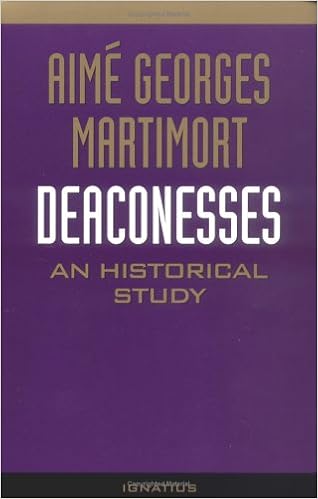 When the Pope appointed that study group, I dusted off my copy of the best thing written to date about women and the diaconate, Deaconesses: An Historical Study by Aime G. Martimort (French 1982 & English – Ignatius Press, 1986). This is this most important, easily obtainable book on the topic in English. I’ve occasionally picked it up and spot read in it, bit by bit, ever since.
Martimort goes through just about everything. Of course his scholarship is limited to his date of 1982. However, there isn’t all that much more to explore. Even if research has turned up more, I am left deeply impressed by Martimort’s conclusion… his literal conclusion on the last page of the text. Here it is, with my usual emphases and comments:
In the end, in my opinion, the conclusion that must impose itself at the termination of a historical study such as ours, conducted in accordance with the requirements of modern scholarship, is that theologians must strictly guard against trying to prove hypotheses dependent upon only a part of the documentation available, a part taken out of context at that. The complexity of the facts about deaconesses and the proper context of these facts prove to be quite extraordinary. There exists a significant danger of distorting both the facts and the texts whenever one is dealing with them secondhand. It is also very difficult to avoid falling into anachronisms when trying to resolve the problems of the present by reference to the solutions appropriate to a past that is long gone. [An example of anachronism would be to assume that deaconettes did in ancient times what permanent deacons do now.]
For the fact is that the ancient institution of deaconesses, even in its own time, was encumbered with not a few ambiguities, as we have seen. In my opinion, if the restoration of the institution of deaconesses were indeed to be sought after so many centuries, such a restoration itself could only be fraught with ambiguity. [NOTA BENE!] The real importance and efficaciousness of the role of women in the Church has always been vividly perceived in the consciousness of the hierarchy and of the faithful as much more broad than the historical role that deaconesses in fact played. [BOOM! Did you get that?] And perhaps a proposal based on an “archeological” institution might even obscure the fact that the call to serve the Church is urgently addressed today to all women, especially in the area of the transmission of Faith and works of charity. [Teaching, nursing, etc. We could come up with other important ways to serve the Church, traditionally carried out by women in an exemplary and edifying way.]
What has Martimort done in this conclusion? He says that
1) we really don’t know enough about deaconesses, and
2) what we do know is ambiguous, and
3) that focusing with such attention on something so elusive and fraught with problems is detrimental to recognition of the terrific contributions which we know for a certainty women can and do offer to the Church and the world.
Bottom line: Promoting ordained diaconate for women, as that Austrian bishop and others do, does women and the whole Church a disservice. It distracts from and even denigrates the tremendous and urgently needed service which women have historically perfected and lovingly contributed.
The moderation queue is ON.
 From a priest….


 For some days now I have been avoiding watching news and news commentary shows, etc. So, through a look at my Twitter feed earlier today, I learned of the horrifying events in Las Vegas.
 Canonist Ed Peters posted at his excellent site
  On this beautiful Feast of our Guardian angels, we must remember the invisible role they inevitably play in our lives. On a plane of being that we humans cannot sense, the holy angels thwart the attacks of hellish fallen angels, bent on our everlasting perdition. We should express gratitude to God and to our angels often, and we should call upon our angels in good times and in bad. Even as they work with us, they know God’s will for us and they behold His face (Matthew 18:10).
 phenomena from an other-worldly viewpoint.

 Recent storms devastated the electrical grid of Puerto Rico. Virtually the entire island is without power. That’s over 3 million people without electricity, water, etc…. for months to come.

 PRJ on Wherein Fr. Z rants. Benediction using the humeral veil BUT… blessings at Communion time? Fathers! THINK!: “A brick for higher up in the wall rebuilding process though, perhaps? At present I fear in most parishes the…”






























