
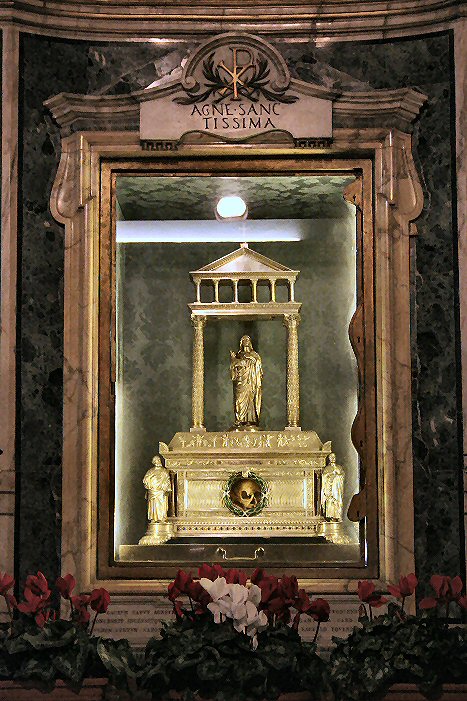
 Behold the skull of Agnes.
The dies natalis ("birthday into heaven") of Agnes was recorded in the register of the depositio martyrum as 21 January.
St. Agnes was slain probably during the reign of the Emperor Diocletian in 304. Some say she died during the time of the Emperor Valerian (+260). The little girl was buried by her parents in praediolo suo, on their property along the Via Nomentana where there was already a cemetery. This cemetery expanded rapidly after that, because many wanted to be buried near the grave of the famous martyr. The ancient cemetery grew in stages between the Basilica which Constantina, daughter of Constantine and Fausta began over her tomb from 337-350 and the small round Basilica of Constantia (Constantine’s daughter). There was an acrostic inscription from that time in verses about the dedication of the temple to Agnes:
Constantina deum venerans Christoque dicata
Omnibus impensis devota mente paratis
Numine divino multum Christoque iuvante
Sacravit templum victricis virginis Agnes…
You get the idea.
The Basilica of St. Agnes was reconstructed towards the end of the 5th c. by Pope Symmachus (+514). Honorius I (+638) rebuilt it as a basilica with three naves, adding a wonderful fresco of Agnes. It was worked on again in the 16th c. by St. Pius V and in the 19t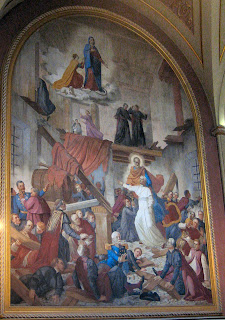 h by Bl. Pope Pius IX. Excavations in 1901 uncovered the silver sarcophagus made by Pius V for St. Agnes together with St. Emerentiana. It contained the headless body of a young girl. Zadock gave us a photo of the miraclous protection of Bl. Pius IX when once at the Basilica there was a near disastrous cave-in/collapse and no one was injured.
While Agnes’s body is in her tomb on the Via Nomentana, her skull is now at the place of her supposed martyrdom at the Piazza Navona in Rome’s heart. It is a fitting place to venerate a saint so much in the heart of the Roman people even today. It is not unusual for people to name their children Agnes in honor of this great virgin martyr, whose name is pronounced in the Roman Canon. The skull was bequeathed to that church at the Piazza by Pope Leo XIII who took it from the treasury of the Sancta Sanctorum. The Piazza itself was in ancient times the Stadium of Domitian (+96) a place of terror and blood for early Christians, far more than the Colloseum ever was. The Piazza is thus called also the "Circo Agonale" and the name of the saint’s church Sant’Agnese in Agone. "Navona" is a corruption of "Agonale", from Greek agon referring to the athletic contests of the ancient world. St. Paul used the athlete’s struggle as an image of the Christian life of suffering, perseverance, and final victory even through the shedding of blood. Early Christian tombs often have wavy lines carved im the front, representing an iron instrument called a strigil, used by athletes to scrape dirt and oil from the bodies after contests. Victory palm branches are still used in the iconography of saints, as well as wreathes of laurels.
We know about St. Agnes from St. Jerome, and especially St. Augustine’s Sermons 273, 286 and 354. St. Ambrose wrote about Agnes in de virginibus 1,2,5-9 written in 377 as did Prudentius in hymn 14 of the Peristephanon written in 405. Ambrose has a wonderful hymn about Agnes (no. 8), used now in the Roman Church for Lauds and Vespers of her feast. The Ambrosian account differs somewhat from others. For Ambrose, Agnes died from beheading. Prudentius has her first exposed to shame in a brothel and then beheaded.
Here is the text of the hymn from the Liturgia horarum for the "Office of Readings" with a brutally literal translation.
Igne divini radians amoris
corporis sexum superavit Agnes,
et super carnem potuere carnis
claustra pudicae.
Shining with the fire of divine love
Agnes overcame the gender of her body,
and the undefiled enclosures of the flesh
prevailed over flesh.
Spiritum celsae capiunt cohortes
candidum, caeli super astra tollunt;
iungitur Sponsi thalamis pudica
sponsa beatis.
The heavenly host took up her brilliant white spirit,
and the heavens lifted it above the stars;
the chaste bride is united to the
blessed bride chambers of the Spouse.
Virgo, nunc nostrae miserere sortis
et, tuum quisquis celebrat tropaeum,
impetret sibi veniam reatus
atque salutem.
O virgin, now have pity on our lot,
and, whoever celebrates your victory day,
let him earnestly pray for forgiveness of guilt
and salvation for himself.
Redde pacatum populo precanti
principem caeli dominumque terrae
donet ut pacem pius et quietae
tempora vitae.
Give back to this praying people
the Prince of heaven and Lord of the earth,
that he, merciful, may grant us peace
and times of tranquil living.
Laudibus mitem celebremus Agnum,
casta quem sponsum sibi legit Agnes,
astra qui caeli moderatur atque
cuncta gubernat. Amen.
Let us celebrate with praises the gentle Lamb,
whom chaste Agnes binds to herself as Spouse,
he who governs the stars of heaven
and guides all things. Amen.
We can note a couple things from this prayer. First, the reference to fire probably a description of Agnes’s death related in a metrical panegyric of Pope Damasus about how Agnes endured martyrdom by fire. On the other hand, St. Ambrose, when speaking of her death, speaks of martyrdom by the sword.
 Pope St. Damasus composed a panegyric, an elogia, inscribed in gorgeous letters on marble (designed and executed by Dionysius Philocalus) in honor of Roman saints, including Agnes. This was the period when the Roman shifted from Greek to Latin. Damasus was also trying to make a social statement with these great inscriptions, set up at various places about the City. The panegyic of St. Agnes was placed in the cemetery near the saint’s tomb, but through the ages it was lost. Amazingly, it was at last rediscovered in 1728 inside the basilica, whole and complete: it had been used upside down, fortunately as a paving stone!
Now it is affixed to the wall in the corridor descending to the narthex. Its discovery was a find of vast importance (thanks to Zadok for the photo of the inscription).
FAMA REFERT SANCTOS DUDUM RETULISSE PARENTES
AGNEN CUM LUGUBRES CANTUS TUBA CONCREPUISSET
NUTRICIS GREMIUM SUBITO LIQUISSE PUELLAM
SPONTE TRUCIS CALCASSE MINAS RABIEMQUE TYRANNI
URERE CUM FLAMMIS VOLUISSET NOBILE CORPUS
VIRIBUS INMENSUM PARVIS SUPERASSE TIMOREM
NUDAQUE PROFUSUM CRINEM PER MEMBRA DEDISSE
NE DOMINI TEMPLUM FACIES PERITURA VIDERET
O VENERANDA MIHI SANCTUM DECUS ALMA PUDORIS
UT DAMASI PRECIBUS FAVEAS PRECOR INCLYTA MARTYR
It is told that one day the holy parents recounted that Agnes, when the trumpet had sounded its sad tunes, suddenly left the lap of her nurse while still a little girl and willingly trod upon the rage and the threats of the cruel tyrant. Though he desired to burn the noble body in the flames, with her little forces she overcame immense fear and, gave her loosened hair to cover her naked limbs, lest mortal eye might see the temple of the Lord. O one worthy of my veneration, holy glory of modesty, I pray you, O illustrious martyr, deign to give ear to the prayers of Damasus.
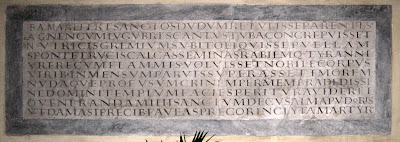
Damasus used the sources available. There were the stories told by her parents, the 4th edict of Diocletian against Christians in 304 (lugubres cantus tuba concrepuisset). Agnes did what she did of her own free will (sponte). Note the reference to the body as temple of God (1 Cor 3:16 and 2 Cor 6:16).
St. Agnes of Rome, has two churches in Rome. She has two feast days in the Roman calendar. Since the reform of the calendar, who now has only one day, alas.
During excavations at the Basilica on the Via Nomentana in 1901 the silver sarcophagus made by St. Pius V for St. Agnes and St. Emerentiana was uncovered.
It was found to contain the headless body of a young girl.































Very informative article. Thank you.
Fr.
Is there a different emphasis between the two feasts in the traditional calendar?
Phil
When I visited Sant’Agnese in Agonia, my two sisters, who are in the medical profession, insisted that the skull was far too small for a 12-year-old girl, even allowing for people being bigger today — they said it was more like a premature infant of today. Were they seeing it wrong, or is the skull really so small?
The first time I saw a statue of the martyrdom of St. Agnes was under her altar in the Brompton Oratory. Not knowing much about her, it immediately caught my attention and drew me into the beauty juxtaposed with the horror of the detail, just as does the story of her life.
Agnes is my middle name. I always hated the name until I learned of St. Agnes. It’s funny that I was not raised Catholic, but have such a Catholic middle name.
Thank you not only for the information on St. Agnes but also for the poetic selections, the sapphic stanzas of the hymn and the hexameters of the Pope Damasus inscription.
Is the hymn found only in the Liturgia Horarum or is it in the older Office as well?
Father,
How is the hymn used? Are the stanzas divided among the hours, as is the Dies Irae for All Souls; or is the entire hymn used at both hours? Thank you, Father.
Father, when is her other feast day?
I thank Fr. Z for mentioning these two outstanding churchs, Sant’Agnese in Agone and Sant’Agnese fuori le mura. The first is a Baroque masterpiece, very theatrical, the transepts like stages, and very fine high reliefs of the martyr. The facade and the dome are among my favorites in Rome.
The second church a splendid example of a church from “Late Antiquity”, when Byzantium was the center of the world. It has wonderful mosaics, one of the saint herself, which can be seen on the Wikipedia article for this church. The 7th Century mosaics are an interesting link from the 4th century mosaics at Santa Pudenziana, the 5th century at Santa Maria Maggiore, 6th century mosaics in Ravenna, and the 9th Century in several churchs in Rome (Santa Cecilia, San Marco, Santa Maria in Domnica, and especially at Santa Prassede). Down below is one of Rome’s best and least crowded catacombs, full of Greek inscriptions. On the grounds is Santa Costanza, with the oldest Christian Mosaics whatsoever.
Mila,
Her other feast is on 28 January. http://www.liturgyoffice.org.uk/Resources/Extraordinary/Calendar/January.html
She is one of my special patrons. I often use as a screen name “MaryAgnesLamb”, to honor the Spotless Lamb, our Mother Mary and Agnes. St. Agnes Pray for us! Thank you for the lovely post on this subject, Father.
Hi Father,
Thank you for the lovely post. You baptized my daughter 12 years ago and we did not give her a saints name. I was a new convert and did not realize the importance of this. You gave her the name Agnes and now as we have grown much deeper in our faith we are so grateful that she has this name. We celebrate our feast days now and all of our children have a saint name. We are very lucky that there are priests like you out there to give us the guidance we need even when we don’t realize it at the time.