Your Sunday Sermon Notes

Was there a good point made in the sermon you heard for your Mass of Sunday Obligation?

Let us know.

I said Masses in both the Extraordinary and the Ordinary Form today, and wound up giving different sermons – as the spirit moved me. Given the harrowing Gospel reading in both forms, actually scarier still in the Novus Ordo form, in both I touched on the need to examine our consciences regarding sins of omission and our obligation to perform corporal and spiritual works of mercy, as our state in life calls.

Someone sent me a photo of Communion time:

15_11_29_Mass_advent

Posted in SESSIUNCULA |
24 Comments

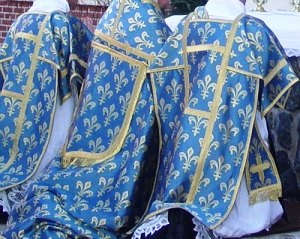
Blue Vestments: wherein Fr. Z rants

Blue Vestments: wherein Fr. Z rantsThe use of blue vestments during Advent is pretty much cliché now, so cliché that not even the aging hippies are clinging to it.  Here’s my annual rant about the use of blue vestments in the Roman Rite.

At this point, some people always blurt, “But Father! But Father! Once upon a time in Spanish territories there was an indult and… therefore… we can… you know!  You hate Vatican II!”

Who knows if that legendary – I repeat legendary – indult still applies. I don’t.  I seriously doubt it does.  Has anyone ever seen the text of that indult?  No. I haven’t either. Over the years more information has come to light about that legendary indult.  According to THIS, we read: “This privilege was granted to Spain, its colonies, and Latin America by a decree of the Sacred Congregation of Rites on Feb. 12, 1864.”  I have not seen the text.  Also, I suppose you would also have to demonstrate that your territory was under Spanish control on 12 Feb 1864.

Apart from whether their use is licit, it is clear that they were used in some Spanish territories and that they probably survive in the Rite of Toledo and in other regions too.

Others will say, “But Father! But Father! There is a custom of using blue during Advent and on Marian feasts!”

Yeah yeah… sure.  It’s against the law.

Also, I I learned last year from a commentator, the Spanish bishops approved, in their liturgical Ordo, the use of blue (“azul”) for the Marian Feast of the Immaculate Conception.   Last year it read:

8 LUNES. LA INMACULADA CONCEPCIÓN DE LA VIRGEN MARÍA, patrona de España, solemnidad
(…)
Misa de la solemnidad (blanco o azul).
bl az MISAL: ants. y oracs. prop., Gl., Cr., Pf. props. No se puede decir
(…)

I’m not in Spain.  Are you?

15_11_29_blue_lampasGiven what’s going these days, I am more inclined to look favorably on a traditionally tinged antinomianism.  HERE  In this Age of Mercy, I guess we can do whatever we want to the Roman Rite.  It’s for the poor, after all.  And, in mercy, some of the things we do in the Extraordinary Form should be done in the Ordinary Form.  No?  Shall I mention the traditional offertory prayers?  The Anglican Use has them.  How about the Last Gospel?  The Anglican Use has it.

Use the prove that I love Vatican II I say “Let’s just do whatever the hell we want!”

Here is another argument: “But FATHER! Solemn occasions merit the most beautiful vestments even though they might not be the right color!  It’s legitimate to use illicit colors if they are the best vestments you have!”

Sure… okay.  But respondeo dicendum: Since blue is not an approved liturgical color in the Roman Rite, why are the blue vestments the best you have?

As soon as blue is approved for use, and I hope it will be, I will be among the first to have a beautiful set made in the Roman style!  I will take up a collection and get a magnificent Pontifical set, replete with cope and humeral veil and all the dalmatics and tunics and gremials and frontals!  I’ll get a stupendous Low Mass set with gold and embroidery.  I will ask for huge donations!  You can bet on it.

In fact… why should I wait?

If bishops – cardinals – can pretend that Christ didn’t mean what he said about one man and one woman and matrimony… can pretend that the magisterium of John Paul II is obsolete and that Benedict didn’t really issue Summorum Pontificum … and can pretend that there is such a thing as mercy without truth… then I can pretend that I’m in Spain and that blue is approved for the entire Latin Church.

Right?

Thus endeth the rant.

Now enjoy this annual song from the official Parodohymnodist.

UPDATE 29 Nov:

There is a treasure trove of information about past concessions to use cerulean/blue vestments HERE.  Ultimate Fr. Z kudos for that.

In a nutshell, the concessions given for the use of cerulean were few in number and were quite restrictive by the clear intent of the Holy See.

Posted in Lighter fare, Liturgy Science Theatre 3000, Parody Songs, Wherein Fr. Z Rants | Tagged , , ,
40 Comments

“Admonish the sinner” reappears

A while back I posted something about a curious lacuna in Misericordiae vultus which listed some of the spiritual works of mercy but which omitted “admonish the sinner”. HERE

However, it now does in the online version in English HERE.

15. […] It is my burning desire that, during this Jubilee, the Christian people may reflect on the corporal and spiritual works of mercy. It will be a way to reawaken our conscience, too often grown dull in the face of poverty. And let us enter more deeply into the heart of the Gospel where the poor have a special experience of God’s mercy. Jesus introduces us to these works of mercy in his preaching so that we can know whether or not we are living as his disciples. Let us rediscover these corporal works of mercy: to feed the hungry, give drink to the thirsty, clothe the naked, welcome the stranger, heal the sick, visit the imprisoned, and bury the dead. And let us not forget the spiritual works of mercy: to counsel the doubtful, instruct the ignorant, admonish sinners [peccatores monere], comfort the afflicted, forgive offences, bear patiently those who do us ill, and pray for the living and the dead.

We cannot escape the Lord’s words to us, and they will serve as the criteria upon which we will be judged….

Posted in Linking Back | Tagged ,
5 Comments

Giving thanks, with Mass, for benefactors and donors

This morning we had a Norman Rockwell like Mass at St. Mary’s. It would have been nice to have a couple photos. We used the texts for the day, of course.

On civil holidays I also like to add Archbishop Carroll’s Prayer for Civil Authorities… which we need to pray often right now.

Since I was able to take my own intention, I said Mass for all my benefactors and donors here. I am grateful for all your support and I remember you in daily prayers and occasional Mass intentions.

Posted in Our Catholic Identity | Tagged ,
7 Comments

Of scapulars, devotions and Russian jet fighters

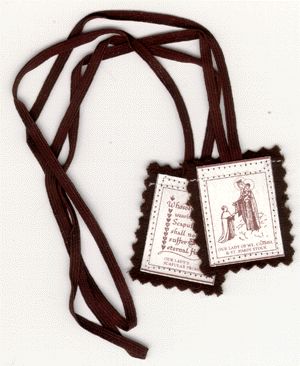
Of scapulars, devotions and Russian jet fightersSome people are quite disciplined in the matter of wearing a scapular. This comes from Latin scapulae, shoulder blades. Scapulars are garments, usually associated with religious habits, which fall down from the shoulders, mostly over the rest of the habit. Another kind of scapular is small, on strings, which symbolically substitutes for the larger scapular. There are different kinds of scapulars which are spiritual aids in various ways. They generally are a symbol of a relationship through which we derive spiritual protection and aid. Probably the most commonly used scapular is the brown Scapular of Our Lady of Mount Carmel.

BTW… once you are “enrolled” and given the brown scapular, if and when your scapular wears out, simply replace it. You don’t have to have the new one blessed.

I am not sure if Eastern Catholics and Orthodox have such things, but a reader alerted me to something which she thought was rather like a Western scapular.

At The Daily Mail there are many photos concerning the destruction of a Russian jet fighter by the Turks. The pilots were killed as they parachuted. Among the photos are the pilots’ effects, including this, which I flipped and cropped:

15_11_26_pilot_icon

Lots of people wear religious items without necessarily being devout in any way.

I hope that this young man was indeed devout and that Our Lady helped him to his end.

That said, reflect now for a moment on your own end, your death, which could come at any moment, whether you regularly are in “harm’s way” or not.

Use well the sacramentals that Holy Church provides for your spiritual benefit.  Devout use of the brown scapular is a common devotion because it is an effective devotion.

Use well the sacraments that Holy Church provides.  Examine your consciences and GO TO CONFESSION.  Make good Holy Communions.  Call upon the graces of the your Confirmation and Matrimony and Holy Orders.

Use well other devotional practices which can be of spiritual benefit to you and others.  Perform indulgenced works, such as making the Way of the Cross, reading Scripture, praying the Rosary.


Posted in Four Last Things | Tagged
43 Comments

ASK FATHER: No Catholic Mass on Sunday. Are we obliged to attend Orthodox Divine Liturgy?

divine liturgyFrom a reader…

QUAERITUR:

My question comes from what my professor said in class and it doesn’t seem correct.

In class, we were told that if a Catholic was in Russia [and there being no Catholic Church; either Latin or Eastern] that the Catholic is bound [under pain of mortal sin] to fulfill his Sunday obligation in the Orthodox Church. The instructor points to C. 844 §2. saying that because the Orthodox have valid sacraments, including the Eucharist, it is this which necessitates the obligation of C. 1247.

Could you please help clarify as to whether the Code can actually bind a person to fulfill their Sunday obligation outside of the Catholic Church?

There has been some confusion on this issue, owing, in part, to an earlier permission. In 1967, the Directory on Ecumenism permitted Catholics to fulfill their Sunday obligation “occasionally” by attending an Eastern non-Catholic Divine Liturgy.

When the 1983 Code was promulgated, Catholics were obliged by can. 1248 to fulfill their obligation “in a Catholic rite.” This law abrogated the practice since 1967 permitting the fulfillment of the obligation in a non-Catholic, but certainly valid, rite.

Any doubt was further removed by the publication of the 1993 Directory for the Application of Principles and Norms on Ecumenism, which states that “even when Catholics participate in ecumenical services, or in services of other Churches and ecclesial communities, the obligation of participating at Mass on these days remains.”

It is true that the Orthodox have valid sacraments. It is true that, in the very special circumstances laid out in can. 844, Catholics can approach the Orthodox for the sacraments of Penance, Holy Eucharist, and Anointing. If one finds oneself in a location where there are no Catholic Masses on a Sunday, one’s obligation is lifted. If there is an Orthodox Divine Liturgy nearby, it would be salubrious to attend and worship the Lord. One is not obliged, however, to do so.

Posted in "How To..." - Practical Notes, ASK FATHER Question Box, Both Lungs, Liturgy Science Theatre 3000, Our Catholic Identity | Tagged , , ,
21 Comments

High praise for Card. Sarah from Archbp. Gänswein

High praise for Card. Sarah from Archbp. Gänswein

Click To Buy
A great gift for a priest!


Ed Pentin has a good note at the National Catholic Register:

Archbishop Gänswein Praises Cardinal Sarah for His Prophetic Witness

Cardinal Robert Sarah’s boldness in proclaiming the Gospel and resisting the Zeitgeist is a prophetic witness reminiscent of a 5th century North African Pope who laid the foundations for healthy church-state relations, Archbishop George Gänswein has said.

In a well-received speech in Rome Nov. 20 at the launch of the German edition of the book ‘God or Nothing’ — an interview with Cardinal Sarah by Nicolas Diat — the personal secretary of Pope Emeritus Benedict XVI compared the cardinal favorably to Pope Gelasius I whom the Church, by coincidence, commemorated on Nov. 20.

[…]

Cardinal Sarah, Archbishop Gänswein said in closing, “is someone who loves”, a man who shows us “how and which masterpiece God wants to shape us into if we do not oppose His artist’s hands.”

During the recent Synod on the Family, Cardinal Sarah gave one of the strongest interventions of the three week meeting, comparing gender ideology and the Islamic State to “apocalyptic beasts“.

Read the rest there.

The text of Archbp. Gänswein’s speech is included.

Posted in Just Too Cool, Our Catholic Identity | Tagged ,
22 Comments

UPDATE: Bishops of England, Wales v. SSPX? Request for review of Good Friday Prayer for Jews

UPDATE 24 Nov:

Fr. H has updated his post about the attack on Pope Benedict’s prayer for the Jews on Good Friday waged by the bishops in England and Wales.  Fr. H asked me to update you.

The BC [bishops conference] has now published a Note (see the thread) which does considerable discredit to whoever drafted it. He or she, indeed, appears to be unaware that the Prayer concerned was written by the Sovereign Pontiff himself … or else wishes the fact not to be known. The Note gives no information about what it is in the text composed by Pope Benedict that contradicts Nostra aetate. It claims that “the Prayer produced in 2008 [written by Benedict XVI!] reverted to being a prayer for the conversion of Jews to Christianity”, but fails to indicate which phrases in the text of the Prayer it deems objectionable. Whoever drafted it is clearly someone who believes, at all costs, in avoiding honest, or precise, dialogue.

At one point only does it come clean. “The Bishops of England and Wales have now added their voice to that of the German Bishops who have asked for the Prayer in the Extraordinary Form to be changed”. [So the Germans are attacking Benedict’s prayer, too.]

So now we know what is going on. Kasper’s belated revenge on Ratzinger, now that he can’t answer back.

____ Original Post Published on: Nov 23, 2015 @ 10:15 CT

Fr. John Hunwicke has at his excellent blog Mutual Enrichment an interesting bit of news.  Perpend:

“The Bishops’ Conference [of England and Wales] … ”

” … requests that the Pontifical Commission Ecclesia Dei review the prayer Pro Conversione Iudaeorum in the Solemn Liturgy of Good Friday in the Extraordinary Form of the Roman Rite, in the light of the understanding in Nostra Aetate of the relationship between the Catholic Church and Judaism”.

There appears to be no indication whether this resolution, passed last week by the English and Welsh Bishops, was unanimous.
Assuming that the bishops did not all wake up one morning with one identical thought in every head, it would be interesting to know where this concern originated; particularly, whether with one of the bishops or in some Liturgy Committee. Such information is always available with regard to the deliberations of the American Episcopal Conference. [But not with the bishops of England and Wales?]

I find it extraordinary that whoever originated this move is unaware that the current form of that Prayer comes directly from the pen of Benedict XVI himself, who was at the Council as a peritus and, it has always seemed to me, gives the impression of knowing some of the Conciliar documents really quite well. And, while aware that a lot of people viscerally loathe Joseph Ratzinger, I have always found his writings, both as a theologian, and as Cardinal Prefect of the CDF, and as Successor of S Peter, cogent, convincing, and illuminating. I would like to be helped to understand where it is that I have gone wrong in this judgement.

A Conspiracy Theorist would probably wonder if this is part of an attempt to get rolling a movement for dismantling the Magisterium of Benedict XVI and for derailing the current rather promising rapprochement under the direction of Pope Francis between the Vatican and the SSPX. I, fortunately, am not a Conspiracy Theorist. What I would like to have, as a concerned Catholic Priest who tries to understand the Church’s Magisterium, is a lucid and unwoffly statement of what exactly it is in the Prayer which contradicts which precise affirmations of Nostra Aetate, [Good question.] a document to which, of course, I subscribe. Since the Prayer as composed by Benedict XVI carefully follows, even verbally, the teaching in the Epistle to the Romans of S Paul (an author whom I spent three decades teaching), I would also be very interested to know what it is in S Paul’s teaching which is deemed to fall under the condemnation of Nostra Aetate. 

I have written about Pope Benedict’s change to the Good Friday Prayer HERE and HERE and HERE and HERE.

In previous posts I give some context, a comparison of texts and my own analysis.


Posted in SSPX | Tagged , , ,
37 Comments

Earth Might Have Hairy Dark Matter!

Some news about your planet.

From the Jet Propulsion Laboratory:

Earth Might Have Hairy Dark Matter

Earth Might Have Hairy Dark Matter!The solar system might be a lot hairier than we thought.

A new study publishing this week in the Astrophysical Journal by Gary Prézeau of NASA’s Jet Propulsion Laboratory, Pasadena, California, proposes the existence of long filaments of dark matter, or “hairs.”

Dark matter is an invisible, mysterious substance that makes up about 27 percent of all matter and energy in the universe. The regular matter, which makes up everything we can see around us, is only 5 percent of the universe. The rest is dark energy, a strange phenomenon associated with the acceleration of our expanding universe.

Neither dark matter nor dark energy has ever been directly detected, although many experiments are trying to unlock the mysteries of dark matter, whether from deep underground or in space.

Based on many observations of its gravitational pull in action, scientists are certain that dark matter exists, and have measured how much of it there is in the universe to an accuracy of better than one percent. The leading theory is that dark matter is “cold,” meaning it doesn’t move around much, and it is “dark” insofar as it doesn’t produce or interact with light.

Galaxies, which contain stars made of ordinary matter, form because of fluctuations in the density of dark matter. Gravity acts as the glue that holds both the ordinary and dark matter together in galaxies.

According to calculations done in the 1990s and simulations performed in the last decade, dark matter forms “fine-grained streams” of particles that move at the same velocity and orbit galaxies such as ours.

“A stream can be much larger than the solar system itself, and there are many different streams crisscrossing our galactic neighborhood,” Prézeau said.

Prézeau likens the formation of fine-grained streams of dark matter to mixing chocolate and vanilla ice cream. Swirl a scoop of each together a few times and you get a mixed pattern, but you can still see the individual colors. [There are people who think this stuff up.]

“When gravity interacts with the cold dark matter gas during galaxy formation, all particles within a stream continue traveling at the same velocity,” Prézeau said.

But what happens when one of these streams approaches a planet such as Earth? Prézeau used computer simulations to find out.

His analysis finds that when a dark matter stream goes through a planet, the stream particles focus into an ultra-dense filament, or “hair,” of dark matter. In fact, there should be many such hairs sprouting from Earth.

A stream of ordinary matter would not go through Earth and out the other side. But from the point of view of dark matter, Earth is no obstacle. According to Prézeau’s simulations, Earth’s gravity would focus and bend the stream of dark matter particles into a narrow, dense hair.


[…]

Read the rest there.  They break it down Barney-style for us.

Posted in Just Too Cool, Look! Up in the sky! | Tagged ,
42 Comments

1st Bishop appointed for an Anglican Ordinariate

From a Press Release of the Anglican Ordinariate of St. Peter for these USA HERE

POPE FRANCIS NAMES FIRST BISHOP TO LEAD CATHOLICS NURTURED IN THE ANGLICAN TRADITION

  • Bishop-elect Steven Lopes to be introduced at press conference today in Houston
  • Rome sends top official to North America to lead structure equivalent to a diocese
  • Vatican also approves use of new texts for the celebration of Mass

HOUSTON — Pope Francis has named the Rev. Monsignor Steven J. Lopes to be the first bishop of the Personal Ordinariate of the Chair of St. Peter: a structure equivalent to a diocese for Roman Catholics who were nurtured in the Anglican tradition.

The Personal Ordinariate of the Chair of St. Peter was established by Pope Benedict [the Pope of Christian Unity] on Jan. 1, 2012, with its headquarters located in Houston, Texas. Founded to serve Roman Catholics across the U.S. and Canada, it is the first diocese of its kind in North America.

The Ordinariate was created to provide a path for groups of Anglicans to become fully Roman Catholic, while retaining elements of their worship traditions and spiritual heritage in their union with the Holy Roman Church.

Msgr. Jeffrey N. Steenson, the leader of the Ordinariate since 2012, will introduce Bishop-elect Lopes at a news conference at 10:30 a.m. today at the Chancery Offices of the Ordinariate in Houston.

With this appointment, Pope Francis affirms and amplifies Pope Benedict’s vision for Christian unity, in which diverse expressions of one faith are joined together in the Church. By naming Bishop-elect Lopes, the Pope has confirmed that the Ordinariate is a permanent, enduring part of the Catholic Church, like any other diocese — one that is now given a bishop so that it may deepen its contribution to the life of the Church and the world.

Bishop Lopes’ appointment comes just five days before the Ordinariate begins using Divine Worship: The Missal, a new book of liturgical texts for the celebration of Mass in the Personal Ordinariates around the globe. The texts were approved by the Vatican for use beginning the first Sunday of Advent, Nov. 29, 2015.

Bishop-elect Lopes was directly involved in developing these texts for worship; since 2011, he has served as the executive coordinator of the Vatican commission, Anglicanae Traditiones, which produced the new texts.

The new missal is a milestone in the life of the Ordinariate, since the Ordinariate’s mission is particularly expressed through the reverence and beauty of its worship, which shares the treasury of the Anglican liturgical and musical traditions with the wider Catholic community.

Pope Benedict’s vision for Christian unity and the concrete ways that Pope Francis is implementing that vision demonstrate that unity in faith allows for a vibrant diversity in the expression of that faith. The Ordinariate is a key ecumenical venture for the Catholic Church and a concrete example of this unity in diversity.

ABOUT BISHOP-ELECT LOPES

Steven Joseph Lopes, 40, is a Catholic priest of the Archdiocese of San Francisco. As the bishop-elect of the Ordinariate, he will reside in Houston, Texas.

Bishop-elect Lopes was born and raised in Fremont, Calif. The only child of Dr. José de Oliveira Lopes (deceased) and Barbara Jane Lopes, he attended Catholic schools in the Golden State, including the St. Ignatius Institute at the University of San Francisco. He earned licentiate and doctoral degrees in sacred theology at the Pontifical Gregorian University in Rome.

He was ordained a priest in June 2001 and spent the first several years of his priesthood as an associate pastor at two parishes: St. Patrick Catholic Church in San Francisco and St. Anselm Catholic Church in Ross, Calif.

Since 2005, he has served as an official of the Congregation of the Doctrine of the Faith, the Vatican office responsible for promoting and preserving Catholic teaching. He was named a monsignor in 2010.

His family includes his mother, Barbara Jane; his step-father, Abilio Dias; five step-brothers; and a step-sister.

Bishop-elect Lopes follows in the footsteps of Msgr. Jeffrey N. Steenson, who was named the first Ordinary (or head) of the Ordinariate when it was established in 2012. Msgr. Steenson’s retirement from his position as Ordinary is effective today, upon Pope Francis’ appointment of Bishop-elect Lopes. However, Msgr. Steenson has been appointed Administrator of the Ordinariate and will continue to oversee its day-to-day activities until Feb. 2, 2016.

Bishop-elect Lopes is the first bishop to be named for any of the three Personal Ordinariates in the world: Our Lady of Walsingham in the United Kingdom; the Chair of Saint Peter in the United States and Canada; and Our Lady of the Southern Cross in Australia.

The ordination of Bishop-elect Lopes is planned for Feb. 2, 2016 in Houston.

A biographical summary, photos, statements from Bishop-elect Lopes and Ordinary Emeritus Msgr. Steenson and other materials are online at www.ordinariate.net/bishop-elect-lopes.

Posted in Benedict XVI, Francis, Pope of Christian Unity | Tagged , , ,
29 Comments