“Asking Our Lady to Help Us Make Up for Lost Time” AUDIO INTERVIEW

On this Feast of the Presentation of the Blessed Virgin Mary, I want to give a couple priest friends a plug.

Msgr. Charles Mangan I have know since the 80’s.  He is a priest of Sioux Falls and he worked in Rome for some years.  He recently did an audio interview with my good friend Fr. Gerald Murray, pastor of the UN parish in Manhattan.

If these two men are involved, it’s gotta be good.

Have a listen!

Theme:   HERE

Posted in HONORED GUESTS, The Campus Telephone Pole | Tagged ,
3 Comments

CQ CQ CQ #HamRadio Saturday – Frigid

First…

Not on the list?  Wanna be? Drop me a line.

Last week I had a spur of the moment field day.  It was an autumnally beauteous day.

CQ CQ CQ #HamRadio Saturday - Frigid

I figured that we weren’t going to have more like that.

Today.

CQ CQ CQ #HamRadio Saturday - Frigid

As you can see, BLAM!,winter has arrived at the Steam Pipe Trunk Distribution Venue.

I haven’t had my rig set up since last Sunday’s field day, having been pretty busy.  But it is set up now.

As far as news is concerned… I met with a local elmer and showed him the Morse Code key that I bought in Tokyo.  Having been a collector of keys, he regarded it with a measure of cool skepticism, pronounced it in need of work, and took it home.  Since then, I’ve been alerted that it is now in better order.

There ensued a brief conversation about the particularity of keys and individuals.  I can only imagine that to be true, since I haven’t yet gotten into CW.

In other news, recent conversations I have had with interested parties suggests that we will a) be able to move forward with a Ham Radio Club (name to be determined – one wag suggested a classic organization from Spanky And Our Gang) and b) the room we need will be made available.

Alas, we did not get antennas up before the snow hit.  It’ll happen.

I have now studied a bit the process for getting a Club recognized and approved (e.g., paperwork, submit to whom, etc).  I think we can get the formalities finished after a Sunday Mass soon.

In other news, I have lost the use of Echolink on my desktop and laptop because of closed port issues.  I’m working on that.  The problem is, I can’t update my call sign with Echolink until I get online with the Echolink software.  So… hmmm… I may have to go to an internet hotspot with my laptop and, in the meantime, work with the IT guy here to get those ports open (the server was recently changed around).

None of this means that YOU can’t make contacts with each other at the “café” set up by our own WB0YLE for our use!   Search WB0YLE-R

UPDATE:

That was fast… the IT guy did his server/port jiu jitsu remotely and opened the proper ports.  I went through the process and, BLAM, just as suddenly as the strike of winter, I have been validated:

The ECHOLINK node number for W9FRZ is now 225022.

Then I had a struggle with the microphone, which had decided all on its own to reset in the recording level to nearly zero.

Having tested … I’m good to go on the desktop and the phone.  Laptop later.

Posted in Ham Radio | Tagged , , ,
4 Comments

ASK FATHER: Is it a sin not to have a cere-cloth on the altar?

ASK FATHER: Is it a sin not to have a cere-cloth on the altar?From a preist reader…

QUAERITUR:

We recently began the Tridentine Mass in Santa Fe, at the oldest church building in the United States, San Miguel Chapel, built in 1610. [Kudos!  It would be nice to visit sometime.] I have a new sacristan. He gave me a copy of a 2-page article put out by “sanctamissa.org.” I know nothing about this organization. [This is from the Canons at St. John Cantius in Chicago.  Great men.]

The article quotes the Catholic Encyclopedia from 1907 and an article from A.J. Schulte that sets forth many requirements for the altar cloths, such as: they must be blessed by a bishop or a priest; there must be three on the altar; the bottom must be sealed with wax; they must be made of linen or hemp. The article also says that celebrating the Mass without these procedures would probably constitute a venial sin, since the rubric is prescriptive. My sacristan is a bit worried.

Can you please advise?

It is good to have a sacristan who is diligent.  Now you can help him to relax a little.

Some of this might be unfamiliar to most of the readers.  In the Extraordinary Form it was proper to have three altar cloths, as described. They are linen and, therefore, absorbent, in case of spills. The top cloth had to cover the whole of the altar top and then be long enough to reach the floor on either side.

Another cloth used (described in the Pontificale Romanum) was a wax-imbued “cere-cloth, also called a Chrismale.  It is called a “Chrismale” because its primary purpose was, during the ceremony of consecrating the altar, to protect the other cloths from the Sacred Chrism that was poured on the altar top.  Thereafter, during the ages before the evil air-conditioning denounced in a papal encyclical, the waxen cloth was useful to keep condensation from the colder marble altar top from wicking up through the other cloths, promoting mold, etc.

According to older legislation, the cere-cloth was not counted as one of the three altar cloths.  After its use at the consecration of the altar, there was no legislation that required the use of the cere-cloth (as a 4th cloth) on the altar.

Beyond the rite of consecrating an altar, is the cere-cloth really useful?  It could be.  Is it cool to have?  It sure is.  Is it a sin not to have one?  No.

Get a cere-cloth if you wish, but you might want to add it a little lower on the list of things to get amongst the things it would be nice to have but can wait.

The rubrics governing the linens required for Mass do seem to be prescriptive.  Also, the “defects” in the way Mass was/is celebrated are described in the Praenotanda as often being sinful, at least venially in some cases.  The lack of a cere-cloth doesn’t fall into that category.

The other day I posted a quote from With God in Russia by Fr. Walter Ciszek. HERE  If the circumstances are not perfect, that’s no reason for foregoing the good of the Mass. Work towards getting the proper linens, the proper vestments, the proper candles, but if the choice is between not having Holy Mass in the Extraordinary Form for lack of a proper cere-cloth, lack of maniples, lack of beeswax candles, or offering the Mass whilst one is still working on gathering the necessary gear, I’d say, offer the Mass.

Don’t let the perfect be the enemy of the good.

Some might wonder if this isn’t all a little persnickety.  No, it really isn’t.  Visit to a few churches where only the Ordinary Form is used and inspect the altar appointments, vessels and vestments.  This can turn out pretty unedifying results.  Regulation of these matters, to provide a practical minimum based on centuries of experience of what works, as well as consistent decorum, produced a knock-on effect in the way the priest celebrated Mass and in the way the lay faithful treated their sacred space.

Posted in "How To..." - Practical Notes, ASK FATHER Question Box, Liturgy Science Theatre 3000, Mail from priests | Tagged ,
9 Comments

Pope Francis to German Bishops: Your Church is a mess! Fix it and … GO TO CONFESSION!

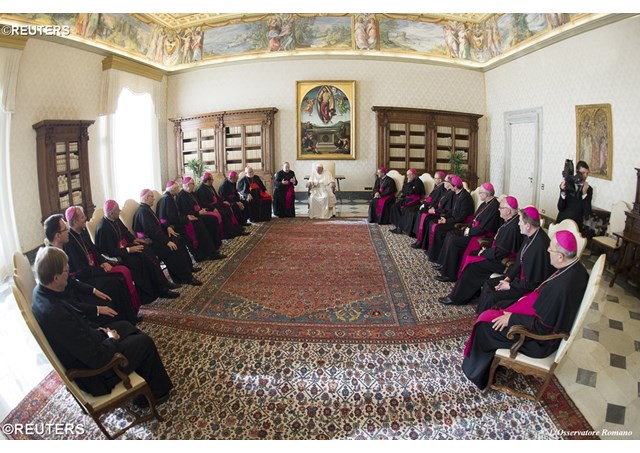
Pope Francis to German Bishops: Your Church is a mess! Fix it and ... GO TO CONFESSION!The German bishops are making their ad limina visit.  Every few years diocesan bishops have to go to Rome to meet with offices of the Roman Curia and, usually, the Pope.

Pope Francis gave an address to the German bishops that was clear, coherent, well-crafted and, in many respects, stinging.  He painted a dire portrait of the Church in Germany.

At one point he said:

One notes in particular in traditionally Catholic regions a very strong decline in participation at Sunday Mass, not to mention the sacramental life.  Where in the 1960’s everywhere just about all the faithful still participated at Holy Mass every Sunday, today there are often less than 10 percent.  Ever fewer people seek the sacraments.  The Sacrament of Penance has almost disappeared.  Ever fewer Catholics receive Confirmation or contract Catholic Matrimony.  The number of vocations to priestly ministry and the consecrated life has sharply diminished.  In consideration of these facts, one can speak truly of an erosion of the Catholic Faith in Germany.

The talk is available in Italian and in German HERE.   Ed Pentin’s report HERE.

Pentin wrote:

In his speech to the bishops, Pope Francis therefore directly appealed to them not to “put trust in administrative structures, in perfect organizations”. He called such a tendency “a sort of new Pelagianism” — a term reminiscent of his critique of the Italian church last week.  [Most of the time I have no idea what the Pope is talking about when he uses this “Pelagian” slap.  Libs titter behind their hands because they think he means conservatives and traditional Catholics.  Here the Pope has shoved it smack into the faces of some of the most liberal Catholics anywhere… German bishops.]

One of the things Francis promoted, hard, was fostering the Sacrament of Penance, getting people back to the confessional.

Also, via Pentin:

Noting the sacraments are approached “less often” (a survey released earlier this year showed 54% of Germany’s priests go to Confession just once a year or less), and that vocations have “significantly diminished”, the Pope said the solution depends upon overcoming “paralyzing resignation”.

Here’s what the Pope said:

Turning now our attention to parochial communities, in which one experiences and lives the faith in a greater way, the sacramental life must be at the heart of the Bishop in a special way.  I would like to underscore only two points: confession and the Eucharist.  The Extraordinary Jubilee of Mercy, which is about to start, offers the opportunity to bring about the rediscovery of the Sacrament of Penance and Reconciliation. Confession is the place where one receives as a gift the forgiveness and the mercy of God. In confession there begins the transformation of every single member of the faithful and the reform of the Church. I hope that greater attention will be given to this sacrament, so important for a spiritual renewal in diocesan and parochial pastoral planning, during the Holy Year and also after. It is also necessary to put into evidence always the intimate connection between the Eucharist and priesthood. Pastoral plans that do not give adequate importance to priests in their ministry of governing teaching and sanctifying in regard to the structures and the sacramental life of the church, on the basis of experience are destined for failure. The precious collaboration of the lay faithful above all where vocations are lacking cannot become a surrogate for priestly ministry or make it even seem simply to be optional. Without the priest there is no Eucharist.

Switching web pages we immediately find editorials at the Fishwrap (National Schismatic Reporter) applauding the Pope’s words about confession and abjuring their heretical notions about the ordination of women, which Pope Francis at other  times has said is impossible.

Oooops… no!  Wait.  I had a monsignor moment there.  Scratch that last part.  As a matter of fact, I didn’t see there any report on the Pope’s stern speech to their German episcopal Liebchen.

What the Fishwrapers want is what the Germans have been up to for years.  And now even Francis has called the German Church to wake up.

The Pope’s speech to the Germans was direct… linear… clear… detailed. Detailed in a way that I would not have expected from Francis.  This was written for him. That’s not a surprise.  Popes generally can’t write their talks, especially in languages they don’t speak about things they don’t know much about.  They depend on others.  Once the Pope reads it, it is his, of course.  But… some German wrote this who knows well the situation of the Church in Germany.  Gee… who might have been available to do that?  I’m pretty sure that Benedict, when he was Pope, provided the content for his own addresses to German bishops.  I mean… who better than he?  Right?

And then we ask the question: why?   Francis seems to have been all over the German message in the last couple years.  Did he finally get tired of seeming like he was on their leash?  Did he talk to enough people to finally get the message about what is really happening in the incredibly wealthy but spiritually enervated German Church?


I don’t know.

But this talk was interesting.  Eventually, I am sure the whole thing will be in English

Posted in Francis, New Evangelization, Our Catholic Identity | Tagged ,
45 Comments

Fr. Z asks help: finding fabrics

Is there anyone out there I could put onto a project?

I need to find some fabric – gold silk – that matches a set of vestments I had made in Rome last year.  During my last trip I went to the store where I bought the bolt.  I was told that they couldn’t get it anymore.

I suspect more is out there.

I would be happy for some advice and help.  I can send swatches if necessary.

The fabric.  Click for larger.

Feel free to work together.

IMG_2729


IMG_2728

Posted in ACTION ITEM! | Tagged
20 Comments

Lutheran Satire

Ever since Pope Francis met with some Lutherans and said pretty confusion things about reception of Holy Communion [HERE], I’ve been keeping half an eye out for a video from Lutheran Satire.

They have a couple already about Pope Francis. They are biting but, in all honesty, pretty funny.  They get some important points about the Church and the papacy right, even as they lampoon.

Years ago I was, for my sins, sent off to an ecumenical breakfast around Thanksgiving time. When I walked in a young man in black clerical clothing made a bee line for me. He was the pastor at the nearby Missouri Synod Lutheran church. Standing in my path, he asked me if I was the priest at the Catholic church nearby who told non-Catholics that they couldn’t come to Communion. “Yes”, I responded, “I am.” He thereupon stuck his hand out and said “Thank you! Many Catholic priests don’t know that not all Lutherans have inter-communion with each other much less with Catholics!” We wound up sitting together and having a cordial morning.

I think that ecumenical or inter-religious dialogue has to begin from a the foundation of true belief in your own doctrine!  And I think that we should still pay attention to Mortalium animos even if more recent magisterial documents have also been promulgated.

On that note, here is a Lutheran Satire video that I discovered today even though it is almost a year old.

Play video

Comment moderation is, of course, ON.

Posted in Francis, Lighter fare, Our Catholic Identity | Tagged ,
11 Comments

ASK FATHER: Can Orthodox obtain indulgences through the Catholic Church?

Carracci-PurgatoryFrom a reader…

QUAERITUR:

I am an Orthodox Christian. I believe that the Roman Catholic Church and the Eastern Orthodox Church are both Apostolic Churches, albeit, not in full communion. I converted to EO from Calvinism after being raised Pentecostal. I don’t believe that any “positive” and “non-polemical” teaching of the EOC contradicts or requires me to disbelieve in RCC doctrines such as the Immaculate Conception, Purgatory, or Indulgences. I am assuming that I am considered a catholic Christian with access to salvific sacraments from the Roman Catholic pov (re: Vatican II’s Decree on Ecumenism, Orientale Lumen).

My question is, can I gain plenary indulgences for souls in purgatory while being a member of the Eastern Orthodox Church? I try to pray the Rosary every day, and there is a chapel at the local cathedral a few blocks from work, so I could easily fulfill the conditions for a plenary indulgence three or four times per week.

The Catechism of the Catholic Church refers to the “Christian faithful” as the subjects of indulgences.

The Church is the dispenser of indulgences and so it would be logically assumed that those faithful united in full communion with the Church are those Christians who are able to obtain the indulgences which the Church so generously dispenses.

However, the Catechism, and Paul VI’s Indulgentiarum doctrina, only speak of the Christian faithful, not of Catholics. The Christian faithful must be properly disposed, free from any ecclesiastical penalties, and having received the sacraments of Penance and the Eucharist within the prescribed times for the indulgence.

Some might consider an Eastern Orthodox person to be in a state of schism, but, canonically, the culpability for schism is only incurred by those who, having once been united to the Church, have separated themselves from it. One who is born and raised outside the Church, though he be in de facto schism from the Church, is not imputable for the sin of schism (though he should be urgently encouraged to return to the fullness of the Church).

Therefore, it seems that it might be possible for an Orthodox Christian, who has never been Catholic, to obtain an indulgence.  It certainly does no harm to try!

Having said that, if you believe what the Catholic Church teaches regarding Purgatory, Indulgences, the Immaculate Conception (issues that are not necessarily at odds with official Orthodox teaching but which are certainly taught more clearly by the Catholic Church), why not advance the issue of true ecumenism and become Catholic?

Then, most certainly, there would be no doubt whatsoever about your ability to gain indulgences.

Posted in "How To..." - Practical Notes, Both Lungs | Tagged , ,
6 Comments

When Jesuits quote Jesus… and when they don’t

When Jesuits quote Jesus... and when they don'tHow the mighty have fallen.

La Civiltà Cattolica is a periodical edited by Jesuits which receives some vetting from the Secretariat of State and, thus, is considered by some to have a measure of “authority”.

However, true authority is based on the truth of premises and the quality of arguments… no matter who writes it or vets it.

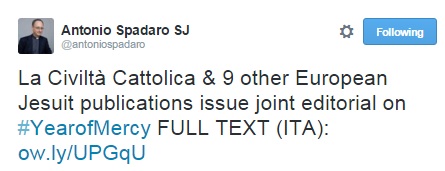
I saw a tweet from Fr. Antonio Spadaro, SJ, who is close to Pope Francis and part of his writing team, and who seems to have a strong interest in the life and works of Pier Vittorio Tondelli (HERE).

15_11_19_tweet_01

“Hmmm…”, quoth I.  “Let’s have a look!”

In the Editorial under – Nell’ultima pubblicazione – n° 3971 del 12/12/2015 (the text is in Italian) I found the names of the other Jesuit publications.  Of course they are European, but I nevertheless found interesting the absence of Amerika.

Even more amusing was this.  Pay attention to their use of the authority of Lumen gentium for their… point:

La Costituzione dogmatica conciliare sulla ChiesaLumen gentium (LG) afferma autorevolmente: siccome «Cristo è stato mandato dal Padre “per annunciare ai poveri un lieto messaggio…, guarire quelli che hanno il cuore contrito” (Lc 4,18 Vlg), “a cercare e a salvare ciò che era perduto” (Lc 19,10), similmente la Chiesa abbraccia con amore quanti sono afflitti dall’umana debolezza, anzi riconosce nei poveri e nei sofferenti l’immagine del suo Fondatore povero e sofferente, cerca di sollevarne l’indigenza e in essi intende servire Cristo» (LG 8).

The Council’s Dogmatic Constitution on the Church Lumen gentium (LG) asserts authoritatively: given that “Christ was sent by the Father ‘to announce to the poor a joyful message…, to heal those who have a contrite heart’ (Luke 4:18 Vulgate), “to seek and to save that which was lost’ (Luke 19:10), similarly the Church embraces with love all those who are afflicted by human suffering, but rather recognizes in the poor and in the suffering the image of her poor and suffering Founder, seeks to alleviate destitution and in them means to serve Christ” (LG 8).

Sounds pretty pious, no?

Not if you read it carefully.

First, the writer utilizes Lumen gentium as an authoritative witness to the point he is trying to make.  However, Lumen gentium authoritatively affirms others things as well, such as the obligation we have to submit to properly defined and taught doctrine (not always a Jesuit strong point), and that those who resist membership in the Church, knowing her for what she is, cannot be saved.  Lumen gentium clearly upholds traditional doctrine about the Church’s hierarchical structure and insists on a qualitative difference between the priesthood of the ordained and of the laity.   There are more items, but that’s enough for now.

But, the Jesuit version of the Documents of Vatican II (i.e, the passages they accept) would be as thin as the Gnostic versions of the Bible.

Next, LG 8 says that Christ was sent by the Father “to bring good news to the poor, to heal the contrite of heart”.  What does “contrite” mean?   Note that Luke 4:18-19 are problematic in the Vulgate and in the Greek. Some scholarly Greek versions omit the part about “contrite heart” (ἰὰσασθαι τοὺς συντετριμμένους τὴν καρδίαν).  But no matter.  The writer is citing the Council document Lumen gentium which reads “Christus a Patre missus est “evangelizare pauperibus,… sanare contritos corde” (Lc 4,18)”.  We, therefore, have to go with the “contrite heart” statement.

Again, what does “contrite” mean?  Contrition of heart (from Latin contritio “a wearing down of that which is hard”) is sorrow of heart for and detestation of sin along with the resolution not to sin again (Council of Trent, session XIV, 4).  Contrition is necessary for forgiveness and, thus, for salvation.  It must be genuine.  It is more perfect when it comes from love for God, less perfect when it comes from fear of punishment (called “attrition”).  Christ came to heal those who are sorry for the sins they have committed and detest sin.  They have repented.  They are not just sad.  They are not just afraid.  They have turned a corner on sin.

Here’s the problem… This is the crew who are constantly chanting mercy mercy mercy without, seemingly, any strong exhortation to repentance and conversion and adherence to the Church’s teaching on faith and morals.  This crew utilizes a conciliar text which they shove in our face as authoritative (i.e., intended to end all discussion).  However, the very text they cite (and there are textual problems with it) affirms precisely what they are trying to avoid: that we have to stop sinning to be healed.

Furthermore, note that, all of a sudden, Christ’s words are really important!   They weren’t so important in the question of the clear and indisputable text about indissolubility of marriage.  But here, the Council and Christ’s words – which I think they misapply – are authoritative even though the Greek and Latin texts are a bit contested.

C’mon, guys.  You would think that Civiltà Cattolica could field a better team than this.
 

Posted in One Man & One Woman, Our Catholic Identity, Sin That Cries To Heaven, The Drill | Tagged , , ,
6 Comments

How about a Masters in RATZINGER STUDIES?

15_11_19_Augnum_02Here is an exciting opportunity for priests and lay people alike.

In Rome there is now a Masters program in RATZINGER STUDIES.  HERE  PDF of the brochure HERE.

The Fondazione Vaticana Joseph Ratzinger Benedetto XVI is sponsoring a Masters Program in Joseph Ratzinger: Studies and Spirituality.

This is a two semester program, beginning February 2016, consisting in a course of one afternoon per week for two semesters.   So, it’ll run from the second semester, starting in February 2016, and then pick up again with the next academic year in October through to January 2017.

And the program is in both Italian and ENGLISH.  That is.. the whole thing is offered… in ENGLISH.  You don’t need to take Italian courses because it is also offered IN ENGLISH.

This would be an amazing opportunity for, say, a priest who is to take a sabbatical year.

Rome in the spring, Ratzinger, summer off, Rome in the fall, Ratzinger … Masters!

15_11_19_Augnum_01The programs is coordinate by and held at my school, the Patristic Institute “Augustinianum“, which is literally across the street from St. Peter’s Square.

This Masters program will trade off with their other Masters program in Augustinian Studies.  So, after the Ratzinger program ends in January 2017, the Augustine program (going on now at the Augustinianum) will start in February 2017.  They will alternate.


Super cool idea and opportunity.

Tempting?


Posted in Benedict XVI, Just Too Cool, The Campus Telephone Pole | Tagged ,
12 Comments

Card. Sarah on marriage, mercy and the incomprehension of doctrine by priests

Card. Sarah on marriage, mercy and the incomprehension of doctrine by priests

Click

I saw at Sandro Magister’s Chiesa that Robert Card. Sarah (cheer here), Prefect of the Congregation for Divine Worship and author of God Or Nothing, [UK HERE] has some strong words for the Church (and churchmen) in the recent L’Homme Nouveau.

Magister has a preview.

Here is a preview of his preview. “Overrated Synod. Before All Else in the Church There Is a Crisis of Faith”.

Card. Sarah responds to critics.  My emphases.

Four objections, four responses, and one conclusion

by Robert Sarah

1. DOCTRINE, LET’S VOTE ON IT BY MAJORITY

[…]

2. COMMUNION FOR ALL, WITHOUT DISCRIMINATION

[…]

3. REMARRIED AND ACTIVE IN THE PARISH. WHY NO COMMUNION?

[…]

4. THE AFRICAN FAMILY IS NOT WHAT YOU TELL US IT IS

[…]

CONCLUSION. THE MAGISTERIUM OF THE CHURCH, THIS UNKNOWN TERRAIN

To conclude, I feel wounded in my heart as a bishop in witnessing such incomprehension of the Church’s definitive teaching on the part of my brother priests.

I cannot allow myself to imagine as the cause of such confusion anything but the insufficiency of the formation of my confreres. And insofar as I am responsible for the discipline of the sacraments in the whole Latin Church, I am bound in conscience to recall that Christ has reestablished the Creator’s original plan of a monogamous, indissoluble marriage ordered to the good of the spouses, as also to the generation and education of children. He has also elevated marriage between baptized persons to the rank of a sacrament, signifying God’s covenant with his people, just like the Eucharist.

In spite of this, there also exists a marriage that the Church calls “legitimate.” The sacred dimension of this “natural” dimension makes it an element awaiting the sacrament, on the condition that it respect heterosexuality and the parity of the two spouses when it comes to their specific rights and duties, and that the consent not exclude monogamy, indissolubility, permanence, and openness to life.

Conversely, the Church stigmatizes the deformations introduced into human love: homosexuality, polygamy, chauvinism, free love, divorce, contraception, etc. In any case, it never condemns persons. But it does not leave them in their sin. Like its Master, it has the courage and the charity to say to them: go and from now on sin no more.

The Church does not only welcome with mercy, respect, and delicacy. It firmly invites to conversion. As its follower, I promote mercy for sinners – which all of us are – but also firmness toward sins incompatible with the love for God that is professed with sacramental communion. What is this if not the imitation of the attitude of the Son of God who addresses the adulterous woman: “Neither do I condemn you. Go and from now on sin no more” (Jn 8:11)?

Read the whole thing there.

Posted in One Man & One Woman, Our Catholic Identity | Tagged
31 Comments