Brick by Brick: New Swiss Bishop gives basilica church to FSSP

A reader sent me some good news:

The new bishop of Lausanne, Geneva, and Fribourg, Switzerland, has given the Basilica of Notre Dame in Fribourg, a beautiful and historic church, to the FSSP! [Fraternity of St. Peter] A FSSP priest will be in charge of all pastoral activities, and a diocesan priest will be administrator for the first year, then hopefully a FSSP will be appointed pastor.
Bishop Morerod is a youngish Dominican involved with the SSPX dialogue before he was named bishop. I’m pretty sure he was rector of the Angelicum, too.  [Yes, he was.]

WDTPRS kudos to Bp. Morerod.

When it comes to parish closures we need to get out of the box and start thinking.


Posted in "How To..." - Practical Notes, Brick by Brick, Just Too Cool, New Evangelization, Our Catholic Identity, Priests and Priesthood, SUMMORUM PONTIFICUM, The future and our choices | Tagged , , , ,
9 Comments

Nancy Pelosi, Doctrix of the Church, on St. Ted Kennedy’s heavenly intercession for Obamatax

Former Speaker of the House and Arm-Chair Doctrix of the Church Nancy Pelosi, if she weren’t so harmful to our nation would be hilarious.

From CNSNews:

Pelosi on Obamacare: I Knew Ted Kennedy ‘Would Go to Heaven and Help Us Pass the Bill
By Elizabeth Harrington

(CNSNews.com) – House Democratic Leader Nancy Pelosi (D-Calif.) said Thursday that “It’s pretty exciting” that the Supreme Court upheld the health-care law’s individual mandate as a tax, saying now Sen. Ted Kennedy can “rest in peace.”

“I knew that when he left us he would go to heaven and help pass the bill,” Pelosi said of the late Massachusetts Democratic senator.

“Now I know he was busily at work until this decision came down, inspiring one way or another. And now he can rest in peace.”

[…]

As one of my interlocutors wrote to me:

I guess when they overturn it, she’ll say, “He must have been on vacation in Heavenisport.”

Can. 915!

Posted in 1983 CIC can. 915, Lighter fare | Tagged , , , ,
26 Comments

Benedict XVI’s sermon for Sts. Peter and Paul: “The Church is not a community of the perfect, but a community of sinners.”

The Holy Father’s sermon for the Feast of Sts. Peter and Paul with my emphases and comments.  (He gently addresses the issue of “scandal”.  Look for it!)

Your Eminences,
Brother Bishops and Priests,
Dear Brothers and Sisters,

We are gathered around the altar for our solemn celebration of Saints Peter and Paul, the principal Patrons of the Church of Rome. Present with us today are the Metropolitan Archbishops appointed during the past year, who have just received the Pallium, and to them I extend a particular and affectionate greeting. Also present is an eminent Delegation from the Ecumenical Patriarchate of Constantinople, sent by His Holiness Bartholomaios I, and I welcome them with fraternal and heartfelt gratitude. In an ecumenical spirit, I am also pleased to greet and to thank the Choir of Westminster Abbey, who are providing the music for this liturgy alongside the Cappella Sistina. [Guaranteed to reveal just how far the Sistina still needs to go!] I also greet the Ambassadors and civil Authorities present. I am grateful to all of you for your presence and your prayers.

In front of Saint Peter’s Basilica, as is well known, there are two imposing statues of Saint Peter and Saint Paul, easily recognizable by their respective attributes: the keys in the hand of Peter and the sword held by Paul. Likewise, at the main entrance to the Basilica of Saint Paul Outside the Walls, there are depictions of scenes from the life and the martyrdom of these two pillars of the Church. Christian tradition has always considered Saint Peter and Saint Paul to be inseparable: indeed, together, they represent the whole Gospel of Christ. In Rome, their bond as brothers in the faith came to acquire a particular significance. Indeed, the Christian community of this City considered them a kind of counterbalance to the mythical Romulus and Remus, the two brothers held to be the founders of Rome. A further parallel comes to mind, still on the theme of brothers: whereas the first biblical pair of brothers demonstrate the effects of sin, as Cain kills Abel, yet Peter and Paul, much as they differ from one another in human terms and notwithstanding the conflicts that arose in their relationship, illustrate a new way of being brothers, lived according to the Gospel, an authentic way made possible by the grace of Christ’s Gospel working within them. Only by following Jesus does one arrive at this new brotherhood: [NB] this is the first and fundamental message that today’s solemnity presents to each one of us, the importance of which is mirrored in the pursuit of full communion, so earnestly desired by the ecumenical Patriarch and the Bishop of Rome, as indeed by all Christians. [Benedict XVI is the Pope of Christian Unity.]

In the passage from Saint Matthew’s Gospel that we have just heard, Peter makes his own confession of faith in Jesus, acknowledging him as Messiah and Son of God. He does so in the name of the other Apostles too. In reply, the Lord reveals to him the mission that he intends to assign to him, that of being the “rock”, the visible foundation on which the entire spiritual edifice of the Church is built (cf. Mt 16:16-19). [Quaeruntur:] But in what sense is Peter the rock? How is he to exercise this prerogative, which naturally he did not receive for his own sake? The account given by the evangelist Matthew tells us first of all that the acknowledgment of Jesus’ identity made by Simon in the name of the Twelve did not come “through flesh and blood”, that is, through his human capacities, but through a particular revelation from God the Father. By contrast, immediately afterwards, as Jesus foretells his passion, death and resurrection, Simon Peter reacts on the basis of “flesh and blood”: he “began to rebuke him, saying, this shall never happen to you” (16:22). And Jesus in turn replied: “Get behind me, Satan! You are a hindrance to me …” (16:23). The disciple who, through God’s gift, was able to become a solid rock, here shows himself for what he is in his human weakness: a stone along the path, a stone on which men can stumble – in Greek, skandalon. [What an interesting way to refer to the “scandals” surrounding the Holy See at the moment.] Here we see the tension that exists between the gift that comes from the Lord and human capacities; and in this scene between Jesus and Simon Peter we see anticipated in some sense the drama of the history of the papacy itself, characterized by the joint presence of these two elements: on the one hand, because of the light and the strength that come from on high, the papacy constitutes the foundation of the Church during its pilgrimage through history; on the other hand, across the centuries, human weakness is also evident, which can only be transformed through openness to God’s action.

And in today’s Gospel there emerges powerfully the clear promise made by Jesus: “the gates of the underworld”, that is, the forces of evil, will not prevail, “non praevalebunt“. One is reminded of the account of the call of the prophet Jeremiah, to whom the Lord said, when entrusting him with his mission: “Behold, I make you this day a fortified city, an iron pillar, and bronze walls, against the whole land, against the kings of Judah, its princes, its priests, and the people of the land. They will fight against you; but they shall not prevail against you, for I am with you, says the Lord, to deliver you!” (Jer 1:18-19). In truth, the promise that Jesus makes to Peter is even greater than those made to the prophets of old: they, indeed, were threatened only by human enemies, whereas Peter will have to be defended from the “gates of the underworld”, from the destructive power of evil. Jeremiah receives a promise that affects him as a person and his prophetic ministry; Peter receives assurances concerning the future of the Church, the new community founded by Jesus Christ, which extends to all of history, far beyond the personal existence of Peter himself.

[Next…] Let us move on now to the symbol of the keys, which we heard about in the Gospel. It echoes the oracle of the prophet Isaiah concerning the steward Eliakim, of whom it was said: “And I will place on his shoulder the key of the house of David; he shall open, and none shall shut; and he shall shut, and none shall open” (Is 22:22). The key represents authority over the house of David. And in the Gospel there is another saying of Jesus addressed to the scribes and the Pharisees, whom the Lord reproaches for shutting off the kingdom of heaven from people (cf. Mt 23:13). This saying also helps us to understand the promise made to Peter: to him, inasmuch as he is the faithful steward of Christ’s message, it belongs to open the gate of the Kingdom of Heaven, and to judge whether to admit or to refuse (cf. Rev 3:7). Hence the two images – that of the keys and that of binding and loosing – express similar meanings which reinforce one another. The expression “binding and loosing” forms part of rabbinical language and refers on the one hand to doctrinal decisions, and on the other hand to disciplinary power, that is, the faculty to impose and to lift excommunication. The parallelism “on earth … in the heavens” guarantees that Peter’s decisions in the exercise of this ecclesial function are valid in the eyes of God.

In Chapter 18 of Matthew’s Gospel, dedicated to the life of the ecclesial community, we find another saying of Jesus addressed to the disciples: “Truly I say to you, whatever you bind on earth shall be bound in heaven, and whatever you loose on earth shall be loosed in heaven” (Mt 18:18). Saint John, in his account of the appearance of the risen Christ in the midst of the Apostles on Easter evening, recounts these words of the Lord: “Receive the Holy Spirit. If you forgive the sins of any, they are forgiven: if you retain the sins of any, they are retained” (Jn 20:22-23). In the light of these parallels, it appears clearly that the authority of loosing and binding consists in the power to remit sins. [GO TO CONFESSION!] And this grace, which defuses the powers of chaos and evil, is at the heart of the Church’s ministry. The Church is not a community of the perfect, but a community of sinners, [Do I hear an “Amen!”?] obliged to recognize their need for God’s love, their need to be purified through the Cross of Jesus Christ. Jesus’ sayings concerning the authority of Peter and the Apostles make it clear that God’s power is love, the love that shines forth from Calvary. Hence we can also understand why, in the Gospel account, Peter’s confession of faith is immediately followed by the first prediction of the Passion: through his death, Jesus conquered the powers of the underworld, with his blood he poured out over the world an immense flood of mercy, which cleanses the whole of humanity in its healing waters.

Dear brothers and sisters, as I mentioned at the beginning, the iconographic tradition represents Saint Paul with a sword, and we know that this was the instrument with which he was killed. Yet as we read the writings of the Apostle of the Gentiles, we discover that the image of the sword refers to his entire mission of evangelization. For example, when he felt death approaching, he wrote to Timothy: “I have fought the good fight” (2 Tim 4:7). This was certainly not the battle of a military commander but that of a herald of the Word of God, faithful to Christ and to his Church, to which he gave himself completely. And that is why the Lord gave him the crown of glory and placed him, together with Peter, as a pillar in the spiritual edifice of the Church.

Dear Metropolitan Archbishops, the Pallium that I have conferred on you will always remind you that you have been constituted in and for the great mystery of communion that is the Church, the spiritual edifice built upon Christ as the cornerstone, while in its earthly and historical dimension, it is built on the rock of Peter. Inspired by this conviction, we know that together we are all cooperators of the truth, [A phrase from Paul which was Card. Ratzinger’s episcopal motto.] which as we know is one and “symphonic”, and requires from each of us and from our communities a constant commitment to conversion to the one Lord in the grace of the one Spirit. May the Holy Mother of God guide and accompany us always along the path of faith and charity. Queen of Apostles, pray for us! Amen.

Posted in Benedict XVI, Our Catholic Identity, Pope of Christian Unity | Tagged , , , , , , , , , ,
12 Comments

Krauthammer: Chief Justice Roberts “goes to China” (Why did he do it? Here’s why.) – POLL

Chief Justice John Roberts

[Lively discussion about the SCOTUS decision is HERE.]

There is alot of speculation about what Chief Justice Roberts did and why in his majority opinion effectively upholding the Patient Protection and Affordable Care Act by coming at it as a tax rather than tackling it under the Commerce Clause.  I am sure we are now all referring to Obamacare also as ObamaTAX.

And the HHS attack on religious freedom still stands.

In National Federation of Independent Business v. Sebelius Roberts wrote (biretta tip to The Motley Monk for the quote):

“Members of this Court are vested with the authority to interpret the law; we possess neither the expertise nor the prerogative to make policy judgments. Those decisions are entrusted to our Nation’s elected leaders, who can be thrown out of office if the people disagree with them. It is not our job to protect the people from the consequences of their political choices.”

Charles Krauthammer opines in the Washington Post about the what and the why.  Without pyschic powers or Robert’s coming clean, this might be as close as we get to answers, and he speaks his piece in about 750 words (amazing).  Mind you, I am not by this saying one way or another that Roberts what right to do what he did.  Some who are both reading- and analysis-challenged will claim that.  For me, Krauthammer’s explanation is the most plausible I have found. Here it is with some (regretted) cuts:

Why Roberts Did It
He’s the custodian of the Court’s reputation. [There it is.]
By Charles Krauthammer

It’s the judiciary’s Nixon-to-China: Chief Justice John Roberts joins the liberal wing of the Supreme Court and upholds the constitutionality of Obamacare. How? By pulling off one of the great constitutional finesses of all time. He managed to uphold the central conservative argument against Obamacare, while at the same time finding a narrow definitional dodge to uphold the law — and [NB] thus prevented the Court from being seen as having overturned, presumably on political grounds, the signature legislation of this administration.

Why did he do it? Because he carries two identities. Jurisprudentially, he is a constitutional conservative. Institutionally, he is chief justice and sees himself as uniquely entrusted with the custodianship of the Court’s legitimacy, reputation, and stature. [I think what we are seeing here is an application of an interpretive principle which I often use in looking at things that happen in and to the Church: ad intra and ad extra.]

[…]  [I hate cutting any of this, it is so well-written.]

Roe v. Wade, which willfully struck down the duly passed abortion laws of 46 states. The result has been four decades of popular protest and resistance to an act of judicial arrogance that, as Justice Ruth Bader Ginsburg once said, “deferred stable settlement of the issue” by the normal electoral/legislative process.

More recently, however, few decisions have occasioned more bitterness and rancor than Bush v. Gore, a 5–4 decision split along ideological lines. It was seen by many (principally, of course, on the left) as a political act disguised as jurisprudence and designed to alter the course of the single most consequential political act of a democracy — the election of a president.

[…]

How to reconcile the two imperatives — one philosophical and the other institutional? Assign yourself the task of writing the majority opinion. Find the ultimate finesse that manages to uphold the law, but only on the most narrow of grounds — interpreting the individual mandate as merely a tax, something generally within the power of Congress.
Result? The law stands, thus obviating any charge that a partisan Court overturned duly passed legislation. And yet at the same time the Commerce Clause is reined in. By denying that it could justify the imposition of an individual mandate, Roberts draws the line against the inexorable decades-old expansion of congressional power under the Commerce Clause fig leaf.
Law upheld, Supreme Court’s reputation for neutrality maintained. Commerce Clause contained, constitutional principle of enumerated powers reaffirmed.
That’s not how I would have ruled. I think the “mandate is merely a tax” argument is a dodge, and a flimsy one at that. (The “tax” is obviously punitive, regulatory, and intended to compel.) Perhaps that’s not how Roberts would have ruled had he been just an associate justice, and not the chief. But that’s how he did rule.
Obamacare [ObamaTax] is now essentially upheld. There’s only one way it can be overturned. The same way it was passed — elect a new president and a new Congress. That’s undoubtedly what Roberts is saying: Your job, not mine. I won’t make it easy for you.

It seems plausible.

What I worry about, however, is that there is now a dangerous, eroding constitutional precedent.

POLL

Please vote and give an explanation in the combox.  And please stick to this topic.

Is Krauthammer right about why Roberts did this?

View Results

Posted in Religious Liberty, The Drill, The future and our choices | Tagged , , , , , , , ,
28 Comments

ALL Supreme Court Decision discussion HERE – POLL OPEN

POLL BELOW

It seems that, in some convoluted way, Obamacare was somewhat upheld by the Supreme Court.

That means that the law under which the the Obama Administration’s “HHS mandate” is still a threat to our religious liberty.

ALMOST TO 10K! HELP!

Here is a place to discuss the Supreme Court decision.

Rules of civility apply. Really.

If you are speaking to someone or responding, as always put that person’s name/handle as the FIRST thing in your comment.

Meanwhile, here is a POLL.

SCOTUS "Obamacare" Decision

View Results

Posted in Our Catholic Identity, POLLS, The Drill | Tagged , , , ,
293 Comments

USCCB Plea To Congress, Obama Administration To Repair Obamacare… er… ObamaTAX

Bishops Renew Plea To Congress And Administration To Repair Affordable Care Act

[My emphases and comments.]

June 28, 2012
Supreme Court decision does not address fundamental flaws in the law
Legislation still needed to fix conscience, abortion funding, immigration problems

WASHINGTON—Today the United States Supreme Court issued a decision upholding as a tax the provision of the Affordable Care Act (ACA) that requires individuals to purchase a health plan—the so-called “individual mandate.”

For nearly a century, the Catholic bishops of the United States have been and continue to be consistent advocates for comprehensive health care reform to ensure access to life-affirming health care for all, especially the poorest and the most vulnerable. Although the United States Conference of Catholic Bishops (USCCB) did not participate in these cases and took no position on the specific questions presented to the Court, USCCB’s position on health care reform generally and on ACA particularly is a matter of public record. The bishops ultimately opposed final passage of ACA for several reasons.

[NB: 1)] First, ACA [Obamacare] allows use of federal funds to pay for elective abortions and for plans that cover such abortions, contradicting longstanding federal policy.  The risk we identified in this area has already materialized, particularly in the initial approval by the Department of Health and Human Services (HHS) of “high risk” insurance pools that would have covered abortion.  [Sec. Kathleen Sebelius’ so-called “HHS mandate”]

[2] Second, the Act fails to include necessary language to provide essential conscience protection, both within and beyond the abortion context.We have provided extensive analyses of ACA’s defects with respect to both abortion and conscience. The lack of statutory conscience protections applicable to ACA’s new mandates has been illustrated in dramatic fashion by HHS’s “preventive services” mandate, which forces religious and other employers to cover sterilization and contraception, including abortifacient drugs. [Against the 1st Amendment.]

[3] Third, ACA fails to treat immigrant workers and their families fairly. ACA leaves them worse off by not allowing them to purchase health coverage in the new exchanges created under the law, even if they use their own money. This undermines the Act’s stated goal of promoting access to basic life-affirming health care for everyone, especially for those most in need.

Following enactment of ACA, the U.S. Conference of Catholic Bishops (USCCB) has not joined in efforts to repeal the law in its entirety, and we do not do so today. [Too bad.  We need a better approach.] The decision of the Supreme Court neither diminishes the moral imperative to ensure decent health care for all, nor eliminates the need to correct the fundamental flaws described above. We therefore continue to urge Congress to pass, and the Administration to sign, legislation to fix those flaws.

Posted in Emanations from Penumbras, Religious Liberty | Tagged , , , , , , , , ,
36 Comments

QUAERITUR: Hard-of-hearing priest confessor. Was I absolved?

I love the fact that we have a human dimension to Holy Church.  We are a Church of flawed sinners, of weak people susceptible to the attacks and problems of the world the flesh and the devil.  Our Lord gave us sacraments which are administered by fragile human beings.

But it all works.

Here is a question from a reader:

“I went to confession recently, and during which, the (older) priest asked me to speak louder. So I did, and repeated my sins. At the end of my part of the confession, he said “I’m really having trouble hearing you.” I asked him: “OK, what have you heard so far, then?” and he responded “Not a whole lot.” Then I asked him if I should repeat myself, and he said “No,” and continued, “your penance is x…”

Was that a valid confession?”

In my opinion you were validly absolved, provided you confessed all your mortal sins with sincere sorrow.

All sacraments have matter and form. In the Sacrament of Penance, the form is the proper form of absolution and the matter is the telling of the sins. You told your sins. The priest didn’t hear nothing. Even if he heard little, or understood little, he could still absolve you. In a similar way, a confessor can absolve a penitent speaking another language even without an interpreter helping or without pointing to numbers of the commandments, etc.

CLICK TO BUY U.O.M. STUFF

Since I am an Unreconstructed Ossified Manualist, I check a couple manuals.  Without going into a long explanation of “remote and proximate matter”, it seems to me that there was sufficient matter in this case.   Prümmer puts it succinctly enough:

Cum autem in iudicio paenitentiali ipse Deus, perscrutator cordium, si principalis iudex, et finis istius iudicii sit sententia reconciliatoria et liberativa, non requiritur, ut confessarius perfecte cognoscat delicta paenitentis. [emphases in the original]

But since in penitential judgment God Himself, the thorough examiner of hearts, is the principle judge, and the end of this judgment is a reconciling and freeing judgement, it is not required that the confessor knows perfectly the penitent’s sins.

Furthermore, fear of being overheard is, in part, an excusing factor when it comes to material integrity of the confession.

I think you can be at ease about what happened.

I am sure you don’t want to have to shout and, perhaps, be heard by others who are waiting in line. Thus, in order to avoid this in the future, if this is your only confessor anywhere near you, then you might either make an appointment or even consider writing things down for him to read if he can’t hear.

Either way, keep going to confession regularly.

A little embarrassment from perhaps being in part overheard is better than dying and going to your judgment unshriven!

NOTE TO BISHOPS, PRIESTS, AND TRANSITIONAL DEACONS (lay people, skip over this part  o{];¬)   ): May I suggest, Fathers, that you find an old manual, yes, one of the old Latin manuals, and – if you don’t know Latin getting help from a priest who does – go through the section on the Sacrament of Penance?  Some of the juridical points about faculties and when and when confessions can be received have changed, but the theology is still pertinent.  In my opinion, we need to refresh ourselves on this sacrament.  Pay special attention, dear Fathers, to our obligation to teach people that they must confess all their mortal sins in kind and number.  When you read these old manuals, you find the theological reasons for this as well as the urgency of the necessity. Don’t assume that you have all this down cold.  We all need reviews.  When I pick up one of these old books, I learn or relearn something interesting and useful.

Okay, lay people, you can start reading again.  

Everyone, go to confession.  Even if it has been a long time, or you don’t like the priest, or you have embarrassing things to confession, or you are afraid, or you are lazy… go to confession.

Most parishes offer opportunities for confession on Saturdays.

Make a plan.

GO TO CONFESSION!

Posted in "How To..." - Practical Notes, ASK FATHER Question Box, GO TO CONFESSION, Liturgy Science Theatre 3000, Our Catholic Identity | Tagged , , , , , , ,
9 Comments

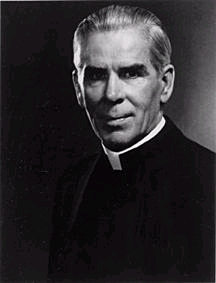
Fulton Sheen is now “Venerable”

Today the Holy Father authorized the promugation of the decree concerning the “heroic virtues” of now Venerable Fulton J. Sheen.

Also, note the same for the former Prelate of Opus Dei.

From VIS:

Vatican City, (VIS) – Today, during a private audience with Cardinal Angelo Amato S.D.B., prefect of the Congregation for the Causes of Saints, the Pope authorised the Congregation to promulgate the following decrees:
MIRACLES
– Servant of God Luca Passi, Italian diocesan priest and founder of the Congregation of the Teaching Sisters of St. Dorothy (1789-1866).
– Servant of God Francesca de Paula de Jesus, known as Nha Chica, Brazilian laywoman (1808-1895).
MARTYRDOM
– Servants of God Manuel Borras Ferre, auxiliary bishop of Tarragona, Spain, Agapito Modesto (ne Modesto Pamplona Falguera) of the Institute of Brothers of Christian Schools, and 145 companions, killed in hatred of the faith in Spain between 1936 and 1939.
– Servant of God Giuseppe Puglisi, Italian diocesan priest (1937-1993), killed in hatred of the faith in Palermo, Italy in 1993.
– Servants of God Ermenegildo of the Assumption (ne Ermenegildo Iza y Aregita) and five companions of the Order of the Blessed Trinity, killed in hatred of the faith in Spain in 1936.
– Servant of God Victoria de Jesus (nee Francesca Valverde Gonzalez), Spanish religious of the “Instituto Calasancio de Hijas de la Divina Pastora” (1888-1937), killed in hatred of the faith in Spain in 1937.
– Servant of God Devasahayam (Lazarus) Pillai, Indian layman (1712-1752), killed in hatred of the faith in India in 1752.
HEROIC VIRTUES
– Servant of God Sisto Riario Sforza, Italian archbishop of Naples and cardinal of Holy Roman Church (1810-1877).
– Servant of God Fulton n, American archbishop, and former bishop of Rochester (1895-1979).
– Servant of God Alvaro del Portillo y Diez de Sollano, Spanish prelate of the Personal Prelature of the Holy Cross and Opus Dei (1914-1994).
– Servant of God Ludwig Tijssen, Dutch diocesan priest (1865-1929).
– Servant of God Cristobal of St. Catherine (ne: Cristobal Fernando Valladolid), Spanish priest and founder of the Congregation and the Hospital of Jesus of Nazareth in Cordoba (1638-1690).
– Servant of God Marie of the Sacred Heart (nee Marie Josephte Fitzbach), Canadian widow and founder of the Handmaidens of the Immaculate Heart of Mary, known as the Good Shepherd Sisters of Quebec (1806-1885).
– Servant of God Mary Angeline Teresa (nee Bridget Teresa McCrory), founder of the Carmelite Sisters for the Aged and Infirm (1893-1984).
– Servant of God Maria Margit (nee Adelaide Bogner), Hungarian professed nun of the Order of the Visitation (1905-1933).
– Servant of God Ferdinanda Riva, Italian professed sister of the Institute of Daughters of Charity (1920-1956).
On 10 May the Holy Father authorised the Congregation to promulgate the decree concerning the martyrdom of Servant of God Juan Huguet y Cardona, Spanish diocesan priest (1913-1936), killed in hatred of the faith in Spain in 1936.

Posted in Just Too Cool, Saints: Stories & Symbols | Tagged , ,
21 Comments

Prayer “Pro Ecclesiae libertate … For the freedom of the Church”

From the Orationes Diversae in the 1962 Missale Romanum, “Pro Ecclesiae libertate”:

Ecclesiae tuae, quaesumus, Domine, preces placatus admitte: ut, destructis adversitatibus et erroribus universis, secura tibi serviat libertate. … We beseech You, O Lord, having been appeased, receive the prayers of Your Church, so that once all adversities and errors have been destroyed, she, secure, may serve You in freedom.


Posted in Our Catholic Identity, Religious Liberty | Tagged ,
1 Comment

“Simon, son of John, do you love Me more than these do?”

When during my ordination I got up to my knees again after lying face down on the floor of St. Peter’s Basilica, from my angle as I looked up at the Successor of Peter before the main altar I could see over his head the inscription high above in huge mosaic letters: “Domine, tu omnia nosti: tu scis, quia amo te. Dixit ei: Pasce oves meas.” The dialogue wraps around part of the basilica.



Ever after, when that dialogue comes up in the readings of Mass, it chokes me up a little.

It came up today in the Extraordinary Form’s Mass for the Vigil of Sts. Peter and Paul:

John 21:15-19

At that time, Jesus said to Simon Peter, Simon, son of John, do you love Me more than these do? He said to Him, Yes, Lord, You know that I love You. He said to him, Feed My lambs. He said to him a second time, Simon, son of John, do you love Me? He said to Him, Yes, Lord, You know that I love You. He said to him, Feed My lambs. A third time He said to him, Simon, son of John, do you love Me? Peter was grieved because He said to him for the third time, Do you love Me? And he said to Him, Lord, You know all things, You know that I love You. He said to him, Feed My sheep. Amen, amen, I say to you, when you were young you girded yourself and walked where you would. But when you are old you will stretch forth your hands, and another will gird you, and lead you where you would not. Now this He said to signify by what manner of death he should glorify God.


Posted in Just Too Cool, Our Catholic Identity, Priests and Priesthood |
6 Comments