Minnesota is now GROUND ZERO for defense of marriage

MN Marriage Amendment 2012I wanted to add a follow up to this: MINNESOTA READERS – WDTPRS POLL

For November 2012 there is on the ballot in Minnesota an amendment to the state constitution which would define marriage as being between one man and one woman.

Minnesota is now ground zero for the issue of marriage.

This amendment must be approved positively by the voters in Minnesota.

HERE’S THE CATCH!

No vote is a “No” vote.

That is, if voters leave that box blank, it will count as a “NO” vote, against the amendment.

Voters must vote YES to have the vote count as a yes.  A nothing winds up being a vote against.

In other words, a voter who leaves that box blank, thinking she doesn’t want to take a position, has been given her position for her.

Blank box = NO.

Get it?

Make a conscious effort to LOOK FOR this item on the ballot, for the ballot may be complicated.

Polling show that only 2% of voters in Minnesota are undecided.

Therefore, it is important for readers of this blog in Minnesota to GET OUT THE VOTE in favor of the amendment.

If you are in Minnesota or have friends or relatives in Minnesota, help to get the vote out.  Keep this in mind as the election draws near.

Get the word out about this tricky ballot blank box problem.

Also, I bring to your attention a good organization you can help no matter where you were.

Check out the page of the Minnesota Family Council, which is a coalition of various groups who are coordinating their efforts in defense of marriage and the family and the passage of the amendment.  Also check out Minnesota for Marriage.

Remember, Minnesota is now GROUND ZERO.

Everyone in the USA has a stake in what is happening in Minnesota.


Posted in "How To..." - Practical Notes, Brick by Brick, One Man & One Woman, Our Catholic Identity | Tagged , , , , ,
19 Comments

Benedict XVI: “So many of the baptized have lost identity.”

The Italian Bishops Conference (CEI) has been meeting in a plenary session these days.  The Holy Father addressed them about the harsh reality we face as countries which were at least Christian but are now losing their identity.  In Italy, of course, the situation is graver in another way because of Italy’s deep Catholic, not just Christian, roots.  Loss of identity has been one of Benedict’s deepest concerns, even for years before his election.  For Benedict, the concept of Europe itself cannot be separated from Christianity.  That would be also the case in many ways for the USA.  It certainly is the case in Italy.

During his speech to the CEI Pope Benedict said (my quick translation):

A sign [of this separation of the West from its spiritual and moral patrimony] is the diminution of religious practice, visible in participation in the Eucharistic liturgy and, even more, in the Sacrament of Penance.  So many of the baptized have lost identity and membership: they don’t know the essential content of the faith or they think they can cultivate it [He was, above, using plant and agricultural images] apart from ecclesial mediation. And while many look dubiously at the truths taught by the Church, others reduce the Kingdom of God to some big values, which certainly have to do with the Gospel, but which don’t any longer have to do with the central core of the Christian faith.  The Kingdom of God is a gift that transcends us. … Unfortunately, it is precisely God who is excluded from the horizons of many people; and when one isn’t met with indifference, closed-mindedness or refusal, the conversation about God is nevertheless relegate to the sphere of the subjective, reduced to a private personal matter, marginalized from public consciousness.  Pass from this abandonment, from this lack of openness to the Transcendent, the heart of the crisis that wounds Europe, which is a spiritual and moral crisis: man claims to have an identity fulfilled simply in himself.

In this context, how can we live up to the responsibility entrusted to us by the Lord?

There is quite a bit more, but I wanted to share with you this small excerpt.

We need a Marshall Plan for our Church.

After World War II many regions of Europe were devastated, especially its large cities and manufacturing.  The USA helped rebuild Europe through the Marshall Plan so as to foster good trading partners and, through prosperity, stand as a bulwark against Communism.

After Vatican II many spheres of the Church were devastated, especially its liturgical and catechetical life. We need to rebuild our Catholic identity so that we can stand, for ourselves as members of the Church and in the public square for the good of society, as a bulwark – indeed a remedy – against the dictatorship of relativism.

If we don’t know who we are as Catholics, if we don’t know what we believe or pray as Catholics, then the world has no reason to listen to anything we have to say as Catholics.  We will be all the more easily driven from the public square.

We see that the Obama Administration is trying to shift “freedom of religion” to simple “freedom of worship”.  That is, they are working to shove religious expression and action out of the public square and relegate both solely to the private sphere, inside your house or your church.  If we are weak, they will win.  If we stay on defense, they will win.  If we don’t live as faithful Catholics, they will win.

I have been saying that for any revitalization of our Catholic identity to be successful, we must renew our liturgical worship of God.  We need action in every other sphere as well, but without a renewed liturgical worship, nothing else will stand.  Everything else we do must be tied to our encounter with the transcendent.


Posted in Brick by Brick, New Evangelization, Our Catholic Identity, The future and our choices, Year of Faith | Tagged ,
5 Comments

On a lighter note… ‘Doctor Who’ fans hack a road sign

If I were to shout “EX-TER-MI-NATE!”, what connection would you make?

From the Denver Post:

Hackers have tweaked an electronic construction sign along Arapahoe Road in Boulder to read “WARNING DALEKS AHEAD,” referencing a villainous race of extraterrestrial mutants from the long-running British sci-fi TV series “Doctor Who.”

The sign, on eastbound Arapahoe before 48th Street, has displayed its “Doctor Who”-themed warning since at least Tuesday night, and, as of 9:30 a.m. Wednesday, the message had not been removed.

Pranksters also struck road signs in Boulder last spring to warn motorists on Foothills Parkway that there were “ZOMBIES AHEAD.”

[…]

Posted in Lighter fare | Tagged , ,
16 Comments

REVIEW: Defending the Free Market: The Moral Case for a Free Economy by Fr. Robert Sirico (Acton Institute)

Please use the sharing buttons!  Thanks!

20120523-100550.jpgMy friend Fr. Robert Sirico of Acton Institute has produced a new book entitled Defending the Free Market: The Moral Case for a Free Economy.

Hardback HERE, Kindle HERE. (UK HERE).  PS: I received a review copy, but I am going to put the Kindle version on my wishlist.  And if you don’t have a Kindle yet, consider getting one.  I love mine.

One of Fr. Sirico’s great strengths is his ability to write with clarity and concision which enables me, decidedly not an economist, to follow easily what he is talking about.

Weighing in at 187 pages of the main text (followed by acknowledgments, bibliography, index), there are nine major chapters after the Introduction.

  1. A Leftist Undone
  2. Why You Can’t Have Freedom without a Free Economy
  3. What to Help the Poor?  Start a Business
  4. Why the “Creative Destruction” of Capitalism Is More Creative than Destructive
  5. Why Greed is Not Good – and Why You Can Get More of It with Socialism than with Capitalism
  6. The Idol of Equality
  7. What Smart Charity Works – and Welfare Doesn’t
  8. The Health of Nations: Why State-Sponsored Health Care Is Not Compassionate
  9. Caring for the Environment Doesn’t Have to Mean Big Government
  10. A Theology for Economic Man

He shares some interesting autobiography which helped shape his ideas, including his personal experiences which explain both how he wound up a seriously screwed up lefty when he was young (think Jane Fonda and protests) and then how he escaped that trap (hint: it involved thinking and reading the right things and growing up).  His experience of escaping from liberal hell motivated his inclusion after each chapter of a short helpful reading list.

I look forward to digging into this book today.  As a matter of fact I have to set aside a couple other things to do that. But my quick scanning of the book shows that the Sirico isn’t just talking about policies which could work better to tackle the contingent choices we are faced with.  He suggests things which can work because they are also the right thing to do.  He makes a moral case, as the title says.  His arguments have a theological underpinning.  In the last chapter, for example, when he is explicitly theological, he raises the question “What does theology have to do with economics?”

A: Economics at its most fundamental level is not about money; it is about human action.  How we answer the big questions – Who am I? What am I here? Where did I come from? Where am I going? What is man? – has n enormous impact on every facet of our lives, including how we work and buy and sell, and how we believe such activities should be directed – on economics, in other words.

One is tempted to say that his economic starting points involve our answer to the first questions in the Baltimore Catechism:

1. Q. Who made the world?
2. Q. Who is God?
3. Q. What is man?
6. Q. Why did God make you?
9. Q. What must we do to save our souls?

How we answer these questions guides everything else we do.  And we cannot not answer these questions.

What he is trying to do, I surmise from my first glances, is make an argument for a free market that is free in a truer sense of freedom, namely, a freedom which comes from doing what we ought to do rather than just doing what we want to do.  There are obviously going to be theological anthropological underpinnings in such an argument.  Moreover, we also have to ask, “What’s it all for?”.  If we think the material world of the here and now is all there is, then our choices will follow accordingly.  Thus, in the last chapter Sirico deals with “vocation”.

This is a timely book, given that we are in a crucially important election cycle in the USA.  Profoundly different visions are on ballot in November.  A major dimension of the different visions involves contingent choices concerning the economy, and therefore jobs, entitlements, etc.  In the last chapter Sirico describes the fictive homo economicus, a cold and selfish caricature of someone advancing “free market” ideas.  I couldn’t help but think of how Pres. Obama and his surrogates, especially in the liberal media, are trying to impose this cold and calculating caricature on Mitt Romney and his time with Bain Capital.  They are doing everything in their power to paint him and others like him as only interested in costs and benefits, the bottom line, entirely disregarding other people’s lives.  I don’t buy that about Romney, by the way.

Anyway, get the book and find out what Sirico means when he argues that

“Failing to understand that man is more than homo economicus will lead to major errors in addressing social problems.  If we treat only the symptoms of social ills – slapping more meddlesome regulations, government spending, or targeted tax cuts onto the surface of a problem without nourishing the wellsprings of human happiness – our solutions will fail.”

For the book launch Fr. Sirico has a brief video blurb.

[wp_youtube]Lt5IHy_bVjY[/wp_youtube]

So, here are the links!

I am looking forward to your comments after you read the book.

Hardback HERE, Kindle HERE. (UK HERE).

UPDATE:

Speaking of the free market, refresh your coffee supply now with Mystic Monk Coffee!

It’s swell!

“But Father! But Father!”, some of you are probably about to say, “You are intimating that Fr. Sirico’s book is so boring that you have to drink coffee to stay awake!”

HA! You fell into my cunning trap.

Above, I linked to their decaf page.

HA!

From Stuart Varney’s show on FNC:

Posted in "How To..." - Practical Notes, Brick by Brick, REVIEWS, The Drill, The future and our choices | Tagged , ,
70 Comments

What does Sacrosanctum Concilium 116 really say?

I saw on Sandro Magister’s site today a piece about Gregorian chant making a come back, a come back promoted by Benedict XVI himself through the Congregation for Divine Worship – whose brief he modified – and through his own ars celebrandi.

This got me thinking about several things which have been obvious over the years and a few which have been obscured.

First, the Council said that Gregorian chant was the characteristic music of the Roman liturgy.  That fact has been entirely ignored.  Also, the very purpose of liturgical music has been obscured.  It is not simply ornamentation or accompaniment.  Sacred music for liturgy is prayer, it is liturgy.  Therefore, the idiom of the music must be appropriate for liturgical action and the texts must be liturgical texts and sacred texts.  This has been widely ignored for a long time, with the result that there is great confusion and shoddy music everywhere.
It could be useful to pull apart that paragraph from the Council’s Sacrosanctum Concilium and have a closer look.

The Second Vatican Council’s Constitution on the Liturgy, Sacrosanctum Concilium, states this about Gregorian chant:

116. Ecclesia cantum gregorianum agnoscit ut liturgiae romanae proprium: qui ideo in actionibus liturgicis, ceteris paribus, principem locum obtineat.

The Latin of SC 116 is often rendered as

The Church acknowledges Gregorian chant as specially suited to the Roman liturgy: therefore, other things being equal, it should be given pride of place in liturgical services.

This isn’t a bad translation, but it is weak.  To my ear it doesn’t convey the force of the vocabulary which sounds like legal language having to do with property, possession, heredity.  This is a powerful declaration about something being a prized possession, even the most prized of all, since it is in the “princeps locus” the “first/chief/most distinguished place”.

Latin agnosco means a range of things, having to do with “knowledge” and “recognition”.  Thus, as the esteemed Lewis & Short Dictionary (everyone should have their own hard copy of this, by the way, for use even when the power goes out) informs us, it is either a simple recognition of something that we have known before, and then logically it means “as a result of this knowledge or recognition, to declareannounceallow, or admit a thing to be one’s ownto acknowledgeown”.  Think of, for example, a father acknowledging the legitimacy of a child and thus making that child an heir, or troops obeying a general, or a person admitting that an object or deed is his.

Something that is proprius is “not common with others, one’s own, special, particular, proper”. It has to do with one’s own property.  It can have an overtone of permanency and peculiarity, in the sense of being special or characteristic, not in the sense of being strange.

Obtineo is a compound of teneo, “to hold, keep, have in the hand, etc.”.  Thus, obtineo is “to take hold of” in the sense of take possession of, but also in the sense of “demonstrate” or “prove”

A locus is “a place, seat” a “lodging”, “a place, locality” and then, “a topic of discussion or thought”, “the grounds of proof”, a “passage in a book”, an “opportunity, cause, occasion, place, time”.  You get the idea.

That qui – referring back to cantus – with the subjunctive down the line gives us a characteristic result clause.  In other words, the nature of the thing referred to in the pronoun leads to a conclusion down the line.  Chant is of such a nature that X results.  In this text the conclusion is strengthened enormously by ideo, “therefore”.  The Council Fathers weren’t fooling around.  They wanted to make this forceful and clear by using a construction that emphasizes the character, the nature of chant, and then producing a conclusion, all using juridical language.

That phrase “ceteris paribus” is juridical and philosophical language.  It is an ablative absolute which provides a statement of conditions contemporary with the time of the verb. It means, “other things being equal”, which is to say, “in normal circumstances” or “leaving aside the special situations”. For example, we might say that every four years, ceteris paribus, we have a leap-year and add an extra day to February. However, every 400 years we have to omit leap days. Thus, we say that, ceteris paribus, every four years there is a leap year, with a nod to those rare (from our perspective) times when there won’t be.

More on that point of rarity.  When we read SC 116 “latinly”, it says that, barring something out of the ordinary, Gregorian chant is the first type of sacred music that is to be used in the Roman liturgy, because the Church claims and acknolwedges and declares Gregorian chant to have the “first place” among all legitimate types of sacred music. Just as when a father recognized a first-born son that son became the principle heir, to be preferred over even all other legitimate children, so to the Church places Gregorian chant in the first place over all other types of sacred liturgical music. At the same time, there are rare occasions when something other than Gregorian chant can be used.

Let’s pry open SC 116 with a literal rendering:

The Church acknowledges Gregorian chant as characteristically belonging to the Roman liturgy, with the result that, therefore, other things being equal, in liturgical actions it (Gregorian chant) takes possession of the first place.

If you aren’t praying with Gregorian chant, 50 years after the Council, then you are 50 years out of step with the Council mandated in the strongest terms.

The Council Fathers in Sacrosanctum Concilium go on to talk about the use of other kinds of music and they provide a welcome flexibility.  But none of those other provisions eliminates or supersede or mitigate what SC 116 says.  In other words, we shouldn’t justify the use of Gregorian chant.  The Church has done that for us.  We have to justify the use of something other than Gregorian chant.

It is time to start asking what we are going to do about that.  The upcoming Year of Faith seems like an auspicious moment to take stock of this and do something about it.  Gregorian chant will foster greater continuity with how Catholic have worshiped over the centuries, it will bring us into harmony with a serious mandate of the Council Fathers, and it will bring a greater sense of the transcendent to our liturgical worship.  The way we pray has a reciprocal relationship with what we believe.  Gregorian chant is liturgy, not decoration.  Using Gregorian chant will do something to our Catholic identity.  This is an appropriate goal for the upcoming Year of Faith.

Posted in "How To..." - Practical Notes, Liturgy Science Theatre 3000, New Evangelization, The Drill, The future and our choices, Wherein Fr. Z Rants | Tagged , , ,
61 Comments

REVIEW: Lorraine Wallace’s new cookbook “Mr. Sunday’s Saturday Night Chicken”

I received my copies of Lorraine Wallace’s new cookbook Mr. Sunday’s Saturday Night Chicken.  I wrote about it here.  I had ordered a couple copies for myself as a gift to my father, to whom I gave an autographed copy of the first book.  Mr. Sunday refers to Chris Wallace, whose news-talk show is on Sunday mornings.

I gave the book a good scan before I send them off for some signatures.

The recipies deals mainly with chicken but has entries for other common poultry. There are a few for turkey, duck, goose, pheasant and quail. There is a section in the back for side dishes (they look good). The writer incorporated also recipes from friends and from restaurants and inspired by restaurants.

If you can get a couple good recipes out of a cookbook which you can really get good at and have in your back pocket, the cookbook has been worth your time and money.  The same goes for cooking magazines.  I try to try one recipe from each issue.

I was amused to find a credit for “food styling” and “prop styling”.   Not all the recipes have photos.

There are a couple features which make the book useful and which you will appreciate.  For example, the table of contents shows that the book is divided into recipes for the four seasons.  There are also sections for Family and Friends, Two-by-Two, and Game Day.  She says that her children urged her to add the Two-by-Two section, which is for quick recipes for two chicken breasts or cutlets and simple ingredients.

She provides a key to categorizing the entries so that you can see quickly the applicability of the recipe for your purposes:

$ for economical entries
Boneless, Skinless
Quick
Rotisserie Chicken (with a store-bought rotisserie chicken)
Good For Company
Potluck
Stovetop
Family Favorite
One Pot
Veggie (with an option to eliminate the chicken!)
Grill

20120522-195812.jpgThe appropriate “keys” appear at the top of each entry under its title.

I like a note she adds in the intro about the recipes being guidelines: “It’s no use driving yourself crazy running to the store when the recipe calls for a red bell pepper and all you have is a green bell pepper.”

There could be a bit more margin space on some of the recipes, for the sake of notes. I add my own observations and also the dates I make things.

There is a Chicken 101 section as well (how to choose, cut up, clean, etc., terms such as “free-range” v. “farm-raised”). There is an index.

I like the fact that there are Wallace family and friend notes and elements too. Eating together, with family and friends, is important.  At the bottom of the front cover we read: “More than 100 Delicious, Homemade Recipes to Bring Your Family Together.”

20120522-195848.jpgThere are recipes that reflect various ethnic influences.  Also, through these are “homemade” recipes, she doesn’t shy from taking some helpful shortcuts, as in using the aforementioned rotisserie chicken, or pre-made store-bought polenta, and so forth.

Her treatment of Coq au vin looks like a classic approach though stream-lined in comparison with my usual choice of Julia Child’s amazing recipe, which breaks down some of Wallace’s steps.  There are a couple veal recipes which are adapted, such as Chicken Marengo and also Saltimbocca.  After years in Rome I am intimately familiar with Saltimbocca, a favorite of mine.  I also make it often.  The idea of using chicken in the place of veal makes my adoptive Roman blood run a little cold, but my wallet might appreciate less strain.  She suggests a lemon sauce for this, which leads me to wonder if she couldn’t decide between Saltimbocca and scalopine al limone.  There is also a “Bolognese” sauce with turkey, for use with polenta rather than pasta.  A little dodgy, but … change the name and the purist in me won’t revolt.   Don’t get me wrong, the recipe looks pretty good.  I also have no qualms, for example, about a Meat Loaf recipe with turkey.

Since it is also a special year for Charles Dickens, I note with interest that she included a recipe for goose called “Dickens’ Christmas Goose”, which has an orange glaze which strikes me as being sweet.  I have in the past preferred a more savory approach to goose and my non-adopted-Roman Teutonic blood expects sauerkraut with it.  Since goose can be pretty greasy, I like a bit of acid to counterbalance the meat.  Sauerkraut is near perfection for goose, in my humble opinion.  When winter rolls back around, perhaps I will have to make a goose to precede the Christmas Pudding.

In any event, I have spotted half a dozen entries I think I will try for sure.


Posted in Fr. Z's Kitchen, Lighter fare, REVIEWS | Tagged , , ,
7 Comments

Card. Brandmüller: Vatican II Declarations do not contain “binding doctrinal content”

From Catholic World News:

Cardinal: ‘binding doctrinal content’ not major part of breach between Holy See, SSPX

The Second Vatican Council’s declarations on non-Christian religions and religious freedom do not contain “binding doctrinal content,” Cardinal Walter Brandmüller said at a press conference on May 21. [So we should allow some real flexibility in interpreting it.]

The retired president of the Pontifical Committee for Historical Sciences, along with Archbishop Agostino Marchetto and Father Nicola Bux, is the coauthor of a newly published book, Le ‘Chiavi’ di Benedetto XVI per interpretare il Vaticano II [Benedict XVI’s ‘Keys’ for Interpreting Vatican II].

Stating that the conciliar documents have differing degrees of authority, Cardinal Brandmuller said that “there is a huge difference between a great constitution and simple declarations.”

“Strangely enough, the two most controversial documents [on religious liberty and relations with non-Christian religions] do not have a binding doctrinal content, so one can dialogue about them,” he continued. “So I don’t understand why our friends in the Society of St. Pius X concentrate almost exclusively on these two texts. And I’m sorry that they do so, because these are the two that are most easy to accept if we consider their canonical nature.” [orrrr… perhaps the easiest not to accept?]

Cardinal Brandmuller added that all the conciliar documents “must be taken seriously as expressions of the living Magisterium,” while Archbishop Marchetto said that Catholics must offer “at least an adhesion of intellect and will” to all of the documents. [A different emphasis!]

“From what I have learned, there must be an acceptance of the Council by those who want to be reunited with the Church,” said Archbishop Marchetto, the retired secretary of the Pontifical Council for Migrants and Travelers. “I don’t think the SSPX can say, ‘Well, we’ll set this or that document aside.’

Cardinal Brandmuller said that the Society of St. Pius X, like the Old Catholics after the First Vatican Council, “have in common a rejection of the legitimate developments of the doctrine and life of the Church,” but the Society is not “insignificant” like the Old Catholics. [Indeed!]

“We hope that the Holy Father’s attempt to reunify the Church succeeds,” added the cardinal, who offered a solemn pontifical Mass in the extraordinary form at St Peter’s Basilica last May.

I am wondering if the Press Office will issue a statement.

Posted in Our Catholic Identity, Religious Liberty, SSPX, The Drill, The future and our choices | Tagged , , ,
41 Comments

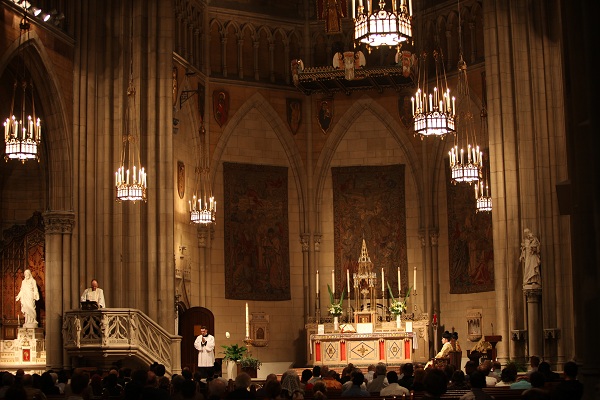
NYC: A newly ordained priest’s First Mass – Extraordinary Form Solemn Mass

I wanted to share some great liturgical eye-candy of a happy event involving some of my friends in New York City.

Fr. Patrick D’Arcy, a brand new priest for the Archdiocese of New York celebrated his First Holy Mass in the Extraordinary Form at Blessed Sacrament Church on the upper west side of Manhattan, where Msgr. Robert C. O’Connor is pastor.

There is a nice write up on the event and great photos from the Society of St. Hugh of Cluny.

The music was as follows:
Mass ordinary, Gregorian Mass VIII Missa de Angelis
Sanctus and Benedictus from the Missa Brevis of Palestrina
Communion Motet Miserere Mei by Gregorio Allegri
Recessional Motet Exsultate Justi by John Williams

A little mix of the old and new, there.

The church during the sermon, delivered by Msgr. Javier Garcia de Cardenas, of the personal prelature of Opus Dei.

I’ll just post a couple of the many photos.

Here’s a Dominus vobiscum:

And a great moment when the new priest is giving First Holy Communion to his little niece.

Just as we are going to see a lot more attacks on the Catholic Church and on faithful Catholics, we are also going to see a lot more of this sort of thing from young priests.

The hermeneutic of discontinuity and rupture is passing faster and faster as the biological solution works its inexorable way with the aging hippies and their tie-dyed ways.

WDTPRS kudos to Fr. D’Arcy.  May he have many great years as a priest.

Posted in "How To..." - Practical Notes, Brick by Brick, Liturgy Science Theatre 3000, Mail from priests, New Evangelization, Non Nobis and Te Deum, Our Catholic Identity, Priests and Priesthood, SUMMORUM PONTIFICUM, The future and our choices |
40 Comments

Liberal Media Bias: Networks refuse to report on Catholic suits against the Obama Administration

From Newsbusters by Brent Bozell with my emphases:

The evening news broadcasts all but spiked the largest legal action in history to defend our constitutionally protected religious freedom. The May 21 editions of ABC’s World News and NBC’s Nightly News refused to report the fact that 43 Catholic dioceses and organizations filed a lawsuit on Monday against the Obama administration. CBS Evening News gave this historic news a mere 19 seconds of air time.

This is the worst bias by omission I have seen in the quarter century history of the Media Research Center. Every American knows about the Chinese communists withholding for 20 years the news that the US had landed on the moon, because it reflected poorly on the government. Our US media today are no different. They are now withholding news from the American people if it is harmful to the re-election of Barack Obama.

This is not a mistake, nor is it an editorial oversight by the broadcast networks. This is a deliberate and insidious withholding of national news to protect the ‘Chosen One’ who ABC, CBS and NBC have worked so hard to elect and are now abusing their journalistic influence to reelect Obama. And when a network like CBS mentions the suit ever-so-briefly, [NB:] they deliberately distort the issue by framing it as a contraception lawsuit instead of what they know it to be: a religious freedom issue. It’s bogus, dishonest – a flat out lie.

The fact is that the Catholic Church has unleashed legal Armageddon on the administration, promising ‘we will not comply’ with a health law that strips Catholics of their religious liberty. If this isn’t ‘news’ then there’s no such thing as news. This should be leading newscasts and the subject of special, in-depth reports. Instead, these networks are sending a clear message to all Americans that the networks will go to any lengths – even censoring from the public an event of this historic magnitude – to prevent the release of any information that will hurt Obama’s chances of re-election.

The so-called ‘news’ media have sunk to a new low. This is despicable.


Posted in Biased Media Coverage, Brick by Brick, Our Catholic Identity, Religious Liberty | Tagged , ,
38 Comments

Catholic Herald: Bishop urges priests to drop the Hail Mary after Prayers of the Faithful during Masses

In this week’s digital or paper, full edition of the UK’s best Catholic weekly, The Catholic Herald (subscribe) a story caught my eye.

Bishop urges priests to drop the Hail Mary from Masses

That is to say, Bp. Kieran Conry of the Diocese of Arundel and Brighton (where I have several priest friends including the great p.p. of St. Mary Magdalen) thinks that there should not be a “Haly Mary” after the prayers of the faithful or bidding prayers during Mass on the basis that the Roman Rite does not envisage the inclusion of devotional prayers like that. Also, it seems that the Holy See wrote to the Bishops of England and Wales to discourage gently the widespread practice. It isn’t widespread in the USA, however.

At my home parish in Minnesota we had either a “Hail Mary” after the intercessions or sometimes the Prayer to St. Michael. The man who formed and ran and really gave the style to the liturgical worship there was (and is, for he lives still as a nonagenarian) an Englishman, a permanent deacon to boot, who had been in the Westminster Cathderal school and was part of the army of boys who served there. He also received a charter from the Archdiocese of Westminster for the first group of the Archconfraternity of St. Stephen outside of England. The liturgical style was that of Westminster of the 1930’s. Very smooth. Precise without being too rushed, rigid or angular (which I detest). Anyway, I am sure the “Hail Mary” after the prayers of the faithful was brought in by this fine MC.

I note also in The Catholic Herald that there is an editorial on the topic and on Bp. Conry’s remarks.

“… This strikes us as sad – for what is being discouraged is a tradition that has been observed in England, known as “Mary’s dowry”, since medieval times. The absence of this venerable prayer will not enrich the Mass in any way; it will, however, distress Catholics who have been saying it at Mass every Sunday of their lives. Surely there are enough genuine liturgical abuses to address that the bishop need not worry about the persistence of this hallowed and much-loved practice.”

Let’s have a poll.

Choose your best answer and give your reasons in the combox, below. Anyone can vote but only registered participants can comment.

A "Hail Mary" (or St. Michael Prayer, etc.) after Prayers of the Faithful.

View Results

Posted in "How To..." - Practical Notes, Liturgy Science Theatre 3000 | Tagged , , ,
100 Comments