The burning of Giordano Bruno

During my years in Rome I came to loath the famous statue of Giordano Bruno in the Campo de’ Fiori, once the place of execution where he was burned.   Bruno was a serious weird guy.  He would have been a great czar for something or other for the Obama Administration.

In any event, from the History Blog comes this rather grisly story and app.

In honor of the 412th anniversary of the burning at the stake of Giordano Bruno, Dominican friar, philosopher, astronomer and master of mnemonic devices so complex he was thought to have magical powers, the Vatican Secret Archives announced Friday that they are releasing a contemporary summary of his trial and a companion smartphone app.

The detailed Holy Office transcripts of Giordano Bruno’s trial were destroyed between 1810, when Napoleon demanded files from the Vatican Archives be sent to Paris, and 1815-1817 when the files were returned to Rome. We don’t know what got destroyed when, exactly, but records do note that one Marino Marini, the man tasked by Pius VII with bringing the Vatican Archives back to Rome from Paris, considered the trial transcripts of the Holy Office useless at best, at worst harmful since they might taint the reputation of the defendants’ descendants. He and Cardinal Consalvi decided to shred entire volumes of them, then soaked the pieces in water and sold the mash to a Parisian cardboard factory for 4,300 francs. Over 2,600 trial transcripts were lost during this period.

All we have left of the Bruno trial is a summary written in 1598, two years before his execution, and preserved in a volume labeled “Miscelleanea Armadi.” It was rediscovered on November 15, 1940 by Cardinal Angelo Mercati, Prefect of the Vatican Archives, who published it in 1942. It’s that volume that will be on public display at the Lux in Arcana exhibit starting February 29th. The app will be made available the same day.

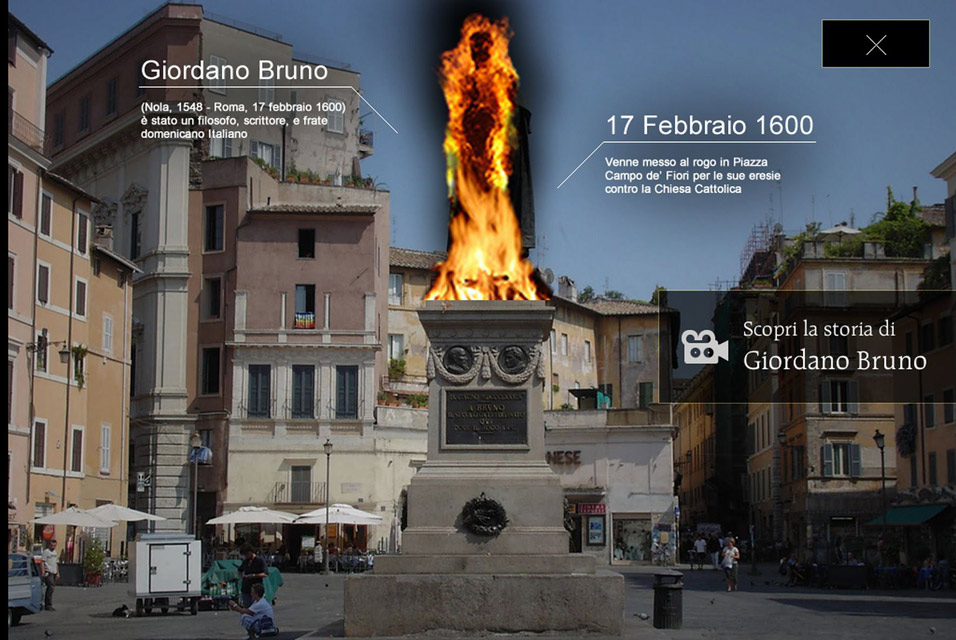
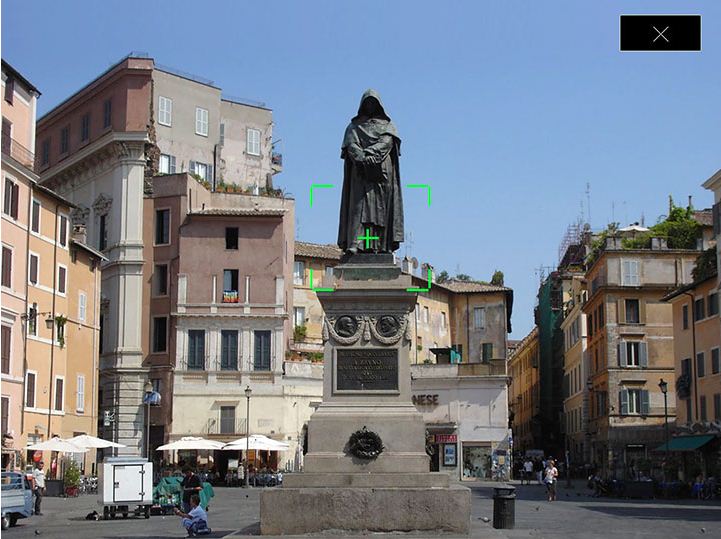
Thanks to the technological partnership with Accenture, the global management, consulting, technology and outsourcing company, as of February 29th, when the exhibition opens, a sophisticated app that was developed specifically for the Vatican Secret Archives on this occasion will make it possible, for example, to focus your tablet or smartphone on the statue of Giordano Bruno at Campo de’ Fiori and see his pyre burst into flame on your device’s display, to open the documents related to the trial of the Dominican friar and philosopher, and to call up videos with further information on his life and his ideas. The app that Accenture developed also makes it possible to explore all the documents in the exhibition with multimedia in-depth contents, thereby heightening the cultural and emotional experience of the event.

It looks like this:

Take a picture of the Giordano Bruno statue in Campo de' Fiori... ... then watch him burn at the pyre for his many heresies.

It’s rather hardcore, especially considering the Church’s statement of sorrow at the “sad episode” and Bruno’s “atrocious death” released on February 17, 2000, the 400th anniversary of the execution. From Cardinal Angelo Sodano’s excruciatingly carefully worded statement:

“It is not our place to express judgments about the conscience of those who were involved in this matter. Objectively, nonetheless, certain aspects of these procedures and in particular their violent result at the hand of civil authority, in this and analogous cases, cannot but constitute a cause for profound regret on the part of the Church.”

I won’t lie, though, it sounds like a pretty kickass app, not so much for the heretic-on-fire screen cap but rather for the easy access to the documents and videos.

The press release says that the Bruno documents are available on the Lux in Arcana website, but all I could find was a short overview of the trial and execution, not the full text. There was a more detailed overview with quotes from the summary available on the Vatican Secret Archives website as recently as last May, but it’s offline now. You can still see it using the Wayback Machine, thankfully.

[…]
You can read the rest over there.

Posted in Dogs and Fleas | Tagged
25 Comments

Lent is near: Fr. Z’s 20 Tips For Making A Good Confession

Quinquagesima Sunday is behind us and Ash Wednesday is upon us. It has been a while since I have posted this.

Fr. Z’s 20 Tips For Making A Good Confession o{]:¬)

We should…

1) …examine our consciences regularly and thoroughly;
2) …wait our turn in line patiently;
3) …come at the time confessions are scheduled, not a few minutes before they are to end;
4) …speak distinctly but never so loudly that we might be overheard;
5) …state our sins clearly and briefly without rambling;
6) …confess all mortal sins in number and kind;
7) …listen carefully to the advice the priest gives;
8) …confess our own sins and not someone else’s;
9) …carefully listen to and remember the penance and be sure to understand it;
10) …use a regular formula for confession so that it is familiar and comfortable;
11) …never be afraid to say something “embarrassing”… just say it;
12) …never worry that the priest thinks we are jerks…. he is usually impressed by our courage;
13) …never fear that the priest will not keep our confession secret… he is bound by the Seal;
14) …never confess “tendencies” or “struggles”… just sins;
15) …never leave the confessional before the priest has finished giving absolution;
16) …memorize an Act of Contrition;
17) …answer the priest’s questions briefly if he asks for a clarification;
18) …ask questions if we can’t understand what he means when he tells us something;
19) …keep in mind that sometimes priests can have bad days just like we do;
20) …remember that priests must go to confession too … they know what we are going through.

Posted in "How To..." - Practical Notes, Our Catholic Identity | Tagged , ,
4 Comments

This Lent brings a new, old Roman tradition for Mass: the Oratio super populum

Now that the new, corrected translation is in force in most places, you will notice with the beginning of Lent something new that is really something old: the Oratio super populum… the Prayer over the people at the end of Mass.

Fathers: You might want to talk you your flocks about this.

The “Prayer over the people” was reintroduced in the Latin edition of the 2002 Missale Romanum. Now that we have a new translation, it is part of the Novus Ordo Mass in English as well.

This is an important custom for Lent.

The origin of the Oratio super populum is quite complex and hard to pin down. The use of this prayer is ancient, found in both the Eastern liturgies of Syria and Egypt and in the West.  It became part of the Roman liturgy very early on.

Turning to Fr. Joseph A. Jungmann’s monumental two volume The Mass of the Roman Rite: Its Origins and Development we find a history of this prayer at the beginning of the section concerning the close of the Mass (II, pp. 427ff). Something Jungmann emphasizes that caught my attention is the fact that we are at a “frontier” moment, the threshold of the sacred precinct of the church and the world.

When properly formed we want the influence of our intimate contact with the divine to carry over into the outside world.

Unlike the Postcommunio, the object of the prayer is not “us”. Instead, the priest prayers for and over the people, not generally including himself as he does in the prayer after Communion.

By the time of Pope Gregory the Great (+604) this Prayer over the people was only in the Lenten season, probably because this is perceived to be a time of greater spiritual combat requiring more blessings. Indeed it was extremely important for those who were not receiving Holy Communion, as was the case of those doing public penance before the Church, the ordo poenitentium.

How important was this prayer to the Romans?

In 545, when Pope Vigilius (537-55) was conducting the Station Mass at St. Cecilia in Trastevere, troops of the pro-Monophysite Byzantine Emperor Justinian arrived after Communion to take the Pope into custody and conduct him to Constantinople. The people followed them to the ship and demanded “ut orationem ab eo acciperent… the they should receive the blessing prayer from him”, by which was meant the Prayer over the people. The Pope recited it, the people said “Amen” and off went Vigilius who would return to Rome only after his death.

With the new translation, more people will begin to experience this old new Roman practice.

Lent is a time of spiritual combat. The Prayer over the people is meant to strengthen you on the threshold between the sacred precinct of the church and the world which you are charged both to shape and to endure.

Posted in "How To..." - Practical Notes, Brick by Brick, Liturgy Science Theatre 3000, Our Catholic Identity | Tagged , , , , ,
10 Comments

Brick by brick in Trenton

A friend sent photos of what may have been the first Solemn Mass in Trenton for… well.. since… you know.

Trenton

I’m told that some 650 people attended the Solemn Mass at the Church of St. Anthony in Hamilton, NJ. The music was Franz Schubert’s Mass in G Major provided by students of Westminster Choir College in Princeton.

The celebrant was Fr. Brian Patrick Woodrow, who is the the Trenton Diocesan “Liason” for the Extraordinary Form. The Deacon was Fr. Kevin J. Kimtis and Subdeacon was Fr. H. Todd Carter, all ordained within the last few years.

Brick by brick.

This is another way to fight the Obama Administration’s attacks on Holy Church.

See my “manifesto” on the matter.

Posted in Brick by Brick, Liturgy Science Theatre 3000, Our Catholic Identity, SUMMORUM PONTIFICUM | Tagged , ,
17 Comments

3…2…1…

A glimpse at the pastoral style of His Hermeneuticalness.

fire

To find out what this is all about, click HERE.

(Darn good idea, if you think about it.)

Posted in Just Too Cool, Lighter fare | Tagged ,
7 Comments

QUAERITUR: Purifying fingers after handling the Eucharist… not.

ablution cupFrom a reader:

I went to a well said Latin low Mass this morning. The celebrant and a deacon gave communion to the faithful. The celebrant followed the rubrics after communion to consume the sacred particles and rinse his fingers. However, the deacon just simply went back to his seat in the sanctuary. There could have been sacred particles on his fingers. In the old days I believe the sacred ministers of communion would have rinsed their fingers in the sacrarium in the sacristy.
The New Mass rubrics are so sloppy on this, but would you know if any minister of communion should also rinse his fingers as does the celebrant after communion in the EF Mass? What about keeping the index finger and thumb together until these have been rinsed.

First, let’s make a couple distinctions. It is okay for deacons to distribute Communion in the Extraordinary Form. Also, had the helper been a priest or a bishop, rather than a deacon, the question about purifying one’s fingers would be the same. This isn’t something about deacons. That said, in the past, permanent diaconate formation in some places has not always been very… thorough. I have met deacons, great and willing and good-hearted men, who knew very little about what was going on. I have met a few whose knowledge would put 90% of the priests I know to shame. Alas, the former group is larger than the later. I think the numbers are shifting in the right direction. But I said this wasn’t about deacons qua deacons.

The additional Minister of Communion ought to have purified his fingers. Even if he didn’t think he had any particles on his fingers, he should have purified his fingers. Why? But people (like you) are often very attentive to everything that happens – or doesn’t happen – in a sanctuary. Had he purified his fingers, you wouldn’t have been distracted by the fact that he did not and we should never have met.  Decide for yourself whether that last point is good or bad.

Now, let’s grant the fellow the benefit of the doubt: maybe he just forgot.  Though it is entirely possible the deacon just didn’t know to do this, perhaps he just forgot!

Don’t climb all over him. Don’t assume he doesn’t believe in the presence of the Lord in Eucharist, or that he is a secret Lutheran, blah blah blah. If the deacon does this regularly, however, perhaps a discreet mention of the fact to the priest some time down the line could clue Father in on a point which, on his own, he could let the deacon/other minister know about.

People have a learning curve when it comes to recovering all the details. Some were fortunate enough to absorb it by osmosis or by really good training. Others slowly pick it up.

Anyway, if someone doesn’t know what we are talking about, there ought to be a small cup of water, normally with a cover, next to the door of the tabernacle. It is called an “ablution cup”.

Someone should do a study, with a graph of course, of the presence of and use of an ablution cup against the rigid imposition of Communion in the hand.

When one handles the Blessed Sacrament, and one is not the celebrant at Mass who will purify his fingers in the normal course of events, you use that small cup and small linen towel, to make sure that no particle of the Eucharist has remained on your fingers.  The ablution cup could also be used for a Host which may need to be dissolved before putting the liquid down the sacrarium.  Then there’s the not-so-legendary-maniple-pin-transfixed-enormous-chalice-invading-spider

The Eucharist is not less the Eucharist in the Ordinary Form than it is in the Extraordinary.  But, alas, I have seen some shockingly relaxed practices concerning handling the Eucharist in some places. We would do well to recover traditional discipline in this matter, a discipline which leads not to soul-crushing anxiety or scrupulosity, but to reverence and awe at what we are privileged to do.

Furthermore, I think Communion in the hand should be abolished. So there!

Posted in "How To..." - Practical Notes, ASK FATHER Question Box, Liturgy Science Theatre 3000, Our Catholic Identity | Tagged , , , ,
22 Comments

QUAERITUR: Ashes, Very Small Children, and You – An annual discussion.

ashes and babiesFrom a priest:

Reverend and Dear Father,

Ash Wednesday is soon to be upon us, and I am faced with the situation I am often faced with: whether to impose ashes on cute, angel-faced infants.

It never fails that, as the faithful come up for ashes, they bring children.

I don’t see the purpose of imposing ashes on babies, who are unaware of not only sin, but what the ashes represent (as well as what the formula spoken means).

I know, if I don’t impose ashes on them, I’ll get bad looks from both sides of the ecclesiological spectrum.

Is there a reason I can cling to why babies should receive ashes?

I hope a few priests will jump in with their experience and thoughts on this matter.

Father, you are right that, looking at it with the cold eyes of reason, there is little point to imposing ashes on an infant.  Sure there is the cuteness factor.  More importantly, you will  avoid the ridiculous discussions you will have to endure if you don’t put ashes on the precious bundle of joy.  Inevitably someone will be upset that little Stupor Mundi didn’t get the ashes, especially because we live in an age when everyone has to “get theirs”, and in particular if it’s free.  No reason will be involved in these discussions, by the way.  You’ll have to deal with emotions, usually “mom’s”, and you cannot win on that field.  So, Father, unless you have lots of time and patience, just put the ashes on the kids.

On the other hand, our Catholic identity is rooted in more than what we grasp from the light of reason. Deep memories and emotions, implanted impressions, also play their role.  I have some really early memories.  You just never know what ineffable memory might be planted!  Seriously.

It seems to me that if it is obvious that mommy or daddy want darling precious to have ashes, then go with that. Put the ashes on the kid and move on (I am assuming that you are moving along the altar rail where people are kneeling like the good Catholics they ought to be).

If you are not sure if mommy or daddy expects Her Cuteness to get smeared with the gritty burnt vegetable remains which could get her wittle eyes, then ask about it.   You could ask something like, “Do you want some of this harsh and gritty burnt vegetable ash near her sensitive eyes or not?”

On second thought, how about, “And your child?”

I would advise, that if the ashes are put on a bit thick on the child’s forehead that you watch carefully that you not get any in the child’s eyes.  After that you can, if the image isn’t a bit ironic, wash your hands of the matter…. which come to think of it you’ll be doing before Mass continues.  I digress.  Just don’t you get ashes in the child’s eyes.  The parent’s eyes, on the other hand….

“But Father! But Father!”, I can hear some people shouting.  “Clearly you think ashes shouldn’t be put on babies.  How old is old enough for the ashes? Do we have to wait for 1st Holy Communion?”

First, I didn’t say babies should not be given ashes.  Read again what I said above about deep memories.  I wasn’t kidding about that.  I am not being merely pragmatic.  However, I would add that if little Stupor Mundi is old enough to say “sorry” to Jesus before beddy-bye, she is also old enough to start learning about penance and self-denial and what the ashes stand for: We are dust and unto dust we shall return.

Hmmm… now that I think of it, if a parent has to look at the smudge on baby’s head and think about death, that could be a good thing.

Reverend and Dear Father, since this is a sacramental, and not a sacrament, I think we can have some leeway.  And before anyone brings it up by shouting “But Father!”, this is not quite like the “blessing for babies at Communion time” issue: that moment is for Communion, not blessings.  Dealing with the fallout (get that “ash” image?  heh?) might be the same, they are not the same problem.

Finally, if you are going to make the decision not to put ashes on babies, may I recommend making a good confession before Ash Wednesday?

If you survive, let us know how it went.

Posted in "But Father! But Father!", "How To..." - Practical Notes, ASK FATHER Question Box, Liturgy Science Theatre 3000, Mail from priests, Our Catholic Identity | Tagged , , , , ,
49 Comments

Catholic Herald notes

In the digital edition of the UK’s best Catholic weekly, The Catholic Herald, I saw a great pieces.

First, and I think this is only on the full, digital edition and not on the website, there is an article by Edward Pentin about the reaction of Robert Card. Sarah of the Pontifical Council “Cor Unum” to efforts by UN head Ban Ki Moom to press a homosexual agenda in African countries.

Catholic Herald

I didn’t see this reported anywhere else.  If it was, I missed it.  But the liberal re-engineering efforts march on, in goose-stepping unity across the globe.

“African bishops must react”, to such a move, the Guinean cardinal told me, adding: “This is not our culture. It’s against our faith.” He said that it is “not possible to impose on the poor this kind of European mentality.”

Perhaps there is a diocese open in the USA which could use the clear language offered by Card. Sarah.
Then there is an article asking which sort of hospital chapel you prefer? The photos give you a sense of the article.

hospital chapels

There is also an article about how priests are remaining in the Syrian city Homs even as violence escalates… and the world watches and does nothing.

Also, there is a good article by my friend Msgr. Andrew Wadsworth, Executive Secretary of ICEL, about what Lent is about.  He uses prayers from various days during Lent to illustrate his point: Lent: A time to go to war – with yourself.  WDTPRS has shown for years the military imagery which is clear in the Latin texts of many of our orations for Mass.

I find the full edition of the Catholic Herald online to be very interesting, especially because they are more advanced in the kulturkampf against the Church and against natural law (reason) in the UK than we are in the US.  Perhaps you would too.

Posted in Our Catholic Identity, REVIEWS | Tagged , , , , , ,
11 Comments

Feast of the Chair of Peter – transferred

The Feast of the Chair of Peter was transferred in the Vatican Basilica to today. It is normally on 22 February. This year the Feast, important in the Vatican Basilica for obvious reasons, would conflict with Ash Wednesday.

20120219-095636.jpg

A shot of the Roman Curia wall calendar.

20120219-095700.jpg

I wish all those who belong to the Ordinariate of the Chair of Peter a fine day.

Posted in Liturgy Science Theatre 3000 | Tagged , ,
3 Comments

Liberal social engineering is destroying us

National Review has a mordant piece by Mark Steyn. There are good points here. He links the so-called “social issues” (and if they go wrong, everything else must necessarily go wrong) and the partisan political mud fight, and the rapidly approaching collapse of the economy.

My emphases.

[…]

The U.S. economy shuts down in 2027? [During a House hearing, Rep. Paul Ryan – R-WI – had sketched out where the economy is headed.] Had you heard about that? It’s like the ultimate Presidents’ Day sale: Everything must go — literally! At such a moment, it may seem odd to find the political class embroiled in a bitter argument about the Obama administration’s determination to force Catholic institutions (and, indeed, my company and your company, if you’re foolish enough still to be in business in the United States) to provide free prophylactics to their employees. The received wisdom among media cynics is that Obama has engaged in an ingenious bit of misdirection by seizing on a pop-culture caricature of Republicans and inviting them to live up to it: Those uptight squares with the hang-ups about fornication have decided to force you to lead the same cheerless sex lives as them. I notice that in their coverage NPR and the evening news shows generally refer to the controversy as being about “contraception,” discreetly avoiding mention of sterilization and pharmacological abortion, as if the GOP have finally jumped the shark in order to prevent you jumping anything at all.

It may well be that the Democrats succeed in establishing this narrative. But anyone who falls for it is a sap. In fact, these two issues — the Obama condoms-for-clunkers giveaway and a debt-to-GDP ratio of 900 percent by 2075are not unconnected. In Greece, 100 grandparents have 42 grandchildren — i.e., an upside-down family tree. As I wrote in this space a few weeks ago, “If 100 geezers run up a bazillion dollars’ worth of debt, is it likely that 42 youngsters will ever be able to pay it off?” Most analysts know the answer to that question: Greece is demographically insolvent. So it’s looking to Germany to continue bankrolling its First World lifestyle.

But the Germans are also demographically exhausted: They have the highest proportion of childless women in Europe. One in three fräulein have checked out of the motherhood business entirely. A nation that did without having kids of its own is in no mood to maintain Greece as the ingrate slacker who never moves out of the house. As the European debt crisis staggers on, these two countries loathe each other ever more nakedly: The Greek president brings up his war record against the German bullies, and Athenian commentators warn of the new Fourth Reich. The Germans, for their part, would rather cut the Greeks loose. In a post-prosperity West, social solidarity — i.e., socioeconomic fictions such as “Europe” — are the first to disappear.

The United States faces a mildly less daunting arithmetic. Nevertheless, the Baby Boomers did not have enough children to maintain mid-20th-century social programs. As a result, the children they did have will end their lives in a poorer, uglier, sicker, more divided, and more violent society. How to avert this fate? In 2009 Nancy Pelosi called for free contraceptives as a form of economic stimulus. Ten thousand Americans retire every day, and leave insufficient progeny to pick up the slack. In effect, Nancy has rolled a giant condom over the entire American economy.

[…]

So, what we really need are free sterilizations, free abortifacients, free contraceptives and contrary-to-nature unions recognized as “marriage”. Under nationalized healthcare, I can imagine a One Child Policy.  After all, babies are expensive.

Furthermore, when we have all these things, liberals will force the Church to accept them (and never preach against them) under pain of fines and prosecution of her bishops and priests.

Hurray for the American Patriot Catholic Association!

American Patriotic Catholic Association

But first, we need to endure a couple more election cycles.  Then we can get down to work!

[wp_youtube]DIrUHVFkm9A[/wp_youtube]

Posted in Emanations from Penumbras, One Man & One Woman, Our Catholic Identity, Religious Liberty | Tagged , , , , , , , ,
19 Comments